Discerning Facial Expressions Using CK+
Yash Raut 1
, Pooja Pande 2
, and Prachi Thakar 3
U.G. Student, Department of Computer Science & Engineering, Prof. Ram Meghe College of Engineering&
Management, Badnera, Maharashtra, India1,2
Assistant Professor, Department of Computer Science & Engineering, Prof. Ram Meghe College of Engineering &
Management, Badnera, Maharashtra, India3
ABSTRACT:Outward appearance is a necessary segment in measuring human feelings, attributable to which the idea of a framework that can perceive outward appearances from a given visual information has collected a great deal of consideration from specialists in brain research, software engineering, phonetics and other related orders, just as enterprises looking for help in boosting human-PC connection. This task goes for building up an effective audit framework for organizations looking to get certifiable consumer loyalty levels, by utilizing AI to peruse a client's feeling by recognizing his/her outward appearance. There are seven sorts of human feelings demonstrated to be all around unmistakable crosswise over various societies: outrage, nauseate, dread, bliss, trouble, shock, hatred.
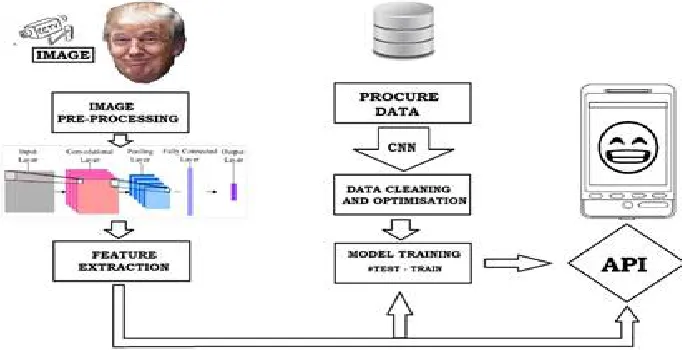
Our framework tries to utilize a profound learning procedure to arrange pictures of countenances into these classes via preparing the framework utilizing the Extended Cohn-Kanade Dataset(CK+). Among the few profound learning models accessible, the convolutional neural system (CNN), a specific kind of profound learning, is the model that will be utilized. Outward appearance Recognition is made out of three noteworthy advances, face and facial segment identification, include extraction, and demeanour grouping. Initial, a face picture is recognized from an information picture, and facial segments are identified. Second, different spatial and transient highlights are removed from the facial parts. Third, the pre-prepared classifiers produce the acknowledgment results utilizing the extricated highlights. The proposed framework uses open source PC vision (OpenCV) and Machine learning with Python.
KEYWORDS: Facial Expression, CK+, CNN, Open CV.
I. INTRODUCTION
There are seven kinds of human feelings demonstrated to be all around conspicuous crosswise over various societies: outrage, appal, dread, satisfaction, trouble, shock, hatred. Strikingly, notwithstanding for complex articulations where a blend of feelings could be utilized as descriptors, multifaceted understanding is as yet watched. In this manner, an utility that recognizes feeling from outward appearances would be broadly pertinent. Such a headway could acquire applications prescription, advertising and stimulation. The assignment of feeling acknowledgment is especially hard for two reasons: 1) There does not exist a huge database of preparing pictures and 2) grouping feeling can be troublesome relying upon whether the info picture is static.
II. RELATED WORK
In the course of recent decades, AI has assumed a focal job in the improvement of present day innovations. It has encouraged cutting edge PCs to take choices with negligible human intercession. Comprehensively, learning can be characterized as the way toward transforming background into information. With information gathering being on the ascent, it has turned out to be significant for PCs to be able to break down and discover designs in information and take an information driven choice. AI can be characterized as a field of concentrate that empowers PCs to learn without having been expressly modified for it.
On the other hand, if execution on an undertaking is improving with expanding background, the framework is said to learn. AI can extensively be characterized into two sorts: Supervised and unsupervised learning. The previous arrangements with mapping of an info variable to a comparing yield dependent on the model information yield information sets (preparing informational index) gave to the framework. The last comprises of preparing a framework to follow up on data without direction, with the calculation taking choices on data that is neither grouped nor named.Supervised learning can be further classified into regression and classification. Regression learning deals with prediction of continuous output based on input feature values. An example for regression would be the prediction of rain fall (continuous) for a given geographical area.
Note that in this case, the training data set will contain all previous states of weather and the corresponding precipitation rate. The other type of supervised learning is classification. This is essentially a regression problem with rather a discrete label/output space. For example, in oncology, the grouping of tumor, based on its size into malignant or benign can be considered as a classification problem. A major example of unsupervised learning is clustering. Clustering is that the method of grouping similar knowledge points along. The aim of unsupervised learning is to find similarities in data points and accordingly group the data points together. This type of learning can usually be applied to scenarios where anomaly detection is required. For example, classification of e-mail into spam or not spam. In this case, the computer would be provided with a training data set consisting of e-mails. The computer would then be entasked with learning what e-mails constitute as “usual” mails and “unusual” mails and correspondingly label them as
spam/ not spam.
Artificial neural network is a mathematical model that is inspired by the functioning of a biological neural network. The network consists of many processing elements (or nodes) that imitate the functioning of a neuron.These nodes are arranged in layers, with a feed forward connection present in between the layers. Nodes in each layer can have multiple inputs from the preceding layer, which after computation, is passed onto subsequent layers. The learning paradigm lies in the assigning of optimal weights to the inputs of a node, leading to a more accurate modelling of data. Neural networks work efficiently in the case of single vector inputs, however if presented with an image input, the number of parameters required for the learning algorithm would increase, making the learning process extremely inefficient. This problem demands a new structure which make the explicit assumption that the inputs are images or vectors of multiple layers, which allows us to encode certain properties into the architecture.
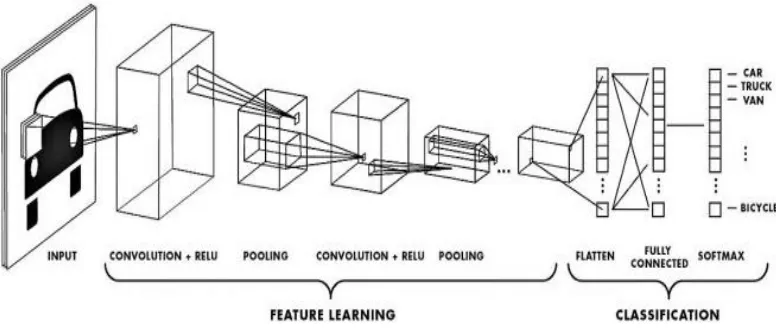
It is these properties that cause a significant reduction in the amount of parameters required in the network, thereby resulting in an efficient implementation of the forward function. This new type of structure is termed as convolutional neural network (CNN). CNN is a multistage learning paradigm, which makes use of a set of layers
grouped by their functionality. The different layers in the structure are as follows: 1) Convolution Layer: This is a
collection of filters which act on the input multidimensional matrix. The result of this stage is a matrix which has as many layers as the number of filters. 2) Activation Layer: It functions as a layer to add non- linearity to the
mapping. 3) Pooling Layer: This stage provides downsampling in a non-linear fashion on the preceding activation map
to reduce the dimension. 4) Fully Connected Layer: It functions as a normal neural network layer which makes
decisions out of the features extracted through previous layers. 5) Softmax Layer: It normalizes the preceding state
Fig. 1: A general convolutional neural network architecture for image classification (An example taken from https: //web.stanford.edu/
class/cs231a/lectures/ intro cnn.pdf )
III.LITERATURE REVIEW
Jayalekshmi, et al. [2] (2017) have proposed an emotion classification system through facial expression recognition for sentiment analysis. The available resources in web are used by the users and also they involve in giving feedbacks and thus generate additional information. It is very essential to explore, analyse and organise their opinions and feedbacks in an efficient way for better decision making. So sentiment analysis is used to find the users opinion about a particular topic, product or problem in a more efficient way. The main aim of sentiment analysis is to solve the problems in relation to opinions about products, movies, politics, review sites etc.
Shan, et al. [1] (2017) have proposed an automatic facial expression recognition system using deep CNN. In this paper, they have employed a Deep Convolutional Neural Network (CNN) to devise a facial expression recognition system, which is capable to discover deeper feature representation of facial expression to achieve automatic recognition. The proposed system is composed of the Input Module, the Pre-processing Module (face detection and Histogram equalisation), the Recognition Module (deep- CNN) and the Output Module. They have introduced both the Japanese Female Facial Expression Database (JAFFE) and the Extended Cohn-Kanade Dataset (CK+) to simulate and evaluate the recognition performance under the influence of different factors. The accuracy of the system is found to be 75.2% using JAFFE and 80.3% using CK+ datasets.
IV.EXPERIMENTAL RESULTS
Fig 2: Model Architecture
To be able to recognize emotions on images we use OpenCV. OpenCV has a few ‘facerecognizer’ classes that
can be used for emotion recognition. They use different techniques; of which we use the Fisher Face one. We start off
by organizing the CK+ dataset. Each picture arrangement comprises of the shaping of an enthusiastic appearance, beginning with a nonpartisan face and consummation with the feeling.So, from each image sequence we extract two images; one neutral (the first image) and one with an emotional expression (the last image).
The classifier works best if the training and classification images are all of the same size and have (almost) only a face on them (no clutter). We want to search out the face on every image, convert to grayscale, crop it and save the image to the dataset. We use a HAAR filter from OpenCV to automate face finding. OpenCV provides 4 pre-trained classifiers, so we detect as many faces as possible.
We then teach the classifier what certain emotions look like. The usual approach is to separate the entiredataset into a classification set and a training set. We use the training set to teach the classifier to recognize the to-be-predicted labels, and use the classification set to estimate the classifier performance. The reason for splitting the dataset is that estimating the classifier performance on the same set as it has been trained is unfair, because we are not interested in how well the classifier memorizes the training set. We see how well the classifier generalizes its recognition capability to never-seen-before data.
We randomly sample and train on 70% of the data and classify the remaining 30%, and repeat the process 10 times. The spread of accuracies between different runs was found to be still quite large. It was found to range from 60% to 68%.
V. CONCLUSION
REFERENCES
[1] Mateusz Zarkowski “Identification-deiven Emotion Recognition System for a Social Robot” IEEE, 2013
[2] BharatiA.Dixit and Dr. A.N.Gaikwad ”Statistical Moments Based Facial Expression Analysis” IEEE International Advance Computing Conference (IACC), 2015
[3] van Gent, P. (2016). Emotion Recognition With Python, OpenCV and a Face Dataset. A tech blog about fun things with Python and embedded electronics. Retrieved from: http://www.paulvangent.com/2016/04/01/emotion-recognition-with- python-opencv-and-a-face-dataset/K. Elissa, “Title of paper if known,” unpublished.
[4] Ahmad R. Naghsh-Nilchi and Mohammad Roshanzamir “An Efficient Algorithm for Motion Detection Based Facial Expression Recognition using Optical Flow” International Scholarly and Scientific Research and Innovation, 2008
[5] K. Shan, J. Guo, W. You, D. Lu and R. Bie, "Automatic facial expression recognition based on a deep convolutional-neural-network structure," 2017 IEEE 15th International Conference on Software Engineering Research, Management and Applications (SERA), London, 2017, pp. 123-128.J. Clerk Maxwell, A Treatise on Electricity and Magnetism, 3rd ed., vol. 2. Oxford: Clarendon, 1892, pp.68–73.
[6] A. S. Dhavalikar and R. K. Kulkarni, "Face detection and facial expression recognition system," 2014 International Conference on Electronics and Communication Systems (ICECS), Coimbatore, 2014, pp. 1-7.
[7] P. Lucey, J. F. Cohn, T. Kanade, J. Saragih, Z. Ambadar, and I. Matthews, “The extended cohn-kanade dataset (ck+): A complete dataset for action unit and emotion-specified expression,” in Computer Vision and Pattern Recognition Workshops (CVPRW), 2010 IEEE Computer Society Conference on, pp. 94–101, June 2010.
[8] Kwang Ho An and Myung Jin Chung “Cognitive Face Analysis System for Future Interactive TV”IEEE, 200 [9] EwaPiatkowska "Facial Expression Recognition System", Master's Thesis Technical Report.
[10] Shuai Liu and Wansen Wang “The application study of learner’s face detection and location in the teaching network system based on emotion recognition” IEEE, 2010
[11] Ekman P, Friesen WV. Constants across cultures in the face and emotion Journal of personality and social psychology 1971; 17:124
[12] Roy, D., Pentland, A. Automatic spoken affect classification and analysis. Automatic Face and Gesture Recognition, 1996., Proceedings of the Second International Conference on , 14-16 Oct. 1996. Pages: 363 – 367