An Efficient Image Encryption Technique
Using RGB Pixel Displacement and Simple
Chaotic Map
Chhavi Garg1,Lalit Mohan Gupta2, Eshank Jain3 M. Tech. Scholar, Dept. of CSE, ITM, Aligarh, India1
Asst. Professor, Dept. of CSE, VCTM, Aligarh, India2
Asst. Professor, Dept. of CSE, ITM, Aligarh, India3
ABSTRACT: Transmission over the Internet for multimedia content has become increasingly frequent. However, digital image security poses a severe threat to the transmission method owing to network openness and sharing. Among different techniques of security, various methods of image encryption have been introduced in the recent past by the researchers. In this paper, we enhanced the security of the image by applying Ex-OR operation on RGB components of the original image with RGB components of the key image. Then, the resultant image goes through chaotic 1D logistic map procedure. 1D logistic map procedure scramble the pixels of the image in very randomness fashion that is very difficult to know the exact position of the pixels for the intruders. Therefore, our technique achieved very high level of security of the image during the communication.
KEYWORDS: 1D logistic, RGB, encryption, decryption
I. INTRODUCTION
II. LITERATUREREVIEW
[1] Manjunath Prasad and K.L.Sudha, shows in their paper that They proposed a new algorithm in the paper that uses the single map. To find the best map for this algorithm, they used Henon map and Lorentz map for pixel shuffling and measured coefficient of correlation and key sensitivity. With the use of a single map, the key space will become less suitable for applications such as wireless communication. At the same time, it gives better confidentiality and a key that is difficult for an unintended user to decipher.
[2] ShrijaSomaraj and Mohammed Ali Hussain, shows in their paper that A new method to encrypt color images or 3D images is proposed in this paper using the concept of rgb displacement and scrambling. The proposed algorithm uses an original color image to be encrypted and the key image of the same size (256x256) is used as another color image. Key process of generation involves dividing the key image into three components, i.e. the components of RGB. One bitplane is selected from each of the three components. This is the key. Also, the original image is divided into three components, which are XORed with the key image's selected bitplanes. This gives the intermediate cipher image that is subjected to further scrambling by RGB and gives the required Cipher Image. The image decryption process is exactly the reverse of the encryption process.
[3]M.Y. Mohamed Parvees, J. Abdul Samath, I. Kaspar Raj and B. Parameswaran Bose, shows in their paper that A new color byte scrambling scheme is proposed in this paper for color image encryption using Logistic and Ikeda map. The chaotic sequences are generated using these chaotic maps and, according to the transformation of chaotic sequences, the position of image pixels and values is changed. The encryption of the chaotic image is done through confusion and diffusion. The confusion is obtained by changing the locations of pixels and the diffusion is obtained by changing the values of pixels. The logistic map is one-dimensional in this scheme that is simple and efficient and used to generate sequences of permutation to create confusion. To achieve diffusion, the two-dimensional Ikeda map is used to generate masking sequences. Finally, the result of the proposed algorithm is compared and validated by different cryptanalysis with existing results.
[4] Kunal Kumar Kabi, Chittaranjan Pradhan, Bidyut Jyoti Saha and Ajay Kumar Bisoi, shows in their paper that They used various versions of 2D chaotic maps in the paper to encrypt the image. Since 2D chaotic maps have more control parameters than the 1D chaotic map, they are more secure. With regard to the nature of security, thry has calculated the values of NPCR and UACI. The results of the experiment show that encryption of 2D chaotic maps is effective and secure.
[5] HeriPrasetyo, shows in his paper that This paper proposes a new technique for image encryption using a simple chaotic number. This approach offers promising results on encrypted image and in terms of objective measurement, it outperforms the old existing image encryption schemes. It validates the usability on the image encryption task of a simple chaotic number.
[6] C. K. Huang, Y. H. Hsu, W. Y. Chen, S. K. Changchien, C. M. Hung, C. H. Liu and Y. R. Tian, , shows in their paper that This paper proposes a novel color image encryption technique, the application of which can achieve highly confidential security in the encryption of color image; the encryption scheme. First, the proposed PCS method generates chaotic sequences from the variable elements of four different chaotic systems, and these sequences ' shuffled pixels can disorder the outlines of the original image completely. In addition, the IME method using various chaotic code sets the color levels of PCS matrices to be ciphered, and the ciphered color levels may confuse the image's histogram.
key space and improve the ability to be anti-aggressive. Matlab7.0 is used to test the image encryption simulation. Experimental results show that the algorithm is feasible and can meet the image transmission and storage security requirements. The Chaos algorithm compound can also be used to encrypt digital images in color.
III. PROPOSEDMETHOD
The proposed algorithm uses two color images of the same dimension (256x256) first image is the image to be
encrypted and the other image will act as a key. Key generation process involves dividing the key image into three
components, i.e. RGB Component. In order to alter pixel, the original image is also divided into RGB components and
then the pixels of both images are XORed.
In this paper, we also used 1D Logistic maps whose definitions areas follows. 1DLogistic map is described as Eq.
Xn+1 = µXn(1−xn)
Where µ ∈ [0,4], Xn∈ (0,1), n = 0, 1, 2, ... the research result shows that the system is in a chaotic state under the
conditionthat3.56994 < µ ≤4.
Encryption process:
Step1:Here, care should be taken to see that the elements generated are unique; no repetition should occur. Now divide the elements generated into three blocks equal to M x N each.
0.91999 0.27085 0.72678 0.73074 0.72407 0.73523 0.71636 0.74771 0.69417 0.78124 0.62891 0.85884 0.44613 0.90932 0.30343 0.77781 0.63596 0.85196 0.46411 0.91526 0.28541 0.75054 0.68900 0.78854 0.61361 0.87249 0.40938
Table.1 Elements generated from chaotic map
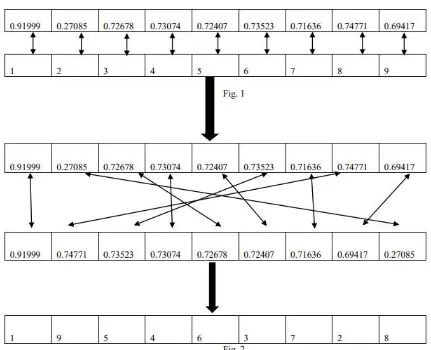
Step2:Now sort each block's elements in ascending or descending order and compare the flaw between each block's original and sorted elements and tabulate the change in the index. According to three blocks, we have three series of index changes.
0.91999 0.27085 0.72678 0.73074 0.72407 0.73523 0.71636 0.74771 0.69417
0.78124 0.62891 0.85884 0.44613 0.90932 0.30343 0.77781 0.63596 0.85196
0.46411 0.91526 0.28541 0.75054 0.68900 0.78854 0.61361 0.87249 0.40938 Table.2 Divided into three separate arrays each of 9 elements
Decryption process
The reverse process followed for encryption is used for decryption.
Step 1: The sequence of received elements is represented in fig 4 row 1; row 2 represents sorted index elements obtained from the encryption process and row 3 represents resorted index elements.
Fig.6 Method of Encryption using RGB Displacement
Intervening cipher
image
Original image
Key image
Red Component
Green Component
Blue Component
Cipher image
Red Component
Green Component
Blue Component
IV.RESULTANDDISCUSSION
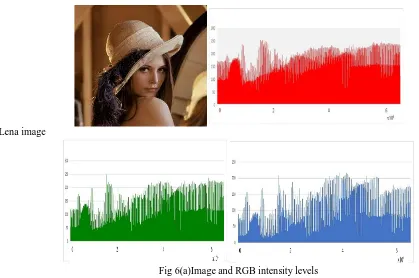
In order to test the proposed pixel scrambling algorithm, two colour images are taken.
Lena image
Fig 6(a)Image and RGB intensity levels
Fig 6(b)Scrambled levels of image and intensity of RGB
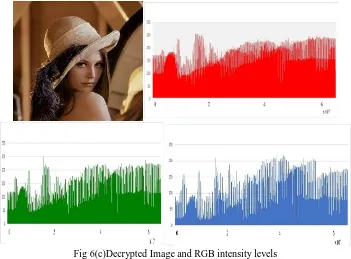
The picture acquired from the encryption method is subjected to a decryption algorithm where the pixel values are rearranged back to their original position, leading in an intensity plot similar to the initial picture intensity plot as shown in Fig 6(c)
Fig 6(c)Decrypted Image and RGB intensity levels
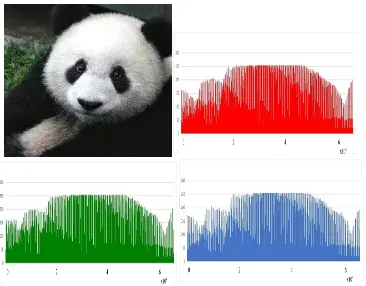
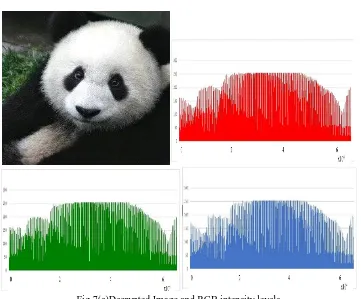
Panda picture (256x256) is another picture taken to test the algorithm. Fig 7(a), 7(b) and 7(c) display the initial picture,
Fig 7(b) Scrambled levels of image and intensity of RGB
Fig 7(c)Decrypted Image and RGB intensity levels
i. PERFORMANCE ANALYSIS
We have calculated the correlation coefficient to measure the performance of the encryption algorithm. If the
correlation coefficient for an encrypted image is closer to zero, then it is said that the algorithm is better. Key
ii. CORELATION COEFFICIENT
The coefficient of correlation evaluates the correlation in an image between two adjacent pixels. In general, the degree
of similarity between two pixels is measured by correlation. An encrypted image should have a low correlation between
two adjacent pixels, so the value of a pixel's neighbours becomes difficult to guess. The following formula can be used
to calculate the coefficient r –
Xi is the pixel intensity of original image
Xm is the mean value of original image intensity
Yi is the pixel intensity of encrypted image
Ym is the mean value of encrypted image intensity
Image R(correlation) G(correlation) B(correlation) total(correlation) Lena.jpg 8.47165e-006 -1.40784e-006 -7.73654e-006 -0.67273e-006 Panda.jpg -2.51233e-005 7.23198e-005 -2.91558e-005 0.601356e-005
Table 3 Correlation coefficient with 1D Logistic Map
iii. KEY SENSITIVITY
A good algorithm for encryption should be very sensitive to the key. A slight variation of the key in the reconstruction
process at the end of the destination should result in a completely different image. The initial condition assumed to
generate the chaotic map is acting as the key in this algorithm. We tried to describe the encrypted image with an initial
condition using another initial condition that differs from a very small value.
Results obtained are shown in figure
(Decrypted image using actual key) (Decoded image with slightly different key) µ=(3.68) µ=(3.69)
V. CONCLUSION
At present times, where the most important communication is through wireless techniques using the internet network to transfer data, the main concerns are about the security of such personal data or defense data. Encryption is a unique way to ensure dignified security on many grounds from unofficial access. In this case, image encryption is striking for research as communication with multimedia object support is rapidly growing. Further image encryption based on chaos has been examined in detail. The chaotic systems are capable of producing a huge number of new chaotic maps in relation to current chaotic maps. Along with exceptional chaotic behaviours, large chaotic range and uniform distributed density function, they all have comparable properties.
To test the distribution of the encrypted image elements, we calculated the correlation coefficient ' r’. The values obtained clearly indicate the importance of this algorithm in image encryption application. The key sensitivity test proves the algorithm's proficiency when it is the wrong key. The proposed method also provides colour images with commendable security. This method can be used to encrypt images of various sizes, types and applications.
This paper describes a novel technique of image encryption using the non-linear dynamic system (chaos) concept. The chaos system is highly sensitive to the system's initial values and parameters. To encrypt the image, the proposed method uses the randomness of the chaos maps. The pixel position is changed in this algorithm according to the randomness of the chaotic elements, which is derived by comparing sorted and unsorted chaotic elements generated from the map of chaos.
REFERENCES
[1] Manjunath Prasad and K.L.Sudha “Chaos Image Encryption using Pixel shuffling”,
[2] ShrijaSomaraj and Mohammed Ali Hussain “A Novel Image Encryption Technique using RGB pixel displacement for Color Images” 2016 IEEE 6th International Conference on Advanced Computing
[3] M.Y. Mohamed Parvees, J. Abdul Samath, I. Kaspar Raj and B. Parameswaran Bose “A Colour Byte Scrambling Technique for Efficient Image Encryption Based on Combined Chaotic Map” International Conference on Electrical, Electronics, and Optimization Techniques (ICEEOT) – 2016 [4] Kunal Kumar Kabi, Chittaranjan Pradhan, Bidyut Jyoti Saha and Ajay Kumar Bisoi “Comparative study of Image Encryption using 2D Chaotic Map” 2014 International Conference on Information Systems and Computer Networks
[5] HeriPrasetyo“A New Image Encryption Technique Using Simple Chaotic Maps” 2018 International Symposium on Electronics and Smart Devices (ISESD)