Abstract
YUAN, PEI-LUN. Game Theoretic Analysis of a Distribution System in
Supply Chain. (Under the direction of Shu-Cherng Fang, and Henry L.
W. Nuttle.)
We consider a distribution system in which one supplier provides a
sin-gle product to several retailers at the beginning of a selling season. The
supplier has infinite capacity. The customer demand at each retailer is
randomly distributed. Customers who encounter a stockout at one
re-tailer may search other rere-tailers for the product. We study the effects
of this market search behavior under both decentralized and centralized
control. For the decentralized control model, we show the necessary and
sufficient conditions for the existence of a Nash equilibrium, and the
suf-ficient conditions for its uniqueness. For the centralized control model,
we find that the payoff function is submodular, and thus we can only
ob-tain allocations that are locally optimal for the entire supply chain. We
also design a channel coordination mechanism to match the allocations in
the decentralized control model with one of the local optimal allocations
Biography
Pei-Lun Yuan was born in Taipei, Taiwan in 1979. She attended the
National Taiwan University through the recommendation of the Taipei
First Girl senior high school in 1997. She graduated with a Bachelor
degree in Chemical Engineering in 2001. She came to North Carolina
State University in the summer of 2001 to begin her graduate studies
in Industrial Engineering. Her main research interests include system
Acknowledgements
I would like to thank my advisors, Prof. Shu-Cherng Fang and Prof.
Henry L.W. Nuttle. They gave me much encouragement and support to
lead me to my graduate study and research. Thanks for their great
pa-tience and teaching. They take care of students like their children. Under
their instruction, I have learned a lot in these two years.
Our group members, Burcu, Chian-Fen, Hao Cheng, Ilker, Saowanee,
Xi-aoli, Yi Ding, Yi Laio, Yong Wang, and Yue Dai, accompanied and helped
me a lot when I had some doubts in my mind. I am very grateful to Yue
Dai for being so patient in answering my endless questions. She taught
me and gave me much priceless advice.
I have many thanks to my friend, Mark and my families. Especially my
mom, Jing Chen, who is my best listener and always prays for me.
Thanks to God, who tell me to forget the things which are behind and
Contents
List of Figures v
1 Introduction 1
2 Background and Literature Review 3
2.1 Market search problem . . . 3
2.2 Game theory . . . 4
2.3 Channel coordination . . . 6
2.4 Product substitution problem . . . 7
3 The model and basic notation 9
4 Decentralized Control System 13
5 Centralized Control System 26
6 Channel Coordination 35
7 Numerical Experiments 38
8 Conclusion 50
List of Figures
1 Decentralized control system . . . 4
2 Centralized control system . . . 5
3 Allocation versus market search probability with 2 retailers . . . 41
4 Profit of retailers versus market search probability with 2 retailers . . 43
5 Profit of supplier versus market search probability with 2 retailers . . 43
6 System profit versus market search probability with 2 retailers . . . . 44
7 Profit improvement after coordination versus market search probability
with 2 retailers . . . 44
8 Wholesale price versus market search probability with 2 retailers . . . 45
9 Allocation versus market search probability with 3 retailers . . . 45
10 Profit of retailers versus market search probability with 3 retailers . . 46
11 Profit of supplier versus market search probability with 3 retailers . . 46
12 System profit versus market search probability with 3 retailers . . . . 47
13 Profit improvement after coordination versus market search probability
with 3 retailers . . . 47
14 Wholesale price versus market search probability with 3 retailers . . . 48
15 Profit percentage after coordination of supplier and retailers versus
1
Introduction
Capacity allocation plays an important role in supply chain management. Decisions
of both suppliers and retailers are significant not only because they determine the
amount of flexibility the supply chain has to meet customers’ demand, but also
be-cause they affect each other. For example, allocating too much capacity to a retailer
results in poor utilization and higher holding cost, but too little capacity results in
poor customer satisfaction and higher penalty cost.
In many supply chains, customers who face a stockout at one retailer may search
for the same product at other retailers. This behavior is called market search.
(Anupindi and Bassok, 1999).
Dai (2002) considers market search in an allocation problem that involves one
supplier and two retailers in the supply chain in a single selling season. Here we
generalize Dai’s (2002) work to the case of one supplier and “multiple” retailers in
the supply chain. We assume the supplier has infinite capacity and the customers’
demand at each retailer is randomly distributed. The market search effect is studied
in two models. In the first model, assuming under decentralized control, all retailers
compete with each other. Therefore, “game theory” is applied to decide their
allo-cations. The other model assumes under centralized control, in which all retailers
collaborate with each other. Thus the allocation for the whole supply chain is
opti-mized.
In Chapter 2, some background knowledge and a literature review are given. In
Chapter 3, we introduce the model and notation. In Chapter 4, we obtain the
In Chapter 5, we show that the payoff function under centralized control is
submod-ular and thus only local optimum allocations can be found. In Chapter 6, we design
a coordination mechanism between decentralized control and centralized control. In
Chapter 7, through numerical experiments, we analyze the effect of coordination and
the market search factor on the retailers, supplier, and whole supply chain. Finally,
2
Background and Literature Review
In this chapter, we present some important concepts used in this thesis and give a
brief literature review. The concepts include market search, game theory, and channel
coordination. We also introduce a related research issue called product substitution.
2.1
Market search problem
Customers who face a stockout at one retailer may keep on looking for the same
product at other retailers. This phenomenon is called market search and was first
introduced by Anupindi and Bassok (1999). They compare the performance of two
systems: one in which the retailers hold stocks separately and the other in which the
retailers centralize stocks at a single location. They find that whether centralization
of stocks by retailers increases profits for the manufacturer depends on the level of
market search in the supply chain. The level of market search is measured as the
fraction of customers who transfer their demand from the original retailer they visit
to other retailers when they encounter a stockout. They show that there exists a
threshold of market search level beyond which the system profit may decrease with
centralization of stocks.
In Anupindi and Bassok’s (1999) model, centralization means that all stocks in
the supply chain are located at one retailer. But in our work, centralization means
collaboration and information sharing. The inventory is held at different retailers
based on the customer demand.
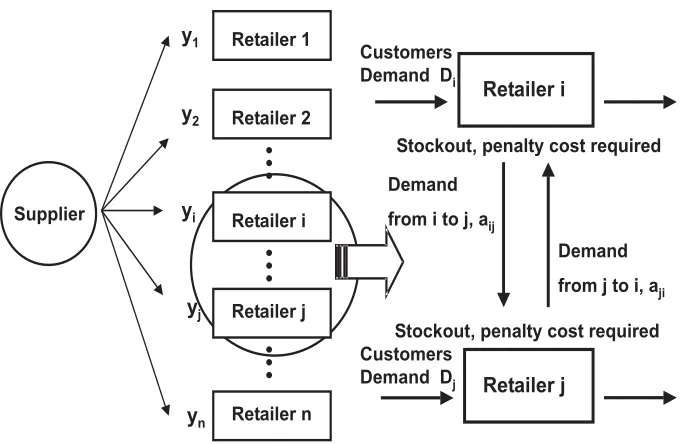
With customers’ market search behavior, we analyze the differences between two
Supplier
Retailer 1
Retailer 2
Retailer i
Retailer j
Retailer n
yn y1
y2
yi
yj
Retailer i
Retailer j
Customers Demand Di
Customers Demand Dj
Stockout, penalty cost required Demand
from i to j, aij
Demand from j to i, aji Stockout, penalty cost required
Figure 1: Decentralized control system
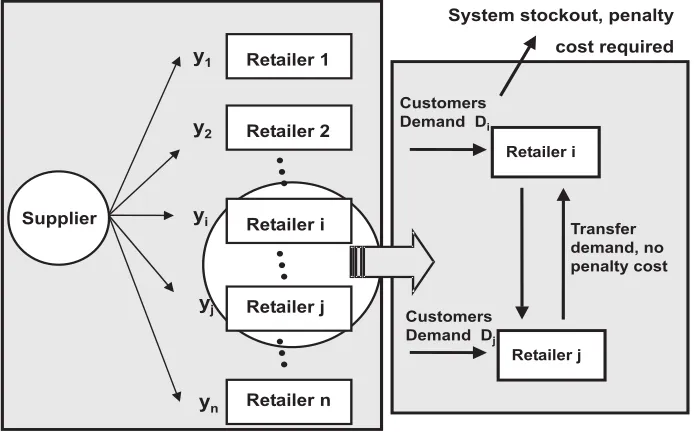
(Figure 2). Under decentralized control, each retailer makes its order decision by itself
and does not cooperate with other retailers. To maximize its own profit, each retailer
has to determine its order strategy so as to compete with other retailers. Under
cen-tralized control, all retailers in the supply chain are willing to cooperate and make
the allocation decisions together with the supplier. If customers encounter a stockout
at one retailer and they want to look for the same product at other retailers, the
initial retailer may tell the customers at which retailers this product is still available.
Therefore, the whole supply chain will pay less penalty cost for lost customers.
2.2
Game theory
Decentralized control is often used in supply chains. Since the ordering decision of
Supplier
Retailer 1
Retailer 2
Retailer i
Retailer j
Retailer n
yn y1
y2
yi
yj
Retailer i Customers
Demand Di
Customers Demand Dj
Transfer demand, no penalty cost
Retailer j
System stockout, penalty cost required
Figure 2: Centralized control system
trying to maximize their own profits. A strategic interaction results from retailers’
ordering decisions. Therefore, we apply game theory to analyze the allocation
deci-sions of retailers in a decentralized control system.
Game theoryhas been widely used in supply chain management (Mesterton, 2000).
The term “players” refers to the different parties who compete with each other in the
supply chain. “Payoff function” is the profit function or utility function of each
player. A strategic game is a model of interactive decision-making in which each
player chooses his or her strategy once and for all, and these choices are made
simu-taneously. In a strategic game, the number of players has to be finite. In game theory,
the players are assumed to be rational. They always try to maximize their individual
profit. The so-calledNash equilibrium establishes when no player has an action
given that every other player chooses his/her equilibrium action, i.e., no player can
profitably deviate when we give other players’ strategies (Osborne, 1996).
Game theory has been applied to solve some inventory problems. Parlar (1988)
studies the substitutable product problem as an extension of the classical newsvendor
problem. In his two-player model, product substitution (which we will describe in
detail later) occurs with a certain probability when customers encounter a stockout.
For this problem, he proves the existence of a unique Nash equilibrium. Lippman and
McCardle (1994) also study an extension of the classical newsvendor problem. They
assume the salvage value of excess inventory and penalty for unsatisfied demand are
zero. Under these assumptions, they examine the equilibrium of inventory levels and
rules for reallocating excess demand. They also provide existence conditions for a
Nash equilibrium when two or more newsvendors are involved.
Under decentralized control, the retailers are the players, and their individual
profit functions are the payoff functions. We apply game theory to analyze the best
strategies for retailers to order the inventory they need. Game theory is also used to
determine the existence conditions of a Nash equilibrium for the decentralized model
in Chapter 4. Futhermore, when a Nash equilibrium exists, we also want to know the
conditions which support global stability of the solution.
2.3
Channel coordination
Compared to decentralized control, centralized control yields more profit for the
sup-ply chain as a whole. However, in reality, most retailers will not cooperate, share
sup-plier unless they are owned by the same company. To improve the performance under
decentralized control, coordination mechanisms can be designed by altering the
indi-vidual payoff functions. In this way, it may be possible to reach the same solution and
the overall profit as with a centralized control system. This approach is called
chan-nel coordination. In a supply chain, channel coordination can be achieved through
a contract between the supplier and retailers. This contract indicates benefit
shar-ing among the supplier and retailers after coordination. To understand the effect of
coordination between supplier and retailers in our senario, we will analyze the profit
ratio of supplier and retailers after channel coordination.
2.4
Product substitution problem
In addition to searching for the same product at other retailers, customers may also
substitute an out-of-stock product with different products. This is calledproduct
sub-stitution. Compared to the market search problem, product substitution problem is
more general. McGillivray and Silver (1978) consider the substitution of two identical
products with independent normally distributed demands and develop heuristics to
obtain the optimal stocking level. Palar and Goyal (1984) analyzed this problem of
two substitutable products with stochastic demands. Pasternak and Drezner (1991)
provide an analytical solution to the problem of two substitutable products and
con-clude that substitution gives a lower revenue. Many people have followed this stream
to work on similar problems. However, it is very difficult to deal with problems which
have more than three substitutable products using the Leibnitz formula. In a 2001
paper, Rudi provides a more tractable expression for derivatives of high dimensional
integrals. Netessine (2001) adopts Rudi’s expression to solve more complex cases of
3
The model and basic notation
Consider one supplier distributing one product to n retailers who sell this product to
customers in a single period on season. If customers who visit retailer i at begining
face a stockout, some of them may search for the same product at a second retailer
j with probability aij. We assume that customers at most visit two retailers, i.e., if
they encounter a stockout at the second visited retailer, they will not search anymore.
Since customers may transfer their demand between retailers, the total customer
demand at any retailer can be separated into local demand anddistant demand. Local
demand is from the customers who visit this retailer at first, whiledistant demand is
the demand transferred from other stocked out retailers. The total customer demand
is called effective demand. Usually, retailers will give priority to their local demand
and use the remaining inventory, if any, to satisfy their distant demand. The
inven-tory of each retailer certainly affects other retailers’ distant demand.
We assume that the supplier has infinite capacity to provide the product. At the
beginning of the season, retailers will receive whatever amount of product that they
ordered. At the end of the season, a holding cost or stockout penalty is incurred by
each retailer depending on whether there is unsold stock or a stockout. In the
decen-tralized control model, the stockout penalty cost is modeled as incurred for unsatisfied
local demand. In the centralized control model, the supplier and all retailers can be
viewed as a whole. Therefore, the average penalty cost of all retailers is incurred by
the system when customers leave the supply chain without a purchase.
In the decentralized control model, each retailer is assumed to be an independent
market search probability of customers. The problem of making optimum ordering
decisions by the retailers is modeled as a game.
In the centralized control model, since the supplier and all retailers cooperate with
each other, instead of playing a game, they have to decide the total production and
allocations together so as to maximize the total expected profits of the supply chain.
Following is the notation that we use in the two models:
for the supplier:
K: the capacity of the supplier;
c: the unit production cost;
wi: the wholesale price to retailer i, i= 1, ..., n;
for retailer i, i= 1, ..., n:
si: the unit selling price for local demand;
ti: the unit selling price for distant demand;
hi: the unit holding cost per unit of product left at the end of the season;
pi: the per unit stockout penalty cost;
¯
p: the average unit stockout penalty cost for then retailers;
Di: a continuous random variable, denoting a stochastic local demand;
Fi(Di): the cumulative distribution function ofDi;
aij: the market search probability from retailer ito retailer j, an element of the
market search matrix, 0 ≤aij ≤1,aii = 0;
yi: the allocation, i.e., inventory, at the beginning of the season;
Ri: the effective demand. It is the summation of local demand and distant
demand,
Ri =Di+ n
j=1aji
(yj −Dj)−, (1)
where (x)−= max{−x,0}, and (x)+= max{x,0};
πi(y1, y2, ..., yn): the expected payoff given all retailers’ allocations,y1,y2,...,yn.
Following Pasternack and Drezner (1991), we make the following assumptions:
(A1) si > wi >0, i= 1, ..., n;
(A2) ti > wi >0, i= 1, ..., n;
(A3) si > ti−pi, i= 1, ..., n;
Assumptions (A1) and (A2) express the idea that the product selling price should
be higher than its cost. Assumptions (A3), as observed by Pasternack and Drezner,
describes the phenomenon that the retailers will satisfy the local demand at first, and
then use the remaining inventory, if any, to satisfy a distant demand. Assumption
only one unit of product left and faces both local and distant demand simultaneously.
Because the local selling price is higher than the distant selling price less the shortage
penalty, retailers will consider local customers as their priority.
If retailericannot distinguish the local demand from distant demand, i.e.,si =ti,
then assumption (A3) for retailer i is unnecessary. However, for other retailers who
can tell the difference between local customers and distant ones, they still need
4
Decentralized Control System
Under decentralized control, each retailer makes his/her own order decision, and does
not cooperate with other retailers. To maximize his/her own profit, each retailer
has to manage his/her order strategy in competition with other retailers. Here we
assume the supplier has infinite capacity, i.e. all retailers can order and be allocated
the amount of inventory they need. Given that retailer i’s order is yi, the payoff for
retailer i consists of:
(i) Purchasing cost: wiyi;
(ii) Holding cost: hi(yi−Ri)+;
(iii) Penalty cost: pi(yi−Di)−;
(iv) Selling revenue: simin{yi, Di}+timin{(yi−Di)+,nj=1aji(yj −Dj)−}.
Thus retailer i’s expected payoff function is
πi(y1, y2, . . . , yn) = E[simin{yi, Di}+timin{(yi−Di)+, n
j=1
aji(yj −Dj)−}
−wiyi
−hi(yi−Ri)+ −pi(yi−Di)−]
= E[siyi−wiyi+pi(yi−Di)
−hi(yi−Ri)+
−(si+pi−ti)(yi−Di)+
−ti[(yi−Di)+− n
j=1
where min{a, b}=a−(a−b)+.
Lemma 1 Given yj, j = 1, . . . , n, j =i, πi(y1, . . . , yn) is strictly concave in yi.
Proof The first derivative of πi(y1, . . . , yn) with respect to yi is
∂πi(y1, y2, . . . , yn)
∂yi = (si−wi+pi) −∂E[hi(yi−Ri)+]
∂yi
−∂E[(si+pi−ti)(yi−Di)+] ∂yi
−∂E[ti((yi−Di)+−
n
j=1aji(yj −Dj)−)+]
∂yi (3)
= (si−wi+pi)
−(si+pi−ti)P r(yi > Di)
−(hi+ti)P r(yi > Ri). (4)
As noted in Netessine (2001), due to the necessity of dealing with nested integrals
of high dimensionality over the regions formed by intersections of a large number of
hyperplanes, it is very difficult to take derivatives by the Leibnitz formula. Thus to
go from (3) to (4), we directly utilize the definition as in Rudi (2001).
The derivate of the function f(x) with respect to variable x is defined as follows,
∂f(x)
∂x = lim→0
f(x+)−f(x)
First, we work with the second term of (3) and determine the derivative of
E[hi(yi−Ri)+]
∂E[hi(yi−Ri)+]
∂yi = hi lim→0E
(yi+−Ri)+−(yi−Ri)+
.
We distinguish these cases, namely
(yi+−Ri)+−(yi−Ri)+ =
0 if yi−Ri ≤ −;
(yi+−Ri) if− < yi−Ri ≤0;
if 0< yi−Ri.
Suppose >0 (analogously, for <0), taking the derivative for each of the three
cases, we obtain,
∂E[hi(yi−Ri)+]
∂yi
=hilim
→0
0P r(yi−Ri <−) + yyi+
i (yi+−x)fRi(x)dx+P r(yi > Ri)
. (5)
hilim→0 yi+
yi (yi+−x)fRi(x)dx
= hilim
→0
E[yi+−Ri|yii< yi+]
P r(yi ≤ Ri < yi + ).
Obviously,
lim
→0
E[yi+−Ri|yi ≤Ri < yi+]
< 1.
Therefore,
lim
→0
yi+
yi (yi+−x)fRi(x)dx
= 0.
Consequently,
∂E[hi(yi−Ri)+]
The third term of (3) is taken from the derivative ofE[(si+pi−ti)(yi−Di)+] in
the same way. Hence
∂E[(si+pi−ti)(yi−Di)+]
∂yi
= (si+pi −ti)P r(yi> Di). (7)
We determine the derivative of the fourth term of (3):
∂E[ti((yi−Di)+−jn=1aji(yj −Dj)−)+]
∂yi = tilim→0E
((yi+−Di)+
− n
j=1
aji(yj −Dj)−)+−((yi−Di)+
− n
j=1
aji(yj −Dj)−)+
.
Here we have four cases, for the numerator of the expression under the expectation,
namely
((yi+−Di)+−
n
j=1
aji(yj −Dj)−)+−((yi−Di)+− n
j=1
aji(yj −Dj)−)+
=
if yi−Di >0,
and (yi−Di)+−nj=1aji(yj −Dj)−>0;
yi+−Di if − < yi−Di ≤0,
and (yi−Di)+−nj=1aji(yj −Dj)−>0;
yi+−Di−nj=1aji(yj−Dj)− if − < yi−Di ≤0,
and − <(yi−Di)+−jn=1aji(yj −Dj)−≤0;
This leads to
∂E[ti((yi−Di)+−jn=1aji(yj −Dj)−)+]
∂yi = tilim→0
P r(yi−Di >0,
(yi−Di)+−
n
j=1
aji(yj−Dj)−>0)
+
yi+
yi
(yi+−x)fDi(x)dx
+
yi+
yi
(yi+−x
−n j=1
aji(yj−Dj)−)fDi(x)dx
+0P r(yi−Di ≤ −)
.
(8)
As described before, the second term of (8) can be re-written as
lim
→0
yi+
yi (yi+−x)fDi(x)dx
= lim
→0
E[yi+−Di|yi ≤Di < yi+]
P r(yi ≤ Di < yi + ).
lim
→0
E[yi+−Di|yi ≤Di< yi+]
< 1.
Hence,
lim
→0
yi+
yi (yi+−x)fDi(x)dx
= 0.
Also, the third term of (8) can be re-written as
lim
→0
yi+
yi (yi+−x−
n
j=1aji(yj−Dj)−)fDi(x)dx
= lim
→0
E[yi+−Di−nj=1aji(yj−Dj)−|yi ≤Di < yi+]
P r(yi ≤Di < yi+)
where
lim
→0
E[yi+−Di−nj=1aji(yj−Dj)−|yi ≤Di < yi+]
< 1.
Consequently,
lim
→0
yi+
yi (yi+−x−
n
j=1aji(yj−Dj)−)fDi(x)dx
Thus, equation (8) can be re-written as
∂E[ti((yi−Di)+−jn=1aji(yj−Dj)−)+]
∂yi = tiP r(yi−Di >0,
(yi−Di)+−
n
j=1
aji(yj −Dj)−>0),
= tiP r(yi−Ri >0). (9)
From (6), (7), and (9), we can obtain the following result:
∂πi(y1, y2, . . . , yn)
∂yi = [si−wi+pi] −hiP r(yi > Ri)
−(si+pi−ti)P r(yi> Di)
−tiP r(yi > Ri)
= [si−wi+pi]
−(si+pi−ti)P r(yi> Di)
−(hi+ti)P r(yi> Ri)
= [si−wi+pi]
−(si+pi−ti)FDi(yi)
−(hi+ti)FRi(yi) (10)
Taking the derivative of (10) with respect to yi, we obtain the second derivative
∂2πi
∂2yi = (−si−pi+ti)fDi(yi) −(ti+hi)fRi(yi)
By assumptions (A2) and (A3), we know thatti >0 andsi+pi > ti,thus ∂2πi
∂2yi <0.
Since the second derivative of πi(y1, . . . , yn) with respect to yi is less than zero,
Lemma 2 If each player’s payoff function πi(y1, . . . , yn) is continuous in all decision
variables (y1, . . . , yn) and concave in its own decision variable yi, then the game has
at least one Nash equilibrium which is determined by letting the first partial derivative
of each player’s payoff function with respect to its own decision variable be zero.
Proof The definition of a noncooperative n-person convex game is given below by M. Dresher and S. Karlin (1953):
(i) Theith player’s strategy space is a compact convex setXi of a topological linear
space Ei;
(ii) The ith player’s payoffπi(x1,· · · , xi,· · · , xn) is concave with respect to his own
strategy variable xi ∈Xi;
(iii) The sum of payoffs ni=1πi(x1,· · ·, xi,· · · , xn)is continuous over the cartesian
product space X1⊗X2⊗ · · · ⊗Xn;
(iv) For each fixed xi, πi(x1,· · · , xi−1, xi, xi+1,· · · , xn) is a continuous function of
the (n-1)-tuple [x1,· · · , xi−1, xi+1,· · · , xn]∈X1⊗ · · · ⊗Xi−1⊗Xi+1⊗ · · · ⊗Xn
respectively.
From Theorem 3.1 of Nikaido and Isora (1955), we know that a convex game
al-ways has at least one Nash equilibrium solution. Since the noncooperative game in
our decentralized control model satisfies the conditions of an-person convex game, it
has at least one Nash equilibrium.
According to Moulin (1986), to compute all Nash equilibra of a given game, G,
we need to solve the system:
Πi(y∗) = max
yi Πi(yi, y
∗
wherei= 1, . . . , n, andy−∗i is the vector of what strategies of the players other thani.
Equation (11) says that given all the other player’s strategies, the Nash equilibrium
strategy for playeri is the one that maximizes his or her profit. If Πi is concave inyi,
and Πi is differetiable inyi, the above system is equivalent to the first order conditions
∂Πi
∂yi(y
∗) = 0,
wherei= 1, . . . , n.
From Lemma 1 and Lemma 2, we can conclude the following theorem.
Theorem 3 There exists at least one Nash equilibrium for our decentralized control model which may be obtained by solving the system of equations that results from
setting the first partial derivative of each player’s payoff function with respect to its
own decision variable to be zero.
Basically, at least one Nash equilibrium can be found in the decentralized control
system by solving the first order conditions. We would also like to know the
unique-ness conditions of aNash equilibrium in the decentralized control system.
Theorem 3 of Chapter 6 of Moulin (1984) states that if the payoff function is twice
differentiable in all of its variables with
∂2πi ∂y2i <
The system is globally stable with a unique Nash equilibrium if
|∂2πi ∂yi2| >
j,j=i |∂2πi
∂yiyj|,
for all i, j = 1, . . . , n, j =i. (12)
In other words, there exists a unique Nash equilibrium for the decentralized
con-trol model if its payoff function satisfies the inequalities of (12).
According to Dai (2002), when there are only two retailers in the supply chian,
we can find the necessary and sufficient conditions for the existence of a unique Nash
equilibrium. When we have more than two retailers, there only exists some sufficient
conditions for a unique Nash equilibrium.
Theorem 4 If nj=1aji < 1, for all i and j, j = i, the Nash equilibrium of the decentralized control model is unique.
Proof From assumption (A3), we know that si+pi−ti >0. Since nj=1aji <1 for all i, and j, j =i,
fRi(yi)>
j,j=i
(ajifRi|Dj≥yj(yi)P r(Dj ≥yj)).
Consequently,
| −(si +pi−ti)fDi(yi)−(ti+hi)fRi(yi)|>
j,j=i
where i, j = 1, . . . , n, andi=j.
Equivalently, we have
|∂2πi ∂y2i |>
j,j=i | ∂2πi
∂yiyj|, wherei, j = 1, . . . , n, j =i
Therefore, nj=1aji < 1, for all i and j, j = i, is a sufficient condition to quarantee
5
Centralized Control System
In the centralized control model, we assume that all retailers in the supply chain
are willing to cooperate and make the allocation decisions together with the supplier
because this approach will maximize the expected total profit of the whole supply
chain. Since all retailers cooperate with each other in the supply chain, when
cus-tomers encounter a stockout at one retailer and decide to look for the product at
other retailers, the initial retailer may tell the customers at which other retailers they
may find the product. We assume that a customer may visit up to two retailers in
search of the product before leaving the system. The stockout penalty is incurred
only when a customer leaves the system without purchasing the product. Because
the supplier and retailers can be viewed as a whole system, we assume that the unit
penalty cost for losing a customer to be the average of the unit penalty costs for
individual retailers in the decentralized model.
We assume the supplier has infinite capacity, andyi is the order (and allocation)
for retailer i. The payoff function for the whole supply chain consists of:
(i) Production cost: cK =c(y1+. . .+yn) = cni=1yi;
(ii) Holding cost: ni=1hi(yi−Ri)+;
(iii) Penalty cost:
n
i=1p¯[(yi−Di)−(1−
n
j=1aij) + (
n
j=1aji(yj−Dj)−−(yi−Di)+)+]
=ni=1p¯[(yi−Di)−(1−nj=1aij)+nj=1aji(yj−Dj)−−(yi−Di)++(nj=1aji(yj−
Dj)−−(yi−Di)+)−];
n
i=1[simin{yi, Di}+timin{(yi−Di)+,
n
j=1aji(yj−Dj)−}]
=ni=1[siyi−si(yi−Di)++ti(yi−Di)+−ti[(yi−Di)+−nj=1aji(yj−Dj)−]+].
Thus the expected payoff function of the whole supply chain is
π(y1, y2, . . . , yn) = E[
n
i=1
(siyi−si(yi−Di)++ti(yi−Di)+
−ti((yi−Di)+− n
j=1
aji(yj−Dj)−)+)
−c n
i=1
yi
−n i=1
hi(yi−Di− n
j=1
aji(yj −Dj)−)+)
−p¯
n
i=1
((yi−Di)−(1−
n
j=1
aij))
−p¯
n i=1 ( n j=1
aji(yj−Dj)−−(yi−Di)+)
−p¯
n i=1 ( n j=1
aji(yj−Dj)−−(yi−Di)+)−]
= E[
n
i=1
(si−c+ ¯p)yi
− n
i=1
(si−ti)(yi−Di)+
− n
i=1
(ti+ ¯p)((yi−Di)+−
n
j=1
aji(yj−Dj)−)+
− n
i=1
hi(yi−Di− n
j=1
aji(yj −Dj)−)+]. (13)
product” problem is submodular. In our market search problem, since the product
sold by different retailers is the same, they are substitutable. In Lemma 5, we show
that the payoff function is submodular.
Lemma 5 In the centralized control model, the payoff function π(y1, y2, . . . , yn) is
submodular in y1, y2, . . . , yn.
Proof To show the payoff function π(y1, y2, . . . , yn) is submodular in y1, y2, . . . , yn, we refer to Sundaram (1999). It is sufficient to demonstrate that the second order
cross-partial derivatives are non-positive.
The first derivative ofπ(y1, y2, . . . , yn) with respect to yi is
∂π(y1, y2, . . . , yn)
∂yi
= (si−c+ ¯p)
−∂E[
n
i=1(si−ti)(yi−Di)+] ∂yi
−∂E[
n
i=1(ti+ ¯p)((yi−Di)+−nj=1aji(yj −Dj)−)+] ∂yi
−∂E[
n
i=1hi(yi−Di−
n
j=1aji(yj −Dj)−)+]
∂yi (14)
= (si−c+ ¯p)
−(si−ti)P r(yi > Di)
−(ti+hi+ ¯p)P r(yi > Ri)
− n
j=1,j=i
(tj+hj+ ¯p)aijP r(Di> yi, Rj < yj). (15)
For (14) and (15), it is easy to see the equivalence of the first two terms in (14)
given as follows.
First, we can separate the third term of (14) into two parts.
∂E[ni=1(ti+ ¯p)((yi−Di)+−nj=1aji(yj−Dj)−)+]
∂yi
= lim
→0
(ti+ ¯p)((yi+−Di)+−
n
j=1
aji(yj−Dj)−)+
−(ti+ ¯p)((yi−Di)+−
n
j=1
aji(yj −Dj)−)+
+ lim →0 n
j=1,j=i
(tj + ¯p)((yj−Dj)+−
n
i=1
aij(yi+−Di)−)+
−(tj + ¯p)((yj −Dj)+−
n
i=1
aij(yi−Di)−)+
. (16)
With (ti + ¯p) being factored out, the numerator of the first term in (16) can be
expressed as:
((yi+−Di)+−
n
j=1
aji(yj−Dj)−)+−(ti + ¯p)((yi−Di)+− n
j=1
aji(yj −Dj)−)+
=
if yi−Di >0,
and (yi−Di)+−nj=1aji(yj −Dj)−>0;
yi+−Di if − < yi−Di ≤0,
and (yi−Di)+−nj=1aji(yj −Dj)−>0;
yi+−Di−nj=1aji(yj−Dj)− if − < yi−Di ≤0,
and − <(yi−Di)+−jn=1aji(yj −Dj)−≤0;
After taking the derivative for the four cases, the first term of (16) can be
re-written as:
lim
→0
(ti+ ¯p)((yi+−Di)+−
n
j=1
aji(yj−Dj)−)+
−(ti+ ¯p)((yi−Di)+−
n
j=1
aji(yj −Dj)−)+
= (ti+ ¯p) lim
→0
P r(yi−Di >0,(yi−Di)+−
n
j=1
aji(yj−Dj)− >0)
+
yi+
yi
(yi+−x)fDi(x)dx
+
yi+
yi
(yi+−x−
n
j=1
aji(yj −Dj)−)fDi(x)dx
+0P r(yi−Di ≤ −)
, (17)
= (ti+ ¯p)P r(yi−Di >0,(yi−Di)+−
n
j=1
aji(yj −Dj)− >0),
= (ti+ ¯p)P r(yi> Ri).
With (tj+ ¯p) factored out, the numerator of the second term of (16) can be expressed
as
((yj−Dj)+−
n
i=1
aij(yi+−Di)−)+−(tj + ¯p)((yj−Dj)+− n
i=1
=
−aij if yi−Di <−,
and (yj −Dj)+−ni=1aij(yi−Di)− >0;
−aij(yi+−Di) if −≤yi−Di <0,
and (yj −Dj)+−ni=1aij(yi−Di)− >0;
0 if 0≤yi−Di,
and 0≤ (yj−Dj)+−in=1aij(yi−Di)−.
Then we take the derivative for these three cases,
lim
→0
n
j=1,j=i
(tj + ¯p)((yj−Dj)+−
n
i=1
aij(yi+−Di)−)+
−(tj+ ¯p)((yj−Dj)+−
n
i=1
aij(yi−Di)−)+
= (tj + ¯p) lim
→0
n
j=1,j=i
−aijP r(yi−Di <−,(yj−Dj)+− n
i=1
aij(yi−Di)−>0)
−
yi+
yi
aij(yi+−x)fDi(x)dx
+0P r(0≤yi−Di,0≤(yj −Dj)+−
n
i=1
aij(yi−Di)−)
=
n
j=1,j=i
(tj+ ¯p)P r(yi−Di <0,(yj−Dj)+−
n
i=1
aij(yi−Di)− >0)
=
n
j=1,j=i
Similarly, for the fourth term of (14), we can show that
∂E[ni=1hi(yi−Di−nj=1aji(yj−Dj)−)+]
∂yi = hiP r(yi> Ri)
+
n
j=1,j=i
hjaijP r(Di > yi, Rj < yj)
(19)
From equations (16) to (19), we obtain the first derivative of the payoff function
with respect to yi in centralized control system as (15).
Taking the derivative of (15), we obtain the second derivative ofπ(y1, . . . , yn) with
respect to yi as
∂2π
∂2yi = −(si−ti)fDi(yi) −(ti+hi+ ¯p)fRi(yi)
− n
j=1,j=i
(tj+hj + ¯p)a2ijfRj|Di>yi(yj)P r(Di > yi). (20)
The first two terms of (20) are easily seen to follow from (15). The third term of
(20) requires some explanation.
∂P r(Di > yi, Rj < yj)
∂yi = lim→0
P r(Di > yi+, Dj +aij(yi+−Di)− < yj)
−P r(Di > yi, Dj+aij(yi−Di)−< yj)
Then we can split up the numerator into three cases:
P r(Di > yi+, Dj +aij(yi+−Di)− < yj)−P r(Di > yi, Dj+aij(yi−Di)− < yj)
=
P r(Di > yi+, Dj −aij(yi+−Di)< yj)
−P r(Di > yi, Dj −aij(yi−Di)< yj) if Di−yi > ,
−P r(Di > yi, Dj −aij(yi−Di)< yj) if 0< Di−yi ≤,
0 if Di−yi ≤0.
Therefore,
∂P r(Di > yi, Rj < yj)
∂yi = lim→0
(P r(Di> yi+, Dj−aij(yi+−Di)< yj)
−P r(Di > yi, Dj −aij(yi−Di)< yj))P r(Di−yi > )
−(P r(Di> yi, Dj −aij(yi−Di)< yj))P r(0< Di−yi ≤)
.
= aijfRi|Di>yi(yj)P r(Di > yi)
In a similar manner, we can show that the second order cross-partial derivative of
∂2π
∂yiyj = −(ti+hi+ ¯p)ajifRi|Dj>yj(yi)P r(Dj > yj) −(tj+hj + ¯p)aijfRj|Di>yi(yj)P r(Di > yi)
− n
r=1,r=i,j
(tr+hr+ ¯p)airajrfRr|Di>yi,Dj>yj(yr)P r(Di> yi, Dj > yj).
Following assumption (A2), since the unit selling price for distant demand is
al-ways greater than zero, the second order cross-partial derivative of π(y1, . . . , yn) with
respect toyi, yj is less than zero. Thusπ(y1, y2, . . . , yn) is submodular iny1, y2, . . . , yn.
Because the payoff function in the centralized control model is only submodular
and not concave, a solution of the first order conditions does not guarantee global
6
Channel Coordination
In reality, retailers usually do not cooperate, share their information, and manage
their inventory allocations in concert with the supplier for the advantage of the whole
system unless they are owned by the same company. However, through channel
co-ordination, the supply chain operating under decentralized control still can reach the
same solution and overall profit as under centralized control.
To accomplish channel coordination, there are three steps commonly used in
sup-ply chain inventory management research. First, apsup-ply game theory to the system
under decentralized control and find the Nash equilibrium satisfying the first order
conditions. Next, determine the optimal inventory allocation under centralized
con-trol. Third, if the solution under centralized control is better than the solution under
decentralized control, alter the players’ payoffs.
In the third step, in order to alter the players’ payoffs, we have to find a parameter
that only exists in the payoff function of the decentralized control model. Thus we
maintain the optimal solution of the centralized control model, and adjust the payoff
of the decentralized control model to yield the same solution. Because the
“whole-sale price” affects the Nash equilibrium in the decentralized control model, but has
no effect on solutions to the centralized control model, we may utilize the wholesale
price wi to provide the coordination between the two solutions.
For the decentralized control model, we know that the Nash equilibrium can be
easily found from the first order conditions. Similarly, we can find a local optimal
so-lution for the centralized control model. If we can find a better local optimal soso-lution
the same solution under decentralized control. The coordination is achieved by solving
∂πi ∂yi =
∂π
∂yi, where i= 1, . . . , n.
Then the wholesale price can be determined by
wi = c+pi−p¯
−piP r(yi > Di)
+¯pP r(yi> Ri)
+
n
j=1,j=i
(tj+hj + ¯p)aijP r(Di > yi, Rj < yj), where i= 1, . . . , n. (21)
to achieve channel coordination between the system under centralized control and
under decentralized control. But the wholesale prices have to satisfy the assumptions
(A1) si > wi >0 and (A2) ti > wi >0, fori= 1, ..., n.
According to the paper, “Vendor Managed Inventories and Supply Chain
Coordi-nation :The Case with One Supplier and Competing Retailers” by Bernstein, Chen ,
and Federgruen (2002),. . . a strong perfect coordination mechanism can be established
when the optimal solution of the whole supply chain arises as the unique Nash