HIGHLIGHTED ARTICLE
| INVESTIGATION
Remarkably Long-Tract Gene Conversion Induced by
Fragile Site Instability in
Saccharomyces cerevisiae
Shahana A. Chumki, Mikael K. Dunn, Thomas F. Coates, Jeanmarie D. Mishler, Ellen M. Younkin,
and Anne M. Casper1
Department of Biology, Eastern Michigan University, Ypsilanti, Michigan 48197 ORCID ID: 0000-0003-4975-5749 (A.M.C.)
ABSTRACTReplication stress causes breaks at chromosomal locations called common fragile sites. Deletions causing loss of
hetero-zygosity (LOH) in human tumors are strongly correlated with common fragile sites, but the role of gene conversion in LOH at fragile sites in tumors is less well studied. Here, we investigated gene conversion stimulated by instability at fragile site FS2 in the yeast Saccha-romyces cerevisiae. In our screening system, mitotic LOH events near FS2 are identified by production of red/white sectored colonies. We analyzed single nucleotide polymorphisms between homologs to determine the cause and extent of LOH. Instability at FS2 increases gene conversion 48- to 62-fold, and conversions unassociated with crossover represent 6–7% of LOH events. Gene conversion can re-sult from repair of mismatches in heteroduplex DNA during synthesis-dependent strand annealing (SDSA), double-strand break repair (DSBR), and from break-induced replication (BIR) that switches templates [double BIR (dBIR)]. It has been proposed that SDSA and DSBR typically result in shorter gene-conversion tracts than dBIR. In cells under replication stress, we found that bidirectional tracts at FS2 have a median length of 40.8 kb and a wide distribution of lengths; most of these tracts are not crossover-associated. Tracts that begin at the fragile site FS2 and extend only distally are significantly shorter. The high abundance and long length of noncrossover, bidirectional gene-conversion tracts suggests that dBIR is a prominent mechanism for repair of lesions at FS2, thus this mechanism is likely to be a driver of common fragile site-stimulated LOH in human tumors.
KEYWORDSloss of heterozygosity; gene conversion; BIR; fragile site; homologous recombination
D
NA integrity is frequently challenged by chemical,vironmental, and physical agents, as well as by en-dogenous factors. Common fragile sites are one source of endogenous damage, causing DNA instability and breaks under conditions of replication stress when DNA replication is partially inhibited (Durkin and Glover 2007; Sarni and Kerem 2016). Replication stress has typically been induced experimentally by treating cells with the polymerase inhibi-tor aphidicolin (Gloveret al.1984) or by genetically lowering the levels of DNA polymerases (Lemoineet al.2005; Lemoine et al.2008).In vivo, replication stress has been observed early in the process of tumor development as a result of alteration of replication fork progression and nucleotide deficiency
caused by activation of oncogenes (Di Micco et al. 2006; Besteret al.2011). In cancer cells, human common fragile sites are hotspots for chromosomal deletions, amplifications, and re-arrangements (Burrowet al.2009; Druscoet al.2011; Ozeri-Galaiet al.2011, 2012), and a large-scale screen of deletions in 746 cancer cell lines reported that many areas of unexplained deletions are in fragile sites (Bignellet al.2010).
The alterations at human common fragile sites in cancer cells are proposed to result from the processes of DNA repair at these sites. Homologous recombination repair pathways are stimulated by DNA breaks, single-strand gaps, and stalled replication forks (Symington et al. 2014); all of which have been proposed to be present at common fragile sites (Le Tallecet al.2014). Although these pathways have the potential to accurately repair breaks, there are many opportunities for mutation (Guirouilh-Barbatet al.2014). In particular, all homologous recombination pathways can result in gene conversion, which causes loss of heterozy-gosity (LOH) (Paques and Haber 1999). In the case of heterozygosity at a tumor-suppressor gene, an LOH event
Copyright © 2016 by the Genetics Society of America doi: 10.1534/genetics.116.191205
Manuscript received May 3, 2016; accepted for publication June 23, 2016; published Early Online June 24, 2016.
Supplemental material is available online atwww.genetics.org/lookup/suppl/doi:10. 1534/genetics.116.191205/-/DC1.
can result in loss of the functional allele, driving cancer progression.
In general, homologous recombination begins with 59to 39 end resection at the break to expose single-stranded DNA (ssDNA) (Symington 2016). Mediator proteins, such as
Rad52p in yeast, nucleate onto the ssDNA and assist in
recruitingRad51pto form afilament that searches for homol-ogy. Invasion of the 39single-stranded tail into a region of homology in an intact duplex forms a D-loop, and at this point, homologous recombination pathways diverge (Mehta and Haber 2014; Symingtonet al.2014). In canonical dou-ble-strand break repair (DSBR), the second 39tail is captured and a double Holliday junction forms. The junctions are cleaved by a resolvase and, depending on the orientation of cleavage, either a reciprocal crossover (RCO) or noncross-over product is formed. Alternatively, helicase dissolution of the junctions can result in a noncrossover product. Repair of mismatches between the paired strands (Spies and Fishel 2015) or DNA synthesis during the process of repair (Wang et al. 2004) can generate areas of gene conversion. In the synthesis-dependent strand annealing (SDSA) pathway, the second 39end tail is detected, but not fully captured as in DSBR (Jainet al.2009). The intact duplex is used as a tem-plate for a short stretch of replication, then the invading strand dissociates and rejoins the other broken end. Again, gene conversion can result. In the break-induced replication (BIR) pathway, the second 39end is either lost or was not present (such as in breaks that result from replication fork collapse) (Llorenteet al.2008). When a second 39end is not detected, replication initiated by the invading 39end pro-ceeds to the end of the chromosome (Mehta and Haber 2014; Symingtonet al.2014). It has been proposed that very long gene-conversion events may result from double BIR (dBIR), in which the homologous chromosome is initially used as a template for DNA replication and then the invading strand dissociates and uses the sister chromatid or the second end of the broken chromosome as a template to complete the replication process (Yimet al.2014).
Previously we reported that homologous recombination resulting in LOH is a frequent outcome of fragile site instability in the yeast Saccharomyces cerevisiae (Rosen et al. 2013). Using SUP4-oas a marker gene to detect LOH events, we reported that instability at the native yeast fragile site FS2 strongly stimulates RCO and BIR events on the right arm of yeast chromosome III. However, becauseSUP4-oin that study was inserted near the telomere of chromosome III—105 kb centromere-distal from FS2—we could not detect local gene-conversion events at FS2 unassociated with a crossover. Here, we insertedSUP4-oclose to FS2, which allows us to charac-terize the frequency of gene conversion stimulated by FS2 instability, the proportion of these gene-conversion events that are unassociated with crossover, and the lengths of these gene-conversion tracts.
We report that gene-conversion events unassociated with crossover represent 6–7% of mitotic LOH at the fragile site FS2, which is only a small fraction of all LOH events compared to
BIR, which is a major source of LOH stimulated by FS2 insta-bility. Both unidirectional and bidirectional noncrossover gene-conversion tracts are observed at FS2 in cells under rep-lication stress. The unidirectional tracts at the fragile site are generally very short and could result from SDSA or dBIR. Usu-ally, bidirectional gene-conversion tracts are suggested to re-sult from repair of mismatches between paired strands formed during canonical DSBR, and DSBR in yeast typi-cally results in crossover events (San Filippoet al.2008; Andersen and Sekelsky 2010; Mitchelet al.2010; Symington et al.2014; Yin and Petes 2014). Unexpectedly, we observed that bidirectional tracts across the fragile site are generally not associated with crossover. Also, these bidirectional noncross-over gene-conversion tracts are very long (median length of 40.8 kb) and may be better explained by a mechanism involv-ing DNA replication than by repair of mismatches over a large region. These characteristics of noncrossover association and long length suggest that most bidirectional gene conversions at FS2 result from dBIR rather than canonical DSBR.
Materials and Methods Strain construction
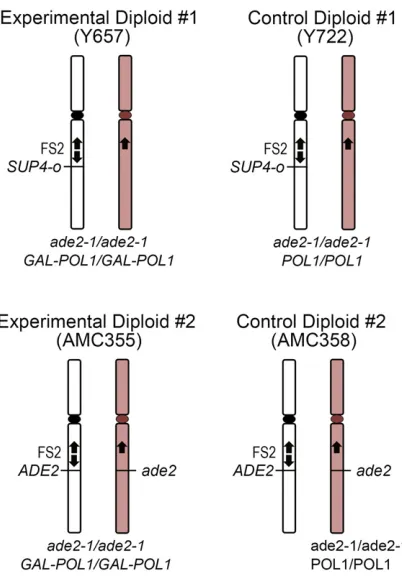
Four diploid strains were used for experiments: Y657, Y722, AMC355, and AMC358 (Figure 1). Each diploid was created by mating an MS71-derived haploid (Kokoskaet al. 2000) with a YJM789-derived haploid (Wei et al. 2007). Diploid Y657 was created by mating haploids Y655 and Y325. Diploid Y722 was created by mating haploids Y651 and AMC273. Diploid AMC355 was created by mating haploids AMC356 and AMC353. Diploid AMC358 was created by mating hap-loids AMC350 and AMC342. Genotypes and construction de-tails are in Supplemental Material,Table S1for MS71-derived haploids andTable S2for YJM789-derived haploids.
Growth media
All yeast strains were maintained at 30°on standard rich media (Guthrie 1991), with the exception that the medium contained 3% raffinose instead of dextrose. Raffinose was used because this carbon source does not affect the GAL10
promoter. Galactose was added to the medium [no galactose, low galactose (0.005%), or high galactose (0.05%)] to con-trol expression of theGAL-POL1construct. Low levels of ga-lactose reduce POL1 expression, which lowers the level of polymeraseain the cell, causing replication stress and insta-bility at fragile site FS2 (Lemoineet al.2005).
Induction of instability at FS2 and screening for LOH events
achieve 150–350 colonies per plate on synthetic complete medium with low adenine and high galactose (0.05%). The synthetic medium was standard (Guthrie 1991) except that it contained 3% raffinose instead of dextrose, and 10 mg/ml adenine (twofold less than standard synthetic medium). A total of 40–60 plates were spread per culture. Replicates of two or three independent cultures were done for each diploid under each condition. After 3 days of growth at 30°, plates were transferred to 4°for 24–48 hr to deepen red color de-velopment in colonies. Colonies were counted and totaled for each diploid in each condition, and all plates were screened for red/white or red/pink sectors. Any event during thefirst or second division at the time the diploid is plated that results in LOH at III170045::SUP4-o in Y657 and Y722, or LOH at III170045::ADE2in AMC355 and AMC358 will produce a sec-tored colony in which the red portion is at least one-fourth of the colony. Thus, each such sectored colony is an independent
event. We isolated a single cell from each half of each sectored colony, purified it, and harvested genomic DNA for analysis.
Initial classification of events resulting in colony sectoring
In Y657 and Y722, sectored colonies result both from point mutations in SUP4-o and from events that cause LOH at
SUP4-o. To distinguish LOH from point mutation, we initially screen the red side of each sectored colony from these strains by PCR using a pair of primers immediately surrounding the site where we insertedSUP4-oon chromosome III (Table S3). WhenSUP4-ois present, a 377-bp product is amplified. When the site is in its native state (lackingSUP4-o), a 130-bp prod-uct is amplified. Experimental diploid #1 and control diploid #1 are hemizygous for theSUP4-oinsertion and both product sizes are produced. Sectored colonies that result from point mutation in SUP4-oremain hemizygous for theSUP4-o in-sertion, therefore PCR on cells from the red side of these types of sectored colonies produces both product sizes. Sectored colonies that result from LOH by chromosome loss, BIR, RCO, or gene conversion have lostSUP4-o; thus PCR on cells from the red side of these types of sectored colonies produces only the 130-bp product size.
Similarly, in AMC355 and AMC358, sectored colonies re-sult both from point mutations in theADE2allele inserted on chromosome III and from events that cause LOH at thisADE2
allele. To distinguish LOH from point mutation, we initially screen the red side of each sectored colony from these by PCR using a pair of primers that produce a 407-bp product when the full-length allele ofADE2is present and a 177-bp product when the 59 deletion allele ofade2 is present (Table S3). Experimental diploid #2 and control diploid #2 are hemi-zygous for the ADE2insertion and both product sizes are produced.
Detailed classification, analysis, and mapping of mitotic LOH events
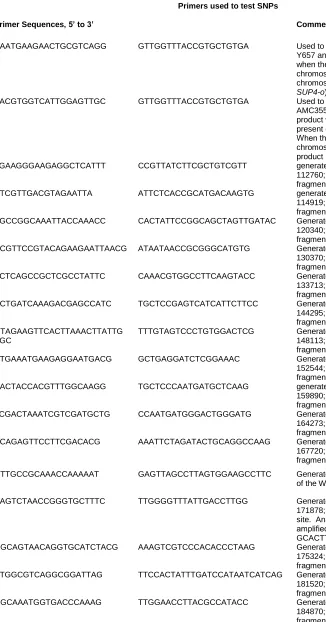
All sectored colonies with a change of zygosity indicating LOH atSUP4-oorADE2on chromosome III were analyzed at ad-ditional polymorphic sites to determine the type and extent of the event responsible for LOH. This testing was done by PCR to amplify polymorphic sites on chromosome III which change a restriction enzyme site. For example, on chromo-some III a single nucleotide polymorphism (SNP) at base 266,045 results in anHpyCH4III site on the YJM789-derived chromosome but not on the other homolog. We amplify the region by PCR, generating a 374-bp product (Table S3). If the site is heterozygous in the cell being examined, digestion of the amplified product withHpyCH4III followed by gel elec-trophoresis reveals three band sizes: the uncut 374-bp prod-uct and the cut 259-bp and 115-bp prodprod-ucts. Primers and diagnostic restriction enzymes for all polymorphic sites tested on chromosome III are inTable S3. SNPs at bases 112,760 and 298,875 were thefirst SNPs analyzed for each sectored colony. SNP 112,760 is on the left arm of chromosome III close to the centromere. Fragile site FS2 and the marker gene, Figure 1 Diploids for analysis of gene-conversion events near fragile site
whetherSUP4-oor ADE2, are on the right arm of chromo-some III. SNP 298,875 is the most distal polymorphic site on the right arm of chromosome III. If these two SNPs remain heterozygous in both the red and white sides of the colony, the sectored colony is classified as a noncrossover gene-conversion event. If both SNPs remain heterozygous in the white side, and both SNPs are homozygous for the YJM789 allele in the red side, the sectored colony is classified as a chromosome loss event. If both SNPs remain heterozygous in the white side, and in the red side SNP 112,760 remains het-erozygous while SNP 298,875 is homozygous for the YJM789 allele; the sectored colony is classified as a BIR event. If SNP 112,750 remains heterozygous on both the red and white sides, and SNP 298,875 is homozygous for the MS71 allele in the white site and homozygous for the JYM789 allele on the red side; the sectored colony is classified as RCO. Sectored colonies that were classified as noncrossover gene-conversion events or RCO events were analyzed using 30 additional poly-morphic sites on the right arm of chromosome III to map the extent of the event (Table S3). Using this mapping informa-tion, the length of gene-conversion tracts was calculated using the same approach as Leeet al.(2009).
Statistical analysis
VassarStats was used to calculate 95% C.I. for the proportion (Newcombe 1998) of each type of mitotic event, for chi-square contingency tables to evaluate the significance of the difference between event frequencies, and fort-tests to compare the distributions of gene-conversion tract lengths.
Data availability
Strains are available upon request. Table S1and Table S2
contain descriptions of all genotypes.Table S3contains pri-mers and diagnostic restriction enzymes for all polymorphic sites tested.
Results
Experimental system for identification and analysis of gene-conversion events near fragile site FS2
We constructed diploids to employ a screening system in which LOH in a mitotic division at the time of plating results in a red/white or red/pink sectored colony (Barbera and Petes 2006; Lee et al.2009). We used this system previously to study RCO, BIR, and chromosome loss stimulated by insta-bility at yeast fragile site FS2 (Rosenet al.2013). Here, we have created diploid strains for the purpose of analyzing gene conversion at FS2 that is unassociated with crossover (Figure 1). All of these diploids are homozygous for theade2-1allele in its native location on chromosome XV. This mutation is an ochre stop codon, and ade2-1yeast is red in color due to buildup of a red intermediate in the adenine biosynthetic pathway. Each experimental diploid is isogenic with its paired control diploid, except that the experimental diploids are homozygous for a construct that places thePOL1gene under control of the GAL10 promoter, while the control diploids
havePOL1under their native promoters. TheGAL-POL1 con-struct enables us to place cells under replication stress, which stimulates instability at FS2. Cells grown in high-galactose medium (0.05%) have 300% of the normal amount ofPol1p, and those in low-galactose medium (0.005%) have 10% of normalPol1plevels (Lemoineet al.2005). All diploids are hemizygous for FS2: one homolog of chromosome III carries the pair of Ty1 elements in inverted orientation that have been characterized previously as fragile site FS2 (Lemoine et al.2005), and the other homolog has a single Ty1 element in this location, in Crick orientation. Experimental diploid #1 and control diploid #1 both are hemizygous for SUP4-o inserted 150 bp centromere-distal to fragile site FS2.SUP4-o is an ochre suppressor transfer RNA (tRNA). In our system, diploids with one copy ofSUP4-oare light pink and those with two copies are white. Experimental diploid #2 and control diploid #2 use theADE2gene instead ofSUP4-oas a marker for screening (Figure 1). Experimental diploids #1 and #2 and control diploids #1 and #2 are isogenic; however rather than
SUP4-o, we inserted ADE2 with its native promoter 150 bp centromere-distal to fragile site FS2. In comparison to the 100-bpSUP4-oinsertion in diploid #1, the ADE2insertion in diploid #2 is2 kb. To avoid differences in recombination resulting from the differing amounts of nonhomologous se-quence inserted, in diploid #2 we inserted anade2allele lack-ing its promoter and lacklack-ing thefirst 36 bp from the 59end at the corresponding location on the YJM789-derived homolog of chromosome III.
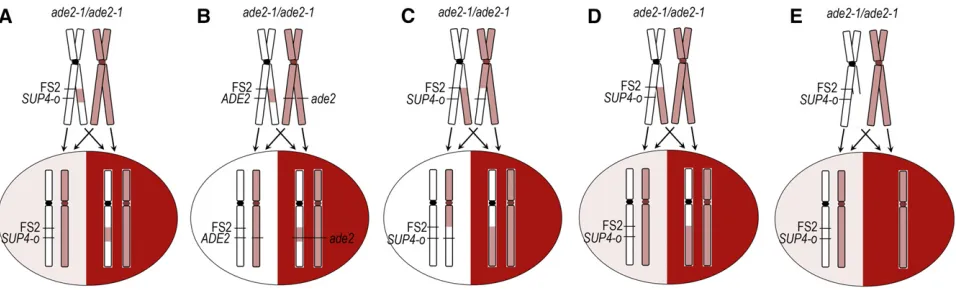
After incubation in either replication-stress or nonstress conditions, cells are plated for single colonies. After growth, plates are screened for red/white or red/pink sectors. Gene-conversion tracts crossing SUP4-oor crossingADE2, which form during a mitotic division at the time of plating, result in a sectored colony (Figure 2). Point mutation, loss of chro-mosome III, and BIR or RCO that cause LOH at SUP4-oor
ADE2in a mitotic division at plating also result in sectoring (Figure 2) (Rosenet al.2013).
Classification of events that result in sectoring
between the homologous chromosomes. Our diploids were constructed by mating a YJM789-derived haploid with a haploid related to S288c; these haploids have0.5% se-quence divergence (Wei et al. 2007). Using SNPs that change a restriction enzyme site, we mapped and classified LOH events through PCR and digested at 32 polymorphic sites on the right arm of chromosome III (Figure 3 and
Table S3) (Rosenet al.2013).
Frequency of gene-conversion events in cells under replication stress
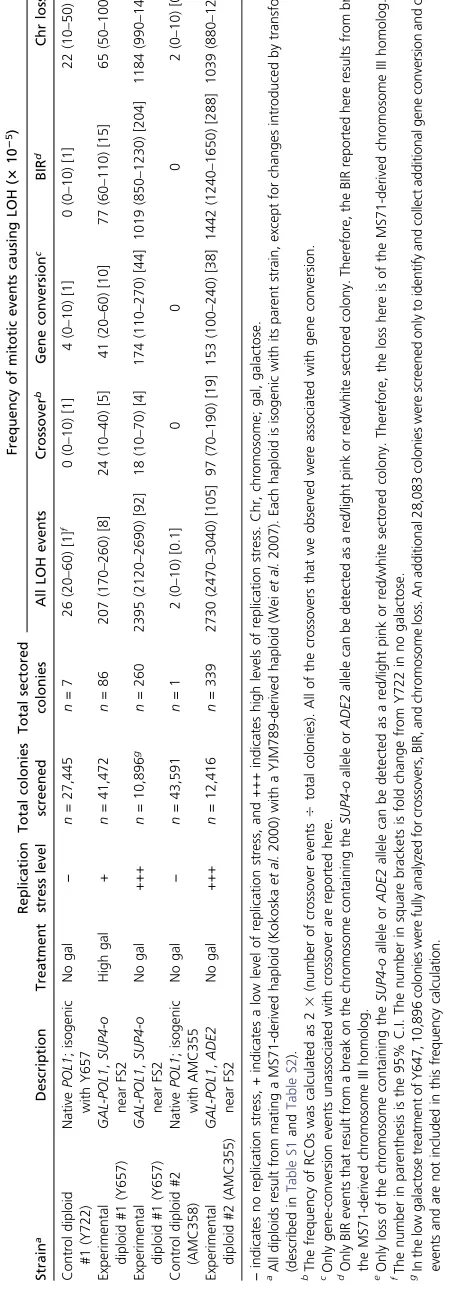
The fragile site FS2 on yeast chromosome III is unstable in cells with low levels of DNAPol1p, the catalytic subunit of polymer-asea(Lemoineet al.2005). Previously, we reported that breaks at FS2 are frequently repaired by homologous recombination resulting in LOH by BIR or RCO; using strains in which the reporter geneSUP4-ois inserted close to the telomere of chro-mosome III, 105 kb centromere-distal of FS2 (Rosen et al. 2013). However, because the placement ofSUP4-oin this sys-tem is far away from FS2, we were not able to detect gene conversions at the fragile site that are unassociated with cross-over. Here, in experimental diploid #1 we have insertedSUP4-o 150-bp centromere-distal to FS2, so that with this marker near-by we are able to detect and evaluate such gene-conversion events. We grew experimental diploid #1 in no galactose (rep-lication stress conditions) to lower the level of DNAPol1pand induce fragile site instability, then screened 10,896 colonies for sectoring. For each strain in each condition, the combined total frequency of LOH was calculated as: (sectored colonies due to BIR + sectors from chromosome loss + sectors from gene conversion unassociated with crossover + 23sectors from RCO)O total colonies screened. RCO sectors were
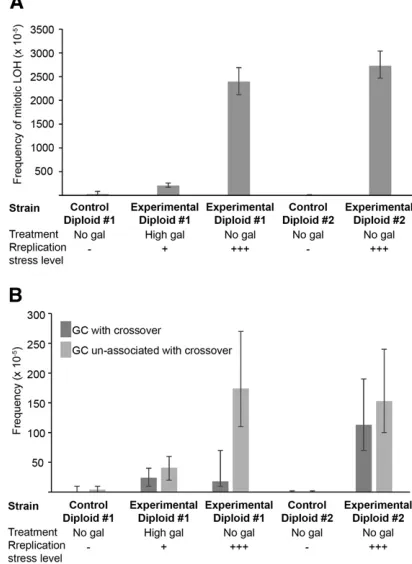
doubled in this calculation because we can only detect cross-overs that segregate both recombinant chromosomes into the same cell; however, the two possible segregation patterns are equally frequent (Chua and Jinks-Robertson 1991). The overall frequency of LOH in experimental diploid #1 in no galactose (replication-stress conditions) in mitosis was 2395 3 1025 events per cell division (95% C.I. 2120–2690) (Figure 4 and Table 1). This frequency is 92-fold higher than the overall frequency of LOH in control diploid #1 in no galactose (P, 0.0001), an isogenic strain that has the native promoter on
observed; indicating that this is a more minor category of events stimulated by fragile site instability compared to the BIR and chromosome loss categories. In strains under repli-cation stress, we observed more conversions unassociated with crossover than crossover-associated conversions (Figure
4 and Table 1). For each strain in each condition, the fre-quency of gene conversion unassociated with crossover was calculated as: total number of sectored colonies observed due to gene conversion unassociated with crossoverOtotal col-onies screened. Gene conversion with crossover frequency was calculated as: (total number of sectored colonies ob-served due to gene conversion with crossover32)Ototal colonies screened.
Locations and characteristics of gene-conversion tracts in cells under replication stress
We mapped and analyzed the locations of all gene-conversion events that were detected (n= 136) using 32 polymorphic sites on the right arm of chromosome III (Figure 5 andTable S3). From experimental diploid #1 under replication stress, there were 54 gene-conversion events (20 detected in the initial experiment, plus 34 collected among another set of Figure 3 Use of SNPs to map the location of mitotic recombination
events. SNPs between the two homologs of chromosome III that alter restriction sites were used to evaluate the type of event responsible for sectoring and to map the location of each event. Experimental diploid #1 is shown. The gray chromosome represents the MS71-derived homolog and the red chromosome represents the YJM789-derived homolog. Cen-tromeres are represented by large ovals and SNP sites by small ovals. FS2 is indicated by yellow bands andSUP4-ois represented by a gray rectan-gle. This strain is homozygous for the ochre-suppressibleade2-1 muta-tion. (A) A BIR event that is stimulated by a lesion at FS2 is shown. The YJM789-derived homolog is used as a template for repair. After chromo-some segregation in mitosis, the light pink cell remains heterozygous at all SNPs, while the red cell is homozygous for the YJM789 form of all SNPs distal to the invasion site. (B) A gene-conversion tract associated with RCO that occurs due to repair of a lesion at FS2 in S or G2phase is shown. The crossover location is indicated by a black X. Transfer of ge-netic information from the YJM789-derived homolog during repair result-ing in 3:1 gene conversion is shown in the yellow box. After chromosome segregation in mitosis, the light pink cell is homozygous for the MS71 version of SNPs distal to the crossover, while the red cell is homozygous for the YJM789 form of SNPs distal to the crossover, and SNPs within the region of gene conversion are homozygous in the red cell but heterozy-gous in the light pink cell. If a crossover occurs at a more centromere-proximal location such that the SUP4-ogene is not included in a 3:1 conversion tract (not shown here), then two copies ofSUP4-ocould be segregated into the same cell during mitosis; resulting in red/white sector-ing instead of red/light pink sectorsector-ing. (C) A noncrossover gene-conversion tract stimulated by a lesion at FS2 in S or G2phase is shown. Transfer of genetic information from the YJM789-derived homolog during repair resulting in 3:1 gene conversion of SNPs shown in the yellow box. After chromosome segregation in mitosis, the SNPs within the region of gene conversion are homozygous in the red cell but heterozygous in the light pink cell. Both the red cell and the light pink cell are heterozygous for SNPs centromere-distal to the gene-conversion tract.
28,083 colonies) and 22 events from this diploid when grown in high galactose. From experimental diploid #2 under rep-lication stress there were 25 gene-conversion events. There was only one gene conversion detected from control diploid #1, and no gene-conversion events were detected from con-trol diploid #2 (Figure 5).
All of the gene-conversion tracts from all strains were 3:1 (similar to the examples in Figure 3), except for one tract. The one unusual tract contained one SNP that was homozygous for the YJM789 form of the SNP in both the red side and the light pink side of the sector, next to a 3:1 region (Figure 5). Hybrid 3:1/4:0 conversion tracts of this type have been re-ported previously and are proposed to result from repair of two double-strand breaks that are generated when a chro-mosome is broken during G1, then replicated during S phase to form two broken chromatids, both of which are repaired during S or G2by homologous recombination (Lee and Petes 2010). In contrast, 3:1 gene-conversion tracts are proposed to result from lesions formed during S phase on one of the two sister chromatids (Lee and Petes 2010). Therefore, the gene-conversion tracts we observed appear to result from lesions during S phase. All but two gene conversions had three copies of the sequence from the YJM789 homolog; in-dicating that they were initiated by a break on the MS71 homolog, which is the homolog containing fragile site FS2 (Nag and Petes 1990; Nickoloff et al. 1999; Merker et al. 2003). All of the crossover events we detected were associated with gene conversion. Of the noncrossover gene-conversion tracts at FS2 in cells under replication stress (no galactose): 42% (n= 27) were unidirectional, with one endpoint at the fragile site FS2 and extending only distally; and 58% (n= 37) were bidirectional, extending on both sides of the fragile site (Figure 5). Unidirectional noncrossover tracts extending only proximal to the fragile site cannot be detected in our system.
Of the 54 gene-conversion tracts collected from experi-mental diploid #1 under replication stress (no galactose), 16 (30%) had one endpoint between the SUP4-o marker inserted at base 170,045 on chromosome III and the next nearest centromere-distal SNP at base 175,324 (Figure 5). Similarly, of the 22 gene-conversion tracts collected from experimental diploid #1 in high galactose, eight (36%) had one endpoint atSUP4-o(Figure 5). The abundance of tracts with one endpoint atSUP4-omay simply result from selection for these events usingSUP4-o, since the shortest tracts that can be detected in our system are those that cross this gene. Alternatively,SUP4-omay be specifically acting as an initiator or terminator of gene-conversion tracts. In yeast, tRNA genes can cause replication fork pausing (Deshpande and Newlon 1996; Dubarryet al.2011), and can act as chromatin silenc-ing barriers or insulators (Simms et al. 2004; Simmset al. 2008). tRNA gene sites are weakly recombinogenic when RNAP III collides with DNA polymerase (de la Loza et al. 2009); and when essential replication genes are downregu-lated, Ty retrotransposons and tRNA genes are frequently found together at the breakpoints of chromosome rearrangements
(Chenget al.2012). To evaluate the potential effect ofSUP4-o either initiating or terminating gene-conversion tracts in our system, we compared these results to experimental diploid #2, in which we replaced theSUP4-omarker on chromosome
III withADE2. There is no statistical difference in the frequency of mitotic gene-conversion tracts detected in experimental dip-loid #2 in no galactose (replication stress) conditions compared to experimental diploid #1 (P = 0.8625), suggesting that
SUP4-o does not initiate gene conversions in our system. In experimental diploid #2 under replication stress (no galac-tose), 8 of the 25 tracts (32%) had one endpoint between the ADE2 marker and the next nearest centromere-distal SNP at base 175,324 (Figure 5). There is no statistical differ-ence between the proportion of tracts with one end atSUP4-o and the proportion of tracts with one end at ADE2 (P = 0.8415), suggesting thatSUP4-odoes not terminate gene con-versions in our system. We also evaluated an additional SNP at base 171,878 and found that 7 of the 24 tracts from experi-mental diploid #1 are homozygous for the YJM789 homolog at this SNP, indicating that these 7 tracts extend beyond this SNP and thus do not have an endpoint atSUP4-o. Therefore, theSUP4-omarker in our experimental system does not impact the extent of gene-conversion tracts, and results from our ex-perimental diploids #1 and #2 can be evaluated jointly when characterizing gene conversion stimulated by FS2 instability.
Length of gene-conversion tracts in cells under replication stress
For each gene conversion, we calculated tract length as the average between the minimum possible size (distance from the
first to last SNP included in the tract) and the maximum possible size (distance between the two nearest outside SNPs). The longest possible tract we can detect is 184 kb, the distance between our
first and last SNPs on the right arm of chromosome III.
In cells under replication stress (no galactose), uni- and bidirectional noncrossover gene-conversion tracts differ sig-nificantly in length. Bidirectional noncrossover tracts, that is, tracts that extend on both sides across the fragile site, have a median length of 40.8 kb and a wide distribution of lengths (interquartile range of 29.2–78.8 kb,n= 37). There are no “hotspots”for the beginning or end of bidirectional tracts; and for each individual tract, the lengths extended to either side of the fragile site are unequal. Unidirectional tracts, that is, tracts that begin at the fragile site FS2 and extend only distally, are significantly shorter with a median length of 3.9 kb and a tighter distribution (interquartile range 3.9– 16.8 kb,n= 27,P,0.0001,t-test assuming unequal sample variances) (Figure 6). Of these 27 unidirectional tracts initi-ated at the fragile site, 17 (63%) were the shortest possible length that can be detected in our system; meaning that these tracts crossed only FS2 and theSUP4-oorADE2marker gene. Crossover-associated gene-conversion tracts in cells under replication stress were also significantly shorter in length than bidirectional noncrossover tracts, with a median length of 11.9 kb (interquartile range 6.2–23.4 kb,P,0.0001,t-test assuming unequal sample variances) (Figure 6).
Ratio of crossover and noncrossover gene conversions
Only RCOs that segregate both recombinant chromosomes into the same cell can be detected in our system. However, the Figure 5 Gene conversions are stimulated by instability at fragile site FS2
during S phase. The MS71-derived homolog of chromosome III is shown in gray and the YJM789-derived homolog of chromosome III is shown in red. SNP markers used to map events are shown bydand
▾
on the chromo-some diagrams.▾
indicates a restriction site exists,dindicates lack of the site. Numbers are the approximate chromosome coordinate in kb. On the chromosome diagrams, ovals represent the centromere and black arrows represent Ty1 elements. The yellow band extending through all parts of thealternate segregation pattern is equally frequent (Chua and Jinks-Robertson 1991). Thus, we make the assumption that the true number of crossover events is double what we detected in our screen. Of the 54 gene-conversion events collected from experimental diploid #1 grown in no galactose (replication-stress conditions), 8 were associated with crossover and 46 were
noncrossover. Thus, 26% of gene conversions were associated with crossover [(832)/(54 + 8)] and 74% were noncrossover. Of the 22 gene conversions from experimental diploid #1 grown in high galactose, 37% were crossover and 63% were noncrossover. Of the 25 gene conversions from experimental diploid #2 in no galactose, 39% were crossover and 61% were noncrossover.
Discussion
Replication stress from low levels of polymerase a causes breaks at the native yeast fragile site FS2, located on the right arm of yeast chromosome III (Lemoineet al.2008). Instabil-ity at FS2 stimulates both RCOs and BIR events during mito-sis (Rosenet al.2013). This study is thefirst to detect and analyze mitotic gene-conversion events at FS2 that are un-associated with crossover. Our key findings are: (1) gene conversion is a relatively minor class of LOH events at FS2, (2) most (78%) of the unidirectional noncrossover tracts ini-tiated at FS2 are the shortest possible length detectable in our screening system, and (3) bidirectional noncrossover tracts that cross FS2 are generally very long. These findings are discussed below.
Types of mitotic LOH stimulated by instability at fragile site FS2
In cells under replication stress resulting from low levels of polymerasea, the most frequent events responsible for mi-totic LOH at fragile site FS2 are chromosome loss and BIR. Our data indicate that gene-conversion events unassociated with crossover account for 6–7% of mitotic LOH events stim-ulated by FS2 instability; and crossover events, both with and without gene conversion, are similarly infrequent. BIR is the homologous recombination repair pathway employed by yeast cells to repair one-end double-strand breaks (Llorente et al.2008). Repair pathways that result in gene conversion, with or without associated crossover, typically require a sec-ond end. The fragile site FS2 consists of a pair of inverted Ty1 elements spaced280 bp apart (Lemoineet al.2005). Under conditions of replication stress resulting from low levels of polymerasea, extended ssDNA on the lagging strand at the replication fork permits intrastrand base pairing between the two Ty1 elements forming a hairpin secondary structure (Fig-ure 7). It is hypothesized that the double-strand breaks that have been observed at FS2 form as a consequence of hairpin cleavage by a nuclease (Lemoine et al.2005; Casperet al. 2009; Rosenet al.2013). Since our data indicate that insta-bility at FS2 stimulates BIR much more than gene conversion, cleavage at the fragile site must typically collapse the repli-cation fork to a one-end double-strand break (Figure 7). The replication origin closest to FS2 isARS 310, which is located 1 kb centromere-proximal to the fragile site. This origin initiates replication relatively early in 90% of cell cycles (Poloumienko et al. 2001). Centromere-distal to FS2, the nearest highly efficient replication origin isARS 315, located 55 kb away; andARS 313, located25 kb distal, initiates Figure 6 Bidirectional noncrossover gene-conversion tracts are longer
replication in only 10% of cell cycles (Poloumienko et al. 2001). Therefore under replication stress, a fork proceeding
from ARS 310 permits hairpin formation on the lagging
strand when it reaches FS2, and cleavage of this hairpin gen-erates a one-end double-strand break (Figure 7).
We propose that replication fork dynamics can explain relative infrequency of gene conversions at FS2. The converg-ing replication fork fromARS 315(or perhapsARS 313) must travel a relatively long distance and the low polymerasea conditions will slow the movement of this fork. Thus after replication fork collapse at FS2, there is likely to be a lag until a converging replication fork reaches the location of the break to form a second end, thus promoting BIR (Mayle et al. 2015). Alternatively, the replication fork from ARS 310 may not collapse but instead proceed, leaving a single-strand gap on the lagging single-strand at the hairpin. In this case, template switching may be used tofill the gap, which results in gene conversion if the homologous chromosome is used as the template (Figure 7) (Carr and Lambert 2013; Rosenet al. 2013; Symingtonet al.2014).
Unidirectional noncrossover gene-conversion tracts at FS2 are short
Gene-conversion tracts are typically reported to result from one of two homologous recombination pathways, either SDSA or canonical DSBR. The SDSA pathway results in only non-crossover events with gene conversion proceeding unidirec-tionally from the break (Figure 7). The DSBR pathway has the potential to result in either crossover or noncrossover events; but in yeast the outcome of DSBR is primarily RCO events, with gene conversion extending bidirectionally from the break (Mitchelet al.2010; Yin and Petes 2014). In the models for these pathways, gene conversion results from mismatch repair of heteroduplex DNA (hDNA), and the unidirectional tracts from SDSA are expected to be shorter than bidirectional tracts from DSBR (Yin and Petes 2014).
The shortest tract that our system has the potential to detect is one that crosses only the marker gene (SUP4-oor
ADE2). No tracts of this type were detected. The next shortest length that is possible to detect is one that crosses the marker gene plus one neighboring polymorphism. The nearest poly-morphism is the Watson-orientation Ty1 of fragile site FS2, located centromere-proximal to the marker gene. We de-tected 17 noncrossover gene-conversion tracts in cells under replication stress (no galactose) that cross only the marker gene and the Watson-orientation Ty1. Thus, for these 17 tracts the initiating lesion is either at the marker gene or at the fragile site. In our comparison of the two experimental strains with different marker genes, we found no statistical difference between the proportion of tracts with one end at
SUP4-oand the proportion of tracts with one end atADE2; thus it is unlikely that either of these marker genes is a hot-spot for initiation or termination of gene-conversion tracts. We assume the 17 tracts that cross only the fragile site and the marker gene are unidirectional tracts that were initiated by a lesion at the fragile site. These tracts could be as short as
161 bp, the distance from FS2 to the edge of the marker gene; or as long as5 kb, the distance from the fragile site to the nearest SNP on the opposite side of the marker gene. Ten additional noncrossover tracts that initiate at FS2 were de-tected, and the median length of these tracts was 18.7 kb. Thus in agreement with models of homologous recombina-tion in the literature, unidirecrecombina-tional gene-conversion tracts are typically shorter than bidirectional tracts. If the replica-tion fork does not collapse at FS2, these unidirecreplica-tional tracts may result from postreplicative template switching to the homologous chromosome to bypass the hairpin on the lag-ging strand (Symingtonet al.2014). The length of the region of bypass would be expected to be constrained to the length of an Okazaki fragment. If the replication fork does collapse, these unidirectional tracts likely result from SDSA, or as explained below, dBIR (Figure 7).
Bidirectional noncrossover gene-conversion tracts at FS2 are very long
Gene-conversion tracts that extend bidirectionally from a break are most often presented as resulting from hDNA formed during canonical DSBR (San Filippoet al.2008; Andersen and Sekelsky 2010; Mitchelet al.2010; Symingtonet al.2014; Yin and Petes 2014). Although DSBR has the potential to result in either crossover or noncrossover events, in yeast the out-come of DBSR is primarily RCO (Mitchel et al. 2010). Therefore, we predicted that bidirectional gene conver-sions at the fragile site would be generally associated with crossovers; however, we observed the reverse—many more bidirectional noncrossover tracts than crossover-associated tracts. We also predicted that bidirectional noncrossover and crossover-associated tracts would have a similar distri-bution of lengths; instead, we observed that bidirectional noncrossover tracts are significantly longer than crossover-associated tracts.
Long mitotic gene-conversion tracts have been suggested to result from template switching during BIR, also called dBIR (Figure 7) (Llorente et al. 2008; Yim et al.2014). Several studies have demonstrated that the invading 39strand during BIR can be displaced and, after displacement, can reinvade at a region of homology and establish a second BIR process (Smithet al.2007; Ruizet al.2009). In the dBIR mechanism, gene conversion results not from hDNA but rather from the amount of DNA synthesis during BIR completed prior to the template switch. Previously we demonstrated that BIR is strongly stimulated in cells under replication stress, and that many of these BIR events are initiated by breaks at FS2 (Rosen et al.2013). BIR events can initiate centromere-proximal to the original break location due to extensive 59to 39end resection at DNA breaks to expose ssDNA (Chunget al. 2010; Symington 2016).
collapse to a one-end break. Of noncrossover gene-conversion tracts at FS2 in cells under replication stress (no galactose), 58% were bidirectional. If all bidirectional noncrossover gene-conversion events we observed are from dBIR, then the
site in cells under replication stress—whether unidirectional or bidirectional—could potentially be attributed to dBIR.
The dBIR events in this study result from template ing to the homologous chromosome III, but template switch-ing to a nonhomologous chromosome is possible if the switch occurs at a dispersed repeated sequence, such as the Ty1 elements at FS2. In our analysis of polymorphic sites on the two homologs of chromosome III, template switching to a nonhomologous chromosome is indistinguishable from typical BIR events that extend to the end of chromosome III. However, by CHEF gel analysis and Southern blotting to determine the sizes of chromosome III in a subset of BIR events, we previously reported that 39% of BIR events initiated at FS2 switch to a nonhomologous template (Rosenet al.2013).
Association of mitotic gene-conversion tracts at FS2 with crossover
The relative frequency of crossover-associated compared to noncrossover gene conversions varies widely in published studies and continues to be a topic of investigation. Since mitotic crossover can result in LOH throughout the region centromere-distal to the crossover, which can be detrimental, it seems logical that noncrossover repair pathways would predominate. This hypothesis has been supported by several studies that found crossover-associated conversions to be approximately one-quarter to one-third of all conversions (Haber and Hearn 1985; Chua and Jinks-Robertson 1991; Inbar and Kupiec 1999; Nickoloffet al.1999; Yin and Petes 2013), but three studies reported that half or nearly half of all conversions were crossover-associated (Aguilera and Klein 1989; Welz-Voegele and Jinks-Robertson 2008; Yim et al. 2014). In this study, among the 79 gene conversions collected from cells grown under replication stress (no galactose), 30% were crossover-associated and 70% were noncrossover-associated. Based on characteristics of the noncrossover gene conversions, we hypothesize that at least half, and perhaps more, of the noncrossover events we observed are due to dBIR. We propose that the differences between studies is attributable to differences in the type and cell cycle timing of the initiating break, resulting in differences in the contri-bution of dBIR and SDSA to the production of noncrossover gene conversions.
Relevance to genomic alterations at human common fragile sites in cancer
Recently, a BIR-like mechanism that repairs damaged repli-cation forks was described in human cells, and this mechanism is dependent on POLD3 (Costantinoet al.2014). Experimen-tal depletion ofPOLD3suppressed changes in copy number in cells under replication stress, and POLD3 was reported to be frequently amplified or overexpressed in tumors (Costantino et al.2014). At an engineered replication fork stalling site in mammalian cells mutant for BRCA1 or BRCA2, a high fre-quency of long-tract gene conversions, similar to the long-tract gene conversions reported here at fragile site FS2, was ob-served (Williset al.2014; Willis and Scully 2016). Replication
difficulty is a hallmark feature of human common fragile sites, and these sites are frequently implicated in genomic alter-ations in tumors (Burrow et al. 2009; Bignell et al. 2010; Ozeri-Galaiet al.2012). These data together with the results presented here suggest that BIR-like mechanisms are likely to be responsible for copy number changes and rearrangements at fragile sites in tumors, and we propose that instability at common fragile sites may also drive LOH in cancer through dBIR-mediated long-tract gene conversion.
Genomic sequencing has revealed that microhomology (5 bp or fewer) is frequently present at the junctions between segments in complex rearrangements in tumors, and preex-isting low-copy repeats are frequently found close to these junctions (Stephenset al.2009; Nik-Zainalet al.2016). Mul-tiple rounds of dissociation and reinvasion of the 39end at short tracts of homology during BIR, termed microhomology-mediated BIR (MM-BIR), has been proposed as a mechanism for generating these complex rearrangements (Ira and Haber 2002; Anand et al. 2014). The mechanisms of BIR and MM-BIR are clearly distinct. BIR requires RAD51and long regions of homology at the 39 end invasion site, while MM-BIR isRAD51-independent, uses very short tracts of ho-mology, and is enhanced by the presence of nearby islands of additional microhomology (Anandet al.2014; Carvalho and Lupski 2016). Recently, it was shown in the yeast model sys-tem that BIR can switch to MM-BIR. The switch occurs when replication during BIR is impaired, and the translesion syn-thesis polymerases z and Rev1p are required for the DNA synthesis initiated at microhomologies (Sakofsky et al. 2015). Given that human common fragile sites are prone to replication difficulties and are enriched in Alu-family repeat sequences (Tsantouliset al.2008) that could serve as islands of microhomology, we speculate that MM-BIR may be a sig-nificant driver of genomic rearrangements at fragile sites. It will be of interest to investigate the role of MM-BIR in repair processes at yeast fragile site FS2. Our system has the poten-tial to identify and evaluate complex genomic rearrange-ments generated by template switching to nonhomologous chromosomes after stimulation of BIR at FS2. Detailed eval-uation of these events, and the effect of mutation inRev1p, polymerasez, and other repair proteins could be analyzed.
In summary, gene conversion causes LOH, and instability at the yeast fragile site FS2 can stimulate repair processes that result in very long gene-conversion tracts. In human cells, LOH is an important contributor to the inactivation of tumor-suppressor genes, and tumor initiation and progression. Greater under-standing of how large regions of LOH are generated is important. The characteristics of very long gene-conversion tracts at FS2 suggest dBIR is a prominent mechanism for repair of lesions at fragile sites. Thus, dBIR is likely to drive common fragile site-stimulated LOH in human tumors.
Acknowledgments
supported by National Institutes of Health grant R15 GM-107841-01 to A.M.C.
Literature Cited
Aguilera, A., and H. L. Klein, 1989 Yeast intrachromosomal re-combination: long gene conversion tracts are preferentially as-sociated with reciprocal exchange and require the RAD1 and RAD3 gene products. Genetics 123: 683–694.
Anand, R. P., O. Tsaponina, P. W. Greenwell, C. S. Lee, W. Duet al., 2014 Chromosome rearrangements via template switching be-tween diverged repeated sequences. Genes Dev. 28: 2394–2406. Andersen, S. L., and J. Sekelsky, 2010 Meioticvs.mitotic recom-bination: two different routes for double-strand break repair: the different functions of meiotic vs. mitotic DSB repair are reflected in different pathway usage and different outcomes. BioEssays 32: 1058–1066.
Barbera, M. A., and T. D. Petes, 2006 Selection and analysis of spontaneous reciprocal mitotic cross-overs in Saccharomyces cerevisiae. Proc. Natl. Acad. Sci. USA 103: 12819–12824. Bester, A. C., M. Roniger, Y. S. Oren, M. M. Im, D. Sarni et al.,
2011 Nucleotide deficiency promotes genomic instability in early stages of cancer development. Cell 145: 435–446. Bignell, G. R., C. D. Greenman, H. Davies, A. P. Butler, S. Edkins
et al., 2010 Signatures of mutation and selection in the cancer genome. Nature 463: 893–898.
Burrow, A. A., L. E. Williams, L. C. Pierce, and Y. H. Wang, 2009 Over half of breakpoints in gene pairs involved in cancer-specific recurrent translocations are mapped to human chromo-somal fragile sites. BMC Genomics 10: 59.
Carr, A. M., and S. Lambert, 2013 Replication stress-induced ge-nome instability: the dark side of replication maintenance by homologous recombination. J. Mol. Biol. 425: 4733–4744. Carvalho, C. M., and J. R. Lupski, 2016 Mechanisms underlying
structural variant formation in genomic disorders. Nat. Rev. Genet. 17: 224–238.
Casper, A. M., P. W. Greenwell, W. Tang, and T. D. Petes, 2009 Chromosome aberrations resulting from double-strand DNA breaks at a naturally occurring yeast fragile site composed of inverted ty elements are independent of Mre11p and Sae2p. Genetics 183: 423–439.
Cheng, E., J. A. Vaisica, J. Ou, A. Baryshnikova, Y. Lu et al., 2012 Genome rearrangements caused by depletion of essen-tial DNA replication proteins in Saccharomyces cerevisiae. Ge-netics 192: 147–160.
Chua, P., and S. Jinks-Robertson, 1991 Segregation of recombi-nant chromatids following mitotic crossing over in yeast. Genet-ics 129: 359–369.
Chung, W. H., Z. Zhu, A. Papusha, A. Malkova, and G. Ira, 2010 Defective resection at DNA double-strand breaks leads to de novo telomere formation and enhances gene targeting. PLoS Genet. 6: e1000948.
Costantino, L., S. K. Sotiriou, J. K. Rantala, S. Magin, E. Mladenov
et al., 2014 Break-induced replication repair of damaged forks induces genomic duplications in human cells. Science 343: 88–91. de la Loza, M. C., R. E. Wellinger, and A. Aguilera, 2009 Stimulation of direct-repeat recombination by RNA polymerase III transcription. DNA Repair (Amst.) 8: 620–626.
Deshpande, A. M., and C. S. Newlon, 1996 DNA replication fork pause sites dependent on transcription. Science 272: 1030–1033. Di Micco, R., M. Fumagalli, A. Cicalese, S. Piccinin, P. Gaspariniet al., 2006 Oncogene-induced senescence is a DNA damage response triggered by DNA hyper-replication. Nature 444: 638–642. Drusco, A., Y. Pekarsky, S. Costinean, A. Antenucci, L. Conti
et al., 2011 Common fragile site tumor suppressor genes
and corresponding mouse models of cancer. J. Biomed. Bio-technol. 2011: 984505.
Dubarry, M., I. Loiodice, C. L. Chen, C. Thermes, and A. Taddei, 2011 Tight protein-DNA interactions favor gene silencing. Genes Dev. 25: 1365–1370.
Durkin, S. G., and T. W. Glover, 2007 Chromosome fragile sites. Annu. Rev. Genet. 41: 169–192.
Glover, T. W., C. Berger, J. Coyle, and B. Echo, 1984 DNA poly-merase alpha inhibition by aphidicolin induces gaps and breaks at common fragile sites in human chromosomes. Hum. Genet. 67: 136–142.
Guirouilh-Barbat, J., S. Lambert, P. Bertrand, and B. S. Lopez, 2014 Is homologous recombination really an error-free pro-cess? Front. Genet. 5: 175.
Guthrie, C. F., and G. R. Fink, 1991 Guide to Yeast Genetics and Molecular Biology(Methods in Enzymology, Vol. 194). Academic Press, San Diego.
Haber, J. E., and M. Hearn, 1985 Rad52-independent mitotic gene conversion in Saccharomyces cerevisiae frequently results in chromosomal loss. Genetics 111: 7–22.
Inbar, O., and M. Kupiec, 1999 Homology search and choice of homologous partner during mitotic recombination. Mol. Cell. Biol. 19: 4134–4142.
Ira, G., and J. E. Haber, 2002 Characterization of RAD51-independent break-induced replication that acts preferentially with short homologous sequences. Mol. Cell. Biol. 22: 6384–6392. Jain, S., N. Sugawara, J. Lydeard, M. Vaze, N. Tanguy Le Gacet al.,
2009 A recombination execution checkpoint regulates the choice of homologous recombination pathway during DNA double-strand break repair. Genes Dev. 23: 291–303.
Kokoska, R. J., L. Stefanovic, J. DeMai, and T. D. Petes, 2000 Increased rates of genomic deletions generated by mu-tations in the yeast gene encoding DNA polymerase delta or by decreases in the cellular levels of DNA polymerase delta. Mol. Cell. Biol. 20: 7490–7504.
Le Tallec, B., S. Koundrioukoff, T. Wilhelm, A. Letessier, O. Brison
et al., 2014 Updating the mechanisms of common fragile site instability: how to reconcile the different views? Cell. Mol. Life Sci. 71: 4489–4494.
Lee, P. S., and T. D. Petes, 2010 Mitotic gene conversion events induced in G1-synchronized yeast cells by gamma rays are sim-ilar to spontaneous conversion events. Proc. Natl. Acad. Sci. USA 107: 7383–7388.
Lee, P. S., P. W. Greenwell, M. Dominska, M. Gawel, M. Hamilton
et al., 2009 Afine-structure map of spontaneous mitotic cross-overs in the yeast Saccharomyces cerevisiae. PLoS Genet. 5: e1000410.
Lemoine, F. J., N. P. Degtyareva, K. Lobachev, and T. D. Petes, 2005 Chromosomal translocations in yeast induced by low levels of DNA polymerase a model for chromosome fragile sites. Cell 120: 587–598.
Lemoine, F. J., N. P. Degtyareva, R. J. Kokoska, and T. D. Petes, 2008 Reduced levels of DNA polymerase delta induce chromo-some fragile site instability in yeast. Mol. Cell. Biol. 28: 5359–5368. Llorente, B., C. E. Smith, and L. S. Symington, 2008 Break-in-duced replication: what is it and what is it for? Cell Cycle 7: 859–864.
Mayle, R., I. M. Campbell, C. R. Beck, Y. Yu, M. Wilson et al., 2015 DNA REPAIR. Mus81 and converging forks limit the mu-tagenicity of replication fork breakage. Science 349: 742–747. Mehta, A., and J. E. Haber, 2014 Sources of DNA double-strand
breaks and models of recombinational DNA repair. Cold Spring Harb. Perspect. Biol. 6: a016428.
Mitchel, K., H. Zhang, C. Welz-Voegele, and S. Jinks-Robertson, 2010 Molecular structures of crossover and noncrossover in-termediates during gap repair in yeast: implications for recom-bination. Mol. Cell 38: 211–222.
Nag, D. K., and T. D. Petes, 1990 Genetic evidence for preferential strand transfer during meiotic recombination in yeast. Genetics 125: 753–761.
Newcombe, R. G., 1998 Two-Sided Confidence Intervals for the Single Proportion: Comparison of Seven Methods. Stat. Med. 17: 857–872.
Nickoloff, J. A., D. B. Sweetser, J. A. Clikeman, G. J. Khalsa, and S. L. Wheeler, 1999 Multiple heterologies increase mitotic dou-ble-strand break-induced allelic gene conversion tract lengths in yeast. Genetics 153: 665–679.
Nik-Zainal, S., H. Davies, J. Staaf, M. Ramakrishna, D. Glodzik
et al., 2016 Landscape of somatic mutations in 560 breast can-cer whole-genome sequences. Nature 534: 47–54.
Ozeri-Galai, E., R. Lebofsky, A. Rahat, A. C. Bester, A. Bensimon
et al., 2011 Failure of origin activation in response to fork stalling leads to chromosomal instability at fragile sites. Mol. Cell 43: 122–131.
Ozeri-Galai, E., A. C. Bester, and B. Kerem, 2012 The complex basis underlying common fragile site instability in cancer. Trends Genet. 28: 295–302.
Paques, F., and J. E. Haber, 1999 Multiple pathways of recombi-nation induced by double-strand breaks in Saccharomyces cer-evisiae. Microbiol. Mol. Biol. Rev. 63: 349–404.
Poloumienko, A., A. Dershowitz, J. De, and C. S. Newlon, 2001 Completion of replication map of Saccharomyces cerevi-siae chromosome III. Mol. Biol. Cell 12: 3317–3327.
Rosen, D. M., E. M. Younkin, S. D. Miller, and A. M. Casper, 2013 Fragile site instability in Saccharomyces cerevisiae causes loss of heterozygosity by mitotic crossovers and break-induced replication. PLoS Genet. 9: e1003817.
Ruiz, J. F., B. Gomez-Gonzalez, and A. Aguilera, 2009 Chromosomal translocations caused by either dependent or pol32-independent triparental break-induced replication. Mol. Cell. Biol. 29: 5441–5454.
Sakofsky, C. J., S. Ayyar, A. K. Deem, W. H. Chung, G. Ira et al., 2015 Translesion Polymerases Drive Microhomology-Mediated Break-Induced Replication Leading to Complex Chromosomal Rearrangements. Mol. Cell 60: 860–872.
San Filippo, J., P. Sung, and H. Klein, 2008 Mechanism of eukary-otic homologous recombination. Annu. Rev. Biochem. 77: 229– 257.
Sarni, D., and B. Kerem, 2016 The complex nature of fragile site plasticity and its importance in cancer. Curr. Opin. Cell Biol. 40: 131–136.
Simms, T. A., E. C. Miller, N. P. Buisson, N. Jambunathan, and D. Donze, 2004 The Saccharomyces cerevisiae TRT2 tRNAThr gene upstream of STE6 is a barrier to repression in MATalpha cells and exerts a potential tRNA position effect in MATa cells. Nucleic Acids Res. 32: 5206–5213.
Simms, T. A., S. L. Dugas, J. C. Gremillion, M. E. Ibos, M. N. Dandurand
et al., 2008 TFIIIC binding sites function as both heterochro-matin barriers and chroheterochro-matin insulators in Saccharomyces cerevisiae. Eukaryot. Cell 7: 2078–2086.
Smith, C. E., B. Llorente, and L. S. Symington, 2007 Template switching during break-induced replication. Nature 447: 102– 105.
Spies, M., and R. Fishel, 2015 Mismatch repair during homolo-gous and homeolohomolo-gous recombination. Cold Spring Harb. Per-spect. Biol. 7: a022657.
Stephens, P. J., D. J. McBride, M. L. Lin, I. Varela, E. D. Pleasance
et al., 2009 Complex landscapes of somatic rearrangement in human breast cancer genomes. Nature 462: 1005–1010. Symington, L. S., 2016 Mechanism and regulation of DNA end
resection in eukaryotes. Crit. Rev. Biochem. Mol. Biol. 51: 195–212.
Symington, L. S., R. Rothstein, and M. Lisby, 2014 Mechanisms and regulation of mitotic recombination in Saccharomyces cer-evisiae. Genetics 198: 795–835.
Tsantoulis, P. K., A. Kotsinas, P. P. Sfikakis, K. Evangelou, M. Side-ridouet al., 2008 Oncogene-induced replication stress prefer-entially targets common fragile sites in preneoplastic lesions. A genome-wide study. Oncogene 27: 3256–3264.
Wang, X., G. Ira, J. A. Tercero, A. M. Holmes, J. F. Diffley et al., 2004 Role of DNA replication proteins in double-strand break-induced recombination in Saccharomyces cerevisiae. Mol. Cell. Biol. 24: 6891–6899.
Wei, W., J. H. McCusker, R. W. Hyman, T. Jones, Y. Ning et al., 2007 Genome sequencing and comparative analysis of Saccha-romyces cerevisiae strain YJM789. Proc. Natl. Acad. Sci. USA 104: 12825–12830.
Welz-Voegele, C., and S. Jinks-Robertson, 2008 Sequence diver-gence impedes crossover more than noncrossover events during mitotic gap repair in yeast. Genetics 179: 1251–1262.
Willis, N. A., and R. Scully, 2016 Spatial separation of replisome arrest sites influences homologous recombination quality at a Tus/Ter-mediated replication fork barrier. Cell Cycle 2: 1–9. Willis, N. A., G. Chandramouly, B. Huang, A. Kwok, C. Follonier
et al., 2014 BRCA1 controls homologous recombination at Tus/Ter-stalled mammalian replication forks. Nature 510: 556–559.
Yim, E., K. E. O’Connell, J. St Charles, and T. D. Petes, 2014 High-resolution mapping of two types of spontaneous mitotic gene conversion events in Saccharomyces cerevisiae. Genetics 198: 181–192.
Yin, Y., and T. D. Petes, 2013 Genome-wide high-resolution map-ping of UV-induced mitotic recombination events in Saccharo-myces cerevisiae. PLoS Genet. 9: e1003894.
Yin, Y., and T. D. Petes, 2014 The role of Exo1p exonuclease in DNA end resection to generate gene conversion tracts in Sac-charomyces cerevisiae. Genetics 197: 1097–1109.
GENETICS
Supporting Information
www.genetics.org/lookup/suppl/doi:10.1534/genetics.116.191205/-/DC1
Remarkably Long-Tract Gene Conversion Induced by
Fragile Site Instability in
Saccharomyces cerevisiae
Shahana A. Chumki, Mikael K. Dunn, Thomas F. Coates, Jeanmarie D. Mishler, Ellen M. Younkin, and Anne M. Casper
TABLE S1
Strain genotypes and constructions for MS71-derived haploids (MATa)
Strain name Relevant genotypea Reference or constructionb
AMC285 (ROSEN et al. 2013) Derivative of MS71a
AMC296 ade2-1 (ROSEN et al. 2013) Derivative of AMC285 with ade2-1 allele
Y649 ade2-1 III170045::pCORE Transformation of AMC296 with KanMX4-URA3 cassette,
pCORE template (STORICI et al. 2001); primers oAC453
(5’TCATCTCGTCCTCAATTTCTAACCAAAATTGGATGATTTT
AGTTC gagctcgttttcgacactgg) and oAC454
(5’TTATTGCATGCTCTTTCGGTGTTAACGTTCAAGCAGCGT
CAGTGA tccttaccattaagttgatc)
Y651 ade2-1 III170045::SUP4-o Transformation of Y649 with SUP4-o allele, genomic DNA
template from strain PSL5 (Lee et al. 2009); primers oAC457
(5’TCATCTCGTCCTCAATTTCTAACCAAAATTGGATGATTTT
AGTTC ggatccggaattcttgaaag) and oAC458
(5’TTATTGCATGCTCTTTCGGTGTTAACGTTCAAGCAGCGT
CAGTGA gatccgggaccggataat)
Y655 ade2-1 III170045::SUP4-o GAL-POL1 Transformation of Y651 with GAL-POL1 allele, genomic DNA
template from strain NPD1 (Lemoine et al. 2005); primers P60
(5’ TTTCTTGTACTGCCTGCAATCTC) and P61 (5’CATTTGCGTAGCGCAGTTTC)
AMC350 ade2-1 III170045::ADE2 Transformation of Y649 with ADE2 allele, genomic DNA
template from strain MS71 (KOKOSKA et al. 2000); primers
oAC618
(5’TCATCTCGTCCTCAATTTCTAACCAAAATTGGATGATTTT AGTTC atcctcggttctgcattgag) and oAC619 (5’
TTATTGCATGCTCTTTCGGTGTTAACGTTCAAGCAGCGTC
AGTGA actcttgttgcatggctacg)
AMC356 ade2-1 III170045::ADE2 GAL-POL1 Transformation of AMC350 with GAL-POL1 allele, genomic
DNA template from strain NPD1 (Lemoine et al. 2005); primers
P60 (5’ TTTCTTGTACTGCCTGCAATCTC) and P61 (5’CATTTGCGTAGCGCAGTTTC)
a
MS71 is a
LEU2
derivative of AMY125 (
ade5-1 leu2-3 trp1-289 ura3-52 his7-2
) (K
OKOSKA
et
al.
2000). Lemoine
et al
(L
EMOINEet al.
2005) and Rosen
et al
(2013) made further alterations
to MS71, resulting in a derivative that is
MATa
can1
Δ
ADE5
III273292::
can1-100 his4::HPH
.
This derivative is named AMC285. All strains in this table are isogenic with this derivative of
b
All transformations and matings were done using standard protocols. For strains constructed
by transformation using PCR fragments to the targeted location, both the template for PCR
amplification and primers are indicated. Primer sequences are shown with upper case letters
corresponding to the targeted genomic regions and lower case letters corresponding to the
selectable marker.
REFERENCES
Kokoska, R. J., L. Stefanovic, J. DeMai and T. D. Petes, 2000 Increased rates of genomic
deletions generated by mutations in the yeast gene encoding DNA polymerase delta or by
decreases in the cellular levels of DNA polymerase delta. Mol Cell Biol 20
:
7490-7504.
Lee, P. S., P. W. Greenwell, M. Dominska, M. Gawel, M. Hamilton et al., 2009 A fine-structure
map of spontaneous mitotic crossovers in the yeast Saccharomyces cerevisiae. PLoS
Genet 5
:
e1000410.
Lemoine, F. J., N. P. Degtyareva, K. Lobachev and T. D. Petes, 2005 Chromosomal
translocations in yeast induced by low levels of DNA polymerase a model for
chromosome fragile sites. Cell 120
:
587-598.
Rosen, D. M., E. M. Younkin, S. D. Miller and A. M. Casper, 2013 Fragile site instability in
Saccharomyces cerevisiae causes loss of heterozygosity by mitotic crossovers and
break-induced replication. PLoS Genet 9
:
e1003817.
TABLE S2
Strain genotypes and constructions for YJM789-derived haploids (MATα)
Strain name Relevant genotypea Reference or constructionb
AMC266 (ROSEN et al. 2013) a
AMC273 ade2-1 (ROSEN et al. 2013) Derivative of AMC266 with ade2-1 allele
Y325 ade2-1 GAL-POL1 (ROSEN et al. 2013) Derivative of AMC273 with GAL-POL
allele
AMC340 ade2-1III170045::pCORE Transformation of AMC273 with KanMX4-URA3 cassette,
pCORE template (STORICI et al. 2001); primers oAC453
(5’TCATCTCGTCCTCAATTTCTAACCAAAATTGGATGATTTT
AGTTC gagctcgttttcgacactgg) and oAC454
(5’TTATTGCATGCTCTTTCGGTGTTAACGTTCAAGCAGCGT
CAGTGA tccttaccattaagttgatc)
AMC342 ade2-1III170045::ade2 Transformation of AMC340 with 5’ truncated ade2 allele,
genomic DNA template from strain MS71 (KOKOSKA et al.
2000); primers oAC618
(5’TCATCTCGTCCTCAATTTCTAACCAAAATTGGATGATTTT AGTTC atcctcggttctgcattgag) and oAC620 (5’
TTATTGCATGCTCTTTCGGTGTTAACGTTCAAGCAGCGTC
AGTGAcaattgggacgtatgattgttg)
AMC353 ade2-1III170045::ade2 GAL-POL1 Transformation of AMC342 with GAL-POL1 allele, genomic
DNA template from strain NPD1(LEMOINE et al. 2005); primers
P60 (5’ TTTCTTGTACTGCCTGCAATCTC) and P61 (5’CATTTGCGTAGCGCAGTTTC)
a
All strains are isogenic with YJM789 (
MAT
ho::hisG lys2 gal2
) (W
EIet al.
2007). Rosen
et al.
(2013) made alterations to YJM789, resulting in a derivative that is
ura3 can1
Δ
trp1
Δ/III313553::
TRP1
III168239::
Ty1
. This derivative is named AMC266. All strains in this
table are isogenic with this derivative of YJM789, except for changes introduced as noted under
“Relevant Genotype”.
b
All transformations and matings were done using standard protocols. For strains constructed
by transformation using PCR fragments to the targeted location, both the template for PCR
amplification and primers are indicated. Primer sequences are shown with upper case letters
corresponding to the targeted genomic regions and lower case letters corresponding to the
REFERENCES
Kokoska, R. J., L. Stefanovic, J. DeMai and T. D. Petes, 2000 Increased rates of genomic
deletions generated by mutations in the yeast gene encoding DNA polymerase delta or by
decreases in the cellular levels of DNA polymerase delta. Mol Cell Biol 20
:
7490-7504.
Lemoine, F. J., N. P. Degtyareva, K. Lobachev and T. D. Petes, 2005 Chromosomal
translocations in yeast induced by low levels of DNA polymerase a model for
chromosome fragile sites. Cell 120
:
587-598.
Rosen, D. M., E. M. Younkin, S. D. Miller and A. M. Casper, 2013 Fragile site instability in
Saccharomyces cerevisiae causes loss of heterozygosity by mitotic crossovers and
break-induced replication. PLoS Genet 9
:
e1003817.
Storici, F., L. K. Lewis and M. A. Resnick, 2001 In vivo site-directed mutagenesis using
oligonucleotides. Nat Biotechnol 19
:
773-776.
TABLE S3
Primers used to test SNPs
Primer Sequences, 5’ to 3’ Comments
CAATGAAGAACTGCGTCAGG GTTGGTTTACCGTGCTGTGA Used to distinguish LOH from point mutation in
Y657 and Y722. Generates a 377 bp product
when the SUP4-o insertion is present on
chromosome III at base 170045. When chromosome III is in its native state (lacking
SUP4-o), a 130 bp product is amplified.
AACGTGGTCATTGGAGTTGC GTTGGTTTACCGTGCTGTGA Used to distinguish LOH from point mutation in
AMC355 and AMC358. Generates a 407 bp
product when the full-length allele of ADE2 is
present on chromosome III at base 170045.
When the 5’ deletion allele of ade2 is present on
chromosome III at base 170045, a 177 bp product is amplified.
TGAAGGGAAGAGGCTCATTT CCGTTATCTTCGCTGTCGTT generates 402 bp product around polymorphic
112760; cuts in SGD with BstBI (285, 117
fragments)
CTCGTTGACGTAGAATTA ATTCTCACCGCATGACAAGTG generates 176 bp product around polymorphic
114919; cuts in YJM789 with HinfI (132, 44
fragments)
AGCCGGCAAATTACCAAACC CACTATTCCGGCAGCTAGTTGATAC Generates 452 bp product around polymorphic
120340; cuts in SGD with HinfI (282, 170
fragments)
CCGTTCCGTACAGAAGAATTAACG ATAATAACCGCGGGCATGTG Generates 422 bp product around polymorphic
130370; cuts in SGD with MspI (236, 186
fragments)
ACTCAGCCGCTCGCCTATTC CAAACGTGGCCTTCAAGTACC Generates 395 bp product around polymorphic
133713; cuts in SGD with BsaHI (274, 121
fragments)
CCTGATCAAAGACGAGCCATC TGCTCCGAGTCATCATTCTTCC Generates 441 bp product around polymorphic
144295; cuts in SGD with NheI (265, 175
fragments) GTAGAAGTTCACTTAAACTTATTG
AGC
TTTGTAGTCCCTGTGGACTCG Generates 370 bp product around polymorphic
148113; cuts in SGD with RsaI (223, 147
fragments)
CTGAAATGAAGAGGAATGACG GCTGAGGATCTCGGAAAC Generates 352 bp product around polymorphic
152544; cuts in YJM789 with AluI (238, 114
fragments)
CACTACCACGTTTGGCAAGG TGCTCCCAATGATGCTCAAG generates 466 bp product around polymorphic
159890; cuts in SGD with BanI (330, 135
fragments)
TCGACTAAATCGTCGATGCTG CCAATGATGGGACTGGGATG Generates 442 bp product around polymorphic
164273; cuts in YJM789 with MspI (288, 154
fragments)
CCAGAGTTCCTTCGACACG AAATTCTAGATACTGCAGGCCAAG Generates 390 bp product around polymorphic
167720; cuts in SGD with HpyCH4III (311, 79
fragments)
GTTGCCGCAAACCAAAAAT GAGTTAGCCTTAGTGGAAGCCTTC Generates 510 bp product only when the 5’ end
of the Watson Ty1 at fragile site FS2 is present
CAGTCTAACCGGGTGCTTTC TTGGGGTTTATTGACCTTGG Generates 453 bp product around polymorphic
171878; this SNP does not change a restriction site. Analysis was carried out by sequencing the amplified product using primer 5’
GCACTTGTTTGATCAGGAAGG
GGCAGTAACAGGTGCATCTACG AAAGTCGTCCCACACCCTAAG Generates 298 bp product around polymorphic
175324; cuts in YJM789 with BanI (192, 106
fragments)
CTGGCGTCAGGCGGATTAG TTCCACTATTTGATCCATAATCATCAG Generates 438 bp product around polymorphic
181520; cuts in SGD with BtsI (257, 181
fragments)
GGCAAATGGTGACCCAAAG TTGGAACCTTACGCCATACC Generates 335 bp product around polymorphic
184870; cuts in YJM789 with MluCI (218, 117
TTCAGCCGGTTCTAGTTCAAGG CCATTGAGAGCCAAACTCCTTC Generates 398 bp product around polymorphic
189048; cuts in SGD with AluI (229, 169
fragments)
TCACGTCGGTACTTACGAAGG CTTTCCACGATTTGAAGACC Generates 351 bp product around polymorphic
193671; cuts in YJM789 with HinfI (229, 122
fragments)
GGGAGGCAACGTTGGAAATC CACCGGTGTATGGCATTGG Generates 364 bp product around polymorphic
195583; cuts in SGD with AluI (215, 149
fragments)
TGCTGAAGTACGTGGTGACG GAACCGCATGGGCAGTTTAC Generates 428 bp product around polymorphic
201157; cuts in SGD with HinfI (250, 178
fragments)
CCTCAAACTCGGATTGTTGC CAAGCCCTGGTTATGGAACG Generates 421 bp product around polymorphic
204526; cuts in SGD with HinfI (264, 157
fragments)
ACTGACGCAGTGAACGCTTG CAGGAATTCTTCTCGACGATATTC Generates 332 bp product around polymorphic
207530; cuts in SGD with HinfI (255, 77
fragments)
TGGTCGAACCCGTGTACTTG TGAACAACCACCTGCGTGAG Generates 423 bp product around polymorphic
211768; cuts in SGD with HinfI (306, 117
fragments)
TAAACCGGTCGGGACCTATG AGACAGAACCGGTCCAGCAG Generates 369 bp product around polymorphic
223672; cuts in YJM789 with DpnII (202, 167
fragments)
TTGGCAACTAACGGAACTAAGG CCGCGCAGCCGAATAAAC Generates 446 bp product around polymorphic
225410; cuts in YJM789 with HaeIII (255, 191
fragments)
CCCGTCTTAACACCTTGTGG CATGGATCTTTTGGCAAGTTTTC Generates 351 bp product around polymorphic
231854; cuts in SGD with NlaIII (248, 103
fragments)
CCCTTCAATATTTGTGGATTCTG TGCTTCTGAATCAATCCCTTC Generates 369bp product around polymorphic
233758; cuts in SGD with HpyCH4III (95, 274
fragments)
CGTATCGGTCCTTAAAAGTCAGC TTTCTCTTGCCTTGGTACCTTATG Generates 355 bp product around polymorphic
246475; cuts in YJM789 with HinfI (233, 100
fragments)
TTGCTCTTCAGGCGACAAATC ACAGCCAATCTTGTCGATGC Generates 364 bp product around polymorphic
252005; cuts in SGD with HinfI (207, 157
fragments)
GAGCATCGGGAACAGACTGG CCACTTTGCCTGTGGTGTCC Generates 429 bp product around polymorphic
261761; cuts in YJM789 with RsaI (252, 177
fragments)
GGCTAAGGAGGACCCACGTC CTGAAGCGGCCAATCCTTC Generates 374 bp product around polymorphic
266045; cuts in YJM789 with HpyCH4III (259,
115 fragments)
CCGCATACGGTAAGGACAGC GCAGTTGTTGCTGCTCAAACG Generates 466 bp product around polymorphic
289633; cuts in YJM789 with MspI (284, 182
fragments)
ACGTCTGCGGCTGGTTGAC CCTACGGTCTTCCGCGTTG Generates 353 bp product around polymorphic
298875; cuts in YJM789 with RsaI (226, 127