ABSTRACT
JIANG, LIEWEN. Methods for Interquantile Shrinkage and Variable Selection in Linear Regression Models. (Under the direction of Huixia Wang and Howard Bondell.)
Conventional research on quantile regression often focuses on fitting the regression
model at different quantiles separately. However, in situations where the quantile
coeffi-cients share some common features, joint modeling of multiple quantiles to accommodate
the commonality often leads to more efficient estimation. One example of common
fea-tures is that a predictor may have a constant effect over one region of the quantile levels
but varying effects in other regions. To automatically perform estimation and detection of
the interquantile commonality, we develop two penalization methods. When the quantile
slope coefficients indeed do not change across quantile levels, the proposed methods will
shrink the slopes towards constant and thus improve the estimation efficiency.
Further-more, if the slope coefficients for some predictors are not significant at certain quantile
levels, or more extremely, over all quantile levels, additional penalization is included to
achieve the variable selection purpose. We establish the oracle properties of the proposed
methods. Through numerical investigations, we demonstrate that the proposed
meth-ods lead to estimations with competitive or higher efficiency than the standard quantile
©Copyright 2012 by Liewen Jiang
Methods for Interquantile Shrinkage and Variable Selection in Linear Regression Models
by Liewen Jiang
A dissertation submitted to the Graduate Faculty of North Carolina State University
in partial fulfillment of the requirements for the Degree of
Doctor of Philosophy
Statistics
Raleigh, North Carolina
2012
APPROVED BY:
Wenbin Lu Yichao Wu
Huixia Wang
Co-chair of Advisory Committee
Howard Bondell
DEDICATION
BIOGRAPHY
Liewen Jiang was born on July 3rd, 1985 in Shangyu, China. Shangyu is a beautiful
coastal city which lays on the mouth of the Hangzhou Wan River. In 2007, Ms. Jiang
graduated with a Bachelors degree in statistics from Sun Yat-sen University, Guangzhou,
China. Upon graduating from Sun Yat-sen University, Ms. Jiang was granted a full
schol-arship to North Carolina State University to earn her Doctorate in statistics. The focus
of Ms. Jiang’s research was directed on the interquantile shrinkage and variable selection
in linear quantile regression models. Along this academic journey, Ms. Jiang earned her
Master degree in 2009 and is expected to graduate with her Doctorate in the Summer of
2012.
During graduate school, Ms. Jiang had the opportunity to participate in two
sum-mer internships. In 2010, she spent three months in Burlington, Vermont at Precision
Bioassay Inc., where she worked closely with Dr. David Lansky and contributed herself
to developing the software package on analyzing bioassay data. The summer of 2011
of-fered Ms. Jiang an incredible internship at Amgen Inc. located in Seattle, Washington.
She worked on mining historical rat data to predict liver toxicity. During this internship,
she maintained close collaborations with toxicologists and biostatisticians, and received
ACKNOWLEDGEMENTS
First and foremost, I would like to express my deep appreciation to my advisors Dr. Huixia
(Judy) Wang and Dr. Howard Bondell. Without their patient and effective guidance,
this thesis would not exist. I would also like to thank my committee memebers: Dr.s
Wenbin Lu, Yichao Wu and Khaled Harfoush. Their valuable advices and comments
helped strengthen this thesis. I also want to thank our fantastic Directors of Graduate
Program (GDPs) in the department of statistics: Dr.s Sujit K. Ghosh, John Monahan,
Pam Arroway, and Jacqueline Hughes-Oliver, for helping me out during my stay in the
graduate program.
My appreciation also goes to Dr. David Lansky, my supervisor at Precision Bioassay
Inc., and Dr.s Cheng Su and Yudong He, my mentors at Amgen Inc. They offered me
great opportunities to gain some valuable industrial experience even before I start my
career.
I would also like to thank all my friends. We shared many great moments in the
graduate school, and with their supports and encouragements, I was able to go through
many difficult situations. I certainly hope that we can maintain close friendship in the
future.
Last but not the least, I would like to show my deepest appreciation to my parents.
Without their endless love and support, I would never get to this stage. Being their child
TABLE OF CONTENTS
List of Tables . . . vii
List of Figures . . . ix
Chapter 1 Introduction . . . 1
1.1 Quantile Regression . . . 1
1.2 Hypothesis Tests in Quantile Regression . . . 4
1.3 Variable Selection . . . 6
Chapter 2 Interquantile Shrinkage in Regression Models . . . 12
2.1 Introduction . . . 12
2.2 Proposed Method . . . 15
2.2.1 Model Setup . . . 15
2.2.2 Penalized Joint Quantile Estimators . . . 17
2.2.3 Computations . . . 18
2.3 Asymptotic Properties . . . 19
2.3.1 Fused Adaptive LASSO Estimator . . . 20
2.3.2 Fused Adaptive Sup-norm Estimator . . . 21
2.4 Simulation Study . . . 22
2.4.1 The Comparison of Different Group-wise Weights in FAS . . . 29
2.5 Real Data Study . . . 33
2.6 Theoretical Proof . . . 40
Chapter 3 Non-crossing Quantile Estimation . . . 47
3.1 Introduction . . . 47
3.2 Non-crossing Constraints . . . 48
3.3 Simulation Studies . . . 50
3.4 Real Data Revisited . . . 52
Chapter 4 Variable Selection in Joint Quantile Regression Models . . . 55
4.1 Introduction . . . 55
4.2 FAL Variable Selection Estimator . . . 57
4.2.1 Proposed Method . . . 57
4.2.2 Oracle Estimator . . . 58
4.2.3 VFAL Estimator . . . 60
4.3 FAS Variable Selection Estimator . . . 60
4.4 Computations . . . 63
4.5 Simulation Study . . . 65
4.7 Theoretical Proof . . . 75
Chapter 5 Discussions and Future Work . . . 81
5.1 Weighted Loss Function . . . 82
5.2 Nonparametric Quantile Regression . . . 84
LIST OF TABLES
Table 2.1 The MISE and ORACLE proportions of different methods in Ex-ample 2.1. . . 24 Table 2.2 Percentage of correctly identifying dk = β(τk)−β(τk−1) over 500
simulations in Examples 2.1-2.3. . . 27 Table 2.3 The MISE and ORACLE proportion of different methods in
Exam-ple 2.4 withγ = 2 and γ = 0, respectively. . . 28 Table 2.4 True Proportion of True Positive (TP) for each interquantile
differ-encedk,l in Example 2.4 withγ = 2 andγ = 0, respectively. The
in-terquantile slope differencesdk,l =βk,l−βk−1,l, l= 1,2, k = 2, . . . ,9.
For γ = 2, the true coefficients dk,1 = 0, but dk,2 6= 0 for all k. For γ = 0, dk,l = 0 for all k and l. . . 29
Table 2.5 The MISE and ORACLE of FAS by adopting different group-wise weights in Example 2.4 with γ = 0 andγ = 2, respectively. . . 32 Table 2.6 Estimated quantile slope coefficients for economic growth data by
FAL. The tuning parameter is selected by AIC. Neighboring esti-mates with underlines beneath are identical. . . 36 Table 2.7 Estimated quantile slope coefficients for economic growth data by
FAS. The tuning parameter is selected by BIC. Neighboring esti-mates with underlines beneath are identical. . . 37
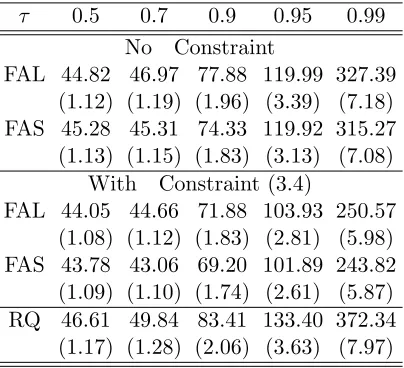
Table 3.1 100×MISE (100×s.e.) of FAL and FAS without and with noncross-ing constraints in Example 3.1 with p = 2 and γ = 2, where the quantile slope coefficients for the 1st predictor are constant, but vary across quantiles for the 2nd predictor. . . 52 Table 3.2 100×MISE (100×s.e.) of FAL and FAS with and without
noncross-ing constraint in Example 3.2 with p = 6, where the slope coeffi-cients corresponding tox3. . . x6 vary across quantiles, but the slope coefficients forx1 and x2 are constant. . . 53 Table 3.3 Average prediction errors with and without non-crossing constraints
for economic growth data. The values in the paretheses are standard errors. . . 53
Table 4.1 The performance of VAL, VFAL, VAS and VFAS methods in 6-dimensional case, where β6(τ) = 2 + Φ−1(τ) vary with τ, β3(τ) = β4(τ) = β5(τ) = 0, and β1(τ) =β2(τ) = 1. . . 69 Table 4.2 MISE of VAL, VFAL, VAS and VFAS methods in 6-dimensional case
Table 4.3 Estimated quantile slope coefficients for economic growth data by using VFAL and VFAS methods, respectively. The tuning parameter is selected by AIC. . . 72 Table 4.4 Estimated quantile slope coefficients for economic growth data by
using VFAL and VFAS methods. The tuning parameter is selected by BIC. . . 73 Table 4.5 Prediction Errors (PE) by using both VFAL and VFAS methods
LIST OF FIGURES
Figure 2.1 Estimated quantile coefficients for the first 9 covariates (intercept is not included) from RQ (solid line), FAL (dashed line with dots) and FAS (dashed line with stars). X-axis is quantile levels. Shaded areas are the 90% pointwise confidence bands from the inverse rank method. . . 38 Figure 2.2 Estimated quantile coefficients for the rest 4 covariates (intercept
is not included) from RQ (solid line), FAL (dashed line with dots) and FAS (dashed line with stars). X-axis is quantile levels. Shaded areas are the 90% pointwise confidence bands from the inverse rank method. . . 39
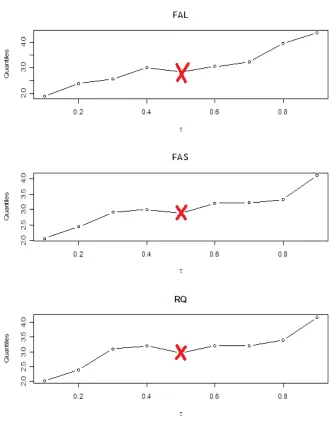
Figure 3.1 Estimated conditional quantiles of GDP growth given the predic-tors having the same characteristics as the ones for Zimbabwe in period 1965-75. The upper plot is for unconstrained FAL, the mid-dle one is for unconstrained FAS, and the lower one is for uncon-strained RQ. Y-axis is the estimated quantiles. Specially, the 0.4th conditional quantile is estimated larger than the 0.5th quantile for
all the three methods, indicating that the unconstrained FAL, FAS and RQ methods suffer from the quantile crossing issue. . . 54
Chapter 1
Introduction
1.1
Quantile Regression
Regression is a core method in statistics. Traditional regression analysis focuses on the
mean, which explores the impact of explanatory variables (predictors) on the mean of
the dependent variable (response). A standard approach in estimating the mean
regres-sion function is Ordinary Least Squares (OLS), in which the unknown parameters are
estimated by minimizing the sum of squared errors. More explicitly, consider a linear
regression model
yi =xiTβ+i, i= 1. . . n,
where β= (β1, . . . , βp)T ∈Rp, xi ∈Rp is the design vector and {i}ni=1 are independent random errors with mean zero. The OLS estimate of β is obtained by minimizing
n
X
i=1
(yi−xiTβ)2.
real applications, heavy-tailed response distributions frequently occur, making the
condi-tional mean regression unstable because it is highly influenced by outliers. An alternative
method is the median regression, which describes the central location of the response
dis-tribution, and is robust to outliers. The Least Absolute Deviation (LAD) method, which
minimizes the sum of absolute errors
n
X
i=1
|yi−xiTβ|,
is used to estimate the conditional median regression function. Secondly, the conditional
mean regression can not provide information about the tail behaviors of the response
distribution without strict parametric assumptions. For instance, the tax-policy study
focuses more on the rich, say, the top 4% of the population, instead of on the mean [27].
Koenker and Bassett (1978) [15] introduced Quantile Regression (QR), a valuable
al-ternative to the ordinary least squares. Quantile regression can automatically capture the
change in any conditional quantile of the response associated with the change in
covari-ates. Therefore, it is more flexible for assessing the relationship between the predictors
and the response. Consider a linear quantile regression model
yi =xTi β(τ) +i,
where i are independent random errors whose τth conditional quantile given xi equals
zero. The τth linear conditional quantile regression model is
Qτ(x) = xTβ(τ), (1.1)
estimate the conditional mean regression function, the τth conditional quantile function
can be estimated by minimizing the sum of asymmetric absolute errors
n
X
i=1
ρτ(yi−xiTβ), (1.2)
where ρτ(u) = u(τ −I(u < 0)) is the so-called check function. At τ = 0.5, the quantile
regression reduces to the least absolute deviation regression.
Quantile regression has attracted enormous attention in various areas since its
in-troduction. Successful applications of quantile regression include the studies of market
returns [3] , risk modeling [6], survival outcomes [17], agricultural land prices [20],
pollu-tion data [23], growth chart [33], microarray data [31], and so forth.
In general, regression at multiple quantiles provides more comprehensive statistical
views than single quantile regression. The standard approach of regression at multiple
quantiles is to fit the quantile regression model at each quantile separately. However, in
applications where the quantile coefficients enjoy some common features across
quan-tile levels, joint modeling at multiple quanquan-tiles can lead to more efficient estimation as
illustrated in Zou and Yuan (2008)[42]. One special case is the regression model with
in-dependent and identically distributed (i.i.d.) errors so that the quantile slope coefficients are constant across all quantile levels. Under this assumption, Zou and Yuan (2008)[40]
proposed the Composite Quantile Regression (CQR) method by combining the objective
functions at multiple quantiles to estimate the common slopes. They showed that for
models withi.i.d. errors, the composite estimator is more efficient than the conventional estimator obtained at a single quantile level. However, in practice, thei.i.d.error assump-tion is restrictive and needs to be verified. It is likely that the quantile slope coefficients
model at multiple quantiles, the common structure of quantile slopes has to be
deter-mined. One way to identify the commonality of quantile slopes at multiple quantile levels
is through hypothesis testing. In Section 1.2, we describe the Wald-type test based on
direct estimation of the asymptotic covariance matrix of quantile coefficient estimates at
multiple quantiles.
1.2
Hypothesis Tests in Quantile Regression
Suppose we are interested inKconditional quantile functions with quantile levelsτ1, . . . , τK.
Assume the linear quantile regression model (1.2), we consider a general linear hypothesis
H0 :Rβ=γ,
where β = (βT(τ1), . . . ,βT(τk))T is a pK×1 parameter vector of quantile slope
coeffi-cients andβ(τj)∈Rp forj = 1, . . . , K. The pre-specifiedq×(pK) matrixRhas full rows,
and γ is a q×1 hypothetical vector. For example, suppose we are interested in testing the equality of quantile slopes across quantile levels τ1, . . . , τK, that is, testing the null
hypothesis H0 : β(τ1) = β(τ2) = . . .= β(τK), it is equivalent to testing H0 :Rβ = γq,
where
R=
Ip −Ip 0 0 . . . 0
0 Ip −Ip 0 . . . 0
.. .
0 0 . . . 0 Ip −Ip
,
The Wald-type test statistic is constructed as
Tn =n(Rβˆ −γ)T(RVnRT)−1(Rβˆ −γ),
Koenker and Bassett (1982)[16] have shown that under H0, the test statistic Tn
asymp-totically follows χ2
q distribution. Here, Vn is the pK×pK asymptotic covariance matrix
of √nβˆ. Specifically, Vn= (Vn(i, j), i, j = 1, . . . , pK) has the sandwich form [9], with
Vn(i, j) = (τi∧τj −τiτj)Hn(τi)−1JnHn(τj)−1,
where
Jn=n−1 n
X
i=1
xixiT
and
Hn(τ) = lim n→∞n
−1
n
X
i=1
xixiTfi{ξi(τ)},
where ξi(τ) = xTiβ(τ) is the τth conditional quantile of yi given xi and fi{ξi(τ)} is the
conditional density of yi, evaluated at the τth conditional quantile ξi(τ) [9].
There are several approaches proposed to estimate the matrix Hn. Hendrickes and
Koenker (1991)[8] showed that by assuming the τth conditional quantile function of y given xis linear fort ∈[τ−hn, τ +hn], the parameters β(τ+hn) andβ(τ−hn) can be
consistently estimated, and the density fi{ξi(τ)} in Hn(τ) can be estimated by
ˆ
fi{ξi(τ)}=
2hn xT
i {βˆ(τ+hn)−βˆ(τ−hn)}
.
A potential problem is that the estimated conditional quantiles may cross, that is,
xT
the estimated density function ˆfi{ξi(τ)}is not guaranteed. Hendricks and Koenker(1991)
[8] suggested
ˆ
fi+ = max
0, 2hn di−
to replace the estimate ˆfi, where di =xTi {βˆ(τ +hn)−βˆ(τ−hn)}, and >0 is a small
tolerance parameter with the purpose of avoiding zero denominators in some special
cases.
Powell et al. (1991)[25] proposed an alternative kernel estimation approach to
ap-proximate the matrix Hn, formulated as
ˆ
Hn(τ) = (nhn)−1
X
i
KN{ˆui(τ)/hn}xixTi ,
where ˆui(τ) = yi−xTi βˆ(τ),hnis the bandwidth satisfyinghn →0 andn1/2hn → ∞. The
notation KN(·) is for the kernel function. If the bandwidth hn and the kernel function
KN(·) are chosen appropriately, under certain conditions, Powell et al. (1991)[25] shows that ˆHn(τ)−Hn(τ)→0 in probability.
1.3
Variable Selection
Variable selection is very important in model building. In practice, it is common to
in-clude a large number of predictors at the initial stage of modeling in order to attenuate
the possible estimation biases. However, keeping too many predictors, especially the
irrel-evant ones in the model will make the interpretation difficult and decrease the prediction
accuracy. Hence, it is desirable to select simpler models containing only important
pre-dictors.
selection is a classic variable selection method. However, subset selection is a discrete
process with predictors being either in or out of the model, which lacks theoretical
prop-erties and model stability. It is possible that a small change in data will result in a very
different model by using subset selection.
As a remedy, penalization has become a popular tool for automatic estimation and
variable selection over the past decades, as it enjoys the favorable properties of both
subset selection and ridge regression. Various penalization methods have been introduced
in the literature for different selection purposes. For example, Least Absolute Shrinkage
and Selection Operator (LASSO), proposed by Tibshirani (1996)[29], penalizes the sum
of absolute values of the coefficients (L1-penalty). Specifically, the lasso estimate ˆβLASSO
is defined by
ˆ
βLASSO = arg min
β
n
X
i=1
(yi−xTi β)
2+λ
p
X
j=1 |βj|,
where λ ≥ 0 is a tuning parameter that controls the degree of shrinkage. If λ is large enough, all slopes βj for j = 1. . . p will be shrunk to exactly 0. On the other hand, if
λ= 0, no shrinkage will be imposed on the coefficients and the LASSO estimator reduces to ordinary least squares estimator.
Fan and Li (2001)[5] proposed another penalization method called the Smoothly
Clipped Absolute Deviation (SCAD), which is a nonconcave penalty and defined through
its first order derivative. The SCAD estimate ˆβSCAD is defined as
ˆ
βSCAD = arg min
β
n
X
i=1
(yi−xTi β)
2 +
p
X
j=1
pλ(βj),
where p0λ(βj) = λ{I(βj ≤ λ) +
(aλ−βj)+
(a−1)λ I(βj > λ)} is the first order derivative of pλ(βj),
that SCAD estimator enjoys the following good properties:
(i) unbiasedness: when the true unknown parameter is large, the corresponding
esti-mator is nearly unbiased;
(ii) sparsity: the small estimated coefficients are automatically set to zero in order to
improve model interpretability;
(iii) continuity: the resulting estimator is continuous to avoid model instability.
Zou (2006)[39] proposed the Adaptive LASSO (ALASSO) penalization method by
including adaptive weights in the L1-penalty. The ALASSO estimate ˆβALASSO is defined by
ˆ
βALASSO = arg min
β
n
X
i=1
(yi−xTi β)
2+λ
p
X
j=1 ˜ wj|βj|,
where ˜wj are adaptive weights controlling the shrinkage speeds for various components
βj, j = 1, . . . , p. If the weights are selected appropriately, for example, let ˜wj = (|β˜j|)−r,
where ˜βj are some consistent initial estimators and r > 0 is a constant, the adaptive
LASSO estimator possesses the oracle properties.
In some circumstances, instead of selecting individual variables, we might be interested
in selecting important explanatory factors, each of which consists of a group of input
varibles. For example, in the multifactor analysis-of-variance (ANOVA), each factor tends
to have several levels, which can be expressed by a group of dummy variables. Thus,
selecting the main effects and interactions essentially becomes selecting the important
groups of variables (factors). Suppose we consider a regression model with J factors
Y =
J
X
j=1
Xjβj+,
where Y ∈Rn,βj = (βj1, . . . , βjpj)
T is ap
and ∈Rn. To select variables Xj with zero βj, Yuan and Lin (2006)[36] proposed the
Group LASSO (GLASSO) penalized estimator
ˆ
βGLASSO = arg min
β kY −
J
X
j=1
Xjβjk
2+λ
J
X
j=1
kβjkKj,
wherek·k2 is theL
2-norm, andkβjkKj = (β
T
jKjβj)1/2, provided that the kernel matrices K1 ∈ Rpj×pj, . . . ,KJ ∈ Rpj×pj are positive definite matrices. In GLASSO, the penalty
function is between the L1-penalty in LASSO andL2-penalty in ridge regression. Hence, it encourages the sparsity in factors, but not in individual variables.
For selecting important factors in classification problems, Zou and Yuan (2008)[41]
proposed a F∞-norm penalization, where the penalty function becomes
J
X
j=1
kβjk∞ =
J
X
j=1
max{|βj1|, . . . ,|βjpj|}.
When pj = 1 for all j, the F∞ reduces to the L1-penalty. Unlike LASSO penalty that leads to selection of individual variables,F∞-norm encourages groupwise selection. If the parameter λ is chosen appropriately, some βj will be shrunk to exactly zero as a whole group, that is, βj1 =. . .=βjpj = 0 for some j.
The aforementioned penalization methods are used for selecting important variables
or factors to achieve sparse models. Some other penalization approaches are designed for
smoothing and selecting variables simultaneously. Tibshirani et al. (2005)[30] introduced
Fused LASSO (FLASSO) approach, which penalizes theL1-norm of both the coefficients and their successive differences. The FLASSO estimator is defined as
ˆ
βFLASSO = arg min
β
n
X
i=1
(yi−xTiβ)
2 +λ1
p
X
j=1
|βj|+λ2 p
X
j=2
where λ1 ≥ 0 and λ2 ≥ 0 are two tuning parameters controlling the sparsity and the smoothness of coefficients. Ifλ2 is large enough, the regression coefficients will be shrunk to piecewise constant. The fused LASSO approach is used in applications where the
predictors are ordered in some natural ways, for instance, in Comparative Genomic
Hy-bridization (CGH) studies [21, 32].
Penalization ideas in linear mean regression models can be extended to quantile
re-gression models, except that we use the quantile loss function (1.2) instead of the squared
sum of residuals. Koenker (1984)[13] employed L1-penalty to shrink random subject ef-fects towards constants in studying conditional quantiles of longitudinal data. Li and
Zhu (2008)[22] studied L1-norm quantile regression and computed the entire solution path for quantile slopes. Wu and Liu (2009)[35] further discussed SCAD and adaptive
LASSO methods in quantile regression and demonstrated their oracle properties. Zou
and Yuan (2008)[41] adopted F∞-norm penalty to select a common subset of covariates when multiple conditional quantiles are modeled simultaneously, that is, covariates can
be excluded from all quantile regression models. In applications, Li and Zhu (2007)[21]
analyzed the quantiles of the CGH data using fused quantile regression, where the changes
in adjacent clones are penalized, adjusted by the distance between clones. Wang and Hu
(2010)[32] adopted fused adaptive LASSO to accommodate the spatial dependence in
studying multiple samples from two different groups. In Chapter 2, we adopt the fusion
idea to shrink the differences of quantile slopes at two adjacent quantile levels towards
zero. As a consequence, the quantile regions with constant quantile slopes can be
auto-matically identified and all coefficients can be estimated simultaneously. We propose two
types of fusion penalties in multiple quantiles regression model: fused LASSO and fused
sup-norm, along with their adaptively weighted versions, and investigate the asymptotic
quan-tile crossing issue. We estimate the quanquan-tile coefficients simultaneously, subject to some
linear non-crossing constraints. Consequently, the estimated quantiles will be
monoton-ically non-decreasing with respect to quantile levels. In Chapter 4, we adopt the fused
idea by including the additional penalty on quantile coefficients to achieve the variable
selection purpose. Two fused penalization methods in multiple quantile regression model
are proposed: fused adaptive LASSO variable selection and fused adaptive sup-norm
variable selection. We further investigate the asymptotic and numerical properties of the
Chapter 2
Interquantile Shrinkage in
Regression Models
2.1
Introduction
Quantile regression has attracted an increasing amount of attention after being
intro-duced by Koenker and Bassett (1978)[15]. One major advantage of quantile regression
over classical mean regression is its flexibility in assessing the effect of predictors on
dif-ferent locations of the response distribution. Regression at multiple quantiles provides
more comprehensive statistical views than analysis at the mean or at a single quantile
level. The standard approach of multiple-quantile regression is to fit the regression model
at each quantile separately. However, in applications where the quantile coefficients enjoy
some common features across quantile levels, joint modeling of multiple quantiles can lead
to more efficient estimations. One special case is the regression model with independent
the Composite Quantile Regression (CQR) method by combining the objective functions
at multiple quantiles to estimate the common slopes. For models with i.i.d. errors, the composite estimator is more efficient than the conventional estimator obtained at a single
quantile level. However, in practice, thei.i.d.error assumption is restrictive and needs to be verified. It is likely that the quantile slope coefficients may appear constant in certain
quantile regions, but vary in others. In order to jointly model at multiple quantiles, the
common structure of quantile slopes has to be determined.
One way to identify the commonality of quantile slopes at multiple quantile levels is
through hypothesis testing. Koenker and Bassett (1982)[16] described the Wald-type test
through direct estimation of the asymptotic covariance matrix of the quantile coefficient
estimates at multiple quantiles. The Wald-type test can be used to test the equality of
quantile slopes at a given set of quantile levels, and this was implemented in the function
‘anova.rq’ in the R packagequantreg. The testing approach is feasible if we only test the equality of slopes at a few given quantile levels. However, to identify the complete quantile
regions with constant quantile slopes, at least 2p(K−1) tests have to be conducted, where K is the total number of quantile levels and p is the number of predictors. This makes the testing procedure complicated, especially when K and pare large. To overcome this drawback, we propose penalization approaches to allow for simultaneous estimation and
automatic shrinkage for interquantile differences of the slope coefficients.
Penalization methods are useful tools for variable selection. In conditional mean
regression, various penalties have been introduced to produce sparse models.
Tibshi-rani (1996)[29] employed L1-norm in Least Absolute Shrinkage and Selection Operator (LASSO) for variable selection. Fan and Li (2001)[5] proposed the Smoothly Clipped
Absolute Deviation (SCAD) penalty, which is a nonconcave penalty and defined through
weights, referred to as adaptive LASSO penalty. Yuan and Lin (2006)[36] introduced
group LASSO to identify significant factors represented as groups of predictors. In
ap-plications where the predictors have a natural ordering, Tibshirani et al. (2005)[30]
in-troduced the fused LASSO, which penalizes the L1-norm of both coefficients and their successive differences.
The penalization idea was also adopted for quantile regression models in various
contexts. Koenker (2004)[13] employed the LASSO penalty to shrink random subject
effects towards constant in studying conditional quantiles of longitudinal data. Li and Zhu
(2008)[22] studied L1-norm quantile regression and computed the entire solution path. Wu and Liu (2009)[35] further discussed SCAD and adaptive LASSO methods in quantile
regression and demonstrated their oracle properties. Zou and Yuan (2008)[41] adopted a
groupF∞-norm penalty to eliminate covariates that have no impact on any quantile levels. Li and Zhu (2007)[21] analyzed the quantiles of the Comparative Genomic Hybridization
(CGH) data using fused quantile regression. Wang and Hu (2010)[32] proposed fused
adaptive LASSO to accommodate the spatial dependence in studying multiple array
CGH samples from two different groups.
In this work, we adopt the fusion idea to shrink the differences of quantile slopes at
two adjacent quantile levels towards zero. Therefore, the quantile regions with constant
quantile slopes can be automatically identified and all the coefficients can be estimated
simultaneously. We develop two types of fusion penalties in the multiple-quantile
re-gression model: fused LASSO and fused sup-norm, along with their adaptively weighted
counterparts.
The remainder of this chapter is organized as follows. In Section 2.2, we illustrate
the proposed methods and discuss the computation issues. In Section 2.3, we discuss
is conducted to assess the numerical performance of our proposed estimators in Section
2.4. We apply the proposed methods to analyze the international economic growth data
in Section 2.5. All technical details are provided in Section 2.6.
2.2
Proposed Method
2.2.1
Model Setup
Let Y be the response variable and X ∈ Rp be the corresponding covariate vector. Suppose we are interested in regression at K quantile levels 0 < τ1 < . . . < τK < 1,
whereK is a finite interger. Denote Qτk(x) as theτ
th
k conditional quantile function of Y
given X =x, that is, P{Y ≤ Qτk(x)|X =x} = τk, for k = 1, . . . , K. We consider the linear quantile regression model
Qτk(x) =αk+x
Tβ
k, (2.1)
where αk ∈ R is the intercept and βk ∈ R p
is the slope vector at the quantile level
τk. Let {yi,xi}, i = 1,· · · , n, be an observed sample. At a given quantile level τk, the
conventional quantile regression method estimates (αk,βTk)T by ( ˜αk,β˜ T
k)T, the minimizer
of the quantile-specific objective function
n
X
i=1
ρτk(yi−αk−x
T i βk),
whereρτ(r) =τ rI(r >0) + (τ−1)rI(r ≤0) is the quantile check function andI(·) is the
separately is equivalent to minimizing the following combined loss function
K
X
k=1
n
X
i=1
ρτk(yi −αk−x
T
i βk). (2.2)
In some applications, however, it is likely that the quantile coefficients share some
commonality across quantile levels. For example, the quantile slope may be constant in
certain quantile regions for some predictors. Separate estimation at each quantile level
will ignore such common features and thus lose efficiency. An alternative strategy is to
model multiple quantiles jointly by borrowing information from neighboring quantiles.
Zou and Yuan (2008)[40] proposed a composite quantile estimator by assuming that
the quantile slope is constant across all quantiles. Such assumption is restrictive, and
it requires the model structure to be known beforehand, which is hard to determine in
practice.
In the following sections, we denote βk,l as the slope corresponding to the l-th
pre-dictor at the quantile level τk, and dk,l = βk,l − βk−1,l as the slope difference at two
neighboring quantiles τk−1 and τk, with k = 2, . . . , K and d1,l = β1,l for l = 1, . . . , p.
Let θ = (αT,dT
1, . . . ,d
T
K)T denote the collection of unknown parameters, where α =
(α1, . . . , αK)T and dk = (dk,1, . . . , dk,p)T for k = 1, . . . , K. Therefore, the τkth quantile
coefficient vector can be written as
(αk,βTk) T
=Tkθ,
where Tk = (Dk,0,Dk,1,Dk,2) ∈ R(p+1)×(p+1)K, Dk,0 is a (p+ 1)×K matrix with 1 in the first row and the kth column, but zero elsewhere, D
k,1 =1Tk ⊗(0p,Ip)T ∈R(p+1)×pk
identity matrix and1k is ak×1 vector with all 1’s. Define zTik = (1,xTi )Tk∈R1×(p+1)K.
With these reparameterizations, the combined quantile objective function (2.2) can be
rewritten as
K
X
k=1
n
X
i=1
ρτk(yi−z
T
ikθ). (2.3)
In order to capture the possible feature that some quantile slope coefficients are constant
in some quantile regions, we propose to shrink the interquantile differences {dk,l, k =
2, . . . , K, l= 1, . . . , p} towards zero, thus inducing smoothing across quantiles.
2.2.2
Penalized Joint Quantile Estimators
We propose an adaptive fused penalization approach to shrink interquantile slope
differ-ences towards zero. The proposed adaptive fused (AF) penalization estimator is defined
as
ˆ
θAF = arg min
θ Q(θ), whereQ(θ) =
K
X
k=1
n
X
i=1
ρτk(yi−z
T
ikθ) +λ p
X
l=1
kDiag( ˜wk,l)θ(l)kν.(2.4)
Here λ ≥ 0 is a tuning parameter controlling the degree of penalization, Diag( ˜wk,l) is a
diagonal matrix with elements ˜w2,l, . . . ,w˜K,l on the diagonal, ˜wk,l is the adaptive weight
fordk,l, andθ(l) = (d2,l, . . . , dK,l)T can be regarded as a group of parameters corresponding
to the lth predictor.
In this paper, we consider two choices of ν: ν = 1 and ν = ∞, corresponding to the Fused Adaptive Lasso (FAL) and Fused Adaptive Sup-norm (FAS) penalization
ap-proaches, respectively. Let ˜dk,l be the initial estimator obtained from the conventional
˜
wk,l = 1/max{|d˜k,l|, k = 2, . . . , K} be the group-wise weights. As a special case, when
all the adaptive weights ˜wk,l = 1, FAL and FAS reduce to Fused LASSO (FL) and Fused
Sup-norm (FS), respectively. Notice that for FAL, the slope differences are penalized
in-dividually, leading to piecewise constant quantile slope coefficients. However, for FAS, the
slope differences are penalized in a group manner, and consequently, either all elements
inθ(l) will be shrunk to be 0, or none of them will be shrunk to 0.
2.2.3
Computations
For a given t, the minimization can be formulated as a linear programming problem with linear constraints, and thus can be solved by using any existing linear programming
software. In our numerical studies, we use the R function “rq.fit.sfn” in the package
quantreg. This function adopts the sparse Frisch-Newton interior-point algorithm so that the computational time is proportional to the number of nonzero entries in the design
matrix.
Note that minimizing (2.4) is equivalent to solving
min
θ
K
X
k=1
n
X
i=1
ρτk(yi−z
T
ikθ), s.t. p
X
l=1
kDiag( ˜wk,l)θ(l)kν ≤t, (2.5)
wheret >0 is a tuning parameter that plays a similar role asλ. Adopting this constraint formulation gives us a natural range of the tuning parameter t ∈[0, tmax], where tmax = Pp
l=1kDiag( ˜wk,l)˜θ(l)kν with ˜θ(l) being the conventional RQ estimator.
Crite-rion (AIC) [1]:
AIC(t) =
K
X
k=1 log
" n X
i=1 ρτk
n
yi−zTikθkˆ (t)
o #
+ 1
nedf(t), (2.6)
where the first term measures the goodness of fit (see [4] for a similar measure for joint
quantile regression), ˆθk(t) is the solution to (2.5) with the tuning parameter valuet, and
edf(t) is the effective degree of freedom associated with the tuning parameter t. We set edf as the number of nonzero d’s for FAL, and as the number of unique d’s for FAS [37].
2.3
Asymptotic Properties
Define Fi as the conditional cumulative distribution function of Y given X = xi. To
establish the asymptotic properties of the proposed FAL and FAS estimators, we assume
the following three regularity conditions.
(A1) Fork = 1, . . . , K, i= 1, . . . , n, the conditional density function ofY givenX =xi,
denoted asfi, is continuous, and has a bounded first derivative, andfi{Qτk(xi)}is uniformly bounded away from zero and infinity.
(A2) max1≤i≤nkxik=o(n1/2).
(A3) For 1 ≤ k ≤ K, there exist some positive definite matrices Γk and Ωk such that
limn→∞n−1Pni=1zikzTik =Γk and limn→∞n−1Pni=1fi{Qτk(xi)}zikz
T
ik =Ωk.
In this thesis, we focus on regression at multiple quantiles. In situations where the
quantile slopes of some predictor are not constant across quantile levels, the boundedness
in that predictor direction is needed in condition (A2) to ensure the validity of the linear
2.3.1
Fused Adaptive LASSO Estimator
For ease of illustration, we consider p = 1 in this subsection. Let θj be the jth element
of θ and ˜wj = |θ˜K+j|−1 for j = 2, . . . , K. Denote θ0 = (θj,0, j = 1, . . . ,2K) as the true value of θ. Let the index setsA1 = {1, . . . , K}, A2 ={j :θj,0 6= 0, j =K+ 1, . . . ,2K}, and A=A1∪ A2. We write θA = (θj :j ∈ A)T, and its truth asθA,0 = (θj,0 :j ∈ A)T.
Before discussing the asymptotic property of the fused adaptive LASSO estimator, we
first examine the oracle estimator in this setting with p= 1. Without loss of generality, we assume that the quantile slopes βk vary for the first s < K quantiles, but remain
constant for the remaining (K−s) quantile levels. The properties of the oracle and fused adaptive LASSO estimators for other more general cases follow the similar exposition,
but with more complicated notations. Suppose that the model structure is known, the
oracle estimator ˆθA∈RK+s can be obtained by
ˆ
θA= arg min
θA
K
X
k=1
n
X
i=1
ρτk(yi−z
T
ik,AθA),
where zik,A ∈RK+s contains the first K+s elements of zik.
Proposition 2.1. Under conditions (A1)-(A3), we have
n1/2(ˆθA−θA,0)
d
→N(0,ΣA), as n → ∞,
where ΣA =
PK
k=1Ωk,A −1n
PK
k=1τk(1−τk)Γk,A o
PK
k=1Ωk,A −1
, Ωk,A and Γk,A are
the top-left (K+s)×(K+s) submatrices of Ωk and Γk, respectively.
However, in practice, the true model structure is usually unknown beforehand. Hence,
where Q(θ) is defined in (2.4) with ν = 1. We show that ˆθF AL has the following oracle
property.
Theorem 2.1. Suppose that conditions (A1)-(A3) hold. If n1/2λ
n→0 andnλn→ ∞ as
n→ ∞, we have
1. sparsity: Pr{j : ˆθj,F AL6= 0, j =K+ 1, . . . ,2K}=A2
→1;
2. asymptotic normality: n1/2(ˆθA,F AL−θA,0)
d
→ N(0,ΣA), where ΣA is the covariance
matrix of the oracle estimator given in Proposition 2.1.
2.3.2
Fused Adaptive Sup-norm Estimator
To illustrate the asymptotic property of the fused adaptive sup-norm estimator, we
con-sider the general case with p predictors. Let θ(0) = (α1, . . . , αK)T ∈ RK be the
vec-tor of intercepts, θ(−1) = d1 = (β1,1, . . . , β1,p)T ∈ Rp be the slope coefficient at τ1, and θ(l) = (d2,l, . . . , dK,l)T ∈ RK−1 be the interquantile slope differences associated
with the lth predictor. For notational convenience, we reorder θ and define the new
parameter vector θ = (θT(−1),θT(0), . . . ,θT(p))T. The vector z
ik here is an updated
vec-tor with the order of elements corresponding to the new parameter vecvec-tor θ. Define
the index sets B1 = {−1,0},B2 = {l : kθ(l)k 6= 0, l = 1, . . . , p}, and B = B1 ∪ B2. Hence θB = (θT(l) : l ∈ B)T is the non-null subset of θ and the true parameter vector
θB,0 = (θT(l),0 : l ∈ B)T. Without loss of generality, we assume that the quantile slopes vary across quantiles for the first g ≥ 0 predictors and remain constant for the others. That is,kθ(l)k= 0 for l=g+ 1, . . . , p.
structure. Assuming conditions (A1)-(A3) hold, we have
n1/2(ˆθB −θB,0)
d
→N(0,ΣB), as n → ∞,
where ΣB =
PK
k=1Ωk,B −1n
PK
k=1τk(1−τk)Γk,B o
PK
k=1Ωk,B −1
, Ωk,B and Γk,B are
the top-left m×m submatrices of Ωk and Γk, respectively, where m=K+p+g(k−1).
Theorem 2.2 shows that when the true model structure is unknown, the FAS penalized
estimator of θ, denoted as ˆθF AS, has the following oracle property.
Theorem 2.2. Suppose that conditions (A1)-(A3) hold. If n1/2λ
n→0 andnλn→ ∞ as
n→ ∞, we have
1. sparsity: P r
{l:kθˆ(l),F ASk 6=0, l = 1, . . . , p}=B2
→1;
2. asymptotic normality: n1/2(ˆθ
B,F AS−θB)→N(0,ΣB) in distribution, where ΣB is the
covariance matrix of the oracle estimator given in Proposition 2.2.
2.4
Simulation Study
We consider four different examples to assess the finite sample performance of our
pro-posed methods. In each example, the simulation is repeated 500 times with 9 quantile
levels τ = {0.1,0.2, . . . ,0.9} being considered. We compare the following approaches, the fused adaptive LASSO (FAL) method, the fused LASSO method without adaptive
weights (FL), the fused adaptive sup-norm (FAS) method, the fused sup-norm method
without adaptive weights (FS), and the conventional quantile regression method (RQ).
To evaluate various approaches, we introduce three performance measurements. The
over 500 simulations, where
ISE = 1 n
n
X
i=1
{(αk+xTiβk)−( ˆαk+xTi βˆk)}2.
Here, (αk+xTi βk) and ( ˆαk+xTi βˆk) are the true and estimatedτkth conditional quantile of
Y given xi. The MISE aims to assess the estimation efficiency. The second measurement
is the overall oracle proportion (ORACLE), defined as the proportion of times where the
true model is selected correctly, that is, all nonzero interquantile slope differences are
estimated as nonzero and all zero ones are shrunk exactly to zero. The oracle proportion
measures the variable selection ability. The third measurement is True Proportion (TP),
defined as the proportion of times where the individual difference of quantile slopes at
two adjacent quantile levels is estimated correctly as either zero or non-zero.
Example 2.1.This example corresponds to a model with a univariate predictor. The
data is generated from
yi =α+βxi+ (1 +γxi)ei, i= 1, . . . ,200, (2.7)
where xi i.i.d
∼ U(0,1), ei i.i.d
∼ N(0,1), α = 1, β = 3, and γ ≥ 0 controls the degree of
heteroscedasticity. Under model (2.7), theτthconditional quantile ofY givenxisQτ(x) =
α(τ) +β(τ)x, where α(τ) = α+ Φ−1(τ), β(τ) = β +γΦ−1(τ) and Φ−1(τ) is the τth
quantile of N(0,1). If γ = 0, (2.7) is a homoscedastic model with the constant quantile slope β(τ) = β. However, if γ 6= 0, (2.7) becomes a heteroscedastic model with the quantile slope β(τ) varying in τ. For this example with p = 1, FAS is equivalent to FS since the penalty only involves one group-wise weight, which can be incorporated into
Table 2.1: The MISE and ORACLE proportions of different methods in Example 2.1.
103×MISE ORACLE
τ 0.1 0.2 0.3 0.4 0.5 0.6 0.7 0.8 0.9
-γ = 2
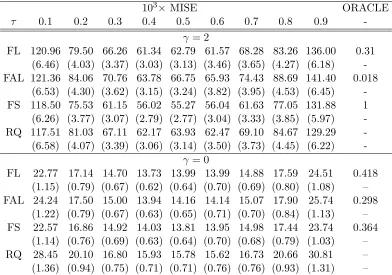
FL 120.96 79.50 66.26 61.34 62.79 61.57 68.28 83.26 136.00 0.31 (6.46) (4.03) (3.37) (3.03) (3.13) (3.46) (3.65) (4.27) (6.18) -FAL 121.36 84.06 70.76 63.78 66.75 65.93 74.43 88.69 141.40 0.018
(6.53) (4.30) (3.62) (3.15) (3.24) (3.82) (3.95) (4.53) (6.45) -FS 118.50 75.53 61.15 56.02 55.27 56.04 61.63 77.05 131.88 1 (6.26) (3.77) (3.07) (2.79) (2.77) (3.04) (3.33) (3.85) (5.97) -RQ 117.51 81.03 67.11 62.17 63.93 62.47 69.10 84.67 129.29 -(6.58) (4.07) (3.39) (3.06) (3.14) (3.50) (3.73) (4.45) (6.22)
-γ = 0
FL 22.77 17.14 14.70 13.73 13.99 13.99 14.88 17.59 24.51 0.418 (1.15) (0.79) (0.67) (0.62) (0.64) (0.70) (0.69) (0.80) (1.08) – FAL 24.24 17.50 15.00 13.94 14.16 14.14 15.07 17.90 25.74 0.298
(1.22) (0.79) (0.67) (0.63) (0.65) (0.71) (0.70) (0.84) (1.13) – FS 22.57 16.86 14.92 14.03 13.81 13.95 14.98 17.44 23.74 0.364
(1.14) (0.76) (0.69) (0.63) (0.64) (0.70) (0.68) (0.79) (1.03) – RQ 28.45 20.10 16.80 15.93 15.78 15.62 16.73 20.66 30.81 – (1.36) (0.94) (0.75) (0.71) (0.71) (0.76) (0.76) (0.93) (1.31) –
The values in the parentheses are the standard errors of103×M ISE. MISE: Mean of Integrated
Squared Errors; ORACLE: the proportion of times where the model is selected correctly among 500 simulations. FL: Fused LASSO; FAL: Fused Adaptive LASSO; FS: Fused Sup-norm; FAS: Fused Adaptive Sup-norm; RQ: Regular Quantile Regression.
Table 2.1 contains the results for Example 2.1 with both γ = 2 and γ = 0. When γ = 2, the slope coefficientsβ(τ) vary across quantile levels. For this scenario, the group-wise shrinkage method FS performs the best with the smallest MISE and the highest
ORACLE. The FL method performs slightly better than FAL, possibly due to the
vari-ation in the adaptive weight estimate.
the conventional RQ method. Similar toγ = 2, FL is better than FAL in terms of MISE and ORACLE. This is largely due to the fact that the quantile slope coefficients are too
close to be distinguished when they are truly constant. In fact, the ideal component-wise
adaptive weights are supposed to be identical. The FL method, which does not assign any
weight, is equivalent to assigning equal component-wise weights. However, FAL adopts the
weights calculated from the RQ estimates with certain degree of variations, particularly in
the tails. Consequently, FAL has lower ability than FL for shrinkingd2 =β(0.2)−β(0.1) and d9 =β(0.9)−β(0.8) to zero (see Table 2.2).
Example 2.2. To further demonstrate the role of adaptive component-wise weights,
we consider a more complex univariate example. Let xi ∼ U(0,1) for i = 1, . . . ,500.
Assume Qτ(xi) =α(τ) +β(τ)xi for any 0< τ <1, where α(τ) =α+ Φ−1(τ) and
β(τ) =
β−γΦ−1(0.49) +γΦ−1(τ) if 0< τ <0.49
β if 0.49≤τ <1,
with α = 0, β = 3, and γ = 15. To generate data, we first generate a quantile level ui ∼
U(0,1) and let yi =α(ui) +β(ui)xi. Therefore, for the quantiles τ = {0.1,0.2, . . . ,0.9},
β(τ) varies for τ = 0.1, . . . ,0.4, but remains as a constant for τ = 0.5, . . . ,0.9.
In this setting,β(τ) has different patterns across τ. Adaptive weights are expected to lead to more efficient shrinkage by controlling the shrinkage speeds of different coefficient
differences dk = β(τk)−β(τk−1), k = 2, . . . ,9. By assigning larger weights to the upper quantiles at whichβ(τ) is a constant, FAL achieves much higher ORACLE and TP at the upper five quantiles than FL (see Table 2.2). This suggests that if the interquantile slope
differences are well distinguished, employing adaptive weights can effectively improve the
Example 2.3. We generate data in the same way as in Example 2.2, but we let
β(τ) =
β−γΦ−1(0.21) +γΦ−1(τ) if 0< τ <0.21
β if 0.21≤τ ≤0.59
β−γΦ−1(0.59) +γΦ−1(τ) if 0.59< τ <1,
with α = 0, β = 3, and γ = 15. We first generate a quantile level ui ∼ U(0,1) and let
yi =α(ui) +β(ui)xi, where xi ∼ U(0,1) for i = 1, . . . ,500. Therefore, for the quantiles
τ ={0.1,0.2, . . . ,0.9},β(τ) is a constant at quantile levels τ = 0.3,0.4,0.5, but varies in the other two quantile regions.
Results in Table 2.2 show that FAL has a clearly higher ORACLE than FL when
the interquantile slope differences are well distinguished. Moreover, when the trued’s are zero (d4 =d5 = 0), FAL is more likely to shrink them to zero by assigning larger adaptive weights. However, for d6 that is truly nonzero, FAL shrinks it to zero incorrectly more often than FL. This is possibly due to the large variation of the initial estimates around
the boundary quantile (τ = 0.6) where β(τ) changes from a constant to be varying inτ.
Example 2.4. In this example, we consider a bivariate case with p = 2. The data are generated from
yi =α+β1xi,1 +β2xi,2+ (1 +γxi,2)ei, i= 1, . . . ,200,
where xi,1
i.i.d
∼ U(0,1), xi,2
i.i.d
∼ U(0,1), ei i.i.d
∼ N(0,1), α = 1, β1 =β2 = 3. Therefore, the τth conditional quantile of Y given x1 and x2 is
Table 2.2: Percentage of correctly identifying dk =β(τk)−β(τk−1) over 500 simulations in Examples 2.1-2.3.
Example 2.1, γ= 2, TP
d26= 0 d36= 0 d46= 0 d56= 0 d6 6= 0 d7 6= 0 d8 6= 0 d9 6= 0 ORACLE
FL 0.69 0.89 0.93 0.91 0.94 0.92 0.89 0.67 0.31
FAL 0.65 0.66 0.67 0.65 0.65 0.67 0.67 0.62 0.02
Example 2.1, γ= 0, TP
d2= 0 d3= 0 d4= 0 d5= 0 d6 = 0 d7 = 0 d8 = 0 d9 = 0 ORACLE
FL 0.91 0.82 0.81 0.78 0.79 0.77 0.82 0.88 0.42
FAL 0.84 0.81 0.84 0.85 0.87 0.81 0.83 0.81 0.30
Example 2.2, TP
d26= 0 d36= 0 d46= 0 d56= 0 d6 = 0 d7 = 0 d8 = 0 d9 = 0 ORACLE
FL 1.00 1.00 1.00 0.99 0.50 0.66 0.67 0.81 0.25
FAL 0.96 0.97 0.97 0.84 0.78 0.98 0.98 0.96 0.52
Example 2.3, TP
d26= 0 d36= 0 d4= 0 d5= 0 d6 6= 0 d7 6= 0 d8 6= 0 d9 6= 0 ORACLE
FL 1.00 1.00 0.45 0.55 0.74 1.00 1.00 1.00 0.21
FAL 1.00 1.00 0.88 1.00 0.32 0.99 1.00 1.00 0.30
TP: percentage of correctly identifying each dk =β(τk)−β(τk−1), k= 2, . . . ,9 over 500
simula-tions. ORACLE: overall percentage of correctly shrinking all zerodk’s to zero and nonzero dk’s
as nonzero.
where α(τ) = α+ Φ−1(τ), β1(τ) = β1 and β2(τ) = β2 +γΦ−1(τ). Unlike β1(τ), which stays invariant for allτ,β2(τ) is constant whenγ = 0 but it varies across τ when γ 6= 0. As a group-wise shrinkage method, FAS either shrinks all interquantile slope
differ-ences dk,l = βk,l −βk−1,l, l = 1,2, k = 2, . . . ,9 to be exactly zero, or none of them to
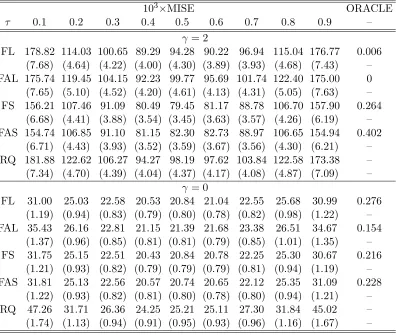
be zero. Consequently, as shown in Table 2.3, when γ = 2, FAS has higher ORACLE than FL and FAL. By imposing two distinguished group-wise weights on two groups of
interquantile slope differences, FAS leads to better model selection results than FS. We
compare FL and FAL in Table 2.4. When the true d’s are indeed zero, FAL has higher TP
FAL may suffer from over-shrinkage problem in the varying regions.
Table 2.3: The MISE and ORACLE proportion of different methods in Example 2.4 with γ = 2 andγ = 0, respectively.
103×MISE ORACLE
τ 0.1 0.2 0.3 0.4 0.5 0.6 0.7 0.8 0.9 –
γ = 2
FL 178.82 114.03 100.65 89.29 94.28 90.22 96.94 115.04 176.77 0.006 (7.68) (4.64) (4.22) (4.00) (4.30) (3.89) (3.93) (4.68) (7.43) – FAL 175.74 119.45 104.15 92.23 99.77 95.69 101.74 122.40 175.00 0 (7.65) (5.10) (4.52) (4.20) (4.61) (4.13) (4.31) (5.05) (7.63) – FS 156.21 107.46 91.09 80.49 79.45 81.17 88.78 106.70 157.90 0.264
(6.68) (4.41) (3.88) (3.54) (3.45) (3.63) (3.57) (4.26) (6.19) – FAS 154.74 106.85 91.10 81.15 82.30 82.73 88.97 106.65 154.94 0.402
(6.71) (4.43) (3.93) (3.52) (3.59) (3.67) (3.56) (4.30) (6.21) – RQ 181.88 122.62 106.27 94.27 98.19 97.62 103.84 122.58 173.38 – (7.34) (4.70) (4.39) (4.04) (4.37) (4.17) (4.08) (4.87) (7.09) –
γ = 0
FL 31.00 25.03 22.58 20.53 20.84 21.04 22.55 25.68 30.99 0.276 (1.19) (0.94) (0.83) (0.79) (0.80) (0.78) (0.82) (0.98) (1.22) – FAL 35.43 26.16 22.81 21.15 21.39 21.68 23.38 26.51 34.67 0.154
(1.37) (0.96) (0.85) (0.81) (0.81) (0.79) (0.85) (1.01) (1.35) – FS 31.75 25.15 22.51 20.43 20.84 20.78 22.25 25.30 30.67 0.216
(1.21) (0.93) (0.82) (0.79) (0.79) (0.79) (0.81) (0.94) (1.19) – FAS 31.81 25.13 22.56 20.57 20.74 20.65 22.12 25.35 31.09 0.228
(1.22) (0.93) (0.82) (0.81) (0.80) (0.78) (0.80) (0.94) (1.21) – RQ 47.26 31.71 26.36 24.25 25.21 25.11 27.30 31.84 45.02 – (1.74) (1.13) (0.94) (0.91) (0.95) (0.93) (0.96) (1.16) (1.67) –
Table 2.3 also shows the results whenγ = 0. As we expect, all the proposed shrinkage methods yield significantly smaller MISEs than RQ when the slope coefficients are
con-stant for each predictor. However, similar to Example 2.1, the quantile slope coefficients
adaptive weights from playing effective roles. Thus, FAL has less estimation efficiency
(higher MISE) and worse selection accuracy (lower ORACLE) than FL, especially in the
tails where the initial quantile estimates are more variable.
Table 2.4: True Proportion of True Positive (TP) for each interquantile difference dk,l
in Example 2.4 with γ = 2 and γ = 0, respectively. The interquantile slope differences dk,l = βk,l −βk−1,l, l = 1,2, k = 2, . . . ,9. For γ = 2, the true coefficients dk,1 = 0, but dk,2 6= 0 for allk. For γ = 0, dk,l = 0 for allk and l.
d2,1 d3,1 d4,1 d5,1 d6,1 d7,1 d8,1 d9,1 d2,2 d3,2 d4,2 d5,2 d6,2 d7,2 d8,2 d9,2
γ = 2
FL 0.79 0.69 0.62 0.58 0.59 0.62 0.79 0.61 0.85 0.92 0.92 0.92 0.92 0.89 0.87 0.58 FAL 0.79 0.80 0.81 0.77 0.82 0.79 0.80 0.79 0.63 0.67 0.67 0.66 0.69 0.65 0.69 0.58
γ = 0
FL 0.93 0.83 0.80 0.75 0.76 0.78 0.83 0.91 0.92 0.85 0.83 0.80 0.78 0.78 0.85 0.91 FAL 0.848 0.808 0.85 0.82 0.84 0.82 0.82 0.83 0.81 0.82 0.85 0.82 0.84 0.83 0.83 0.80
2.4.1
The Comparison of Different Group-wise Weights in FAS
In Section 2.2.2, we defined the group-wise weight in FAS as ˜wk,l =h
max{|d˜k,l|:k= 2, . . . , K}
i−1 ,
where ˜dk,l is the initial estimator obtained from the conventional quantile regression. In
fact, for each l, ˜wk,l is the same for different k’s. Hence the notation can be simplified as
˜
wl. However, we can define the group-wise weight in many other ways, and the
asymp-totic properties will not be affected. In this subsection, we access the sensitivity of FAS
against the choice of different group-wise weights.
As we know, the group-wise weight ˜wl aims to distinguish groups with constantβ(τ)
from those with τ-dependent ones. In other words, ˜wl controls the group-wise shrinkage
quantile slope coefficients corresponding to the first predictor are constant, but vary
across quantiles for the second one. In this scenario, the ideal group-wise weight ˜w1should be much larger than ˜w2 so thatθ(1), the first group of interquantile slope differences, can be shrunk to zero much faster than θ(2). On the other hand, if both groups of quantile slope coefficients are constant, say γ = 0 in Example 2.4, the ideal group-wise weights should be close, so that θ(1) and θ(2) would be shrunk to zero at the same speed. Due to the characteristics of adaptive group-wise weights, we study some other ones in this
subsection. The asymptotic properties are not affected by different choices of ˜wl.
Choice 1 (weighted average of ˜d’s): we define the group-wise weight as the average of initial slope difference estimates, but weighted by their variances. Explicitly speaking,
define
˜ wl(1) =
"( |d2˜,l|
var( ˜d2,l)
+. . .+ | ˜ dK,l|
var( ˜dK,l)
)
( 1 var( ˜d2,l)
+. . .+ 1 var( ˜dK,l)
)#−1
, l = 1, . . . , p.
Since the initial estimates of quantile slope coefficients have different variations at
differ-ent quantile levels, ˜wl(1) aims to downweight ˜dk,l with a larger variation corresponding to
the lth predictor.
Choice 2 (median of ˜d’s): another choice of adaptive group-wise weights can be defined as
˜
w(2)l =hmedian{|d˜2,l|, . . . ,|d˜K,l|}
i−1
, l= 1, . . . , p.
Using median instead of mean can result in a more robust measurement of the group-wise
weights, especially for groups with non-constant quantile slope coefficients.
and define
˜
w(3)l =hmedian{|d˜k,l|/sd( ˜dk,l), k= 2, . . . , K}
i−1
, l= 1, . . . , p,
where sd( ˜dk,l) is the standard deviation of ˜dk,l. In this choice, ˜wl(3) aims to downweight
˜
dk,l with a larger standard deviation, and it is robust to the outliers of estimated ˜dk,l for
each l.
Table 2.5 shows the results of FAS with four different choices of the group-wise weight
in Example 2.4 with γ = 0 and γ = 2, respectively. Results suggest that FAS is quite insensitive to different group-wise weights. Therefore, we stay with ˜wl in the subsequent
Table 2.5: The MISE and ORACLE of FAS by adopting different group-wise weights in Example 2.4 with γ = 0 and γ = 2, respectively.
103×MISE ORACLE
τ 0.1 0.2 0.3 0.4 0.5 0.6 0.7 0.8 0.9
-γ = 0
regular 31.92 25.26 22.59 20.59 20.78 20.63 22.13 25.40 31.29 0.226 choice 1 32.09 25.34 22.73 20.59 20.78 20.85 22.23 25.45 30.94 0.234
(1.22) (0.94) (0.83) (0.79) (0.80) (0.79) (0.80) (0.96) (1.20) – choice 2 32.43 25.34 22.67 20.56 20.93 20.87 22.35 25.65 31.03 0.234
(1.22) (0.94) (0.83) (0.78) (0.80) (0.79) (0.81) (0.94) (1.19) – choice 3 32.21 25.25 22.64 20.50 20.92 20.94 22.43 25.68 31.08 0.23
(1.23) (0.93) (0.83) (0.78) (0.80) (0.79) (0.81) (0.95) (1.20) –
γ = 2
regular 154.74 106.85 91.10 81.15 82.30 82.73 88.97 106.65 154.94 0.402 choice 1 154.32 107.18 91.48 80.57 81.65 82.29 88.91 106.40 154.03 0.438
(6.75) (4.55) (3.91) (3.49) (3.56) (3.67) (3.57) (4.30) (6.18) – choice 2 154.30 107.71 91.79 81.03 81.61 81.82 88.58 106.04 153.58 0.464
(6.81) (4.57) (3.96) (3.50) (3.55) (3.63) (3.53) (4.31) (6.30) – choice 3 154.04 107.39 91.65 81.28 82.50 82.64 89.23 106.76 153.98 0.458
(6.79) (4.54) (3.92) (3.56) (3.60) (3.64) (3.59) (4.31) (6.29) –
Different choices of group-wise weights. Regular: 1/max, that is, the regular group-wise weight
discussed in Section 2.2.2; choice 1: average ofds, weighted by their variances; choice 2: median˜
of ds; choice 3: median of˜ ds, but weighted by their standard deviations. The values in the˜
2.5
Real Data Study
In this section, we apply the proposed methods to analyze the international economic
growth data, which were originally taken from Barro and Lee (1994)[2] and later studied
by Koenker and Machado (1999)[18]. This data set is available as ‘barro’ in R package
quantreg.
The data set contains 161 observations. The first 71 observations correspond to 71
countries and their averaged annual growth percentages of per Capita Gross Domestic
Product (GDP growth) from period 1965-1975 are recorded. The rest 90 observations are
for period 1975-1985. Some countries may appear in both periods. There are 13
covari-ates involved in total: the initial per capital GDP (igdp), male middle school education (mse), female middle school education (f se), female higher education (f he), male higher education (mhe), life expectancy (lexp), human capital (hcap), the ratio of eduction and GDP growth (edu), the ratio of investment and GDP growth (ivst), the ratio of public consumption and GDP growth (pcon), black market premium (blakp), political instabil-ity (pol) and growth rate terms trade (ttrad). All covariates are standardized to lie in the interval [0,1] before analysis, and we focus on τ ={0.1,0.2, . . . ,0.9}. Our purpose is to investigate the effects of covariates on multiple conditional quantiles of the GDP growth.
Koenker and Machado (1999)[18] studied the effects of covariates on certain
condi-tional quantiles of the GDP growth by using the convencondi-tional quantile regression method
(RQ). In this study, we consider simultaneous regression of multiple quantiles by
employ-ing the proposed adaptively weighted penalization methods FAL and FAS, and select the
penalization parameter by minimizing the AIC value as described in Section 2.3
(Re-sults are in Tables 2.6 and 2.7 for FAL and FAS, respectively). Figures 2.1-2.2 show
levels for 13 covariates. In each plot, the shaded area is the 90% pointwise confidence
band constructed from the inversion of rank score test described in Koenker and Bassett
(1982)[16]. The points connected by solid lines correspond to the estimated quantile
co-efficients from RQ, while the points connected by dashed lines are FAL estimates, and
the stars with dashed lines are FAS estimates. The FAS shrinks the slope coefficients
of mhe, ivst and blakp to be constant over τ, while FAL tends to shrink neighboring quantile coefficients to be equal, resulting in piecewise constant quantile coefficients. In
contrast, the solid lines (RQ) are more variable compared to the dashed lines (FAL and
FAS), since RQ can not make any shrinkage.
To further verify the shrinkage results, we conduct hypothesis tests to check the
constancy of slope coefficients by using the R function “anova.rqlist” inquantreg package. This function is based on the Wald test described in Koenker and Bassett (1982)[16] and
can be used to test if the slope coefficients are identical across different specified quantiles.
For the covariate ivst, for example, the anova test for equality of quantile coefficients at τ = 0.1, . . . ,0.9 results in a p-value of 0.9324, suggesting that the effect of ivst does not vary significantly across the nine quantile levels, which agrees with the results from
FAL and FAS, where the nine quantile coefficients are shrunk to be a constant. On
the other hand, for the covariate pol, the equality test on the quantile coefficients at τ = 0.1, . . . ,0.9 results in a p-value of 0.000996, implying that the effect of pol varies across the 9 quantile levels. More specifically, the equality test at τ = 0.5, . . . ,0.9 shows the significant differences in quantile slope coefficients. However, if we test the equality
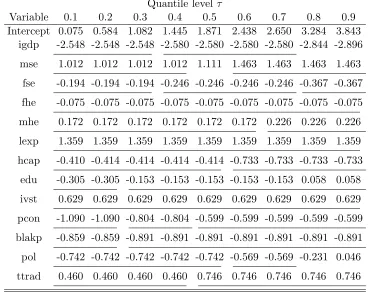
of slope coefficients atτ = 0.1, . . . ,0.5, the null hypothesis was failed to be rejected. This agrees with the results from FAL, which shrinks the first 5 quantile coefficients to be a
constant, but keeps the upper quantile coefficients vary.
valida-tion. The data are randomly split into a testing set with 50 observations and a training
set with the rest 111 observations. For each method, we estimate the quantile coefficients
based on the training set, denoted as ˆβ(τj), j = 1, . . . ,9 and predict the τjth conditional
quantile of the GDP growth on the testing set. Prediction Error (PE), used to assess the
prediction accuracy, is defined as
PE = 9 X
k=1 50 X
j=1
ρτk{yj−x
T
jβˆ(τk)},
where {(yj,xj), j = 1, . . . ,50} are in the testing set. We repeat the cross validation 200
times and take the average of PE. For FAL, the mean PE is 253.33 (s.e.=1.68), while it
is 252.80 (s.e.=1.71) for FAL and 258.94 (s.e.=1.65) for RQ. The results show that both
proposed penalization approaches yield higher prediction accuracy than the conventional
Table 2.6: Estimated quantile slope coefficients for economic growth data by FAL. The tuning parameter is selected by AIC. Neighboring estimates with underlines beneath are identical.
Quantile levelτ
Variable 0.1 0.2 0.3 0.4 0.5 0.6 0.7 0.8 0.9 Intercept 0.075 0.584 1.082 1.445 1.871 2.438 2.650 3.284 3.843
igdp -2.548 -2.548 -2.548 -2.580 -2.580 -2.580 -2.580 -2.844 -2.896
mse 1.012 1.012 1.012 1.012 1.111 1.463 1.463 1.463 1.463
fse -0.194 -0.194 -0.194 -0.246 -0.246 -0.246 -0.246 -0.367 -0.367
fhe -0.075 -0.075 -0.075 -0.075 -0.075 -0.075 -0.075 -0.075 -0.075
mhe 0.172 0.172 0.172 0.172 0.172 0.172 0.226 0.226 0.226
lexp 1.359 1.359 1.359 1.359 1.359 1.359 1.359 1.359 1.359
hcap -0.410 -0.414 -0.414 -0.414 -0.414 -0.733 -0.733 -0.733 -0.733
edu -0.305 -0.305 -0.153 -0.153 -0.153 -0.153 -0.153 0.058 0.058
ivst 0.629 0.629 0.629 0.629 0.629 0.629 0.629 0.629 0.629
pcon -1.090 -1.090 -0.804 -0.804 -0.599 -0.599 -0.599 -0.599 -0.599
blakp -0.859 -0.859 -0.891 -0.891 -0.891 -0.891 -0.891 -0.891 -0.891
pol -0.742 -0.742 -0.742 -0.742 -0.742 -0.569 -0.569 -0.231 0.046
Table 2.7: Estimated quantile slope coefficients for economic growth data by FAS. The tuning parameter is selected by BIC. Neighboring estimates with underlines beneath are identical.
Quantile levelτ
Variable 0.1 0.2 0.3 0.4 0.5 0.6 0.7 0.8 0.9 Intercept 0.034 0.592 1.093 1.505 2.003 2.396 2.779 3.230 3.833
igdp -2.606 -2.601 -2.606 -2.611 -2.616 -2.621 -2.625 -2.630 -2.635 mse 1.097 0.998 0.899 0.998 1.097 1.195 1.294 1.393 1.436
fse 0.072 0.105 0.026 -0.053 -0.131 -0.210 -0.288 -0.367 -0.446 fhe -0.138 -0.109 -0.081 -0.052 -0.023 -0.052 -0.081 -0.109 -0.138 mhe 0.161 0.161 0.161 0.161 0.161 0.161 0.161 0.161 0.161
lexp 1.298 1.330 1.362 1.330 1.353 1.385 1.386 1.354 1.322 hcap -0.487 -0.498 -0.508 -0.519 -0.530 -0.540 -0.551 -0.561 -0.572
edu -0.355 -0.304 -0.253 -0.202 -0.150 -0.099 -0.058 -0.007 -0.058 ivst 0.612 0.612 0.612 0.612 0.612 0.612 0.612 0.612 0.612
pcon -1.001 -0.917 -0.833 -0.749 -0.665 -0.641 -0.557 -0.473 -0.389 blakp -0.935 -0.935 -0.935 -0.935 -0.935 -0.935 -0.935 -0.935 -0.935
0.2 0.4 0.6 0.8 -3 .5 -3 .0 -2 .5 -2 .0 ig d p
0.2 0.4 0.6 0.8
-0 .5 0 .0 0 .5 1 .0 1 .5 2 .0 2 .5 ms e
0.2 0.4 0.6 0.8
-1 .5 -1 .0 -0 .5 0 .0 0 .5 1 .0 1 .5 fs e
0.2 0.4 0.6 0.8
-1 .0 -0 .5 0 .0 0 .5 fh e
0.2 0.4 0.6 0.8
-0 .5 0 .0 0 .5 1 .0 mhe
0.2 0.4 0.6 0.8
0. 5 1 .0 1. 5 2 .0 le x p
0.2 0.4 0.6 0.8
-1 .0 -0 .5 0 .0 0 .5 hc ap
0.2 0.4 0.6 0.8
-1 .0 -0 .5 0 .0 0 .5 ed u
0.2 0.4 0.6 0.8
0 .2 0 .4 0. 6 0 .8 1. 0 1 .2 iv s t
0.2 0.4 0.6 0.8
-1 .5 -1 .0 -0 .5 pc o n
0.2 0.4 0.6 0.8
-1 .2 -1 .0 -0 .8 -0. 6 -0. 4 bl ak p
0.2 0.4 0.6 0.8
-1 .0 -0 .5 0 .0 po l
0.2 0.4 0.6 0.8
0. 2 0 .4 0. 6 0 .8 1 .0 tt ra d
2.6
Theoretical Proof
Lemma 2.1 (Convexity Lemma) Let {hn(u) : u ∈ U} be a sequence of random
convex functions defined on a convex, open subset U of Rd. Suppose h(u) is a
real-valued function on U for which hn(u) → h(u) in probability for each u ∈ U. Then for
each compact subset Kof U, supu∈K|hn(u)−h(u)| →0 in probability. Proof The proof can be found in [24].
Proof of Proposition 2.1 Define
Ln(δ) = K X k=1 n X i=1
ρτk{yi−z
T
ik,A(θA,0+n−1/2δ)} −ρτk(yi−z
T
ik,AθA,0)
,
where δ ∈ RK+s is bounded. The minimizer to Ln(δ), denoted as ˆδ, is n1/2(ˆθA−θA,0). Following the identity in [11], we have
ρτ(r−s)−ρτ(r) = −s{τ −I(r <0)}+
Z s
0
{I(r ≤t)−I(r≤0)}dt.
Therefore, Ln(δ) = −n−1/2
PK
k=1 Pn
i=1z
T
ik,A{τk −I(yi −zTik,AθA,0 < 0)}δ + PK
k=1B (k)
n ,
where
Bn(k) =
n
X
i=1
Z n−1/2zTik,Aδ
0
n
I(yi−zTik,AθA,0 ≤t)−I(yi−zTik,AθA,0 ≤0) o