Estimation of Effect of Characteristics
Parameters on Flow Battery Operation
Santhosh 1, Pradeep Kumar2
P.G Scholar, Dept. of Electrical & Electronics Engineering, NMAMIT, Nitte, Karkala(Tq), Udupi(Dist),India1
Asst. Professor, Dept. of Electrical & Electronics Engineering, NMAMIT, Nitte, Karkala(Tq), Udupi(Dist),India2
ABSTRACT: Nowadays the consumption of electrical energy from fossil fuels goes to an extreme level. Due to this there is release of pollutant gases, so environment health goes to the worst condition. If we use renewable energies like solar and wind for generation of power then environment pollution may be reduced to some extent. But problem with this is they are not uniform. They may vary seasonally and even in day itself. So there is need of battery to store energy when it is available. Nowadays so many batteries are available in market but those requires replacement after some limited period. In smart cities concept this problem is overcome by very popular kind of battery called Redox flow battery. This paper gives very brief introduction about flow battery, types of flow battery and explains why vanadium redox flow battery well popular among flow batteries. MATLAB programming is to estimate various losses in flow battery. The flow rate and operating temperature are also important parameters, this paper also explain how they influence on battery operation.
KEYWORDS: Flow battery, Vanadium, Stack, Flow rate.
I. INTRODUCTION
NASA studied the Redox Flow Battery (RFB) for building stationary energy storage systems in 1970’s. In early 1984 Maria Skyllas-Kazacos[1]and co-workers at the University of New South Wales, Australia developed the first Vanadium Redox Flow Battery (VRB). In 1998 the Australian Pinnacle Vanadium Redox Batteries Company bought the basic patents, and later Sumitomo Electric Industries (SEI) designed cell stacks and completed integrated systems under a license from Pinnacle VRB Company (S. Eckroad, 2007). Among various kinds of RFBs, the Vanadium Redox Flow Battery (VRB) was the first one introduced into commercial energy storage applications by SEI in 1996. In 1996, Kashima Kita Power Station utilized an in-load leveling application with 800kWh[5]. Between 1996 and 2005, SEI had built VRB plants for solar energy storage (240kWh), wind turbine output stabilization and storage (6MWh), power quality (1500kWh), and peak shaving (5MWh) (S. Eckroad, 2007) [2].
Copyright to IJIRSET DOI:10.15680/IJIRSET.2016.0505619 709
II.FLOW BATTERY WORKING PRINCIPLE
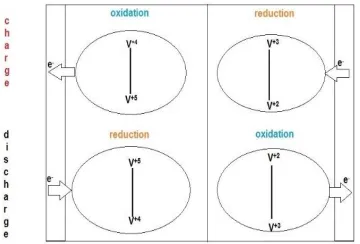
Figure 1: Redox Reactions in Vanadium Flow Battery
The working principle of flow battery is also same as normal electrochemical batteries a potential difference between two electrodes. In normal electrochemical batteries the reaction usually between electrode and electrolytes. But in case of flow battery it is between two electrolytes which are stored in positive and negative tanks. The materials which are used as electrolytes are designer choice and it is based on low cost, power density, efficiency and long life. The Redox reaction place a very important role in flow battery. The entire process in flow battery explained in two phases as shown in figure 1, they are as follows,
CHARGING
Let us consider V4+ solution and V+ 3 solution in positive tank negative tank of flow battery respectively. Now during charging process the electrical energy need to be store in form of chemical energy. At anode/ positive tank V4+ changes to V5+ oxidation process is takes place, due to this an electron will flow from positive electrode to negative electrode and where V3+ reduces to V2+. The electrolytes are pumped out from cell effectively to store electrical energy into chemical energy [2]. The following equations (1) & (2) represents the charging process.
(1)
(2)
DISCHARGING
Now discharging process takes place in exactly opposite to charging process. Electrical power is produced by pumping electrolytes back into reaction cell. Consider flow battery is initially charged. So positive tank and negative tank consists of V5+ and V2+ respectively [2]. During discharging process oxidation process is takes place in negative and reduction in positive tank. So that stored electrical energy in chemical will now transform back into electrical energy via load. The following equations (3) & (4) represents the discharging process.
(3)
III.FLOW BATTERY CONSTRUCTIONAL DETAILS
Figure 2: Block Diagram of Vanadium Flow Battery
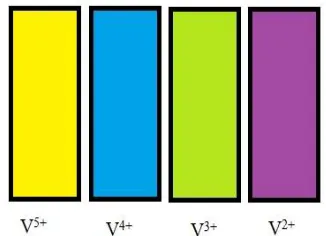
Figure 3: Various Oxidation states of Vanadium
The structural and functional unit of flow battery is a flow cell. The structural view of flow battery is as shown in Figure 2. It mainly consists of positive and negative tank. In vanadium flow battery both tanks are filled with vanadium solution which are at different oxidation state. The vanadium element mainly available in four oxidation states (V5+, V4+, V3+& V2+) and special thing about this is all are available at four different colours (yellow, blue, green & purple) as shown in Figure 3. Battery contains two pumps which are used to flow electrolytes in and out from tank/cell. The electrode are usually made of graphite which acts as electron collectors. Whose area mainly determines current density of battery [3]. Most important structure in flow battery is ion exchange membrane, which allows only H+ ions through them.
IV.CHARACTERISTIC PARAMETERS
Characteristics parameters of flow battery are as follows:-
Internal resistance
Copyright to IJIRSET DOI:10.15680/IJIRSET.2016.0505619 711
INTERNAL RESISTANCE
Figure 4: Power lose due to internal resistance
This power losses due to the ohmic-resistance of the charging or discharging current. The current can be either charging current or discharging current. When the battery is in charging process, current will have a positive value otherwise the current will have a negative value. R is the resistance varying depending on charging process or discharging process shown in figure 4.
PR (5)
FLOW RATE
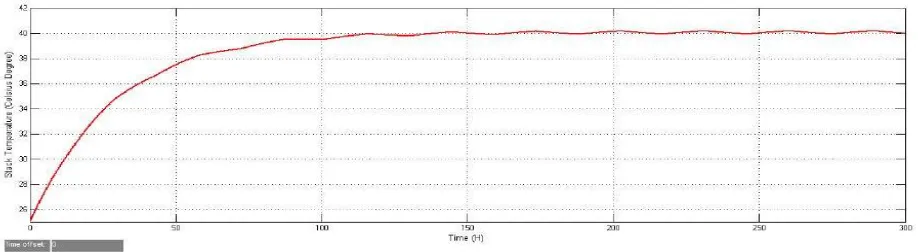
The vanadium redox flow battery is one type of flow battery. Therefore the flowing rate of the electrolyte is another important and unique property for this kind of battery. In order to maintain a proper working condition, the flowing rate of the electrolyte must be maintained above a minimum value which is called the minimum flow rate. For more accurate simulations, the minimum flow rate has to be calculated [5]. To calculate it, the equation (6) & (7) are used. The figure 5 & 6 shows the must be the limitations on flow rate and stack temperature.
Cs,t= Cs,in ± =SOC * Cin(0) ± (6)
QStack,min = ± (I*N) / ( * * * Cin(0) ) (7)
Stack temperature is also very important characteristic parameter in vanadium flow battery which mainly effects on its operation. If the temperature exceeds a certain temperature limit, the precipitation of the vanadium will form at the electrode which will block the electrodes and prevent the normal working of the battery. This rage is from 15 to 35 degree Celsius [1][4].
Figure 6: Stack Temperature variation with flow rate (180cm3/sec)
If the temperature is below 5 degree Celsius, the precipitation of v+2/v+3 will form in the negative electrolyte. Likewise, if the temperature exceeds 35 degree Celsius, the v+4/v+5 precipitation will form in the positive electrolyte. If the temperature is not controlled properly, the batteries performance will be deteriorated. An investigation on how the different currents and flow rates of the electrolyte will affect the temperatures of the VRB is carried out by using the equation of balanced energy relations. The temperatures of two element of the battery are simulated respect to the time, one is the stack temperature and the other is the tank temperature.
V. CONCLUSION
The main characteristics parameters of vanadium redox flow battery like internal resistance, stack temperature and flow rate are estimated by simulation. Internal resistance is one main power losing element in flow battery, this value need to set to minimum by proper modelling the battery. The variation of stack temperature with different flow rate of electrolyte are as shown in above figures. So those figures 5 & 6 and minimum flow rate calculation conclude that stack temperature should maintain in the range of 15 to 35 degree Celsius and flow rate should kept 30cm3/sec.
REFERENCES
[1] Jia Junduo , “Thermal Modelling of Vanadium Redox Flow Battery", vol. 2, no. 17, 2013.
[2] Ya-Ching Tseng , “Design, Construction, and study of Performance in a Vanadium Redox Flow Battery", vol.3, no. 05, 2013.
[3] A . Negishi , K. Nozaki , H. Kaneko , “Electrolyte of Vanadium Redox Flow Battery for Load Leveling, Bulletin of Electrotechnical Laboratory", Vol. 63, No. 4, 5, pp. 27-34, 2010.
[4] Xiong Binyu , Jinyu Zhao , Wei Zhangbao , Zhang Chenda, “State of Charge Estimation of an All-Vanadium Redox Flow Battery Based on a Thermal-Dependent model", Vol. 67, No.5,6, pp. 12-19 , 2011.