Analysis of Surface Roughness of PTFE Plates
on Drilling Process by ANOVA Methodology
Desikan.S 1 Kalaiyarasan.V 2 Kannan. Ttm 3 Vijayakumar.P 4 Pankaj Kumar5, Elaiyarasan.U6 Department of Mechanical Engineering, PRCET, Vallam, Thanjavur, India
ABSTRACT : Nowadays Teflon (PTFE) plates and cylindrical rods play an important role in modern manufacturing trends,PTFE plates are suitable for corrosive environment like marine, automobile applications. In this experimental work ,the drilling process conducted on Teflon plates with various process parameters like spindle speed ,feed rate and drilling diameter and response parameter as surface roughness is analyzed, in this experimental work L27 orthogonal array is used as DOE to optimize the parameters specifically signal to noise ratio curves and ANOVA techniques. It indicate spindle speed play an important role for achieving lower surface rouhness in PTFE Plates in drilling process.
KEYWORDS: Drilling, PTFE, Process parameters, surface roughness , ANOVA
I. INTRODUCTION1
Drilling is basic material removal processes, familiar over the years. The cutting temperature directly influences the hole accuracy hole diameter, perpendicularity, and cylindricity, surface roughness, and tool wear. The experimental investigation of the material removal rate changes that occur on the cutting tool during the material removal processes is a traditional concern. In automotive industry depending on the application hole quality is very important and response process variable outputs. A statistical technique, using orthogonal arrays and analysis of variance, has been employed to investigate the influence of cutting parameters in machining. The Cutting speed, feed rate, drill and work piece material, drilling nomenclature which highly affect the performance measures, the main concepts to determine thrust force, torque, metal removal rate
II. LITERATURE SURVEY
1. CATALINFETECAU, Felicia Stan (2012) – Measurement- Study of cutting force and surface roughness in the turning
ofpolytetrafluoroethylene composites with a polycrystalline diamond tool
2. Francisco Mata, V.N. Gaitonde, S.R. Karnik and J. Paulo Davim (2009)- Journal of materials processing technology-Influence of cutting conditions on machinability aspectsof PEEK, PEEK CF30 and PEEK GF 30 composites using PCD tools.
3. Rama Rao. S, Padmanabhan (2012) - International Journal of Engineering Research and Applications (IJERA) - Application of Taguchi methods and ANOVA in optimization of process parameters for metal removal rate in electrochemical machining of Al/5%SiC composites.
4. G. Petropoulos, F. Mata, J. Paulo Davim (2008) - Materials and Design - Statistical study of surface roughness in turning of peek composites.
ISSN(Online) : 2319-8753 ISSN (Print) : 2347-6710
I
nternational
J
ournal of
I
nnovative
R
esearch in
S
cience,
E
ngineering and
T
echnology
(An ISO 3297: 2007 Certified Organization)
Vol. 5, Special Issue 8, May 2016
5. Palanikumar, J. Paulo Davim (2007) – Materials and Design -Mathematical model to predict tool wear on the machining of glassfibre reinforced plastic composites.
III. POLYTETRAFLUOROETHYLENE(PTFE)
PTFE is a strong, tough, waxy , nonflammable synthetic resin produced by the polymerization of tetrafluoroethylene known by such a trademark of Teflon . PTFE is distinguished by its slippery surface,high melting point and resistant to attack of almost all chemicals.these properties have made familiar to all by coating on non stick cookware and also it is used to fabricate industrial products like pipe liners ,valves and pumps
The chemical formula for PTFE
Table 1 specific properties of PTFE
Density Melting
point
Yield strength
Youngs modulus
Thermal diffiusivity
2200 kg/m3 600 K 23 Mpa 0.5 Gpa 0.124 mm2/s
IV. PROBLEM IDENTIFICATION
The identification of Drilling problem for PTFE flat plates which cannot be tackled using conventional technique because of following problems occurs in Drilling process.
1. Difficult to drill
2. Low coefficient of friction 3. High surface Roughness. 4. Poor Chip Breaking.
The above problems are to overcome during Drilling process and achieve good surface finish.
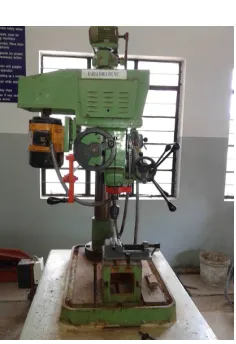
V. EXPERIMENTAL SETUP
Fig 2 drills used
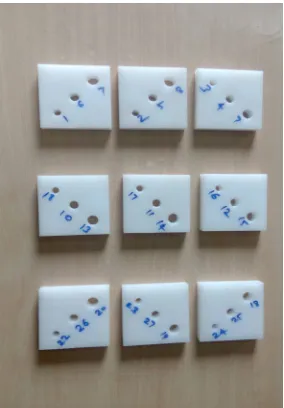
Fig 3 PTFE Drilled plates
VI. METHODOLOGY
State the problem
State the objectives of experiments
Select the factors that may influence the selected quality characteristics Identify quality and noise factors
Select levels for the factors
Select appropriate orthogonal array
Select interactions that may influence the selected quality characteristics Conduct the tests described by trails in orthogonal array
ISSN(Online) : 2319-8753 ISSN (Print) : 2347-6710
I
nternational
J
ournal of
I
nnovative
R
esearch in
S
cience,
E
ngineering and
T
echnology
(An ISO 3297: 2007 Certified Organization)
Vol. 5, Special Issue 8, May 2016
Conduct confirmation experiment
VII. TAGUCHI DESIGN OF EXPERIMENTS
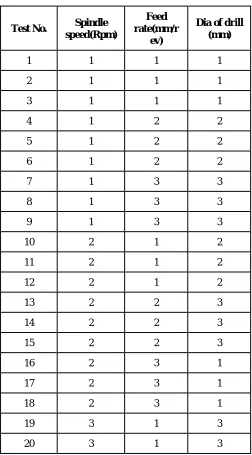
Taguchi method is a powerful tool in quality Optimization makes use of a special design of orthogonal array (OA) to examine. Number of experiments used to design the orthogonal array for 3 parameters and 3 levels of Drilling parameters
Table 2. L 27 Taguchi’s Design of Experiments
Test No. Spindle
speed(Rpm)
Feed rate(mm/r
ev)
Dia of drill (mm)
1 1 1 1
2 1 1 1
3 1 1 1
4 1 2 2
5 1 2 2
6 1 2 2
7 1 3 3
8 1 3 3
9 1 3 3
10 2 1 2
11 2 1 2
12 2 1 2
13 2 2 3
14 2 2 3
15 2 2 3
16 2 3 1
17 2 3 1
18 2 3 1
19 3 1 3
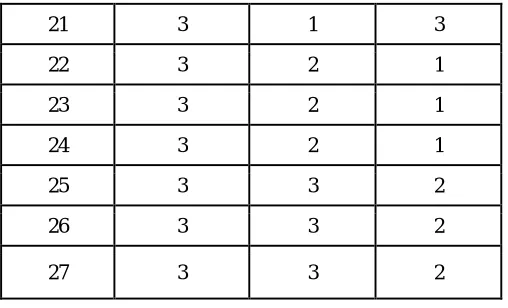
21 3 1 3
22 3 2 1
23 3 2 1
24 3 2 1
25 3 3 2
26 3 3 2
27 3 3 2
VIII. RESULT AND DISCUSSION
Heat Generation
After conducting the experiments of Drilling operation on PTFE Plates (75x75x15mm) of surface roughness values are given.
1.Cutting speed is a dominating parameter of Drilling process for achieving surface roughness of PTFE plates. 2.The optimum parameter of Drilling operation of PTFE plates were 1000RPM of spindle speed,0.015 mm/rev of Feed and 8 mm diameter of drill.
3.However PTFE plate having reasonable Machinability.
4.During drilling processes all parameters are interact and dependant able the drilling operation.
Response Table for Signal to Noise Ratios of surface roughness values (Smaller is better)
Table 4 S/N ratio of Drilling parameters of surface roughness
Level Spindle speed Feed rate Dia of drill
1 -51.73 -54.45 -51.70
2 -54.42 -54.52 -57.46
3 -59.27 -56.43 -56.27
Delta 7.54 1.95 5.76
Rank 1 3 2
ISSN(Online) : 2319-8753 ISSN (Print) : 2347-6710
I
nternational
J
ournal of
I
nnovative
R
esearch in
S
cience,
E
ngineering and
T
echnology
(An ISO 3297: 2007 Certified Organization)
Vol. 5, Special Issue 8, May 2016
M e a n o f S N r a ti o s 3 2 1 -8 -10 -12 -14 3 2 1 3 2 1 -8 -10 -12 -14
Spindle speed Feed rate
Diamet er of drill
Main Effects Plot (data means) for SN ratios
S ignal-to-noise: Smaller is better
Spindle spee d
3 2
1 1 2 3
6
4
2
Fe ed ra te
6
4
2
Dia meter of dr ill
Spindle 3 speed 1 2 Feed 3 rate 1 2
Interaction Plot (data means) for Surface roughness
Feed rate S p in d le s p e e d 3.0 2.5 2.0 1.5 1.0 3.0 2.5 2.0 1.5 1.0 Surface
3 - 4 4 - 5 > roughnes
5 < 2 2 - 3
3
Surface roughness
2
2 4
Spindle speed
6
1
2 1
3
Feed rate
Surface Plot of Surface roughness vs Spindle speed, Feed rate
IX. CONCLUSION
By taking input parameters like spindle speed,feed rate and diameter of drill for the output parameter surface roughness the experiment is conducted by using DOE concepts the optimsed parameter which give minimum surface roughness of PTFE Teflon plates is as follows
1.Spindle Speed is 1000 rpm 2.Feed rate is 0.0015 mm/rev 3.Diameter of drill is 8 mm
REFERENCES
[1] CatalinFetecau, Felicia Stan (2012) Study of cutting force and surfaceroughness in the turning ofpolytetrafluoroethylene composites with a polycrystalline diamond tool, Measurement, 1367–1379.
[2] Francisco Mata, V.N. Gaitonde, S.R. Karnik and J. Paulo Davim (2009)Influence of cutting conditions on machinability aspectsof PEEK, PEEK CF 30 and PEEK GF 30 composites using PCD tools, Journal of materialsprocessing technology, 1980–1982, 1984–1987.
[3] Rama Rao. S, Padmanabhan (2012) Application of Taguchi methods andANOVA in optimization of process parameters for metal removal rate inelectrochemical machining of Al/5%SiC composites, International Journal ofEngineering Research and Applications (IJERA),192-197.
[4] G. Petropoulos, F. Mata, J. Paulo Davim (2008) Statistical study of surfaceroughness in turning of peek composites, Materials and Design, 218–223. [5] Palanikumar, J. Paulo Davim(2007) Mathematical model to predict toolwear on the machining of glassfibre reinforced plastic composites, Materials
and Design, 2008–2014.
[6] FarhadKolahan, Reza Golmezerji, MasoudAzadiMoghaddam (2012)Multi Objective Optimization of Turning Process using GreyRelationalAnalysis and Simulated Annealing Algorithm, Applied Mechanics
and Materials, 2926-2932.
[7] FarukUnsacar (2006) SuleymanYaldız Design, development and testing of a turning dynamometer for cutting force measurement, Materials and Design,
839–846.