A Social Cloud for Sharing Resources via
Social Network
Archana G
1, Anju J Prakash
2PG Student, Dept. of CSE, Sree Buddha College of Engineering For women, Kerala, India1
Asst. Professor, Dept. of CSE, Sree Buddha College of Engineering For women, Kerala, India 2
ABSTRACT: A social cloud is a resource and service sharing framework utilizing relationships established between
members of a social network. Social networks are used to represent actual world relationships that allow users to share information and form connections between one another creating dynamic virtual organizations. So to enable social sharing a social cloud requires access to user’s social networks. Two-sided accepted matching is followed here. In order to gain access to the social network two factor based authentication is followed. The consumer's likings for each possible friend are then calculated by regaining preferences stored in the database. This information is then aggregated and sent to the matching service to determine an appropriate match. The main advantage is that social networks can be used in the implementation of cloud computing infrastructures and the resources can be allocated in the presence of user sharing preferences.
KEYWORDS: Cloud Computing; Resource Sharing; Social Network; Social Cloud; Security.
I. INTRODUCTION
A Social network is a set of actors and a set of some relationship among the actors. Actors in a Social network are connected by a set of relationships, such as friendship, affiliation, co-workers. Facebook, Google+, LinkedIn are some examples of social networking site as web based services which allow users to create their profile and show it to a list of other users with whom they share a connection. Users share their information, thoughts, ideas, photos and videos from their personal desktop or laptop to friends in online social network community. Social cloud aims to provide mechanism for resource sharing. Social cloud model allows users to satisfy need of an individual by availing underutilized resources of other users in social network environment.
The term Cloud refers to a Network or Internet. In other words cloud is something, which is present at remote location. Cloud Computing refers to handling, arranging, and accessing the applications online. Thus cloud computing refers to the access of computing resources across a network. Major benefit is that applications and data can be accessible at any time through the Internet. Thus cloud computing refers to the delivery of computing resources over the Internet. Cloud computing and social networking has combined in a variety of ways. Most obviously social networks can be hosted on cloud platforms or have scalable applications within the social networks.
A Social Cloud is a platform for sharing resources within a social network. A social cloud [1] can be considered as a cloud platform where resource and service sharing framework utilizing relationships established between members of an existing community. The main feature of a social cloud is that it enables sharing, not selling of resources. There are numerous existing social networking websites such as Orkut, Facebook and Google+. On these sites, one of the greatest concerns has been the security and privacy of personal data. That is to control the personal information that is being shared to other users and social applications. A social cloud is a platform for sharing resources within a social network. As a service social cloud can be applied in the healthcare field. It uses database that has enormous articles regarding life sciences which will automatically identify sentences and provides the relation between the diseases and treatments. Healthcare related information is fetched from published article.
II. RELATED WORK
countries to share access to virtual machines through platforms like Amazon EC2. Existing allocations is subdivided to reduce instance cost over a wider group of users. Using a cloud bartering model, the system enables resource sharing using social networks without the exchange of money and relying on a notion of trust to avoid free riding. It uses virtual container to provide virtualization within the existing virtual machine instance. Gracia-Tinedo et al. [4] proposed a friend-to-friend Cloud storage solution like F2Box. It retains a reliable service while using the best effort provisioning of storage resources from friends. Since a pure friend-to friend system cannot compare in terms of quality of service with traditional storage services. So a hybrid approach where reliability and availability can be improved using services like Amazon provides a valuable consideration in the realization of a social cloud. Cloud computing in social network now has become an important part of many people's life. It provides a platform for sharing and communication between users. The structure of a social network is a dynamic virtual organization that uses the trust relationship established between friends. Social networks are used to reflect real world relationships that allow users to share information and form connections between one another, essentially creating dynamic virtual organizations. This leverage the pre-established trust formed through friend relationships within a Social network to form a dynamic social Cloud, enabling friends to share resources within the context of a social network [5]. Social cloud as social networking services support users to build their profiles, discover other users, make it possible for direct and indirect communication between users, share information with each other, maintain self-centric connections and make users aware about other users of common interest. Wooten et al. [6] presents Health-care Social Cloud (HHSC). HHSC is a cloud assisted social health care network where various types of users, for example, patients, physicians and those who would like to know medical issues, can interacts through special typed blogs. Users shares their blogs with each other on internet. In HHSC users have blogs and they can create posts and comments. Each user takes decision independently to whom allow to view its blog contents results in cooperation. The vision of HHSC is to build health care environment and to assist a user to develop secure relations with other users. A health care environment is one where some users discuss their health related issues, while other users (e.g., physicians) help them in managing their own care.
III. PROPOSED SYSTEM
A. Social Cloud:
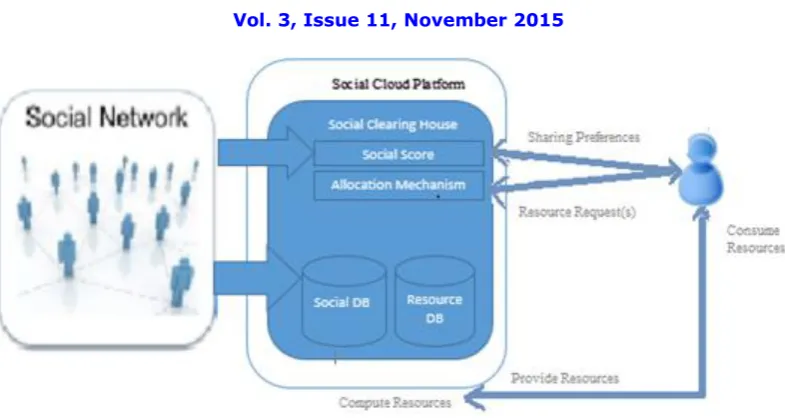
The proposed system social cloud is a platform for sharing resources within a social network. A social cloud is a dynamic environment through which cloud like provisioning scenarios can be established based upon the implicit levels of trust that go beyond the inter-personal relationships digitally encoded within a social network. The view about social cloud is motivated by the need of individuals or groups to access resources they are not in possession of, but that could be made available by connected peers which show users are willing to donate personal compute resources. Using this approach, users can leverage their personal social network and provide resources to, or consume resources from, their friends through a Social Clearing House. The functionalities needed for the construction of a social cloud are
A Social Clearing House.
A Socio Technical Adapter.
A Socio Economic Model.
B. Description of the Social Cloud Platform:
Figure 1: Social cloud and its Components
Module 1: Social Clearing House:
A social clearing house is an institutionalized micro economic system that defines how supply is allocated to demand. A social clearing house captures the following: the protocols used for distributed resource allocation, the rules of exchange, that is who can take part, and with whom may they exchange, and the formalization of one or more allocation mechanisms. A social clearing house is therefore the central point in the system where all information concerning users, their sharing preferences and their resource supply and demand is kept. For this reason, the social clearing house requires two databases: to capture the social graph of its users, as well as their sharing preferences, and a resource manager to keep track of resource reservations, availability, and allocations. The cloud provider is used to provide the basic resource fabrics.
Module 2: Socio Technical Adapter:
A socio technical adapter is needed to provide access to the necessary aspects of user’s social networks, and acts as a means of authentication. Once a user’s social network has been acquired via the socio-technical adapter, the social clearing house requires the sharing preferences of the user to facilitate resource allocation. Therefore, a preferences module that provides the necessary functionality for the capture and representation of sharing preferences is required. The key to the basic assumptions of a social cloud is that an element of bilateral approval has occurred in the establishment of a digital social tie. One user initiates the establishment of a digital tie, and the second user must confirm the request in order for the link to be established. This process is applied in social network platforms.
To start resource sharing in social cloud there should be some relationship between members of the social network. Through these users can share photos, videos, messages with their friends in the community. Also they can search for new friends by viewing their profile and can add them. The basic details such as mobile number, DOB all are hidden for other members in the SN. Only thing to remember is that bidirectional link should be established in order to perform sharing. The number of times other members viewed their profile is also displayed here. Also they can change their own profile picture, they can change their time line picture and can give updates. It is also possible to like or unlike the photos or videos of their friends and can give comments also for their postings.
Module 3: Socio Economic Model:
IV.SOCIAL RESOURCE ALLOCATION
The general process of allocation in the Resource Allocation Server is to first determine available donations with which the requesting user has a relationship. For this the list of all workers in the system is filtered by the list of friends for the corresponding user. The consumer’s preferences for each possible friend are then computed by retrieving preferences stored in the database. Similarly, the preferences for each of these friends of the requesting user are calculated. This information is then aggregated and sent to the matching service to determine an appropriate match. The resource allocation server acquires available nodes from the provider to satisfy the request using resource acquisition mechanisms. Here resources include memory space, disk stored contents and services include web search and health care services. Here registered users can provide free storage space on their own machines for data backup and other purposes for other users. Based on the social score values resources are allocated to users. Social score [7] is calculated as an average of three metrics used to assess the connectivity of a node within a graph. A node that has greater potential to link other nodes with each other has a higher social score. The metrics used are nodes:
(1) Degree Centrality (DC): It is simply the number of links incident to the node
(2) Betweenness Centrality (BC): It quantifies the number of times a node acts as a bridge along the shortest path between two other nodes
(3) Eigenvector centrality (EC): It defines the influence of the node within a network that is it measures how closely a node is connected to other well connected nodes. It assigns relative scores to all nodes in the network based on the concept that connections to high scoring nodes contribute more to the low scoring nodes.
Social Score = (DC + BC + EC) /3
If the values is less than particular value which is set on the social score then resources are not shared otherwise resources are shared among members of the network. The resources which are made available from the provider by sharing across the cloud platform via social network can be retrieved. The shared resources are stored in cloud.
In this social cloud if its already registered user then he/she can sign in with particular username and password otherwise he/she have to register by providing details such as name, emailid, password , mobile number etc. After login he/she have to use USB drive for authentication purpose. After that successful login it will redirect the users to the home page. Here users can edit their personal details, can change their password, can change their profile picture as like in social network. Also he/she can see all the friends list and all the friend requests. Also it is possible to upload photos and videos and can share it with his/her friends. The sender can delete particular photo/video as per his/her wish. It is possible to send message to his/her friends individually. For that a message window will appear and can send the message. When that particular friend come online he/she can view all the messages (with time showing when the particular sender has send the message) and can delete it if not needed.
For sharing memory space particular user can share up to 1GB memory space. He/she will upload memory space telling that this much space is free. His/her friends will view this message and if any particular friend is in need of that space then he/she should accept that request and will send that request to the owner. After viewing this request the owner can accept it or reject it as per wish. If he is ready to give space then the owner should send acceptance message after viewing this the particular friend will send the file (word document, pdf, .exe document or audio or video) to that respective owner’s storage area. While he/she sends particular document it will be stored in cloud space and from there the owner of the particular storage space need to be download the file. The sharing of memory space is mainly for backup purpose.
The web search engine has long become the most important portal for ordinary people looking for useful information on the web. However, users might experience failure when search engines return irrelevant results that do not meet their real intentions. Such irrelevance is largely due to the enormous variety of user’s contexts and backgrounds, as well as the ambiguity of texts. Personalized web search [9] is a general category of search techniques aiming at providing better search results, which are tailored for individual user needs. When a user issues a query on the client, the proxy generates a user profile in runtime in the light of query terms. The query and the generalized user profile are sent together to the PWS server for personalized search. The search results are personalized with the profile and delivered back to the query proxy. Finally, the proxy presents the raw results to the user.
Using social cloud the members of the social cloud will get news updates. Here news are collected from the sites which are provided by RSS feeds. RSS feeds uses a family of standard web feed formats to publish frequently updated information: blog entries, news headlines etc. Here the advantage is that user does not have to navigate to different websites repeatedly to get access to their feeds.
V.SECURITY FEATURES
Security threats regarding data and resources are associated with resource sharing. Although the resource sharing is performed between users who are involved in trust based social relationship but to some extent these threats exist in this resource sharing framework.
Features:
1. To provide security to the Social cloud access to the social network is done through two way authentication. First time authentication is accessed by providing username and password. For second time authentication here developed a new high-level security portable system that is USB key [10]. The USB flash is a kind of mass storage device which provides security. Here when the USB is connected it will generate a serial number for the particular USB. This serial number is used for authentication.
2. Also in most of the social network sites the profile pictures, photos and images can be saved. This is a disadvantage in most of the site. Here in this nobody can copy or save the images or photos.
3. When particular user downloads the resource which someone has shared then a mail will be sent to the owner’s mail id informing that particular user has downloaded his/her resource.
VI.RESULT AND DISCUSSION
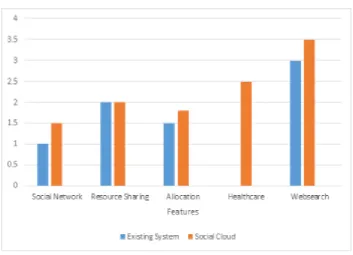
Figure 2. Comparison chart showing performance of social cloud
VII.CONCLUSION AND FUTURE WORK
A social cloud is a platform that enables the sharing of resources between friends via social relationships. In social cloud users can discover and do services contributed by their friends, taking advantage of preexisting trust and relationships between them. This methodology can be used by users to communicate with each other and interact with the resources of their friends. The service provider can share his service with free of cost. Service provider allows only their social website friends to access the service. The authorized users can share the services such as healthcare services and can perform web search. The main feature of social cloud is that it enables sharing of resources not selling. As future work it will include additional ways for users to provide their preferences, as well as methods to detect them automatically from their social network based on homophily (aspects of similarity).
REFERENCES
1. Simon Caton, Christian Haas and Kyle Chard, “A Social Compute Cloud Allocating and Sharing of Infrastructure Resources via Social Networks”, IEEE Transactions on Services Computing, 2014.
2. A. Mahon and V. Milenkovic, “A Social Volunteer Computing”, On Systemics Cybernetics and Informatics, 2011.
3. Z. Ali, R. Rasool, and P. Bloodsworth, “Social Networking for Sharing Cloud Resources”, Cloud and Green Computing, Second
International Conference, pp. 160–166, 2012.
4. R. GraciaTinedo and M. Sanchez Artigas, “Friendbox A Hybrid f2f Personal Storage Application”, Cloud and Green Computing, IEEE
5th International Conference, pp. 131–138,2012.
5. Kyle Chard and Simon Caton, “Social Cloud Cloud Computing in Social Network”, Third International Conference, 2010.
6. R. Wooten, R. Klink, and F. Sinek, “Design and Implemenation of a Secure Health care Social Cloud”, Cluster and Grid Computing,
Second International Conference, 2012.
7. Ioan Petri and Magdalena, “Broker Emergence in Social Cloud”, International Conference, 2008
8. OanaFrunza, Diana Inkpen, and Thomas Tran, “A Machine Learning Approach for Identifying Disease Treatment Relation in short text”,
Knowledge and Data Engineering, 2011.
9. LidanShou, He Bai, Ke Chen, and Gang Chen, “Supporting Privacy Protection in Personalized Web Search”, In System man and Cybernetics, 2014.
BIOGRAPHY