DEVELOPMENT OF AN INTELLIGENT AGENT FOR SPEECH
RECOGNITION AND TRANSLATION
(PEMBANGUNAN AGEN PINTAR UNTUK PENGECAMAN SUARA
DAN PENTERJEMAHAN)
ABD MANAN BIN AHMAD
RESEARCH VOT NO:
74076
Jabatan Kejuruteraan Perisian
Fakulti Sains Komputer dan Sistem Maklumat Universiti Teknologi Malaysia
ABSTRACT
Nowadays, speech researchers and software engineer make an effort to integrate speech function into internet applications. Intelligent Agent for Speech Recognition and Translation prototype has been build to achieve that purposed. This prototype also proposed a new framework for speech recognition, word translation and mobile agent technology. Intelligent Agent for Speech Recognition and Translation is a system that recognized human voice in spoken English, then translate English word to Malay word. Generally, this prototype is a merge of two areas, speech recognition and word translation and using mobile agent technology to integrate them. This prototype is a system executed in Local Area Network (LAN) environments and also called Distributed Speech
Recognition (DSR) system. DSR system divided into two parts, front-end processing (feature extractions) and back-end processing (recognition). There is a server which connected with a number of client devices. At the client side, the system will received human voice in spoken English and front-end processing will be done here. Then the feature files will be transmits to the server side which executed the back-end processing. When the voice has been recognized, the result will be translated into Malay word in text. After translation process is done, the Malay word in text will be send back to the client computer. All these processes will be handled and monitor by agent. With contribution from mobile agent technology, the efficiency of speech recognition server can be
ABSTRAK
Kini, penyelidik suara dan juga jurutera perisian telah berusaha untuk
mengintegrasikan fungsi-fungsi suara ke dalam aplikasi internet. Prototaip Agen Pintar untuk Pengecaman Suara dan Penterjemahan telah dibangunkan untuk bersama-sama memenuhi tujuan tersebut. Prototaip ini juga mengusulkan kerangka baru untuk
pengecaman suara, penterjemahan perkataan dan juga teknologi agen bergerak. Prototaip ini adalah satu sistem yang mengecam suara manusia dalam sebutan bahasa Inggeris, kemudian menterjemahkan perkataan Inggeris tersebut ke dalam perkataan bahasa
Melayu. Umumnya, prototaip ini adalah gabungan daripada dua bidang iaitu pengecaman suara dan juga penterjemahan perkataan serta menggunakan pendekatan teknologi agen bergerak untuk proses pengintegrasian. Prototaip ini dilarikan pada persekitaran
Rangkaian Kawasa Setempat (LAN) serta boleh dinamakan sebagai sistem Pengecaman Suara Teragih (PST). Sistem PST dibahagikan kepada dua bahagian utama iaitu
pengecaman suara pelayan adalah lebih baik jika dibandingkan dengan pengecaman suara teragih tradisional dalam konteks pemprosessan masa. Secara kesimpulannya, dengan menggunakan pendekatan teknologi agen, pengecaman suara pelayan boleh
CONTENTS
NO TITLE PAGE
ABSTRACT i
ABSTRAK ii
CONTENTS iii
LIST OF FIGURES viii
LIST OF TABLES x
LIST OF ABBREVIATIONS xi
LIST OF APPENDICES xii
CHAPTER I PROJECT OVERVIEW
1.1 Introduction 1.2 Background 1.3 Problem Statement 1.4 Aim
1.5 Project Objective 1.6 Scope Project 1.7 Thesis Arrangement
CHAPTER II LITERITURE REVIEW
2.1 Introduction 2.2 Mobile Agent
2.2.1 Network Computing Paradigm 2.2.2 Contemporary Mobile Agent System 2.2.3 Agent Design Pattern
2.2.3.1 Traveling Pattern 2.2.3.2 Task Pattern 2.2.3.3 Interaction Pattern
2.2.4 Parallel Processing using Mobile Agent 2.2.5 Multi-Threaded Application
2.2.5.1 Single-Threaded Programming 2.2.5.2 Multiprocess Programming 2.2.5.3 Multi-threaded Programming 2.3 Speech Recognition
2.4 Distributed Speech Recognition
2.4.1 Fundamental Architecture of DSR 2.4.2 Advantages of DSR
2.5 Word Translation 2.6 Development Tools
2.6.1 Java Agent Development Framework 2.6.2 CMU Sphinx4 Speech Recognition Engine
Framework 7 8 10 12 13 14 15 16 18 20 21 21 22 23 27 28 29 30 31 32 33
CHAPTER III METHODOLOGY
3.1 Introduction
3.2 Research Framework
3.2.1 Planning & Selection Phase 3.2.2 Design Phase
3.2.2.1 Analysis Stage 3.2.2.2 Design Stage 3.2.3 Operation & Implement Phase
3.2.3.1 Develop Prototype
3.2.3.2 Implement & Prototype Testing 3.2.3.3 Result & Discussion
3.2.3.4 Revise & Enhance 3.2.3.5 Wrapping Modules 3.2.4 Validation Phase
3.3 Research Methodology
3.4 General Framework of Intelligent Agent for Speech Recognition and Translation.
3.5 Data Source
3.5.1 Training and Testing Data 3.6 Analyze Requirement
3.6.1 Software Requirement 3.6.2 Hardware Requirement 3.7 Summary
39 40 40 40 41 41 42 43 43 44 47 48 48 50 50 52 53
CHAPTER IV DATA & DISCUSSION
4.1 Introduction 4.2 Data
4.2.1 DSR & Agent Development Data 4.2.1.1 DSR Data
4.2.1.2 Agent Development Data 4.2.2 Prototype Data
4.3 Data Format 4.4 Discussion
4.4.1 Design Process
4.4.2 Implementation Process
4.4.3 Testing Process and Result 4.5 Summary
73 84
CHAPTER V CONCLUSION
5.1 Introduction 5.2 Advantages 5.3 Contribution
5.4 Suggestion & Future Work 5.4.1 Academic Values 5.4.2 Commercial Values 5.5 Summary
86 87 87 89 89 90 90
REFERENCES APPENDICES
LIST OF FIGURES
NO FIGURES PAGES
2.1 Client-Server Paradigm 10
2.2 Code-on-Demand Paradigm 11
2.3 Mobile Agent Paradigm 12
2.4 Scenario of master-slave agent technique 16 2.5 Block diagram of recognition management in SRP 19
2.6 In single-threaded execution, statements are executed
sequentially 21
2.7 Application process can fork into two, having one or more
sub-processes perform useful work 22
2.8 Human speech recognition process 24
2.9 General Speech Recognition Architecture 25
2.10 General architecture for distributed speech recognition system 27
2.11 Jade platform 32
2.12 Sphinx4 Framework 33
3.1 Research framework for intelligent agent for speech recognition
and translation. 37
3.2 Research Methodology for Intelligent Agent for Speech
Recognition and Translation. 44
3.3 Framework of Intelligent Agent for Speech Recognition and
4.1 Example of transcripts and format naming files 58
4.2 Example of naming file 58
4.3 Applying Intelligent agent for Speech Recognition and
Translation Framework 59
4.4 Block diagram of the client-side for speech recognition system. 60
4.5 The architecture of an intelligent agent for speech recognition
and translation prototype 61
4.6 Master-Slave Agent Architecture for Speech Recognition &
Translation in Network 63
4.7 Detailed architecture of distributed speech recognition system 65
4.8 Sample code for SpeechAgent 69
4.9 Sample code for TranslationAgent 70
4.10 Sample code for ClientAgent 71
4.11 Sample code for register the service 72
4.12 User interface at the client side 72
4.13 Server side interface 73
4.14 Time Processing of Speech Recognition Engine Server and
Word Translation for 2 clients 78
4.15 Time Processing of Speech Recognition Engine Server and
Word Translation for 4 clients 79
4.16 Time Processing of Speech Recognition Engine Server and
Word Translation for 6 clients 80
4.17 Average Task Time Processing of Speech Recognition Engine
time performance 82
LIST OF TABLES
NO TABLE PAGE
2.1 Agent Design Patterns 17
2.2 List of Technical Terms 30
3.1 English and Malay word keep in MySQL database 49
4.1 Grouping of computer clients 74
4.2 Speech recognition time processing for 2 clients. 75 4.3 Speech recognition time processing for 4 clients. 76 4.4 Speech recognition time processing for 6 clients. 77 4.5 Average speech recognition engine time processing for each
task per total assigned tasks. 81
LIST OF ABBREVIATIONS
ASR - Automatic Speech Recognition
AMS - Agent Management System
AUML - Agent Oriented Unified Modeling Language
CORBA - Common Object Request Broker
Architecture
DCT - Discrete Cousine Transform
DF - Directory Facilitator
DSR - Distributed Speech Recognition
FFT - Fast Fourier Transform
HMM - Hidden Markov Models
IP - Internet Protocol
Jade - Java Agent Development
JDK - Java Development Kit
LAN - Local Area Network
LPC - Linear Predictive Coding
MaSE - Multiagent Systems Engineering
MESSAGE - Methodology For Engineering Systems Of Software Agent
LIST OF APPENDICE
APPENDIX TITLE PAGE
CHAPTER I
PROJECT OVERVIEW
1.1 Introduction
Intelligent networking is helping to advance the sharp rise and wide exploitation of agent technologies. Mobile agent technology, a profound revolution in computer software technology, is a brand new computing technique promoted for solving the complicated and dynamic applications of distributed intelligence. Followed by the rapid development of artificial intelligence and computer networking, especially for the popular applications of Internet and related technologies in recent years, the network has become a basic platform for people to publish and obtain information. Under this
background, computing is no longer limited to few servers in the network, but all computers are required to get involved into this environment.
1.2 Background
This research is about Development of an Intelligent Agent for Speech
Recognition and Translation. Basically, input for this system is voice in English sound and the output is Malay text. Therefore, this system also can call it as English – Malay word translation system based on voice input and the result is in text. This system support utterance of technical terms based on Information Technology domain. This research involved three main parts: mobile agent, speech recognition and word translation. Generally, this system runs on Local Area Network (LAN) environments and it also called distributed speech recognition. User will record voice at the client-side while at the server-side, recognition and translation process will be done and the result will be send to the user. Translation part was based on translate word from English word to a Malay word. Those words were based on 10 confusable technical terms – in the Information Technology domain.
This system was developed based on mobile agent technology on networks to support distributed speech recognition system and English – Malay word translation as well. Agent development was based on Java Agent DEvelopment (JADE) framework, which contained management agent for both speech process and word translation process. While, speech recognition processed was based on CMU Sphinx4 Speech Recognition engine. MySQL 5.1 also has been applied to support prototype database, especially used in translation parts. Further description about these parts will be explains in the next section.
1.3 Problem Statement
vectors are obtained at the client side and transmitted to the remote server for recognition. These services are based on a client-server architecture:
i. The client device quantizes and packetizes the speech features and transmits them over the communication channel to a remote ASR server. ii. The remote ASR server performs the speech recognition task.
For this research, we also applied both of the services but not exactly based on client-server architecture. It is because client-server implementation was highly dependent on sufficient network bandwidth (Robert S. Gray, 2001). However, for running distributed speech recognition system, network bandwidth was not usually in a good condition. Differs from mobile agent technology, agent implementations saved network bandwidth at the expense of increased server computation. In this situation, we believed by using mobile agent technology to support distributed speech recognition system was an excellent idea. We also applied mobile agent parallel processing to support remote server computation to recognize the features files.
Based on experiments done by Robert S. Gray (2001), mobile agents can be beneficial in situations with low network bandwidth and plentiful server capacity. Indeed, in many environments it is easier to add more server capacity than to add network
capacity. With those problems, we believed this project, Development of Intelligent Agent for Speech Recognition and Translation can solve the problems either to improve the accuracy of speech recognition performance or to come out with new architecture of mobile agent technology in DSR systems.
1.4 Aim
spoken English and output as a Malay in text. In addition, the systems run on Local Area Network (LAN) environment.
1.5 Project Objectives
The purposed of this research was to develop agent-based distributed speech recognition and translation. The input was spoken English and the output was Malay word in text. The systems execute on LAN environment. There are several objectives for this project. There are:
i. To identify a framework of human speech.
ii. To develop an architecture of an intelligent agent for speech recognition. iii. To develop a prototype of a speech recognition system for the
improvement of an existing online ‘Sistem Penterjemahan Istilah Teknologi Maklumat’ from Dewan Bahasa dan Pustaka.
This research also wants to know the efficiency of mobile agent technology in distributed speech recognition environment. These efficiencies can be look deeper in two ways:
i. How mobile agent technology is competent to support distributed speech recognition application through network compare with client-server method?
ii. How mobile agent technology can optimize speech recognition engine server processes for each request and response from client devices?
1.6 Scope Project
Development of Intelligent Agent for Speech Recognition and Translation prototype is based on several conditions and scopes. These kinds of scopes are lists below:
i. The prototype runs on Local Area Network (LAN) environments. ii. The translation process is based on English – Malay word translations.
iii. The prototype used CMU Sphinx4 speech recognition engine as speech recognition engine server.
iv. The prototype used Java Agent Development Framework to develop agent functions.
1.7 Thesis Arrangement
i. Project Overview.
First chapter that should be done is Project Overview. This chapter describes project overview: Development of an Intelligent Agent for Speech Recognition and Translation. It contains of general overview about three main parts in this research project: Mobile Agent, Speech Recognition Engine and Word Translation, our research target and project objectives.
ii. Literature Review
iii. Methodology
In this chapter, it will describe about the methodology, method and techniques that will be use in this system development life cycle. This chapter will be divided into two parts: project development methodology and system prototype development methodology.
iv. Project Design and Implementation
In this chapter, it consists of two main process development : mobile agent system development and speech recognition engine development. This chapter will describe a model to develop the system and the methodology based on agent development process and also methodology based on CMU Sphinx4 Speech recognition engine.
v. Result and Conclusion
CHAPTER II
LITERATUR REVIEW
2.1 Introduction
2.2 Mobile Agent
Mobility is an orthogonal property of agents. That is, not all agents are mobile. An agent can just sit there and communicate with its surroundings by conventional means, such as various forms of remote procedure calling and messaging. We call agent that do not or cannot move stationary agent.
Stationary Agent-A stationary agent executes only on the system where it begins execution. If it needs information that is not on that system or needs to interact with an agent on a different system, it typically uses a communication mechanism such as remote procedure calling (RPC) (Danny B. Lange and Mitsuru Oshima, 1998).
In contrast, mobile agent is not bound to the system where it begins execution. The mobile agent is free to travel among the hosts in the network. Created in one execution environment, it can transport its state and code with it to another execution environment in the network, where it resumes execution. By the term state, it typically means the attribute values of the agent that help it determine what to do when it resumes execution at its destination. By the term code, in an object-oriented context, the class node necessary for the agent to execute.
Mobile Agent - A mobile agent is not bound to the system where it begins execution. It has the unique ability to transport itself from one system in a network to another. The ability to travel allows a mobile agent to move to a system that contains an object with which the agent wants to interact and then to take advantage of being in the same host or networks as the object (Danny B. Lange and Mitsuru Oshima, 1998).
requests (Herve Paulino, 2002). This mobility greatly enhances the productivity of each computing element in the network and creates a powerful computing environment. Mobile agents require a software infrastructure that provides them security and data protection. This infrastructure includes protocols, rules for safe mobility and, directions and directories with information about all available hosts.
The use of mobile agents for distributed applications has several potential benefits (Stefan Fünfrocken and Friedemann Mattern, 1999). Those benefits are as follows:
i. Asynchronous task execution: while the agent acts on behalf of the client on a remote site, the client may perform other task.
ii. More dynamic: It is not necessary to install a specific procedure at a server before-hand and to anticipate specific service request types; a client or a service provider may send different types of agents to a server without the need to reconfigure the server.
iii. Reduced communication bandwidth: If vast amounts of server data have to be processed and if only a few relevant pieces of information have to be filtered out, it is more economical to transfer the computation to the data than the data to the computation.
2.2.1 Network Computing Paradigm
Mobile agents provide a powerful, uniform paradigm for network computing. Mobile agents can revolutionize the design and development of distributed systems. There are several programming paradigm for distributed computing such as client-server, code-on-demand and mobile agents (Danny B. Lange and Mitsuru Oshima, 1998).
i. Client-Server Paradigm
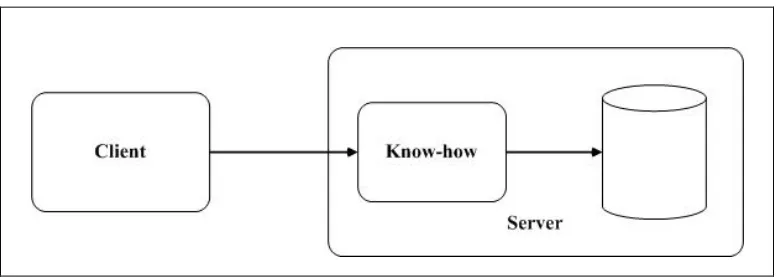
In the client-server paradigm (see figure), a server advertises a set of services that provide access to some resources (such as database). The code that implements these services is hosted locally by the server. The server holds the know-how. Finally, it is the server itself that executes the services and thus has the processor capability. If the client is interested in accessing a resource hosted by the server, the client will simply use one or more of the services provided by the server. Clients need some “intelligence” to decide which of the services it should use. The server has it all: the know-how, resource and processor. So far, most distributed systems have been based on this paradigm. We see it supported by a wide range of technologies such as remote procedure calling (RPC), object request broker (CORBA) and Java remote method invocation (RMI).
ii. Code-On-Demand Paradigm
According to the code-on-demand paradigm (see figure ), you first get the know-how when you need it. Suppose that the client initially is unable to execute its task because of a lack of code (know-how). Fortunately, a host in a network provides the needed code. Once the code is received by the client, the computation is carried out in the client. The client holds the processor
capability as well as the local resource. In contrast to the classical client-server paradigm, the client does not need preinstalled code because all the necessary code will be downloaded. The client has the resource and processor, and the host has the know-how. Java applets and servlets are excellent
practical examples of this paradigm. Applets get downloaded in web browsers and execute locally, whereas servlets get uploaded ti remote Web servers and execute there.
Figure 2.2: Code-On-Demand Paradigm
iii. Mobile Agent Paradigm
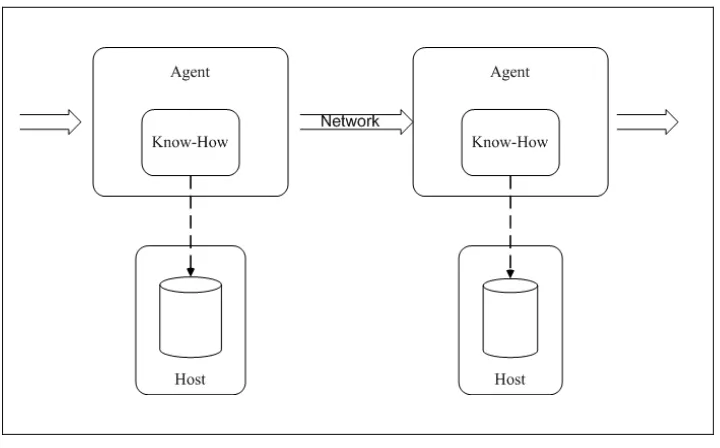
A key characteristic of the mobile agent paradigm (see figure ) is that any host in the network is allowed a high degree of flexibility to possess any mixture of know-how, resources and processors. Its processing capability can be
Figure 2.3: Mobile Agent Paradigm
The comparison between these three paradigms is the chronological trend toward greater flexibility. The client and server has merged and become a host. The applet and the servlet, while serving as client and server extenders, respectively, have been
combined and improved with the emergence of mobile agents.
2.2.2 Contemporary Mobile Agent Systems
What kind of mobile agent systems are available? Fortunately, Java has generated a flood of experimental mobile agent systems. Numerous systems are currently under development, and most of them are available for evaluation on the web (Danny B. Lange and Mitsuru Oshima, 1998). Some of Java-based mobile agent systems are as follows:
combining agent and applet. One of the aglet purposed is to make aglets an exercise in clean design. So that, applet programmers will appreciate the many ways in which the aglet model reflects the applet model.
ii. Odyssey. General Magic Inc. invented the mobile agent and created Telescript, the first commercial mobile agent system. Based on proprietary language and network architecture, Telescript had a short life. In response to the popularity of the internet and later the steamroller success of the Java language, General Magic decided to re-implement the mobile agent paradigm in its Java-based Odyssey. This system effectively implements the Telecsript concepts in the shape of Java calluses. The result is a Java class library that enables developers to create their own mobile agent applications.
iii. Concordia. Mitsubishi’s Concordia is a framework got the development and management of mobile agent applications that extend to any system
supporting Java. Concordia consists of multiple components, all written in Java, which are combined to provide a complete environment for distributed applications. A Concordia system, at its simplest, is made up of a standard JavaVM, a server and a set of agents.
iv. Voyager. ObjectSpace’s Voyager is a platform for agent-enhanced distributed computing in Java. While Voyager provides an extensive set of abject
messaging capabilities, it also allows objects to move as agents in the network. You can say that the voyager combines the properties of a Java-based object request broker with those of a mobile agent system. In this way, Voyager allows Java programmers to create network applications using both traditional and agent-enhanced distributed application techniques.
2.2.3 Agent Design Pattern
idea of design patterns is to define general solution models for common problems found in a given context. In fact, some problems can be faced many times during different phases of the development process. It would be worthwhile if good solutions for these problems could be reused instead of the necessity to develop a new one from scratch. Design patterns make easier the development of applications, increasing flexibility and promoting reuse.
The advantage of using mobile agent design patterns in JADE framework has been shown in (Emerson Ferreira et. al, 2003). The use of agent design patterns has generally increased due to the advantages they can bring to applications development, like reuse and a better understanding of their project. These advantages can also be obtained when developing mobile agent-based applications by using mobile agent design patterns. These patterns present solutions that can be reused, avoiding loss of time and effort to investigate problems that have already been solved.
The patterns so far can be divided into three classes: traveling, task and interaction. This classification scheme makes it easier to understand the domain and application of each pattern, to distinguish different patterns, and to discover new patterns. We describe the three classes of patterns as well as the patterns in each class.
2.2.3.1Traveling Pattern
The ticket pattern, an enriched version of the concept of a URL, embodies
requirements concerning quality of service, permission or other data. For example, it can include time-out information for dispatching the agent to a remote host. Thus, instead of naively trying to dispatch to a disconnected host forever, the agent now has the necessary information to make reasonable decisions while traveling.
2.2.3.2Task Pattern
Task patterns are concerned with the breakdown of task and how these tasks are delegated to one or more agent. In general, task can be dynamically assigned to general purpose agents. Furthermore, a given task can be accomplished either by a single agent or by multiple agent working in parallel and cooperating to accomplish it (such as in the case of a parallel search).
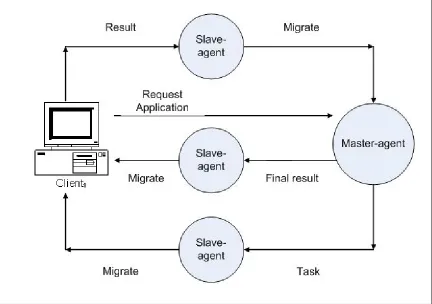
The fundamental task pattern is Master-Slave pattern, which allow the master agent to delegate a task to a slave agent. The slave agent moves to a destination host, performs the assigned task, and sends back the result of that task. The more complex Plan pattern adopts a workflow concept to organize multiple tasks to be performed in sequence or in parallel by multiple agents. The plan encapsulates the task flow, which is then hidden from the agent. The agent merely provides the mobility capabilities needed to perform activities at specific destinations. The plan promotes reusability of tasks,
Figure 2.4 : Scenario of master-slave agent technique
2.2.3.3Interaction Pattern
The ability of agent to communicate with one another is vital for cooperation among agents. The interaction patterns are concerned with locating agent and facilitating their interactions. The Meeting pattern is an interaction patterns that provides a way for two or more agent to initiate local interaction at a given host. It abstracts the
bringing along data that for the moment are not needed. Later, agent can return and retrieve the private data stored in the locker. For example, in an agent-based purchasing system, an agent may visit a vendor’s host locker before leaving the company network. The result is a reduction of network traffic and improved data confidentially.
Agent can establish remote communication by using the Messenger pattern, which objectifies messages in the form of agent that carry and deliver messages between agents. For example, if a slave agent wishes to report a possibly intermediate result back to the master agent, it can send the result by a messenger agent while continuing with its current task.
The Finder pattern describes a naming and locating service for agents. It is so often convenient to assign a symbolic (meaningful) name to an agent in order to locate it later. For example, an information-gathering agent may continuously move in the
network and other agents may from tome to time wish to retrieve updates from the information-gathering agent without actually knowing its present location.
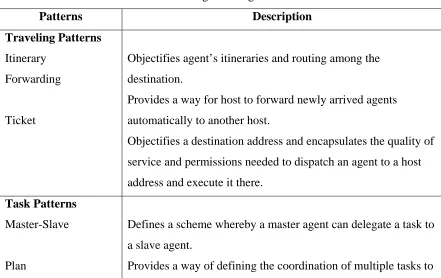
Table 2.1: Agent Design Patterns
Patterns Description Traveling Patterns
Itinerary Forwarding
Ticket
Objectifies agent’s itineraries and routing among the destination.
Provides a way for host to forward newly arrived agents automatically to another host.
Objectifies a destination address and encapsulates the quality of service and permissions needed to dispatch an agent to a host address and execute it there.
Task Patterns Master-Slave
Plan
Defines a scheme whereby a master agent can delegate a task to a slave agent.
be performed on multiple hosts.
Interaction Patterns Meeting
Locker
Messenger
Finder
Provides a way for two or more agents to initiate local interaction at a given host.
Defines a private storage space for data left by an agent before it is temporarily dispatched (sent) to another destination. Defines a surrogate agent to carry a remote message from one agent to another.
Defines an agent that provides services for naming and locating agents with specific capabilities.
2.2.4 Parallel Processing using Mobile Agent
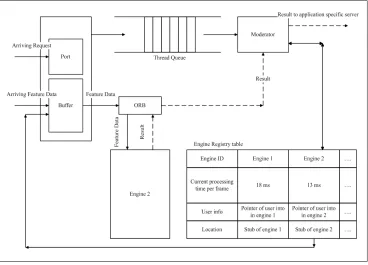
Wei Qi Zhang et al, (2000) also described implementation of recognition server which they used CORBA method and the core components in CORBA is SRP. The data/control flow inside SRP is shown in figure 2.5. In this figure, when a request arrives on SRP, SRP creates a new thread Thread2 to manage the connection and receive the following feature data. When the data completely received, the handle of Thread2 is put into Thread Queue, which is a buffer used to contain all the requesting thread handles. When Thread2’s handle reaches the top of the queue, this handle is deleted from the queue if there are available engine servers. Otherwise, Thread2’s handle has to wait.
Moderator decides which engine server is available according to a workload schedule scheme. A workload schedule scheme is typically geared to meet certain performance metrics, which include CPU efficiency of engine server, number of jobs (threads), response time of each request (user), amount of processed data, communication throughput and memory requirement.
This prototype intelligent agent for speech recognition and translation applied mobile agent technology to support parallel processing in speech recognition server. Mobile agent has a method that called agent design pattern. This method has been
described before at section 2.1.3. This method has three classes and task pattern class has been chosen to support parallel processing in speech recognition server.
In class task pattern, it provided Master-Slave pattern, which allow the master agent to delegate a task to a slave agent. The slave agent moves to a destination host, performs the assigned task, and sends back the result of that task (Danny B. Lange and Mitsuru Oshima, 1998). Based on this pattern, a parallel processing for speech
recognition server has been build and implemented. A master-slave responsible to manage, monitor, create and control each agent that executed and connected with this system. Master-slave will delegate the speech and translation process to each slave-agent that he created. For every slave-agent, they have their own thread. With that thread, they can perform the given task without have to queue.
2.2.5 Multi-Threaded Application
Multi-threaded programming is an important concept in Java networking, as networking clients and servers must often perform several different tasks at a time (for example, listening for incoming requests and responses, processing data, and updating the text or graphical user interface for the user). Multi-threading is a strategy to split tasks into manageable units (David Reilly and Michael Reilly, 2002). There are three types of multi-threaded programming:
2.2.5.1 Single-Threaded Programming
Traditional software written in procedural languages is compiled into a machine-readable format, which is called machine code. This code is read by a central processing unit (CPU), which executes programming statements one after another, in a sequential manner (see figure 2.6). The time taken to execute each statement may vary (due to the nature of the operation, such as comparing two bytes for quality or adding two number together), but until a statement is completed, no further statement will run. This is single-threaded execution.
Figure 2.6 : In single-threaded execution, statements are executed sequentially statement 1
statement 2 statement 3 ………….. ………….. statement n
2.2.5.2 Multiprocess Programming
Multiprocess programming can be described as each application runs as a process, with memory allocated for program code and data storage (Multiple processes would run on the same machine. The operating system would allocate CPU time to each process, suspending a process when its time was up and allowing another to take its place.
Sometime, a process will become blocked (waiting an I/O), or may voluntarily choose to yield it CPU time.
of programming is useful, as it means that work can be performed even if one part of the program becomes stalled (for example, waiting for input).
Although multiprocess programming works well, there are disadvantages to its use. First, when a process branches into two, there is overlap between the data storage of one process and another. Because two copies of data are being kept, more memory than is needed is consumed. Second, there isn’t an easy way for one process to access and
modify the data of another.
Figure 2.7: Application process can fork into two, having one or more sub-processes perform useful work
2.2.5.3 Multi-threaded Programming
is, many tasks are performed at the same time, rather than one task having to finish before another can start. Multi-threading, also known as multiple thread of execution, allow a program to have multiple instances of itself running, while using the same shared
memory space and code (David Reilly and Michael Reilly, 2002). An application can be performing many different tasks concurrently and thread may access shared data
variables to work collaboratively.
2.3 Speech Recognition
Speech recognition is an alternative to traditional methods of interacting with a computer, such as textual input through a keyboard. An effective system can replace, or reduce the reliability on, standard keyboard and mouse input. This can especially assist the following:
• People who have little keyboard skills or experience, who are slow typist, or do not have the time to resources to develop keyboard skills.
• Dyslexic people, or others who have problems with character or word use
and manipulation in a textual form.
• People with physical disabilities that affect either their data entry, or
ability to read (and therefore check) what they have entered.
Speech and understanding voice message by human is a complex process. Factors like height, weight, sex, teeth and lips can give an impact to their speech. Voice processing by human can be simplified as below.
Processing sequence in the human auditory system.
- Fixed filter which represents the transfer from free field to eardrum and through the middle ear.
- Dynamic compression, when mechanical energy is transformed to neural signals by the hair cells.
- Periodicity estimation at each band.
- Integration of the band-wise processed signals and further calculations. This takes place in the central nervous system (brains).
Human perception of speech starts with receiving signal by the ear. It will then pass the membrane basilar in the inner ear where the signal will be analyzed. The analyzed signal will pass to neural tranductor that convert the signal into activity signal on the auditory nerve and the brain will translate and understood the speech. Figure 2.8 show the scenario of human speech recognition process.
Figure 2.8: Human speech recognition process
A speech recognition system consists of the following:
• A microphone, for the person to speak into.
• Speech recognition software.
• A computer to take and interpret the speech.
• A good quality soundcard for input and/or output.
“fits” an acceptable phoneme string or structure that the software can derive from its dictionary.
It is a common misassumption that such a system can just be used “out of the box” for work purposes. The system has to train to recognize factors associated with the users voice e.g speed, pitch. Even after this training, the user often has to speak in a clear and partially modified manner in order for his or her spoken words to be both recognized and correctly translated.
Most speech recognition software is configured or designed to be used on a stand-alone computer. However, it is possible to configure some software in order to be used over a network. We can classify speech recognition tasks and systems along a set of dimensions that produce various tradeoffs in applicability and robustness. A speech recognition system can be used in many different modes (speaker dependent or independent, isolated / continuous speech, for small or large vocabulary). Figure 2.9 show the general speech recognition architecture which it contains two main components, Features Extraction and Speech Recognizer. This architecture received speech voice as an input and text as an output.
Isolated word versus continuous speech: Some speech systems only need identify single words at a time (e.g., speaking a number to route a phone call to a company to the appropriate person), while others must recognize sequences of words at a time. The isolated word systems are, not surprisingly, easier to construct and can be quite robust as they have a complete set of patterns for the possible inputs. Continuous word systems cannot have complete representations of all possible inputs, but must assemble patterns of smaller speech events (e.g., words) into larger sequences (e.g., sentences).
Speaker dependent versus speaker independent systems: A speaker dependent system is a system where the speech patterns are constructed (or adapted) to a single speaker. Speaker independent systems must handle a wide range of speakers. Speaker dependent systems are more accurate, but the training is not feasible in many applications. For instance, an automated telephone operator system must handle any person that calls in, and cannot ask the person to go through a training phase before using the system. With a dictation system on your personal computer, on the other hand, it is feasible to ask the user to perform a hour or so of training in order to build a recognition model.
Small versus vocabulary systems: Small vocabulary systems are typically less than 100 words (e.g., a speech interface for long distance dialing), and it is possible to get quite accurate recognition for a wide range of users. Large vocabulary systems (e.g., say 20,000 words or greater), typically need to be speaker dependent to get good accuracy (at least for systems that recognize in real time). Finally, there are mid-size systems, on the order to 1000-3000 words, which are typical sizes for current research-based spoken dialogue systems.
2.4 Distributed Speech Recognition
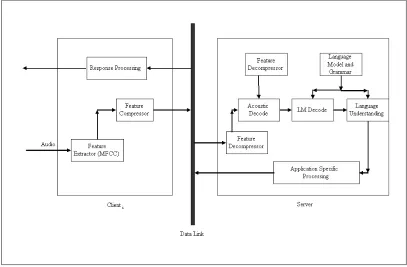
Based on (Imre Kiss et. al, 2003), in the Distributed Speech Recognition (DSR) system, the recognition process is split between the terminal device and the network server. Feature extraction (front-end) followed by parameter compression is carried out at the terminal end (server). The compressed recognition parameters are subsequently transmitted to the network server where the actual pattern matching stage (back-end) is performed. (Imre Kiss et. al , 2003) also mentioned that the development of DSR has been motivated by two main reasons. By computing the recognition parameters at the terminal end and sending them as data over the channel, it is possible to have less distorted input for the recognition process. This arrangement helps to improve the robustness against channel errors, as well as distortions introduced by the speech coding algorithm. Secondly, DSR is efficient from the channel occupation point of view, as only a handful of recognition parameters need to be sent to the network end. Figure 2.10 show the general architecture for distributed speech recognition.
2.4.1 Fundamental Architecture of DSR
Generally there are three alternative strategies in the design of DSR architectures (Wei Qi Zhang et. al, 2000). Those three architectures are as follows:
i. Server-only processing.
All processing done at the server side and the speech signal is transmitted to the server either through the internet by using speech coding or via a second channel like telephone (Domonic Vaufreydaz et. al. 1999; Zhemin Tu and Philipos C. Loizou, 1999).
ii. Client-only Processing
Most of speech processing is done at the client-side and the results are transmits to the server (Aldebaro Klautau, 2000).
iii. Client-server processing.
In this model, front-end processing of speech features are transmitted to the server and finally the processing of speech decoding and language
understanding are performs at the server-side. However, all the distributed speech recognition strategies were based on client-server model.
These types of architectures gave some advantages to the DSR systems. By using DSR systems:
i. By maintaining language models, dictionaries and user interface components on the server, DSR is less constrained by memory limitations on wireless devices.
ii. DSR lets the developer add voice interfaces to a variety of mobile devices without significant hardware requirements.
For this development of an intelligent agent for speech recognition and
translation, we used the third architecture: client-server processing. We divided speech recognition components into two parts. One part runs at the client-side (front-end
processing) and the other part runs at the server-side (back-end processing). At the client-side, the user will speak a word in English and record the voice into the interface layer. The interface layer can receive and record voice from the user. After the voice is
recorded, it will send to the speech encoder. The speech encoder processes the input and extracts the features of the voice. The extracts data then send to the speech decoder at the server-side. At the server-side, speech decoder will recognize the extract data and covert it into a text.
2.4.2 Advantages of DSR
Based on (David Pearce, 2000), the main benefits of DSR are as follows:
i. Improved recognition performance over wireless channel and network. The use of DSR minimizes impact of speech codec and channel errors that reduce the performance from recognizers accessed over digital mobile speech channels.
ii. Ease of integration of combined speech and data applications.
Many new mobile multimodal applications are envisioned; such as the use pf speech to access wireless internet content. The use of DSR enables these to operate over a single wireless data transport rather than having separate speech and data channels
trained over man network give a compromise performance. DSR in the other hand offers the promise of guaranteed level of recognition performance over every network. It uses the same front-end and there is no channel distortion coming from the speech coded and its behavior in transmission errors.
2.5 Word Translation
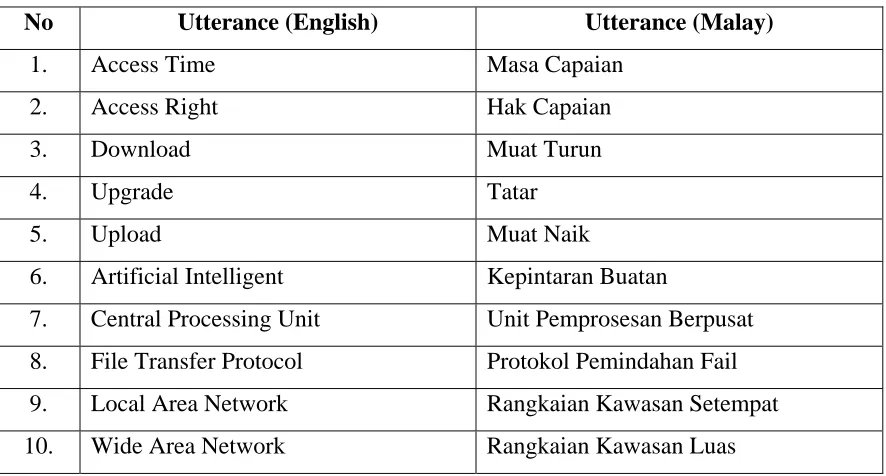
This prototype involved two main areas, speech recognition and word translation. It will receive a wav file as an input and a text file as an output. After the prototype received a wav file, the file will be processes by speech recognition engine until get a result. The result is in text file and in English. The purpose of this prototype is to translate the English word to Malay word. So, the translation engine will translate the source word (English) to the target word (Malay). For this prototype, several technical terms has been used for both processes training and testing. The lists of the technical terms are shows at table 2.2.
Table 2.2: List of technical terms
No Utterance (English) Utterance (Malay)
1. Access Time Masa Capaian
2. Access Right Hak Capaian
3. Download Muat Turun
4. Upgrade Tatar
5. Upload Muat Naik
2.6 Development Tools
In this research project, “Development an Intelligent Agent for Speech
Recognition and Translation” we selected and used several tools that we found it suitable for us to develop the systems. Tools like Java Agent Jade for mobile agent development and Sphinx4 Speech Recognition engine for speech recognizer are the best framework that we have chosen.
2.6.1 Java Agent Development Framework (JADE)
JADE is completely written in Java and JADE programmers work in full Java when developing our agents. An overview of the JADE platform, the description of it architecture, main functionalities and the outline of the conceptual model is shown in (Willlie Walker et al ,2004). There are two major aspects in Jade: distributed system topology with peer-to-peer networking and software component architecture with agent paradigm. JADE is an enabling technology, a middleware for the development and run-time execution of peer-to-peer applications which are based on the agents paradigm and which can seamless work and interoperate both in wired and wireless environment.
JADE is fully developed in Java and is based on the following driving principles:
Interoperability – JADE is compliant with the FIPA specifications. As a
consequence, JADE agents can interoperate with other agents, provided that they comply with the same standard.
Uniformity and portability – JADE provides a homogenous set of API’s
that are independent from the underlying network and Java version. More in details, the JADE run-time provides the same APIs both for J2EE, J2SE and J2ME environment. In theory, application developers could decide the Java run-time environment at deploy-time.
Easy to use – The complexity of the middleware is hidden behind a simple
and intuitive set of APIs.
Pay-as-you-go philosophy – Programmers do not need to use all the
features provided by the middleware. Features that are not used do not require programmers to know anything about them, neither add any computational overhead.
2.6.2 CMU Sphinx4 Speech Recognition Engine Framework
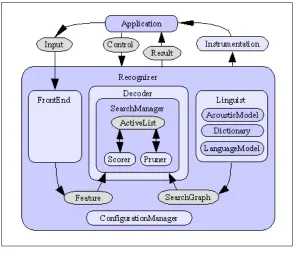
The Sphinx-4 framework has been designed with a high degree of flexibility and modularity. Figure 2.12 shows the overall architecture of the system. Each labeled element in Figure 2.12 represents a module that can be easily replaced, allowing researchers to experiment with different module implementations without needing to modify other portions of the system.
Figure 2.12: Sphinx4 Framework
There are three primary modules in the Sphinx-4 framework: the FrontEnd, the Decoder, and the Linguist. The FrontEnd takes one or more input signals and
CHAPTER III
METHODOLOGY
3.1 Introduction
3.2 Research Framework
Figure 3.1: Research framework for intelligent agent for speech recognition and translation.
3.2.1 Planning and Selection Phase
should be executed. Generally, it summed up to a manageable groundwork towards the research goal.
In this stage, a broad view of the current situation within intelligent agent, mobile agent, distributed speech recognition and word translation is examined. Request for a new system springs from desire for enhancement in current system which still has large rooms for improvements are extracted. From the extracted information, possible candidates of solutions and improvements are gathered and clustered by their weakness and
advantages. The best cluster of possible solutions is carried out to the next stage for analysis. The next task in this process is investigating the current of mobile agent, distributed speech recognition, and word translation system and the proposed solutions. Furthermore, the investigation leads out to the requirements of justifications and
specifications for the research study.
In this phase also, research planning must be clarified. Careful planning at the beginning of the project is perhaps the single most important factor that distinguishes success from failure. From the available model and approach comparison, mobile agent technology approach is chosen for agent development while Sphinx4 speech recognition engine for recognition performances.
3.2.2 Design Phase
Before developing a working model of the research, a design is created. This is to ease development process forward in this stage. A design based on Multiagent System Engineering (MaSE) methodology is being used. MaSE methodology is similar to traditional software engineering methodologies is but specialized for use in the
distributed agent paradigm (Deloach, 1998). MaSE methodology takes an initial system specification, and produces a set of formal design documents in a graphically cased style. The MaSE will guide a designer through the software lifecycle from a prose specification to an implement agent system. The MaSE will chart out and organized the proposed prototype model which is easy to developed and maintained. The next step is the development process of the model designed.
3.2.2.1Analysis Stage
In the analysis stage, the requirements of the proposed system are determined. Candidate solutions are discussed and compared in selecting the best alternative which meets the systems needs. The best solution selected is then studied detailed down to its structure before implemented within the research study.
The analysis process does not end with the selection of the solution. The analysis is the continuing by exploring the environments of the current both mobile agent and distributed speech recognition systems. The environment are analyzed in determining the others contributions factors that has effects to the distributed speech recognition
3.2.2.2Design Stage
At this level, design stage will define (or reuse) the agent architectures for each individual agent type. The agent architecture defines the components within each agent and how they interact. The agent level is documented. At this stage also, some of the process must be defined such as mapping actions identified in agent conversations to internal components, defining data structures identified in agent conversations and defining additional data structures, internal to the agent. At this stage also the overall of system design is specified using an AgML deployment diagram. To ease the process of the design, some steps should be followed. Those steps are: i) selecting the agent types that are needed, ii) determining the number of agents required of each type and defining. The output of this design stage will be use for system development at the next phase.
3.2.3 Operation & Implement Phase
Operation defined here as a process which the functions are defined and
developed. As this stage is based on prototyping approach in software development, the prototyping process will lead out from this point though out to the end of the stage.
3.2.3.1Develop Prototype
the expect inputs and outputs, the modules functions, and general design are then being developed accordingly.
3.2.3.2Implement and Prototype Testing
The developed model is then implemented to a real system. There are two types of implementation done to test the developed model. There are alpha and beta testing. The alpha testing will be testing among team development (organization) where the outputs are the results of input generated within the team development.
The mistakes and errors found within these testing phases will be addressed in the next stage Result & Discussion for process evaluation.
3.2.3.3Result & Discussion
After Implement & Prototype Testing stage has been done, the result will be
addressed to Result & Discussion stage. This stage is a process to ensure all the result has match and fulfill all the system objectives and also to ensure the prototype is ready to work in a real environment. This stage also, the result will be discussed. The outcomes of the discussion, solid or poor result will be addressed to Revise & Enhance stage for revise and enhancement process until the prototype system ready to work in a real environment.
i.System Performance
ii.Malay acoustics model for speech recognition
This section is a process to ensure the accuracy of Malay acoustic model for speech recognition performance is ready to be implemented in a real environment.
Intelligent Agent for Speech Recognition and Translation used Malay acoustic model based on phoneme acoustic model unit. Once this phoneme accuracy is higher that 95%, the Malay acoustic model ready to use. However, if the phoneme accuracy for Malay acoustic model is below than 95%, some modification or
parameters setup in training process for acoustic model should be done to ensure the accuracy must higher than 95%.
iii.Objective Verification
After making the final conclusions on the findings from the analysis, the objectives of this project are verified to make sure that research has fully accomplished the vision of this project. All the objectives have to be met in order to clarify that this research project is success. The purpose of this section is to ensure all objectives, vision can be achieved and all the problems that stated earlier are solved at the end of research.
3.2.3.4Revise & Enhance
The revise & enhance stage will ensure that all the errors and mistakes found within the working model is taken care and corrected. A suitable patch for each error will be produced if error occurred in previous phase. It is a continuing loop for the Revise and Enhance stage with Design phase and Developed Prototype stage in the Operation & Implementation phase until there are no more errors found within the working model.
If the major mistakes or errors are found within the module which needs
process. As a research study and a new adapt technology, the Intelligent Agent for Speech Recognition and Translation cannot run away from these changes as it is involving exploring new areas of solutions.
3.2.3.5Wrapping Modules
After the two previous phases has been done, the working prototype model is then being wrapped up as a library for the use in the validation process. The module is an interactive module which it has inputs and outputs. The module structures are still designed accordingly to the MaSE designed.
At this stage, it is a wrap for the development of the Intelligent Agent for Speech Recognition and Translation prototype. The working prototype then passed from
Operation & Implementation phase to the Validation phase.
3.2.4 Validation Phase
3.3 Research Methodology
Intelligent Agent for Speech Recognition and Translation prototype has been developed based on research methodology that been produced. This methodology contains the process from the beginning of the executed system to the end or until prototype was shut down. Figure 3.2 shows the research methodology for developing Intelligent Agent for Speech Recognition and Translation.
Figure 3.2: Research Methodology for Intelligent Agent for Speech Recognition and Translation.
This research methodology can be divided into two main parts, client side processing and server side processing. The important process for both parts is to create agents, ClientAgent (client side), SpeechAgent and TranslationAgent (both at the server side). These three agents have their own tasks and responsibility. The process by each part will be described separately.
Interface, Request/Response management and Receive/Transmit Data. Client Interface responsible for interacting between user and system, while Request/Response
management responsible for request and response any process either from server side or itself. Receive/Transmit Data responsible to handle any kind of data that will send from client to server and also received data from server to client.
Client Interface will be act like connection between user and system. In
distributed speech recognition system, front-end processing will be executed at the client side. Therefore, Client Interface will performs this tasks and will be guided and monitor by ClientAgent. Two processes can be described here in front-end processing which are recording voice and feature extraction. User voice will be recorded using Sphinx4
recording component and will save as wav files. This file will be an input for this system. Once user voice has been recorded, the feature extraction will be done. In feature
extraction, the wav file will be converted from analog signal to digital signal. It’s important because computer just process digital signal not analog signal. This digital signal then will be process to be a file of features using some kind of technique like Linear Predictive Coding (LPC), Fast Fourier Transform (FFT) and Filter Bank. This process is important because feature voice that been accepted will be use to represent reference pole and pole that want to be recognized at the recognition stage.
These components all at the client side, which these components responsible just at the client side only. On the other hand, at the server side, there also a number of components that integrated together to perform a number of tasks at the server side. At the server side, the important process still the same as at the client side, create agents. However, the numbers of agents are differences. At the server side, there are
SpeechAgent and TranslationAgent. Both of them perform different responsibility. SpeechAgent performs a tasks related with speech recognition process, while
At the server side, there are some components that have the same responsibility as components at the client side. Components like Request/Response and Receive/Transmit still needed at the server side. Both components will be used by both agents, SpeechAgent and TranslationAgent. However, at the server side, there still another components at the server side such as Create Agent Slave, Recognition, Training, Testing and Word Translation.
When SpeechAgent and TranslationAgent have been created, there is another component that can create slave agent, called SpeechSlave and TranslationSlave. This component called Create Agent Slave. This component will create new agent for both agents, SpeechAgent and TranslationAgent when needed. The purpose of this component is to perform concept of master/slave agent in design agent pattern techniques.
SpeechAgent related with several components such as Create Agent Slave,
Receive/Transmit, Request/Response. One more components is Recognition. Recognition component is responsibility to recognize the feature file that it got from client side (front-end processing). To develop Recognition component, it consists of two processes,
Training and Testing. Both processes contain data in wav files. These data were collected from a number of speakers. In this prototype, 50 speakers voice have been collected. They consist of 25 male speakers and 25 female speakers. For each speaker, they will speak 10 times of each word. There are 10 confusable technical terms in the Information Technology domain. Generally, for 50 speakers, total of collected voice is 5000 wav files. These 5000 wav files will be used for training and testing. The recognition process will used the result from these two processes. Further information will be described in the next section.
For TranslationAgent, there is component called Word Translation. This
component is responsible to translate English word to Malay word. The English word is an input from the result of Recognition process. For each feature file that been
format. The ease this process, this prototype use MySQL 4.1 database to keep all the translate words. Once Word Translation components got a task to translate a word, it will search a number of data from this database. When, the translated word has been found, the result will be send back to the client side for user’s view.
3.4 General Framework of Intelligent Agent for Speech Recognition and Translation.
This is the general framework for Intelligent Agent for Speech Recognition and Translation that present the working ground of mobile agent application, speech
recognition engine and word translation. This framework shows where mobile agent interacted with speech recognition components and word translation engine in distributed application environment.
There are two sides of processing, server-side and client-side. At the client-side, voice will be recorded and also end processing will be done. The output from front-end processing is a feature file. Once the feature files ready, it will be transmitted to the server-side for recognition performance. All this process at the client-side will be handle together with agent. Agent acts like manager, manage the conversation among agent in one purpose to complete the given task.
At the server-side, recognition process and translation will be performed. The recognition process will be used the feature files that been transmitted to do that. The outcome of the recognition process is text in English word. Then, the English text will be addressed to English-Malay word translation engine by agent. Lastly, the English word will be translated to Malay word before the end result is send to the client-side.
3.5 Data Source
For data source section, it can represent as a used data for prototype development. Data source can be described as training and testing data. Further information about this data will be described below.
3.5.1 Training and Testing Data
2000 wav files will be collected after all speakers finish their jobs. Table 3.1 shows the list of words that speakers will speak. Data was collected by using GoldWave with data format, sampling rate: 16000 and mode: mono.
However, raw data for translation process is a data that consists of a number of words and put aside in a database. There are two columns, Malay word and English word. The database that been chose in this prototype is MySQL 4.1. Table shows the English and Malay words that keep in MySQL database.
Table 3.1 : English and Malay words in MySQL database.
No Utterance (English) Utterance (Malay)
1. Access Time Masa Capaian
2. Access Right Hak Capaian
3. Download Muat Turun
4. Upgrade Tatar
5. Upload Muat Naik
3.6 Analyze Requirement
To develop a prototype of Intelligent Agent for Speech Recognition and
Translation, this prototype needs two requirements, software and hardware to achieve the process development.
3.6.1 Software Requirement
There are several types of software involved in this research prototype.
i. Java Development Kit (JDK)
The development of this prototype used JDK 1.5.2 that been provided by Java developer. To execute this prototype, the system needs JDK 1.5.2.
ii. JADE 3.3 (Java Agent DEvelopment)
iii. NetBean 4.0
This software is provided by Sun Microsystem’s Netbean to support developer who works in Java language. It also provides an interface programming, so that the interface can be a middleware between user and system.
iv. CMU Sphinx4 Speech Recognition Engine
This is the main engine that been used in Intelligent Agent for Speech Recognition and Translation. The prototype speech function and agent
functions will interact with this engine. Process recording function also related with this engine where the developer used it class function to record the voice.
v. MySQL 4.1
The development of this prototype used MySQL 4.1 version for database purpose. For word translation function, the prototype will save and search the exact word that want to be translate in MySQL database.
3.6.2 Hardware Requirement
Hardware also is a main component parts in prototype development. Generally, there are two computers (server and client) applied in prototype development. This hardware specification is as below:
i. Personal Computer 1 (Server) a. Pentium IV 1.8 GHz Processor b. 40 GB Hard Disk
c. 512 Mb RAM
d. Keyboard and Mouse e. Monitor 17”
f. Sound Card
a. Pentium IV 1.6 GHz processor b. 35 GB Hard Disk
c. 512 Mb RAM
d. Keyboard and Mouse e. Monitor 17”
f. Sound Card and Microphone
iii. Minimum requirement for Computer Client a. Pentium 800 MHz processor
b. 128 Mb RAM
c. Keyboard and Mouse d. Monitor
e. Sound Card and Microphone
3.7 Summary
A well designed and robust methodology is needed to run such an intensive research as the Intelligent Agent for Distributed Speech Recognition and Word
CHAPTER IV
DATA & DISCUSSION
4.1 Introduction
This chapter describes about two topics, the data and discussion. The data will be explained in two parts, data for DSR and agent development, and data for prototype testing. A discussion about the whole prototype system including the result also will be explained in detailed.
4.2 Data
4.2.1 DSR & Agent Development Data
Data is one of the most important parts in this prototype development. This prototype has been building based on two main parts, DSR and agent development. Both of them need a data to ensure the development process is going well. DSR need a data to ensure the recognition engine can recognize the input voice, while a data for agent development is based on when the agent prototype system is running.
4.2.1.1 DSR Data
The data for DSR will be found in database which it called speech database. (Claudio Becchetti and Lucio Prina Ricottu, 2002) say that speech databases are essential to allow the ASR to grow on performance. The speech data may come from databases (in training step) or from a microphone. Since these data comply with different standards, the database/signal interface processes data to supply the successive blocks with a consistent input.
The speech database is a collection of recorded speech accessible on a computer and supported with the necessary annotations and transcriptions. The speech database will record different voice (data) from different people. It’s important to provide the database with all possible documentation about the recorded material. The documentation produced during the database design and realization should describe recording
techniques, number and type of speakers, linguistic content, etc. in the most detailed manner, to help in subsequent use by other interested people.