A Survey on User-Aware Location Based
Sleep Scheduling in Wireless Sensor Networks
Integrated with Mobile Cloud Computing
Raksha R. Gound, M. L. Bangare
Student of ME, Dept. of I.T., SKN College of Engineering, University of Pune, India
Assistant Professor, Dept. of I.T., SKN College of Engineering, University of Pune, India
ABSTRACT: Wireless Sensor Network (WSN) contains the limited large number of sensor devices which communicates through wireless media. WSN consists of many sensors to examine physical or environmental conditions, such as health state monitoring, military applications, temperature, sound or pollutants and to transfer the data through the network to a central location. The primary constraints of WSN are little power and minimum processing. The nodes in WSN have to self-organize as per the user's requirement to monitor environments. The sensor nodes are placed in an inaccessible location for the particular mission; it's hard to exchange or recharge the nodes battery. So to increase the lifespan of Wireless Sensor Network, well-organized utilization of power is required. To minimize the processing and storage capacity of data at mobile nodes WSN and mobile cloud computing has to be integrated. In this paper, two collaborative location-based sleep scheduling (CLSS) schemes are proposed for non-rechargeable batteries with limited energy. Based on the location of the user, CLSS dynamically determines the asleep or awake status of the sensor node to reduce the power consumption of the whole network.
KEYWORDS: Mobile cloud computing; wireless sensor networks; integration; location base; WSN lifetime; sleep scheduling
I. INTRODUCTION A. MOBILE CLOUD COMPUTING
Cloud computing (CC) enables convenient, on-demand network access to a shared pool of configurable computing resources. By further integrating CC into a mobile environment, mobile cloud computing (MCC) can decrease the load of data processing and storage tasks from mobile devices to the cloud. MCC services are mobile cloud learning, mobile cloud gaming, mobile cloud healthcare.
B. WSN
Applications of WSN are in military, industrial, and civilian fields (e.g., battlefield surveillance, air pollution monitoring, landslide detection, water quality monitoring). A basic structure of a sensor node about its energy source is presented in Fig 1. The node is composed of five components. These are (a) the sensing unit that collects environmental variables; (b) the processing unit, which handles the processing of all the information on the sensor. (c) The storage unit that stores data and code; (d) the timing unit, used to activate processes and to wake up the system; (e) the communication unit that transmits and receives data to/from other sensors.
Figure 1. Sensor node architecture [7]
II. LITERATURE SURVEY
H. T. Dinh and et al. have discussed integrating CC into a mobile environment; mobile cloud computing (MCC) can offload much of the data processing and storage tasks from mobile devices (e.g., smart phones, tablets, etc.) to the cloud. MCC is widely considered to not only significantly reduce the processing, storage, and energy capacity limitations of mobile devices, but also provide users with many new mobile services (e.g., mobile cloud learning, mobile cloud gaming, mobile cloud healthcare).[1]
C. Zhu and et al. have discussed wireless sensor networks (WSNs) are networks consisting of distributed autonomous sensors to cooperatively collect physical or environmental information. The traditional way for people to interact with the world gets changed. Thus WSNs have been the research focus of both academic and industrial communities in the field of military, industrial, and civilian applications. For example, regarding landslide detection, a WSN can be utilized by the landslide detection system to detect the slight movements of soil as well as other changes in various parameters that may occur before or during a landslide, and thus it is possible to predict the occurrence of a landslide long before it happens.[2]
P. Zhang, Z. Yan and et al. have discussed an integration architecture based on CC and WSNs is given in this paper. It assumes that the cloud acts as a virtual sink with many sink points collecting sensing data from sensors. Also, each sink location is in charge of gathering the sensed records in a zone. Then the cloud stores and processes the collected sensing data in a distributed manner. The primary focus of the integration is to improve the packet transmission error rate as well as the number of end-to-end hops of WSNs.[3]
Chunsheng Zhu and et al. have discussed the framework that reduces the time of the transmission, prolongs the WSN lifetime. It decreases the storage requirements of the sensors and the WSN gateway and reduces the traffic load and bandwidth requirement of sensed data transmissions. It also improves security. Data encryption and decryption techniques are proposed in this paper. Environmental parameters such as temperature, humidity, light, etc. are considered as parameters.[4]
this TDMA-based algorithm is not applicable in scenarios where the environment remains constant; because, without environmental variation, the timeslot size remains static and the advantages of the proposed algorithm cannot be perceived. Further examples of scenarios where the proposed approach is not suitable are those where the variation lasts less than the system latency. [5]
Harshal D. Misalkar and et al. have discussed the sensors are usually equipped with non-rechargeable batteries with limited energy. If the sensor nodes continuously transmit the collected data to the cloud, the energy of these sensor nodes will be depleted quickly and the lifetime of the WSN will be short. The area around the Sink forms a bottleneck zone due to heavy traffic flow, which limits the network lifetime in WSN. An efficient communication model has been adopted in the bottleneck region by combining duty cycle and network coding. The sensor nodes in the bottleneck area are divided into two groups. First node is the simple relay sensors and second is network coder sensors. The first category nodes simply forward the received data. The network coder nodes transmit using the proposed network coding based algorithm. Energy efficiency of the bottleneck zone gets increased because the large volume of data will be forwarded to the Sink with the same number of transmissions.[6] This technique improves the overall lifetime of the network.
R. R. Rout and et al. have discussed duty-cycled WSNs are ones in which sensors are sleep scheduled to reduce energy consumption. Most of the existing work has not considered the fact that sensors can be mobile. Sleep scheduling for geographic routing in duty-cycled WSNs with mobile sensors is discussed in this paper. And proposed two geographic-distance based connected-k neighbourhood (GCKN) sleep scheduling algorithms.[7] The first one is the geographic distance based connected-k neighbourhood for the first path (GCKNF) sleep scheduling algorithm. The second one is the geographic distance based connected-k neighbourhood for all paths (GCKNA) sleep scheduling algorithm.
C. Zhu and et al. have discussed the mechanism for Cluster head selection using basic information of node and objective function. In all algorithms, data processing is done at the Cluster Head (CH) which use the huge amount of energy because power consumption depends on upon the length of the packet which is transmitted and the distance between nodes to CHs and CH to BS. The proposed work in this paper minimizes the length of the packet by processing the data at the node. The Three approaches were discussed in this: one regarding with the selection of cluster head by considering objective function. Second, this paper presents a method to reduce the length of the data packet. Finally, this article shows the approach for node state switching mechanism which helps to maximize the lifetime of the network. These three schemes effectively work for reducing energy consumption. This Mechanism for selection of cluster head uses external battery support, topology strength and Local battery power.[8]
Chunsheng Zhu and et al. have discussed the critical issues that affect the usefulness of sensory data and the reliability of WSN, and then proposes a novel WSN-MCC integration scheme named TPSS.[9] It consists of two main parts 1) time and priority-based selective data transmission (TPSDT). TPSDT is used for WSN gateway to selectively transmit sensory data that are more useful to the cloud, considering the time and priority. 2) priority-based sleep scheduling (PSS) algorithm. This algorithm is used for WSN to save energy consumption so that it can gather and transmit data in a more reliable way.
III.PROPOSED WORK
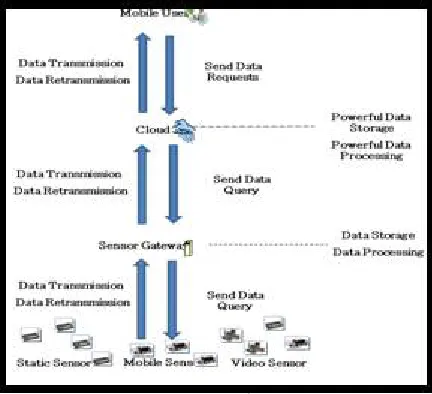
The fundamental idea of integrations of WSN and MCC is to utilize the vast cloud to store and process the sensory data collected by WSNs. Then any mobile user who wants to access the sensed data can just issue an information request to the cloud, and the sensed data will be returned from the cloud to the mobile user. This scenario is presented in Fig 2. Since the data requests of mobile users require the cloud to respond in real-time, all current MCC-WSN integration schemes make use of always-on (AO) WSNs in which sensor nodes are always working to transmit the sensory data to the cloud. But In this paper, two collaborative location-based sleep scheduling (CLSS) schemes are proposed for WSNs integrated with MCC. The locations of mobile users decide the awake or asleep state of sensor nodes in the integrated WSN to reduce the energy consumption.
A. OVERALL SYSTEM MODEL
base stations with unlimited energy supply, serving as the gateway between each WSN and the cloud. Time is T and the interval of each time TP is t.
Figure 2. Integration of WSN-MCC
B. PROPOSED CLSS SCHEME
Firstly the mechanism to obtain the mobile user location list is presented here.
Mobile User Location List
To achieve the location list L of mobile user u, the location history of u is extracted by the cloud c based on the StarTrack service. Specifically, StarTrack is a mobile client application, and it periodically captures the user's current location (e.g., with GPS) and relays the location information to the StarTrack server which runs as a service in the cloud c. Further, the StarTrack server processes these location data.
CLSS Scheme
There are two collaborative location-based sleep scheduling (CLSS) schemes for the integrated WSN and the pseudo codes of these two CLSS schemes in each time TP are shown as follows.
CLSS1 [10]
Regarding CLSS1 scheme, database first obtains the current location lu of mobile user u. Then according to whether lu is in the location list L or not, a flag A or Z is sent to base station s by database. Base station s further broadcasts the flags. At last, each sensor node i determines its awake or asleep state according to the flag it receives in each time T.
CLSS2 [10]
IV.PSEUDO CODE
A. CLSS1:
Step 1: Cloud c obtains mobile user u's current location lu.
Step 2: If Lu € L, c sends flag A to base stations. Otherwise, c sends s flag Z. Step 3: s broadcasts flags to sensor nodes.
Step 4: Run Step 5 at each node i
Step 5: If node i receives flag A, remain awake. Otherwise, go to sleep.
B. CLSS2:
Step 1: Cloud c obtains mobile user u's current location lu.
Step 2: If lu € L, c sends flag A to base stations. Otherwise, c sends s flag Z. Step 3: s broadcasts flags to sensor nodes.
Step 4: Run Step 5 at each node i.
Step 5: If node i receives flag A, remain awake. Otherwise, run Step 6 to Step 12.
Step 6: Get the current residual energy Eranki.
Step 7: Broadcast Eranki and receive the ranks of its currently awake neighbours Ni. Let Ri be the set of these ranks.
Step 8: Broadcast Ri and receive Rj from each j Є Ni.
Step 9: If |Ni|< k or |Nj|< k for any j Є Ni, remain awake. Go to Step 12. Step 10: Compute Ci = {j|j Є Ni and Erankj > Eranki}.
Step 11: Go to sleep if both the following conditions hold. Remain awake otherwise.
Any two nodes in Ci are connected either directly themselves or indirectly through nodes within i’s 2-hop
neighborhood that have Erank more than Eranki.
Any node in Ni has at least k neighbors from Ci.
Step 12: Return.
Comparing CLSS schemes and AO system, both CLSS1 and CLSS2 have longer network lifetime than AO.
V. CONCLUSION AND FUTURE WORK
MCC-WSN integration systems make use of AO (Always On) WSN. In this paper, two CLSS schemes (i.e. CLSS1 and CLSS2) for WSNs integrated with MCC are proposed. Collaborative location-based sleep scheduling systems involve both the WSN and the cloud. CLSS dynamically change the awake or asleep status of the sensor node in the integrated WSN, based on the locations of the mobile user. CLSS1 focuses on saving the energy consumption of the integrated WSN. CLSS2 further pays attention to the scalability and robustness of the integrated WSN. These two algorithms are implemented in this paper without trusted sensors. In further we can make the transaction with trusted sensors with more than one base station.
VI.ACKNOWLEDGMENTS
For everything we get, the credit goes to all those who had helped us to complete this survey successfully. I am thankful to "Prof. M. L. Bangare for guidance and review of this paper. I would also like to thanks, all faculty members of SKN College of Engineering".
REFERENCES
1. H. T. Dinh, C. Lee, D. Niyato, and P. Wang, ‘A survey of mobile cloud computing: Architecture, applications, and approaches’, Wireless Commun. Mobile Comput., vol. 13, no. 18, pp. 1587–1611, Dec. 2013.
2. C. Zhu, L. Shu, T. Hara, L. Wang, S. Nishio, and L. T. Yang, ‘A survey on communication and data management issues in mobile sensor networks’, Wirel. Commun. Mob. Comput., vol. 14, no. 1, pp. 19–36, Jan. 2014.
3. P. Zhang, Z. Yan, and H. Sun, ‘A novel architecture based on cloud computing for wireless sensor network’, in Proc. 2nd Int. Conf. Comput.
4. Chunsheng Zhu, Hai Wang, Xiulong Liu, Lei Shu, Laurence T. Yang, Victor C. M. Leung, ‘A Novel Sensory Data Processing Framework to Integrate Sensor Networks with Mobile Cloud’, IEEE Syst. J, vol. PP, no. 99, pp.1-12, Jan. 2014.
5. Adelcio Biazi, Cesar Marcon, Fauzi Shubeita, Letícia Poehls, Thais Webber, Fabian Vargas, ‘A Dynamic TDMA-Based Sleep Scheduling to
Minimize WSN Energy Consumption’, IEEE 13th International Conference on Networking, Sensing and Control, April 28-30, 2016.
6. Harshal D. Misalkar, Anup W. Burange, Umesh V. Nikam, ‘Increasing Lifespan and Achieving Energy Efficiency of Wireless Sensor
Network’, International Conference On Information Communication And Embedded System,2016.
7. R. R. Rout and S. K. Ghosh, ‘Enhancement of lifetime using duty cycle and network coding in wireless sensor networks’, IEEE Trans. Wireless
Commun., vol. 12, no. 2, pp. 656–667, Feb. 2013.
8. C. Zhu, L. T. Yang, L. Shu, V. C. M. Leung, J. J. P. C. Rodrigues, and L. Wang, ‘Sleep scheduling for geographic routing in duty-cycled mobile sensor networks’, IEEE Trans. Ind. Electron., vol. 61, no. 11, pp. 6346–6355, Nov. 2014.
9. Chunsheng Zhu, Zhengguo Sheng, Victor C. M. Leung, Lei Shu, Laurence T. Yang, ‘Toward Offering More Useful Data Reliably to Mobile
Cloud From Wireless Sensor Network’, IEEE Trans. On emerging topics in computing, Vol. 3, No. 1, March 2015.
10. Chunsheng Zhu, Victor C. M. Leung, Laurence T. Yang, Lei Shu, ‘Collaborative Location-Based Sleep Scheduling for Wireless Sensor
![Figure 1. Sensor node architecture [7]](https://thumb-us.123doks.com/thumbv2/123dok_us/1423939.1174928/2.595.211.393.152.313/figure-sensor-node-architecture.webp)