University of Windsor University of Windsor
Scholarship at UWindsor
Scholarship at UWindsor
Electronic Theses and Dissertations Theses, Dissertations, and Major Papers
8-2013
Designing and Implementing a Hospital Environmental
Designing and Implementing a Hospital Environmental
Management Framework
Management Framework
Taylor Purdy University of Windsor
Follow this and additional works at: https://scholar.uwindsor.ca/etd Part of the Civil and Environmental Engineering Commons
Recommended Citation Recommended Citation
Purdy, Taylor, "Designing and Implementing a Hospital Environmental Management Framework" (2013). Electronic Theses and Dissertations. 4995.
https://scholar.uwindsor.ca/etd/4995
This online database contains the full-text of PhD dissertations and Masters’ theses of University of Windsor students from 1954 forward. These documents are made available for personal study and research purposes only, in accordance with the Canadian Copyright Act and the Creative Commons license—CC BY-NC-ND (Attribution, Non-Commercial, No Derivative Works). Under this license, works must always be attributed to the copyright holder (original author), cannot be used for any commercial purposes, and may not be altered. Any other use would require the permission of the copyright holder. Students may inquire about withdrawing their dissertation and/or thesis from this database. For additional inquiries, please contact the repository administrator via email
Designing and Implementing a Hospital Environmental Management Framework
By
Taylor Purdy
A Thesis
Submitted to the Faculty of Graduate Studies
through the Department of Civil and Environmental Engineering in Partial Fulfillment of the Requirements for
the Degree of Master of Applied Science at the University of Windsor
Windsor, Ontario, Canada
2013
Designing and Implementing a Hospital Environmental Management Framework
by
Taylor Purdy
APPROVED BY:
______________________________________________ Dr. Michelle Freeman
Faculty of Nursing
______________________________________________ Dr. Rajesh Seth
Department of Civil and Environmental Engineering
______________________________________________ Dr. Edwin Tam, Advisor
Department of Civil and Environmental Engineering
iii
DECLARATION OF ORIGINALITY
I hereby certify that I am the sole author of this thesis and that no part of this thesis has been published or submitted for publication.
I certify that, to the best of my knowledge, my thesis does not infringe upon anyone’s copyright nor violate any proprietary rights and that any ideas, techniques, quotations, or any other material from the work of other people included in my thesis, published or otherwise, are fully acknowledged in accordance with the standard referencing practices. Furthermore, to the extent that I have included copyrighted material that surpasses the bounds of fair dealing within the meaning of the Canada Copyright Act, I certify that I have obtained a written permission from the copyright owner(s) to include such material(s) in my thesis and have included copies of such copyright clearances to my appendix.
iv ABSTRACT
Modern Canadian hospitals are large generators of landfilled waste. However, much of
the waste disposed of by hospitals is divertible. A Hospital Environmental Management
Framework (HEMF) was designed and implemented in a local hospital in an effort to
control the organization’s landfilled waste and improve environmental performance.
Environmental issues are gaining awareness among businesses in other sectors, but are
not commonly addressed in hospitals, where patient care takes priority over the
environment. While specific, recommended waste reduction initiatives tailored to
hospital operations have been widely published, information on how to implement these
initiatives is lacking. The results from this research yielded a significant decrease in
landfilled waste, a notable increase in recycled items, and a significant decrease in waste
hauling costs, indicating that the HEMF was a success. The proposed HEMF can be
v
DEDICATION
vi
ACKNOWLEDGEMENTS
I would like to thank the test hospital for allowing me to put my research into action.
Without their participation, the achieved results would not have been possible.
I would like to thank Dr. Rajesh Seth for his direction and input to this thesis.
Special thanks to Dr. Michelle Freeman, whose healthcare perspective has led to a
realization and appreciation of the potential real-world applications of my research.
I would also like to thank my advisor, Dr. Edwin Tam, for his endless assistance and
vii
TABLE OF CONTENTS
DECLARATION OF ORIGINALITY ... iii
ABSTRACT ... ivv
DEDICATION ...v
ACKNOWLEDGEMENTS ... vi
LIST OF TABLES ...x
LIST OF FIGURES ... xi
LIST OF APPENDICES ... xiii
CHAPTER 1: INTRODUCTION ...1
Section 1.1: Problem Statement ... 1
Section 1.2: Objectives... 1
Section 1.3: Benefits of Incorporating EMS Elements into HEMF ... 3
Section 1.4: Hypothesis ... 4
Section 1.5: Significance of Hospital HEMF Research ... 5
Section 1.6: Measuring the Success of the HEMF ... 8
Section 1.7: Transferability ... 9
CHAPTER 2: REVIEW OF LITERATURE ...11
Section 2.1: Reducing Health Care’s Carbon Footprint – The Power of Nursing………..11
Section 2.2: Analyses of the Recycling Potential of Medical Plastic Wastes ... 13
Section 2.3: Hospitals that go Green can see Green with Effective Waste Strategies ... 15
Section 2.4: Hospital Waste Management and Toxicity Evaluation: A Case Study …………...17
Section 2.5: The Environmental Toll of Plastics ... 19
Section 2.6: Benefits of Environmental Management Systems ... 21
Section 2.7: Developing an Environmental Management System for a UK Hospital Trust ... 22
Section 2.8: Structure of a General EMS ... 24
Section 2.9: The ISO 14001 EMS Model ... 25
Section 2.9.1: Steps to Implementing an ISO 14001 EMS ... 26
Section 2.10: The EMAS System ... 28
Section 2.10.1: Steps to Implementing an EMAS System ... 28
viii
Section 2.11.1: Steps to Implementing a BS 8555 EMS ... 31
CHAPTER 3: DESIGN AND METHODOLOGY ...34
Section 3.1: Developing the Structure of the HEMF ... 34
Section 3.1.1: Elements of EMAS and BS 8555 to Include in HEMF ... 34
Section 3.2: Test Hospital’s HEMF ... 36
Section 3.2.1: Environmental Policy ... 36
Section 3.2.2: Environmental Statement ... 37
Section 3.2.3: Planning ... 37
Section 3.2.4: Implementation ... 38
Section 3.2.5: Policies and Procedures ... 43
Section 3.2.6: Checking and Corrective Action ... 44
Section 3.2.7: Management Review ... 44
Section 3.3: Ontario Hospital Association (OHA) Green Hospital Champion Fund Implementation Program Award ... 44
CHAPTER 4: RESULTS ...46
Section 4.1: Decreased Landfilled Waste and Increased Recycled Material ... 46
Section 4.2: Initial Waste Audit Results (Baseline Waste Percentage Composition) ... 53
Section 4.3: Final Waste Audit Results (Updated Waste Percentage Composition) ... 56
Section 4.4: Issues Specific to Hospital Waste Audits ... 57
Section 4.5: Composting ... 58
Section 4.6: Biohazardous Waste Management ... 63
Section 4.6.1: Reusable Pharmaceutical Containers ... 63
Section 4.6.2: Bagless Biomedical Waste Containers ... 64
Section 4.6.3: Automated Bedpan Flushers ... 68
Section 4.6.4: Aqueous Ozone Cleaning Solution ... 74
Section 4.7: Hospital Environmental Management Framework ... 78
Section 4.8: Next Steps in HEMF Impementation at the Test Hospital ... 81
Section 4.8.1: Installation of Reusable Pharmaceutical Containers ... 81
Section 4.8.2: Continued Automated Bedpan Flusher Installation, Training, and Use ... 81
Section 4.8.3: Styrofoam Elimination ... 82
Section 4.8.4: Single Stream Recycling ... 84
ix
Section 4.8.6: Continued Development of the HEMF ... 85
Section 4.9: Recommendations for Successful Implementation of HEMF Hospital Facilities 87
CHAPTER 5: CONCLUSION ...89
Section 5.1: Conclusion ... 89
Section 5.2: Summary of Research Tasks Undertaken ... 89
Section 5.3: Summary of Recommendations for Test Hospital ... 91
REFERENCES/BIBLIOGRAPHY...94
APPENDICES ...99
Appendix A: Environmental Policy ... 99
Appendix B: Environmental Statement ... 100
Appendix C: Policies and Procedures for New Initiatives... 103
Appendix D: Annual Hospital Styrofoam Usage ... 112
x
LIST OF TABLES
Table 1: 2012 Waste Composition Results ...55
Table 2: 2013 Waste Composition Results ...56
Table 3: Comparison of Composter and Pulper Energy and Water Usage ...61
Table 4: Comparison of Composter and Pulper Operational Costs ...62
Table 5: Comparison of Automated Bedpan Flusher and CSR Sterilizer Energy and Water Usage ...72
Table 6: Comparison of Automated Bedpan Flusher and CSR Sterilizer Operational Costs ...73
xi
LIST OF FIGURES
Figure 1: Structure of General EMS (PDCA Cycle) ...24
Figure 2: Five Main Sections of ISO 14001 EMS Model ...26
Figure 3: Six Phases of BS 8555 Implementation ...31
Figure 4: Test Hospital’s HEMF...36
Figure 5: Monthly Waste Sent to Landfill Between May 2012 and June 2013 ...46
Figure 6: Monthly Landfilled Waste Costs Between May 2012 and June 2013 ...47
Figure 7: Monthly Recycled Waste Between May 2012 and June 2013 ...49
Figure 8: Monthly Cost of Recycling Between May 2012 and June 2013 ...49
Figure 9: Instrument Trays Wrapped in Blue Wrap ...50
Figure 10: Monthly Weight of Cardboard/Blue Wrap Recycled Between August 2012 and June 2013 ...51
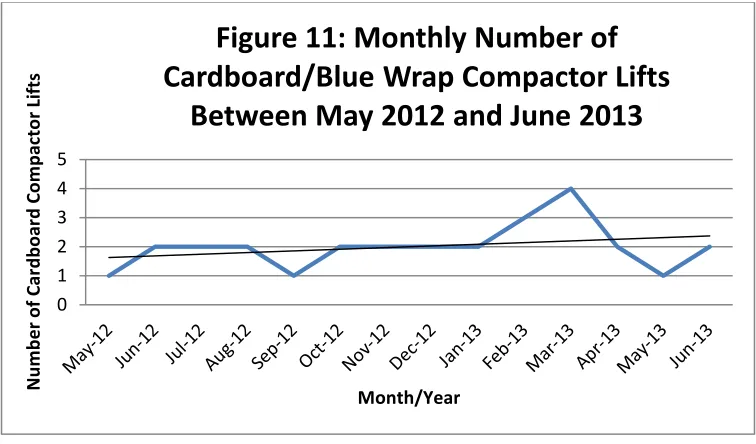
Figure 11: Monthly Number of Cardboard/Blue Wrap Compactor Lifts Between May 2012 and June 2013 ...52
Figure 12: Monthly Cardboard/Blue Wrap Recycling Costs Between May 2012 and June 2013...52
Figure 13: Food Cycler 250 ...59
Figure 14: Composting Process ...60
Figure 15: Reusable Pharmaceutical Container ...63
Figure 16: Bagless Biomedical Waste Container ...66
Figure 17: Monthly Biomedical Waste Generated Between May 2012 and June 2013 ....67
Figure 18: Monthly Cost of Biomedical Waste Disposal Between May 2012 and June 20131...68
Figure 19: Hopper System ...68
Figure 20: Hopper Fecal Contamination (Spray) ...68
xii
Figure 22: LotusPro Aqueous Ozone Dispenser ...74
xiii
LIST OF APPENDICES
Appendix A: Environmental Policy ...99
Appendix B: Environmental Statement ...100
Appendix C: Policies and Procedures for New Initiatives...103
1 CHAPTER 1
INTRODUCTION
1.1 PROBLEM STATEMENT
The primary focus of modern-day hospitals is to maintain the health of the population and
aid the sick throughout recovery. While idealizing intentions of good health, hospitals are
large institutions, and with size comes significant environmental impacts, such as:
emissions to air, land, and water, inefficient energy consumption, lack of recycling,
excessive waste generation, and increased traffic and noise levels (Douglas and Meltzer,
2004). Modern Canadian hospitals are large contributors to the landfilled waste stream.
Much of the waste disposed of by hospitals is preventable: controlling their landfilled
waste would lower their environmental impacts and provide significant benefits.
1.2 OBJECTIVES
The main objective of this research is to reduce the waste sent to landfill by modern
hospitals. This will be accomplished by developing and implementing a Hospital
Environmental Management Framework (HEMF) - a comprehensive approach to
improving a healthcare facility’s environmental performance, which incorporates
elements of an Environmental Management System (EMS) and attempts to harness
innovations specific to hospital settings.
According to the Environmental Innovations Branch of Nova Scotia (2004), an EMS is “a
set of management procedures that allows an organization to identify, evaluate, and
reduce the environmental impact of its activities.” A traditional EMS encompasses
2
will focus on the hospital’s production of waste that would nominally classify as
municipal solid waste (MSW). According to the United States Environmental Protection
Agency (2013), municipal solid waste consists of everyday items that are discarded after
use, including newspapers, product packaging, food scraps, etc.
The research and HEMF implementation will be carried out at a local test hospital which
represents the characteristics of most modern-day Canadian hospitals; that is, the hospital
is located in a typical urban setting, serves a large, diverse population, and is under
budgetary and resource limitations. The test facility is a teaching hospital located in
Southwestern Ontario with over 2,000 employees, physicians, and volunteers, and 324
patient beds.
The research has the following sub-objectives to complement the main objective:
1) Determine the composition of baseline landfilled waste generated by the test
hospital;
2) Determine which areas of the hospital generate the highest amount of preventable
waste, and give these units top priority in waste management efforts;
3) Implement relevant waste management initiatives; and
4) Determine the amount of waste reduction and financial savings achieved by the
implemented initiatives.
The objectives of this research will be accomplished not only by developing and
implementing an HEMF, but by understanding barriers to hospital waste management, as
well as recognizing which actions will compliment the HEMF. A conventional EMS
3
environmental performance. This HEMF goes beyond the simple EMS process to include
step-by-step instructions on how to achieve results. For example, rather than simply
stating that waste reduction initiatives must be implemented, this HEMF suggests
targeted projects which will achieve this goal, such as blue wrap recycling, reusable
pharmaceutical containers, etc. Each step of the proposed HEMF implementation process
is supported by hospital implemented suggestions. This research will establish not only
best practices, but innovative practices toward achieving improved hospital waste
management.
1.3 BENEFITS OF INCORPORATING EMS ELEMENTS INTO HEMF
EMS elements will be incorporated into the HEMF, as they have been shown to improve
environmental performance in the following ways:
1) Compliance with an EMS forces an organization to enact its due diligence
To comply with an EMS, yearly audits must be performed and environmental impact
reporting must be published (European Commission, 2013). By requiring
accountability, an EMS ensures that the organization will truly follow the
implemented initiatives and waste reduction program. To provide reporting and audit
results, data is required. This encourages an organization to track their progress and
commit to the program.
2) An EMS provides a detailed framework for compliance
By creating a simple process for complying with the waste reduction initiatives, even
the busiest of staff will be able to effectively participate in improving environmental
4
With no real framework for use, the waste reduction projects may be misused or
underutilized. Policies and procedures will be designed and implemented for each
initiative encompassed by the HEMF. This will communicate expected compliance,
as policies are enforced in the workplace.
3) An EMS dictates responsibility
Without proper delegation of responsibility, the waste reduction initiatives will not be
successful. Employees are responsible for participating in waste reduction programs,
and designated champions will be available to answer any questions that may arise. It
is imperative that staff understand the proper use of the new technologies, as well as
the environmental importance of the initiatives.
1.4 HYPOTHESIS
The test hospital will benefit from the implementation of an HEMF in the following
ways:
1) Reduction in solid waste sent to landfill;
2) Reduction of operational costs (removed waste is billed by weight; the less
landfilled waste, the lower the cost); and
3) Reduction in negative environmental impact.
Given the complexity of hospital settings, implementation of environmental practices will
be more effective if a series of small changes are introduced, rather than a single, mass
5 1.5 SIGNIFICANCE OF HEMF RESEARCH
Several businesses and other organizations have successfully implemented an EMS to
control their environmental performance (Commission for Environmental Cooperation,
2005). However, hospitals present unique obstacles to taking environmental action,
which highlights the significance of HEMF research. These barriers must be overcome in
order to pave the way for future environmental success. Many hospitals have yet to
formally commit to improving their environmental performance. This is due to a number
of reasons, including, but not limited to:
1) Patient health is the main focus for hospital organizations
Environmental performance is secondary to the importance of providing quality
healthcare. While the status of the environment is important, a hospital’s main
concern will always be human health. Human health is affected by the health of the
environment (Douglas and Meltzer, 2004), and an innovative integrated approach to
healthcare and environmental performance will be beneficial.
2) Lack of expertise/champion
No employee position exists at the test hospital to specifically deal with improving
environmental performance. Any staff members working towards reducing
environmental impact are often doing so on a voluntary basis, typically on top of their
stressful and busy workload. While staff may be aware of the facility’s landfilled
waste issue, there may be a lack of knowledge of evidence-based practices related to
environmental management. Healthcare providers are generally not educated in
environmental issues, and would not be aware of the methodologies available to
6 3) Resource constraints
Time and money constraints are major factors in the implementation of any project,
both of which are uncommon in a hospital setting. With little time to devote to the
design and supervision of a project, as well as a lack of funds required to purchase
equipment, environmental programs are not prevalent in hospitals.
4) Employees are incredibly busy
Hospital nurses, physicians, support staff, and volunteers are incredibly busy during
their workdays. Misconceptions of the difficulty of environmental management may
have previously prevented its implementation. It is the goal of this thesis to
implement an HEMF that is straightforward and convenient: even the busiest of
employees should be able to follow the program.
5) Belief in direct disposal for contaminated items
Many materials in a hospital setting come into contact with patients (tongue
depressors, scissors, oxygen tubing, etc.). It is widely believed that in order to
prevent the spread of disease, used materials should be placed in the garbage for
direct disposal to landfill (Branswell, 2012), or incinerated (Lee et al, 2002). Unless
the used items came into contact with an extremely infectious agent (in which case,
separate disposal procedures exist), these materials can often be recycled or
composted without harm. Many reprocessing techniques involve the application of
extremely high temperatures (Al-Salem et al, 2009), which would disinfect the
7 6) Lack of environmental/situational awareness
Many employees are unaware of the gravity of the test hospital’s landfilled waste
situation (Munoz, 2012). While throwing a single empty can into the trash may seem
insignificant to them as individuals, the cans disposed add up quickly. If each
employee continues their environmentally-taxing behaviour, thinking it has no
impact, the situation will spiral out of control.Staff are also likely unaware of the
negative financial effects caused by unintentional wasteful behaviours. Until
employees understand the reality of their actions, they will be unlikely to change
their ways. A comprehensive information strategy and later, employee education
program (if necessary), are key elements to bringing about long term change.
7) System flaws (inertia)
Hospitals and their employees have treated waste in the same way for many years: it
is difficult to alter established habits and approaches. However, there have been
major improvements in waste management capabilities and strategies. More items
can now be recycled, and composting is emerging as a viable waste diversion
measure.
The aforementioned hospital-specific barriers to implementing an HEMF can be
addressed in the following ways:
1) Staff education
If employees are aware of the gravity of their organization’s environmental
8
they will be more likely to make an effort to change their ways and improve their
personal waste diversion rates (Munoz, 2012).
2) Effective communication and promotion
Staff should be constantly aware of the “right thing to do” when disposing of their
waste. Effective information and communication (newsletter articles, intranet notices,
proper signage, etc.) will ensure that employees never have to question how they
should dispose of their used items.
3) Implementation of technology
By implementing new technologies (such as in-vessel composters or automated
bedpan flushers), the test hospital will be able to accomplish waste diversion in a way
that would not be possible with current practices.
4) Leadership engagement
In order to positively influence the implementation of employee-led initiatives,
hospital leaders (supervisors, managers, directors, etc.) must be fully engaged and on
board with the new procedures. Staff buy-in can be achieved through successful
management practices, and a positive, encouraging work environment is conducive to
the acceptance of change (Goretsky, 2003).
1.6 MEASURING THE SUCCESS OF THE HEMF
Following implementation of the HEMF and a period of staff adjustment and adaptation,
it will be necessary to measure the system’s success. The effectiveness of the HEMF can
9 1) Achieved waste reduction
A follow-up waste audit will determine the amount of landfilled waste being
generated by the test hospital subsequent to HEMF implementation. This can be
compared to the baseline waste generation as determined by the initial waste audit,
establishing the amount of waste reduction achieved by the HEMF initiatives.
2) Reduced waste removal costs
Waste collected for disposal is billed by weight. Therefore, the more waste
generated, the more the test hospital must pay for its removal. By sending less waste
to landfill, the organization should realize a decrease in the costs for waste removal.
3) Reduced purchasing costs
Reducing the amount of resources consumed will lead to a reduction in purchasing
costs. For example, as seen in section 3.2.4, if bedpan flushers are installed in patient
care departments, fewer soiled bedpans will be sent to landfill to avoid manual
cleaning. This will lead to a decrease in the number of replacement bedpans that must
be purchased.
1.7 TRANSFERABILITY
As stated in section 1.2, an environmental management system is a set of management
procedures that allows an organization to identify, evaluate, and reduce the
environmental impact of its activities. The very nature of an HEMF (policies and
procedures) makes it amenable to transfer to other hospitals. This research can lead to a
future policies that outline acceptable environmental practices with the goal of reducing
10
until now did not believe that controlling their landfilled waste in a fast-paced and
sometimes uncertain healthcare environment was feasible.
The initiatives and policies should be easily adopted by other hospitals, as they will have
already been conceptualized and documented. The only action required to implement
these policies and initiatives at other organizations will be customization to the specific
facility (if needed), and education of staff on the new guidelines. The HEMF will include
a list of projects/initiatives that will improve environmental performance, which can
easily be used by other hospitals: it may be as straightforward as choosing which
initiatives to implement. At the very least, this research can provide a basic template to
guide the implementation of an HEMF in other hospitals.
The HEMF created through this research will focus on waste management, but this
framework can be expanded to include water usage, energy consumption, and
11 CHAPTER 2
REVIEW OF LITERATURE
2.1 REDUCING HEALTH CARE’S CARBON FOOTPRINT – THE POWER OF NURSING
Munoz (2012) extensively researched the role of healthcare providers in hospital waste
management, and her findings are as follows:
Hospitals are among the worst environmental performers. Healthcare facilities are
charged with improving human health, yet they contribute significantly to the declining
health of the environment. It is estimated that US hospitals generate over 2 million tonnes
of waste each year. Healthcare procedures often utilize a multitude of supplies, which are
considered contaminated and requiring disposal if they are opened but unused, creating a
vast amount of waste.
Paper and cardboard comprise 45%-50% of hospital waste, but is usually discarded to
landfill, rather than recycled. Plastics make up another 15%-30% of hospital waste.
Unrecovered or incinerated plastic releases carcinogenic dioxins into the environment.
Hospitals operate around the clock, and generate a wide variety of waste types.
Incineration leads to the release of toxic chemicals into the atmosphere, while landfilling
waste contributes to greenhouse gas emissions and harmful leachate. Due to the several
complexities involved in hospital waste generation and disposal, addressing these issues
is a difficult task.
Nurses comprise the largest group of hospital employees, and a great amount of
12
factor in nursing practice, which should prevent harm by reducing the hospital’s carbon
footprint. If proper waste management is considered as part of nursing practice, rather
than as an additional task, positive changes will be adopted over time.
The majority of hospitals have not made an effort to be more environmentally-friendly.
Typically, nurses do not feel that their single contribution to the waste stream could have
an effect on the environment. There is often a lack of responsibility for actions, since
there are several healthcare providers performing the same activity (putting waste into the
trash instead of recycling). There is also often a desire to let someone else take the lead
on environmental initiatives, but when nobody does, no action is taken for change. It is
important for nurses - and all hospital employees - to see themselves as an integral
component of a larger system that benefits them (the environment), not as a stand-alone
employee. This mentality is more likely to lead to a positive shift toward sustainable
actions.
Further research is needed to document effective strategies to develop environmental
policies and promote sustainable practices. Current literature focuses on the negative
impacts of uncontrolled hospital waste management, but little information is available on
the subject of controlling this waste successfully.
In summary, Munoz (2012) determined that a lack of environmental understanding,
coupled with passive behaviours, has led to indifference among healthcare providers
toward waste management. While it is well-documented which initiatives can potentially
reduce landfilled waste, further research into how to actually successfully implement,
13
2.2 ANALYSES OF THE RECYCLING POTENTIAL OF MEDICAL PLASTIC
WASTES
Lee et al (2002) studied the plastic waste generated at various hospitals throughout
Massachusetts. Their findings are summarized below:
Traditionally, medical waste has been incinerated or sent to landfill. In 1996, the United
States Environmental Protection Agency (US EPA) estimated that there were 2300
medical incinerators in use across the country. Historically, medical waste has been
improperly treated in incinerators that are either poorly designed or insufficiently
controlled. This has led to the emission of hazardous air pollutants (mercury, lead,
dioxins, furans, etc.) and to subsequent public concern over the proper disposal of
medical waste.
If medical waste is not infectious, it does not require incineration. It can be recycled or
sent to landfill. According to the US EPA, plastics accounted for 25.1% of landfill space
by volume in 1996. The average recovery rate of all combined recyclable items was
27.3%, while the recovery rate of plastics alone was 5.4%. Plastics occupied a large
amount of landfill space, as they were not effectively recycled.
Plastics comprise an average 20%-25% (by weight) of medical waste, which is a
significantly higher fraction than the plastics content of regular municipal solid waste. To
conserve landfill space, increase plastics recovery, and reduce the high cost of hospital
waste disposal, it would be beneficial to focus on plastics recycling in healthcare
14
This study evaluated the plastics generation of 3 animal hospitals and 8 general hospitals.
The most prevalent plastic items in the hospitals’ waste streams were cafeteria plastics,
sharps, medical packaging, and IV bags and tubing. These items comprised 67% of the
total hospital plastics.
Approximately 73% of the total studied waste was generated in laboratories, facilities,
and operating rooms, but the cost for disposal of these wastes amounted to 83% of the
total. This is due to the fact that waste generated in these areas is more likely to be
considered hazardous, and therefore is incinerated which is more costly than landfill).
The average plastic content of all the studied waste was 30% by weight. Plastics
generated in operating rooms, labs, etc. are often incinerated due to their potential
contamination, but plastics generated in the cafeteria, offices, and other hospital areas are
prime candidates for recycling.
The main barrier to the development of medical plastics recycling programs is the
potential contamination of plastic items. The overly-broad classification of hazardous
waste prevents some otherwise recyclable items from being recovered (they are
incinerated instead). Since the cost of hazardous waste disposal continues to rise, and
landfill availability is decreasing, many hospitals have made an effort to minimize their
waste generation and increase plastics recovery.
Non-contaminated cardboard, paper, glass, and metal are being recycled in several
hospitals. The recovery of plastics is increasing, and the new focus is on recycling IV
15
in the hazardous waste stream, due to lack of information. This leads to a significant
increase in hazardous waste disposal costs.
If items cannot be recovered (hazardous waste), it would be beneficial to switch to less
toxic materials. If recycling is not an option, it would be an improvement if fewer
contaminants were released during the incineration process.
In summary, Lee et al (2002) determined that proper waste classification and segregation
can lead to an increase in recycled plastics. If plastics cannot be recovered for
contamination purposes, it is recommended that less toxic base materials be used to
manufacture these items, which will reduce the toxins emitted upon incineration.
2.3 HOSPITALS THAT GO GREEN CAN SEE GREEN WITH EFFECTIVE
WASTE STRATEGIES
Gillmeister (2012) reports on the waste management situation among American hospitals.
Her findings are as follows:
In the United States, the healthcare sector’s environmental footprint is growing (8% of
the country’s total footprint). US hospitals are the nation’s largest contributors of carbon
emissions, and the second-largest energy consumers. Together, US hospitals generate
6,600 tonnes of waste daily. Traces of medications can be found in drinking water, and
syringes and other infectious wastes are making their way to landfills, illustrating
deficiencies in hospital waste handling.
Clearly, improvements to how hospitals handle wastes are needed, but this is not an easy
16
regulated. Internally, no single hospital department is in control of all aspects of waste
collection.
The first step towards effecting change in waste management is to perform a waste audit
to determine which waste streams require immediate attention. It would be beneficial to
observe current practices in all areas of the hospital to establish what areas require
improvement.
There are six considerations for the strategic management of hospital waste, including:
1)Anticipate barriers and complications when implementing a coordinated waste
management effort;
2)Understand that waste amounts will vary (facility size, local regulations, and patient
volume all contribute to waste generation);
3)Consider partnering with a licensed third-party waste management company to ensure
compliance;
4)Opt for sustainable practices whenever possible (for example, utilize reusable
containers instead of a disposable option);
5)Keep track of waste costs, both direct and indirect; and
6)Develop a “Green Team” comprised of hospital staff to create change throughout the
organization. Executive support is recommended to lend credence to the project.
Even though waste is such a large component of hospital operations, 90% of hospital
leaders surveyed had no idea how much waste removal was costing their facility. It is
17
In summary, Gillmeister (2012) determined that while hospitals generate a large amount
of complex waste, proper segregation and waste management practices can lead to cost
savings, which benefits both the hospital and the environment.
2.4 HOSPITAL WASTE MANAGEMENT AND TOXICITY EVALUATION: A
CASE STUDY
Tsakona et al (2007) studied hospital waste management practices. Their findings are
summarized below:
Little attention is given to the management and disposal of hospital waste. Current waste
management practices differ among hospitals, but the associated difficulties are nearly
identical. The segregation, collection, packaging, storage, transport, treatment, and
disposal of waste all present challenge to healthcare facilities.
A study of the hospital identified the following problematic waste management practices:
Municipal solid waste was often discarded in the hazardous waste stream. This
unnecessarily increased the amount of hazardous waste to be incinerated, and therefore
lead to higher costs.
Poor-quality (thin) garbage bags were used. Bags had to be removed before they were
full in order to prevent tearing, which leads to an excess use of bags.
There was insufficient labeling of waste streams. This creates confusion while
discarding waste.
Hazardous waste was handled manually, which can lead to a needle-stick injury or
18
Hazardous waste was transported in the same cart as municipal solid waste, creating
the opportunity for the municipal solid waste to become contaminated before going to
landfill.
Waste collection carts were not properly disinfected, which could lead to the
transmission of infection.
Waste collection carts were overfilled, which could potentially lead to a spill.
Waste personnel wore only thin gloves while collecting waste, which is not sufficient
to protect against needle-stick injuries.
There was no designated elevator for waste. Healthcare providers and patients used the
same elevator as waste handling personnel, which can lead to cross-contamination.
Hazardous waste was not stored in an area inaccessible to the public – anyone could
access the area, which could lead to transmission of infection.
Waste was stored at times for greater than 24 hours. This could lead to unsafe
conditions.
The waste storage areas were not properly cleaned upon waste removal. Liquid
stagnated on the floors and was not removed.
In order to overcome the aforementioned waste management issues, it is recommended
that:
Proper training must be provided to all hospital employees. Anyone who generates,
disposes, packages, or transports waste must know how to do so properly. Staff must
also be made aware of the potential consequences associated with improper waste
management.
19
waste management procedures.
Effective waste bags and containers must be utilized, and each waste receptacle must
be properly labeled.
Waste carts are required to be easy to clean, and it is recommended that each hospital
area has their own waste cart, to prevent cross-contamination among units.
Waste must be stored in areas that are only accessible by waste handling personnel and
their supervisors.
Waste collection should reflect the frequency of waste generation. Waste should not be
stored for over 24 hours.
It is recommended that a recycling program be set in place to recover as many items as
possible.
Waste handling staff must be equipped with proper personal protective equipment
(puncture-resistant gloves, eye protection, etc.) to prevent infection.
In summary, Tsakona et al (2007) observed a wide array of unfit waste management
practices and provided several suggestions to remedy the situation. Hospital waste is not
dealt with appropriately; however, there are readily-available solutions to resolve these
issues.
2.5 THE ENVIRONMENTAL TOLL OF PLASTICS
Environmental Health News (2009) reports the following:
Plastic has become a staple in modern society. A strong material, plastic has the ability to
remain in use for a number of years, yet today’s main use of plastic is for disposable
20
The properties that make plastic so versatile are now contributing to human health
problems and environmental issues:
Plastic that ends up in bodies of water is ingested by marine life, which can harm or
poison them.
Floating plastic debris, which can persist in water bodies for thousands of years, allow
for the transportation of invasive species, which disrupt natural habitats.
Plastic in landfills can leach chemicals into the groundwater and be absorbed by
humans. This can alter hormone levels and cause other adverse health effects.
Eight percent of the world’s oil resources are used to generate new plastic items.
Humans are constantly exposed to plastics. 80% of newborns and nearly 100% of adults
have measurable levels of plastic compounds in their bodies. Environmental plastic
exposure in animals has led to problems with reproduction and development, and human
exposure has been linked to increased heart rate and diabetes.
Plastics account for 10% of the world’s generated waste, most of which is sent to landfill
after use. The volume of generated plastics is increasing at a rate of 9% per year. It is
important to address the issue of the sustainability of plastic. Recycling must be
encouraged for all plastic products. Used plastic should be thought of as a raw resource
with which to manufacture new plastic, not as waste to be discarded.
In summary, according to Environmental Health News (2009), plastics existing in the
environment, due to lack of recovery, present health issues for both animals and humans.
21
in order to prevent environmental contamination and to reduce the amount of crude oil
required to manufacture new plastic products.
2.6 BENEFITS OF ENVIROMENTAL MANAGEMENT SYSTEMS
According to the Commission for Environmental Cooperation (2005), a properly
implemented EMS has the potential to greatly affect an organization in the following
ways:
1) Reduced costs, resource use, and waste generation
Decreasing material consumption and waste generation will lower costs. If fewer
materials are consumed, fewer replacement materials must be purchased. Waste removal
is charged for by mass, therefore, the less waste is generated, the lower the removal costs.
2) Regulatory compliance
Legislation currently exists to govern the basic environmental performance of all
Canadian hospitals. Implementing an EMS will ensure that all existing regulations are
followed. In the event that the government issues more stringent guidelines for hospitals,
the test hospital will be prepared due to the EMS.
3) Employee Involvement
The successful implementation of an EMS requires employee responsibility and
participation. This creates a sense of accomplishment and morale among staff members.
The health of the environment has become a popular notion, and a sense of wellbeing
22 4) Improved Public Image
The implementation of an EMS will showcase the test hospital’s commitment to the
environment. This will create a highly-accepted and appreciated public image.
In summary, the Commission for Environmental Cooperation (2005) reports that the
implementation of an EMS will lead to reduced waste generation (and subsequently
reduced waste removal fees), increased regulatory compliance, employee involvement
and satisfaction, and an improved public image.
2.7 DEVELOPING AN ENVIRONMENTAL MANAGEMENT SYSTEM FOR A
UK HOSPITAL TRUST
Douglas and Meltzer (2004) present a case study on the implementation of an EMS in a
UK hospital. Their findings are summarized below:
Salford Royal Hospitals National Health Service Trust (SRHT), located in the United
Kingdom, was a 900-bed, 3,500-staff teaching hospital at the time of the case study. In
2002, SRHT developed and implemented an EMS in an attempt to reduce their
environmental impact. The obstacles encountered during the implementation process
were mostly due to the politics associated with large organizations. A hospital’s main
objective is to provide clinical healthcare to its patients, and this dominates over other
objectives. The introduction of an EMS was seen as secondary in priority to the primary
goal of healthcare delivery. While the health of patients is of utmost importance, the
health of the environment is an increasingly significant factor, and can contribute to
23
SRHT determined that environmental impact should be treated as a risk and included in
the hospital’s risk management program. This ensured that the initiatives would be
enforced and the hospital would be in compliance with environmental legislation.
Various aspects of SRHT’s impacts (waste generation, energy consumption, water usage,
etc.) were reviewed, and priorities were set based on the areas with the most damaging
environmental performance.
SRHT established a green team, consisting of staff representatives from various units, to
cooperatively oversee the implementation of the EMS. Members of the green team were
responsible for educating staff prior to initiative implementation and answering any
questions that may arise regarding the EMS process.
By following the steps required to implement an ISO 14001 EMS, and by persevering
when faced with political obstacles, SRHT effectively established a system to improve
their environmental performance. The organization observed documented reductions in
waste sent to landfill and incineration, as well as a boost in staff morale stemming from
the collective desire to improve environmental health.
In summary, Douglas and Meltzer (2004) report that while patient care is the main
priority for healthcare providers, it must be recognized that polluting the environment
will negatively impact patient health. Hospital politics can be daunting, but by
persevering and following the ISO14001 framework, a successful EMS was implemented
24 2.8 STRUCTURE OF A GENERAL EMS
According to the European Commission (2013), an Environmental Management System
is a tool used to manage and improve an organization’s environmental performance.
While various EMS frameworks exist, each follows the general principals of the
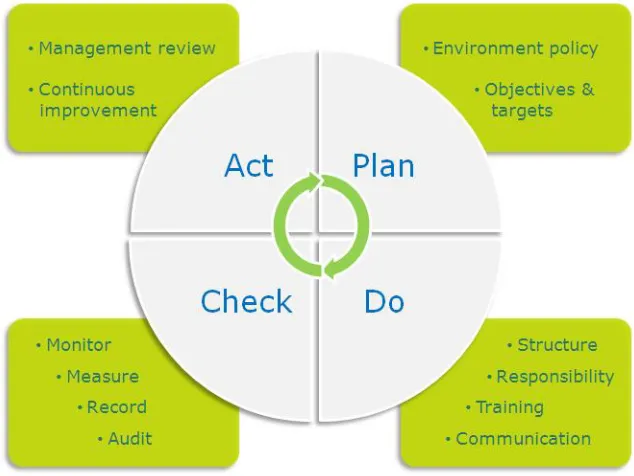
“Plan-Do-Check-Act (PDCA) Cycle”, as shown in Figure 1.
Figure 1: Structure of General EMS (PDCA Cycle)
Image from the European Commission
The steps in the PDCA cycle are as follows (European Commission, 2013):
1) Plan: An environmental policy, including objectives and targets, is created. Action
plans are set in place to address various environmental issues (for example, lack of
25
2) Do: Initiatives meant to rectify environmental issues, as addressed in Step 1 (Plan),
are implemented. Resources are allocated to achieve proposed initiatives, and
responsibilities are assigned to ensure success. All affected staff must be properly
trained on the new initiatives, using effective communication.
3) Check: The results of the newly-implemented initiatives must be analyzed to confirm
that the change resulted in an improvement.Results can be determined through
monitoring, staff feedback, and auditing.
4) Act: If the initiatives did not result in an improvement, the process must be
reconfigured and started anew (back to Step 1: Plan). If the initiatives did in fact
result in an improvement, there is always room to do better. This step requires
constant review of environmental performance to determine if there is anything else
that can be improved upon.
The PDCA cycle sets the grounds for the structure of a general EMS. This can be used as
a stepping stone toward a more intricate and recognized EMS, such as ISO 14000,
EMAS, or BS 8555.
2.9 THE ISO 14001 EMS MODEL
In North America, the ISO 14001 model is the most popular form of EMS. According to
the International Organization for Standardization (2011), an EMS meeting the ISO
14001 standard enables an organization to:
1) Identify and control the environmental impact of its activities, products or services;
26
3) Implement a systematic approach to setting environmental objectives and targets; and
4) Demonstrate that these environmental objectives/targets have been achieved.
2.9.1 STEPS TO IMPLEMENTING AN ISO 14001 EMS
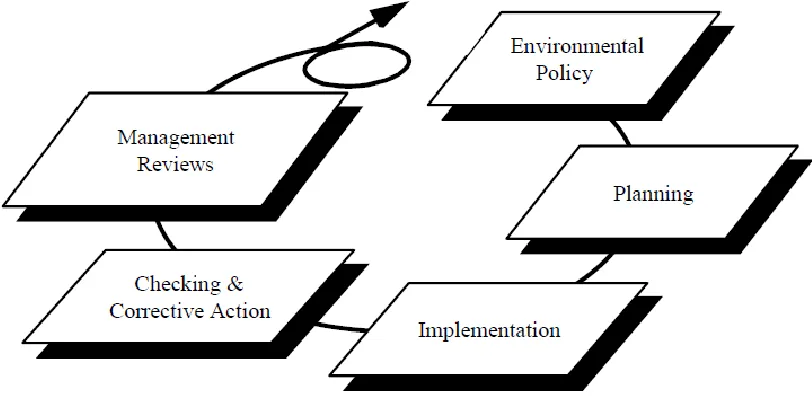
Figure 2 illustrates the five major sections of the ISO 14001 EMS model:
Figure 2: Five Main Sections of ISO 14001 EMS Model
Image from Five Winds International
To successfully implement an ISO 14001 EMS, the five steps highlighted in Figure 2
must be implemented (Five Winds International, 2004). A detailed explanation of the
action required at each step is as follows:
1) Environmental Policy
Effectively communicates the organization’s commitment to continuously reducing
their environmental impact.
Identifies existing legal environmental requirements with which the organization must
27 2) Planning
Identifies environmental issues and defines the initiatives required to meet the
organization’s goals as set out in the environmental policy.
Defines possible projects/processes that will yield the desired result of improved
environmental performance.
Staff training is required to effectively communicate the new strategy with employees
and ensure compliance.
Documentation of the EMS is required to ensure consistency and formality.
3) Implementation
Describes procedures necessary to implement the desired initiatives.
Identifies individual responsibilities for accomplishing goals.
4) Checking and Corrective Action
Monitors the organization’s environmental performance subsequent to the
implementation of environmental initiatives. If the outcome of an initiative is not as
predicted, corrective action can be taken to improve the results.
If a sector is found in non-compliance, action must be taken to ensure total staff
participation.
5) Management Reviews
Evaluation of the EMS to determine its effectiveness in reducing negative
environmental impacts and continuously improving the organization’s performance.
28 2.10 THE EMAS SYSTEM
According to the European Commission (2013), the Eco-Management and Audit Scheme
(EMAS) can be voluntarily adopted by organizations in an effort to improve their
environmental and economic performance, while communicating these achievements to
the public. EMAS encompasses three key elements, as described below:
1) Performance: each year, the organization must update its environmental policy, as
well as report on achieved targets and plans for future improvement.
2) Credibility: independent third party auditors review and verify the environmental
performance and claims made by the organization in order to maintain credibility.
3) Transparency: the organization must release its environmental statement, policy, and
performance review to the public. This ensures that stakeholders are aware of the
organization’s performance, and motivates the organization to perform to the best of
their ability.
2.10.1 STEPS TO IMPLEMENTING AN EMAS SYSTEM
EMAS is not specifically a type of EMS, but it includes the implementation of an EMS as
part of its many requirements (Commission for Environmental Cooperation, 2005).To
successfully implement an EMAS system, the following steps must be undertaken:
1)Environmental Review: The organization must consider and evaluate all of its
environmental impacts, including those related to facility activities, products and
29
to evaluate the methods currently in place to monitor and report environmental
performance.
2)Environmental Policy: The organization must create a policy which outlines their
commitment to comply with all applicable environmental legislation, as well as to
strive for and achieve continuous progress in environmental performance.
3)Environmental Program: The organization must develop a document that describes
its specific environmental goals and targets. This will help them to plan and implement
new initiatives that will lead to the realization of their goals.
4)Environmental Management System: Based on the results of the Environmental
Review, the organization must enact an EMS to help them reduce their environmental
impacts and continuously improve their performance. The EMS will prescribe
responsibilities, action plans (based on the Environmental Program), procedures and
training requirements associated with new initiatives, methods to monitor
performance, and communication plans.
5)Environmental Audit: the organization must perform an audit to assess the EMS and
determine how well the facility’s goals are being met, policy is being followed, and
regulatory requirements are being achieved.
6)Environmental Statement: the organization must create and release a document
highlighting its environmental performance, including the results of the initiatives and
whether goals were attained. The statement must also include future objectives
30
7)Accreditation: following the implementation of the previous steps, the organization’s
actions and documents must be verified by an approved third party. Upon approval,
the organization can officially claim to be EMAS-accredited, and may use the EMAS
logo in their publications.
While EMAS requires organizations to address all of their environmental issues (i.e.
waste management, energy usage, etc.), they are not required to do so all at once. The
aspects of the organization’s operations that create the greatest environmental impacts are
focused on first, and once these items are under control, new initiatives can be undertaken
to expand the program (Institute of Environmental Management & Assessment, 2011).
EMAS relies heavily on employee involvement for its success. Each staff member, from
the board of executives to all levels of management and frontline staff, must participate in
the new initiatives if the program is to achieve environmental success (IEMA, 2011).
According to the Institute of Environmental Management & Assessment (2011), only
organizations based within the European Union are eligible for true EMAS registration
and certification. This means that the test hospital is not eligible for environmental
certification using an EMAS system.
2.11 THE BS 8555 EMS MODEL
The British Standard, Guide to the Phased Implementation of an Environmental
Management System Including the Use of Environmental Performance Evaluation (BS
8555), is another type of EMS that is used to control the environmental performance of
31
This system incorporates a generic EMS, which is not certifiable by a third party (ENDS
337, 2003). However, the BS 8555 EMS can easily be upgraded to ISO 14001 or EMAS.
BS 8555 focuses on delivering measurable environmental and financial benefits for the
organization, delivering environmental performance data for public reporting, and
creating credibility and a competitive edge for the organization. BS 8555 organizations
encourage their suppliers and vendors to improve their environmental performance and to
provide more sustainable products (ENDS 337, 2003).
2.11.1 STEPS TO IMPLEMENTING A BS 8555 EMS
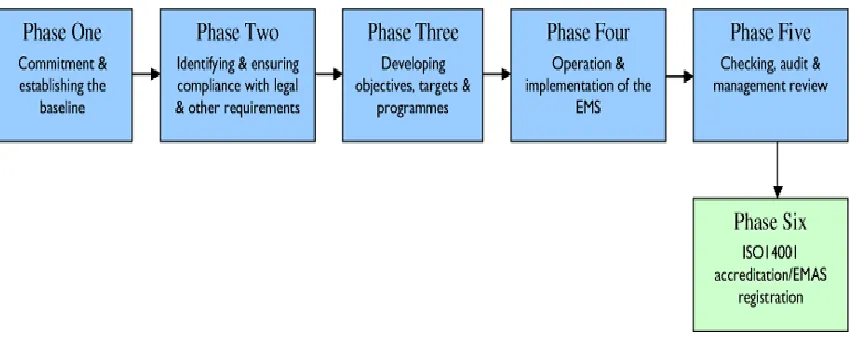
BS 8555 is achieved by an organization over several phases, as shown in Figure 3:
Figure 3: Six Phases of BS 8555 Implementation
Image from the Institute of Environmental Management & Assessment
An explanation of the steps required to implement the BS 8555 system, according to the
Institute of Environmental Management and Assessment (2011), is as follows:
1)Commitment and Establishing the Baseline: In Phase 1, the organization must
commit to managing their environmental performance. The main environmental issues
32
must be recruited for participation in new procedures, as well as to lend input into
what needs to be done to make the organization a more environmentally-friendly
facility. In this Phase, the EMS and environmental policy must be drafted and prepared
for implementation and release.
2)Identifying and Ensuring Compliance with Legal Requirements: In Phase 2,the
organization must identify all environmental regulations that must be abided by. By
recognizing what performance is legally mandated, the organization can implement the
necessary initiatives to remain in compliance with these requirements. The
organization must generate an action plan to deal with non-compliance and to reward
those who follow the plan.
3)Developing Objectives, Targets and Programs: In Phase 3, the organization must
build on what they drafted in Phase 1 to establish the key features of their EMS
(objectives/targets, and how they will be achieved). This should be updated on a
regular basis to allow for continuous improvement of environmental performance.
Responsibilities for the carrying out of these action plans must be assigned, and proper
staff training must be allocated. The Environmental Policy (as drafted in Phase 1) must
be finalized and released to appropriate stakeholders. Environmental performance
indicators must be determined, as this will help the organization conclude whether the
environmental initiatives resulted in an improvement (for example, waste hauling
records can be reviewed to determine the amount of waste sent to landfill).
4)Implementation and Operation of the Environmental Management System: In
Plan-33
Do-Check-Act scheme. All employees must be aware of their roles within the EMS to
ensure success.
5)Checking, Audit and Review: In Phase 5, the organization must audit and review
their environmental performance in order to determine the effectiveness of their EMS.
If flaws are detected in the EMS, corrective measures must be taken to rectify the
situation. This should be done on a semi-regular basis to facilitate continuous
improvement.
6)Environmental Management System Upgrade: In Phase 6, the organization has the
opportunity to upgrade their BS 8555 EMS to either an accredited ISO 14001 or
registered EMAS, at the discretion of an external auditor/verifier. If the goal is to
acquire EMAS certification, the organization will have to prepare an Environmental
Statement.
After each BS 8555 implementation phase, the organization must conduct an audit of the
actions taken during the phase. This can be done internally, or by a third party reviewer,
with the goal of ensuring that the requirements for the specific phase have been met
before moving on to the next phase.
The stepwise approach to BS 8555 implementation is ideal for financially challenged
organizations. The facility may undertake one phase, and choose to wait to implement the
next phase until the appropriate resources become available. This is appealing for
organizations (such as Canadian hospitals) which do not have the funds to implement a
34 CHAPTER 3
DESIGN AND METHODOLOGY
3.1 DEVELOPING THE STRUCTURE OF THE HEMF
Although an EMS can be limiting in some aspects, it would be beneficial for the test
hospital to incorporate elements of the ISO 14001 EMS model into the HEMF. With
respect to other current EMS approaches, EMAS is only recognized within the European
Union (IEMA, 2011), and BS 8555 is not a certifiable EMS model (ENDS 337, 2003).
However, certain elements of the EMAS and BS 8555 systems can be included to
improve the overall effectiveness of the HEMF.
3.1.1 ELEMENTS OF EMAS AND BS 8555 TO INCORPORATE INTO HEMF
The EMAS and BS 8555 systems contain elements that would increase the effectiveness
of the ISO 14001 model. These factors were encompassed in the design of the test
hospital’s HEMF, and include:
1) Environmental Statement (EMAS)
The EMAS model requires the creation and release of an annual Environmental
Statement, highlighting the organization’s environmental performance. If initiatives were
undertaken, the results of these must be made available, as well as the rate at which goals
were met (or not met). This forces the organization to perform to the best of their ability,
as they are being held publicly accountable.
2) Environmental Review (EMAS)
EMAS requires an organization to undertake a review of all its environmental impacts,
35
it is necessary to establish which environmental aspects require attention. Without fully
investigating which impacts require mitigation, there will undoubtedly be some left out.
While every environmental issue must be handled through EMAS, they do not have to be
addressed all at once. For the purpose of this thesis, the HEMF will be developed to
address the issue of waste management only. In the future, the HEMF can be expanded to
include other environmental impacts, such as air emissions, water usage, and energy
consumption.
3) Stepwise Approach to Implementation (BS 8555)
If funding is not immediately available for HEMF implementation, organizations will not
be able to afford to execute the entire system simultaneously. The BS 8555 model utilizes
a stepwise approach, whereas the organization can implement the HEMF in a series of
phases. Upon the completion of one phase, the next phase can be put off until the
appropriate resources become available. Canadian hospitals do not have an abundance of
available funds, and will benefit from the opportunity to implement their HEMF in
phases.
4) Employee Involvement (EMAS)
The EMAS system emphasizes the importance of employee involvement throughout the
HEMF implementation phase. If staff members do not participate in new environmental
initiatives, goals will not be attained, and the HEMF will not succeed. It is important for
all employees (from top-level executives to frontline staff) to be engaged in the
36 3.2 TEST HOSPITAL’S HEMF
In keeping with the general ISO 14001 EMS framework (as described in section 2.9.1),
and with the addition of the aforementioned elements from the EMAS and BS 8555
systems, the test hospital’s HEMF is illustrated in Figure 4, and is described below:
Figure 4: Test Hospital’s HEMF
3.2.1 ENVIRONMENTAL POLICY
The environmental policy that will be released to hospital staff, physicians, and
volunteers can be found in Appendix A. This policy demonstrates the test hospital’s
commitment to improving their environmental performance, and will provide motivation
to achieve the published goals.
Environmental Policy + Environmental
Statement
Planning - 1st waste audit
(baseline) - Environmental review
Implementation - Waste reduction
initiatives
- Policies and procedures Checking and Corrective Action
- 2nd waste audit (comparison) - Check invoices for actual waste
and cost reductions Management Review
37 3.2.2 ENVIRONMENTAL STATEMENT
In order to keep hospital employees and the public informed on the hospital’s
environmental performance, an annual environmental statement must be generated and
released. With the knowledge that environmental performance will be scrutinized by the
public, employees will be motivated to improve their practices to the utmost.
For the purpose of this thesis, the environmental statement will focus on solid waste
management, but future expansion of the HEMF would lead to a statement regarding the
organization’s total environmental performance. See Appendix B for the test hospital’s
Environmental Statement.
3.2.3 PLANNING
Prior to the execution of the HEMF, several processes must be undertaken to prepare for
successful implementation, including:
1) Initial Waste Audit to Establish Baseline Waste Composition
In order to determine the baseline of generated waste amounts, an initial audit must be
conducted on the hospital’s waste. All waste generated by the hospital over a 24-hour
period was collected and sorted into various categories (i.e. metal, glass, plastic, etc.).
The separated waste was weighed to determine the composition of the hospital’s waste
stream. This audit will highlight which waste components are prevalent and require
attention for reduction.
2) Environmental Review to Target Areas for Improvement
A process review is necessary to physically establish which areas of the hospital require
38
determine which areas generate the most avoidable waste. This will indicate where the
most emphasis on waste management needs to be placed. While this thesis focuses solely
on solid waste management, the HEMF can be expanded in the future to include all
environmental impacts (water, energy, pollution, etc.). In this case, a full environmental
review would be required to determine which negative impacts are present and require
mitigation, leading to an expanded set of environmental initiatives suggested for
implementation.
3.2.4 IMPLEMENTATION
Several waste management strategies and projects were implemented in order to reduce
the hospital’s unnecessary outputs. An environmental review was undertaken to
determine which environmental issues required attention. The entire hospital was toured
to pinpoint the areas which presented the poorest environmental performances. Priority
was given to these areas, as the large margin for improvement would yield the most
positive impact on the environment. Readily-available technology and equipment made it
possible to address issues that otherwise may not have been as easily resolved.
1) Implementation of a Green Team
Prior to the research, no environmental initiatives were taking place at the test hospital. A
dedicated group of staff was formed to keep environmental initiatives on track and to
respond to questions from hospital employees throughout the project. A group setting
boosted morale and offered support during project implementation and continuation. The
test hospital’s inaugural Green Team consisted of over 10 representatives from various
39
management, laboratory, executive, etc.). Team members brought forward environmental
issues from their specific areas and units, and the group was able to brainstorm and
determine solutions to the issues.
2) Blue Wrap Recycling
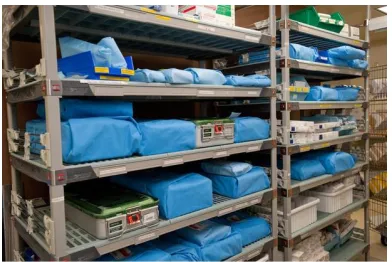
Instrument trays are bound in “blue wrap” to keep them sterile. Prior to the research, all
blue wraps (#5 plastic) generated by the hospital were sent to landfill, where they will
take hundreds of years to degrade (Saskatchewan Waste Reduction Council, 2008). The
test hospital has partnered with a qualified waste management provider to recycle their
blue wrap and divert mass amounts from landfill annually.
3) Composting
Prior to the research, the hospital’s kitchen processed all of its food waste with the use of
a pulper, which mulched up the food. This food mulch was collected and sent to landfill.
The hospital is charged by weight for the removal of waste, and food scraps are the
heaviest component of the waste stream. To divert organics from the waste stream, and to
significantly reduce the cost of waste removal, two in-vessel composters were installed in
the Dietary department. The composters each convert 250 pounds of organic waste into
fertilizer in a 15-hour period, reducing mass by 90%. Agitators break down the food into
small particles, which are heated to 180°F/82°C. This decomposes and deodorizes the
organics, while sterilizing and killing bacteria, meaning that even food that has come into
contact with infectious patients can be safely composted. The fertilizer is being donated
to a local non-profit organization which grows produce for those in need in the
community. The test hospital has become only the second hospital in Canada to