Efficient Algorithm Used for Radio Frequency
Identification Tag in Wireless Sensor Network
C.Anitha1, M.Devaraj2, K. K. Kavitha3
Asst. Professor, Dept. of Computer Science, Selvamm Arts & Science College (Autonomous), Tamilnadu, India 1
Research Scholar, Dept. of Computer Science, Selvamm Arts & Science College (Autonomous), Tamilnadu, India 2 HOD&Vice Principal, Dept. of Computer Science, Selvamm Arts & Science College (Autonomous), Tamilnadu, India 3
ABSTRACT:Radio frequency identification (RFID) systems are the collision between tags that lowers the potency of
the RFID systems. The favored anti-collision algorithms is ALOHA-type algorithms and have smart performance once the quantity of tags to be scan is cut-rate .Associate degree increased dynamic framed slotted acknowledgment algorithmic rule for RFID is extended to a lot of general shut type becomes just one special case represented. The improved acknowledgment algorithmic rule for RFID tag identifications has abundant larger capability to handle the cases once the tag numbers increasing mostly whereas each frame keeping the optimum system potency thirty five.5%. Simulation results show that the projected algorithmic rule improves the potency nicely as compared with the traditional algorithms.
KEYWORD: RFID, Wireless Networks, Anti-Collision, Protocol, collision threshold.
I. INTRODUCTION
The reader offers data to the tags concerning the frame size and random variety that is employed to pick a wring the frame. Every tag selects a slot variety for access exploitation the random variety and responds to the slot variety within the frame.
The method of BFSA rule, within the initial browse cycle, Tag one and Tag three at the same time transmit
their Serial numbers in Slot one. Tag two and Tag five transmit their serial numbers in Slot two severally. As those area unit collided one another, i.e. tag collision, Tag 1, 2, three and five should respond next request of the reader. The reader will establish Tag four within the initial reader cycle as a result of there's just one tag response within the time interval three. The frame size is about to a few slots. Since the frame size of BFSA rule is fastened, its implementation is simple; but, it's a liability that drops potency of tag identification. The tag is also known tho' the browse cycle is unvaried if there are a unit too several tags and every one the slots is also crammed with collision. Or the waste of your time slots generates if an outsized size frame is employed within the case of little variety of tags.
Anti-collision algorithmic rule of slots needed to scan the tags will increase exponentially because the number of tags will be identified. The BFSA algorithmic rule downside by estimating the amount of uninformed tags and permitting solely a fraction of tags to retort soon provide the best system potency, When the amount of tags is just too massive for the given most frame size. The amount of tags area unit too little for the given frame size and also the system potency isn't best, the algorithmic rule then decreases the frame size so the system potency are often maintained optimally.
II. EXISTING SYSTEM
RFID could be a wireless communication technology that has automatic identification or chase and information assortment from any labeled object. Attributable to the shared communicating between the reader and therefore the tags throughout the identification method in RFID systems, several tags might communicate with the reader at constant time, which causes collisions. The tag collision should be addressed to own quick multiple tag identification method. In RFID system, one in every of the issues that we have a tendency to should solve is that the collision between tags that lowers the potency of the RFID system. ciao rule is employed to beat this downside.
Drawbacks of Existing System
RFID communication system scan the information in terribly slow manner.
Efficiency of the information reading method is extremely low.
III. PROPOSED SYSTEM
This paper describes the method and performance of the tag anti-collision algorithms of the tree-ALOHA trend. In the paper, we tend to propose a brand new anti-collision formula known as increased Dynamic framed Slotted ciao (EDFSA) that estimates the amount of uninformed tags initial and adjusts the amount of responding tags or the frame size to offer the best system potency. As a result, within the projected technique, the amount of slots to browse the tags will increase linearly because the amount of tags will. Simulation results show that the projected formula improves the slot potency by 85∼100% compared to the standard algorithms once the amount of tags is a thousand.
Advantages of Proposed System
ALOHA rule is employed to cut back the collision between readers and tags.
In this methodology is incredibly straightforward to speak tags.
The performance of the acknowledgment rule is sweet
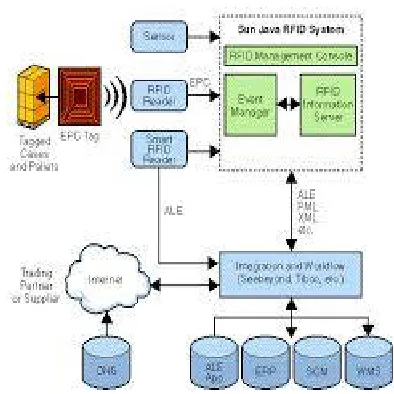
System Architecture
IV. IMPLEMENTATION
Design issues
The RFID (Radio Frequency Identification-13.56MHz RFID system) basically consists of associate degree
RFID Reader/Writer (Transceiver), associate degree HF Tag and a Processor unit interfacing to varied peripherals.
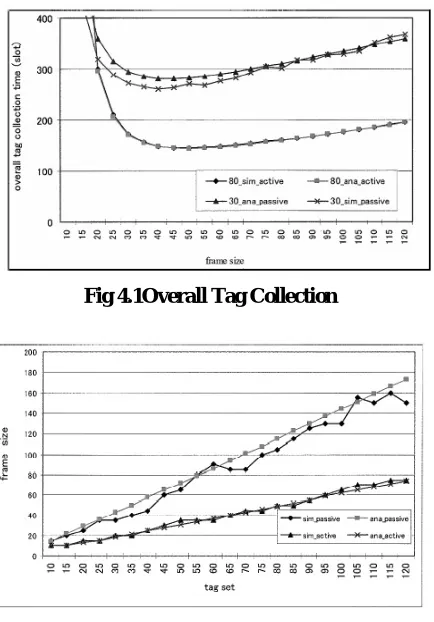
Fig 4.1Overall Tag Collection
Fig 4.2Frame Size
RFID Reader/Writer (Transceiver)
The RFID Transceiver represents the core of the RFID reader. Besides the interface to the reader’s antenna, a parallel or serial communication is used between the Processor and also the Transceiver unit. varied programming choices build the TI's RFID Transceiver appropriate for a large vary of proximity (communication distance to Transceiver - Tag: <10cm) and section (communication distance to Transceiver - Tag: >50cm) RFID applications.
ISO15693, IOS14443-A bit rates starting from 106kbps to 848kbps, ISO18000-3 and Tag-it RFID communication protocols area unit supported. enclosed with the on chip knowledge coding/encoding is that the automatic generation of SOF (Start of Frame), EOF (End of Frame), CRC and/or parity bits.
Processor
BASIC framed SLOTTED algorithmic program (BFSA)
BFSA algorithmic program uses a hard and fast frame size and doesn't modification the dimensions
throughout the method of tag identification. In BFSA, the reader offers info to the tags concerning the frame size and therefore the random range that is employed to pick out a wring the frame. every tag selects a slot range for access victimization the random range and responds to the slot range within the frame.
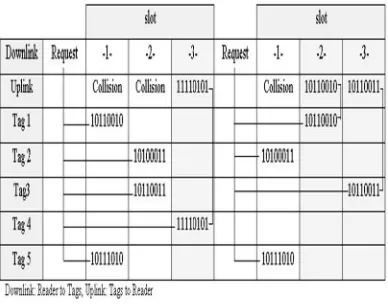
Fig 4.3: The process of BFSA algorithm
One presents the method of BFSA algorithmic program. within the 1st scan cycle, Tag one and Tag three at the same time transmit their serial numbers in Slot one. Tag a pair of and Tag five transmit their serial numbers in Slot a pair of severally.
As those are collided one another, i.e. tag collision, Tag 1, 2, three and five should respond next request of the reader. The reader will establish Tag four within the 1st reader cycle as a result of there's just one tag response within the slot three. during this example, the frame size is about to 3 slots. Since the frame size of BFSA algorithmic program is mounted, its implementation is easy, however, it's a liability that drops potency of tag identification. for example, no tag is also known tho' the scan cycle is unvaried if there ar too several tags and every one the slots is also crammed with collision. Or the waste of your time slots generates if an oversized size frame is employed within the case of tiny range of tags.
Through simulation we are able to live the full census delay by varied the frame size for given range of tags. Then we are able to notice the optimum frame size which ends within the minimum total census delay, for given range of tags.
The optimum frame sizes, leading to minimum census delay, are often determined consistent with the full range of tags. Presents associate degree example of the link between total range of tags and frame size. for instance, the optimum frame size for eighty active tags is forty five, whereas for thirty passive tags
V. CONCLUSION
anti-collision algorithms. We tend to believe that we are going to be ready to observe additional improvement if the amount of tags is larger. Within the algorithmic rule tho' we will improve the performance of the projected algorithmic rule if we tend to use natural numbers rather than the ability of 2 once choosing the frame size and Modulo, the performance improvement isn't vital. once we use the amount with the ability of 2, we tend to area unit achieving the system potency of a minimum of thirty four.6 %, whereas we will do thirty six.8 % if everything is ready to best. Thus, we tend to believe that the algorithmic rule we tend to projected is easy to implement whereas achieving the performance near theoretical most.
REFERENCES
[1] .B. Glover and H. Bhatt, RFID essentials. Farnham: O'Reilly, 2006.
[2] C. Lee, H. Cho, and S. W. Kim, "An Adaptive RFID Anti-Collision Algorithm Based on Dynamic Framed ALOHA," IEICE TRANS. COMMUN, vol. VOL.E91–B, 2008.
[3] D. H. Shih, P. L. Sun, D. C. Yen, and S. M.Huang, "Taxonomy and survey of RFID anti-collision protocols,” Computer Communications vol. 29, pp. 2150-2166, 2006.
[4] H. Cho, W. Lee, and Y. Baek, "LDFSA: A Learning-Based Dynamic Framed Slotted ALOHA for Collision Arbitration in Active RFID Systems," Advances in Grid and Pervasive Computing, pp. 655-665, 2007.
[5] H. Vogt, "Efficient Object Identification with Passive RFID Tags," in Pervasive Computing First International Conference, vol. Volume 2414/2002. Switzerland: Springer Berlin / Heidelberg, 2002, pp. 98.
[6] J. H. Choi, D. Lee, H. Jeon, J. Cha, and H. Lee, “Enhanced Binary Search with Time-Divided Responses for Efficient RFID Tag Anti-Collision," in ICC '07. IEEE International Conference Communications. Glasgow, 2007
[7] J. Myung and W. Lee, "An Adaptive Memory less Tag Anti-Collision Protocol for RFID Networks," IEEE ICC, 2005.
[8] J. Myung, W. Lee, J. Srivastava, and T.K. Shih, “Tag-Splitting: adaptive collision arbitration Protocols for RFID tag identification," In IEEE Trans. on Parallel and Distributed Systems,, vol. 18 (6), pp. 763-775, Jun. 2007.
[9] J. R. Cha and J. H. Kim, "Dynamic Framed Slotted ALOHA Algorithms using Fast Tag Estimation Method for FRID system," presented at 3rd IEEE Consumer Communications and Networking Conference, Las Vegas, NV, United States, 2005.
[10] J. R. Cha and J. H. Kim, "Novel anti-collision algorithms for fast object identification in RFID system," presented at 11th International Conference on Parallel and Distributed Systems Workshops, Fukuoka, Japan, 2005.
[11] K. Finkenzeller, RFID handbook : fundamentals and applications in contactless smart cards and identification, 2nd ed. Chicester, England;Hoboken, N.J.: Wiley,2003.
[12] L. A. Bordet, "RFID Multiple Access Methods," ETH Zurich 2004
[13] L. Biao, H. Ai qun, and Q. Zhong yuan,"Trends and Brief Comments on Anti-collision Techniques in Radio Frequency Identification System, “in 6th International Conference on ITS Telecommunications Proceedings, 2006.
[14] L. Liu and S. Lai, "ALOHA-Based Anti-Collision Algorithms Used in RFID System," in Wireless Communications, Networking and Mobile Computing. China 2006
[15] L. Liu, Z. Xie, J. Xi, and S. Lai, "An improved anti-collision algorithm in RFID system," presented at 2nd International Conference on Mobile Technology, Applications and Systems, Guangzhou, China, 2005.
[16] M. A. Bonuccelli, F. Lonetti, and F. Martelli,"Tree Slotted Aloha: a New Protocol for Tag Identification in RFID Networks," presented at International Symposium on a World of Wireless, Mobile and Multimedia Networks, Buffalo-Niagara Falls, NY, United States, 2006. [17] M. Bhuptani and S. Mora pour, RFID field guide : deploying radio frequency identification systems. Upper Saddle River, NJ: Sun
Microsystems/Prentice Hall PTR, 2005.
[18] N. Raze, V. Bradshaw, and M. Hague,” Applications of RFID technology," presented at RFID Technology (Ref. No. 1999/123), IEE Colloquium on, 1999.
[19] S. R. Lee, S. D. Joo, and C. W. Lee, "An enhanced dynamic framed slotted ALOHA algorithm for RFID tag identification, “presented at Second Annual International Conference on Mobile and Ubiquitous Systems -Networking and Services, San Diego, CA, United States, 2005. [20] T. P. Wang, "Enhanced binary search with cut through operation for anti-collision in RFID systems," IEEE Communications Letters, vol.10,
pp. 236-238, 2006.
[21] T. W. Hwang, B. G. Lee, Y. S. Kim, D. Y. Suh , and J. S. Kim, "Improved Anti-collision Scheme for High Speed Identification in RFID System," presented at First International Conference Innovative Computing, Information and Control, 2006.