DEVELOPMENT OF IMMUNOENZYMATIC METHODS FOR DETECTION AND QUANTITATION OF POLIOVIRUS
F r e d e r i c K. Pfaender and Gary K. Whitmyre Department o f Environmental Sciences and Engineering
School o f Pub1 i c H e a l t h
U n i v e r s i t y o f N o r t h Carol i na a t Chapel H i 11 Chapel H i 1 1
,
N o r t h Carol i n a 27514The work upon which t h i s p u b l i c a t i o n i s based was supported i n p a r t by funds p r o v i d e d by t h e O f f i c e o f Water Research and Technology, U. S. Department o f t h e I n t e r i o r , Washington, D. C., through t h e Water Resources Research I n s t i t u t e o f The U n i v e r s i t y o f N o r t h C a r o l i n a , as a u t h o r i z e d by t h e Water Research and Development A c t o f 1978.
DISCLAIMER STATEMENT
Contents of t h i s publication do not necessarily r e f l e c t the views and p o l i c i e s of the Oflice o f Water Research and Technology, U . S.
ACKNOWLEDGMENTS
The a u t h o r s would l i k e t o express t h e i r a p p r e c i a t i o n t o Dr. Gordon
Sharp, Department o f M i c r o b i o l o g y , U n i v e r s i t y o f N o r t h C a r o l i n a , Chapel H i l l ;
ABSTRACT
A major problem t h a t must be faced i n assessing t h e m i c r o b i o l o g i c a l q u a l i t y o f a wide v a r i e t y o f water sources i s t h e i d e n t i f i c a t i o n o f human e n t e r i c v i r u s e s . Moni t o r i ng programs based on e s t i m a t i n g b a c t e r i 01 o g i c a l contamination o f water a r e of q u e s t i o n a b l e value i n p r e d i c t i n g v i r u s con- c e n t r a t i o n s . Routine m o n i t o r i n g o f s u r f a c e , d r i n k i n g , and r e c r e a t i o n a l waters f o r v i r u s c o n t e n t i s s e v e r e l y hampered by t h e absence o f a r e l i a b l e , s p e c i f i c , and s i m p l e procedure f o r q u a n t i f i c a t i o n o f t h e number o f v i r u s p a r t i c l es present. T h i s research was d i r e c t e d toward devel opment o f a methodology u s e f u l f o r assessing e n t e r o - v i r u s contamination. The method i s based on an immunoenzymatic assay i n which v i r u s s p e c i f i c antibody, t o which i s bound o t h e r a n t i bodies and enzymes, i s r e a c t e d w i t h t h e v i r u s . The
complex can subsequently be v i s u a l i z e d by a d d i t i o n o f enzyme reagents which produce a c o l o r change i n t h e presence o f v i r u s p a r t i c l e s . Two forms of t h i s assay have been developed, one u s i n g a m i c r o s c o p i c v i s u a l i z a t i o n o f t h e c o l o r e d p a r t i c l e s and t h e o t h e r based on r e a c t i o n s i n a t e s t tube w i t h
us. Both methods o f f e r i n moderately contaminated
o f g r e a t e r s e n s i t i v i t y . b e i n g used t o q u a n t i f y v i r
t o count v i r u s p a r t i c l e s lopment o f f e r s t h e promise t o t a l c o l o r
TABLE OF CONTENTS
Summary and Concl u s i on Recommendation
I n t r o d u c t i o n L i t e r a t u r e Review 4.1 I n t r o d u c t i o n
4.2 E n t e r i c Viruses
-
Background and Pathology 4.21 E n t e r i c Viruses-
General Background4.22 Water Borne I n f e c t i o n s
-
E n t e r i c V i r u s Involvement 4.23 P o l i o n w e l i t i s4.3 E n t e r i c Viruses
-
Removal/Survival i n Treatment Processes 4.31 Removal/Survival i n Wastewater Treatment Processes 4.32 Removal/Survi v a l During Water Treatment Processes 4.33 Occurrence and S u r v i v a l i n Wastewater Treatment S l udge 4.4 Occurrence and S u r v i v a l o f E n t e r i c Viruses i n t h e Environment4.41 Occurrence and Surv-i v a l i n t h e A q u a t i c Environment 4.41 1 Occurrence and S u r v i v a l i n Water
4.41 2 Occurrence and S u r v i v a l i n Sediments 4.413 Occurrence and S u r v i v a l i n She1 1 f i s h
4.42 Occurrence and S u r v i v a l i n t h e T e r r e s t r i a l Envi ronment 4.43 Factors A f f e c t i n g V i r u s S u r v i v a l i n t h e Envi ronment 4.5 The Need f o r V i r u s Standards f o r Water
4.6 C u r r e n t Methods f o r Concentration and D e t e c t i o n o f E n t e r i c V i ruses i n Envi ronmental Samples
4.7 Immunoenzymati c Methods f o r D e t e c t i on o f V i r a l and Nonvi r a l A n t i gens
4.71 Qua1 i t a t i ve Methods 4.72 Q u a n t i t a t i v e Methods
A Proposed Immunoenzymatic Method f o r D e t e c t i o n o f Pol i v i r u s i n Water M a t e r i a1 s and Methods
C e l l C u l t u r e
Pol i o v i r u s P r o d u c t i o n
P u r i f i c a t i o n o f Antibody by Immunoadsorption P r e p a r a t i o n o f Monodi sperse V i r u s
V i r u s Plaque Assay
P h y s i c a l Assay o f P u r i f i e d V i r u s
6.9 Gel D i f f u s i o n
6.10 Reduction o f N o n s p e c i f i c Background S t a i n i n g 6.11 V i r u s R e t e n t i o n on F i l t e r s
6.12 D e t e r m i n a t i o n o f P r o p e r t i e s o f A1 g i n a t e F i 1 t e r s 6.13 Immunoenzymati c Tube Assay
6.14 Immunoenzymatic F i l t e r Assay
6.15 Photomicroscopy
R e s u l t s and Discussion
7.1 Sheep A n t i p o l i o v i r u s Antibody P r o d u c t i o n 7.2 Gel D i f f u s i o n
7.3 Reduction o f N o n s p e c i f i c Background S t a i n i n g 7.4 V i r u s Rentention on F i l t e r s
7.5 P r o p e r t i e s o f A1 g i n a t e F i 1 t e r s 7.6 Immunoenzymatic Tube Assay 7.7 Immunoenzymati c F i 1 t e r Assay
1.0 Summary and Concl u s i ons
Immunoenzymatic assays have been developed f o r d e t e c t i n g v i r u s e s u s i n g t e s t tubes on f i l t e r s . Both methods have a t h e o r e t i c a l d e t e c t i o n 1 i m i t o f about 100 plaque f o r m i n g u n i t s (PFU). The t e s t tube method i s a m o d i f i c a - t i o n o f t h e E L I S A technique i n which v i r u s p a r t i c l e s a r e bound t o p o l y - s t y r e n e w i t h a n t i v i r a l a n t i body, and t h e n assayed by a d d i t i o n o f immuno- enzymatic reagents t o t h e tube. Development o f a f i l t e r assay i n v o l v e d se- l e c t i o n o f a method f o r r e d u c i n g n o n s p e c i f i c background s t a i n i n g , s c r e e n i n g o f f i l t e r s f o r v i r u s r e t e n t i o n and s u i t a b i l i t y , and s e l e c t i o n o f o p t i m a l c o n c e n t r a t i o n s o f immunoenzymatic reagents. For b o t h t h e f i l t e r and tube assays, p o l i o v i r u s t y p e 1 was t h e model v i r u s used f o r development o f these assay systems due t o i t s wide occurrence and p e r s i s t e n c e i n t h e e n v i ron- ment.
Although development o f these methodologies was i n i t i a t e d by i n t e r e s t i n t h e presence o f v i r u s i n s h e l l f i s h - g r o w i n g waters, t h e techniques may be g e n e r a l l y a p p l i c a b l e t o m o n i t o r i n g v i r u s i n water and wastewater samples, and may even have biomedical appl i c a t i ons.
There a r e p o t e n t i a l problems which w i l l have t o be addressed p r i o r t o a p p l i c a t i o n o f t h i s methodology t o a r o u t i n e m o n i t o r i n g s i t u a t i o n . One i n - volves m o d i f i c a t i o n o f e x i s t i n g v i r u s c o n c e n t r a t i o n techniques f o r t h e wide- l y v a r y i n g c o n d i t i o n s t h a t may occur i n environmental samples, especi a1 l y w i t h r e g a r d t o suspended p a r t i c u l a t e m a t t e r and p a r t i c u l ate-bound v i r u s
.
A second i n v o l v e s development o f pre-assay techniques t o render a concen- t r a t e d v i r u s sample s u i t a b l e f o r assay. T h i s c o u l d i n v o l v e removal o f p a r t i c u l a t e m a t t e r and o t h e r undesired m a t e r i a l . A t h i r d i s t h e e l i m i n a - t i o n o f i n t e r f e r i n g m a t e r i a l s . For t h e immunoperoxi dase technique, d i s s o l v e d o r suspended i r o n p r e s e n t s an i n t e r f e r e n c e problem f o r immunoenzymatic assays. T h i s i n t e r f e r e n c e problem may be s o l v a b l e by iron-removal methodologies now a v a i l a b l e . T h i s i n t e r f e r e n c e may n o t e x i s t f o r c e r t a i n enzymelsubstrate combinations.C u r r e n t l y , these immunoenzymatic methods a r e l i m i t e d t o d e t e c t i n g v i r u s i n moderately t o h i g h l y contaminated waters. A p p l i c a t i o n t o t h e low end o f t h e v i r u s c o n c e n t r a t i o n range ( e l 0 0 PFU/100 g a l l o n s ) w i l l r e q u i r e f u r t h e r improvement i n t h e s e n s i t i v i t y o f t h e methods. The s e n s i t i v i t y can be maximized i n s e v e r a l ways. Enzymes o f h i g h e r s p e c i f i c a c t i v i t y and h i g h e r - t i t e r a n t i bodies improve t h e s e n s i t i v i t y . The n o n s p e c i f i c s t a i n i n g problem, which may be one o f t h e g r e a t e s t f a c t o r s t h a t l i m i t s e n s i t i v i t y , can be reduced by u s i n g immunoenzymatic reagents o f v e r y h i g h p u r i t y .
2.0 Recommendati ons
Two m a j o r areas w i t h r e g a r d t o t h e s e q u a n t i t a t i v e imrnunoenzymatic methods r e q u i r e f u r t h e r r e s e a r c h . F i r s t , a d d i t i o n a l e f f o r t s h o u l d be p u t i n t o i m p r o v i n g t h e s e n s i t i v i t y , and t h u s t h e d e t e c t i o n 1 im i t, o f b o t h t h e t u b e and f i l t e r assays. T h i s goal can be p a r t i a l l y achieved by d e v e l o p i n g new methods t o reduce background. Second, f o l l o w - u p r e s e a r c h s h o u l d be i n i t i a t e d t o d e t e r m i n e what m o d i f i c a t i o n s i n these methods a r e necessary t o make them s u i t a b l e f o r a s s a y i n g f i e l d samples. T h i s c o u l d range f r o m i n v e s t i g a t i n g what sample p r e t r e a t m e n t measures a r e necessary, t o making improvements i n procedures and/or t h e equipment used i n t h e assays t o r e - duce t h e t i m e r e q u i r e d f o r t h e assay.
3.0 Introduction
This project was i n i t i a t e d by the Water Resources Research I n s t i t u t e
to identify and develop ways t o quantify viruses t h a t are not dependent on
cell culture techniques. This was deemed important because cell culture
assays are expensive, and not a l l types of viruses can be assayed by e x i s t -
ing cell culture techniques. This prohibits routine use of cell culture
i nan extensive vi rus monitoring program. We
have developed two immunoenzymati c
methods f o r quantitation of poliovirus. Such methods should give a b e t t e r
indication of viral contamination than i n d i r e c t methods
1
i ke the col i form
monitoring techniques, and can unequivocally demonstrate the presence and
concentration of human e n t e r i c virus
i ncontaminated water.
This report i s organized i n t o seven sections. Section
4.0presents a
review of relevant 1
it e r a t u r e , and provides a background on e n t e r i c viruses,
why they are of concern, and what methods currently e x i s t f o r detecting
virus
i nwater. Section 5.0 presents the proposed immunoenzymatic pro-
cedure f o r detecting pol iovi rus. Section
6.0summari zes the experimental
4.0 L i t e r a t u r e Review
4.1 I n t r o d u c t i o n :
One o f t h e b u i l t - i n paradoxes o f modern e x i s t e n c e i s t h a t t h e p e r c a p i t a demand on o u r water resources i s i n c r e a s i n g , w h i l e a t t h e same t i m e l e s s and l e s s o f t h i s resource i s a v a i l a b l e a t t h e d e s i r e d q u a l i t y . Pre- s e n t l y , each person i n t h e U n i t e d S t a t e s uses f r o m f i f t y t o f i v e - h u n d r e d l i t e r s o f water each day, most o f i t b e i n g r e t u r n e d t o t h e watershed from which i t was drawn a l o n g w i t h an added bonus
-
an anthropogenic r e s i d u a l o f i n o r g a n i c and o r g a n i c chemical p o l 1 u t a n t s,
and microorganisms i n c l u d i n g human e n t e r i c v i r u s e s (Shuval,
1976).The e n t e r i c v i r u s e s which i n f e c t man a r e o f i n c r e a s i n g concern today, now t h a t b a c t e r i a l diseases have been w e l l s t u d i e d and, f o r t h e most p a r t , a r e r e a d i l y c o n t r o l l e d w i t h a n t i b i o t i c s . I n c o n t r a s t t o t h e i n c i d e n c e s o f most b a c t e r i a l diseases which have been d e c l i n i n g over t h e l a s t few decades, t h e i n c i d e n c e of human e n t e r i c v i r a l diseases has increased (Committee on Envi ronmental Qua1 i t y & Management, 1970).
The pathways o f v i r u s t o man a r e i l l u s t r a t e d i n F i g u r e 4-1 (Gerba, e t a1
.
,
1975). The water r o u t e i s b e i n g i n c r e a s i n g l y a p p r e c i a t e d as a s i g n i r-
f i c a n t mechanism through which man i s i n f e c t e d by v i r u s . T h i s r o u t e i s made p o s s i b l e f o r e n t e r i c v i r u s e s by t h e i r a b i l i t y t o s u r v i v e i n t h e n a t u r a l environment, a p o i n t which
w i l l
be discussed i n f u r t h e r d e t a i l , and t h e i r a b i l i t y t o be t r a n s p o r t e d t o p o i n t s f a r from t h e i r p o i n t o f e n t r y i n t o t h e environment ( G r i n s t e i n , e t a1.
,
1970; Lamb and Chin, 1964; Metcal f and S t i l e s , 1968; Shuval,
e t a1.
,
1 9 m ) F4.2 E n t e r i c Viruses
-
Background and Pathology:4.21 E n t e r i c Viruses
-
General Background. Fenner, e t a1.
,
1974, have d e f i n e d e n t e r i c v i r u s e s as those which can s u r v i v e t h e a c i d i c andb i 1 ia r y s e c r e t i o n s o f t h e v e r t e b r a t e d i g e s t i v e t r a c t and i n i t i a t e i n f e c t i o n , e i t h e r symptomatic o r asymptomatic, i n g u t - a s s o c i a t e d t i s s u e . These v i r u s e s a r e o b l i gate p a r a s i t e s
,
r e l y i ng on v e r t e b r a t e animal c e l l s f o r r e p r o d u c t i on o f t h e i r own k i n d . Berg,--
e t a l . (1971), have p o i n t e d o u t t h a t e n t e r i cv i r u s e s u l t i m a t e l y f i n d t h e i r way i n t o a q u a t i c environments, where t h e y " a r e always p r e s e n t i n small numbers t h a t d i m i n i s h w i t h n a t u r a l d i e - o f f and any t r e a t m e n t t o which t h e water i s subjected." The small r e s i d u a l o f v i a b l e v i r u s e s i s s t i l l s i g n i f i c a n t , however, s i n c e even a s i n g l e v i a b l e v i r u s p a r t i c l e i s capable o f i n f e c t i n g a s u s c e p t i b l e host.
The nomenclature o f t h e e n t e r i c v i r u s e s by group and subgroup i s shown i n Table 4-1. P o l i o v i r u s i s t h e most commonly r e p o r t e d e n t e r i c
EXCRETA
-
MAN ANDANIMALS
I
TABLE 4-1
-
Human E n t e r i c V i r u s C l a s s i f i c a t i o nGroup Subgroup Number o f Types
E n t e r o v i r u s e s
Pol i o v i ru s e s
Coxsackievi r u s e s A Coxsackievi ruses B Echovi r u s e s
New E n t e r o v i ruses
Adenovi r u s e s 33
Reovi r u s e s 3
R o t a v i r u s e s (Duovi r u s e s ) ?
H e p a t i t i s A V i r u s e s
*
?Norwal k and Re1 a t e d Agents*
2
( ? )*
These v i r u s e s may a l s o be c l a s s i f i e d as P a r v o v i r u s e sHepatitis
A,
which appears t o be a parvovirus
on
the basis of
physical and chemical evidence (Shuval
,
1972), t h e only v i r u s f o r which a
water route of transmission has been unequivocally demonstrated.
Nonbacterial g a s t r o e n t e r i t i s has t r a d i t i o n a l l y been a wastebasket
category f o r e n t e r i c diseases where an agent has not been i s o l a t e d . There
a r e two recently-recognized groups of viruses associated
w i t houtbreaks of
nonbacterial g a s t r o e n t e r i t i s . These groups a r e t h e Norwal
kand re1 ated
agents, and the rotaviruses. These agents a r e q u i t e f a s t i d i o u s and cannot
be is01 ated by ordinary virological techniques. Furthermore, the quanti t a -
t i v e assay methodology i s not well developed f o r these agents (Sobsey,
1974). The Norwal
kand r e l a t e d parvovi rus-1
ike agents cause an acute
g a s t r o e n t e r i t i s
w i t hdiarrhea and vomiting. This agent was responsible f o r
the common source outbreak of acute i n f e c t i o u s nonbacterial g a s t r o e n t e r i t i s
t h a t occurred
i nNorwalk, Ohio in 1968. The rotaviruses a r e the leading
cause of winter g a s t r o e n t e r i t i s i n i n f a n t s where diarrhea and vomiting a r e
symptoms, and a major cause of i n f a n t mortality i n t h e Third World (Sobsey,
1972). Acute i n f e c t i o u s nonbacteri a1 g a s t r o e n t e r i t i s i s second only t o
acute r e s p i r a t o r y i l l n e s s as t h e most frequent form s f i l l n e s s . This
disease has a course from twenty-four t o forty-eight hours
w i t hsymptoms
t h a t can incl ude, besides diarrhea and vomiting, low-grade fever, abdominal
pain, headache, and malaise (Dolin,
- -
e t
a1
.
,
1973).
The Norwalk agent has been i s o l a t e d from stool f i l t r a t e s of infected
i ndi
v idual s
,
and examined serological l y and by immune electron microscopy
[IEM).
I t has been characterized as a 27
nm
p a r t i c l e t h a t bears resemblance
t o a parvovi
rus
on t h e basis of physical parameters (Kapi kian, 1972). The
Norwalk agent has been compared t o two s i m i l a r viruses
-
one i s o l a t e d in
Honolulu, Hawaii, and one i s o l a t e d from Montgomery County, Maryland. A1 1
three agents produce c l i n i c a l l y s i m i l a r i l l n e s s e s . The Norwalk and
Montgomery County agents a r e s i m i l a r a n t i g e n i c a l l y , but t h e Hawaii agent i s
d i s s i m i l a r from both of these viruses a n t i g e n i c a l l y (Wyatt, e t a1
.
,
1974).
The reovi rus o r r o t a v i r u s agent i s involved
i nmany cases of i n f a n t i l e
g a s t r o e n t e r i t i s (Holmes,
&
a l . , 1975; Kapikian, e t a l . , 1974; P e t r i c ,
et
a1
1975), and upon examinaEon
byIEM
and complement f i x a t i o n (CF) i s
-' 9
seen t o be a n t i g e n i c a l l y r e l a t e d t o viruses t h a t cause diarrhea
i ni n f a n t
mice, and t o Nebraska Calf Diarrhea
Virus
(NCDV) (Kapi kian, e t a1
.
,
1974).
Physically
i ti s a p a r t i c l e
w i t ha sedimentation c o e f f i c i e n t of 520-530
S ,and a buoyant density
i ncesium chloride of 1.36 g/ml ( P e t r i c , e t a1
.
,
1975).
A
breakthrough
i nt h e study of t h i s group of agents was t h e accom-
plishment of successfully growing t h e
virus
i n - v i t r o i n human f e t a l
i n -t e s t i nal organ c u l t u r e s (Wyatt, e t a1.
,
1 9 7 4 r
4.22 Water Borne Infections
-
Enteric Viruses.
The
f a c t t h a t water
i s able t o serve a s a vector of e n t e r i c disease a s e n t s was recoqnized
b.yJohn Snow about 1854. This was a long time p r i o r - t o t h e sciences achieving
any understanding of the causati ve pathogenic mi croorgani sms invol ved
and because of t h e i r common occurrence i n man's environment.
A s t a t i s t i c a l breakdown o f r e p o r t e d v i r a l waterborne disease outbreaks i n t h e U n i t e d S t a t e s between 1971 and 1975, i n c l u s i v e l y , y i e l d s 17,752 cases (63 outbreaks) o f g a s t r o e n t e r i t i s o f unknown e t i o l o g y and 369 cases (14 outbreaks) o f H e p a t i t i s A. Most outbreaks o f waterborne disease occur i n S p r i n g o r Summer, many i n v o l v i n g semi-publ i c water s u p p l i e s , such as those i n r e c r e a t i o n a l areas, where t r e a t m e n t i s l a c k i n g o r u n s o p h i s t i c a t e d . These outbreaks a r e u s u a l l y a s s o c i a t e d w i t h improper c h l o r i n a t i o n o f d r i n k i n g water (Sobsey, 1977). C l a r k e and Chang (1959) have reviewed t h e water- borne epidemics o f i n f e c t i o u s h e p a t i t i s i n t h e U n i t e d S t a t e s and abroad, and d i s c o v e r e d t h a t t h e g r e a t m a j o r i t y o f these outbreaks have r e s u l t e d from sewage-contami nated water suppl i e s
,
p r i m a r i l y those t h a t a r e p r i v a t e o r semi-public. The most n o t o r i o u s i n f e c t i o u s h e p a t i t i s outbreak, however, occurred from an u n a n t i c i p a t e d gross sewage contamination o f a r i v e r which served as t h e source f o r a p u b l i c water supply. T h i s o c c u r r e d i n 1955 i n New D e l h i , I n d i a , where an e s t i m a t e d 30,000 t o 50,000 persons were a f f e c t e d( V i s i vanathen and S i ndhu, 1957). I n f e c t i o u s h e p a t i t i s has a1 so r e s u l t e d from consumption o f s h e l l f i s h grown i n sewage-contaminated waters (Bryan, 1972). Hundreds o f cases o f she1 1 f i s h - t r a n s m i t t e d h e p a t i t i s have been r e - p o r t e d (Gerba, e t a l . , 1975; Mason and McLean, 1962), and e n t e r i c v i r u s e s have been i s o l a t e d f r o m o y s t e r s taken from b o t h t h e East and G u l f coasts of t h e U n i t e d S t a t e s (Gerba, e t a l . , 1975). Another disease f o r which a 7 -
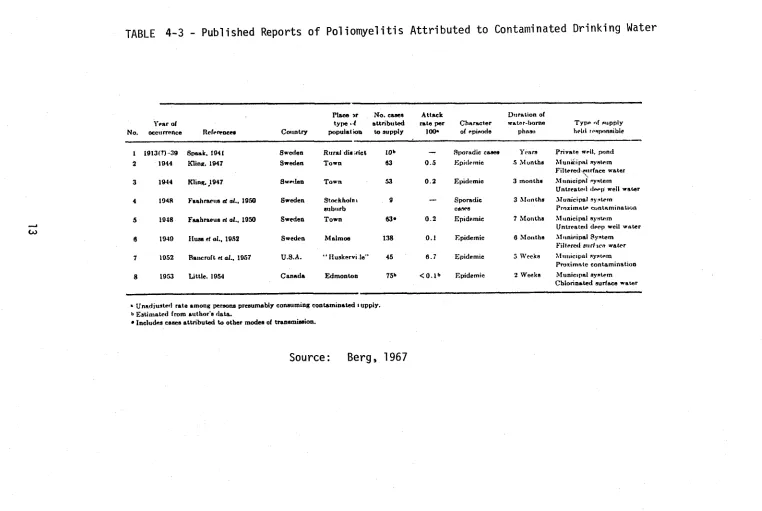
w a t e r r o u t e has been i m p l i c a t e d b u t n o t u n e q u i v o c a l l y demonstrated i s p o l i o - myel i t i s , t h e c a u s a t i v e agent b e i n g p o l i o v i rus. There have been s e v e r a l outbreaks t h a t have been a s s o c i a t e d w i t h d r i n k i n g water ( B a n c r o f t , e t a l . ,
--
1957; L i t t l e , 1964; Mosley, 1967).
The e x t e n t t o which waterborne v i r u s e s t h r e a t e n p u b l i c h e a l t h i s con- t r o v e r s i a l . Some persons propose t h a t s i n c e one i n f e c t i o u s u n i t i s
t h e o r e t i c a l l y capable o f producing i n f e c t i o n i n man, then t h e presence o f one v i r u s u n i t i n a water supply poses a p o t e n t i a1 hazard (Gerba, e t a1
- -
.
,
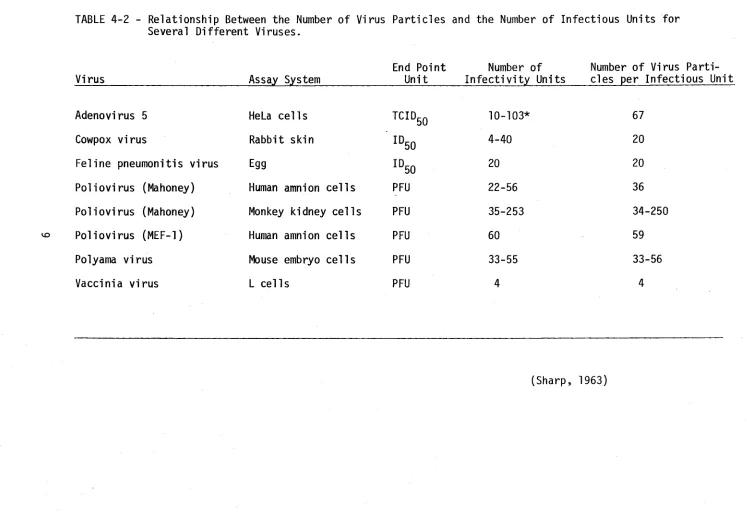
1975). There a r e several arguments c o u n t e r t o t h i s view. F i r s t o f a l l , s e v e r a l o r many v i r u s p a r t i c l e s a r e r e q u i r e d t o c o n s t i t u t e a s i n g l e i n -f e c t i o u s u n i t . T h i s i s i l l u s t r a t e d i n Table 4-2. For p o l i o v i r u s t h i s t r a n s - l a t e s t o up t o 200 o r 300 v i r u s p a r t i c l e s p e r i n f e c t i o u s u n i t (Sharp, 1963). Secondly, i n g e s t i o n o f an i n f e c t i o n w i t h small amounts o f v i r u s does n o t n e c e s s a r i l y 1 ead t o expression as disease. T h i r d l y , t h e r i s k s represented by v i r u s e s i n d r i n k i n g w a t e r must be e v a l u a t e d r e l a t i v e t o o t h e r r i s k s t o man's h e a l t h t h a t a r e p r e s e n t i n water, such as t h e m y r i a d o f carcinogens/ mutagens p r e s e n t i n c h l o r i n a t e d d r i n k i n g water.
TABLE 4-2
-
R e l a t i o n s h i p Between t h e Number o f V i r u s P a r t i c l e s and t h e Number o f I n f e c t i o u s U n i t s f o r Several D i f f e r e n t Viruses.End P o i n t Number o f Number o f V i rus P a r t i - V i r u s Assay System U n i t I n f e c t i v i t y Uni t s c l es p e r I n f e c t i o u s U n i t
Adenovirus 5 Cowpox v i r u s
Fel i ne pneumoni t i s v i r u s Pol i o v i r u s (Mahoney) Pol i o v i r u s (Mahoney)
HeLa c e l l s TCI DSO 10-1 03"
Rabbit s k i n
I
D 5 ~ 4-40Egg I D50 20
Human amnion c e l l s P FU 22-56
Monkey kidney c e l l s PFU 35-253
Pol i o v i r u s (MEF-1) Human amnion c e l l s P FU
Polyama v i r u s Mouse embryo c e l l s PFU
Vaccinia v i r u s L c e l l s PFU 4 4
feces, which then ultimately find t h e i r way into the aquatic environment.
These persons are also of tremendous importance epidemiologically as they
can a c t as foci of infection. Thus from the few infected asymptomatic
persons who obtained viruses from the water route, the viruses spread into
the community by the fecal -oral route and by di rect-contact transmission.
Infection and the resulting disease following t h i s pathway would appear t o
the epidemiologist as a classical picture of di rect-contact transmission
only, and not as the common-source transmission
t h a t
i t actually i s (Berg,
e t a1
.
,
1971
;Lenette, 1977).
- -
Of course, there are many types of e n t e r i c viruses. Reinfections with
the same type of virus are r a r e , and hence epidemic "peaks" of c l i n i c a l
and subclinical infections might be expected t o occur when a s u f f i c i e n t
number of suscepti bles, usually children, i s attained within the population.
4.23 Pol iomyeli t i s . Poliomyelitis i s an acute viral i l l n e s s manifest-
ed by a wide variety of s e v e r i t i e s from asymptomatic infections t o the
paralytic disease (Nenenson, 1970). The disease i s caused by a small
enteri c vi rus
,
pol i ovi rus
,
of the enterovi rus group. Pol i ovi rus parti cl es
are
28nm
in s i z e and r e l a t i v e l y heat s t a b l e , especially in t h e presence of
divalent cations 1 ike magnesium. The virus i s inactivated by
UV1
i g h t , dry-
ing, and low residuals (0.1
ppm)of chlorine (Jawetz,
- -
e t a l . , 1974).
There a r e 3 antigenic types, designated 1 ,
2 ,and 3 (Jawetz, e t a l .
,
1974). Additional l y , there are genetic markers which distinguish t h e w i l d
type virulent s t r a i n s from the avirulent s t r a i n s . For example, polio-
virus type-1 s t r a i n Mahoney, a virulent s t r a i n , has the markers
d+T+and
poliovirus type-1 s t r a i n Lsc, which i s avirulent, has the markers d-T-.
The marker
d+designates the abi 1 i t y of viral plaques t o form in c e l l mono-
layers in the presence of 0.07% sodium bicarbonate whereas
d-designates
the i n a b i l i t y of viral plaques t o form in the presence of 0.40% sodium bi-
carbonate. Tt indicates plaque-formation capabi 1 it y a t 40°C and T- indi
-
cates t h a t plaques will
n o t
form a t temperatures greater than 37OC (Melnick
and Melnick, 1959). Furthermore, heated pol iovi rus shows di f f e r e n t surface
antigens compared t o native virus. Native virus has two major surface a n t i -
gens,
Nand
D ,whereas heated virus has the antigens
Hand
C.This pre-
sumably i s due t o denaturation of the virus coat proteins which expose new
segments of the polypeptide chains (Beala and Mason, 1968).
Poliovirus invades the alimentary t r a c t , causing a viremia
i nsome
cases, followed by invasion of the central nervous system
(CNS)and selec-
t i v e involvement of motor c e l l s leading t o , in the extreme case, paralysis
(Nenenson
,
1970). The incubation period f o r the disease i s seven t o four-
teen days on the average, with a range of three
t o
t h i r t y - f i v e days
(Jawetz,
--
e t a1
.
,
1974). Paralysis i s implicated in only about three t o
four percent of the c l i n i c a l l y recognizable cases of poliomyelitis. The
remainder involves a milder i l l n e s s such as aseptic meningitis (Jawetz,
e t a l . , 1974; Paul, 1971). Transmission i s thought
t o
be primarily through
- -
The age distribution of the disease has been well studied.
I nisolated
unvaccinated areas, polio attacks a l l age groups equally. In crowded primi-
t i v e s o c i e t i e s , where poor sanitation favors wide dissemination of the
virus, polio continues t o be a disease of infancy,
w i t ha l l children over
four years of age possessing anti bodies t o the virus (Jawetz, e t a1
.
,
1974).
Unexplained, however, i s the recent s h i f t in the age incidence of polio-
myelitis t h a t s t a r t e d a few decades ago in western society. Poliomyelitis
i s now occurring more frequently in increasingly older age groups than i t
had in the past in the United S t a t e s , England, Denmark, Sweden, and
Australia (Keswick and Gerba, 1980). Currently there i s concern t h a t a
f a l s e sense of security resulting from the sharp decline in poliomyelitis
incidence in recent years i s leading t o a lapse in vaccination programs.
This may be producing large numbers of susceptible youngsters t h a t may
eventually r e s u l t in an epidemic. Figure 4-2 shows the seasonal pattern
t h a t the disease follows, with ~ e a k s
in l a t e Summer and early Fall.
As mentioned before the existence of a water route f o r poliomyelitis
i s supported by evidence. Pol iovi rus i s present in sewage-contaminated
water, and undoubtedly many persons ingest small quantities of virus daily.
Interestingly, 13 of
the
19 i s o l a t e s of polioviruses
t h a t
Wallis and Melnick
(1967) found in municipal sewage had
d+markers, which indicated t h a t
e i t h e r the vaccine s t r a i n s had p a r t i a l l y reverted, o r t h a t wi ld-type s t r a i n s
were circulating in the population in the absence of c l i n i c a l disease. To
date e f g h t reported polio outbreaks have occurred in which drinking water
was thought t o be the cause as summarized in Table 2-3.
Six of the out-
breaks occurred in Sweden during the 1930's
a n d1940's. In the
U.S.,the
one confirmed water-borne outbreak occurred in 1952 in Huskervill e ,
Nebraska in a c l u s t e r of row houses with a common contaminated water supply
(Bancroft, e t a1
.
,
1957). The Edmonton, A1 berta outbreak of 1953 occurred
in l a t e
alla and
accompanied the ma1 functioning of the chlorination process
f o r sewage e f f l u e n t in a town twenty miles upstream from where Edmonton
drew i t s water supply ( L i t t l e , 1954).
4.3 Enteric Vi ruses
-
Removal /Survi val in Treatment Processes:
4.31 Removal/Survival in Wastewater Treatment Processes. Wastewater
treatment processes, besides reducing the bi 01 ogi cal oxygen demand (BOD) of
the wastewater, a1 so s i g n i f i c a n t l y reduces the number of infectious virus
p a r t i c l e s present in the wastewater.
Concern about e n t e r i c viruses would
end a t the treatment plant i f conventional sewage treatment yielded 100%
inactivation of these viruses. However, t h i s i s not the case (Berg, 1973;
Ma1 ina, 1976; Schwartzbrod,
e
J
a l . , 1973; Sproul
,
1974). The effluent of
a
PARALYTIC POL~OMYELITIS
-
Reported Cases by Month, United States, 1962-1971PARALYTIC WLlOMYELlTlS REPORTED CASES 8 Y FIVE-YEAR AGE G m P
1971
3 I
4 I
4 0 IQ 60 70
A G E
FIGURE 4-2
-
Seasonal Occurrence of Pol iomyel i t is
TABLE
4-3-
Pub1
i shedReports of
Poliomyel
i t is Attributed t o Contaminated
D r i n k i n gWater
Place ,r No. cases Attack Dtrrnt~on of
Yrar of type ..f attributed n r s per C h ~ r a c t e r wntcr-borne Type d rupply No. occurrrnce Refrreneer Conniry population to supply 100. of rpinode phnaa hrlcl rcymnatble
1 1813(?)-39 Spsak. 1941 B a d a n Rural die .net 10b
-
Slmradic c a d s Yrnm Prrvnte arll. pond2 1944 Klins. 1847 Sweden Town 63 0 . 5 I.:p~drmrc S Muntba Xlurt<c~pnl aynlcm Filteredyirfnce water Swmlen T o r n 53 0 2 Eptdrmrc 3 months M u n ~ c ~ p n l -y-tem
Untreatrd tlrrp well v a a r
4 1048 Fauhmcus d ol.. 19.50 Sweden Stnckholn~ 8
-
Sporadic 3 hlcrnths JZunicirml ))*ternsuburb cl~9es ProximnLP cunt~mrnatton
5 1048 Fnahraeua LI ol., 1950 Sweden Town 83 0 . 2 Ep~demie 7 Months h l ~ r n ~ c i p a l nyltrm
Untreated deep well water
6 1940 IIusa el al., 18.52 Sweden Malmm 138 0.1 Epidemic 8 Morrtba . \ l ~ ~ n i r i p a l Pyqtcm
FtlIrrml errrl xcn water 7 1052 R a ~ ~ c r o l t rt 01.. 1057 U.S.A. " liuskrrvi la" 45 8 . 7 Epidem~c j Weeks >11111rc1pnl n y s t ~ m
Pmxirnnte contaminatron
8 1053 Little. I054 Canads Edmonton 75b < 0.1 b Epidemic 2 Weeka Municlpnl syatern Cblorinded surfaes water
* Unndiustrrl rate among perwns p r e s u ~ b i y consuming contaminated up ply.
b Eatimat~d from author's dub.
Includes canes attributed fo other modes of tranambion.
s e t t l i n g t i m e . I n secondary, o r b i o l o g i c a l treatment, v i r u s removal can be as h i g h as 97% (Safferman and M o r r i s , 1976). T h i s i s f o l l o w e d b y a d i s i n - f e c t i on process, usual l y c h l o r i n a t i o n , which reduces t h e l e v e l s o f v i r u s even f u r t h e r . The c o n c e n t r a t i o n s o f bacteriophage and human v i r u s e s have o c c a s i o n a l l y been used as an i n d i c a t i o n o f t h e e f f e c t i v e n e s s o f w a t e r and wastewater t r e a t m e n t processes ( C l a r k e , e t a l . , 1961 ; Malina, e t a l . , 1975;
- -
Safferman and Morris, 1976; S h e l t o n and E e Z y , 1973).V i r u s removal has been w e l l s t u d i e d f o r secondary and t e r t i a r y sewage t r e a t m e n t . I n l a b o r a t o r y s t u d i e s , t r i c k l i n g f i l t e r s have reduced v i r u s 1 eve1 s by up t o 2 "1 ogs"
,
o r 99% (Shuval,
1970), and a c t i v a t e d sludge r e - duced v i r u s l e v e l s w i t h a w i d e l y v a r y i n g e f f i c i e n c y . For a c t i v a t e d sludge Coxsackievi r u s t y p e A9 was reduced 96 t o 99%, b u t p o l i o v i r u s t y p e 1 was r e - duced as l i t t l e as 38% a f t e r s i x t o e i g h t hours o f exposure t o t h e process(Clarke,
- -
e t a1.
,
1961 ).
T e r t i a r y treatment, o r advanced chemical t r e a t m e n t o f wastewater l e a d s t o g r e a t e r r e d u c t i o n s i n v i r u s c o n c e n t r a t i o n s t h a n p r i m a r y o r secondard t r e a t m e n t . Chemical coagul a t i o n - f l o c c u l a t i o n can be p a r t i c u l a r l y e f f e c t i v e i n removing v i r u s , a1 though a g a i n t h e v a r i a b i l i t yi n removal e f f i c i e n c i e s i s g r e a t . I n l a b o r a t o r y s t u d i e s , a1 uminum s u l f a t e (alum) c o a g u l a t i o n has y i e l d e d v i r u s r e d u c t i o n s as h i g h as 99.8 t o 99.9% (Wolf,
- -
e t a1.
,
1974). Lime treatment, besides removing v i r u s by a d s o r p t i o n t o o r entrapment i n t h e f l o c , has t h e added advantage o f i n a c t i v a t i n g t h e v i r u s by t h e h i g h pH a t t a i n e d i n t h i s process, sometimes up t o 4 " l o g " o r 99.99% removal (Berg,- -
e t a1.
,
1968; S a t t a r , e t a1--
.
,
1976).F u r t h e r r e d u c t i o n i n v i a b l e v i r u s can be achieved by d i s i n f e c t i o n . C h l o r i n e i s now t h e most w i d e l y used d i s i n f e c t a n t f o r t h i s purpose, a l - though ozone, i o d i n e , and bromine a r e r e c e i v i n g s e r i o u s c o n s i d e r a t i o n as a l t e r n a t i v e d i s i n f e c t a n t s . D i s i n f e c t i o n e f f i c i e n c y depends on a number o f v a r i a b l e s , i n c l u d i n g t h e t y p e o f v i r u s present, i t s p h y s i c a l s t a t e , t h e t y p e o f d i s i n f e c t a n t used, t h e q u a l i t y and n a t u r e o f t h e waste, pH, tempera- t u r e , and 1 e n g t h o f t r e a t m e n t (Gerba,
--
e t a1.
,
1975; Sharp, e t a1.
,
1976).If halogens a r e used i t i s necessary t o add amounts beyond t h e d e m a n d o f t h e endogenous o r g a n i c and i n o r g a n i c m a t e r i a l p r e s e n t b e f o r e any s i g n i f i c a n t r e d u c t i o n i n v i r u s occurs (Freund, 1976). For secondary e f f l u e n t , one must r a i s e t h e dose t o as h i g h as 40 mg/l f o r t e n minutes t o o b t a i n a 3 - l o g
removal. However, t h i s h i g h a dose o f c h l o r i n e does n o t come w i t h o u t i t s own problems. The c h l o r i n a t e d o r g a n i c compounds formed show t o x i c i t y t o - ward v a r i o u s forms o f a q u a t i c 1 i f e as wel 1 as p r o v i d i n g a source o f con-
t a m i n a t i o n o f t h e environment w i t h p o t e n t i a l l y c a r c i n o g e n i c compounds (Gerba, e t a1
.
,
1975).f l u c t u a t i n g from week t o week and season t o season (England, 1972). Even a p p a r e n t l y heal t h y i n d i v i d u a l s e x c r e t e e n t e r i c v i r u s e s , especi a1 l y c h i 1 dren under t h e age o f 15 (Ramao-Alvarez and Sabin, 1956). On t h e average about 10% o f t h e c h i l d r e n i n t h i s age group a r e shedding v i r u s e s a t any g i v e n t i m e (Gelfand,
- -
e t a l . , 1957; Honig, e t a l . , 1956; Sabin, 1955). I n i n f e c t - ed i n d i v i duais, e n t e r i c v i ruses a r e e x c r e t e d i n c o n c e n t r a t i o n s as h i g h as 100,000 TCID50 p e r gram o f feces, b u t t h e average c o n c e n t r a t i o n i s a magnitude l o w e r , o r about 10,000 TCID50 p e r gram. Sabin (1955), (assuming t h a t 10% o f t h e p o p u l a t i o n under age 15 a r e asymptomatic e x c r e t e r s , and t h a t t h e symptomatic i n d i v i d u a l s w i l l be few) c a l c u l a t e d an average v a l u e o f 311 TCID50 p e r gram feces f o r t h e t o t a l p o p u l a t i o n . Between 16% and 100% of t h i s v i r u s i s a s s o c i a t e d w i t h suspended s o l i d s i n t h e i n p u t stream and throughout t h e t r e a t m e n t process (We1 1 in g s , e t a1.
,
1976). The types o f v i r u s t h a t have been i s o l a t e d from sewage a r c n o t e d i n Table 4-4.4.32 Removal / S u r v i va1 D u r i n g Water Treatment Processes. Water t r e a t - ment processes were o r i g i n a l l y designed t o reduce t u r b i d i t y and improve t h e
bacterial o g i c a l qual i t y - o f water. c o n v e n i e n t l y i t a l s o removes e n t e r i c v i r u s e s from t h e w a t e r q u i t e e f f e c t i v e l y (Guy, e t a l . , 1977). T h i s removal, however, i s n o t complete (GUY, e t a1
.
,
1977 ; ~ a e r z i t e ,--
e t a1.
,
1975 ; York and Drewry, 1974). From t h i s a s s = t h e pub1 i c h e a l t h concern about v i r u s e s i n d r i n k i n g water.R i v e r s which r e c e i v e raw o r t r e a t e d sewage may c o n t a i n one t o t e n PFU p e r 100 m i l 1 i 1 i t e r s o r h i g h e r , depending on f l o w c o n d i t i o n s (Shuval
,
1976). P h y s i c a l -chemical t r e a t m e n t , as f o r wastewater, i s by f a r t h e most e f f e c t i v e t r e a t m e n t process f o r removing v i r u s e s from water. W i t h t h i s process alone a removal o f 3 o r 4 l o g s (99.9%-
99.99%) i s p o s s i b l e (Gerba, e t a1.
,
1975; Farrah, e t a1.
,
1978). For water t h i s i n v o l v e s a1 urn (a1 uminum s u l f a t e ) addi t i o n T o n o w e d by 1 ime ( c a l c i u m h y d r o x i d e ) . I t i s i m p o r t a n t t o n o t e t h a t a l l v i r u s e s a r e n o t e q u a l l y removed by t h e r e s u l t i n g f l o c (Farrah, e t a l . , 1978). D i s i n f e c t i o n i s t h e f i n a l b a r r i e r between t h e v i r u s e s p r e s e xl'n
t h e raw water and t h e g l a s s o f w a t e r consumed by man. For c h l o r i n e a 5 mg/l f r e e c h l o r i n e r e s i d u a l o v e r a 30 minute exposure p e r i o d leads t o about a 4 l o g r e d u c t i o n i n ti tr e y a1 though t h i s v a r i e s from v i r u s t o v i r u s , and a1 so as a f u n c t i o n o f environmental c o n d i t i o n s such as o r g a n i c c o n t e n t , pH, and temperature. Another d i s i n f e c t a n t , used l e s s f r e q u e n t l y , i s ozone. It, un- l i k e t h e halogens, has a t h r e s h o l d e f f e c t . There i s l i t t l e i n a c t i v a t i o n u n t i l one has about 0.2-1 m i l l i g r a m o f ozone p e r l i t e r . A problem w i t h t h i s d i s i n f e c t a n t i s t h a t i t l a c k s a r e s i d u a l (Sobsey, 1974). Bromine i s r e c e i v i n g i n c r e a s i n g a t t e n t i o n as a d i s i n f e c t a n t and shows p r o m i s i n g d i s i n - f e c t i o n qua1 i t i e s toward v i r u s e s (Sharp,- -
e t a1.
,
1975).There i s l i t t l e i n f o r m a t i o n a v a i l a b l e on t h e occurrence o f v i r u s e s i n d r i n k i n g water. Two French s t u d i e s i n P a r i s i n t h e 1960's showed e n t e r i c v i r u s e s i n 18% and 8%, r e s p e c t i v e l y , o f t h e f i n i s h e d water samples examined.
TABLE 4-4
-
Types o f V i r u s e s I s 0 1 a t e d From SewageYear L o c a t i o n Types I s o l a t e d Comments
1964 Chicago, 111.
Southern Cal i f o r n i a
Houston, Texas
Pol i o v i ru s e s 1,2,3 Same t y p e s i s o l a t e d C o x s a c k i e v i r u s e s A & B f r o m upper I 1 1 in o i s R. Echovi r u s 7 below sewage o u t f a l l .
Reovirus 1 Corresponded w i t h
p o l i o m y e l i t i s o u t - break
-
44 cases Adenovi ruses/Echo-v i ruses/Reovi ruses/ Pol i o v i ruses/Coxsac k i e - v i r u s e s B
P o l i o v i r u s e s 2,3/Echo- 13 o f 1 9 p o l i o v i r u s v i ru s e s ( 9 ) / C o x s a c k i e i s o l a t e s had d+ markers v i r u s e s ( 2 )
Pol i o v i ru s e s 1,3/Echo- Wide range o f v i r u l ence. v i ruses 3,6,7/Coxsackie- M a j o r i t y o f i s 0 1 a t e s v i r u s e s B3, B5 w i t h i n t e r m e d i a t e
v i r u l e n c e c h a r a c t e r - i s t i c s .
The average v i r u s c o n c e n t r a t i o n i n t h e f i r s t o f t h e two s t u d i e s was d e t e r - mined t o be 1 i n f e c t i o u s u n i t p e r 300 l i t e r s . More r e c e n t l y , e n t e r i c v i r u s e s have been i s o l a t e d from d r i n k i n g w a t e r o f communities i n South A f r i c a and New England (Gerba, e t a1
.
,
1975). A d m i t t e d l y,
e n t e r i c v i r u s e s have been d e t e c t e d o n l y r a r e l yin
d r i n k i n g w a t e r t h a t has been p r o p e r l y t r e a t e d (Shuval,
1976), b u t i t i s n o t c e r t a i n whether t h i s i s due t o t h e i r absence o r t o t h e l a c k o f s u f f i c i e n t e f f o r t i n m o n i t o r i n g d r i n k i n g w a t e r f o r t h e presence o f v i r u s . To date, t h e r e i s no r o u t i n e program f o r v i r u s m o n i t o r i n g i n d r i n k i n g w a t e r e x c e p t i n P a r i s , where t h e gauze pad method, one of r e l a t i v e l y l o w e f f i c i e n c y , i s employed (Shuval,
1976).4.33 Occurrence and S u r v i v a l i n Wastewater Treatment Sludge. Sludge a r i s e s from wastewater t r e a t m e n t s e t t l i n g processes such as p r i m a r y t r e a t - ment, and f r o m b i o l o g i c a l t r e a t m e n t processes 1 i ke a c t i v a t e d s l udge. The s l u d g e generated i n t h i s process i s sometimes c o n c e n t r a t e d by such processes as a n a e r o b i c s l u d g e d i g e s t i o n , which i n v o l v e s e l e v a t e d temperatures, c e n t r i - f u g a t i o n , and e v a p o r a t i o n . V i r u s e s a r e a s s o c i a t e d w i t h sludge by adsorp- t i o n and entrapment. The f a t e o f t h i s s l udge-associated v i r u s needs t o be known s i n c e sludge, whether viewed as a waste p r o d u c t t o be d i s p o s e d o f , o r as a r e s o u r c e t o be u t i l i z e d , w i l l end up i n t h e environment.
Raw s l u d g e s o l i d s a r e q u i t e p r o t e c t i v e o f v i r u s e s (Ward, e t a1
.
,
1976).I t has been demonstrated t h a t v i r u s removed by a d s o r p t i o n t o o r e n t r a p m e n t w i t h i n alum and 1 ime f l o c s d u r i n g w a t e r t r e a t m e n t i s n o t i n a c t i v a t e d (Wolf, e t a1
.
,
1974). The same i s t r u e f o r sludges o b t a i n e d i n m u n i c i p a l waste-- -
w a t e r t r e a t m e n t processes ( G i 1 c r e a s and Kel l y , 1955; Stevenson, e t a1
.
,
1956; Ward, 1977). V i r u s has been demonstrated i n f u l l y - d i g e s t e d s i i d g e ( 6 0 days o l d , 34OC) and d r i e d sludge. The t y p e s o f v i r u s e s t h a t have been i s o l a t e d f r o m t r e a t e d s l u d g e i n c l u d e d p o l i o v i r u s e s , r e o v i r u s e s , and echovi ruses (We1 1 i ngs,
- -
e t a1.
,
1976).Raw sludge i s q u i t e p r o t e c t i v e f o r p o l i o v i r u s i n p a r t i c u l a r (Ward, 1977). Even w i t h o u t a p p l i e d heat, p o l i o v i r u s i s more r a p i d l y i n a c t i v a t e d i n a n a e r o b i c a l l y d i g e s t e d s l udge t h a n i n raw s l udge (Ward, e t a1
.
,
1976 ;Ward, 1978). I n t h i s case ammonia formed i n t h e d i g e s t i o n p r o c e s s i n t h e v i r u c i d a l agent, t h e presence o f w h i c h i s r e f l e c t e d b y t h e 2 o r d e r s - o f -
magnitude h i g h e r pH i n d i g e s t e d s l u d g e compared t o raw s l u d g e (Ward, e t a1
.
,
1976; Ward and Ashley, 1977; Ward, 1978). I t i s i m p o r t a n t t o make t h e-
q u a l i f i c a t i o n t h a t ammonia i s n o t a general v i r u c i d a l agent. Reovirus i s i n d i f f e r e n t t o t h e presence o f ammonia i n t h e c o n c e n t r a t i o n s e x p e r i e n c e d i n d i g e s t e d s l u d g e (Ward, 1978). When s l u d g e i s reduced i n volume b y de- w a t e r i n g t h r o u g h e v a p o r a t i o n , some v i r u s i n a c t i v a t i o n occurs, a l t h o u g h i ti s n o t complete. Pol i o v i r u s , c o x s a c k i e v i r u s and r e o v i r u s a r e known t o be p a r t i a l l y i n a c t i v a t e d by t h e d e w a t e r i n g process (Ward and Ashley, 1977). 4.4 The Occurrence and S u r v i v a l o f E n t e r i c V i r u s e s i n t h e Environment
i n a v proven condi t months
( K l i ng
4.411 Occurrence and S u r v i v a l i n Water. I t has been general p r a c t i c e t o discharge sewage, t r e a t e d o r u n t r e a t e d i n t o t h e n e a r e s t a v a i l - a b l e body o f water, Often, due t o i n s u f f i c i e n t c o n c e n t r a t i o n o f c o n t a c t t i m e w i t h d i s i n f e c t a n t , much of t h e v i r u s p r e s e n t i n sewage i s d i s c h a r g e d
i a b l e s t a t e ( L e n e t t e , 1977). L a b o r a t o r y and f i e 1 d s t u d i e s have t h a t e n t e r i c v i r u s e s , dependins on v i G s t v ~ e and e n v i ronmental ons, can s u r v i v e i n t h e environment f o r times r a n g i n g f r o m days t o
( A k i n ,
- -
e t a l . , 1971; Shuval, 1976).P o l i o v i r u s has been i s o l a t e d from contaminated w e l l w a t e r
,
1940) and contaminated s u r f a c e water (Paul and Fiask, 1941 ) . Herrmann, e t a l . , (1974) have demonstrated t h a t i n l a k e w a t e r ( i n - s i t u ) , 10% o f t h e o r i g i n a l v i r u s i n t r o d u c e d i n t o t h e water were s t i l l i n f e c t i o u s a f t e r 8 days. Coxsackie A9 and p o l i o v i r u s t y p e 1 were i n a c t i v a t e d more r a p i d l y i n u n t r e a t e d l a k e water than i n s t e r i l e l a k e water i n d i c a t i n g a b i o l o g i c a l f a c t o r m i g h t be i n v o l v e d i n t h e i n a c t i v a t i o n . I n an--
i n - s i t u s t u d y which u t i l i z e d v i r u s t h a t was l a b e l l e d v i a ~ 1 4 - l e u c i n e , Herrmann and coworkers (1974) showed t h a t t h e v i r u s c o a t p r o t e i n s were degraded, presumably by t h e microorganisms indigenous t o t h e l a k e water.I n contaminated reaches o f t h e I l l i n o i s R i v e r Lamb and Chin (1 964) i s o l a t e d v i r u s e s i n c l u d i n g p o l i o v i ruses 1
,
2, and 3, cox-s a c k i e v i ruses A and B, echovi r u s t y p e 7, and r e o v i r u s t y p e 1. The presence o f these v i r u s e s i n t h i s s t u d y corresponded w i t h a p o l i o m y e l i t i s o u t b r e a k
i n t h e Chicago m e t r o p o l i t a n area i n v o l v i n g t h e t y p e 1 and t y p e 3 v i r u s . Human pathogenic v i r u s e s may a l s o f i n d t h e i r way i n t o
c o a s t a l waters v i s d i r e c t discharge o f wastes, o r from sewage contaminated r i v e r s t h a t f l o w through c o a s t a l e s t u a r i e s . The s u r v i v a l t i m e s f o r v i r u s e s i n seawater vary. DeFlora, e t a1
.
,
(1975) s t u d i e d water, sand, and s e d i - ments i n c o a s t a l water near a sewage o u t f a l l . Many o f t h e v i r u s e s i s o l a t e d were vaccine s t r a i n s o f p o l i o v i r u s . I n--
i n - s i t u s t u d i e s t h e y n o t e d a 10%s u r v i v a l o f p o l i o v i r u s a f t e r 6 days i n t h e seawater phase. T h i s compares t o a 10% s u r v i v a l o f p o l i o v i r u s a f t e r 1 t o 2 days found by Shuval (1976) f o r Mediterranean seawater. T h i s t h r e e - f o l d d i f f e r e n c e i n apparent s u r - v i v a l may r e f l e c t d i f f e r e n c e s i n seawater temperature.
V i r u s i n a c t i v a t i o n r a t e s have been seen t o be dependent on many f a c t o r s , b u t e s p e c i a l l y on temperature. O t B r i e n and Newman ( 1 977)
4.412 Occurrence and Survival in Sediments. In aquatic
environments, the majority of the virus present i s bound t o particulate
matter. When these particulates s e t t l e out of the water phase, they become
part of the sediments, an association t h a t i s a reversible one. Turbulence
can cause resuspension of these particulates. This, along with certain
changes in the physical/chemical environment, can cause elution of virus
p a r t i c l e s from the particulates.
In the in-vitro studies by DeFlora and co-workers (l975),
10% of the original poliovirus in the sediments was s t i l l viable a f t e r 30
days.
Viruses were transferred from the sediments t o the water phase by
"simulated wave action" (simp1 e mechanical shaking). Gerba and co-workers
(1977) found t h a t poliovirus adsorbs readily t o natural marine sediments,
to the extent t h a t they observed a 10 t o 100-fold concentration of viruses
i nthe sediments re1 a t i ve t o the overlying water. Metcal f ,
--
e t a1
.
(1 974),
were able t o i s o l a t e enteroviruses from bottom
mudsamples of the Houston
Ship Canal. Mud samples taken from some oyster-growing beds have proved
posi t i ve f o r col i phages and human enteri c vi ruses (Vaugh and Metcal f
,
1975).
In-vitro studies show t h a t viruses are provided enhanced survival in s a l i n e
--water when adsorbed t o clay p a r t i c l e s (Bi tton and Mi tchel 1
,
1974; Gerba and
Schaiberger, 1975). This has imp1 ications both from public health and
environmental sampling viewpoints.
I t i s likely t h a t sediments could a c t as a reservoir f o r
viruses (DeFl ora,
- -
e t a1
.
,
1975; Gerba and Schai berger, 1975), being re-
leased into the water phase when conditions favoring desorption e x i s t .
Viruses can be released by any one of a number of processes, both natural
and man-made, including wave-acti
o n ,
dredging, and increases in the organic
content of the overlying water (Gerba and Schai berger, 1975). Indeed,
t h i s virus "time-bomb" in the sediments may endanger recreational and shel 1
-
fishing uses of the water long a f t e r contamination has occurred.
Asimilar
type of phenomena may occur in freshwater sediments.
4.41
3Occurrence and Survival in She1 1 f i s h . Laboratory
studies indicate t h a t oysters, clams, and mussels can concentrate e n t e r i c
viruses t o levels 10
t o
60 times higher than t h e i r surrounding water
(Crovari, 1958; Hedstrom and Lycke, 1964; Mitchell,
e ta l . , 1966). The
survival of enteroviruses t h a t are taken in by s h e l l f i s h i s s i g n i f i c a n t l y
prolonged.
Coxsackievirus
B-3and echovirus
6p e r s i s t a t detectable levels
for
upt o four months
i nthe eastern oyster Crossostrea virginica (Metcalf
and S t i l e s , 1967; Metcalf and S t i l e s , 1968). The high incidence of s h e l l -
fish-induced h e p a t i t i s epidemics may be the r e s u l t of the virus surviving f o r
longer periods in s h e l l f i s h than they would in water.
The f a c t t h a t most
s h e l l f i s h are f i l t e r feeders accentuates the problem, f o r they f i l t e r the
virus particles out of the water into the protected s h e l l f i s h . These
viruses do not grow within the shel 1 f i s h c e l l s , they merely survive f o r
long periods.
Significantly,
human
e n t e r i c viruses have been isolated
from oysters harvested from seawater which was within the 70 coliform
Fugate,
- -
e t a1.
,
(1975) a d d i t i o n a l l y have i s 0 1 a t e d echovi r u s t y p e 4 andp o l i o v i r u s e s types 1 and 3 from oyster-growing waters t h a t met t h e b a c t e r i a l standard. The types of e n t e r o v i r u s e s t h a t have been i s o l a t e d f r o m s h e l l - f i s h exposed t o sewage-contaminated water i n c l u d e s echoviruses 5, 6, 8, and 12; p o l i o v i r u s e s 1 and 3; and c o x s a c k i e v i r u s A-18 (Bendenell i and Rucchi
,
1969). A d d i t i o n a l l y , A u s t r a l i a a n t i g e n , which i s t h e a n t i g e n i c marker f o r H e p a t i t i s t y p e B v i r u s , was found i n clams contaminated by drainage of un- t r e a t e d h o s p i t a l sewage (Mahoney, e t a l . , 1974). I n t h i s s t u d y v i r u s was found t o pass from i n f e c t e d clams p r e v i o u s l y u n i n f e c t e d clams.4.42 Occurrence and S u r v i v a l i n t h e T e r r e s t r i a1 Envi ronment. V i ruses contaminate t h e t e r r e s t r i a l environment p r i m a r i l y through l a n d d i s p o s a l o f domestic wastewater e f f l u e n t s o r sludges', and thkough l a n d f i l l d i s p o s a l o f s o l i d wastes c o n t a i n i n g v i r u s e s . The v i r u s hazards o f d i s p o s a l o f sewage- r e l a t e d m a t e r i a l s on l a n d should be apparent. That o f m u n i c i p a l s o l i d waste d i s p o s a l may be l e s s obvious. The m a t e r i a l s comprising s o l i d waste a r e q u i t e heterogeneous, and one would expect v i r a l pathogens t o be p r e - s e n t i n such items as disposable diapers and p e t e x c r e t a (Peterson, 1971). A p o t e n t i a l problem may be t h e p o s s i b i l i t y t h a t v i r u s e s a r e l e a c h i n g from
l a n d f i l l areas and e n t e r i n g groundwater. The a b i l i t y o f v i r u s p a r t i c l e s t o do t h i s depends on i n t e r a c t i o n o f t h e v i r u s w i t h o t h e r components i n theb waste, w i t h i t s p h y s i c a l /chemical environment
,
and w i t h o t h e r s o i 1 f a c t o r s which a f f e c t i t s a b i l i t y t o m i g r a t e through t h e s o i l (Lenette, 1977). The average d e n s i t y o f v i r u s e s i n m u n i c i p a l s o l i d waste i s e s t i m a t e d a t 32 v i r u s i n f e c t i o u s u n i t s p e r 100 grams. Viruses may s u r v i v e and appear i n l a n d f i l l l e a c h a t e f o r up t o 90-140 days (Gerba,- -
e t a l . , 1975; L e n e t t e , 1977). V i r u s "leakage" from t h e l a n d f i l l area i s e s p e c i a l l y l i k e l y i f t h e u n d e r l y i n g s o i l does n o t have a h i g h c l a y c o n t e n t (Gerba,- -
e t a1.
,
1975).W i t h i n c r e a s i n g s t a t e and f e d e r a l r e s t r i c t i o n s and requirements on t h e discharge o f sewage i n t o bodies o f water, more and more m u n i c i p a l i t i e s a r e g i v i n g s e r i o u s c o n s i d e r a t i o n t o d i s p o s a l o f domestic sewage on land. A r e - cent EPA r e p o r t i n d i c a t e s t h a t more t h a n 1000 communities i n t h e U.S. a r e c u r r e n t l y u t i l i z i n g l a n d s i t e s f o r d i s p o s a l o f sewage sludge and e f f l u e n t s
(Lenette, 1977). Deep-well i n j e c t i o n i s a l s o being considered as a method f o r d i s p o s i n g o f sewage sludges, i n p a r t i c u l a r . T h i s may pose a t h r e a t t o groundwater q a u l i t y . Some c o m f o r t i s d e r i v e d from t h e f a c t t h a t many s o i l s adsorb v i r u s e s s t r o n g l y , b u t t h i s i s o f f s e t by t h e r e l a t i v e l y slow i n a c t i v a - t i o n r a t e of s o i l - b o i n d v i r u s e s , and o f t h e f a c t o r s which f a v o r v i r u s de- s o r p t i o n from s o i l p a r t i c l e s , such as s o i l soaking by heavy r a i n s , (Gerba, e t a1 1975).
-
' 3L a b o r a t o r y s t u d i e s u s i n g s o i l columns i n d i c a t e t h a t v i r u s may move c o n s i d e r a b l e d i s t a n c e s through s o i l , p a r t i c u l a r l y wet o r soggy sandy s o i l .
p a r t i c l e s occurs with f l u c t u a t i o n s in the i o n i c s t r e n g t h and
pH(DuBoise,
e t a l . , 1976).
- -
4.43 Factors Affecting Virus Survival in the Environment.
There a r e
two competing and opposing processes
i nt h e environment which a r e of concern
t o virus survival
.
One s e t of processes a r e those which favor survival of
the i n f e c t i o u s u n i t ,
thisincludes f a c t o r s such a s aggregation, and auto-
chthonous and allochthonous organic matter (Berger,
- -
e t a l .
,
1970; Clarke,
e t a1
.
,
1956; Joyce and Weiser, 1967). The second s e t of processes a r e
- -
those which tend t o favor i n a c t i v a t i o n of t h e i n f e c t i o u s virus p a r t i c l e s ,
and includes f a c t o r s such as microbial enzymes, heavy metals, e t c . (Lycke,
e t
a1
.
,
1965; Mi tchel
1,
1971
;Mi t c h e l l and Jannasch, 1969).
- -
Viruses can be transported g r e a t distances in natural waters (Grinstein,
e t a l . , 1970; Lamb and Chin, 1964; Metcalf and S t i l e s , 1968; Shuval
,
e t a l . ,
- -
1971
;Theios, e t a1
.
,
1967). This may be mainly a function of t h e minimum
water velocity threshold t h a t prevents virus-laden p a r t i c l e s from s e t t l i n g
by gravity o r t o coagulate and s e t t l e , t h i s threshold depending mainly on
p a r t i c l e s i z e (Schaub and Sagi
k ,1975). The p a r t i c u l a t e matter t o which
t h e majority of virus
i nnature a r e attached c o n s i s t s of inorganic material
( c l a y s , s i l t s ) and organic matter ( l i v i n g and dead microbial c e l l s , c e l l
d e b r i s , d e t r i t u s ) . I t has been well demonstrated t h a t e n t e r i c viruses ad-
sorb strongly t o this p a r t i c u l a t e matter under a wide range of temperature,
pH,
and metal ion concentrations in both f r e s h water and marine aquatic
environments (Carlson, e t a1
.
,
1968; DeFlora, e t a1
.
,
1975; Gerba, e t a1
.
,
1975; Hamblet, 1969; ~ c h a u b a n d
Sagik, 1975; ~ 8 - l % g s ,
- -
e t a l . , 1976K S u c h
sol ids-associated
virus
i s s t i l l i n f e c t i o u s i n t i s s u e c u l t u r e and whole
animals (Gerba, e t a l . , 1975; Schaub and Sagik, 1975) and plays an i m -
portant r o l e in aiding survival of viruses in t h e environment (DeFlora,
et
a l . , 1975; Wellings, e t a l . , 1976).
-