Electronic Theses and Dissertations Theses, Dissertations, and Major Papers
5-15-2018
THE IMPLEMENTATION AND EVALUATION OF AN ATHLETE
THE IMPLEMENTATION AND EVALUATION OF AN ATHLETE
LEADERSHIP DEVELOPMENT PROGRAM WITH MALE OLDER
LEADERSHIP DEVELOPMENT PROGRAM WITH MALE OLDER
YOUTH HOCKEY PLAYERS
YOUTH HOCKEY PLAYERS
Matthieu Boisvert University of Windsor
Follow this and additional works at: https://scholar.uwindsor.ca/etd
Recommended Citation Recommended Citation
Boisvert, Matthieu, "THE IMPLEMENTATION AND EVALUATION OF AN ATHLETE LEADERSHIP
DEVELOPMENT PROGRAM WITH MALE OLDER YOUTH HOCKEY PLAYERS" (2018). Electronic Theses and Dissertations. 7471.
https://scholar.uwindsor.ca/etd/7471
This online database contains the full-text of PhD dissertations and Masters’ theses of University of Windsor students from 1954 forward. These documents are made available for personal study and research purposes only, in accordance with the Canadian Copyright Act and the Creative Commons license—CC BY-NC-ND (Attribution, Non-Commercial, No Derivative Works). Under this license, works must always be attributed to the copyright holder (original author), cannot be used for any commercial purposes, and may not be altered. Any other use would require the permission of the copyright holder. Students may inquire about withdrawing their dissertation and/or thesis from this database. For additional inquiries, please contact the repository administrator via email
THE IMPLEMENTATION AND EVALUATION OF AN ATHLETE LEADERSHIP DEVELOPMENT PROGRAM WITH MALE OLDER YOUTH HOCKEY PLAYERS
by
Matthieu M. Boisvert
A Thesis
Submitted to the Faculty of Graduate Studies Through the Department of Kinesiology in Partial Fulfillment of the Requirements for
the Degree of Master of Human Kinetics at the University of Windsor
Windsor, Ontario, Canada
2018
THE IMPLEMENTATION AND EVALUATION OF AN ATHLETE LEADERSHIP DEVELOPMENT PROGRAM WITH MALE OLDER YOUTH HOCKEY PLAYERS
by
Matthieu M. Boisvert
APPROVED BY:
______________________________________ D. Bussière
Odette School of Business
______________________________________ K. Chandler
Department of Kinesiology
______________________________________ T. Loughead, Advisor
Department of Kinesiology
DECLARATION OF ORIGINALITY
I hereby certify that I am the sole author of this thesis and that no part of this thesis has
been published or submitted for publication.
I certify that, to the best of my knowledge, my thesis does not infringe upon anyone’s
copyright nor violate any proprietary rights and that any ideas, techniques, quotations, or any other
material from the work of other people included in my thesis, published or otherwise, are fully
acknowledged in accordance with the standard referencing practices. Furthermore, to the extent
that I have included copyrighted material that surpasses the bounds of fair dealing within the
meaning of the Canada Copyright Act, I certify that I have obtained a written permission from the
copyright owner(s) to include such material(s) in my thesis and have included copies of such
copyright clearances to my appendix.
I declare that this is a true copy of my thesis, including any final revisions, as approved by
my thesis committee and the Graduate Studies office, and that this thesis has not been submitted
ABSTRACT
The purpose of the current study was to implement and evaluate a leadership
development program that targets the enhancement of athlete leadership behaviours, cohesion,
and collective efficacy. The sample comprised of 14 male major midget hockey players (M =
16.46, SD = 0.78) from one team competing in the Bluewater Hockey League during the
2017-2018 season. Players participated in six leadership development workshops over the course of
the season. The results indicated no significant mean changes at post-intervention for athlete
leadership behaviours, cohesion, and collective efficacy. A focus group interview conducted with
the team’s leadership core (i.e., captain and 3 assistant captain) following the intervention
revealed that the players believed the leadership development program helped buffer against the
ACKNOWLEDGEMENTS
This thesis would not have been possible without the help and support of many people.
First, I would like to thank my advisor, Dr. Todd Loughead. Your guidance and support
throughout my entire master’s degree has been remarkable. Under your tutelage, I have grown as
a student, researcher, and person. I feel extremely fortunate to have had the opportunity to have
been mentored by such an accomplished scholar. I look forward to our continued collaboration
as I carry on with my doctoral studies. I would also like to thank Dr. Krista Chandler for her help
and guidance throughout my thesis, Both Drs. Loughead and Chandler have created an
atmosphere in the Sport Psychology and Physical Activity Research Collaborative (SPPARC)
that encourages teamwork and support. I would also like to thank my external committee
member Dr. Dave Bussière for his contribution throughout this process.
I would also like to thank current and past members of the SPPARC lab for their
continued help and support throughout the past two years. The friendships make my experiences
here at the University of Windsor much more enjoyable.
Finally, I would like to thank my family, without whose help this thesis would not have
been possible. To my parents, Pierre Boisvert and Lorraine Boilard, your continued love and
TABLE OF CONTENTS
DECLARATION OF ORIGINALITY ... iii
ABSTRACT ... iv
ACKNOWLEDGEMENTS ... v
LIST OF TABLES ... viii
LIST OF FIGURES ... ix
LIST OF APPENDICES ... x
RESEARCH ARTICLE ... 1
Introduction ... 1
Method ... 7
Participants ... 7
Measures ... 7
Procedure ... 11
Intervention ... 12
Results ... 13
Quantitative Analysis ... 13
Qualitative Analysis ... 16
Discussion ... 21
References ... 29
Tables ... 35
Figures ... 39
LITERATURE REVIEW ... 43
Cohesion... 55
Collective Efficacy ... 58
References ... 65
FIGURES ... 71
APPENDICES ... 73
LIST OF TABLES
Table 1 Workshop Behaviours and Sample Activities………...35
Table 2 Descriptive Statistics for Leadership Behaviours………..37
LIST OF FIGURES
Figure 1 Sequential Analysis for Athlete Leadership Behaviours………...39
Figure 2 Sequential Analysis for Cohesion………..41
Figure 3 Sequential Analysis for Collective Efficacy ……….…42
Figure 4 Multidimensional Model of Leadership………....…71
LIST OF APPENDICES
Appendix A Athlete Demographics………...73
Appendix B Leadership Scale for Sports………...74
Appendix C Differentiated Transformational Leadership Inventory………...77
Appendix D Youth Sport Environment Questionnaire………...79
Appendix E Collective Efficacy Questionnaire for Sports……….…...80
Appendix F Letter of Information for Consent to Participate in Research…………....81
RESEARCH ARTICLE
Introduction
The importance of leadership in sport is well documented (e.g., Bucci, Bloom, Loughead,
& Caron, 2012). In fact, effective leadership is identified as a crucial factor in achieving team
success (Zaccaro, Rittman, & Marks, 2002). To date, most of the research examining leadership
in sport has primarily focused on the coach, which is not surprising given the coach is
responsible for making decisions with respect to team matters such as strategy, tactics, and team
personnel (Loughead, Hardy, & Eys, 2006). However, the importance of athlete leadership in
sport teams has received some attention (Loughead et al., 2006). In fact, Gould, Hodge, Peterson,
and Petlichoff (1987) stated that coaches consider athlete leadership an important component for
effective team performance.
Athlete leadership is defined as “an athlete occupying a formal or informal role within a
team who influences team members to achieve a common goal” (Loughead et al., 2006, p. 144).
The above definition highlights two types of leadership roles. First, formal athlete leaders are
those who are assigned to their leadership role by the coach or through team selection (e.g.,
captain, assistant captain). Second, informal athlete leaders emerge based on their interactions
with other teammates (e.g., veteran players). Crozier, Loughead, and Munroe-Chandler (2013)
examined what athletes considered to be the ideal number of athlete leaders on a team as well as
the benefits of having athlete leaders. Athletes indicated that 85% of a team’s roster should be
comprised of athlete leaders. Specifically, formal leaders should occupy 19% of a roster while
informal leaders should occupy 66%. Furthermore, athletes reported that having an ideal number
of athlete leaders created opportunities to share responsibilities and increased the amount of
believed to positively influence a number of group dynamic constructs, including team structure
(e.g., enhanced role clarity), team processes (e.g., increased communication between team
members), and team cohesion (Crozier et al., 2013).
While Crozier et al. (2013) indicated that the presence of athlete leaders could potentially
have a positive impact on many group dynamic variables, the present study will concentrate on
two of these variables: cohesion and collective efficacy. The construct of cohesion is considered
one of the most important small group variables (Lott & Lott, 1965) and is defined as “a dynamic
process that is reflected in the tendency for a group to stick together and remain united in the
pursuit of its instrumental objectives and/or for the satisfaction of member affective needs”
(Carron, Brawley, & Widmeyer, 1998, p. 213). One aspect of this definition is that it highlights
how cohesion contains both a task and social orientation towards the group. Specifically, a task
cohesion orientation refers to the general tendency of the group to stick together to achieve its
objectives, while a social cohesion orientation represents feelings of closeness, similarity, and
bonding of the group as a social unit.
Several studies have examined the athlete leadership-cohesion relationship. For example,
Dupuis, Bloom, and Loughead (2006) qualitatively examined the leadership behaviours of six
retired hockey captains. The results indicated that these former captains used leadership
behaviours to enhance the cohesiveness on their teams. In particular, the leadership behaviours
of training and instruction (i.e., improving athlete performance) and social support (i.e.,
satisfying interpersonal needs of group members) enhanced both task and social cohesion. From
a quantitative perspective, athlete leadership behaviours have been examined using primarily two
questionnaires (Loughead, 2017). The first questionnaire researchers have used is the Leadership
surveyed varsity athletes to examine the relationship between athlete leadership behaviours and
perceptions of cohesion. Athlete leaders who were perceived as showing higher frequencies of
training and instruction and social support had teammates with stronger perceptions of both task
and social cohesion. Furthermore, the leadership behaviour of democratic behaviour (i.e.,
including group members in the decision process) was positively related to task cohesion, while
autocratic behaviour (i.e., acting independently in decision making) was negatively associated
with task and social cohesion. Similarly, Burkett, Blom, Razon, and Johnson (2014) examined
the impact of formal and informal athlete leadership behaviours on team cohesion with
basketball athletes from NCAA Division III. For formal athlete leaders, positive correlations
were found between the leadership behaviour of training and instruction and task cohesion.
Further, the leadership behaviours of social support and positive feedback were positively
associated with both task and social cohesion. However, a significant negative relationship was
found between the leadership behaviour of autocratic behaviour and both task and social
cohesion. As for informal athlete leaders, a significant positive relationship was found between
training and instruction and task cohesion. In addition, democratic behaviours, social support,
and positive feedback were positively related to both task and social cohesion (Burkett et al.,
2014).
The second questionnaire used to measure athlete leadership when examining cohesion
are those related to transformational leadership. For example, Callow, Smith, Hardy, Arthur, and
Hardy (2009) examined the relationship between transformational leadership behaviours and
team cohesion of ultimate Frisbee team captains. The transformational leadership behaviours of
individual consideration (i.e., leaders attending to individual follower’s needs and concerns),
team goals), and high-performance expectations (i.e., leaders showing that he/she expects high
standards from the team) were positively related to task cohesion. Additionally, fostering
acceptance of group goals was positively associated with social cohesion.
In addition to cohesion, the other group dynamics variable targeted in this proposed study
is collective efficacy. Bandura (1997) defined collective efficacy as a “group’s shared belief in
its conjoint capability to organize and execute the courses of action required to produce given
levels of attainment” (p. 477). According to Bandura, a team’s collective efficacy contributes to
optimal team functioning, motivation, and perseverance, and influences individual team
members’ behaviours, effort, and persistence in the face of adversity. Similar to cohesion,
collective efficacy has been shown to be related to athlete leadership. For instance, Price and
Weiss (2011) found that being viewed as an effective athlete leader was associated with
teammates having greater perceptions of collective efficacy. Furthermore, athletes who rated
themselves higher in athlete leadership behaviours reported greater collective efficacy. Similarly,
Price and Weiss (2013) found that coach’s transformational leadership behaviours were
positively related to collective efficacy.
With athlete leadership behaviours related to both cohesion and collective efficacy, it
would be helpful to have a conceptual model that highlights these relationships. Chelladurai
(2007) developed the Multidimensional Model of Leadership (MML), a linear model composed
of three components: a) antecedents, b) leader behaviours, and c) consequences (see Figure 1).
Antecedents consist of situational (i.e., team norms and goals), leader (i.e., leaders’ personal
characteristics), and member characteristics (i.e., members’ personality, experience, and ability).
Leader behaviours, consist of three behaviour types: a) required, b) preferred, and c) actual.
behaviours refer to the preferences of team members for certain leadership behaviours. The
preferences for certain behaviours from the leader are determined by the team’s situation and the
nature of the group. Actual behaviours refer to how the athlete leader behaves, and are largely
dependent on the leader’s personal characteristics, such as personality, expertise, and experience.
Finally, the consequences in the model refer to outcomes, such as performance and satisfaction.
In relation to the present study, the model highlights that leadership behaviours can impact team
level outcomes (e.g., cohesion and collective efficacy). Consequently, it becomes important to
develop these leadership behaviours in order to positively influence these outcomes. As such,
leadership development involves enhancing the leadership capability by putting an emphasis on
individual knowledge, skills, and abilities and by expanding the collective capacity of team
members to engage effectively in leadership roles and processes (Day, 2001).
Research focusing on athlete leadership development programs is limited. Among the
few articles, Gould and Voelker (2010) described a captain’s leadership training program
developed to teach high school captains how to be effective leaders. The program was delivered
as a one-day workshop and involved three breakout sessions: what you need to know as a leader,
handling common team problems, and getting your questions answered. Overall, athletes
reported finding the workshop helpful and enjoyable. Seeking to expand Gould and Voelker’s
one-day workshop, Blanton, Sturges, and Gould (2014) described a two-year long high school
youth leadership club intended to develop leadership capabilities. Specifically, the program was
designed to help student-athletes develop their leadership skills, enabling these high school
athletes to deliver a leadership program to middle school students. Similarly, Voight (2012)
conducted a season-long athlete leadership development program with two NCAA Division I
roles and responsibilities, captain platform) and was developed to help improve team
communication and functioning, assist the team on a daily basis, and foster the personal
leadership development of team leaders. The results of individual interviews with the team
captains conducted at the end of the season revealed a positive response to the leadership
development program. The captains reported that the program had a positive impact on their
personal leadership skills, team cohesion, and team and teammate performance.
Finally, Duguay, Loughead, and Munroe-Chandler (2016) developed and administered a
season-long athlete leadership development program. A total of 27 female varsity athletes
participated in four 1 hour-long leadership workshops throughout their season. The program
positively impacted most of the athlete leadership behaviours targeted, specifically training and
instruction, democratic behaviours, social support, positive feedback, appropriate role model,
inspirational motivation, high performance expectations, and fostering acceptance of group goals
and promoting team work. That is, participants reported employing these behaviours more after
the leadership development program. Furthermore, the athlete leadership development program
positively influenced athlete satisfaction and peer motivational climate (Duguay et al., 2016).
Although these studies highlight the benefits of conducting athlete leadership
development programs, limitations remain. Primarily, the Gould and Voelker (2010) program
does not appear to be theoretically grounded, while Voight (2012) simply stated that the program
was grounded in leadership research and organizational psychology without any additional
insight or information into which theories were used to develop the leadership development
program. Additionally, there were no quantitative measures used to objectively assess their
results. Furthermore, much of the research on athlete leadership development has focused on
gaps in the literature by conducting an athlete leadership development program grounded in
theory (i.e., Chelladurai, 2007) with youth athletes.
The purpose of the current study was to implement and evaluate a leadership
development program that targets the enhancement of athlete leadership behaviours, cohesion,
and collective efficacy. Based on the success of Gould and Voelker (2010), Voight (2012),
Blanton et al. (2014), and Duguay et al.’s (2016) leadership development programs, it was
hypothesized that the athlete leadership development program would positively impact athlete
leadership behaviours, cohesion, and collective efficacy.
Method
Participants
Participants in the current study were 17 male major midget hockey players from one
team competing in the Bluewater Hockey League during the 2017-2018 season. Throughout the
season, three players left the team, leaving 14 players who completed the measures both pre- and
post-intervention. Major midget is the second highest level of minor hockey in Ontario. Athletes
in the present study ranged in age from 15 to 17 years (M = 16.46, SD = 0.78) and had been
playing hockey for an average of 10.79 years (SD = 2.04). The regular season for this team
started in October and concluded in March. The team ended their season with a record of 3-26-5
(i.e., win-loss-tie), collecting 11 points out of a possible total of 68 points giving them a 16.18%
winning percentage.
Measures
Demographics. Athletes completed demographic information including name, age,
experience playing hockey, position played, if they have ever received leadership training in the
Athlete leadership behaviours. Athlete leadership behaviours were assessed using two
questionnaires. The first questionnaire was a modified version of the Leadership Scale for Sports
(LSS; Chelladurai & Saleh, 1980, see Appendix B) consisting of 40 items and assessing the same
five dimensions as the original version: training and instruction, positive feedback, social
support, democratic behaviour, and autocratic behaviour. All responses on the LSS are scored on
a 5-point Likert scale ranging from (1) never to (5) always with higher scores reflecting higher
occurrences of the leadership behaviours. The modified version has been used in previous athlete
leadership research (Loughead & Hardy, 2005). These authors reported acceptable internal
consistency values for the five dimensions and evidence of concurrent validity with a wide range
of independent and interdependent team sport athletes. The only modification, as noted by
Loughead and Hardy (2005), concerned the stem that preceded the items. In the original version,
the stem reads “My coach” whereas in the athlete leader version the stem reads “The athlete
leader(s) on my team.” The first dimension, training and instruction, contains 13 items and
examines leader behaviours aimed at improving the athletes’ performance through physical and
skill development. A sample item from this dimension is “Sees to it that every team member is
working to his/her capacity.” The second dimension, democratic behaviour, contains 9 items and
examines the extent to which the leader involves their teammates in the decision-making. A
sample item from this dimension is “Lets team members decide on the plays to be used in a
game.” The third dimension, autocratic behaviour, contains 5 items and examines behaviour that
involves the athlete leader’s independence in decision-making. A sample item from this
dimension is “Refuses to compromise a point.” The fourth dimension, social support, contains 8
items and examines the leader’s concern for his/her teammates’ welfare. A sample item from this
feedback, contains 5 items and examines the leader’s tendency to reinforce a team member’s
behaviour. A sample item from this dimension is “Compliments a team member for his/her
performance in front of others.” Vincer and Loughead (2010) found the LSS had a reasonably
good model fit: CFI = .99, TLI = .98, and RMSEA = .05. Further, the Cronbach’s alpha
coefficients were as follows: training and instruction (α = .88), democratic behaviour (α = .79),
autocratic behaviour (α = .74), social support (α = .86), and positive feedback (α = .84) (Vincer
& Loughead, 2010).
The second questionnaire used to measure athlete leadership behaviours was the
Differentiated Transformational Leadership Inventory (DTLI; Callow et al., 2009, see Appendix
C). The DTLI contains 31 items and measures six transformational and one transactional
behaviours: inspirational motivation (4 items), appropriate role modeling (5 items), individual
consideration (4 items), intellectual stimulation (4 items), high performance expectations (5
items), fostering acceptance of group goals (3 items), and contingent reward (6 items). Each item
from the inventory is scored on a 5-point Likert scale ranging from (1) not at all to (5) all the
time. The first behaviour, inspirational motivation, examines athlete leader behaviours that
motivates and inspires teammates. A sample item is “My athlete leader(s) talks enthusiastically
about what needs to be accomplished.” The second behaviour, appropriate role-modeling,
examines athlete leadership behaviour of setting the example for followers to emulate. A sample
item is “My athlete leader(s) leads from the front whenever he/she can.” The third behaviour,
individual consideration examines athlete leader behaviour that demonstrates attending to
individual team member’s personal needs and feelings. A sample item is “My athlete leader(s)
recognizes that different players have different needs.” The fourth behaviour, intellectual
and creative. A sample item is “My athlete leader(s) challenges me to think about problems in
new ways.” The fifth behaviour, high performance expectations, examines athlete leader
behaviour that express expectations of high standards. A sample item is “My athlete leader(s)
expects us to achieve high standards.” The sixth behaviour, fostering acceptance of group goals,
examines athlete leader behaviour that promotes a focus on common goals. A sample item is
“My athlete leader(s) develops a strong attitude and spirit among team members.” Within the
transactional behaviour dimension, contingent reward examines athlete leader behaviour that is
characterized by an exchange process between the leader and team member. Callow et al.
reported support for the psychometric properties of the DTLI, and Arthur, Woodman, Ong,
Hardy, and Ntoumanis (2011) found support for the factorial and discriminant validity of this
6-factor model. Callow et al. (2009) reported the following Cronbach’s alpha coefficients:
individual consideration (α = .66), fostering acceptance of group goals (α = .73), high
performance expectations (α = .86), appropriate role model (α = .81), inspirational motivation (α
= .75), and intellectual stimulation (α = 82).
Cohesion. Cohesion was assessed using the Youth Sport Environment Questionnaire
(YSEQ; Eys, Loughead, Bray, & Carron, 2009; see Appendix D). The YSEQ was developed to
measure cohesion in adolescent athletes aged 13-17 years. The YSEQ is an 16-item
questionnaire measuring task and social cohesion in addition to two negatively worded spurious
items. All items are scored on a 9-point Likert scale ranging from (1) strongly disagree to (9)
strongly agree, with higher scores reflecting greater perceptions of cohesion. Task cohesion (α =
.89) contains eight items (e.g., “We like the way we work as a team”) and social cohesion (α =
analyses provided support for the factorial validity of the YSEQ with an acceptable model fit:
CFI = .90 and SRMR = .068 (Eys et al., 2009).
Collective efficacy. Players’ perceptions of their team’s collective efficacy were assessed
using the Collective Efficacy Questionnaire for Sports (CEQS; Short, Sullivan, & Feltz, 2005;
see Appendix E). The CEQS is a 20-item questionnaire that measures the five dimensions of
collective efficacy: ability (four items; e.g., “Your team’s ability to outplay the opposing team”),
effort (four items; “Your team’s ability to demonstrate a strong work ethic”), persistence (four
items; “Your team’s ability to perform under pressure”), preparation (four items; “Your team’s
ability to be ready”), and unity (four items; “Your team’s ability to resolve conflicts”). All items
are scored on an 11-point Likert scale, ranging from (0) not at all confident to (10) extremely
confident, with higher values representing a greater rating of the team’s confidence in their
ability to successfully achieve a goal. A CFA revealed a good model fit: CFI= .92, NNFI= .90,
SRMR= .06, and RMSEA= .10 (Short et al., 2005). Cronbach’s alphas were as follows: ability (α
= .91), effort (α = .87), persistence (α = .81), preparation (α = .87), and unity (α = .85) (Short et
al., 2005).
Procedure
Prior to data collection, ethics approval was obtained from the University of Windsor’s
Research Ethics Board. Data collection occurred at two-time points during the study. The first
data collection, baseline, occurred prior to the leadership development intervention. For baseline,
athletes were asked to read a letter of information for consent to participate in research (see
Appendix F), and sign a consent to participate in research form (see Appendix G). Once consent
was obtained, pre-intervention questionnaires were administered measuring demographics,
(i.e., CEQS). Following baseline testing, athletes participated in six leadership development
workshops over the course of the season. Each workshop lasted approximately 45-60 minutes.
Following the final workshops, participants completed all of the questionnaires post-intervention.
An outline of the leadership behaviours covered in each workshop is provided in Table 1.
Following post-intervention data collection, a focus-group interview was conducted to evaluate
the effectiveness of the athlete leadership development program.
Athlete Leadership Intervention
The intervention included six workshops. Similar to Duguay et al. (2016), each workshop
was designed using the recommendations of Whetten and Cameron (1995) for leadership
development. For each workshop, participants were given 1) a presentation of the leadership
behaviours to be learned, 2) a demonstration of the leadership behaviours in action, and 3) the
opportunity to practice these leadership behaviours.
Each workshop featured a set of athlete leadership behaviours that were targeted for
development. During the workshop, participant worked either individually or in small groups to
complete activities designed to reinforce and practice the leadership behaviours covered within
each workshop. All activities finished with a group discussion highlighting how these leadership
behaviours benefit the participants themselves and the team as a whole (i.e., cohesion and
collective efficacy). To encourage maximum participation from the participants, workshops were
delivered prior to the team’s practices. Consequently, nearly every participant was present for
each workshop. The few absences were due to work conflict or illness.
In addition to the workshops, participants were given a leadership workbook to support,
workbook included an introduction to the program, important definitions, activities to
accompany the targeted leadership behaviours, and a reflection section.
Results
Descriptive Statistics
Means and standard deviations for the leadership behaviours are presented in Table 2,
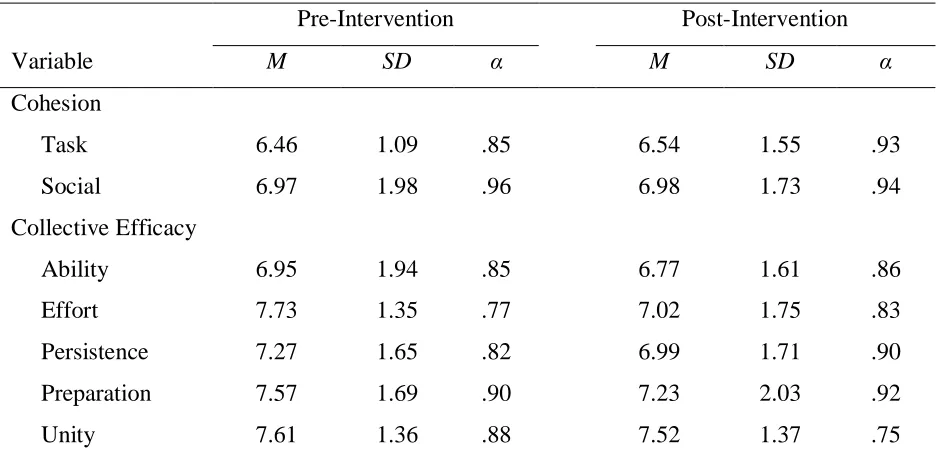
while cohesion and collective efficacy are presented in Table 3. For the athlete leadership
behaviours, the means for social support, positive feedback, inspirational motivation, intellectual
stimulation, acceptance of group goals, high performance expectations, appropriate role model,
and contingent reward appeared to trend downward from pre- to post-intervention, while
democratic behaviour, autocratic behaviour, and individual consideration appeared to trend
upward. Training and instruction remained the same from pre- to post-intervention.
As for cohesion and collective efficacy, both the means of task and social cohesion
appeared to trend upward from pre- to post-intervention, while the means for the five dimensions
of collective efficacy trended downward.
Quantitative Analysis
The data were screened for missing values, outliers, skewness, and kurtosis. The data
were deemed to be normally distributed, therefore no transformations to the data were necessary.
To determine whether there were differences in leadership behaviours, cohesion, and collective
efficacy pre- and post-intervention, a series of paired-samples t test were carried out to determine
the effect of the intervention. Specifically, separate Frequentist and Bayesian paired-samples t
tests were carried out for athlete leadership behaviours, cohesion, and collective efficacy. These
two types of paired-samples t tests were calculated to assess if Bayesian analyses would yield
Bayesian analyses have been shown to be more trustworthy than Frequentist analyses
when dealing with small sample sizes (Wanless, Rimm-Kaufman, Abry, Larsen, & Patton,
2015). Whereas Frequentist analyses consider parameters to be fixed and data to be random,
Bayesian analyses consider parameters to be random (i.e., have distributions) and the data fixed
(McNeish, 2016). As a result, each framework views statistical inferences from different
perspectives. On one hand, Frequentist analyses attempt to find the likelihood of obtaining the
values in the data given the set of parameter values. On the other hand, Bayesian analyses
approach statistical modeling from the viewpoint that, given the data available, what are the
values for the parameters. In Bayesian analyses, the posterior distribution (equivalent to
Frequentist point estimates and standard error) is a combination of prior distributions
(determined by the researcher) and the likelihood (determined by the data). An advantage of the
Bayesian analyses is the inclusion of prior information into the model through prior distributions,
which can help the accuracy of predictions (McNeish, 2016). The inclusion of prior distributions
in the analysis allows research with small sample sizes to base the results on more information
than is available in the data. The contribution of the prior distribution and likelihood to the
posterior distribution is not equal. When dealing with a small sample size, the prior distribution
is given more weight than the likelihood (McNeish, 2016).
The reported findings of the paired-samples t test include both Frequentist and Bayesian
approaches. Bayesian analyses were conducted in JASP (JASP Team, 2018). A Bayes factor of
10 (i.e., BF10) compares the alternative hypothesis (H1) to the null hypothesis (H0). Bayes factors
between 1 and 3 were interpreted as anecdotal (i.e., weak) evidence for H1, while Bayes factors
between .1 and .33 were interpreted as moderate evidence for H0 (Jeffreys, 1961). The results of
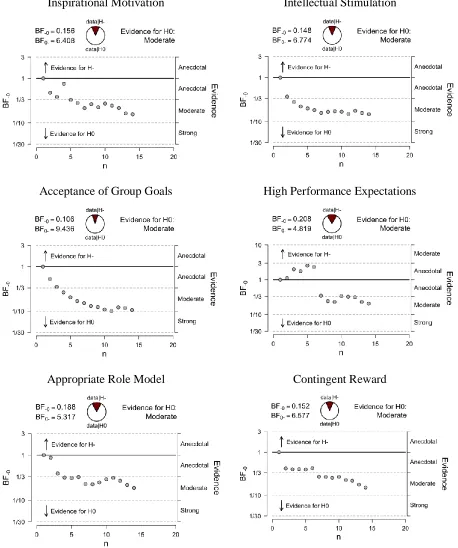
Analysis. The Sequential Analysis displays the Bayes factor as a function of the number of
paired observations (n) using the researcher-defined prior, a pie chart depicting the odds of the
data under the null vs. alternative hypothesis, and the decisiveness of the evidence according to
Jeffreys' (1961) evidence categories. In each Sequential Analysis graph, the x-axis represents the
number of data points and the y-axis represents the Bayes factor. Each graph tracks the Bayes
factor as it changes after every data point. For the current study, the prior was set at the default of
0.707.
Athlete leadership behaviours. The results of the Frequentist paired samples t-test
showed no significant difference from pre- to post-intervention for all of the leadership
behaviours which included training and instruction (t(13) = .000, p = 1.000), democratic
behaviour (t(13) = -.088, p = .931), autocratic behaviour (t(13) = -1.578, p = .139), social
support (t(13) = 1.158, p = .268), positive feedback (t(13) = 1.895, p = .081), individual
consideration (t(13) = -.112, p = .912), inspirational motivation (t(13) = .933, p = .368),
intellectual stimulation (t(13) = 1.059, p = .309), acceptance of group goals (t(13) = 2.075, p =
.058), high performance expectations (t(13) = .393, p = .700), appropriate role model (t(13) =
.563, p = .583), and contingent reward (t(13) = .991, p = .340).
The Bayesian paired t-test indicated moderate evidence in favour of the null hypothesis
for training and instruction (BF10 = .270), democratic behaviour (BF10 = .288), social support
(BF10 = .142), positive feedback (BF10 = .111), individual consideration (BF10 = .294),
inspirational motivation (BF10 = .156), intellectual stimulation (BF10 = .148), acceptance of group
goals (BF10 = .106), high performance expectation (BF10 = .208), appropriate role model (BF10 =
.188), and contingent reward (BF10 = .152). Anecdotal evidence in favour of the alternative
more autocratic behaviours at the end of the season than at the beginning. These findings are
consistent with the Frequentist t tests results suggesting no significant changes from pre- to
post-intervention. See Figure 1 for the athlete leadership behaviour Sequential Analysis graphs.
Cohesion. The results showed no significant change from pre- to post-intervention for
task cohesion (t(13) = -.186, p = .855) and social cohesion (t(13) = -.024, p = .340). Similarly,
Bayesian paired t-test showed moderate evidence in favour of the null hypothesis for both task
cohesion (BF10 = .311) and social cohesion (BF10 = .275). These findings are consistent with the
Frequentist t tests results suggesting no significant changes from pre- to post-intervention. See
Figure 2 for the cohesion Sequential Analysis graphs.
Collective efficacy. Frequentist paired samples t-test indicated that ability (t(13) = .540,
p = .599), effort (t(13) = 1.868, p = .084), persistence (t(13) = .712, p = .489), preparation (t(13)
= .752, p = .466), and unity (t(13) = .289, p = .777) showed no significant mean increases from
pre-intervention to post-intervention. Bayesian paired t-test showed moderate evidence in favour
of the null hypothesis for ability (BF10 = .191), effort (BF10 = .112), persistence (BF10 =.174),
preparation (BF10 = .170), and unity (BF10 = .221). These findings are consistent with the
Frequentist t tests results suggesting no significant changes from pre-intervention to
post-intervention. See Figure 3 for the collective efficacy Sequential Analysis graphs.
Qualitative Analysis
Following the athlete leadership development intervention, a focus group interview was
conducted with four players from the team’s leadership core (i.e., 1 captain and 3 assistant
captains). The players selected to participate in this qualitative piece were chosen with the help
of the team’s head coach who felt these players would be able to speak about the program in an
occupying a formal leadership role may lead to some bias in the responses. The purpose of this
focus group was to allow participants to reflect on their season and qualitatively evaluate the
effectiveness of the athlete leadership development program. Conducting a focus group interview
allowed the athletes to give a detailed account of their personal opinions and perceptions
concerning the leadership program and its effect on individual players and the team as a whole.
The focus group interview lasted approximately 30 minutes. A social constructivist approach
was used to understand the players’ views and interpretations concerning their experiences
throughout the leadership program, as opposed to trying to find a universal truth that is
independent of human interpretations and social meanings (Creswell, 2013). This qualitative
piece was grounded in ontological relativism (i.e., social reality is constructed and multiple) and
epistemological constructionism (i.e., knowledge is subjectively created) (Smith & Caddick,
2012). The data were examined using hierarchical content analysis, allowing for the
identification and description of patterns in the data (Sparkes & Smith, 2014). Specifically,
meaningful pieces in the transcript were organized into raw data themes. Next, themes that
appeared to fit well together were combined into categories. From these categories, two general
dimensions were created: team challenges and intervention effectiveness and recommendations.
Athletes’ names were changed for the quotes below to HP (i.e., hockey player) and a given a
number (e.g., HP1).
An interview guide comprising of four sections was developed. The first section
consisted of opening questions designed to create discussion around the team’s performance
throughout the season (e.g., Do you feel your record accurately reflects how the team performed
this season?). The second section included the main questions concerning the participants’
of the leadership program? What do you think were the benefits of the leadership program? Did
the program help you deal with conflicts?). The third section consisted of summary questions
related to the content of the responses (e.g., Do you feel going through this leadership program
made you better leaders?). Finally, the fourth section consisted of concluding questions that
allowed participants to provide recommendations on how to improve the athlete leadership
development program (e.g., Do you have any final thoughts? Anything you want to add?). The
focus group was audio recorded and transcribed verbatim, resulting in 11 pages of single-spaced
transcribed text. Based on the interviews two major themes emerged that involved the challenges
the team faced during the season and the effectiveness of the intervention. Each theme will be
discussed below.
Team challenges. The participants discussed the challenges they faced throughout the
season and what contributed to their poor on-ice performance (i.e., 16.18% winning percentage).
Every player in the focus group agreed that a lack of effort was the element that contributed the
most to their poor on-ice performance. Specifically, the players indicated that they knew it might
be a difficult season but expected teammates to put in the effort.
I knew we weren’t going to win a lot of games coming into the season, but I expected
that everyone would at least try 100% every game. That wasn’t really the case. If we got
down one, two, or three goals everyone just shut down. Everyone wanted to do
something about it [being down in the game] but no one wanted to do the work to change
the outcome. (HP1)
Participants noted how the lack of effort impacted their team’s performance: “You need a
whole team to put in the effort, if you only have 5 or 6 guys going out every game and trying,
participants also mentioned that they felt their season could have gone differently if players had
put in the effort consistently: “We had a lot of one goal losses. We didn’t take the extra step,
there could have been better outcomes if we would have taken the extra step but instead we just
held back” (HP4). Players mentioned that their regular season record of 3-26-5 (i.e., win-loss-tie)
did not accurately reflect how the team performed. In fact, players mentioned that these close
losses helped them remain confident in the team’s ability to win throughout the season.
Intervention effectiveness. The players mentioned how the athlete leadership
development program helped them deal with their frustrations (e.g., lack of effort, losing games)
by teaching them to communicate more effectively with each other. As one participant noted,
“We were talking to each other more, people were actually stepping up and saying what they had
to say” (HP4). The enhanced communication was particularly useful in dealing with conflicts
that occurred throughout the season.
When conflict arose, instead of yelling and getting mad at each other, we just told
ourselves let’s settle down, talk it out, and find a good solution that benefits both sides
and let’s get back in the game and focus. (HP3)
The players also discussed how the athlete leadership development program helped put the
frustration of consistently losing into perspective. As one participant highlighted: “The program
definitely gave us the mindset that yes we are losing games, but you have to remember it’s a
team sport not an individual sport. While losing is difficult, you have to stick together win or
lose” (HP2).
It definitely helped everyone keep their cool. We told ourselves let’s relax, we all want to
be on the same page, we all want to win. Let’s figure out a way to do it together, let’s not do
Players also talked about how their poor on-ice performance impacted the cohesion
between players. As one participant noted: “Once something goes wrong [during a game]
everyone looks around to find someone to pass the blame” (HP1). Players expanded on who was
the target of the blame: “A lot of the blame was put on the goalie, instead of looking at maybe
the problem with effort and dedication we [the team] just blamed the goalie” (HP1). However,
the participants mentioned that tensions between players on the ice did not impact relationships
off the ice. For instance, “Once we stepped off the ice, we accepted the fact that we lost another
game, the frustrations always stayed on the ice” (HP1). Further, the players discussed how the
athlete leadership development program influenced the team’s cohesiveness.
It [athlete leadership development program] brought us together more, we all got along
before, but we weren’t really united. It brought us all together as more than just friends. If
something happened on the ice, everyone took it to heart. For instance, if someone got
checked from behind or got high sticked and got hurt, everyone took it to heart. We just
cared about each other more. (HP1)
Additionally, the participants mentioned how the athlete leadership development program
helped individual players and the team as a whole. In terms of individual benefits, participants
discussed how the program influenced their own personal leadership development. This included
stepping up and taking action regardless of whether or not you were a formal leader. As one
player noted: “I learned that you don’t have to have a “C” or an “A” on your jersey to be a
leader. Anyone can step up. As well, you don’t have to necessarily be a verbal leader, you can
lead by example” (HP2). Additionally, the participants discussed learning how to motivate their
[The athlete leadership development program] taught me how to motivate my teammates,
get them to be on the same page, be more open minded. It also taught me how to take
other people’s opinion and work it in with my own ideas and form one single plan that
would work for everyone. (HP1)
The participants also noted how their own leadership behaviours impacted their teammates:
“[The athlete leadership development program] taught you how to make everyone around you a
leader as well and teach everyone else how to lead the team” (HP3).
In terms of team benefits, participants discussed how the skills they learned during the
athlete leadership development program impacted the way the team played. Following the end of
the program, the team played in a tournament and players credited the way the team played to
what they learned throughout the workshops. Specifically, players mentioned playing more
cohesively: “It [the program] inspired everyone to work together … we all worked together and
were all on the same page” (HP3).
Lastly, the participants noted a few suggestions in terms of enhancing the leadership
program. These recommendations included starting the workshops in the preseason, including
more workshops during the season, and incorporating more team-building activities.
Discussion
The purpose of the current study was to implement and evaluate an athlete leadership
development program that targeted the enhancement of athlete leadership behaviours, cohesion,
and collective efficacy with older male youth hockey players. It was hypothesized that the athlete
leadership development program would positively impact athlete leadership behaviours,
cohesion, and collective efficacy. In general, the results partially support this hypothesis. On the
athlete leadership development program did not significantly increase the measured constructs
pre- to post-intervention. On the other hand, the findings from the focus group interview showed
evidence that the athlete leadership development program was beneficial in helping the players
improve their leadership behaviours along with maintaining perceptions of cohesion and
collective efficacy. Further benefits from the focus group interview included better
communication amongst team members and dealing with conflict more effectively. Beyond these
findings, a number of aspects related to the results should be highlighted.
At first glance the quantitative results indicated that participants did not report using
athlete leadership behaviours more frequently or have enhanced perceptions of cohesion and
collectively efficacy following the athlete leadership development program, leading one to
believe that the intervention was not successful. However, it may be premature to come to such a
conclusion when considering the results of the focus group interview. In the following
paragraphs, an examination of each construct measured (i.e., leadership, cohesion, and collective
efficacy) in the present study is scrutinized.
Participants did not report using athlete leadership behaviours significantly more
following the athlete leadership development program, as measured using the LSS (Chelladurai
& Saleh, 1980) and the DTLI (Callow et al., 2009). This may be due to the baseline mean scores
of the athlete leadership prior to the start of the intervention. While there are few athlete
leadership intervention studies that have quantitatively measured athlete leadership behaviours,
there is only one that has been conducted by Duguay et al. (2016) using quantitative methods
that may help shed some light on the results of the current study. Similar to the present study,
Duguay et al. measured athlete leadership behaviours using both the LSS and DTLI pre- and
post-intervention. Of interest to the current study are the descriptive statistics reported for the
athlete leadership behaviours from the Duguay et al. study. In general, the mean scores of the
athlete leadership behaviours post-intervention are similar or lower than the mean scores
pre-intervention from the current study. As such, it is possible that a ceiling effect occurred in the
current study. That is, participants in the current study were already using leadership behaviours
to a high degree (i.e., mean of 3.85 on 5-point Likert scale) at the start of the athlete leadership
development program. Therefore, it may have been difficult for the athlete leadership
development program in the current study to enhance further the leadership behaviours. In fact,
the findings of the focus group interview conducted with the team’s leadership core (i.e., 1
captain and 3 assistant captains) helped shed light on the usefulness of the intervention on the
development of various leadership behaviours. The participants mentioned learning how to step
up and take action, regardless of whether you have a letter on your jersey. This is consistent with
previous athlete leadership development research where participants in Duguay et al. mentioned
that the leadership development program encouraged team members to step up and fulfill
leadership roles. Similar to athletes in the current study, athletes in Duguay et al.’s study also
mentioned that the leadership program helped the team get on the same page as to what is needed
to be done for the team. Consistent with findings in the current study, athletes in Voight (2012)
reported that the leadership program taught them what it takes to be a leader, and how to
effectively communicate with teammates. Players in the current study also mentioned that the
program helped put their performance-related frustrations into perspective, emphasizing that
hockey is a team sport and as such the team must work together to overcome these frustrations.
These findings are consistent with Voight’s (2012) leadership development intervention
Similar to the athlete leadership behaviours, cohesion showed no significant increase
from pre- to post-intervention. This result is similar to the findings of a cohesion intervention
studies. Herein, Senécal, Loughead, and Bloom (2008) examined the effects of a season-long
team-building intervention aimed at enhancing cohesion. Athletes in the intervention group
showed no significant increase in cohesion from the beginning of the season to the end of the
season, while athletes in the control condition showed a significant decrease in cohesion during
the season. Based on their study (i.e., Senécal et al., 2008), it would appear that the intervention
was helpful in maintaining levels of cohesion throughout the season. It is possible that a
comparable effect occurred in the present study. However, it is difficult to ascertain this without
the presence of a control condition. Nonetheless, when asked in the focus group interview
concerning the cohesiveness amongst teammates, the participants mentioned that the leadership
program brought the team closer together and made them feel more united, despite already being
friends and getting along before the start of the program. It should be noted that the mean scores
of task cohesion at baseline (i.e., pre-intervention; M = 6.46) in the current study was similar or
higher to the level of task cohesion in previous research utilizing the YSEQ (e.g., Bruner,
Boardley, & Côté, 2014, M = 6.66; McLaren, Eys, & Murray, 2015, M = 7.01; Vierimaa,
Bruner, & Côté, 2018, M = 5.99); while the mean score for social cohesion in the current study
(M = 6.97) was higher than in other studies (e.g., Bruner et al., 2014, M = 6.27; McLaren et al.,
2015, M = 4.02). As such, a ceiling effect may have occurred in the present study. The fact that
baseline data collection in the current study occurred five weeks after the season had started may
help to explain why cohesion did not increase post-intervention. That is, the athletes were
already a fairly cohesive team when the baseline were collected. Taken as a whole, the results
levels were maintained throughout the season. These results are more impressive when you
consider the losing record of the team. In fact, Muthiane, Rintaugu, and Mwisukha (2015) found
that cohesion levels were significantly lower for athletes on losing teams than those on winning
teams.
Consistent with athlete leadership and cohesion, collective efficacy also showed no
significant increase from pre- to post-intervention. It is worth noting that the team finished the
year with a 16.18% winning percentage, making it reasonable to expect a significant decrease in
collective efficacy scores at post-intervention. An examination of the means indicated that the
collective efficacy dimension of effort showed the largest decrease at post-intervention, which
coincides with the responses from those in the focus group indicating that a lack of effort
contributed the most to their poor on-ice performance. More specifically, the participants from
the focus group interview mentioned that their poor winning record did not accurately reflect
their on-ice performance, adding that their season could have gone differently if every player
consistently put in a more sustained effort. Additionally, the participants in the focus group noted
that individuals were more supportive despite their lack of on-ice success. This may have
contributed to the team remaining confident in their ability to win despite only winning three
games all season. In fact, research on resilience has identified social support as protective factor
(Sarkar & Fletcher, 2014). That is, resilience has been shown to be a fundamental factor allowing
athletes to overcome adversity (Joyce, Smith, & Vitaliano, 2005). Further, Freeman and Rees
(2010) examined the stress-buffering effects of social support on self-confidence among
university athletes, and found that high perceived emotional, esteem, and informational support
from teammates buffered the potential detrimental effects of performance-related stressors on
mentioned many factors enabled them to handle their poor on-ice performance, including caring
and supporting one another through performance slumps. Further, an athlete’s level of
confidence has been identified as a potential buffer against sport related pressures and stress
(Galli & Vealey, 2008; Sarkar & Fletcher, 2014). In an examination of Olympic athletes,
Fletcher and Sarkar (2012) identified confidence as an important factor in the
resilience-stress-performance relationship. Additionally, Vealey and Chase (2008) argued that confidence is an
essential component in athletes’ ability to overcome setbacks. This may help explain why
athletes in the current study remained confident in their team’s ability to achieve their goals
despite having poor on-ice performances.
There were two unique results that emanated from the focus group interview pertaining to
the benefits of having participated in the athlete leadership development program revolving
around conflict and communication. The participants noted that since the team had a poor
winning record, there were moments of conflict amongst the team. However, the participants
mentioned that the leadership development program provided them with the skills to
communicate more effectively and, therefore, they were able to constructively deal with conflict
by finding solutions that benefited all team members. According to Dionne, Yammarino,
Atwater, and Spangler (2004), communication and conflict management are crucial processes to
team development. Moreover, communication is an essential component in preventing,
processing, and resolving conflicts (Rhind & Jowett, 2010). As such, athletes who accept each
other and deal with disputes in constructive and integrative ways are better equipped at managing
conflict (Sullivan & Feltz, 2003). Consequently, the leadership development program in the
current study may have provided the participants with the necessary skills to more effectively
The current study is not without limitations. First, the small sample size may have
impacted the statistical power. Studies with low statistical power have a reduced ability to detect
a true effect (Button et al., 2013). Therefore, it is important for future researchers to recruit more
participants to further examine the impact of an athlete leadership development program.
Second, it is unknown if the non-significant findings pertaining to athlete leadership behaviours,
cohesion, and collective efficacy are the result of a ceiling effect. Therefore, including a control
group would aide in determining whether the intervention was effective at maintaining the levels
of these constructs and help buffer the effect of losing. Furthermore, the intervention in the
current study was implemented several weeks after the season had begun. This was done in order
for perceptions of leadership, cohesion, and collectively efficacy to form. However, delaying the
start of the intervention may have led to a ceiling effect. Consequently, researchers conducting a
leadership development program should consider starting the intervention at the beginning of the
season, and consider collecting data at three time points throughout the season (beginning,
middle, end). Additionally, the current program consisted of six workshops. Players who
participated in the focus group mentioned wanting more workshops throughout the season.
Future leadership development programs should include a larger number of workshops, possibly
starting in the preseason. Another possible limitation to this study is the athlete leadership
inventories used in this study (i.e., LSS and DTLI). These inventories were developed for adult
populations and primarily utilized with intercollegiate athletes. Therefore, there may be a need
for the development of a youth athlete leadership inventory to accurately capture the factors that
are important to younger athletes.
Taken together, the results from the current study provide researchers, coaches, and
athlete leadership development program as a method of maintaining levels of athlete leadership
behaviours, cohesion, and collective efficacy throughout the season. Specifically, is appears that
the athlete leadership development program can potentially act as a buffer against the negative
effects of poor performance. Hopefully, this study will lead to further examination into the
benefits of developing athlete leadership behaviours, cohesion, and collective efficacy. Finally, it
is hoped that the information presented in this study will encourage coaches and mental
performance consultants to implement an athlete leadership development program with their
References
Arthur, C. A., Woodman, T., Ong, C. W., Hardy, L., & Ntoumanis, N. (2011). The role
of narcissism in moderating the relationship between coaches’ transformational leader
behaviors and leadership effectiveness. Journal of Sport & Exercise Psychology, 33,
3-19.
Bandura, A. (1997). Self-efficacy: The exercise of control. New York, NY: Freeman.
Blanton, J. E., Sturges, A. J., & Gould, D. (2014). Lessons learned from a leadership
development club for high school athletes. Journal of Sport Psychology in Action, 5,
1-13.
Bruner, M. W., Boardley, I. D., & Côté, J. (2014). Social identity and prosocial and antisocial
behavior in youth sport. Psychology of Sport and Exercise, 15, 56-64.
Bucci, J., Bloom, G. A., Loughead, T. M., & Caron, J. (2012). Ice hockey perceptions of athlete
leadership. Journal of Applied Sport Psychology, 24, 243-259.
doi:10.1080/10413200.2011.636416
Burkett, B. M., Blom, L. C., Razon, S., & Johnson, J. E. (2014). Formal and informal athlete
leaders: The relationship between athlete leadership behaviors and cohesion. The Journal
of SPORT, 3(1), 2-29.
Button, K. S., Ioannidis, J. P. A., Mokrysz, C., Nosek, B. A., Flint, J., Robinson, E. S. J., &
Munafò, M. R. (2013). Power failure: Why small sample size undermines the reliability
of neuroscience. Nature Reviews Neuroscience, 14, 365-376. doi:10.1038/nrn3475
Callow, N., Smith, M., Hardy, L., Arthur, C., & Hardy, J. (2009). Measurement of
transformational leadership and its relationship with team cohesion and performance
Carron, A.V., Brawley, L. R., & Widmeyer, W. N. (1998). Measurement of cohesion in sport
and exercise. In J. L. Duda (Ed.), Advances in sport and exercise psychology
measurement (pp. 213–226). Morgantown, WV: Fitness Information Technology.
Chelladurai, P. (2007). Leadership in Sports. In: G., Tenenbaum, & R. C., Eklund. (Eds.),
Handbook of sport psychology (p. 113-135). Hoboken, NJ: John Wiley & Sons.
Chelladurai, P., & Saleh, S. D. (1980). Dimensions of leader behaviour in sports: Development
of a leadership scale. Journal of Sport Psychology, 2, 34-45.
Creswell, J.W. (2013). Qualitative inquiry and research design: Choosing among five
approaches (3rd ed.). Thousand Oaks, CA: Sage.
Crozier, A. J., Loughead, T. M., & Munroe-Chandler, K. J. (2013). Examining the benefits of
athlete leadership in sport. Journal of Sport Behavior, 34, 346-364.
Day, D. V. (2001). Leadership development: A review in context. The Leadership Quarterly, 11,
581-613.
Dionne, S. D., Yammarino, F. J., Atwater, L. E., & Spangler, W. D. (2004). Transformational
leadership and team performance. Journal of Organizational Change Management, 17,
177-193. http://dx.doi.org/10.1108/09534810410530601
Duguay, A. M., Loughead, T. M., & Munroe-Chandler, K. J. (2016). The development,
implementation, and evaluation of an athlete leadership development program with
female varsity athletes. The Sport Psychologist, 30, 154-166
Dupuis, M., Bloom, G. A., & Loughead, T. M. (2006). Team captains’ perceptions of athlete
leadership. Journal of Sport Behavior, 29, 60–78.
Eys, M. A., Loughead, T. M., Bray, S. R., & Carron, A. V. (2009). Development of a cohesion
Exercise Psychology, 31, 390-408.
Feltz, D. L., & Lirgg, C. D. (1998). Perceived team and player efficacy in hockey. Journal of
Applied Psychology, 83, 557-564.
Fletcher, D., & Sarkar, M. (2012). A grounded theory of psychological resilience in Olympic
champions. Psychology of Sport and Exercise, 13, 669-678.
Freeman, P., & Rees, T. (2010). Perceived social support from team-mates: Direct and stress
buffering effects on self-confidence. European Journal of Sport Science, 10, 59-67.
Galli, N., & Vealey, R. S. (2008). “Bouncing back” from adversity: Athletes’ experiences of
resilience. The Sport Psychologist, 22, 316-335.
Gould, D., Hodge, K., Peterson, K., & Petlichkoff, L. (1987). Psychological foundations of
coaching: Similarities and differences among intercollegiate wrestling coaches. The Sport
Psychologist, 1, 293-308.
Gould, D., & Voelker, D. K. (2010). Youth sport leadership development: Leveraging the sports
captaincy experience. Journal of Sport Psychology in Action, 1, 1-14.
JASP Team (2018). JASP (Version 0.8.6) [Computer software].
Jeffreys, H. (1961). Theory of probability (3rd ed.). Oxford, UK: Oxford University Press.
Joyce, P. Y., Smith, R. E., & Vitaliano, P. P. (2005). Stress-resilience, illness, and coping: a
person-focused investigation of young women athletes. Journal of Behavioral
Medicine, 28, 257-265.
Lott, A. J., & Lott, B. E. (1965). Group cohesiveness as interpersonal attraction: A review of
relationships with antecedent and consequent variables. Psychological Bulletin, 64, 259–
Loughead, T. M. (2017). Athlete leadership: A review of the theoretical, measurement, and
empirical literature. Current Opinion in Psychology, 16, 58-61.
Loughead, T. M., & Hardy, J. (2005). An examination of coach and peer leader behaviours in
sport. Psychology of Sport and Exercise, 6, 303-312.
Loughead, T. M., Hardy, J., & Eys, M. A. (2006). The nature of athlete leadership. Journal of
Sport Behavior, 29, 142–159.
McLaren, C. D., Eys, M. A., & Murray, R. A. (2015). A coach-initiated motivational climate
intervention and athletes’ perceptions of group cohesion in youth sport. Sport, Exercise,
and Performance Psychology, 4, 113-126.
McNeish, D. (2016). On using Bayesian methods to address small sample problems. Structural
Equation Modeling: A Multidisciplinary Journal, 23, 750-773.
Muthiane, C. M., Rintaugu, E. G., & Mwisukha, A. (2015). The relationship between team
cohesion and performance in basketball league in Kenya. International Journal of
Applied Psychology, 5, 90-95. doi: 10.5923/j.ijap.20150504.02
Price, M. S., & Weiss, M. R. (2011). Peer leadership in sport: Relationships among personal
characteristics, leader behaviours, and team outcomes. Journal of Applied Sport
Psychology, 23, 49-64.
Price, M. S., & Weiss, M. E. (2013). Relationships among coach leadership, peer leadership, and
adolescent athletes' psychosocial and team outcomes: A Test of Transformational
Leadership Theory. Journal of Applied Sport Psychology, 25, 265-279.
Rhind, D. J., & Jowett, S. (2010). Relationship maintenance strategies in the coach-athlete
relationship: The development of the COMPASS Model. Journal of Applied Sport