ISSN(Online): 2320-9801
ISSN (Print) : 2320-9798
I
nternational
J
ournal of
I
nnovative
R
esearch in
C
omputer
and
C
ommunication
E
ngineering
(An ISO 3297: 2007 Certified Organization)
Vol. 4, Issue 3, March 2016
A Study on Concerns and Impetus Aspects for
Hybrid Cloud Adoption
Siddharth Mishra1, Puneet Sharma2
M. Tech Student,Department of Computer Science and Engineering, Amity University, Uttar Pradesh, India1
Assistant Professor, Amity University, Uttar Pradesh, India2
ABSTRACT: Cloud computing is an incipient computing exemplar in which resources of the computing framework
are given as services over the internet. Cloud computing follows an on-demand approach for providing different IT services where users can easily scale up or scale down these services and pay according to the usage. With the advancement and development of cloud computing technology, the social interest for cloud computing is constantly increasing and when the number of cloud user increases this subsequently leads to information security and privacy threats. Efficient information recovery and data confidentiality are real issues which stops client from adopting cloud computing. But with the progression in technology hybrid cloud model is proving itself as the final destination for IT industry. This paper reviews the challenges and issues in hybrid cloud and different motivation factors for its adoption.
KEYWORDS: Hybrid Cloud; Security Issues; Cloud Computing; Motivation Factors; Challenges in Hybrid cloud.
I. INTRODUCTION
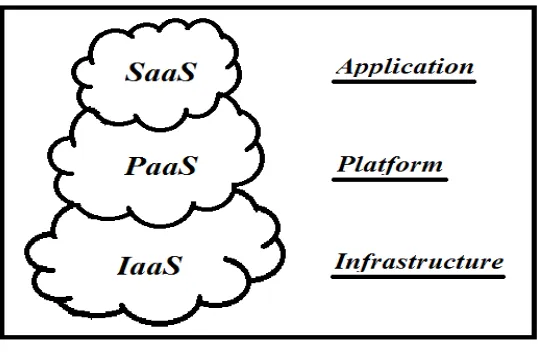
Cloud Computing is the virtualized pool of resources whose services can be configured and used over the internet. Cloud provides different IT services on demand where these can be easily scaled up or scaled down and users can pay accordingly. Cloud services are provided by third party organizations that have the proper infrastructure. It has the capabilities to eradicate the necessities for establishing of expensive computing framework for Information Technology based services and solutions that an organization uses. In cloud computing, there are three reference models i.e. IaaS, SaaS and PaaS. According to the survey conducted by Netwrix research labs in 2015, 45% of organizations prefer to use Software as a service model while 35% prefers to use Infrastructure as a service and only 22% prefer to use Platform as a service model [4].
Fig 1. Cloud Computing Reference Model.
ISSN(Online): 2320-9801
ISSN (Print) : 2320-9798
I
nternational
J
ournal of
I
nnovative
R
esearch in
C
omputer
and
C
ommunication
E
ngineering
(An ISO 3297: 2007 Certified Organization)
Vol. 4, Issue 3, March 2016
organizations have started moving towards hybrid cloud as it’s architecture proposal provisions security along with cost saving, flexibility, scalability, high performance while gathering business and technical needs [1].
II. HISTORY
In comparison to traditional methods, cloud computing can provide services to more number of clients using same hardware with the use of virtualization. Earlier technologies like Grid and Cluster computing were application based, where as Cloud computing is a service based technology. Cloud computing is evolved from the combination of many old technologies and utility computing to enable a more flexible slant for arraying and scaling applications at low cost. Below we have given an overview of these technologies.
A. Virtualization
Virtualization provides abstraction of physical resources into logical resources which are availed by the end users. It provides mapping of a VM (virtual machine) that provides OS, hardware, software logical entities onto actual physical hardware and software resources. Virtual Machine provides scalability, migration and load balancing potentialities with less maintenance and more security on working environment. Virtualization uses fewer resources and physical machines making it a cost effective and more demanding technology.
B. Distributed Computing
It is the networking scheme where data processing power of connected computers is pooled along with shearing of storage device and data program. Rapid change in technology creates complex and large problems. In distributed computing troublesome or complex problems are administered out to large number of computers for processing connected through the internet. Processing power of each connected system is used only when it is in idle mode.
C. Grid Computing
The initial idea of grid computing was introduced in early 1990s. According to the definition of Globus Project Grid is “a structure that empowers the integrated, combined usage of high-end computers, networks, databases, and scientific instruments retained and succeeded by numerous organizations” [2].
D. Utility Computing
Utility computing is a pay per use charging technique where Information Technology services and solutions are available when requested or needed. It is a computing commercial model in which the provider controls, holds and supervises the resources and IT infrastructure. The subscriber utilizes it as and when needed on a charge or metered source [6].
.
III.HYBRID CLOUD MODEL
ISSN(Online): 2320-9801
ISSN (Print) : 2320-9798
I
nternational
J
ournal of
I
nnovative
R
esearch in
C
omputer
and
C
ommunication
E
ngineering
(An ISO 3297: 2007 Certified Organization)
Vol. 4, Issue 3, March 2016
IV.CHALLENGES AND INSIGHT
A. Confidentiality and Integrity
By relocating computation and data to the hybrid cloud, organizations can enormously decrease IT costs. Yet at the same time a large portion of them have security concerns. The significant concern is the breach of secrecy and trustworthiness of information. An organization's data present in cloud can be spilled or altered, purposefully or accidentally. Consequence of such activities could be damage of reputation and finances of an organization.
B. Shared Technology Issue
IaaS suppliers offer partitioned Virtual Machine (VM) to several clients to utilize the same physical server. Frameworks that offer multi-tenancy store different customers' information in one logical and physical database. They are more prone to this sort of mistake than those that store every inhabitant's information in separate logical databases with various schemas for every customer. Likewise, any individual who has advantaged access to the VM can read or control a client's information.
C. Account Management and Billing
Another field that requires watchful consideration is billing. It's critical to have on-demand access to current charges to maintain a strategic distance from month to month cloud charge shocks, and up and coming billing cycle forecasts.
Visibility into cloud costs are offered by outsider administrations such as Right Scale and Cloud. Budget alerts and recommendations for instance sizing and cost-allocation reporting are likewise given by these administrations. Budget alerts are particularly useful in the event that they combine charges from private and public clouds.
Depending upon the level of control that an association wishes to execute, there are possibilities for restricting cloud costs. Some third-party tools have controls that prevent resource provisioning once associations surpass the allotted spending amount. This choice would function admirably for development and test situations.
Financial plan controls ought to be drawn cautiously for production instances. In the event that expenses surpass a limit, operational frameworks can be unexpectedly closed down. As an indication of an effective sales or marketing campaign, surprising peaks in demand for production systems can be observed. Therefore, it is absurd to close down servers utilized in selling the products and rain on the parade.
D. Portability
Numerous begin the hybrid cloud path with the goal of moving workloads effortlessly amongst hosts as the business necessity demands. Moving virtual machines and applications between clouds has gotten less intricate. Be that as it may, it is still a battle to move metadata and configurations impeccably between environments. It is not as large of a test if the hybrid cloud is based on undistinguishable platforms on both ends. But this will turn into an area of frustration if there’s any compatibility mismatch.
E. Networking
Meaningful hybrid integration involves attentive network design. It requires data, such as, impact of inactivity among the public cloud location(s) and your private framework, amount of struggle of chatty applications to work over wide area networks, proper bandwidth for transferring large data sets, use of existing IP blocks by the hybrid network topology and use of same network security appliances of the private cloud by the public environment. Cloud suppliers are progressively offering sophisticated networking choices. Be that as it may, it is exceedingly testing to locally extend your current topology to the cloud.
F. Absence of Data Redundancy
Despite the fact that they take best endeavors, issues are unavoidable for any cloud supplier. Hybrid cloud is a mind boggling framework. The administration has limited involvement in dealing which creates great perils. To direct the effect of a blackout in a single data server cloud architects need redundancy across data centers. An absence of redundancy can turn into a genuine safety hazard in hybrid cloud, particularly if redundant prints of data are not spread across data centers. It’s less demanding to move virtual machine (VM) illustrations among data hubs than among widespread data sets [7].
Cloud architects can execute contrivance redundancy using multiple data centres from a single provider or multiple public cloud providers or a hybrid cloud. Enhancing business continuity with a hybrid cloud shouldn't be the main motivation to execute this model. You could spare expenses and accomplish comparative stages of risks moderation utilizing numerous data hubs from a single cloud provider.
ISSN(Online): 2320-9801
ISSN (Print) : 2320-9798
I
nternational
J
ournal of
I
nnovative
R
esearch in
C
omputer
and
C
ommunication
E
ngineering
(An ISO 3297: 2007 Certified Organization)
Vol. 4, Issue 3, March 2016
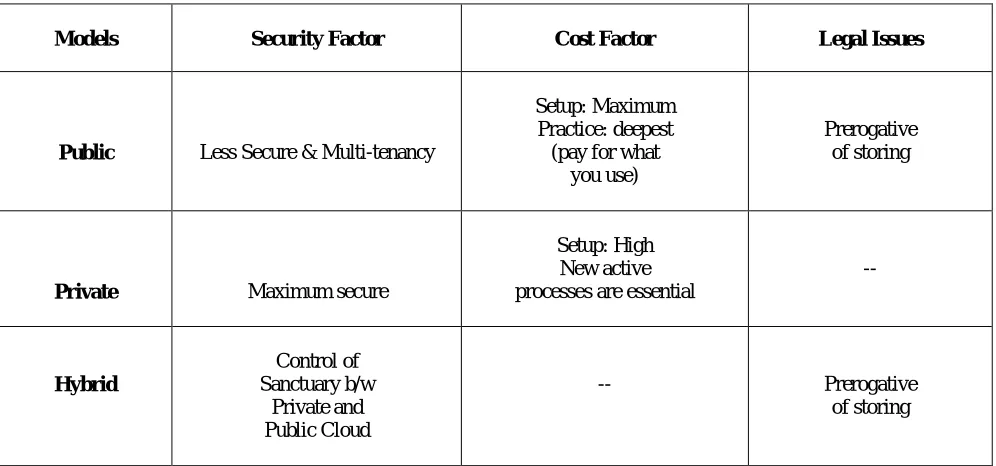
V. CLOUD MODEL ANALYSIS
Models Security Factor Cost Factor Legal Issues
Public Less Secure & Multi-tenancy
Setup: Maximum Practice: deepest
(pay for what you use)
Prerogative of storing
Private Maximum secure
Setup: High New active processes are essential
--
Hybrid
Control of Sanctuary b/w
Private and Public Cloud
-- Prerogative
of storing
Table 1: Cloud Deployment models and issues
VI.MOTIVATION FACTORS
A. High Availability and Resilience
Resiliency and disaster recovery are improved in hybrid cloud computing by using multiple partners. Along with entire network configuration smart data centers in hybrid cloud provides complete disaster recovery capabilities with the intention of replicating the servers between data centers. It is done in such a way that recovery of network is as fast as the backed up cloud servers.
B. Scalability
The ability to add and remove capacity anywhere anytime is one of the important benefits of Hybrid cloud. As the size of clouds is eventually inadequate by the overall existing hardware, hybrid clouds can take benefit of more than one public cloud as elastic scaling.
C. Cost Efficiency
Incremental (step by step) installation of hybrid cloud technology can save organizations’ overall spending. It is designed to utilize private as well as public clouds. So it permits clients access to significant economies of scale without exposing mission critical applications or essential information to third-party vulnerabilities.
D. Guarantee Isolation
Hybrid cloud computing allows an organization for putting right isolation, expense and scaling requirements. In this, requirements can be classified and services can be distributed amongst different clouds.
E. Existing Infrastructure
If you have already established IT infrastructure, the hybrid cloud lets you take full benefit of that investment. It also empowers you to move different applications to the public cloud.
F. Fit for Purpose
ISSN(Online): 2320-9801
ISSN (Print) : 2320-9798
I
nternational
J
ournal of
I
nnovative
R
esearch in
C
omputer
and
C
ommunication
E
ngineering
(An ISO 3297: 2007 Certified Organization)
Vol. 4, Issue 3, March 2016
Hybrid Cloud is a comprehensive way to deal with the utilization of IT. It is approximately coordinating the correct answer for the right employment.
VII. CONCLUSION AND FUTURE WORK
The eventual fate of cloud computing is splendid as it keeps on advancing and developing in the forward direction. In this paper, we have discussed about the hybrid cloud model, its challenges and insight and the motivation factors for its adoption. We have also described a table which analyses the security, cost and legal factors for public, private and hybrid clouds. Cloud computing is a help to both IT businesses and singular clients. It will be a very large and multifaceted paradigm in the upcoming time. Security is still an issue inside of cloud computing. However, the above exploration proposes it is taking a positive spin and is extraordinarily enhancing. Hybrid cloud innovators are continuously trying to create new and easy methods for its adoption. Work on creating uncomplicated and efficient inter-cloud migration ways is also in progress.
REFERENCES
.
1. Security Challenges in Hybrid Cloud Infrastructures.Koushik Annapureddy Aalto University - School of Science and Technology 2. R.Esposito, P.Mastroserio et al., (March 2003) “Standard FTP and Grid FTP Protocols for International Data Transfer in Pamela Satellite
Space Experiment”. [Online]. Available: http://arxiv.org/ftp/hepex/papers/0305/0305084.pdf
3. Private Cloud Matures, Hybrid Cloud Is Next.Available:http://www.gartner.com/document/2585915?ref=QuickSearch
4. 2015 Netwrix Cloud security survey.Available:http://www.netwrix.com/download/documents/netwrix_report_cloud_security_2015.pdf
5. http://www.businessdictionary.com/definition/distributed-computing-DC.html
.
6. https://www.techopedia.com/definition/14622/utility-computing.7. Security Issues: Public vs Private vs Hybrid Cloud Computing .International Journal of Computer Applications (0975 – 8887) Volume 55– No.13, October 2012.