University of Windsor University of Windsor
Scholarship at UWindsor
Scholarship at UWindsor
Electronic Theses and Dissertations Theses, Dissertations, and Major Papers
1-27-2016
Design and Implementation of Continua Compliant Wireless
Design and Implementation of Continua Compliant Wireless
Medical Gateway
Medical Gateway
PUTUL SAHA
University of Windsor
Follow this and additional works at: https://scholar.uwindsor.ca/etd
Recommended Citation Recommended Citation
SAHA, PUTUL, "Design and Implementation of Continua Compliant Wireless Medical Gateway" (2016). Electronic Theses and Dissertations. 5664.
https://scholar.uwindsor.ca/etd/5664
This online database contains the full-text of PhD dissertations and Masters’ theses of University of Windsor students from 1954 forward. These documents are made available for personal study and research purposes only, in accordance with the Canadian Copyright Act and the Creative Commons license—CC BY-NC-ND (Attribution, Non-Commercial, No Derivative Works). Under this license, works must always be attributed to the copyright holder (original author), cannot be used for any commercial purposes, and may not be altered. Any other use would require the permission of the copyright holder. Students may inquire about withdrawing their dissertation and/or thesis from this database. For additional inquiries, please contact the repository administrator via email
Design and Implementation of Continua Compliant
Wireless Medical Gateway
By
PUTUL SAHA
A Thesis
Submitted to the Faculty of Graduate Studies
through the Department of Electrical and Computer Engineering in Partial Fulfillment of the Requirements for
the Degree of Master of Applied Science at the University of Windsor
Windsor, Ontario, Canada
2015
© 2015 Putul Saha
All Rights Reserved. No part of this document may be reproduced, stored or otherwise
retained in a retrieval system or transmitted in any form, on any medium by any means
Design and Implementation of Continua Compliant Wireless Medical Gateway
By
PUTUL SAHA
APPROVED BY:
______________________________________________ Dr. Z. Pasek
Department of Industrial & Manufacturing Systems Engineering
______________________________________________ Dr. Mitra Mirhassani
Department of Electrical & Computer Engineering
______________________________________________ Dr. K. Tepe, (Advisor)
Department of Electrical & Computer Engineering
iv
DECLARATION OF ORIGINALITY
I hereby certify that I am the sole author of this thesis and that no part of this thesis has
been published or submitted for publication, and to the best of my knowledge, my thesis
does not infringe upon anyone’s copyright nor violate any proprietary rights and that any
ideas, techniques, quotations, or any other material from the work of other people
included in my thesis, published or otherwise, are fully acknowledged in accordance with
the standard referencing practices. Furthermore, to the extent that I have included
copyrighted material that surpasses the bounds of fair dealing within the meaning of the
Canada Copyright Act, I certify that I have obtained a written permission from the
copyright owner(s) to include such material(s) in my thesis and have included copies of
such copyright clearances to my appendix.
I declare that this is a true copy of my thesis, including any final revisions, as approved
by my thesis committee and the Graduate Studies office, and that this thesis has not been
v
ABSTRACT
Collecting data from various medical devices associated with a patient at one location and
sending it to a caregiver at another location in an integrated format is a challenge in
telehealth systems. This challenge comes from following factors. First, these medical
devices are not equipped with long range communication technologies. Second, medical
devices from different manufacturers lack interoperability. Third, communication time is
inconsistent. In order to address above challenges, a Continua compliant Wireless
Medical Gateway (WMG) is designed and implemented in this research using various
hardware components such as BeagleBone Black, Stollmann adapter and Unison
Real-Time OS (RTOS). Being complaint to Continua enables interoperability between medical
devices from different manufacturers. The selected hardware and software provide easy
interface for data transfer over long range. The prototype has been tested extensively
using various scenarios to calculate the total communication time, delay consistency and
data accuracy. The results show the consistent deviation in communication time for
WMG.
vi
DEDICATION
To my Parents,
Pran Ballab Saha and Babuli Rani Saha
For raising me to believe that everything was possible
&
To my Brother, Robin Saha and my Husband, Prosanjit Paul
vii
ACKNOWLEDGEMENTS
I would like to extend my deepest gratitude to my supervisor, Dr. Kemal Tepe, for his
consistent support and guidance throughout the research. I have truly enjoyed working
with him and I consider myself very fortunate to have got this opportunity. I would like to
thank my committee members, Dr. Z. Pasek and Dr. Mitra Mirhassani, for their valuable
input and guidance throughout the research process. I would like to extend my gratitude
to my fellow laboratory members Dr. Brajendra Kumar Singh, Ms. Saneeha Ahmed, Mr.
Jeremy Coulter, Dr. Kazi Atiqur Rahman, Mr. Gorge Pelington, Mr. Michael Mati and
Mr. Sanam Mehta for their constant involvement and valuable feedback. Finally, I wish to
extend a special thank you to my loving family, especially my parents for always being
there and believing in me. At last but not the least I would like to thank my husband for
viii
TABLE OF CONTENTS
DECLARATION OF ORIGINALITY ... iv
ABSTRACT ... v
DEDICATION ... vi
ACKNOWLEDGEMENTS ... vii
LIST OF TABLES ... xi
LIST OF FIGURES ... xii
LIST OF ABBREVIATIONS ... xiii
1. INTRODUCTION ... 1
1.1 Problem Statement ... 2
1.2 Thesis Contribution ... 3
1.3 Background ... 4
1.4 Gateway Design Requirements ... 4
1.5 Thesis Organization ... 4
2. RELATED WORK ... 6
2.1 Introduction ... 6
2.2 Continua ... 6
ix
2.2.2 Health Device Profile ... 9
2.3 Components and Services of Existing Gateway ... 10
2.3.1 Systems with Embedded Application ... 11
2.3.2 Systems with General Operating System ... 12
2.4 Summary ... 14
3. RESEARCH WORK ... 15
3.1 Introduction ... 15
3.2 The Telehealth System with WMG ... 16
3.3 Dataflow of WMG Based System ... 17
3.4 The Design Methodology of WMG ... 18
3.4.1The hardware configuration ... 18
3.4.2 Software Components and Configurations ... 21
3.5 Development Tools ... 23
3.6 Channel Formation and Management: ... 24
3.6.1 Finite Sate Machine: ... 25
3.6.2 HDP Connection Management ... 26
3.7 Continua Compliant Packets Formation ... 27
3.8 Summary ... 28
4. TESTING AND RESULT ANALYSIS ... 29
x
4.2 Test Scenarios ... 30
4.3 Test Cases ... 32
4.3.1 Test Case 1: CCON with data channel establishment delay ... 33
4.3.2 Test Case 2: CWMG with data channel establishment delay ... 34
4.3.3 Test Case 3: CCON without Data Channel Establishment Delay ... 35
4.3.4 Test Case 4: CWMG without Data Channel Establishment Delay ... 36
4.3.5 Test Case 5: CWMG and CCON for Different Users without Data Channel Establishment Delay ... 36
4.4 Result Analysis ... 36
4.4.1 Result Analysis of Test Case 1 and Test Case 2 ... 36
4.4.2 Result Analysis of Test Case 3 and Test Case 4 ... 37
4.4.3 Result Analysis of Test Case 5: ... 38
4.4.4 Analyzing Accuracy in Data Transfer ... 40
4.5 Summary ... 41
5. CONCLUSION ... 42
REFERENCE ... 43
APPENDIX ... 47
xi
LIST OF TABLES
xii
LIST OF FIGURES
Figure 1: Hardware Configuration and Connection ... 16
Figure 2: The Dataflow of WMG Based System ... 17
Figure 3: Block Diagram of Medical Gateway ... 19
Figure 4: BeagleBone Black [39] ... 19
Figure 5: Stollmann Adapter ... 20
Figure 6: Channel Formation Management. ... 24
Figure 7: The FSM for HDP Connection ... 25
Figure 8: HDP Message Communication ... 26
Figure 9: Packet Structure of HDP ... 28
Figure 10: Test-bed for Measuring CCON time ... 30
Figure 11: Test-bed for Measuring CWMG time. ... 30
Figure 12: The Data Establishment Delay ... 32
Figure 13: CCON time and CWMG Time with Data Channel Establishment Delay ... 37
Figure14: The Comparison of CCON Time and CWMG time without Data Channel Establishment Delay ... 38
Figure 15 User to User CCON time without Data Channel Establishment Delay ... 39
xiii
LIST OF ABBREVIATIONS
APDU Application Packet Data Unit
BT Bluetooth
BPM Blood Pressure Monitor
BT-HDP BlueTooth Health Device Profile
BT SIG BlueTooth Special Interest Group
CCON Communication between Continua to BPM
CESL Continua Enabling Software Library
CWMG Communication between WMG and BPM
E2E End-to-End
ECG ElectroCardioGram
GAP Generic Access Profile
GUI Graphical User Interface
HRN Health Record Network
IDE Integrated Development Environment
IEEE Institute of Electrical and Electronics Engineers
xiv MD Medical Device
MED WG Medical Device Working Group
OS Operating System
OPE Optimized Exchange Protocol
PAN Personal Area Network
PDH Personal Health Device
RTOS Real-Time Operating System
SDP Service Discovery Protocol
TAN Touch Area Network
WMG Wireless Medical Gateway
WAN Wide Area Network
WBAN Wireless Body Area Network
1
1. INTRODUCTION
Health care is an expensive affair. The cost of healthcare is expected to increase from the
current $500 billion per year to $685 billion per year by 2020 in North America [1]. It is
estimated that, spending on the treatment of heart diseases, stroke and diabetes will
increase by $9 billion in North America alone [2]. Due to environmental and lifestyle
factors, large number of people are becoming vulnerable to different types of chronic
diseases like, cardiovascular diseases, respiratory diseases, neurological diseases and
diabetes etc [3]. Technology has been playing vital role in healthcare to enable the
practitioners offer efficient patient care. The recent developments in information and
communication technologies have increased the degree of connectivity between people
using smart devices. These technology advancements can help the healthcare practitioners
offer cheaper, faster and more efficient care. A World Health Organization (WHO)
report, estimates that the usage of various technology driven healthcare approaches will
result in savings of $1 billion over the next 10 years [2]. One of such approaches is
personal telehealth systems. Personal telehealth systems, including remote patient
monitoring and management, can facilitate caregiver to effectively deliver high-quality
healthcare service at lesser cost. However, telehealth systems depend on a large number
of medical devices installed at both the patient's and health caregiver's end. A growing
number of manufacturers are producing different types of medical devices for telehealth
2
manufacturers and can communicate or transmit data - only to vendor specific software
applications. So, handling information from various medical devices becomes a challenge
for healthcare practitioner. In addition to lack of interoperability, existing systems have
limited connectivity and inconsistent delays. For example, to know the Blood Pressure
(BP) of patient, who is getting an extended care from home, need trained people or
professional’s involvement.
To overcome these limitations, a long range multi-hop communication with various types
of medical devices with consistent delays is needed. The Wireless Medical Gateway
(WMG) presented in this thesis is one such implementation devised to overcome the
limitations associated interoperability, connectivity and delay consistency.
The WMG is designed to allow plug-n-play connectivity to the patients monitoring
devices. The WMG can collect medical data wirelessly from various health parameter
measurement devices and transmit the data over the internet. For data communication,
Continua Health Alliance (Continua) specified standard protocol is implemented in the
WMG. This protocol ensures the interoperability between various medical devices
following the same standard.
The WMG provides multi-hop and long range communication with shorter consistent
delay for transmitting Continua compliant medical data. Also the plug-n-play
connectivity and less complex hardware design ensure that any general user can operate
the gateway with minimal knowledge of Bluetooth connectivity.
1.1 Problem Statement
Collecting data from various medical devices associated with a patient at one location and
3
This challenge comes from following requirements. First, quite often, these medical
devices are not equipped with long range communication technologies. Second, each of
these medical devices come with its own user interface to display the acquired data,
hence, a mechanism is needed to combine the data from various medical devices
associated with one patient and forward it to the concerned system through internet.
Third, as any medical data is crucial for monitoring the patient’s health, maintaining the
delay consistency is a must while forwarding medical data. Finally, now-a-days,
increasing numbers of medical devices are designed with Continua health alliance
guidelines for communication. Hence, any solution to the above problem should also be
compliant to continua guidelines.
1.2 Thesis Contribution
In order to collect data from various continua compliant medical devices, a continua
compliant medical gateway is designed and implemented in this research. Specifically,
the designed gateway supports Ethernet communication to send data over the internet.
This gateway is tested with continua compliant blood pressure monitor devices. As this
test device was working on Bluetooth (BT) technology with Bluetooth Health Device
Profile (HDP), the whole HDP code is implemented in C language in the WMG. The
collected data from blood pressure monitoring device is sent over the internet using
Ethernet interface of the gateway. The gateway is designed such that it is completely
4
1.3 Background
Communication gateways for medical data are becoming popular to form a network of
ubiquitous medical devices. In medical applications, slightly corrupted or delayed data
may cause serious issues. Therefore, the medical gateway has to ensure some desired
characteristics such as correctness of received data, low delay, delay consistency and
plug-n-play capability. Hence, a ubiquitously communicable solution is necessary to
collect data within a short delay.
1.4 Gateway Design Requirements
The Continua compliant medical gateway has three major design requirements; (1) data
communication with consistent delay (2) correctness of received data with respect to sent
data and (3) conformance to Continua guidelines. A software module called Bluetooth
Continua Communication (BT-CC) module has been developed for implementing the
Continua guideline in WMG. This module plays a crucial role to enable the Continua
compliant BT communication in the gateway. The BeagleBone Black (BBB) has been
chosen as a development platform for WMG. It is chosen for its high computational
power compared to its compact size. BBB provides high performance through the ARM
cortex A8 processor [9], 5 high speed I/O ports, built-in antennae, separate data and
instruction memories and high speed RAM.
1.5 Thesis Organization
This thesis is organized into 5 chapters. The Chapter 1 (this chapter), explains the
problem statement and contribution of this thesis towards the solution. The related work
5
collection, existing communication gateways and their limitations are discussed in
Chapter 2. The major challenges faced during the development of WMG, design
requirements, model of proposed prototype and major assumptions and limitations are
provided in Chapter 3. The performance analysis of the system for verifying the timing,
delay consistency and error in received data packets has been illustrated in Chapter 4. The
6
2. RELATED WORK
2.1 Introduction
Using the developments in networking and communication technology, many systems
[7], [8], [11], [12], [13], [14], [15], [16] are proposed to handle the transmission of health
data from patient to care giver. Most of these systems are built with a custom hardware
and unique design [7], [8], [11], [12], [13], [14], [15], and [16]. For instance, [8] and [15]
use Power over Ethernet (PoE) (for lower power consumption) and ZigBee based
multi-hop communication to transfer data. A three layer application based medical information
network model with customized network interface, application and operating system is
proposed in [7]. All these systems provide communication between the medical device or
sensor and receiving end. However, all these systems have inconsistent delay [11],
inaccuracy [12], [13] and complex non-interoperable design [8], [14], [15], [16]. This
chapter explains what Continua is and why it is important for the medical devices and
gateways to be compliant to Continua standards. Then, this chapter discusses the existing
gateway systems, their components and limitations.
2.2 Continua
The Continua Health Alliance, normally referred as "Continua" is an international
non-profit group and the leading organization convening global technology industry to
develop end-to-end, plug-and-play connectivity for personal connected health. Continua's
7
standardized development and create new market opportunities for interoperable personal
health devices and services used to collect and relay vital health information. Continua is
a pioneer in establishing standards-based guidelines and security for connected health
technologies such as smart phones, sensors, remote monitoring devices, tablets and
gateways, as well as networked and cloud solutions [1][11] . This guideline is based on
IEEE 11073- Personal Health Device (PHD) communication standards and Health Device
Profile (HDP) [18]. This guideline of continua provides acknowledgement based packet
transmission which ensures the reliable data transmission for any Continua certified
devices. Continua, through its product certification program, certify the medical devices
with a recognizable logo signifying interoperability with other certified products [17].
The guideline is divided into multiple clauses for implementing a medical device which
can be certified by the Continua [49]. The applicable clauses for a specific device
implementation have to be chosen by the developer.
The clauses 1 to 5 of continua guideline provide background information such as
definition, supported interfaces and terminology necessary to understand the
specifications. Then, clause 6 provides the E2E system architecture, device components
which have been followed in this project. This clause also defines the security
requirements such as authentication protocol and integrity checks implemented in the
BT-CC module of the gateway. Additionally, this clause describes topologies and
compatibility requirements that have been considers in the implementation of BT-CC
module. The clause 7 of the continua guideline in called the "Common PAN Interface
design guideline" which provides the guidelines for data layer that are common to all BT
8
The applicable standards are selected for the individual layers for following the guideline.
These standards are IEEE 11073-20601: Optimized Exchange Protocol (OEP) [18] and
Bluetooth Health Device Profile. This IEEE 11073-20601 protocol acts as a bridge
between devices. The sub clause of 7, "The compatibility clause" defines the semantics of
command and messages to establish communication of WMG with various kinds of MDs.
In this research a Blood Pressure Monitor (BPM) is the MD and the device specific
requirements "-10407: Blood Pressure Monitor" have been followed from IEEE 11073.
The BT-CC module has been developed mainly based on the clause 6 and 7. The BT-CC
module uses HDP massage communication to determine channel formation and
management. The hand shaking procedure, channel establishment, is based on the clause
7 of Continua guideline. Clause 8 of the guideline is about the Touch Area Network
(TAN) interfaces, which is not in the scope of this research work. At last, the important
device information (e.g. manufacturer name, model number, serial number, system ID)
that needs to be exchanged during channel establishment process which is explained in
clause 9.
2.2.1 IEEE 11073 Standard
IEEE 11073 is a set of standards that specify nomenclature, an abstract data model, a
service model and transport specifications for interoperable devices [13], [18], [19]. The
specifications have 12 parts; 10101-Nomenclature, 10201- Domain information model,
10408- Device specialization (Thermometer), 10407- Device specialization (BPM),
20601- Optimized Exchanged Protocol (OEP) and others, under the general title "Health
informatics — Personal health device" [21]. The OEP specifies the definition of the
9
data exchange procedure between agents and managers [13], [21]. Implementation of this
protocol allows the connection management to support any type of agent. In the proposed
system, the agent is the medical device and manager is the WMG. Implementation of this
connection oriented protocol provides reliable communication to any system. This
protocol uses acknowledgement based packet transmission and handshake based data
channel formation.This protocol specifies the threshold for delay in data communication,
which is up to 3s. This threshold is the timeout for data channel mentioned in the
standard. This implies a maximum allowable delay of 3s in communication.
Another important aspect of IEEE 11073 is device specific services for various types of
medical devices. According to IEEE 11073 all medical devices are classified as either
agents or managers based on their services. The BPM has been chosen as the agent for the
experiments done in this research.
2.2.2 Health Device Profile
Bluetooth is vastly used as a near-distance wireless technology in many applications and
is very suitable for many medical device applications. Until 2008, the Bluetooth systems
for medical application used proprietary implementations and data format. In most cases
applications that run on top of the Serial Port Profile (SPP) were used. Such systems are –
if they don´t come from one supplier – non-interoperable. Since the implementation is
customized for just one vendor and/or device, data exchange between such systems is
often difficult. Even Bluetooth interoperability with PC´s using different Bluetooth stack
versions from different vendors is hard to achieve. To solve such issues, in 2008, the
Bluetooth SIG released the Bluetooth HDP [26]. The BT-HDP supports a variety of
10
saturation data transmitters, blood glucose level meters and blood pressure meters that
transmit the measurements to a monitoring system [12]. BT- HDP provides a wireless
discovery method to determine device-type and supported data-type. BT-HDP uses the
handshaking procedure for data and control channel establishment, link maintenance and
retransmission of erroneous packets [12]. Other advantages of HDP are flexible data
channel configuration, clock synchronization and resource optimization for constrained
devices.
2.3 Components and Services of Existing Gateway
Medical connectivity involves data transfer between an agent and manager. Medical
devices connectivity can be wired or wireless such as Bluetooth, Bluetooth low-energy,
Wi-Fi etc. In terms of energy efficiency, accessibility, remote communication and
independency; wireless devices are better than wired solutions. Most of the recent
medical devices can communicate wirelessly. However, these wireless technologies
support only near-distance communication and can’t connect to internet directly. To be
able to transfer the medical data to a care giver who’s at different location, connectivity to
internet is needed and that can be achieved through a gateway. These gateways are
sometime referenced as aggregation manager or medical device hub. Selection of
appropriate technology and implementation procedure is a crucial consideration for
medical gateways as the applications are inherently delay intolerant and require accurate
data.
The available medical gateway systems can be classified into two categories
1) Systems that are using single embedded application.
11
2.3.1 Systems with Embedded Application
Systems working as medical gateways with embedded application are discussed in [8],
[15], and [28]. In [14], [16], [21] [29], [28] designs have been explained which works
with the modification of the hardware or software of a mobile phone to use it as gateway.
In [8], the design and implementation of a two-fold Dual Radio ZigBee Homecare
Gateway (DRZHG) has been proposed. Important features of the gateway are low
latency, highly accurate telehealth service and zero configurations. This system has a
ZigBee transceiver connected to a 32 bit Micro Controller Unit (MCU) through Universal
Asynchronous Receiver/Transmitter (UART) interface. Here, the MCU processes the data
and interacts with different communication interfaces for medical data collection. The
ZigBee has lower data transmission rate and long transmission distance than Wi-Fi and
Bluetooth [29]. The majority of Continua certified medical devices are communicating
using Bluetooth and Bluetooth Low Energy (BTLE), which can't be supported by the
proposed solution. Also, this system will need a ZigBee node for each medical device and
this system is not continua compliant so, lacks interoperability.
The gateway designs explained in [15] and [28] are focused on energy efficiency and
scalability at a low cost with massive ubiquitous deployment. The paper [18] shows the
benefits of a Power over Ethernet (PoE) enabled medical gateway, where the data and
power are combined into a single cable. The literature [28] has mainly focused on low
costing middleware for collecting data from various medical devices (MD). The system is
built on Microchip 8 bit MCU, PIC 18F67J94 which has inbuilt USB interface, LCD
12
configured for enabling BT, Ethernet and GPRS. The gateway proposed in [18] has
limited communication ability with Continua certified medical device.
The three systems discussed above along with [16], [17], [19], [20] have specific
hardware and embedded software application and don’t use any operating system. The
OS generally hides the hardware details from the application programmers and provides
multitasking, threading, scheduling which are usually help in rapid development,
scalability and maintenance of the application. The systems proposed in [19], [16], [17]
have designs where mobile phones are integrated into the system. These systems need
installing specific application on mobile phones to achieve data transaction. Also, to
communicate with these gateways, a specific model of medical sensors or medical device
is needed, which does not, ensures the plug-n-play facility.
2.3.2 Systems with General Operating System
The gateway systems proposed in [7], [26], and [27] are built on general operating
systems. In [6] an Android-based smart mobile phone has been used as health-care
gateway. The main mechanism of this type of gateway is- collecting data from medical or
body sensors via classic Bluetooth and transfer them to the server or central system via
GPRS or cellular technology. These designs ensure that, the gateways are capable of
sending raw data using low power consumption and very small packets loss. The
gateway’s application is built on OS to handle multiple tasks and leverage other features
of OS. However, these technologies do not ensure interoperability and bounded delay for
13
multiple pre-programmed mobile phones are needed, which is a big restriction in
industrializing these design architectures.
A patient centric health monitoring system has been developed by the author of [30]. A
quite complicated architecture has been proposed to provide solution to the health
monitoring systems. A wireless body area network has been created by developing
various body sensors which are attached in patient body. Communication has been
enabled in the body sensor using ZigBee and Bluetooth. To communicate with body
sensors, a personal server has been created by employing mobile phone networks or
WLAN to reach internet. Security has been ensured by storing patient authentication
information in personal server cross checked by the sensors before sending patient data.
Some software modules are running on IAS/ISMP and Tmote sky platforms for personal
server and sensor node. It uses TinyOS environment for backend applications. This
system is very stable because of operating system. But the personal server has some
limitations, like its communication is only bounded with specified sensors and it is not
ensuring any interoperability among various medical sensors from other vendors.
Literature [17] and [31] only explain about ensuring the security during data
communication. Thus, in [17], a security policy delivery system called MOPS has been
developed. The MOPS is security application layer of a medical information network
model. Whereas, the stable secured communication technology have been developed
using SUSE Linux 9.2 FTP Version [31] for central system. It ensures partial stability and
secure medical data transfer through the application. The research on this system is based
14
HTTP server and middleware of a medical network. These systems do not ensure
interoperability and guaranteed timing.
2.4 Summary
This chapter gave an introduction to Continua and importance of being complaint to
continua standards. Also, it discussed systems architecture and features of some existing
medical gateways and their design limitations. How the usage of continua standards and
BT HDP can help in developing a gateway system to overcome the discussed limitations
was discussed here.
15
3. RESEARCH WORK
3.1 Introduction
The Wireless Medical Gateway proposed in this research is designed to meet the
following end goals.
1. The WMG shall be able to connect to internet so that the medical data can be
transferred between the patients and health care practitioner who are geographically
separated. Internet is the right medium for such long distance communications due to its
ubiquitous availability and increasing reliability.
2. The WMG shall be able to seamlessly connect to Continua certified; Bluetooth
enabled medical devices without any changes to the system.
3. A consistent delay is maintained in the data transfer between the MD and the gateway.
The following subsections will explain how the WMG is designed and implemented
16
3.2 The Telehealth System with WMG
Figure 1: Hardware Configuration and Connection
Different subsystems of the telehealth system with the WMG and connectivity between
them are shown in Figure 1. The WMG subsystem is designed to connect continua
compliant MDs like BPM through Bluetooth interface to the internet by using the
Ethernet interface. Any monitoring system capable of connecting to internet can receive
the data by connecting to the WMG. The WMG also connects to the host computer
system through serial and J-tag interfaces. Any monitoring system application running on
the host computer can receive the medical data over the serial interface. The J-tag
17
3.3 Dataflow of WMG Based System
Figure 2: The Dataflow of WMG Based System
The Figure 2 explains the data flow in the telehealth system with the designed WMG. The
medical data or patient's health data is collected from various Continua certified MDs.
The WMG forward the data to the end receiver with an Ethernet connection. At the end
point, the user can accrue the data from internet in various ways like an automated email
service, an emergency SMS service, a monitoring system in website, a server, or a
18
3.4 The Design Methodology of WMG
The design of proposed WMG is carried out in two phases
(1) The hardware configuration
(2) The development of the software
3.4.1The hardware configuration
The Figure 3: Block Diagram of Medical Gateway shows different components of the
designed WMG. The BeagleBone Black (BBB) hardware has been chosen as the base
development board for this implementation. In order to add the BT interface to the BBB,
a BT-HDP based adapter is used. This adapter is connected to BBB through a USB
interface. This adapter is manufactured by Stollmann Inc, and from now on it will be
referenced as "Stollmann adapter" throughout this thesis. Through the Stollmann adapter,
the BBB can connect to the Blood Pressure Monitor (BPM) to receive the data read from
human body. A LAN cable is connected in the Ethernet port of the BBB. The BBB has a
surface soldered J-tag header to load the binary image of software on to BBB. The BBB
has a serial interface and can be connected to any host system though a serial to USB
19
Figure 3: Block Diagram of Medical Gateway
3.4.1.1 BeagleBone Black (BBB)
20
BBB is a miniaturized energy efficient computer with high computational capabilities
[39]. BBB has open source libraries and low cost development platform, which was
appealing in selection as the implementation platform for this prototyping effort. BBB is
built with a TI-Sitara AM335x ARM Cortex-A8 processor, has 512MB DDR3 SDRAM,
4GB ROM with 8-bit embedded multi-media card, Ethernet, USB, HDMI, UART and
mini USB interfaces [40]. The BBB is powered with 5V DC. This board comes with open
source UNIX based operating system called Angstrom and supports other UNIX based
OSs [41]. However, because of the research was collaboration between an industrial
partner and our research lab, real-time Unison OS had to be ported to the BBB and used
as the OS in WMG implementation.
3.4.1.2 Stollmann Adapter
Figure 5: Stollmann Adapter
Stollmann is a Germany based company which has been developing serial and USB BT
adapters and standard modules since 1999. Stollmann has a proprietary BT adapter, which
21
functionality to any PC with a standard USB slot [47]. By using this adapter a HDP based
communication can be established between the WMG and any Continua certified MD.
The Stollmann adapter uses Continua specified Local Transport Protocol (LTP) to
communicate with MDs.
3.4.2 Software Components and Configurations
Following are the software components that are used in the implementation of WMG
software.
1. The Unison Real Time Operating System (RTOS)
2. The BT-CC module
3. The Internet Communication Module
3.4.2.1 Real Time Operating System
RTOS is an operating system which processes real-time application data without
buffering delays [34]. RTOS guarantees a certain application execution capability within
a specified time constraint. How an RTOS meets the deadline determines whether it's
hard RTOS or soft RTOS.
In this research Unison RTOS is used since the project was collaboration with Rowebots
Inc. Unison is ultra tiny Linux and POSIX compatible embedded RTOS and is developed
and maintained by RoweBots. It supports many general purpose microcontrollers
(MCUs), digital signal processors (DSPs), FPGAs, microprocessors (MPUs) and digital
signal controllers (DSCs) [37]. Unison ensures multitasking and threads scheduling by
employing round robin scheduling method, pre-emptive dynamic multithreading and
22
uses Interrupt Service Routines (ISR) to handle hardware interrupt requested by the
processors [36].
3.4.2.2The BT-CC module
The BT-CC module through Stollmann adapter, manages the complete HDP message
communication between WMG and MD. The BT-CC module has been developed by
following the guideline provided by Continua and satisfies the OEP and "Device
specification" sections of the IEEE 11073 standard. The BT- CC consists of one read and
one write function. The read function receives and interprets the signal sent by MD
through Stollmann and the write function reply back with the response signal according to
the request. The BT-CC module is developed inside the main thread of the Unison RTOS
which has the highest priority among all threads. This ensures the timely execution and
real time behavior of the BT-CC module.
This module is responsible for carrying out all BT communication steps such as channel
formation, channel management, packet formation, connection management and data
transfer. The channel formation and management guideline has been followed from the
standard for managing the data communication. The module ensures acknowledgement
based data transmission and performs handshaking procedure for channel establishment.
The packet formation procedure does a CRC check to ensure the payload is error free.
Any payload data that do not pass this CRC check will be dropped by the system before it
can reach to the user end. So, the user does not receive any erroneous data packet. To
initiate the communication, a command is generated from WMG to MD. The response to
23
profile connection request etc. Various steps are involved in formation of the connection
which are discussed in the sections 3.5 and 3.6
3.4.2.3 The Internet Communication Module
The Internet Communication module of the WMG software is responsible for forwarding
the received medical data from BPM to the remote server at the healthcare provider’s end
over the internet. The medical data to be sent over internet is formed by extracting 4 bytes
from 100+ data bytes received from BPM over the BT-CC communication. These 4 data
bytes are packed into an IPV4 packet as payload which is accessible to the remote server
using HTTP protocol. An html web page is designed on the healthcare provider’s end to
display this received data on the web based GUI.
3.5 Development Tools
The development of WMG software has been done on Code Composer Studio (CCS).
The CCS is an Integrated Development Environment (IDE) for TI's microcontroller and
embedded processors [42]. CCS includes C/C++ compiler, source code editor, project
build environment, debugger and profiler. It offers different features for various
development boards. By combining the advantages of the eclipse software framework and
advanced embedded debug capabilities, CCS is a good platform for embedded systems
software development. In this research a number of selective modules of RTOS have been
combined using CCS under one project. The build output of the project is “.out” file
which is a binary image of the Unison RTOS with BT-CC and Ethernet modules [43].
24
3.6 Channel Formation and Management:
Figure 6: Channel Formation Management.
The connection management of the BT-CC module is explained in Figure 6. The
communication is initiated by requesting the radio connection with the nearby Continua
certified device. The radio connection is created using frequency hopping. Once the radio
connection is established the BT profile is obtained from the device. After verifying the
BT profile, WMG establishes the profile connection. The profile connection enables
BT-CC on WMG to select appropriate connection management and signal handling
procedure. Later the WMG creates the communication channel 1. This channel is used for
exchanging initial information like device name, device id, device type, BT address. The
successful formation of this channel allows secure communication between MD to WMG.
This channel is also called as control channel. At this stage, the BT-CC waits for the
request from MD to open a data channel. The data channel is also known as
communication channel 2 and is managed by the BT-CC. the secure transmission is
initiated by WMG. After the data transmission is complete, the BT-CC closes the data
25
This entire communication is complaint to the Continua guidelines for CC. The
BT-CC is implemented as a Finite State Machine (FSM) and HDP connection management
sequence.
3.6.1 Finite Sate Machine:
Figure 7: The FSM for HDP Connection
Figure 7 illustrates the states of the FSM implemented in HDP connection establishment.
This diagram shows the successful HDP connection but does not consider the HDP
reconnect functionality. Some initial information is exchanged at the starting of the BT
26
handled by the FSM. A signaling mechanism for HDP connection has been created using
this State diagram.
3.6.2 HDP Connection Management
Figure 8: HDP Message Communication
Figure 8 illustrates the signaling mechanism for handling the incoming connection
27
WMG and MD are in the idle state. Later the WMG issues command to MD and enter
into the connect state. In the connected state, authentication parameters are exchanged.
After completing the authentication a control channel is established. On this channel the
initial parameters such as device type, BT id, device ID, timing information and profile
identifiers are exchanged and Create Data Channel Request is sent by the MD. The WMG
opens the channel and receives Connect Data Channel Response from MD. At this point,
the data channel is established. When the data is available in the MD, it sends Data
Request to the WMG. After receiving the data request WMG starts receiving the data
from MD via Stollmann. When the complete data is received an acknowledgement is sent
by WMG to MD. After receiving this acknowledgement from WMG, the MD issues the
disconnect request. WMG disconnects the data channel and sends the disconnect
confirmation massage. Then WMG enter into the disconnected state. Meanwhile MD
requests WMG to delete the data channel information for the device and MD closes the
control channel.
3.7 Continua Compliant Packets Formation
The packet formation procedure is implemented by following IEEE 11073 standards. The
BT-CC HDP packet consists of cmd, copmsk, lp, P1, P2, P3, payload fields. The cmd is a
1 byte field which defines command type. The copmsk is defined as ‘cmd optional
parameter mask’. Copmsk is a 1 byte field which specifies the optional parameter for the
command given in the cmd field. ‘lp’ is 2 byte field which defines the length of the
packet. The P1, P2, P3 are optional parameters whose values depend upon the payload.
The payload is appended at the end of the packet and may occupy up to 64 kilo bytes
28
Segmentation And Reassembly (SAR) mechanism is provided in the standard the
realization of segmentation and reassembling is left to the developers.
Figure 9: Packet Structure of HDP
3.8 Summary
A Continua compliant WMG that is capable of communicating with any Continua
certified MD has been developed and implemented in this research. The design
methodology for developing the WMG prototype has been explained in this chapter. A
detailed description of required hardware and software components of WMG has been
given in this chapter. The data flow of the full medical network using this WMG is also
explained. Detailed development procedure of BT-CC communication module has been
29
4. TESTING AND RESULT ANALYSIS
4.1 Introduction
In this section, the delay consistency of end-to-end communication between BPM and the
designed WMG is measured and analyzed. The timely receiving of medical data at the
care givers end is very important. If the medical data is delayed then giving timely
services to the patient in emergency may not be possible.
In order to determine and compare delay in the end-to-end communication time of WMG,
two test setups are used. In one setup, as shown in Figure 11, the BPM sends the
measured BP values to WMG over Bluetooth. This communication between BPM and
WMG is denoted as CWMG in this thesis. The WMG then forwards the data to the global
internet. In another setup, as shown in Figure 10, the BPM sends the data over Bluetooth
to a PC application called Continua manager. The Continua manager application is
developed and maintained by the Continua health alliance. In this thesis the
30
Figure 10: Test-bed for Measuring CCON time
Figure 11: Test-bed for Measuring CWMG time.
4.2 Test Scenarios
The data transfer sequence between BPM and Continua Manager or the designed
WMG has following steps. Here, steps are explained with respect to the designed WMG.
Same steps are applicable for connecting to Continua Manager. The Figure 12 shows how
31
1. When the designed WMG is powered up, it waits for the BPM to become visible
as Bluetooth device.
2. When the Bluetooth device is powered up, it becomes visible to the WMG.
3. The user selects the BPM device on the WMG for data transfer. At this stage,
messages are exchanged between the BPM and the designed WMG for authentication,
pairing and establishment of the connection. This time is represented as ‘data channel
establishment’ delay.
4. Once the connection is established, the BPM measures the data (Data Collection)
and transfer the data (Data Transmission) to the WMG.
5. The designed WMG receives data and display it on the serial terminal and forward
it to the global internet on request.
In Test Scenario 1, the time is measured from the time BPM is powered up until receiving
data on the serial terminal. In Test Scenario 2, the data channel establishment delay is
32
Figure 12: The Data Establishment Delay
4.3 Test Cases
Multiple test cases are executed to measure the accuracy of medical data and delay
consistency in communication. The accuracy is measured through comparison of received
data with sent data. The CCON time is compared with the CWMG time to measure
performance of WMG. In the first case, the CCON time and CWMG time are measured
with data channel establishment delay. In the second case the data channel establishment
delay is excluded from measurement. For each scenario 25 observations are taken and the
33
interface to forward the data to global internet. However, the Ethernet delay is not
considered in these measurements and it's assumed to be constant as given in [38].
The Continua certified BPM developed by A&D medical is used as MD in all these test
cases. The measurements are taken on real people.
4.3.1
Test Case 1: CCON with data channel establishment delay
Objective of this test case is to measure the total time needed for taking one set of reading
using BPM and Continua Manger. The test setup as shown in Figure 10 is used for
running this test case. The Continua Manager is running on PC and communicating to
BPM through the Stollmann adapter. The PC is connected to internet. As shown in Figure
10, the total communication time includes 4 parameters, namely, data channel
establishment delay (TH), observation delay (TO), BPM to Continua Manager
communication time (TCCON) and Ethernet delay (Teth).
Procedure:
Step 1: Start the Continua Manager tool and connect it with BPM using the setup
discussed in Appendix A.
Step 2: Power up the BPM. Let the Continua Manager discover the nearby BT devices.
Step 3: Once the BPM is discovered by the Continua Manager, tool sends the pairing and
connection request to BPM. There is a delay from the time when pairing request is made
until the BPM completes the connection and states "END" on the screen
Step 4: Now, attach the BPM cuff to the patient’s arm. Press the "start" button of the
BPM to let the BPM measure blood pressure data. Wait till the BPM inflates the cuff and
34
(Diastolic) blood pressure and pulse of the user. This is another source of the delay. This
delay is called "observation delay" and can vary from user to user on the basis of physical
conditions of the user.
Step 5: Once the blood pressure is measured, the BPM forwards the data to the Continua
manager. This process is automatic and only involves the transmission delay of the
medium, which is negligible. The installation and user instructions for Continua manager
and Tera-term are explained in the appendices.
Various delay times explained in the above steps were measured using a separate timer
application.
4.3.2 Test Case 2: CWMG with data channel establishment delay
Objective of this test case is to measure the total time needed for taking one set of reading
using BPM and WMG. The test setup as shown in Figure 11 is used for running this test
case. As shown in Figure 11, the total communication time includes 4 parameters namely
data channel establishment delay (TH), observation delay (TO), BPM to WMG
communication time (TCWMG) and Ethernet delay (Teth)
Procedure:
Step 1: Connect the Stollmann adapter to the WMG. Make the j-tag connection between
the WMG and the PC where WMG software binary is available. Connect the serial port
on WMG to the USB port of PC through a USB to serial converter. Load the WMG
35
Step 2: Power up the BPM. The designed WMG will connect with the BPM by sending
the pairing and connection request. When the connection is established after data channel
establishment delay, the "END" will be displayed on the BPM screen.
Step 3: Now, attach the BPM cuff to the patient’s arm. Press the "start" button of the
BPM to let the BPM measure blood pressure data. Wait till the BPM inflates the cuff and
release the air pressure to calculate the upper bound (Systolic) and lower bound
(Diastolic) blood pressure and pulse of the user. .
Step 4: Once the blood pressure is measured, the BPM forwards the data to the designed
WMG. The WMG displays the received medical data on the Tera-term. The Tera-term is
an open source terminal application that can be used to send and receive data over serial
port connection
The total communication delay is calculated using the following equations;
TD = TH + TCCON --- (1)
TD = TH + TCWMG --- (2)
4.3.3 Test Case 3: CCON without Data Channel Establishment Delay
Objective of this test case is to measure the total time needed for taking one set of
reading from BPM on Continua Manger but without the data channel delay. The same
setup and procedure as used for test case 1 is used for this test. Only difference is that, the
time is measured after the BPM and Continua Manager connection is established up to
36
4.3.4 Test Case 4: CWMG without Data Channel Establishment Delay
Objective of this test case is to measure the total time needed for taking one set of reading
from BPM on the designed WMG, but without the data channel delay. The same setup
and procedure as used for test case 2 is used for this test. Only difference is that, the time
is measured after the BPM and WMG connection is established up to receiving data on
the Tera-term.
4.3.5 Test Case 5: CWMG and CCON for Different Users without
Data Channel Establishment Delay
Objective of this test case is to measure the data transfer time for different users. To do
this, the test cases 3 and 4 are repeated for 3 different users. The reason for selecting test
cases 3 and 4 is that, the data channel establishment delay doesn’t vary from user to user
and hence, doesn’t need to be measured. In this experiment, two female users aged 34 and
27, one male user aged 25 have gone through the test procedure.
4.4 Result Analysis
4.4.1 Result Analysis of Test Case 1 and Test Case 2
The Figure 13 shows comparison of total time TD measured for CCON and CWMG in test
37
Figure 13: CCON time and CWMG Time with Data Channel Establishment Delay
It is observed that the average CWMG TD is higher as compared to the CCON TD.
However, the difference in the means of TD (CWMG) and TD (CCON) is less than 10
seconds. The deviation in TD (CCON) is about ±5.6127s but the deviation in TD (CWMG)
is ±1.928s. This illustrates that, the maximum deviation in TD (CWMG) is 3.856s whereas
the maximum deviation in TD (CCON) is 11.22s. This implies a better delay consistency
of the designed WMG in data transfer. The total communication time TD includes the data
channel establishment delay during which no medical data is transferred. The delay
consistency of communication without the data channel establishment delay is illustrated
in the next section.
4.4.2 Result Analysis of Test Case 3 and Test Case 4
The Figure14 shows comparison of data transfer times TCCON and TCWMG measured in test
cases 3 and 4. 40 50 60 70 80 90 100
1 3 5 7 9 11 13 15 17 19 21 23 25
38
Figure14: The Comparison of CCON Time and CWMG time without Data
Channel Establishment Delay
It is observed that the difference in the means of TCWMG and TCCON is 0.7965s. The
deviation in TCCON time is about ±2.86854s and the deviation in TCWMG time is
±2.32934s. This illustrates that the maximum deviation in TCWMG is 4.64879s whereas the
maximum deviation in TCCON is 5.73707s.
4.4.3 Result Analysis of Test Case 5:
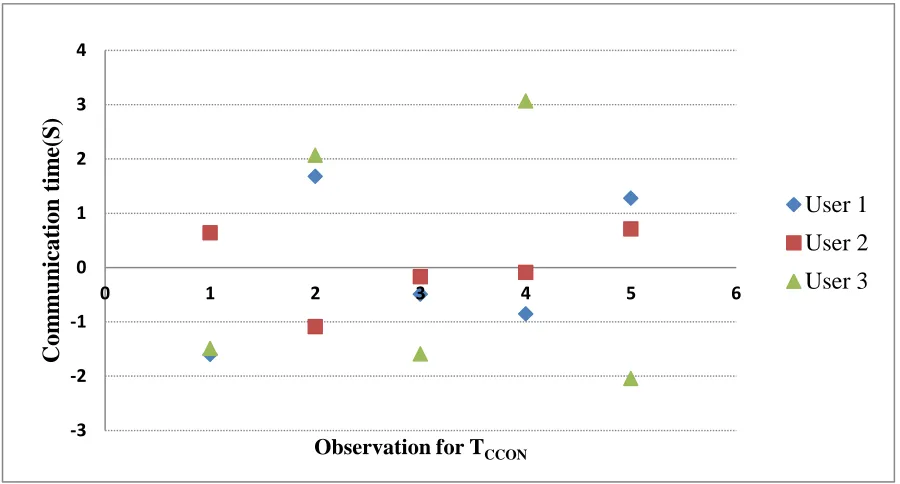
The results of the test case 5 are plotted in Figure 15 and Figure 16. The measurement
time varies from user to user based on their arm size. So, plotting total communication
time for different users in one graph to get an even distribution is difficult. So, in this plot,
‘deviation from mean’ for a given user for 5 observations is plotted. 15 20 25 30 35 40 45
1 2 3 4 5 6 7 8 9 10 11 12 13 14 15 16 17 18 19 20
39
Figure 15 User to User CCON time without Data Channel Establishment Delay
Figure 16: User to User CWMG time without Data Channel Establishment Delay
-3 -2 -1 0 1 2 3 4
0 1 2 3 4 5 6
Com m u n icat ion tim e(S)
Observation for TCCON
User 1 User 2 User 3 -3 -2 -1 0 1 2 3 4
0 1 2 3 4 5 6
Com m u n icat ion tim e (S)
Observations for TCWMG
User 1
User 2
40
Suppose, the recorded communication time for an observation i is xi and the mean of
communication time for 5 observations is 𝑥. Then deviation from mean is computed as
yi= xi - 𝑥.
It is demonstrated in Figure15 and Figure 16, that TCCON has higher variation among the
readings as compared to TCWMG. The maximum variation in CWMG is for user 2 and
TCWMG is 3.18s. Whereas the maximum variation in CCON is for user 3 and TCCON is
5.11s. As discussed earlier in the result analysis of test cases 3 and 4, the standard
deviation for TCCON is about ±2.86854s and the deviation in TCWMG is ±2.32934s. This
shows that the designed WMG can operate at narrow delay margins consistently.
4.4.4 Analyzing Accuracy in Data Transfer
In table 1, a comparison of data as read on BPM against the data received on the
designed WMG is shown. The BPM shows the data in decimal. The WMG shows the
data on the terminal in hexadecimal. For easier comparison, the data received on the
WMG is converted to decimal.
Observation Sent Data
(Decimal)
Received
Data (Hex)
Received Data
(Decimal)
1 Systolic: 114
Diastolic: 78 Pulse/Min: 88 Systolic: 72 Diastolic: 4E Pulse/Min:58 Systolic: 114 Diastolic: 78 Pulse/Min: 88
2 Systolic: 115
Diastolic: 75 Pulse/Min: 78 Systolic: 73 Diastolic: 48 Pulse/Min:4E Systolic: 115 Diastolic: 75 Pulse/Min: 78
3 Systolic: 114
Diastolic: 80
Systolic: 72
Diastolic: 50
Systolic: 114
41
Pulse/Min:76 Pulse/Min: 4C Pulse/Min: 76
4 Systolic: 114
Diastolic: 80 Pulse/Min: 76 Systolic: 72 Diastolic: 50 Pulse/Min: 4C Systolic: 114 Diastolic: 80 Pulse/Min: 4C
5 Systolic: 114
Diastolic: 82 Pulse/Min: 79 Systolic: 72 Diastolic: 52 Pulse/Min: 4F Systolic: 114 Diastolic: 82 Pulse/Min: 79
6 Systolic: 114
Diastolic: 79 Pulse/Min: 79 Systolic: 72 Diastolic: 4F Pulse/Min:4F Systolic: 114 Diastolic: 79 Pulse/Min: 79
Table 1: The Comparison between receive data and sent data
The comparison in table 1 shows, that there is no discrepancy between received data and
sent data. This proves that the data transfer is 100% accurate.
4.5 Summary
The various testing scenarios for the designed WMG and their results analysis has been
provided in this chapter. Test case results show that the deviation in the communication
delay is very minimal and thus the designed WMG has a very good delay consistency
while maintaining the 100% accuracy in the data receiving. A comparison of different
communication times against the communication time of Continua Manager has also been
42
5. CONCLUSION
The Wireless Medical Gateway (WMG) designed and implemented in this thesis, meets
all the design goals. It can connect to Bluetooth enabled Continua complaint medical
devices and communicate with them with consistent communication delay. Being
continua compliant, it is readily interoperable with medical devices from different
manufacturers who follow the same guidelines. Through various test cases and their
results analysis, it is observed that the communication time variation is ± 2.33 seconds
and this variation is consistent across the users of different body physics. It can connect to
the internet through an Ethernet interface and successfully send the medical data to
remote server. Through various measurements it is observed that medical data is always
received at the WMG without any error.
Establishing the initial communication between the designed WMG and Continua
compliant medical device has been challenging, primarily because of abstractness in the
Stollmann adapter functionality and non-availability of tools to sniff over-the-air
Bluetooth communication. Because of these challenges, Local Transport Protocol (LTP)
interface library could not be developed for BT-CC communication. Now, that good
information on BT-CC communication is available in this thesis, development of the LTP
library can be taken up as extension and future work. Adding the connectivity with
medical devices with low power Bluetooth (BTLE) and ZigBee interfaces can be taken up
43
REFERENCE
[1] Continua Health Alliance (2015, Nov. 15). Personal Telehealth Overview [Online]. Available: http://www.continuaalliance.org.
[2] World health organization (WHO) report (2015, Nov. 19). The impact of chronic disease in Canada [Online]. Available:
http://www.who.int/chp/chronic_disease_report/media/canada.pdf?ua=1.
[3] S. Healy "Care in the Community Economy: Towards an Alternative Development of Health Care," Ph.D. dissertation, Dept. of Geosci., Univ. of Massachusetts, Amherts, 2006.
[4] L. Schmitt et al., "Towards Plug-and-Play Interoperability for Wireless Personal Telehealth Systems", in 4th International Workshop on Wearable and Implantable Body Sensor Networks (BSN 2007), Aachen, Germany, Mar. 2007, pp. 257-263.
[5] Search data centre (2015, Nov. 18). Real-time operating system (RTOS) definition [Online]. Available: http://searchdatacenter.techtarget.com/definition/real-time-operating-system.
[6] Quality RTOS & Embedded Software (2015, Nov. 18). Free RTOS. Available: http://www.freertos.org/aboutRTOS.html".
[7] T. Oida et al., "A Security Gateway System for Medical Communication Networks – Inter-Hospital Use of the Secure Socket Layer", in Joint International Conference on Autonomic & Autonomous Systems on Networking and Services, New Jersey, USA, Oct. 2005, pp. 35-35.
[8] H. Yan Tung et al., "The Design of Dual ZigBee Homecare Gateway for Remote Patient Monitoring", IEEE Trans. Consum. Electron., vol. 59, pp. 756-764, Nov. 2013.
[9] E. Principi et al., "Low- Power High performance on the Beagleboard Platform", in 5th European DSP Education and Research Conference, Amsterdam, Sept. 2012, pp. 35-39.