Scholarship at UWindsor
Scholarship at UWindsor
Electronic Theses and Dissertations Theses, Dissertations, and Major Papers
2016
A HAPA Inspired, Agent-Based Model and Simulation of Activity in
A HAPA Inspired, Agent-Based Model and Simulation of Activity in
an Online Community
an Online Community
James Reid
University of Windsor
Follow this and additional works at: https://scholar.uwindsor.ca/etd
Recommended Citation Recommended Citation
Reid, James, "A HAPA Inspired, Agent-Based Model and Simulation of Activity in an Online Community" (2016). Electronic Theses and Dissertations. 5913.
https://scholar.uwindsor.ca/etd/5913
This online database contains the full-text of PhD dissertations and Masters’ theses of University of Windsor students from 1954 forward. These documents are made available for personal study and research purposes only, in accordance with the Canadian Copyright Act and the Creative Commons license—CC BY-NC-ND (Attribution, Non-Commercial, No Derivative Works). Under this license, works must always be attributed to the copyright holder (original author), cannot be used for any commercial purposes, and may not be altered. Any other use would require the permission of the copyright holder. Students may inquire about withdrawing their dissertation and/or thesis from this database. For additional inquiries, please contact the repository administrator via email
A HAPA Inspired, Agent-Based Model and
Simulation of Activity in an Online Community
By:
James Reid
A Thesis
Submitted to the Faculty of Graduate Studies Through the School of Computer Science In Partial Fulfillment of the Requirements for
The Degree of Master of Science at the University of Windsor
Windsor, Ontario, Canada
A HAPA Inspired, Agent-Based Model of a Spinal Cord
Injury Community
By:
James Reid
APPROVED BY:
Dr. Christine Thrasher Faculty of Nursing
Dr. Alioune Ngom School of Computer Science
Dr. Robert Kent, Advisor School of Computer Science
iii
AUTHOR’S DECLARATION OF ORIGINALITY
I hereby certify that I am the sole author of this thesis and that no part of this thesis has
been published or submitted for publication.
I certify that, to the best of my knowledge, my thesis does not infringe upon anyone’s
copyright nor violate any proprietary rights and that any ideas, techniques, quotations, or any
other material from the work of other people included in my thesis, published or otherwise, are
fully acknowledged in accordance with the standard referencing practices. Furthermore, to the
extent that I have included copyrighted material that surpasses the bounds of fair dealing within
the meaning of the Canada Copyright Act, I certify that I have obtained a written permission
from the copyright owner(s) to include such material(s) in my thesis and have included copies of
such copyright clearances to my appendix.
I declare that this is a true copy of my thesis, including any final revisions, as approved
by my thesis committee and the Graduate Studies office, and that this thesis has not been
iv
This thesis is an examination of a Health Action Process Approach (HAPA) developed originally
by R. Schwarzer for use in understanding and effecting health behaviour adoption. Although
HAPA provides an integral aspect of formulating health treatment strategies by human
practitioners for human patients, at the present time no simulation models suited to computer
implementation and usage exist for the study of and support for health behaviour adoption within
a HAPA framework.
This thesis examines the relevant research with respect to HAPA and the components
necessary to build a simulation model and platform for an online, self-managing SCI community.
We design an architecture for the platform that satisfies the primary requirements suggested by
HAPA and SCI patients, particularly directed at gathering relevant data consisting of health
indicators. Also, we develop several algorithms used for analysis of HAPA related health states
and transitions between states. Since this research did not involve any human subjects, the
intention was to simulate certain critical behaviours and changes using an agent based modeling
approach. Inasmuch as agents can provide only approximations to real human behaviour, they
are still useful and informative.
As part of our results, we show that an automated HAPA classification can reduce the
risk of agents dropping a health behaviour or program due to misclassification. Further, findings
revealed that 6% of the agents are in danger of dropping the adoption of an individual health
behaviour within two weeks and that 14% of the agents are at risk of dropping out of the
v
I dedicate this thesis to my mother who died of complications resulting from a chronic disease, in hopes that this work will assist with the design of future self-management programs
vi
I would like to acknowledge all the support from my friends and family whose encouragement
was paramount at times, the direction and assistance provided by my committee and graduate
staff, and the inspiration from the SCI community who demonstrated a genuine meaning of
community. I would like to thank the Craig H. Neilsen Foundation for funding the Parkwood
Hospital development of the URinCharge online community, which provided most of the
motivation for this thesis. I thank the Parkwood staff for allowing me to participate in the
URinCharge project, and my supervisor for his guidance and patience that enabled this thesis.
Finally, I acknowledge funding received from the Craig H. Neilsen Foundation in partial support
vii
CONTENTS
AUTHOR’S DECLARATION OF ORIGINALITY III
ABSTRACT IV
DEDICATION V
ACKNOWLEDGEMENTS VI
LIST OF TABLES XI
LIST OF FIGURES XII
CHAPTER 1 INTRODUCTION 1
1.1 Motivation 1
1.2 The Problem Context 3
1.3 The Proposed Approach 4
1.4 Contribution 4
1.5 Organization of Document 5
CHAPTER 2 HAPA AND ONLINE COMMUNITIES 6
2.1 Agent-Based Models 6
2.1.1 Fuzzy logic 8
2.2 Health Behaviour and HAPA 10
2.2.1 HAPA role in chronic disease treatment 12
2.2.2 Self-Efficacy 13
viii
2.3 Factors 17
2.3.1 Adherence 17
2.3.2 SCI Community Current Internet Use 18
2.3.3 Personality Effects and Learning Styles 19
2.4 HAPA Inspired Online Community 20
2.5 Summary 23
CHAPTER 3 THESIS HYPOTHESIS AND METHODOLOGY 24
3.1 Thesis Problem 24
3.2 Thesis Hypothesis 25
3.3 Objectives 26
3.4 Methodology 26
3.5 Summary 28
CHAPTER 4 ABM DESIGN 29
4.1 HAPA Online Community Representation 29
4.2 Computational HAPA Model 30
4.3 Agent Simulation 31
4.3.1 Fuzzy Classifier 33
4.3.2 Healthy Enough 35
4.3.3 Personality 35
ix
4.3.5 Dropout 37
4.3.6 Summary 39
4.4 Model Design 39
4.5 Classification 43
4.5.1 Classification Overview 44
4.5.2 Classification Flow 45
4.5.3 Classification Training Set 46
4.5.4 Self-Efficacy 46
4.6 Summary 47
CHAPTER 5 SIMULATION AND RESULTS 49
5.1 Data Acquisition 49
5.2 Simulation Validation 49
5.1.1 Personality Validation 50
5.1.2 Learning Validation 52
5.3 Simulation Output 54
5.3.1 Simulation Analysis 54
5.3.2 Categorization Analysis 55
5.4 Summary 57
CHAPTER 6 CONCLUSION 58
x
BIBLIOGRAPHY 61
APPENDIX A 72
A.1 MAIN SIMULATION 72
A.2 INITIALIZE MODEL 73
A.3 INITIALIZE DAILY 74
A.4 GET RESOURCE 74
xi
LIST OF TABLES
Table 4.1: Community Representation as GUIDs ... 30
Table 5.1: Dropouts within 120 Days ... 55
xii
LIST OF FIGURES
Figure 2.1: Fuzzy Logic [33] ... 9
Figure 2.2: HAPA Diagram (adapted from Ralf Schwarzer [36]) ... 11
Figure 2.3: Self-Efficacy within HAPA (adapted from Ralf Schwarzer [10]) ... 13
Figure 2.4: Sources of Self-Efficacy (adapted from Bandura [40])... 14
Figure 2.5: SCI Site Overview ... 21
Figure 2.6: SCI Logon Flow ... 22
Figure 4.1: HAPA State Diagram (adapted from Schwartwarz’s HAPA Model [21]) .... 31
Figure 4.2: Agent Simple Day ... 32
Figure 4.3: Agent steps throughout a day ... 33
Figure 4.4: Simple Binary Fuzzy Declassified ... 34
Figure 4.5: Personality Reflection ... 36
Figure 4.6: Negative Results processing ... 38
Figure 4.7: SCI Agent ... 40
Figure 4.8: Model Flow Diagram ... 43
Figure 4.9: HAPA Diagram showing Knowledge and Efficacy Artifacts ... 44
Figure 4.10: Classification Process Flow... 45
Figure 5.1: Single Run Trend Line Analysis of Social Actions ... 51
Figure 5.2: Multiple Run Trend Line Analysis of Social Actions ... 52
1
CHAPTER 1
Introduction
1.1 Motivation
Imagine you are going to visit a friend, along the way you are involved in some kind of accident
and you wake up in an ambulance. After awakening from emergency surgery, you find out that
you have sustained a spinal cord injury; it is immediately clear that you have lost a significant
degree of your ability to move your legs, your body and your arms. You are now one of the
4,300 Canadians who sustained a spinal cord injury (SCI) this year [1]. Today 86,000 people are
living with a Spinal Cord Injury in Canada, and this figure is projected to be 121,000 by 2030
[1]. Many of the symptoms associated with SCI are treatable; however, the conditions related to
SCI, including restricted mobility and loss of control of bladder and bowels, among others, are
not curable (at least, not at this time). As a result, SCI is considered to be a chronic illness along
with hypertension, asthma, chronic obstructive pulmonary disease (COPD), diabetes, and
arthritis, to name a few conditions.
Chronic Disease is a human health condition or disease that is persistent or otherwise
long-lasting in its effects. As a person with SCI, your life has changed; you will be involved
with self-management programs and self-assessing your health for the rest of your life. In
addition to the mobility issues you will now visit your physician 2.7 more often, be hospitalized
2.3 more often, and live 15 – 30 years less than you would have before the accident [1]. Patients
with chronic illness are plagued with secondary issues associated with their disease, and 58% of
family physician visits were related to secondary complications for SCI patients [2] [3]. To
Hygiene, fluid intake, physical activity, bladder management, and monitoring yourself for
secondary complications have just become your priorities to improve the quality of your life.
Historically, the management of chronic disease has been a doctor or nurse centred
approach involving an application of treatment to the patient by trained health practitioners.
Today, self-management has been found to be critically important for improving chronic disease
outcomes by engaging patient clients directly, as participants and stakeholders, through
education, self-monitoring, goal setting, and peer support to promote healthy behaviours [3] [4].
Self-management interventions currently use Patient Reported Outcomes (PROs) to
monitor a person’s progress in a program and the program overall success. PROs provide a
patient's feedback on their feelings or what and how they can do as they deal with their chronic
diseases or conditions [5] [6]. PROs typically cover three areas, or domains: physical, mental,
and social health. The following are simple examples of PROs:
• I always drink 6-8 cups of water a day.
• I rate my physical health as poor.
• I feel like something awful might happen.
Typically, such self-assessments utilize non-standardized measures such as Likert scales.
Although proven effective in health practice, PROS are criticized because they are subject to a
range of biases, such as poor memory or inability to summarize past experiences accurately [7]
[8]. Smoking patients tend to underestimate the benefits and overestimate the deficiencies [9],
Researchers and clinicians are currently developing and modifying self-management
programs for the SCI community. URinCharge is an example of a SCI self-management
program at the Parkwood Hospital in London, Ontario, Canada [11]. The URinCharge
self-management platform refers to the Health Action Process Approach (HAPA) framework, due to
Ralf Schwarzer [12], as a basis for development.
This thesis describes and documents an investigation into the feasibility and benefits of
automating HAPA classification within an online self-management system. If we can augment
PROs with data from the online community not subject to human biases, we could, in principle,
improve HAPA categorization and ultimately improve the online self-management experience.
1.2 The Problem Context
Chronic illness is costing Canada over $80 billion each year. The current models in health care
are not suitable for modeling individual patients within a self-management program [13] [14].
The analytical tools used in health are primarily diagrammatic logic models and epidemiological
forecasting models. These models are not well suited to capture the dynamic complexity of
chronic diseases [15] [16] [17] [18] [19]. Brailsford categorized health models as:
Models of the human body frequently called “disease models.”
Models for tactical purposes at the healthcare unit level.
Models for strategic purposes comprising system-wide models.
These models are not intended for, nor are they capable of, modeling individual actions.
The SCI online community currently under development [11] will not be released for
this investigation into the feasibility and benefits of automating HAPA classification. There are
no suitable simulation models for individual intervention planning, new tool impact assessment,
and prediction of a community’s general health status based on the HAPA framework [20].
Currently, clinicians are designing online self-management programs basing many design
decisions on unproven assumptions rather than results from a model. Thus, there is no real data
available for this study, or models to generate the data.
1.3 The Proposed Approach
To overcome the lack of real human data and suitable HAPA simulation models, we decided to
develop a model to simulate activity within the SCI online community using an Agent-Based
Model (ABM). We used the model to understand the benefits of automated HAPA classification
by studying when agents abandoned health behavior adoption or dropped out altogether.
1.4 Contribution
In this thesis, we have done the following:
We outline a HAPA inspired online community, suitable for any treatment of any online
community (Section 2.4).
We design the components of the Agent-Based Model (ABM) (Section 4.3).
We outline the online HAPA classifier to be used in the real SCI online community
(Section 4.5).
We verify our model actions against the logic programmed into the agents since there is
no data set suitable for validation (Section 5.1).
We analyze the simulation results to understand the benefits of automated HAPA
1.5 Organization of Document
The remainder of this thesis is organized as follows. Chapter 2 introduces the reader to the
relevant background information on the HAPA framework and various health and behavioural
factors necessary to design and build a HAPA inspired ABM of an online community. Chapter 3
contains the thesis problem, hypothesis, objectives, and methodology. Chapter 4 describes my
solution and implementation, including the reasons behind choices we made in our design.
Chapter 5 includes the results of the simulations and discussion of the model validation. Chapter
6
CHAPTER 2
HAPA and Online Communities
In this chapter, we introduce the relevant material pertaining to this thesis. We begin by briefly
looking at Agent-based modeling (ABM). Then we examine health behaviour adoption to gain
an understanding the interaction between the agent and the SCI online community. Next, we
look at the factors that will drive the agent’s actions and decisions. We conclude this chapter
with an examination of the SCI online community in development.
2.1 Agent-Based Models
The purpose of the thesis is to simulate the use of an SCI online community by real people as
they attempt to improve their quality of life by adopting and maintaining prescribed health
behaviours. In this section we will briefly review computer simulation and ABM, to ensure that
it is suitable for modeling the online community. Finally, we will briefly discuss the use of
fuzzy logic as a means to have the agent actions appear less binary.
Computer simulation is the process of running a computer model to reproduce the
behaviour of a system or network. In this case, the simulation would repeatedly be running a
model of the online community while using its output as the input to the subsequent run.
Computer models are used in a variety of disciplines, from astrophysics to weather forecasting,
using a variety of tools and platforms. Agent-based modeling (ABM) is a preferred method
when modeling complex reactive systems.
An ABM is a modelling paradigm, which utilizes agents to simulate the actors within the
an SCI client; while, in modelling geese flight an agent would represent a single goose. The
term “agent” is widely used in modelling, without a standard definition [21]. An agent is more
often defined in literature by it attributes rather than by a single definition. This is most likely
because the agents within models differ between fields of studies. For the purpose of this thesis,
we will use the following to define an agent. An agent is anything that can be viewed as
perceiving its environment through sensors and acting upon that environment through an actuator
[22]. An agent needs to possess the following general characteristics to accomplish its task:
independence, learning, cooperation, reasoning, and intelligence [22] [23] [24]. An intelligent
agent performs, reactively and or pro-actively, interactive tasks tailored to a user’s needs without
humans or other agents telling it what to do [23]. Please remember that an agent is still only a
software program that operates within a given environment performing only the actions for
which it is programmed. Agents are used in modelling to gain insight into the system’s behaviour
and outcomes.
As stated above ABM is a preferred method when modeling complex reactive systems
and has been used in health for modelling the complex dynamics associated with obesity [25],
and as a basis for a decision support system managing patient falls in a hospital setting [26].
ABMs have also been used to model behaviours in child seat use [27], and to model other health
frameworks [24]. Finally, an ABM has also been used to model ancient societies [28].
Modelling behaviours require ABM techniques because it requires independent agents to model
complex individual and social interactions [29] [30].
To simulate the online SCI community we need to mimic human interactions with an
simulate the agent's actions driven by the factors discussed in Section 2.3. Given that, this model
must simulate people’s complex actions within the SCI online community it would appear that
an ABM is an acceptable approach for modelling the SCI online community.
There are varieties of ABM platforms ranging from desktop models to high-performance
computing. The desktop platforms range from excel spreadsheets to open source and licensed
software. MASON, Netlogo, Repast, StarLogo, ZEUS are just a few of the popular software
packages encountered during this research. We started the modelling efforts using Repast
because of the support available within our lab and online. Repast was quick and easy to install
and provided the necessary infrastructure to construct an ABM. ABMs require more than a
platform to be successful. According to Macal and North an ABM, requires the modeler to
consider the following points. 1) Identify the agents and the factors that drive the agent
behaviour. 2) Identify the relationships and in the agent interactions within the model. 3) Select
or design and develop suitable ABM platform. 4) Get the agent-related data. 5) Validate the
agent behaviour. Finally, 6) run the model and analyze the output from an individual and system
basis [21]. To satisfy Macal and North’s first two requirements, we will examine health
behaviours to understand the interactions between the agent and online system in Section 2.2 and
the factors that will drive the agent behaviour in Section 2.3. The remainder of Macal and
North’s requirements are discussed in Chapters 4 and 5.
2.1.1 Fuzzy logic
In this section, we discuss fuzzy logic as a means to make the agents appear more realistic and
less deterministic. The questions that we answer daily, such as “Do you feel healthy enough to
binary. Fuzzy Logic allows classification engines and ABMs to handle unclear (fuzzy) values.
The core of both classical and fuzzy logic is the idea of a set. In classical set theory, an element
belongs or does not belong to a set. The fuzzy set theory permits the gradation of the
membership of the element in a set [31]. The central term in this fuzzy logic is the "fuzzy
variable." In the logic domain, the fuzzy variable is one that can deal with values from zero to
one, in contrast to the Boolean variables that can assume only the values 0 and 1 [32]. An
application of fuzzy logic can be seen in Figure 2.1. The vertical line in the image represents a
particular temperature that the three arrows (truth values) gauge. Since the red arrow points to
zero, this temperature may be interpreted as "not hot." The orange arrow (pointing at 0.2) may
describe it as "slightly warm" and the blue arrow (pointing at 0.8) "fairly cold." You can also
state that the value belongs to the cold set with degree .8 and the warm set with a degree of .2.
Figure 2.1: Fuzzy Logic [33]
Fuzzy logic is well-known for its strength in managing classification problems where boundaries
between classes are ambiguous [34]. One of the hallmarks of fuzzy logic is that it allows
nonlinear input and output relationships to be expressed by a set of qualitative “if-then” rules
Above, we briefly reviewed computer simulation and discussed fuzzy logic as a method
to deal with unclear or fuzzy decisions. In the next section, we will discuss the factors that will
drive the drive the agent actions.
2.2 Health Behaviour and HAPA
The Health Action Process Approach (HAPA) is a psychological theory of health behaviour
change, developed by Ralf Schwarzer [36], which has been applied to individuals or
communities. In this section, we will briefly examine HAPA role in treating chronic illness, its
current measures, its self-efficacy, and its health adoption predictive capabilities, in order to gain
an understanding of how a community will interact with individuals. For the purposes of this
thesis, this will translate into a model of the relationship between an online community and
software agents.
HAPA is an open-ended (or multi-phased) “… framework of various motivational and
volitional constructs …” that are assumed in order to explain and predict individual changes in
health behaviours [10] [37]. Individuals are categorized into a framework for each behaviour
Figure 2.2: HAPA Diagram (adapted from Ralf Schwarzer [36])
Figure 2.2 shows the phases and classifications inherent within HAPA. A person who is
in the volitional phase is characterized as a Preintender and is trying to move from wishing they
would adopt the behaviour to where they will start to adopt the behaviour. In this phase,
Preintenders review their priorities, weigh the pros and cons of actions, and eventually decide to
adopt or not adopt a health behaviour (e.g. dieting, using condoms, or giving up smoking). The
Motivational phase is divided into the Intender and Actor stages. Intenders have decided to
adopt the behaviour, but, have yet to start. They are in the process of planning how to overcome
their remaining barriers. Finally, those who have begun to adopt their behaviours are classified
as Actors.
The HAPA framework is just one of many frameworks that are used to understand
for the Transtheoretical and Health Belief Models [38], both of which are widely cited in the
literature for the understanding of health behaviour adoption.
2.2.1 HAPA role in chronic disease treatment
HAPA as stated above, is just a framework used to explain and predict individual
changes in health behaviours. HAPA has been used as the basis for the development of several
self-management programs and tools used to promote such behaviours as: seat belt use; breast
examination; and, physical activity for people with Multiple Sclerosis [10]. Historically,
treatment has been a doctor or nurse centred approach involving the application of a treatment
regimen to a patient; however, self-management has been found to be critical for improving
chronic disease outcomes by engaging clients through education, self-monitoring, goal setting,
and peer support to promote healthy behaviours [3] [4]. Programs and tools based on HAPA
first categorize a client into one of the HAPA stages and then tailor the delivery of materials
intended to meet their needs. Examples of a tailored delivery could be providing discounted gym
memberships to an Actor who is trying to lose weight, a list of gyms with daycare for an Intender
with children, and, finally, material reviewing the benefits and deficiencies of weight loss to
2.2.2 Self-Efficacy
Figure 2.3: Self-Efficacy within HAPA (adapted from Ralf Schwarzer [10])
Efficacy represents one-third of the HAPA diagram as highlighted in Figure 2.3.
Self-Efficacy must be accounted for in any HAPA simulation model. Self-Self-Efficacy is an individual’s
perception of what they can accomplish given their current circumstances and it influences a
person at each HAPA stage, since people are more likely to engage in activities for which they
have high Efficacy and less likely to engage in those they do not [39]. We equate
Self-Efficacy to “I can. Therefore, I will”. Self-Self-Efficacy must not be confused with Self-esteem,
which is a feeling of self-worth.
In the HAPA diagram context, Schwarzer asserts that task, maintenance, and recovery
Self-Efficacies are required to adopt fully and maintain a health behaviour. Task Self-Efficacy is
control, maintenance and recovery Self-Efficacy are regarded as being influential in the
subsequent goal-pursuit (volitional) phase.
Figure 2.4: Sources of Self-Efficacy (adapted from Bandura [40])
Figure 2.4 is just one of many similar images showing sources of Self-Efficacy [41],
particularly a perspective created by Bandura showing four sources of information that
individuals use to judge their efficacy [40]. Self-Efficacy is primarily a function of your
similar tasks or behaviours is the most influential source of efficacy information because they
provide the most authentic evidence of whether one can muster whatever it takes to succeed [12].
Mastery can be characterized as: “You’ve done it before. You can do it again.” Lacking personal
experience, we next use our vicarious experience to judge if we can muster what it takes to
succeed, which can be characterized as: “My friends have done it so I can do it too.” Verbal
persuasion can take the form of advertisements, pamphlets, and social influences, and its
effectiveness depends on the credibility of the persuader. Finally, physiological feedback refers
to your comfort level with the task; this feedback is usually the least influential of the four
factors.
2.2.3 Health Behaviour adoption
In this section, we explore the question: Can health behaviour adoption be predicted by looking
first at health behaviour adoption, as a baseline, and then investigating if others have been able to
predict health behaviour changes towards adoption?
When you first look at the HAPA diagram, it suggests that you might be able to use a
simple equation to calculate when a person would move from a Preintender to an Intender.
However; behaviour change is not necessarily linear and may be best represented as a series of
interactions that contribute to a person’s knowledge, attitude, efficacy or intention which could
trigger a behaviour change [6]. Each interaction contributes to an individual’s knowledge; this
varies between individuals. My favourite metaphor of knowledge gain is from an unknown
author who represented knowledge gain as a sack of balls covered in a sticky substance where
the balls are the artifacts the sticky substance is knowledge. As people extract and replace the
or agent interacts with the online community, their interactions affect their knowledge. Since the
online community contains vetted resources and is monitored, we can assume that most
interaction will result in a positive gain in knowledge, attitude, efficacy or intention. Knowledge
has proven to become less effective over time [8], and that is why the HAPA goal is to provide
the material at the right moment.
We found that the HAPA framework has been used successfully to obtain health
behaviour adoption in physical activity, exercise adherence, breast self-examination, seat belt
use, dietary behaviours, and Dental Hygiene [13] [42] [43]. PROs and other evidence measures
have been used in predicting dietary change [9], participation in a breast screening intervention
[29], and determining HAPA Intenders and non-intenders [3].
HAPA variables have been used to establish HAPA stages, participation, and outcome of
behaviour change interventions. The challenge is to identify a set of variables and outputs,
which can be for categorization in the simulation model. The online community can utilize PROs
for HAPA categorization; however, looking ahead in the thesis, the simulation model to be
established in Chapter 4 and discussed in part in the following section, requires an automated
HAPA categorization, since PROs cannot be reasonably administered during the computer-based
simulation. The model as discussed in Chapter 4 must represent pertinent PROs such as an
average health score and other attributes, since as mentioned in Section 1.3, we lack of real
human data suitable for the simulation. That is not say that PROs are not available on a variety
2.3 Factors
In this section, we will examine the factors, which drive agent interactions within the simulation
model. The online community, by its nature, currently limits the actions that an agent can
perform to provide a safe moderated online experience. The agents can only research topics of
interest, interact with other agents via forums to develop relationships, utilize toolkits to track
health variables such as water consumption, or ask for assistance; but, how they use the online
community still needs to be established to program the agents. Specifically, we need to answer
these questions:
1) What causes someone to stop or drop the program?
2) What will they do in the online community?
3) What drives their online selections?
4) How long are they online?
2.3.1 Adherence
Adherence and compliance are terms used to describe the degree to which a patient correctly
follows medical advice. In a perfect world, everyone who started a self-management intervention
program would continue with the program. We know that this is not true in the real world.
Therefore, in this section we will examine some reasons, or identifiers, for adherence that we can
reasonably emulate in the ABM.
Studies have shown that patients continue, on average to take about 50% of prescribed
medication [44], and 25%–40% patients are not adherent [39]. In a study on compliance, it was
consistently between studies [45] which, conversely, explains why there is no ultimate list of
non-adherence reasons. Munce et al, in a study to understand perceived facilitators and barriers
to self-management to prevent secondary complications in SCI community, found physical
limitations, funding, accessibility, mood , caregiver burnout, and control over care to be barriers
that need to be overcome to achieve adherence [46].
We found the reasons vary between studies depending on the field of study; but, a typical
list of reason were conflicting information, costs, religious beliefs, lack of time, lack of
resources, the time span of treatment, and ineffective treatment [47]. The latter two reasons can
be represented in our model. In addition to the reasons which can be modeled, we must account
for people randomly dropping out of a behavior adoption or the complete program. The model
must account for agents dropping out when they see no progress, when they are given incorrect
material, and even randomly to account for the other reasons, which cannot be modelled
individually.
2.3.2 SCI Community Current Internet Use
In this section, we briefly examine SCI population use of the Internet to understand what actions
the agents must be able to perform.
The SCI community currently uses the internet to improve their general quality of life
and will most likely use the future online community to improve their health-related quality of
life [47] [48]. The benefits and uses of the internet by the SCI community has been well studied,
but from results rather than an action perspective which is needed to develop a model. To
understand the actions that were used by the SCI community to achieve their results, we need to
information, form relationships and discussions with likeminded people [49]. Pendry’s actions
are reflected in Miller’s article, which studied the internet use in individuals with spinal cord
injury [50].
The SCI population uses the internet for a variety of reasons, but the interactions boil
down to seek information, share information, form relationships and discuss with like-minded
people especially in an online forum.
2.3.3 Personality Effects and Learning Styles
In this section, we examine how personality and learning styles could drive an agent behaviour in
the online community. Traditionally, extroverts were considered more outgoing, and introverts
were seen as shy. The intranet and the anonymity it provides has changed how everyone
interacts. It has been found that extroverts prefer communication media that enable direct and
immediate contact with others, and they join more groups [51], while introverts prefer to use
computer-mediated communication means for their communication and research to help reduce
anxiety [51] [52]. These studies agree with the traditional view; however, other studies have
found that low risk and familiar Internet service usage are not affected by personality traits [52],
and self-esteem was found to be an important personality characteristic that significantly
identifies media choice [53]. The internet appears to be associated with any of a range of trait
and cognitive personality variables [54], and results differ from study to study depending on the
field. Therefore, we will use the definition of introvert and extrovert loosely allowing an agent
to be between being a total introvert or extrovert.
Personality traits could not be correlated to time spent in online communities or amount
which 12 hours is social and disability related [50], which is just slightly above the social
worldwide average 11.9 hours a week excluding teens [55].
Learning styles are not as controversial as personality traits with respect to computer use,
but they still play a part in how we approach the task at hand. Your learning style is simply your
preferred method of learning. Ford and Moss could not link cognitive learning styles an internet
search study [56]. They discussed the importance of Self-Efficacy in information retrieval and
touch on the term globetrotting. Merriam et.al discuss global and analytical processing styles in
adult learning, which describe how one receives and processes information [57]. A global
learner processes multiple ideas and experiences in a global fashion, while an analytic learner
processes information in a step-by-step objective manner. In the model, the analytic learner will
focus on their most important while the global learner will attempt to address all at once.
2.4 HAPA Inspired Online Community
In this the final section of the design chapter, we need to outline the actual online community
being developed. The online community will become a main interaction point for the SCI
community, and the only interaction point for the agents. Therefore it is imperative that the
Online community is reflected in the model.
The ultimate goal of the online community is to help a person adopt the necessary health
behaviours by providing a safe environment where one can gain the will and the way to improve
their individual circumstances. The online community will provide a personalized experienced
based on HAPA level, pertinent physical characteristics and have a social environment to
promote friendships and encourage ongoing use of the community because chronic disease
There are a variety of tools which can be configured to achieve a community. The online
community as described by the SCI community in workshops consists of the following:
themed HAPA filtered repositories (libraries),
forums,
discussions boards,
personal blogging tool with tagging and voting capabilities,
a variety of applications or trackers designed to address individual health concerns,
HAPA categorization engine,
and, most importantly, a human advocate to address concerns which cannot be resolved
by an online community.
The SCI community has eight health behaviours of interest and approximately fourteen
areas of interest as taken from current SCI discussion boards.
SCI Homepage
Profile Health Behaviour Resources
ToolKit(s) Ask a Medicial Professional
Personal Blog discussions broads General Resources Topics of interest Resources Search HAPA Classification Tickler Reminders
Figure 2.5: SCI Site Overview
The essential components as seen above in Figure 2.5 exist in many websites today for
the SCI community except the HAPA classification and filtering. The HAPA Classification and
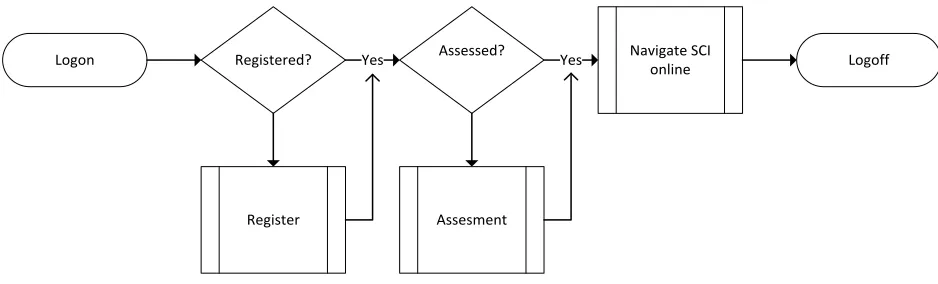
enforces a strict registration, assessment and initial HAPA classification process flow before
granting access to any resources to achieve the full benefits of personalization. The initial
account setup is currently a vetted process ensuring that all users have a legitimate reason for
belonging to the community. Figure 2.6 shows the login process forcing clients to register and
take an assessment before being allowed to navigate the SCI online community. The
personalization is required for achieving a HAPA inspired online community since it ensures that
the clients receive the appropriate material given their current HAPA stage.
Logon Registered? Assessed?
Register Assesment
Navigate SCI
online Logoff
Yes Yes
Figure 2.6: SCI Logon Flow
The toolkit(s) are a combination of resources, goal setters, trackers, and community and
friend comparison applications. The goal is to foster a supportive atmosphere to encourage
program adherence through peer pressure and competition. During the workshop, it was
mentioned by several of the participants that they adhered to their goals to avoid disappointing
their peers. Toolkits also have the ability to be programmed with logic to recognize when a
person has progressed to the next HAPA level. An example of toolkit classification could be that
once a person maintains a healthy water intake for a month, they are automatically classified as
2.5 Summary
In this chapter, we discussed the key elements of the thesis required to build a HAPA inspired
ABM. We introduced health behaviour by discussing HAPA, Self-Efficacy, and health
behaviour adoption which are key to the SCI online community. Then, we discuss computer
simulation and the factors that will drive the model and agent behaviour. Finally, we introduce
the SCI online community. In the next Chapter 3, we present our thesis problem, our thesis
24
CHAPTER 3
Thesis Hypothesis and Methodology
In this chapter, we will discuss the thesis problem, our hypothesis, objectives, and research
methodology.
3.1 Thesis Problem
As we have presented in Chapter 2, HAPA is a framework, used for many self-management
programs, which has proven successful in understanding the adoption of health behaviours [10]
[36] [58] [59].
At the time of this writing, HAPA categorization within self-management programs
appears to be based primarily on Patient Reported Outcomes (PROs). Although proven
effective, PROS are criticized because they are subject to a range of biases, such as poor memory
or inability to summarize past experiences accurately [7] [8]. Smoking patients tend to
underestimate the pros and overestimate the cons [9], Participants sometimes inflate estimates
of control [10]. We could not find any mention of automated HAPA classification in the
research literature reviewed.
As mentioned in Chapter 1, our work began with a funded research project, called
URinCharge [11], to design and implement a web-based framework for Spinal Cord Injury
patients and the online community they are part of, including other patients and health
professionals. The SCI online self-management program currently uses PROs for HAPA
classification. HAPA classification is used to personalize the client online experience. If the
will occur at the beginning, at registration into the system, and throughout the program on a
scheduled basis; we note that scheduling, if not done correctly, can increase dissatisfaction
between classification periods.
At the time of working on this research and thesis, the SCI online community
URinCharge was still in active construction and validation; hence, we were not able to gather
sufficient data for an investigation into the feasibility and benefits of automating HAPA
classification. However, there are no simulation models for individual intervention planning,
new tool impact assessment, and prediction of a community’s general health status based on the
HAPA framework [20]. Thus, we determined that to investigate automating HAPA
classification an Agent-Based model (ABM) of an SCI online community could be developed to
study the feasibility and benefits of automating HAPA classification. This is the essential
problem addressed by this thesis research.
3.2 Thesis Hypothesis
To address the problem defined in the previous section, our hypothesis is:
As people (or agents) seek to satisfy their individual needs in an online community (or
simulated environment), their activities can be classified by HAPA Stage.
From a computer science perspective, this statement may be stated in the form:
An Agent-Based model (ABM) is appropriate to study simulated SCI patient behaviour
relating to needs and activities, and to provide automated classification according to
Inasmuch as the hypothesis statement is somewhat abstract and vague, in order to describe in
simple terms the nature of complex software systems, we provide a more detailed list of specific
objectives in the next section.
3.3 Objectives
In order to validate our hypothesis, we considered the following objectives as necessary elements
of our research work:
Design the software framework and elements required to model and simulate activity
within a HAPA inspired online community.
Build a HAPA inspired ABM of the SCI online community.
Quantify and evaluate the benefits, and potential deficiencies, of automated HAPA
classification.
3.4 Methodology
The URinCharge project [11], which has stimulated many aspects of this thesis research, is based
on a Participatory Action Research (PAR) methodological approach. This is reasonable due to
the kind of innovative health research presented by such self-management approaches and
platforms, where all participants for whom the platform is intended must be involved in order to
ensure that their various interests are properly met. Although this thesis research work is
independent of the PAR paradigm, we have had significant opportunities to interact with a
multi-disciplinary team of experts and SCI clients to understand better, and more completely, the
Since PAR must be excluded from consideration, we adopted a system design based
approach to our methodology. Thus, my approach consisted of the following steps:
1. Assist with the design and development of a HAPA Online Community through a
thorough investigation of needs, stated in the forms of requirements and
specifications.
A solid understanding of the online community is required before it can be
modeled and simulated.
2. Literature review.
Review the pertinent literature on HAPA to serve as a basis for the Agent-Based
model, and for modeling agent actions.
3. Agent-Based Model Development
a) Design the ABM
A stochastic Agent-Based Model of the SCI online community must be
designed, based on recent studies of SCI and HAPA classification models.
b) Build the Agent-Based Model
The SCI ABM programs has been developed in C# to accommodate
moving the categorization engine eventually to the proposed SCI online
community, URinCharge.
The model output has to be subjected to logical consistency evaluation as
a replacement for formal validation; no HAPA or similar community
exists, at this time, that is capable of supplying real data for formal
comparison and analysis.
d) Investigate thesis question.
Once the model is verified for logical consistency, we will investigate and
quantify, wherever possible and reasonable, the benefits of automated
HAPA Classification.
3.5 Summary
In this Chapter 3 we have presented the problem underlying this thesis research, both from the
perspective of designing and building a intervention and support tool for self-management of
health among persons with spinal cord injuries, and also from the viewpoint of designing and
building appropriate, complex software systems that support the health driven objectives. One
vital aspect that defines the problem is incorporating the HAPA model into the software design.
This led to our hypothesis that an Agent-Based model (ABM) is appropriate to study the SCI
patient behaviour relating to needs and activities, and provide automated classification according
to HAPA stages; these stages are used as indicators of adherence, or commitment, to maintaining
positive health strategies. We then proceeded to state several specific objectives needed to verify
our model and simulation results and provided a detailed methodology for carrying out the
research program.
29
CHAPTER 4
ABM Design
In this chapter, we will present and discuss how to translate the HAPA framework from a health
practitioner perspective into a suitable software architecture and the computable software
components necessary to build the model. The primary goal of the Agent-Based model is to:
simulate individual interactions with the online community using an Agent-Based modeling
approach; provide input to a HAPA categorization engine; and, provide clinicians with a tool to
test assumptions on filtering and classification strategies.
4.1 HAPA Online Community Representation
To model the online community, we need to represent the community in a digital form for the
agents. This will establish the environment in which agents interact. The online community
consists of themed HAPA filtered repositories (libraries), forums, discussions boards, a personal
blogging tool, and a forum to ask a health professional or advocate to address concerns which
cannot be resolved by an online community. In this section, we describe how to represent the
online community to the agents.
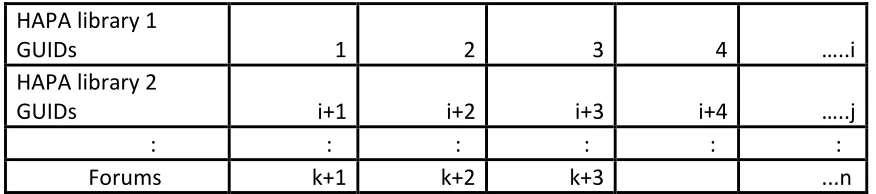
We can all envision the individual components of the online community, but to the
system, everything is just a resource referenced by an address or globally unique identifier
(GUID). We view libraries as a series of documents, or a forum as a series of messages, often
focusing on the title or another attribute. The actual system is presenting us a series of GUID
the online community as a series of arrays with ascending GUIDs rather than focusing on the
titles.
HAPA library 1
GUIDs 1 2 3 4 …..i
HAPA library 2
GUIDs i+1 i+2 i+3 i+4 …..j
: : : : : :
Forums k+1 k+2 k+3 ...n
Table 4.1: Community Representation as GUIDs
In our online community as seen in Table 4.1, we have eight HAPA arrays, one for each
health behaviour that the SCI community needs to address. Initially, the HAPA arrays would
contain the GUIDs 1 – 16000 assuming that there are 4 HAPA levels (including the
non-intender) and each repository having 500 resources available. Any non-static additions after the
initialization such as forum entries would be assigned the next GUID as seen in the table above
as GUIDs k+1 …k+3.
4.2 Computational HAPA Model
The HAPA model provides an excellent flow chart for understanding what influences a person
while adopting a health behaviour; however, the HAPA model alone is not sufficient to create an
agent within an Agent-Based model (ABM). To be able to configure an agent within a HAPA
inspired ABM, we converted Schwarzer’s model to a state like diagram shown in Figure 4.1,
Figure 4.1: HAPA State Diagram (adapted from Schwartwarz’s HAPA Model [21])
In the diagram, each arrow represents an interaction with the online community. The R
in the arrow represents the result from the agent interaction followed by the resulting HAPA
stage. The results from the interaction can be a resource HAPA library resource, a forum reply,
an answer from the nurse, a friendship formed, or nothing because they just posted a question
followed. Once the agent has collected the necessary resources and achieved a sufficient
Self-Efficacy level, they can ascend to the next HAPA level.
4.3 Agent Simulation
In this section, we examine the design of the agent and the factors that drive the agent behaviour.
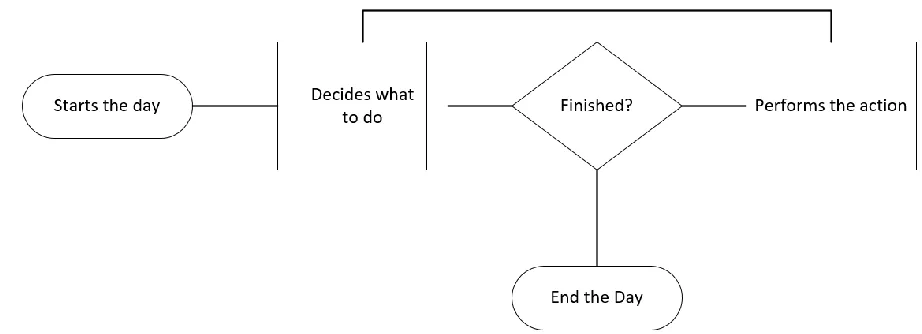
An Agent, in replicating human activities, starts the day and makes decisions throughout the day.
Figure 4.2: Agent Simple Day
In the ABM, we are only concerned with simulating the interactions between the agent
and the online SCI community. The following factors are used to drive how the agent will
interact with the community: health, personality type, learning style, average online time,
tolerance and receptiveness. The simulated day is represented in five-minute cycles, since the
activities we are simulating can be time intense as people review material, craft questions, and
partake in discussions. The simulation model polls the agent every cycle to see if it is ready to
perform another action, given a variety of agent attributes such as usual start time, average usage
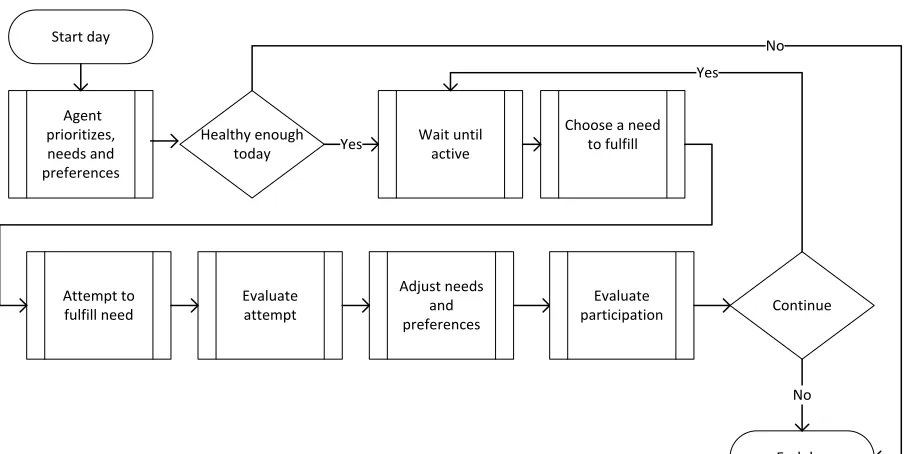
Start day
Agent prioritizes, needs and preferences
Choose a need to fulfill Evaluate attempt Adjust needs and preferences Attempt to fulfill need End day Evaluate participation Continue No Healthy enough today Wait until active Yes Yes No
Figure 4.3: Agent steps throughout a day
The daily flow diagram in Figure 4.3 shows the necessary steps the agent will take
throughout the day to satisfy its needs. The agent first prioritizes its needs and preferences; then
if it is healthy enough to continue they attempt to meet its needs while evaluating its needs and
adjusting its preferences, much as we do throughout our day.
4.3.1 Fuzzy Classifier
In Section 2.2.1, we discussed fuzzy logic as a means to make the agents appear more realistic
and less deterministic. The interpretation of a fuzzy rule set or defuzzification can be performed
in several different ways. The most popular method is the centroid method [60]. The centroid
method calculates the center of gravity for the area under the curve. The centroid method is
effective across multiple planes, or when boundaries are erratic. The fuzzy classifiers used in
shown in Figure 4.4. The output of the classifier is true or false and calculated using a variance,
and the input value. In Figure 4.4, we see the input value marked by the vertical line at position
50 on the horizontal axis. The variance is used to calculate the true and false hard thresholds
from the input value. In this example, a 10% variance each way, gives us a false threshold of 40
and a true threshold of 60. Any number between 40 and 60 are subject to the fuzzy
declassification described below.
Figure 4.4: Simple Binary Fuzzy Declassified
In this example, we belong equally to the true and false sets. As we move towards the
value 60, we become more true than false, which increases our chances of returning true. The
fuzzy de-classifier used in the model compares the degree of true to a random number between 0
and 1. The degree of truth is calculated by dividing the distanced between the threshold and the
upper limit of a hard false divided by the slope of the line. In this example, the slope of the line
is 20; the threshold is 50; and the upper limit of a hard false is 40. This means that the degree is
4.3.2 Healthy Enough
The initial factor we chose to drive the agent actions is health. Is the agent healthy enough to
even want to login to the community? The SCI community is prone to 2.5 urinary tract
infections a year, which can be disabling [61]. We chose to represent health as an individual
percentage for an agent that can vary daily. To calculate if an agent will participate that day we
compare a random number against its daily health percentage using the fuzzy de-classifier
described in Section 4.3.1. The daily health value is the agent average health plus a random
variance as shown in Equation (4.3.1). The actual decision shown in Equation (4.3.2) is a fuzzy
variable that becomes random close to the Daily Health value as described in Section 4.3.1.
Daily Health = (Average Health + random variance); (4.3.1)
Daily Heath binary = Fuzzy Decision (Daily Health,
Variance);
(4.3.2)
4.3.3 Personality
The next factor that we chose to drive the agent actions was personality. A daily personality
value is used to drive how the agent prioritizes its needs. The daily personality value is similar
to the daily health value in Section 4.3.2, with the added feature of reflection. The flow chart in
Figure 4.5 shows how the agent experience adjust its preferences. If an agent had a bad social
Figure 4.5: Personality Reflection
If the agent is feeling social, then the social features are included in its choices of options
to use to fulfill its needs. The Equations (4.3.3) and (4.3.4) shown below are similar to the health
variable allowing daily value to differ from its average value and using fuzzy logic to give the
agent a more realistic appearance.
Daily Personality = (Average Personality+ Yesterday evaluation
+ random variance);
(4.3.3)
4.3.4 Learning Style
The next factor that we chose to drive the agent behaviour is style of learning. A learning value
will decide how the agents will fulfil its needs. The daily learning value is similar to the daily
health value in Equations (4.3.5) and (4.3.6). If the agent learning style is organized, it will
focus on its highest ranked need, rather than try to address multiple needs throughout the day.
The higher the learning value the more likely it will focus its highest ranked need each day.
Daily Learning Style= (Average Learning Style+ Yesterday
Evaluation + Random Variance);
(4.3.5)
Learning Indicator = Fuzzy Decision (Daily Learning Style,
Variance);
(4.3.6)
4.3.5 Dropout
The final factors that we chose to drive the agent behaviour are acceptance and tolerance that
influence participation in the program. The model must account for agents quitting the adoption
of a health behaviour and or the community. In the research, we found that people would stop
treatment because of excessive treatment time, incorrect treatment, and in some cases for
nothing.
The first of these factors is acceptance, which will impact how the agent judges the
interaction with the site. In the real online community, the site content is moderated, filtered,
positive, we use a simple comparison of an agent acceptance score to a random number to judge
if its interaction was beneficial, and update the relevant preferences and results accordingly.
The second factor is tolerance which will impact how long an agent will tolerate negative
interactions before abandoning a health behaviour adoption or the program. Tolerance is used to
judge both ineffective treatment and excessive time spans. To calculate ineffective treatment, we
compare the agent tolerance level against its percentage of successes within a behaviour. To
calculate excessive time spans, we examine the time variation between an agent trying to adopt a
behaviour against the model averages for each behaviour level.
Figure 4.6: Negative Results processing
When an agent receives an incorrect resource due to misclassification, or the agent rejects
the material, then the steps in Figure 4.6 are activated. First, the agent updates the preferences
and personality scores. Then they check tolerance levels for the given behaviour it is trying to
Finally, to account for an agent dropping out not for the reasons above we use daily
random comparison against a drop value for the model. Each agent is tested at the start of the
day to see if they will drop a behaviour or the community.
4.3.6 Summary
There are any number of logic, factors, and actions that we could have chosen to model the SCI
online community. Our goal was only to model the activities in a realistic fashion to gain an
understanding of the benefits, and the potential deficiencies, of automated HAPA classification
within an online community. In order to accomplish this, we chose to utilize fuzzy logic, where
appropriate, to avoid a binary appearance in the model. Then, we chose to use properties of
agent health, personality, and learning style to drive agent actions. Finally, we chose to utilize a
random drop out process to simulate non-adherence to attempt to deal with a non-specific set of
rationales that are not modeled by research to date.
4.4 Model Design
In this section, we will examine the ABM design, which incorporates the factors and elements
discussed above. First, we will examine the agent and then the model in which the agent
operates. In Figure 4.7, we see a typical depiction of a SCI agent. The depiction shows the
agent interacting with the SCI environment governed by its programmed logic and influenced by
Figure 4.7: SCI Agent
In Section 4.3, we touched on several attributes that the agent uses to drive its actions.
These traits can be sub-divided into two categories being personality traits and general
characteristics. The personality traits are those attributes you would associate to a person such
as: personality style as described in Section 4.3.3, learning style as described in Section 4.3.4,
tolerance level and acceptance level both described in Section 4.3.5. Personality traits drive the
agent decisions on how to proceed to satisfy their needs. If an agent has a low personality level,
they are considered more introverted and are likely to shy away from the social aspects of the
online community. The general characteristic are attributes that define their needs and drive the
agent actions. The general characteristic are an average health value described in Section 4.3.2,
ranking of the HAPA behaviours introduced in Section 1.1, HAPA levels introduced in discussed
in Section 4.2, typical start time, average daily use and status that are self-explanatory. To
style have daily values that vary from the average values given a random variance. All these
attributes are currently loaded randomly when the model is activated using a random number
generated with a seed value if available. For instance, the average time spent online as described
in Section 2.3.3 is the average of the seed values used to generate the random value that will be
assign to the agent upon activation. These attributes being loaded actually simulate the PROs
discussed in Section 1.1. If the thesis had actual people being modelled we would be asking
them questions about their average health and variations rather than using random numbers.
In the model, the agent only interacts with the online system, which is by design. The
URinCharge platform enforces that all interactions are through the online system to maintain a
vetted safe environment. The agent can only seek information, share information, form
relationships and have online discussions with like-minded people as described in Section 2.3.2.
Once the scheduler has activated the agent, it will decide which of the actions it wants to perform
to satisfy a need calculated from the agent attributes. The agent will perform the action, which is
tracked in the model using a globally unique identifier (GUID). If the agent is trying to adopt a
health behaviour and they chose to retrieve a resource, they will be presented with the first
resource classified for their current HAPA level for that given behaviour. Upon the next query
on the same subject, they will be presented with the next resource classified for their current
HAPA level for that given behaviour. The resources are presented in order, until the agent
adopt at their current HAPA level. If they exhaust all the resources and have not ascended, then
negative process flow shown in Figure 4.6 is activated.
The model is programmed in C#, which allows the code to be shared between the model
and the actual online SCI community. Although the modelling started with Repast, we moved
the agent logic into a C# platform. In addition to promoting code sharing, we achieved full
control of the model by using C#. In the initial stages of modelling, we found Repast was quick
and easy to use and get started with ABM. However, as modelling became more complex; it
eventually became easier to port the logic to C# rather than to continue to troubleshoot issues in
the source code.
The ABM model, as stated above, is built in C# and contains the environment described
in Section 4.1, an agent scheduler, various log generators, and a module to create Weka ARRF
files to enable classification by researchers. Weka is a popular open sourced data mining and
machine learning software package [62]. The agent memory and attributes are maintained in a
series of corresponding matrixes during the simulation.
The main log files created during the simulation are the client, the GUI and the drop log.
These logs record the agent actions, results, and failures during the simulation with related
information to simplify analysis for researchers. The client log timestamps the agent actions
with the agent personality and learning scores. The GUI log timestamps the results of the agent
actions capturing the GUI provided to the agent. The GUI log also records; personality score,
learning scores, agent HAPA classification, and system estimated HAPA classification for that
agent. The drop log timestamps when an agent drops a health behaviour and or the program.
classification, and system estimated HAPA classification.
Figure 4.8: Model Flow Diagram
The model flow shown in Figure 4.8 is typical flow for a time-based ABM. The model is
loaded and initialized which in this case is similar to administering PROs. Once initialized, the
model loops through simulation daily adjusting the agent goals and drivers until the simulation is
complete. APPENDIX A contains the pseudo code for the model; the actual code is available
upon request.
4.5 Classification
In this section, we describe how the components required for classification are represented in the
model and the flow of the classification process. First, we examine how the online community
maps into the HAPA framework. Then we discuss the flow of the proposed HAPA classifier
4.5.1 Classification Overview
Figure 4.9: HAPA Diagram showing Knowledge and Efficacy Artifacts
In the HAPA diagram in Figure 4.9, several shapes have been filled to emphasize how the online
system will address the different influences that affect health behaviour adoption. The online
system will attempt to increase knowledge to address the influences shaded in blue and improve
Self-Efficacy to address the influences partially filled. The system will use hard artifacts such as
pamphlets, articles, forum postings to increase knowledge to affect changes in expectations,
perceptions, barriers, and support. The Self-efficacy improvements are being addressed by the
online community mostly through the social aspects of the site. There are some resources such
as games and videos that can both increase knowledge and self-efficacy. An agent must address
all the influences at its current level before progressing to the next level. The actual online
community is being set up to increase their client's knowledge and Self-Efficacy surrounding the
![Figure 2.1: Fuzzy Logic [33]](https://thumb-us.123doks.com/thumbv2/123dok_us/1389306.1171633/22.612.198.448.395.509/figure-fuzzy-logic.webp)
![Figure 2.2: HAPA Diagram (adapted from Ralf Schwarzer [36])](https://thumb-us.123doks.com/thumbv2/123dok_us/1389306.1171633/24.612.82.529.80.346/figure-hapa-diagram-adapted-ralf-schwarzer.webp)
![Figure 2.3: Self-Efficacy within HAPA (adapted from Ralf Schwarzer [10])](https://thumb-us.123doks.com/thumbv2/123dok_us/1389306.1171633/26.612.108.530.106.341/figure-self-efficacy-hapa-adapted-ralf-schwarzer.webp)
![Figure 2.4: Sources of Self-Efficacy (adapted from Bandura [40])](https://thumb-us.123doks.com/thumbv2/123dok_us/1389306.1171633/27.612.152.505.174.540/figure-sources-self-efficacy-adapted-bandura.webp)

![Figure 4.1: HAPA State Diagram (adapted from Schwartwarz’s HAPA Model [21])](https://thumb-us.123doks.com/thumbv2/123dok_us/1389306.1171633/44.612.165.483.74.356/figure-hapa-state-diagram-adapted-schwartwarz-hapa-model.webp)