LEE YENG HONG
LEE YENG HONG
A Thesis Submitted as Partial Fulfillment of the Requirements for the Degree of Master of Chemistry Education
Fakulti Pendidikan Universiti Teknologi Malaysia
DEDICATION
ACKNOWLEDGEMENTS
Special thanks go out to the following people:
To Prof. Madya Dr. Mohd Yusof bin Arshad for his guidance and being flexible, accessible and so very helpful throughout my master dissertation.
To the schools which have allowed me the opportunity to utilize their classes for data collection.
To my family members for the many prayers and words of encouragement.
ABSTRACT
ABSTRAK
CONTENTS
CHAPTER LIST OF CONTENTS PAGE
TITLE i
DECLARATION ii
DEDICATION iii
ACKNOWLEDGEMENT iv
ABSTRACT v
ABSTRAK vi
CONTENTS vii
LIST OF TABLES xii
LIST OF FIGURE xv
LIST OF ABBREVIATIONS xvi
LIST OF APPENDICES xvii
1 INTRODUCTION 1
1.1 Introduction 1
1.2 Background of the Research Problem 2 1.2.1 Learning Styles and its Importance 3 1.2.2 Learning Styles, Academic Performance 5
and Learning Styles Inventory
1.2.4 Learning Styles, Algorithm and Chemistry 7 Conceptual Understanding Problem
1.3 Statement of Problem 9
1.4 Objective of the Study 10
1.5 Research Questions 11
1.6 Significance of the Study 12
1.7 The Limit of Study 12
1.8 Conceptual Framework 13
1.9 Definition 15
1.10 Summary 17
2 LITERATURE REVIEW 18
2.1 Introduction 18
2.2 Learning Style Taxonomy 20
2.2.1 Kolb Learning Style Model 22 2.2.2 Kolb Learning Style Inventory (LSI) 27 2.2.3 Learning Styles of Chemistry Students 29
2.3 Chemistry Problems 31
2.4. Problem Solving 33
2.4.1 Algorithm and Problem Solving 33 2.4.2 Conceptual Understanding and 36 Problem Solving
2.4.3 Comparison between the Performance 39 in Solving Algorithmic Questions and
2.5 Students’ Difficulties with Chemical Formulae 42 and Equations
2.6 Summary 45
3 METHODOLOGY 46
3.1 Introduction 46
3.2 Research Design 46
3.3 Respondents of the Study 47
3.4 Research Instrument 48
3.5 Research Procedure 52
3.6 Pilot Study 53
3.7 Data Analysis 53
3.7.1 The Dominant Learning Style of 54 Chemistry Students
3.7.2 Performance on Chemistry Problem 55 Solving: Algorithmic Questions and
Conceptual Questions
3.7.3 Effect of Learning Styles on Problem 60 Solving Performance (Algorithmic and
Conceptual Questions)
3.7.4 Students’ Difficulties in Solving 61 Algorithmic and Conceptual Questions
3.8 Summary 61
4 FINDINGS AND DISCUSSION 62
4.2 Chemistry Students’ Learning Styles 63 4.2.1 The Distribution of Respondents 63
According To Learning Styles
4.3 Performances On Algorithmic and 65
Conceptual Questions Across Learning Styles
4.3.1 An Overview of Performance in 66 Solving Chemistry Questions Within
Learning Styles Groups
4.4 Effect of Learning Styles on Performances 69 on Problem Solving
4.4.1 Effect of Learning Styles on Algorithmic 70 Problem Solving
4.4.2 Effect of Learning Styles on Conceptual 71 Problem Solving
4.5 The Possible Reasons Why the Significant 72 Differences of performance on Algorithmic and
Conceptual Problem Solving Across Learning Styles 4.5.1 Learning Style and the Mode of 73 Perceiving Information
4.5.2 Learning Styles and the Completeness 74 of Algorithmic Questions and
Conceptual Questions
4.6 Students Difficulties in Solving Algorithmic and 76 Conceptual Questions
4.6.1 Students’ Performance and Difficulties of 76 Constructing Chemical Equation
4.6.2 Students’ Performance and Difficulties of 79 Balancing Chemical Equation
4.6.4 Students’ Performance and Difficulties 88 of Solving Stoichiometry Problem
4.6.5 Students’ Performance and Difficulties in 91 Identifying Limiting Reagent
4.6.6 Students’ Performance and Difficulties in 99
Molarity
4.7 Summary 104
5 CONCLUSIONS, IMPLICATIONS AND 106
RECOMMENDATIONS
5.1 Introduction 106
5.2 Conclusion 106
5.2.1 The Dominant Learning Style of 107 Chemistry Students
5.2.2 Students’ Learning Styles and Performance 107 in Solving Chemistry Questions
5.2.3 Effect of Learning Styles on Algorithmic 108 and Conceptual Problem Solving
5.2.4 Students Difficulties in Solving Algorithmic 109 and Conceptual Questions
5.3 Implications of Research 111
5.4 Recommendations for Future Study 112
5.5 Summary 113
REFERENCES 114
LIST OF TABLES
NO. TABLE TITLE PAGE
2.1 Cassidy learning style models taxonomy 20
(Cassidy, 2004)
2.2 Summary of Kolb’s Learning Styles 24
2.3 Learning styles of Science students 30
2.4 Classification of Problems 31 (Johnstone, 1993, cited in Reid, 2002)
2.5 Difference of Algorithmic Questions and 33
Conceptual Questions
2.6 Summary of Students’ Problem Solving in 43 the Concept-related Questions
3.1 The Distribution of Respondents According to 47 School, Races, and Genders
3.2 Mark and Objectives of Algorithmic and 51
3.3 The Schema of Solving Algorithmic and 56
Conceptual Questions
4.1 Distribution of Students’ Learning Styles 64
4.2 An Overview of Performance in Solving 68 Chemistry Questions within Learning Styles
Groups
4.3 The Summary of Students’ Performance on 69 Algorithmic Questions and Conceptual Questions
4.4 ANOVA Table for the Learning Style Groups 71 and Their Performances in Solving Algorithmic
Questions
4.5 ANOVA Table for the Learning Style Groups and 72 Their Performances in Solving Conceptual Questions
4.6 Learning Styles and the Percentage of Completeness 74
of Questions
4.7 Students’ Performance on Algorithmic and Conceptual 78 Questions in Aspect of Writing Chemical Equation
4.9 Students’ Performance on Algorithmic and Conceptual 85 Questions in Aspect of Molecular Formula and the
Molar Mass
4.10 Students’ Performance on Algorithmic and Conceptual 90 Questions in Stoichiometry
4.11 Students’ Performance on Algorithmic and Conceptual 92 Questions in Identifying Limiting Reagent
4.11.1 Students’ Answer to the Conceptual Question 4 and the 97 Interpretation
4.12 Students’ Performance on Algorithmic and Conceptual 101
Questions in Molarity
4.12.1 The Concepts that Students Used to Explain their 103 Choice of (b) and (d) in Conceptual Question 5
5.1 Summary of Students’ Difficulties in solving the 109 Algorithmic and Conceptual Questions Related to
LIST OF FIGURE
NO. FIGURE TITLE PAGE
1.1 Conceptual Framework 13
2.1 Kolb’s Learning Cycle 23
2.2 Learning Style Modality as x-y axis and 26 Learning Style Types as Quadrants
2.3 Kolb’s Learning Style Type Grid 27
3.1 Kolb’s Learning Style Type Grid 54
LIST OF ABBREVIATIONS
AC Abstract Conceptualization AE Active Experimentation ANOVA Analysis of Variance
BPPDP Bahagian Perancangan dan Penyelidikan Dasar Pendidikan CE Concrete Experience
dfb Degrees of Freedom for Treatment dfw Degrees of Freedom for Error ELM Experiential Learning Style Model
EPRD Educational Program Research and Development ILP Inventory of Learning Process
JPNJ Jabatan Pelajaran Negeri Johor KPM Kementerian Pendidikan Malaysia LSI Learning Style Inventory LSQ Learning Styles Questionnaire PPD Pejabat Pelajaran Daerah RO Reflective Observation SMK Sekolah Menengah Kebangsaan SPSS Statistical Packages for Social Science SPQ Study Process Questionnaire
LIST OF APPENDICES
APPENDIX TITLE PAGE
A Questionnaire 125
B Letter from UTM 137
C Letter of BPPDB 139
D Letter from JPNJ 142
CHAPTER 1
INTRODUCTION
1.1 Introduction
Chemistry is an elective science subject offered at upper secondary level to
provide students with knowledge and skills in chemistry. Chemistry enables learners to
understand what happens around them and therefore it is considered the most important
branches of science (Sirhan, 2007). Chemistry curriculum incorporates many abstract
concepts. The introduced concepts form the basis of further concepts which are difficult
to grasp. Hence, students sometimes repel themselves from continuing their chemistry
studies (Sirhan, 2007).
Learning style refers to the distinctive and habitual manner of acquiring
knowledge, skills or attitudes through study or experience (Smith and Dalton, 2005). It
has been often conceived as the manner to approach a learning situation. Thus learning
style is believed to have an impact on learning performance (Cassidy, 2004). To
facilitate students’ learning, their learning styles and the related topics are studied.
Research into learning styles has been fairly comprehensive, but incomplete. Most
studies identify students’ learning styles (Lee Ming Foong, 2001; Baykan and Nacar,
2007); the relation of learning styles with academic performance (Lynch et al., 1998;
Yeung et al., 2005) or are related to cognitive skills (Zoller, 1997). Still, the weaknesses
There exists a lot of research (Chiu, 2001; Boujaoude and Barakat, 2003; Toth
and Sebestyen, 2009) which shows that students’ performance on algorithmic problem
solving and conceptual understanding in chemistry are different. They report that
students perform better on algorithmic questions than conceptual questions. Findings
have indicated that algorithmic and conceptual questions present students with different
types of problems. In light of this information, there is a need to ascertain students’
chemistry performance by assessing their performance on these types of questions
(algorithmic and conceptual questions) separately. By doing so, teachers may gain a
better understanding of know their students’ learn and at the same time, spot the
students’ difficulty in chemistry.
The (Chiu, 2001; Boujaoude and Barakat, 2003; Toth and Sebestyen, 2009)
literature proves the learning styles can affect students’ approach to learning and
academic performance. Nonetheless, no published research has been found on students’
learning styles and academic performance based on types of these problems: algorithmic
and conceptual problems. Thus, this study is ultimately concerned with the effect of
learning styles on performance in solving algorithmic and conceptual understanding
questions in chemistry. This study is also interested in determining the performance of
types of learners solving the chemistry questions. In addition, the dominant type of
student learning style and student difficulties in solving algorithmic and conceptual
questions are also discussed in this report.
1.2 Background of the Research Problem
The study aims to investigate students’ learning styles and their performance in
Style Inventory was used to determine the learning styles of Form Four chemistry
students. In this section, some previous studies related to this researched topic are
described. From the background information of previous studies has come the rationale
to conduct this present research.
1.2.1 Learning Styles and its Importance
Learning style is the typical way an individual likes to go about learning (Smith
and Dalton, 2005). To determine learning styles, many learning style models have been
made available for this purpose. Regardless of a wide variety of models to choose from,
the outcome of these models describes how a learner responds to a wide range of
intellectual and perceptual stimuli to approach new material. For example, some students
may prefer a learning experience which involves discussion, while others prefer to study
alone (Chamillard and Sward, 2005).
One of the learning style models which focus more on students’ preferences for
the learning environment is Grasha & Reichmann’s Student Learning Styles Scales
(Logan & Thomas, 2002). This model proposes six different learning styles to determine
how people interact with a learning environment. The six learning styles are competitive,
collaborative, avoidant, participant, dependent, and independent. Among these learning
styles, researches regarding collaboration in students learning are found. Cooper et al.
(2008), for example probed the effectiveness of using small groups to improve problem
solving.
In Cooper et al. (2008) study, the participants were 713 students enrolled in the
investigate the effectiveness of a collaborative group, the participants were paired up and
asked to answer five questions. They were then asked to answer five more questions
individually. The findings indicated that individual performance improved after
grouping. The findings of Cooper et al. also report that learning styles can affect student
effectiveness in chemistry problem solving. Undoubtedly, a collaborative environment
provides students with a learning experience in their learning process. Cooper et al.
(2008) described that such learning experiences are important in chemistry performance.
Kolb’ learning style model emphasizes the important role that experience plays in
learning (Kolb, 1976). However, no published research has been found which uses
Kolb’s model to study learners’ performance on chemistry problem solving, especially
performance in solving chemistry questions in algorithm-form and concept-form. Thus
there is a need to study this current topic.
Jegede (2007) conducted research to identify the factors that cause student
anxiety towards learning chemistry. The study was conducted by using questionnaire. In
the study, Jegede found that 82% of students agreed that their teacher’s teaching caused
them great anxiety when learning chemistry. The findings suggest that accommodating
students’ learning styles in teaching can create a comfortable or harmonious
environment which will serve to enhance students’ understanding towards abstract
concepts. If not, students may simply have a phobia about chemistry. Some questions
arise from the findings: “If learning styles affect students’ learning, what about the
relationship between learning style and problem solving ability?” “Will a specific type
of learners show better performance in solving problems?” These questions need to be
1.2.2 Learning Styles, Academic Performance and Learning Styles Inventory
A number of researchers have investigated the effect of learning styles on
students’ chemistry performance. For example, Yeung et al. (2005) used the Paragon of
Learning Styles Inventory (PLSI) on first year chemistry students and found that most of
the Introverts outperformed Extroverts and Thinkers outperformed Feelers. While most
of us agree on the impact of learning styles, some refute that claim. Nor Hafidatulhusna
(2009) has determined Form Four students’ learning style using Honey and Mumford
(1992) LSQ. Her findings indicated that learning styles were not related to academic
performance and students were generally good in problem solving. Yeung et al. (2005)
and Nor Hafidatulhusna (2009) used different learning style models in their study. Thus,
it makes the readers wonder if the psychometric properties of the model used cause the
contradiction between the results of Yeung et al. (2005) and Nor Hafidatulhusna (2009).
Honey and Mumford’s Learning Style Questionnaire (LSQ) has been proposed by Duff
& Duffy (2002) as an alternative to Kolb’s Experiential Learning Style Model (ELM)
Penger et al. (2008). If so, will the findings using Kolb’s ELM show the same results as
LSQ (2009)?
A paucity of research uses Kolb’s ELM to determine the chemistry students’
learning styles. At the same time, little is known about Malaysian students’ learning
styles, especially in the field of chemistry education. Thus, research about this topic
1.2.3 Problem Solving in Chemistry
Problem solving can be defined as systematically finding the right solutions in
unfamiliar or challenging situations, or in the face of unanticipated difficulties.
Johnstone (1993) categorized the problems into 8 types (cited in Reid (2002) (refer to
Table 2.4). In this classification, the aspects to be considered are data, methods, and
goals or outcomes. Data problems are concerned with the completeness of the data; that
is the data given is either complete or incomplete. The methods relate to the familiarity
of students to the problems – familiar or unfamiliar. Goals or outcomes refer to the
clarity of the goal, that is, the goal is given or open. Among the types of problems, type
1 has been focused on the most in schools and universities (Reid, 2002; Bennett, 2008).
Type 1 problems are algorithmic in nature. In these types of problems, the data
and goal are given, and the students are familiar with the methods to solve the problems.
The skill bonus acquired by the students in solving this type of problem is the recalling
of algorithms. The emphasis on this skill and algorithmic problems concerns readers and
lead them to wonder if it is the best predictor for students’ problem solving ability.
Research (Aziz and Hasnah, 1990; Chiu, 2001; BouJaoude and Barakat, 2003; Schmidt
and Jigneus, 2003) has shown that students who could solve algorithmic questions were
not necessarily good problem solvers. The researches also found that students who did
not know the relevant concept resorted mostly to algorithmic problem solving to get the
correct answer, and when in answering more conceptual problems, students used
algorithms blindly or showed messy solving strategies. The researches finding suggests
that algorithms are not the only nature of chemistry and that chemistry is also abstract in
nature. Hence algorithmic questions should not be the only questions used to test a
Previous studies (Aziz and Hasnah, 1990; Chiu, 2001; BouJaoude and Barakat,
2003; Schmidt and Jigneus, 2003) have found that student performances on algorithmic
problem solving and conceptual understanding were different. The results showed that
most of the students performed better in algorithmic questions than conceptual
understanding questions. On the other hand, Stamovlasis et al. (2005) reported that
students did well only in simple algorithmic, but when algorithmic questions became
complex, students’ performed worse than they did on conceptual questions. The
mentioned researches have suggested the ability to solve algorithmic and conceptual
questions are different. Thus if these abilities are not evaluated separately, the evaluation
of students’ performance in chemistry is not effective enough to know their level in this
subject.
Benett (2008) stated that chemistry problems are not merely the exercise or the
application of the algorithm, but the totality of the problem. As a result, teachers should
attach greater important to students’ conceptual understanding as well so that they can
become good problem solvers.
1.2.4 Learning Styles, Algorithm and Chemistry Conceptual Understanding
Problem
Previous researchers (Yeung et al., 2005; Nor Hafidatulhusna, 2009) have
studied the effect of learning style on students’ chemistry performance. However their
conclusions were not as one on this topic. Yeung et al. (2005) concluded that learning
styles affected students’ performance, whereas Nor Hafidatulhusna (2009) disagreed.
chemistry education. Thus it is hard to build a general conclusion about the effect of
learning styles on chemistry performance with the limited information available.
Studies (Aziz and Hasnah, 1990; Chiu, 2001; BouJaoude and Barakat, 2003)
have discovered that students’ performances in algorithmic problem solving and
conceptual understanding of chemistry are different. The findings of the studies showed
that students performed better in algorithmic questions than conceptual questions. These
findings support and align with abundant studies which reported that secondary students
held misconceptions about concepts in chemistry (Aziz and Hasnah, 1990; Lin et al.,
2002; Tee, 2002; Onwu and Randall, 2006; Yau, 2007; Lee, 2009). The findings indicate
that the ability to solve algorithmic problems is not equivalent to the ability of solve
conceptual problem. Hence, it brings into the question the validity of tests used to
measure academic performance in chemistry. If problems in chemistry are focused
mostly on algorithms, can chemistry be said to teach the nature of science? Can the
result represent the conceptual understanding of students? Also, will the test show bias
to students who favor algorithmic questions?
Learning styles model that stresses the process of learning can be a cognitive
information processing model to explain assimilation of information (Duff, 2004). The
suggested model is Kolb’s ELM (1976) (Duff, 2004). Assimilating information is
important in problem solving. Lee et al. (2001) reported that linkage skill (effect of
assimilating) was a cognitive variable which significantly affected problem solving
performance. The findings reveals that learning style and problem solving involve
cognitive and the assimilation of information. From these similarities, it can be said that
learning styles and problem solving are related.
To study the effect of learning styles on problem solving, an appropriate learning
students’ performance has to be considered. From the results of previous researches
(Yeung et al., 2005; Nor Hafidatulhusna, 2009), it seems that in choosing an
inappropriate learning style model, the test questions may not measure the students’ real
problem solving abilities and therefore, the effect of learning styles on their problem
solving abilities. Instead of thinking and searching for the right model or facing
unexpected factors which might affect the result, is it not better just to compare the
performance on problem solving within the learning styles? Riechmann-Hruska (1989)
suggested that a successful teaching has to consider at least two learning styles.
Comparing learners’ performance in two types of chemistry questions (algorithmic and
conceptual questions) is thus more meaningful as it suggests two learning styles in
teaching chemistry.
To simplify this study and to eliminate unwanted factors which might affect the
result, the interest of this present study lies mainly in comparison among students’
learning styles and their performance in solving algorithmic and conceptual questions of
chemistry.
1.3 Statement of Problem
Learning styles leverage the way we acquire knowledge (Smith and Dalton,
2005), but previous researches showed a contradictory relation between learning styles
and academic performance (Yeung et al., 2005; Nor Hafidatulhusna, 2009). Studies have
reported an inequality of algorithm and conceptual understanding problem solving (Aziz
and Hasnah, 1990; Chiu, 2001; BouJaoude and Barakat, 2003). Therefore the finding
suggests type of problems should be varied to measure the real chemistry performance
Duff (2004) described the model that stressed that learning process can be used
to explain ways to assimilate information. One of the learning style models suggested by
Duff (2004) is Kolb’s ELM (1976). The importance of assimilation is reported by Lee
et al. (2001). They reported that linkage skill (effect of assimilating) was a cognitive
variable which significantly affected problem solving performance. The result implies
that problem solving strategies depend on the effects of assimilation. In other words,
problem solving also depends on learning styles to assimilate information in solving
problems.
Riechmann-Hruska (1989) suggested that a successful teacher has to consider at
least two learning styles. Thus, comparing learners’ performance in two types of
chemistry questions (algorithmic and conceptual) will be more meaningful as it suggests
two learning styles in teaching chemistry. In addition, psychometric properties of
learning styles and unstudied type of problems (e.g. hands-on problem) may ruin the
study. Therefore, this present study concentrates on the comparison between students’
learning styles and their performance in solving algorithmic and conceptual chemistry
questions.
1.4 Objective of the Study
This research concentrates on the learning styles of chemistry students and their
performance in algorithmic and conceptual problem solving, as well as the objectives
arising there from. The objectives of the study are:
1. To ascertain the dominant type of Kolb’s learning styles amongst Form Four
2. To determine performance on algorithmic and conceptual problem solving
across learning styles
3. To determine any significant differences in performance on algorithmic and
conceptual problem solving across learning styles
4. To find out students’ difficulties when solving algorithmic and conceptual
questions
1.5 Research Questions
This study provides answers to the following questions:
1. What is the dominant type of Kolb’s learning styles amongst Form Four
Chemistry students?
2) How is the performance of algorithmic and conceptual problem solving
across learning styles?
(3) Is there any significant difference in performance between algorithmic and
conceptual problem solving across learning styles?
(4) What are the difficulties students face when solving algorithmic and
1.6 Significance of the Study
This study is important for three primary reasons. One is the notion of
determining students’ learning style to develop teaching strategies to enhance students’
learning. The second is the knowledge of strengths and weaknesses of type of learners
that help in improving the performance of students solving chemistry problems. The
third is to provide better insight into the effect of learning styles on problem solving in
chemistry.
1.7 The Limit of Study
This research does not study the background and gender of the students. 347
students from 6 SMK secondary schools in Pontian are involved in this study. The
selected schools are:
1. SMK Dato’ Ali Haji Ahmad
2. SMK Sri Tanjung
3. SMK Dato' Mohd. Yunos Sulaiman
4. SMK Sri Perhentian
5. SMK Pekan Nanas
1.8 Conceptual Framework
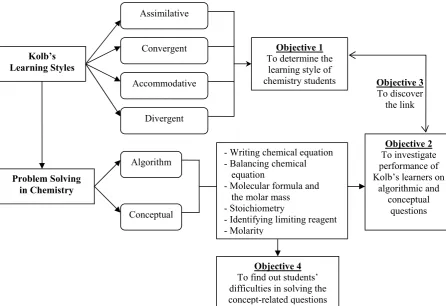
There are 4 objectives in this study. The objectives are indicated in Figure 1.1
below.
Figure 1.1: Conceptual Framework
There are many learning style models to explain the way that students prefer to
learn. One of the models is Kolb’s model. In this model, Kolb identifies 4 types of
Objective 2
To investigate performance of Kolb’s learners on
algorithmic and conceptual questions Problem Solving in Chemistry Kolb’s Learning Styles Assimilative Divergent Convergent Accommodative Objective 1
To determine the learning style of chemistry students
Algorithm
Conceptual
- Writing chemical equation - Balancing chemical equation
- Molecular formula and the molar mass
- Stoichiometry
- Identifying limiting reagent - Molarity
Objective 3
To discover the link
Objective 4
learning styles. These are: 1) Assimilative learning style 2) Convergent learning style 3)
Accommodative learning style 4) Divergent learning style. Kolb (1981) demonstrated
that undergraduates majoring in chemistry tended to favor an assimilative learning style.
Kolb believed that undergraduate education was a major factor in shaping one’s learning
style. If so, how about the preferred learning styles of chemistry students in secondary
education? Thus, one of the purposes of this study is to determine their preferred
learning style.
The concept behind Learning Style is that learners differ in regards to what mode
of instruction is most effective for them. It emphasizes that learners should learn with
their own learning style to help them learn best in a learning situation. Theoretically,
learning style is an important determinant of academic performance. However there is
research that is not in agreement. For example, Nor Hafidatulhusna (2009) concluded
that there was no relationship between learning styles and chemistry performance.
It is generally agreed that academic performance depends on the ability to solve
problems. In chemistry, academic performance depends on the ability to solve
conceptual and algorithmic questions. In Nor Hafidatulhusna (2009) study, she did not
categorize the types of problems when examining the effect of leaning styles on
academic performance. Thus, it might be the reason she failed to study the effect of
learning style.
Different disciplines have different learning content and different types of
problems. In Chemistry, conceptual and algorithmic questions make up the problems,
whereas other disciplines are not involved. Therefore, it is believed that not every
learning style favors different disciplines and one’s learning style may not dovetail in
Reviewing the previous researches, most of them studied the link between
learning styles and academic performance in Chemistry, but none of them classified
problems into conceptual and algorithmic problems before studying the link. Many
researchers have reported that students show different abilities in solving conceptual and
algorithmic questions, which may be one of the reasons why previous researches showed
inconsistent findings of the link between learning styles and academic performance in
Chemistry.
It is suspected that a thorough understanding of the link between learning styles
and academic performance points to the need to explore links between learning styles
and performance in solving chemistry problems. As a result, this study investigates
learning style groups and their performance on algorithmic and conceptual questions.
Only then can the effect of learning styles on the performance in solving algorithmic and
conceptual questions be open to discovery. In order to provide initial insight into the
problems students have in solving algorithmic and conceptual questions, their
difficulties in solving these types of questions are studied.
1.9 Definition
Some terminologies have been used in this research. The following terms are
a. Kolb’s Learning Style Model
This model is based on experiential learning to define learners’ learning styles
(Kolb, 1984). The four learning styles in this model are:
(i) Divergence learning style (divergers)
(ii) Assimilation learning style (assimilators)
(iii) Convergence learning style (convergers)
(iv) Accommodation learning style (accommodators)
b. Kolb’s Learning Style Inventory
Kolb’s is an instrument built to measure preference of four learning styles:
divergence, assimilation, convergence, and accommodation.
c. Conceptual Understanding Problem
According to Bowen and Bunce (1997), conceptual questions tap into the “why”
aspect of a response that indicates understanding of chemical ideas associated with the
question. To achieve an understanding in chemistry, an ability to represent and translate
chemical problems using three forms of representation (macroscopic, microscopic, and
symbolic) must be possessed. Conceptual problems in this study are the problems that
d. Algorithmic Problem
According to Bowen and Bunce (1997), algorithmic questions are problems that
can be answered by applying a set of procedures to generate a response. Thus the
algorithmic problems in this study will be the problems that can be solved by applying a
set of steps or procedures to obtain answers without probing or using the three forms of
representation (macroscopic, microscopic, and symbolic).
1.10 Summary
This chapter has presented an overview of the background and rationale for this
study. In summary, this study uses Kolb’s model to determine chemistry students’
learning styles. The performances within learning style groups in solving algorithmic
and conceptual questions have been studied. Then, the effect of learning styles on
students problem solving was analyzed. Finally, the difficulties that students faced in
Aziz bin Nordin dan Hasnah binti Mohd. Sirat (1990). Cubaan Murid Meyelesaikan
Masalah Pengiraan Konsep Mol. Buletin Pendidikan Sains dan Teknik. 2 (2),
26 – 39.
Aziz bin Nordin and Ling, S. M. (2005). Hubungan Antara Gaya Kognitif dan
Keupayaan Penyelesaian Masalah Stoikiometri di Kalangan Pelajar
Tingkatan Empat. Buletin Persatuan Pendidikan Sains dan Matematik Johor.
14 (1), 16 – 23.
Baykan, Z. and Nacar, M. (2007). Learning Styles of First-Year Medical Students
Attending Erciyes University in Kayseri, Turkey. Adv Physiol Educ. 31, 158
- 160.
Bennett, S. W. (2008). Problem Solving: Can Anybody Do It? Chemistry Education
Research and Practice. 9, 60 – 64.
Bohlen, G. A. and Ferratt, T. W. (1993). The Effect of Learning Style and Method of
Instruction on the Achievement, Efficacy and Satisfaction of End-Users
Learning Computer Software. New York: ACM Press.
BouJaoude, S. and Barakat, H. (2003). Students' Problem Solving Strategies in
Stoichiometry and their Relationships to Conceptual Understanding and
Learning Approaches. Electronic Journal of Science Education. 7 (3).
http://unr.edu/homepage/crowther/ejsev7n3.html
Bowen, C. W. and Bunce, D. M. (1997). In the Classroom: Testing for Conceptual
Chamillard, A. T. and Sward, R. E. (2005). Learning Styles across the Curriculum.
Paper presented in ITiCSE’05, Monte de Caparica, Portugal.
Chiu, M. H. (2001). Algorithmic Problem Solving and Conceptual Understanding of
Chemistry by Students at a Local High School in Taiwan. Proc. Natl. Sci. Counc.
ROC(D). 11 (1), 20-38.
Cooper, M. M., Cox, C. T., Jr., Nammouz, M., and Case, E. (2008). An Assessment of
the Effect of Collaborative Groups on Students’ Problem-Solving Strategies and
Abilities. Journal of Chemical Education. 85 (6), 866 – 872.
Cornwell, J. M., Manfredo, P. A., and Dunlap, W. P. (1991). Factor Analysis of the 1985
Revision of Kolb's Learning Style Inventory. Educational and Psychological
Measurement. 51, 455 – 462.
Czarnocha, B., Baker, W., Prabhu, V., and Dias, O. (2009). Problem Solving and
Remedial Mathematics. Mathematics Teaching-Research Journal Online. 3 (4),
81 – 89.
Dori, Y. J. and Hameiri, M. (2003). Multidimensional Analysis System for Quantitative
Chemistry Problems: Symbol, Macro, Micro, and Process Aspects. Journal of
Research in Science Teaching. 40 (3), 278–302.
Duff, A. (2004). The Role of Cognitive Learning Styles in Accounting Education:
Developing Learning Competencies. Journal of Accounting Education. 22,
Dureva, D., and Tuparov, G. (2008). Learning Styles Testing in Moodle. Paper
presented at International Conference on Computer Systems and Technologies
CompSysTech’08 in Bulgaria.
Ealy, J. B. (2004). Students’ Understanding Is Enhanced Through Molecular Modeling.
Journal of Science Education and Technology. 13 (4), 461 – 461.
Eilks, I., Moellering, J., and Valanides, N. (2007). Seventh-grade Students'
Understanding of Chemical Reactions: Reflections from an Action Research
Interview Study. Eurasia Journal of Mathematics, Science & Technology
Education. 3 (4), 271 – 286.
Frazer, M. J. and Sleet, R. J. (1984). A Study of Students’ Attempts to Solve Chemical
Problems. European Journal of Science Education. 6 (2), 141 – 152.
Gabel, D. L.; Bunce, D. M. (1994). Research on problem solving: Chemistry. In D. L.
Gabel (Ed.), Handbook of Research on Science Teaching and Learning. New
York: Macmillan.
Gauchon, L. and Méheut, M. (2007). Learning About Stoichiometry: From Students’
Preconceptions to the Concept of Limiting Reactant. Chemistry Education
Research and Practice. 8 (4), 362-375.
Given, B. K. (1996). Learning Styles: A Synthesized Model. Journal of Accelerated
Heitzman, M. and Krajcik, J. (2005). Urban Seventh-grader’s Translations of Chemical
Equations: What Parts of the Translation Process do Students Have Trouble?
Paper presented at the annual meeting of the National Association for Research
in Science Teaching, April 2005, Dallas, TX.
Hinton, M. E. and Nakhleh, M. B. (1999). Students’ Microscopic, Macroscopic, and
Symbolic Representations of Chemical Reactions. Chem. Educator. 4, 158 –
167.
Jegede, S. A. (2007). Students’ Anxiety towards the Learning of Chemistry in some
Nigerian Secondary Schools. Educational Research and Review. 2 (7), 193 – 197.
Kim, E. S. and Pak, S. J. (2002). Students Do Not Overcome Conceptual Difficulties
After Solving 1000 Traditional Problems. American Association of Physics
Teachers. 70 (7), 759 – 765.
Kolb, D. A. (1976). Management and the Learning Process. SPRING. XVIII (3), 21 – 31.
Kolb, D. A. (1981). Learning Styles and Disciplinary Differences. In Chickering, A (ed.),
The Modern American College. San Francisco: Jossey-Bass.
Kolb, D. A. (1984). Experiential Learning: Experience as The Source of Learning and
Development. New Jersey: Prentice - Hall.
Kolb, A. Y. and Kolb D.A. (2005). Learning Styles and Learning Spaces: Enhancing
Experiential Learning in Higher Education. Academy of Management Learning
Lee, K.W.L., Tang, W., Goh, N., and Chia, L. (2001). The Predicting Role of Cognitive
Variables in Problem Solving in Mole Concept. Chemistry Education: Research
and Practice in Europe. 2 (3), 285 – 301.
Lee, M. F. (2001). Pola Gaya Pembelajaran Pelajar Dan Gaya Pengajaran Guru Di
Kalangan Pelajar Dan Guru Sekolah-Sekolah Menengah Akademik Daerah
Johor Bahru - Satu Kajian Kes. Unpublished Bachelor’s Degree Thesis. Fakulti
Pendidikan, Universiti Teknologi Malaysia, Skudai, Johor.
Lee, Y. H. (2009). Miskonsepsi Dalam Konsep Mol Di Kalangan Pelajar Tingkatan
Empat SMK Pontian, Johor. Unpublished Bachelor’s Degree Thesis. Fakulti
Pendidikan, Universiti Teknologi Malaysia, Skudai, Johor.
Lin, H. S., Thomas Yang, C., Chiu, H. L., and Chou, C. Y. (2002). Students’ Difficulties
in Learning Electrochemistry. Proc. Natl. Sci. Counc. ROC(D). 12 (3), 100 – 105.
Lodico, M. G., Spaulding, D. T. and Voegtle, K. H. (2006). Methods in Educational
Research. San Francisco: Jossey-Bass..
Logan, K. and Thomas, P. (2002). Learning Styles in Distance Education Students
Learning to Program. 14th Workshop of the Psychology of Programming Interest
Group, Brunel University.
Luke, S. D. (2006). The Power of Strategy Instruction. Evidence of Education. 1 (1), 1 –
Markham, S. (2004). Learning Styles Measurement: A Cause for Concern. Computing
Educational Research Group.
McMurry, J. and Fay, R. C. (1995). Chemistry. New Jersey: Prentice Hall.
McMurry, J. and Fay, R. C. (2001). Chemistry (Third Edition). New Jersey:
Hall.
Metallidou, P. and Platsidou, M. (2008). Kolb's Learning Style Inventory-1985: Validity
issues and relations with metacognitive knowledge about problem-solving
strategies. Learning and Individual Differences. 18, 114 – 119.
Nakhleh, M. B. and Mitchell, R. C. (1993). Concept Learning Versus Problem Solving:
There is a Difference. Journal of Chemical Education. 70 (3), 190 – 192.
Nurrenbern, S. C., and Pickering, M. (1987). Concept Learning Versus Problem Solving:
Is There a Difference? Journal of Chemical Education. 64 (6), 508 – 510.
Onwu, G. and Randall, E. (2006). Some Aspects of Students’ Understanding of a
Representational Model of the Particulate Nature of Matter in Chemistry in
Three Different Countries. Chemistry Education Research and Practice. 7 (4),
226 – 239.
Nor Hafidatulhusna Hilmi Bt. Miskam. (2009). Hubungan Antara Pembelajaran
Dengan Pencapaian Akademik. Unpublished Bachelor’s Degree Thesis. Fakulti
Conservation of Matter in Open and Closed-System Chemical Reactions.
Chemistry Education: Research and Practice. 4 (3), 279 – 290.
Pashler, H., McDaniel, M., Rohrer, D., and Bjork, R. (2009). Learning Styles: Concepts
and Evidence. Association for Psychological Science. 9 (3), 105 – 117.
Penger, S., Tekavcic, M., and Dimovski, V. (2008). Comparison, Validation and
Implications of Learning Style Theories in Higher Education in Slovenia: An
Experiential and Theoretical Case. International Business & Economics
Research Journal. 7 (12), 25 – 44.
Reid, N. (2002). Open-ended Problem Solving in School Chemistry: A Preliminary
Investigation. International Journal of Science Education. 24 (12), 1313 – 1332.
Riechmann-Hruska, S. (1989). Learning Styles and Individual Differences in Learning.
Equity & Excellence. 24 (3), 25 – 27.
Sawrey, B. A. (1990). Concept Learning Versus Problem Solving: Revisited. Journal of
Chemical Education. 67 (3), 253 – 254.
Schmidt, H-J (1990). Secondary School Students’ Strategies in Stoichiometry.
International Journal of Science Education. 12 (4), 457 – 471.
Schmidt, H-J., and Jigneus, C. (2003). Students’ Strategies in Solving Algorithmic
Stoichiometry Problems. Chemistry Eucation: Research and Practice. 4 (3),
Smith, P. and Dalton, J. (2005). Getting to Grips With Learning Styles. Australia:
NCVER.
Stamovlasis, D., Tsaparlis, G., Kamilatos, C., Papaoikonomou, D., and Zaroiadou, E.
(2005). Conceptual Understanding versus Algorithmic Problem Solving: Further
Evidence from a National Chemistry Examination. Chemistry Education
Research and Practice. 6 (2), 104 -118.
Stavy, R. (1990). Pupils' problems in Understanding Conservation of Matter.
International Journal of Science Education. 12 (5), 501 – 512.
Swinton, L. (2006). Kolb’s Learning Style Inventory and Kolb’s Learning Cycle
Explained – no fluff, no filler, just facts. Online:
learning-style-inventory.html
Sumfleth, E. (1988). Knowledge of Terms and Problem Solving in Chemistry.
International Journal of Science Education. 10 (1), 45 – 60.
Talib, O., Matthews, R., and Secombe, M. (2005). Constructivist Animations for
Conceptual Change: An Effective Instructional Strategy in Understanding
Complex, Abstract and Dynamic Science Concepts. Malaysian Online Journal of
Instructional Technology (MOJIT). 2 (3), 78 – 87.
Tee, L. W. (2002). Kajian Kefahaman Konsep Mol Dalam Mata Pelajaran Kimia KBSM
Di Kalangan Pelajar-Pelajar Tingkatan IV. Unpublished Bachelor’s Degree
Tsaparlis, G. (2000). Problem Solving in Chemistry and Science Education. In M. Ahtee
et al. (eds.), Research on Mathematics and Science Education, pp. 67 – 87.
University of Jyvaskyla, Finland: Institute for Educational Research.
Willocoxson, L. and Prosser, M. (1996). Kolb’s Learning Style Inventory (1985). Review
and Further Study of Validity and Reliability. British Journal of Educational
Psychology. 66, 251 – 261.
Reprint at:
http://cleo.murdoch.edu.au/asu/staffdevt/pubs/lesleyw/bjedpsych96.html
By permission, British Psychological Society Journals Office.
Wood, C. (2006). The Development of Creative Problem Solving in Chemistry.
Chemistry Education Research and Practice . 7 (2), 96 – 113.
Wu, K. K., Krajcik, J. S., and Soloway, E. (2000). Using Technology to Support the
Development of Conceptual Understanding of Chemical Representations. In B.
Fishman & S. O’Connor-Divelbiss (Eds.), International Conference of the
Learning Science (pp. 121 – 128). Mahwah, NJ: Erlbaum.
Yau, S. F. (2007). Pemahaman Konsep Ikatan Kimia Dalam Kalangan Bakal Guru
Kimia Di Fakulti Pendidikan Universiti Teknologi Malaysia. Unpublished
Bachelor’s Degree Thesis. Fakulti Pendidikan, Universiti Teknologi
Malaysia, Skudai, Johor.
Yeung, A., Read, J. R., and Schmid, S. (2005). Students’ Learning Styles and Academic
Yeung, A. Read, J. R., and Schmidt, S. (2006). Are Learning Styles Important When
Teaching Chemistry? Sydney: School of Chemistry. University of Sydney.
Zoller, U. and Tsaparlis, G. (1997). Higher and Lower-Order Cognitive Skills: The Case
of Chemistry. Research in Science Education. 7 (1), 117 – 130.
Zumdahl, S. S., and Zumdahl, S. A. (2006). Chemistry (Sixth Edition). Boston: