COMMUNICATIVE LANGUAGE TEACHING IN
MALAYSIAN SECONDARY SCHOOLS
REZA RAISSI MASHHADSARI
ESL TEACHERS‟ AND STUDENTS‟ PERCEPTIONS TOWARD
COMMUNICATIVE LANGUAGE TEACHING IN
MALAYSIAN SECONDARY SCHOOLS
REZA RAISSI MASHHADSARI
A thesis submitted in fulfilment of the
requirements for the award of the degree of
Doctor of Philosophy (Teaching English as Second Language)
Faculty of Education
Universiti Teknologi Malaysia
I dedicate this dissertation to my beloved family;
my dear father;
and my merciful mother,
& my supervisor assoc. prof Dr Faizah Mohamad Nor
iv
ACKNOWLEDGEMENT
First, I would like to thank almighty Allah for establishing me with strength
and faith, and giving me the sight to realize myself. In controvertibly, I owe my
supervisor, Associate Professor Dr. Faizah Mohamad Nor a great deal of debt, for
her kindness and guidance throughout my entire research. She encouraged me by her
constructive advices and intellectual supports during my doctoral period. Her
friendly personality has always created a positive atmosphere and motivated me to
work. I have learned from her not only how to perform and interpret the study but
how to think and move the project forward. In addition, I want to extend my thanks
to the all faculty of education professors and members for their friendship,
invaluable assistance and giving me invaluable advice during throughout this period.
I would also like to thank all those who were involved directly or indirectly
in the completion of this project. My thanks also go to my parents for their blessings
and encouragements throughout my life. Last but not least, I would like to express
utmost appreciation to my lovely and kind sisters for their love, support and
ABSTRACT
vi
ABSTRAK
TABLE OF CONTENTS
CHAPTER TITLE PAGE
DECLARATION ii
DEDICATION iii
ACKNOWLEDGEMENT iv
ABSTRACT v
ABSTRAK vi
TABLEOF CONTENTS vii
LIST OF TABLES xx
LIST OF FIGURES xxiii
LIST OF ABBREVIATIONS xxiv
LIST OF APPENDICES xxv
1 INTRODUCTION 1
1.1 Introduction 1
1.2 Background of the study 3
1.3 Statement of the Problem 6
1.4 Objectives of the study 10
1.5 Research Questions 10
1.6 Research Hypotheses 11
1.7 Significance of the Study 12
1.8 Theoretical Framework 12
1.8.1 Active Learning 15
1.8.2 Constructed Knowledge 16
1.9 Conceptual framework 17
1.10 Scope of the study 19
1.11 Overview of the Study 19
viii
1.12.1 Teachers‟ perception 20
1.12.2 Knowledge of the Teacher 20
1.12.3 Communicative Language Teaching 21
1.12.4 ESL 21
1.12.5 Instructional practice 21
1.12.6 CLT instruction challenges 22
2 LITERATURE REVIEW 1
2.1 Introduction 1
2.2 Teacher Perception and Knowledge 1
2.2.1 Definitions of Teacher Knowledge 1
2.2.2 The Role of Personal Life Experiences 2
2.2.3 Role of Observation Training 2
2.2.4 Role of Teaching Practice 3
2.2.5 The Role of Reflection 4
2.2.6 Teachers‟ perceptions towards In-service
training 6
2.3 Constructivism theory and ZPD 8
2.3.1 What is constructivism? 8
2.3.2 What is Social constructivism? 10
2.3.3 Social constructivist view of learner 11
2.3.4 Social constructivist view of teacher 12
2.3.5 Zone of Proximal Development (ZPD) 12
2.4 History of English Language Teaching in the 20th
Century and CLT related challenges 14
2.4.1 The Grammar-Translation Method (GTM) 14
2.4.2 The Direct Method 15
2.4.3 The Reform Movement 16
2.4.4 The Reading Approach 16
2.4.5 The Audiolingual Approach 16
2.4.6 The Oral-Situational Approach 17
2.4.7 The Cognitive Approach 17
2.4.8 The Affective-Humanistic Approach 17
2.4.9 The Comprehension-Based Approach 18
2.4.11 What Is the Communicative Language
Teaching? 19
2.4.11.1 Role of the learner in CLT 25
2.4.11.2 Role of the teacher in CLT 28
2.4.11.3 Grammar instruction in CLT 29
2.4.11.4 CLT tasks and activities 31
2.4.11.5 Error correction in CLT 35
2.4.12 Criticism of CLT 37
2.4.13 Communicative Language Teaching: Theory
and Classroom Practice 40
2.4.14 Traditional communicative language
teaching and the practice of communicative
competence in the language classroom 41
2.4.15 Conceptualization of Communicative
approach 43
2.4.16 Communicative Language Teaching (CLT)
implementation 47
2.4.17 Application of CLT around the World 53
2.4.18 Educational reforms in Asian countries 60
2.4.19 Adapting communicative approach for Asian
countries 64
2.5 Teachers‟ perceptions of Communicative Language
Teaching (CLT) in non-Asian countries 66
2.5.1 Teachers‟ perceptions of CLT in Asian
countries 71
2.6 Technology and language learning 91
2.6.1 Computer-Mediated Communication and
Communicative Language Teaching 92
2.7 Conclusion 95
3 RESEARCH METHODOLOGY 96
3.1 Introduction 96
3.2 Research Design 97
3.3 Population and Sampling 98
3.4 Research instruments 100
3.4.1 Questionnaire 101
3.4.1.1 Justification of translating and reading aloud the
x
3.4.1.2 Pilot study 104
3.4.1.3 EFA on CLT Constructs 106
3.4.1.4 Initial Solution Results 106
3.4.1.5 Reliability of the
questionnaire 107
3.4.2 Interview guide 109
3.4.2.1 Interview of Instructors 112
3.4.2.2 Interview of Learners 112
3.4.3 Rationale for Classroom Observations 112
3.4.3.1 Participant Observations 113
3.4.3.2 Classroom Observation 114
3.5 Research procedure 115
3.6 Data Analysis 118
3.6.1 Data Triangulation 120
3.6.2 Qualitative Data Analysis 121
3.6.3 Measuring Inter and Intra Coder Reliability 126
3.6.3.1 Types of Reliability 126
3.6.3.2 Calculating Reliability 127
3.7 Summary 129
4 FINDINGS AND DISCUSSION 130
4.1 Introduction 130
4.2 Teachers‟ Perceptions of CLT 131
4.2.1 Teachers‟ level of agreement towards the CLT principles related to the facilitative, multi-tasking and resourceful role of the
teacher in the CLT 134
4.2.1.1 Teachers perceptions
regarding item 16, “Several roles of the teacher during
CLT instruction”. 134
4.2.1.2 Teachers‟ perceptions
regarding item 19, “Implicit instruction of teachers by transmitting knowledge
through tasks and activities.” 135
4.2.1.3 Teachers‟ perceptions
dominant and authority role of
the teacher in the class.” 136
4.2.1.4 Teachers‟ perceptions
regarding item 24, “ Necessity of using supplementary
materials beside textbooks to support varying need of the
students.” 136
4.2.1.5 Teachers‟ perceptions
regarding school facilities 139
4.2.2 Teachers‟ level of agreement towards the CLT principles related to the significance of
group/pair work activities in the CLT 141
4.2.2.1 Teachers‟ perceptions
regarding item 2, “Necessity of using group/pair work in
CLT classes.” 142
4.2.2.2 Teachers‟ perceptions
regarding item 9, “Value of group/pair work in the learning procedure of the
students.” 143
4.2.2.3 Teachers‟ perceptions
regarding item 13, “ It is not necessary to conduct
group/pair work activities as these activities waste class
time.” 144
4.2.2.4 Teachers‟ perceptions
regarding item 21, “It is better to have a teacher-dominant class rather than teaching
through tasks and activities.” 144
4.2.2.5 Teachers‟ perceptions
regarding item 22, “Group work activities are not useful as during the activities teachers cannot control class and prevent students from
using mother tongue.” 146
4.2.3 Teachers‟ level of agreement towards the CLT principles related to the significant role and responsibility of the learners in the CLT
instruction and their needs 147
4.2.3.1 Teachers‟ perceptions
xii
improves responsibility and self-discipline and permits learners to improve their
potentials.” 148
4.2.3.2 Teachers‟ perceptions
regarding item 18, “Efficiency of learning language in an implicit over explicit manner
.” 148
4.2.3.3 Teachers‟ perceptions
regarding item 4, “Students cannot suggest the lesson content as they do not have
enough language knowledge.” 149
4.2.3.4 Teachers‟ perceptions
regarding item 20, “Necessity of negotiating and adapting the tasks based on the
learners‟ viewpoint.” 150
4.2.3.5 Teachers‟ perceptions
regarding item 5, “ It is not useful to train learner to take responsibility regarding their
learning.” 150
4.2.3.6 Teachers‟ perceptions
regarding item11, “It is impossible in large classes to
teach efficiently.” 151
4.2.4 Teachers‟ level of agreement towards the CLT principles related to the significance of
implicit grammar instruction in the CLT 152
4.2.4.1 Teachers‟ perceptions
regarding item 12, “It is not enough to only teach knowledge of the language
rules.” 153
4.2.4.2 Teachers‟ perceptions
regarding item 3, “Grammar should be learned by means of
using it in activities” 154
4.2.4.3 Teachers‟ perceptions
regarding item 17, “ It is not enogh for the students to master grammatical rules, but they have to learn grmmar use
4.2.4.4 Teachers‟ perceptions regarding item 1, “Language performance of the students can be judged by grammatical
correctness.” 154
4.2.4.5 Teachers‟ perceptions
regarding item 23, “Direct grammar instruction helps students for perfect English
communication.” 155
4.2.5 Teachers‟ level of agreement towards the CLT principles related to the significance of implicit error correction in the CLT and its
effect on learners 159
4.2.5.1 Teachers‟ perceptions
regarding item 6, “Implicit error correction improves
communicative competence.” 159
4.2.5.2 Teachers perceptions
regarding item 14, “Much error correction is waste of
time.” 160
4.2.5.3 Teachers‟ perceptions
regarding item 10, “Ignoring the errors will cause imperfect
learning.” 163
4.2.5.4 Teachers‟ perceptions
regarding item 15, “The outcome of CLT is inaccurate
but fluent students.” 163
4.2.6 Teachers‟ perceptions of challenges regarding the CLT implementation in the
Malaysian secondary schools 165
4.2.7 Research question one: Summary of the
Findings 169
4.3 Students‟ perceptions toward CLT 172
4.3.1 Students‟ level of agreement towards CLT
principles related to the facilitative, multi-tasking and resourceful role of the teacher in
the CLT 174
4.3.1.1 Students‟ perceptions
regarding item 7, “Not
dominant and authority role of
xiv
4.3.1.2 Students‟ perceptions
regarding item 24, “Necessity of using supplementary materials beside textbooks to support varying need of the
students.” 175
4.3.1.3 Students‟ perceptions
regarding item 16, “Several roles of the teacher during
CLT instruction.” 176
4.3.1.4 Students‟ perceptions
regarding item 19, “Implicit instruction of teachers by transmitting knowledge
through tasks and activities.” 177
4.3.1.5 Students‟ perceptions
regarding the lack of facilities
in the schools 178
4.3.2 Students‟ level of agreement towards CLT
principles related to the significant role and responsibility of the learners in the CLT
instruction and their needs 179
4.3.2.1 Students‟ perceptions
regarding item 4, “Students cannot suggest the lesson content as they do not have
enough language knowledge.” 180
4.3.2.2 Students‟ perceptions regaring item 5, “ It is not useful to train learners to take
responsibility regarding their
learning.” 181
4.3.2.3 Students‟ perceptions
regarding item 8, “CLT improves responsibility and self-discipline and permits learners to improve
potentials.” 181
4.3.2.4 Students‟ perceptions
regarding item 11, “It is impossible in large classes to
teach efficiently.” 182
4.3.2.5 Students‟ perceptions
implicit over explicit
manner.” 183
4.3.2.6 Students‟ perceptions
regarding item 20, “Necessity of negotiating and adapting the tasks based on the
learners‟ viewpoint.” 183
4.3.3 Students‟ level of agreement towards CLT
principles related to the significance of
group/pair work activities in the CLT 184
4.3.3.1 Students‟ perceptions
regarding item 2, “Necessity of using group/pair work in
CLT classes”. 185
4.3.3.2 Students‟ perceptions
regarding item 9, “Value of group/pair work in the learning procedure of the
students”. 186
4.3.3.3 Students‟ perceptions
regarding item 13, “It is not necessary to conduct
group/pair work activities as these activities waste class
time.” 187
4.3.3.4 Students‟ perceptions
regarding item 21, “It is better to have a teacher-dominant class rather than teaching
through tasks and activities.” 187
4.3.3.5 Students‟ perceptions
regarding item 22, “Group work activities are not useful as during the activities teachers cannot control class and prevent students from
using mother tongue.” 188
4.3.4 Students‟ level of agreement towards CLT
principles related to significance of implicit
grammar instruction in the CLT 188
4.3.4.1 Students‟ perceptions
regarding item 1, “Language performance of the students can be judged by grammatical
xvi
4.3.4.2 Students‟ perceptions
regarding item 3, “Grammar should be learned by means of
using it in activities.” 190
4.3.4.3 Students‟ perceptions
regarding item 12, “It is not enough to only teach knowledge of the language
rules.” 190
4.3.4.4 Students‟ perceptions
regarding item 17, “It is not enough for the students to master grammatical rules, but they have to learn grammar
use too.” 190
4.3.4.5 Students‟ perceptions
regarding item 23, “Direct grammar instruction helps students for perfect English
communication.” 191
4.3.5 Students‟ level of agreement towards CLT
principles related to the significance of implicit error correction in the CLT and its
effect on learners 192
4.3.5.1 Students‟ perceptions
regarding item 6, “Implicit error correction improves
communicative competence.” 193
4.3.5.2 Students‟ perceptions
regarding item 10, “Ignoring the errors will cause imperfect
learning.” 194
4.3.5.3 Students‟ perceptions
regarding item 14, “Much error correction is waste of
time.” 195
4.3.5.4 Students‟ perceptions
regarding item 15, “The outcome of CLT is inaccurate
but fluent students.” 195
4.3.6 Students‟ challenges about CLT
implementation in the Malaysian secondary
schools 197
4.3.7 Research question two: Summary of the
4.4 Results of the third objective of the study: comparison between teachers‟ and students‟ perceptions about
CLT 201
4.4.1 The comparison between
students‟ and teachers‟ perceptions regarding the facilitative, multi-tasking and resourceful role of the teacher
in the CLT 204
4.4.2 The comparison between students‟ and
teachers‟ perceptions regarding the significant role and responsibility of the learners in the CLT instruction and their
needs 206
4.4.3 The comparison between students‟ and
teachers‟ perceptions regarding the
significance of implicit grammar instruction
in the CLT 209
4.4.4 The comparison between students‟ and
teachers‟ perceptions regarding the significance of implicit error correction in
the CLT and its effect on learners 211
4.4.5 The comparison between students‟ and
teachers‟ perceptions regarding the
significance of group/pair work activities in
the CLT 214
4.4.6 Research Question Three: Summary of the
Findings 216
4.5 Results of the fourth objective of the study: Instructional CLT practices of the Malaysian
secondary school teachers 217
4.5.1 The facilitative, multi-tasking and
resourceful role of the teacher in the CLT: the instructional practices of the teachers in
reality 220
4.5.1.1 Instructional practices of teachers regarding item 9, “Use of idiomatic/everyday language during the
instruction” 221
4.5.1.2 Instructional practices of teachers regarding item 7, “Emphasis on both oral skills
xviii
4.5.1.3 Instructional practices of teachers regarding item 10,
“Use of authentic resources” 222
4.5.1.4 Instructional practices of teachers regarding item 11, “Emphasis on inferential
questions” 223
4.5.1.5 Instructional practices of teachers regarding item 12,
“Emphasis on meaning” 223
4.5.1.6 Instructional practices of teachers regarding item 15,
“The teacher as the facilitator” 224
4.5.1.7 Instructional practices of item 1, “Focus on language as a
medium of communication” 224
4.5.1.8 Instructional practices of teachers regarding item 16, “Focus on all the components of Communicative
Competence” 224
4.5.2 Instructional practices of the teachers about the significance of group/pair work activities
in the CLT 231
4.5.2.1 Instructional practices of teachers regarding item 2, “Classroom activities
maximizing communication” 232
4.5.2.2 Instructional practices of teachers regarding item 6, “Emphasis on pair-work and
group-work” 232
4.5.3 Instructional practices of the teachers related to implicit error correction in the CLT and its
effect on learners 234
4.5.3.1 Instructional practices of teachers regarding item 4,
“Tolerating students‟ errors” 234
4.5.3.2 Instructional practices of teacher regarding item 14, “Emphasis on both fluency and accuracy during the
instruction” 235
4.5.4 Instructional practices of the teachers related
4.5.4.1 Instructional practices of teacher regarding item 8, “Teaching grammar but not
systematically” 238
4.5.4.2 Instructional practices of teachers regarding item 13, “Use of variety of language
structures” 238
4.5.5 Instructional practices of the teachers about significant role and responsibility of the learners in the CLT instruction and their
needs 242
4.5.5.1 Instructional practices of teachers regarding item 3,
“Pupil-oriented instruction” 243
4.5.5.2 Instructional practices of teachers regarding item 5, “Rehearsal of real-life situation and for real-life communication among
learners” 243
4.5.6 Research question four: Summary of the
Findings 245
4.6 Results of the fifth objective of the study: comparison between teachers‟ perceptions and instructional
practices of CLT 245
4.6.1 Research question five: Summary of the
Findings 250
4.7 Conclusion 254
5 SUMMARY AND CONCLUSION 258
5.1 Introduction 258
5.2 Implications of the Study 260
5.3 Recommendations for Future Studies 265
5.4 Limitations of the study 268
5.5 Conclusion 269
REFERENCES 272
xx
LIST OF TABLES
TABLE NO. TITLE PAGE
2.1 A brief summary of challenges associated with
communicative tasks 50
3.1 KMO and Bartlett's Test for OP Measures 106
3.2 The EFA analysis of the five CLT items 107
3.3 Results of Reliability Tests upon the Feedback from 30
Respondents 108
3.4 Interview codes identifed by the inter-coders 123
3.5 Observation codes identifed by the inter-coders 124
3.6 Research Questions and Related Instruments 125
3.7 Kappa-Coefficient analysis of inter-coders regarding
interview coding 127
3.8 Kappa-Coefficient analysis of inter-coders regarding
interview coding 129
4.1 Questionnaire items on the five principles of CLT 131
4.2 Teachers‟ perceptions on the five principles of CLT 132
4.3 Teachers‟ responses about the CLT principles related to the
facilitative, multi-tasking and resourceful role of the teacher
in the CLT 134
4.4 Teachers‟ responses about the CLT principles related to the
significance of group/pair work activities in the CLT 142
4.5 Teachers‟ responses about the CLT principles related to the
significant role and responsibility of the learners in the CLT
instruction and their needs 147
4.6 Teachers‟ responses about the CLT principles related to the
significance of implicit grammar instruction in the CLT 153
4.7 Teachers‟ responses about the CLT principles related to the
implicit error correction in the CLT and its effect on
learners 159
4.9 Students‟ responses about the facilitative, multi-tasking and
resourceful role of the teacher in the CLT 174
4.10 Students‟ responses about CLT principles related to the significant role and responsibility of the learners in the CLT
instruction and their needs 180
4.11 Students‟ responses about CLT principles related to the
significance of group/pair work activities in the CLT 185
4.12 Students‟ responses about CLT principles related to the significance of implicit grammar instruction method in the
CLT 189
4.13 Students‟ responses about CLT principles related to the implicit error correction in the CLT and its effect on
learners 193
4.14 Mean Index comparison between students‟ and teachers‟
perceptions toward CLT 202
4.15 A comparison between students‟ and teachers‟ perceptions
regarding CLT principles 202
4.16 Mean Index comparison between students and teachers‟
perceptions regarding the facilitative, multi-tasking and
resourceful role of the teacher 204
4.17 A comparison between students‟ and teachers‟ perceptions
regarding the facilitative, multi-tasking and resourceful role
of the teacher in the CLT 205
4.18 Mean Index comparison between students‟ and teachers‟
perceptions toward the significant role and responsibility of
the learners in the CLT instruction and their needs 207
4.19 A comparison between students‟ and teachers‟ perceptions
regarding the significant role and responsibility of the
learners in the CLT instruction and their needs 207
4.20 Mean Index comparison between students‟ and teachers‟
perceptions toward the significance of implicit grammar
instruction in the CLT 209
4.21 comparison between students‟ and teachers‟ perceptions
regarding the significance of implicit grammar instruction
in the CLT 209
4.22 Mean Index comparison between students‟ and teachers‟
perceptions toward the significance of implicit error
correction in the CLT and its effect on learners 211
4.23 A comparison between students‟ and teachers‟ perceptions regarding the significance of implicit error correction in the
CLT and its effect on learners 213
4.24 Mean Index comparison between students‟ and teachers‟
regarding the significance of group/pair work activities in
xxii
4.25 A comparison between students‟ and teachers‟ perceptions
regarding the significance of group/pair work activities in
the CLT 215
4.26 Observation scheme items on the five principles of CLT 218
4.27 Mean Index of the teachers‟ instructional practices of the
CLT principles 219
4.28 Instructional practices of the Malaysian secondary school teachers regarding the facilitative, multi-tasking and
resourceful role of the teacher in the CLT 221
4.29 Instructional practices of the Malaysian secondary school teachers regarding the significance of group/pair work
activities in the CLT 231
4.30 Instructional practices of the Malaysian secondary school teachers regarding the significance of implicit error
correction in the CLT and its effect on learners 234
4.31 Instructional practices of the Malaysian secondary school teachers regarding significance of implicit grammar
instruction in the CLT 237
4.32 Instructional practices of the Malaysian secondary school teachers regarding the significant role and responsibility of
the learners in the CLT instruction and their needs 243
4.33 Mean Index of the teachers‟ perceptions and their
instructional practices 246
4.34 A comparison between teachers‟ perceptions and
instructional practices regarding CLT application in
LIST OF FIGURES
FIGURE NO. TITLE PAGE
1.1 Social constructivisim factors 15
1.2 Conceptual frame work 19
3.1 Research Procedure 117
xxiv
LIST OF ABBREVIATIONS
ALM - Audio Lingual Method
CLT - Communicative Language Teaching
EFL - English as a Foreign Language
ESL - English as a second language
GTM - Grammar Translation Method
IPA - International Phonetics Association
KBSM - Kurikulum Bersepadu Sekolah Menengah
LSP - Language for Specific Purposes
MELTA - Malaysian Language Teaching Association
SEDC - State Education Development Commission
SLA - Second Language Acquisition
TBLT - Task Based Language Teaching
TESL - Teaching English as Second Language
TESOL - Teachers of English to Speakers of Other Languages
EFA - Exploratory Factor Analysis
CFA - Confirmatory Factor Analysis
LIST OF APPENDICES
APPENDIX TITLE PAGE
A Questionaire 313
B Observation Scheme 315
C Interview Sample (Teachers) 316
D Interview Sample (Students) 320
E Observation of a form 3 class 321
F Demographic information of the participants (Teachers) 323
G Demographic information of the participants (Students) 324
CHAPTER 1
1 INTRODUCTION
1.1 Introduction
According to Littlewood (2007) some methods of language teaching like
Grammar Translation Method (GTM), and Audio Lingual Method (ALM) could not
encourage ESL learners to communicate with each other in English well. Dam
(2001) emphasized that GTM is considered an effective language teaching for
focusing on grammatical forms, but this approach is criticized for its main
shortcoming in that it turns students to passive recipients of the grammatical rules,
and it ignores the importance of using the target language in the English classes.
According to Rao (1996) after several years of language learning, most students who
were trained by old language teaching approaches may have good grammatical
competence, and they can easily translate from a target language to their mother
tongue, but they cannot speak the target language fluently. Those students cannot
understand exactly what native speakers say, and they cannot communicate with
them easily. GTM and other old language teaching methods mainly focus on reading
and writing, and they do not focus on the speaking and listening skills.
Consequently, fluency based approaches seem essential for the English
learners, especially for those who are studying English for immigration purposes, and
people who want to immigrate for studying and living abroad. Larsen-Freeman
(2011) believed that in Communicative Language Teaching (CLT), communicative
competence of the students can be improved by using authentic materials and tasks.
over authentic interactions. Littlewood (2007) was of the idea that CLT is recognized
as an effective language teaching method in which ESL learners can communicate
with each other, and this method of language teaching is much more effective
compared to the pre-CLT methods. Brown (2000) stated some guidelines for the
CLT instruction namely that CLT instruction mainly focuses on communicative
competence, and not linguistic competence. According to his idea, this approach was
designed to force students to use the target language to improve their communicative
competence in an authentic, real life situation. According to the CLT principles,
fluency has priority over accuracy to push students communicating in a real life
situation. In the communicative classes, students are engaged to use the language
productively and receptively in a stress-free condition.
Since 1970s, English teachers, especially teachers of English as a second
language (ESL) were assigned to use CLT in their classes. According to some
researchers, Asian teachers had some pr in implementing the CLT in the ESL
contexts, like the size of the classes and school facilities. Thus, most of the teachers
resorted to form-based and knowledge-based teaching methods, which conflicted
with the CLT principles (Anderson, 1993; Li, 1998; Littlewood, 2007; Liao, 2003).
Cohen and Teller (1994) believed that teacher and student perceptions have very
important roles in applying an approach, consequently, teacher and student
perceptions regarding the CLT implementation can significantly influence their
performance. In this regard, Barkhuizen (1998) investigated student interest regarding language learning in South Africa, and concluded that teachers‟ classroom
practices influenced student performance to a high extent. Results of this study
showed that South African students were more eager to do form-based activities than
communicative ones.
English language teachers in Malaysia are concerned with the task of training
learners with good English proficeicency. Due to the importance of knowing the
students and teachers‟ perceptions regarding the CLT principles, their instructional
practices, and their tentative challenges, the researcher had several motives to
conduct the current study in Malaysian secondary schools. The first aim is related to
3
assigned by the Malaysian Ministry of Education. By conducting the current study,
the researcher reported the applicability of this method in Malaysia with diversity of
L1 languages and cultures, which will be discussed in the following chapters. The
second aim of the researcher for conducting the study was related to the other
important characteristic of the CLT, which focuses on improving the English learners‟ communicative competence, to see whether this approach is suitable for the
pedagogical purposes of the Malaysian teachers, and pedagogical goals of the
Malaysian Ministry of Education. Having a good command of English can help
Malaysian society to be more proficient in English in the global community as the
ninth ranked tourist country in the world, and results of the current study can help the
Ministry of Education of Malaysia to know the CLT implementation challenges. The
third aim was related to the Malaysian educational system, in which Malaysian
Ministry of Education assigned all of the secondary school language teachers to
apply CLT in their classes, and investigating the effectiveness of this method seems
necessary.
1.2 Background of the study
CLT was established in the Western countries during the 1970s, and became
popular in many countries (Brown, 2007; Richard & Rodgers, 1986; Savignon,
2001). The Council of Europe planned notional-functional syllabi to improve the
language proficiency of second language learners as the number of immigrants and
workers increased in the European countries significantly (Savignon, 2001).
Notional-functional syllabi focused on the function as the main purpose of foreign
language instruction, and consequently, the focus on grammar decreased
significantly (Brown, 2007). "Notions" referred to the exact concepts like time, space, and contexts like travel and schooling. Additionally, “Functional” referred to
the functions of language like classifying, reporting, rejecting, and asking for
permission (Brown, 2007). According to Savignon (1997) function refers to the students‟ needs, which is considered the main goal of language instruction programs,
and functional syllabus worked based on varying needs of the learners (Savignon,
focusing on grammatical and linguistic features of the language, the communicative
perspective would be ignored (Brown, 2007; Savignon, 1997; Savignon, 2001).
During the 1980s, CLT became very popular in English as Second Language
(ESL) contexts (Brown, 2007). ESL learners had instant needs to use English for
their survival reasons in social contexts and academic areas. Additionally, in ESL
classes, students could not use their native languages (Ellis, 1996). In a comparison
between CLT and other language teaching approaches, CLT has two distinct
features. The first and most important feature of CLT is communicative competence,
which is recognized as the goal of language teaching and learning. Second important
feature of CLT relates to its focus on improving the four language skills over
authentic communications. Littlewood (1981) declared that one of the most
important characteristics of CLT refers to its focus on the language function in
real-life situation, and it helps learners to learn the language in an authentic context.
According to the curriculum assigned by the Malaysian Ministry of
Education Kurikulum Bersepadu Sekolah Menengah (KBSM), all Malaysian
secondary schools have to use Communicative Language Teaching (CLT) approach
in their national curriculum. CLT mainly focuses on improving the communicative
competence of the students to make them proficient in speaking. Richards and
Rodgers (2001) believed that CLT is not a new approach of language teaching, and
some linguists started to use it from 1960s, in England. Malaysian Ministry of
Education began to introduce and implement a curriculum for all governmental
secondary schools under the name Kurikulum Sekolah Menengah „KBSM‟, in 1988.
This curriculum was adapted and implemented according to the national philosophy
of education in this country. The main goal of this curriculum was to improve the
communicative competence among English learners to learn and use language in
authentic and real-life situations. This syllabus aimed to improve four major skills of
the students, namely; speaking, reading, writing and listening, and other sub-skills
like grammar, pronunciation and vocabulary over authentic communications in the
5
The KBSM curriculum is arranged based on several topics. The topics which
should be taught and covered during the academic year for each level are classified
accordingly. Topics are chosen from a variety of challenges, and include several real-life situation contexts such as home, students‟ studying place, their living place and
the world they are living in. The topics cover four language skills, and the contents
cover communicative and moral values of the multicultural society of Malaysia. In
the Form Five curriculum specification, the focus is on the language skills through “recycled topics”. During the recycling procedure, the topics which are introduced in
the previous levels are introduced in different levels of difficulty to involve students
with a better level of intellect and maturity. Another goal of the KBSM syllabus
relates to its focus on the philosophy of Reconstructionism, in which the focus is on
using language in an authentic manner and in real-life situation contexts. The topics
of the curriculum are mainly related to authentic subjects which relate to the students‟ daily needs and challenges. The main topics inserted in the curriculum
relate to the society and culture. Curriculum makes the learners ready to face
controversial challenges to make them ready for use in real-life contexts.
Educational researchers have investigated factors affecting teachers‟
perception; in 1980, they considered teachers active decision-makers in the
classrooms. Accordingly, Borg (2003) conducted a research by reviewing 64 studies
of teacher cognition, and identified several factors in this regard like knowledge of
the teachers, their perceptions and their way of thinking that had pivotal role in their
teaching career. Additionally, he believed that contextual factors can influence both
teachers‟ cognition, and the way they teach in the classroom. In the Teaching English
as Second Language (TESL) studies, a challenging question for researchers is which
factors of language teaching can change their performance in the classroom, what
can push them to use modern language teaching approaches, and what can cause
them to decline it.
In fact, several factors can motivate teachers to use or deny an approach in
language teaching, namely, governmental decisions, their previous teaching
practices about CLT which are assigned to be applied in Malaysian secondary
schools. Teachers‟ and students‟ challenges in applying this approach, their
instructional practices, and positive as well as negative points of this approach from the teachers‟ and students‟ viewpoints in the Malaysian secondary schools were
investigated.
1.3 Statement of the Problem
In the 1970s, Communicative Language Teaching (CLT) was created to
respond to and push back against teaching English using the audio-lingual and
grammar-translation methods. CLT emphasizes communication proficiency instead
of text translation, rote memorization and error-free speech (Larsen-Freeman, 2000).
CLT incorporates all four language skills at the beginning of the learning process
according to Finocchiario and Brumfit (1983), rather than a single aspect such as
speech or grammar as in other methods. CLT sees errors as part of the learning
process instead of mistakes to be rigorously avoided. CLT focuses on the
understanding of meanings and functions necessary for communication
(Larsen-Freeman, 2000). As stated by Savignon (1991), in CLT ESL students are not passive
receivers of what is told to them by language teachers, but "active participants in the
negotiation of meaning" (p. 261). This is because effectively learning a language
requires inter-student involvement. This is often done by giving small student group‟s problem solving tasks to complete in English (Richards & Rodgers, 2001).
Despite Richards and Rodgers stating that CLT arose during a "paradigm
shift" in language education (2001, p. 172) and CLT‟s continued popularity, it has been argued that the CLT principles of teachers‟ role, learners‟ role, implicit
grammar instruction, implicit error correction, and group/pair work activities may
not be completely beneficial. Kumaravadivelu (2006) stated that CLT was a "a
classic case of a centre-based pedagogy that is out of sync with local linguistic,
educational, social, cultural, and political exigencies" (p. 64) and that CLT may not
function perfectly in some cultures and contexts. CLT‟s primary goal is commutative
7
growing number of studies (e.g. Bums, 1990; Hird, 1995; Kamaradivelu, 1993;
Karavas-Doukas, 1993 & 1996; Kuo, 1995; Lamb, 1995; Lersg, 1997; Li, 1998; Ng & Tang, 1997; Nunan, 1987; Thornbury, 1998: Wang, 2002) show that although
teacher profess to using CLT methods, they often in practice employ traditional
techniques. CLT is not often employed in the classroom despite widespread
promotion in curriculums. Thornberry (1998) observed in L2 classrooms as well as
initial and in-service training programs that CLT is rarely seen and direct
grammar-based methods remain widespread. Teaching alternatives such as task-grammar-based
pedagogy have made little lasting impact to English language teaching customs and
practices (Thornbury, 1998).
Celce-Murcia, et. al (1998) observed that “a great deal of language teaching
around the world follows, to a large extent, traditional grammar-translation principles”. Data indicates that CLT, despite its usefulness is difficult to implement
in non-western cultures, as evidenced in teacher and student frustrations. A study of South Korean, Japanese, and Taiwanese teacher‟s views on CLT effectiveness by
Butler (2005) found that they found it hard to implement due to methodical
misunderstandings. A study on Bangladesh schools by Hamid and Baldauf (2008)
found that all six of the teachers they interviewed "admitted that they did not have a
clear idea about or understanding of CLT; nor did they know the 'whats' and 'hows'
of implementing it in the classroom for developing learners' communicative
competence" (p. 18), possible due to a lack of training and support for CLT practices.
Some investigations have demonstrated that teachers consider a lack of
authentic materials or a lack of preparation time a difficulty in implementing CLT
(Burnaby & Sun, 1989; Eveyik-Aydin, 2003; Li, 1998). A study by Li (1998) found
that some South Korean teachers had to create their own education material because
all available textbooks were structured with traditional methods in mind. A study in
China by found Yu (2001) that teachers lacked time for syllabus or curriculum
reform due to having to work several jobs to make ends meet. Another difficulty in
implementing CLT is a lack of access to native English speakers (Li, 1998). A study
on South Korea by Li (1998) found a lack of government support for teacher training
over accuracy impacting test scores. Oyuang (2003) found in China university
students dislike CLT due to being more comfortable with traditional ESL teaching
methods. Chinese students found that foreign, native-speaker English professors
improvised too often in class, made it difficult to take notes, focused too much on “fun” activities, did not correct errors to the extent that students wished, and gave
higher marks to students that favour creativity and critical thought over accuracy.
CLT has failed to be implemented in multiple countries due to a lack of teaching
materials, a lack of access to native speakers, and a lack of teacher training, student
resistance, and washback from national exams.
ESL theories and methodologies have been developed in the last couple of
decades to assist ESL teachers and students. Pre-CLT teaching methods in East Asia
focus on rote memory using book and teacher-focused grammar-translation methods
(Rao, 2002). Each of the four basic language skills is taught separately and their
concepts are reinforced through difficult, rigid exams. This results in Asian students
who verbally struggle with English despite years of education. CLT was developed
to improve educational results in Asian ESL students by focusing on functional
language use through interaction and collaboration. Researchers believe CLT plays a
critical role in ensuring proficiency in second language education (Celce-Murcia,
1991; Ellis, 2001; Musumeci, 1997; Savigon & Bems, 1983).
Furthermore, teachers‟ and students‟ perceptions mainly show what they
think about language teaching and it is very important to know what they really
know and think about CLT principles, and what they apply in their classrooms. The
main challenges in CLT implementation relate to the teachers‟ and students‟
perceptions regarding the CLT principles as the main role makers of the CLT in the
classes (Karavas-Doukas, 1996). Littlewood (1981) stated that CLT principles may
contradict the existing perceptions of language teaching in many contexts. According
to the curriculum assigned by the Malaysian Ministry of Education, all public
secondary schools have to apply CLT. It is important to investigate Malaysian secondary schools teachers‟ and students‟ perceptions, challenges and instructional
practices. The present Malaysian secondary school teachers of English are the
9
This category of English teachers have the belief that accuracy is more important
than fluency, when it comes to their instruction, they may not want to change their
beliefs and adapt the CLT approach, which emphasizes fluency rather than accuracy.
Then, there are other factors like contextual factors which include the setting
of the school. Teachers who teach in rural schools have found it a big challenge to
adapt the CLT approach in their English classes. This is because the students in rural
schools are generally very weak in English, as they have very limited exposure to the
language, and they do not speak the language at home and even at school. The only
possible limited exposure they have is the use of English when watching English TV
programs or listening to English songs, if at all. Thus, English is a foreign language
to the learners in rural schools. These learners do not see the importance of mastering
the language and in general do not have the motivation to learn the language, and
English is a very difficult subject for them to learn. With these challenges and
restrictions among the learners, English teachers are faced with the challenge of
implementing and using the CLT approach in their classes, whereby the techniques
would usually include group discussions and role plays that would force learners to
use the language and assume that they already have the knowledge of the language.
In short, the challenges in implementing the CLT approach when teaching English at
school lie in the learners and teachers. As for the learners, it is their limitation in their
English proficiency and their role of motivation in learning the language. As for the
teachers, the challenges reported lie in their perceptions and beliefs. Most teachers
believe that CLT will not produce proficient English speakers and that CLT would
only produce learners who can speak the language with confidence, but without the
grammatical knowledge (Hird, 1995; Holliday, 1997; Ellis, 1996; Wu & Fang, 2002;
Rao, 1996; Sakui, 2004; Lewis & McCook, 2002; Li, 1998; Liao, 2000; Karim,
2004; Rao, 2002; Savignon, 2002; Yu, 2001, Barkhuizen, 1998; Hu, 2002; Lo, 2001;
Shamim, 1996). This study focuses on CLT because it is an offshoot of
learner-centred educational methods and is useful for educational reform in Malaysia. CLT
promotes communicative competence, which provides students with competitive
1.4 Objectives of the study
During the current study, the researcher attempted to investigate Malaysian secondary school students‟ and teachers‟ perceptions, challenges and instructional
practices regarding the CLT implementation, and to see the relationship of their
perceptions and instructional practices. Thus, in this study, the researcher had the
following objectives.
1. To investigate Malaysian secondary school teachers‟ perceptions
regarding Communicative Language Teaching (CLT).
2. To investigate English language learners‟ perceptions of
Communicative Language Teaching (CLT).
3. To compare CLT teachers‟ and students‟ perceptions regarding the
CLT principles. both
4. To investigate CLT teachers‟ instructional practices in Malaysian
secondary schools.
5. To identify the differences between Malaysian secondary school teachers‟ perceptions and their instructional practices on CLT in
Malaysian secondary schools.
1.5 Research Questions
The following questions are generated from the objectives of this study, and
hopefully answered during the research procedure.
1. What are English language teachers‟ perceptions regarding the
Communicative Language Teaching (CLT) implementation in
Malaysian secondary schools?
2. What are English language learners‟ perceptions regarding the
Communicative Language Teaching (CLT) implementation in
11
3. Are there any significant differences between teachers‟ and students‟ perceptions regarding Communicative Language
Teaching (CLT)?
4. What are English language teachers‟ instructional practices in the
classrooms?
5. Are the teachers‟ instructional practices consistent with their
perceptions of Communicative Language Teaching (CLT)?
The first and second research questions aimed to investigate students‟ as well as teachers‟ perceptions and challenges regarding the CLT approach. The third research question was an attempt to portray the differences between teachers‟ and students‟ perceptions about CLT, if there are any. The fourth research question
aimed to understand teachers‟ current instructional practices of the CLT approach, and thus provides information about teachers‟ future professional developments.
Finally, the last research question was an attempt to investigate the differences between teachers‟ perceptions of CLT and their instructional practices. It must be
noted that two hypotheses were developed to address research questions 3 and 5 as
shown below.
1.6 Research Hypotheses
1. There is not a significant difference between teachers‟ and students‟ perceptions regarding Communicative Language
Teaching (CLT) implementation in Malaysian Secondary schools.
2. There is not a significant difference between Malaysian teachers‟
instructional practices of Communicative Langauge Teaching
1.7 Significance of the Study
Teachers‟ and students‟ perceptions toward the CLT are important for
transferring from pre-CLT to the CLT approach in English classes. Based on the related literature, teachers‟ perceptions can affect their classroom instruction to a
high extent (Barkhuizen, 1998; Cohen & Teller, 1994). In this study, the researcher attempted to understand Malaysian teachers‟ and students‟ perceptions regarding the
CLT and the factors which affected their instructional practices. The researcher
attempted to contribute to the aspect of language teaching and learning in Malaysia,
which was rarely studied in this country to identify the required condition of effective language instruction from both students‟ and teachers‟ viewpoint.
This study is significant for the following reasons. First, this study aimed to understand the relationship between English language instructors‟ and students‟
perceptions and challenges of CLT, and their instructional practices which is a
unique contribution to the particular ESL context of Malaysia. Another significance
of this study is to reveal the challenges that the teachers encountered when
implementing or trying to implement CLT in Malaysia. This information is helpful
for several people namely; 1. The curriculum developers of general English
programs in the Ministry of Education, 2. Administrative executives in the Ministry
of Education, and 3. The professional organizations that focus their interest on
English language teaching of Malaysia. Additionally, Malaysian students and
teachers as the main role makers in applying Communicative Language Teaching
(CLT) could express their perceptions and challenges they faced and their roles in
applying CLT.
1.8 Theoretical Framework
In this study, CLT was modified using social constructivism to examine the
culture of Malaysia. Cognitive and social constructivism share a similar
epistemology but they differ in how important they see the role of the individual and
social interactions in the construction of knowledge (Russell, 1993). Several social
13
social interaction as the primary factor behind the cognitive development of
individuals who internalize concepts encountered during social interactions. Piaget
stated that social interaction is "the imposition of adult functions on biologically
determined stages of cognitive development" (Russell, 1993, p. 189). According to Piaget‟s view, lessons should be designed to give students the assistance they need
according to their stage of development. The students‟ stage of development will determine how they assimilate new information. Piaget‟s views are different from
those of the social constructivists who see learning as a constant reinterpretation of
experiences rather than occurring in stages. Vygotsky defined the learning experience as the continuous reweaving of “the web of meaning”, whereas Dewey defined it as the constant “reconstruction of experience.” that humans use to create
new social practices that meet their needs and that allow them to adapt and transform
their environment (Russell, 1993, p. 179).
Social constructivists and Piaget also differ in their views regarding the
relationship between social interactions and self-regulation. Self-regulation occurs
when an individual uses language to solve problems and finds their authentic voice.
Social constructivists such as Vygotsky (1978) claimed that learning in isolation will
not result in cognitive development. Instead, they assert that social interactions with
other individuals is required for learning and cognitive development and the
construction of knowledge. Vygotsky went on to state that learning in the Zone of Potential Learning (ZPD) is the distance between the individual‟s stage of
development determined by independent problem solving and the stage of
development that could be potentially reached by the individual under the
supervision of adults or by collaborating with their peers. Vygotsky believed that
human cognitive development was the result of interactions with others and the
cultural environment that occurred within the ZPD. Currently, language students and
teachers are encouraged to improve their cognitive development by interacting with
others who are more proficient. In this way, the ZPD of less capable students grows
to include new information and ways of thinking. The ZPD of more proficient
students improves as they uncover missing information, acquire new insights and
It seems like the adaption of western teaching methods is inevitable in
Malaysian secondary schools. It is not enough to slavishly follow western teaching
methods, the theories and assumptions underlying the western education system must
also be understood if Malaysia is to effectively adapt these practices. Johnson and
Golombek argue that the education of teachers is done in three ways, internalization
and transformation, Zone of Proximal Development (ZPD), and mediational.
Internalization and transformation is the process in which an individual engages in
external and internal activities in such a way that they build on and complement each other. Johnson and Golombek state that “Internalization involves a process in which a person‟s activity is initially mediated by other people or cultural artefacts but later
comes to be controlled by the person as he or she appropriates resources to regulate his or her own activities” (p. 731). Vygotsky defines ZPD as a process of social
mediation that occurs due to collective collaboration mediated by cultural elements.
ZPD occurs at three levels, object-regulation (e.g. lesson plan), other-regulation (e.g.
talking with other teachers), and self-regulation (e.g. keeping personal teaching
diaries) (Johnson and Golombek, 2003). ZPD allows teachers to collaborate, access
enteral resources, and illiterate their own methods.
Constructivism is based on the idea that humans rely on sensations and
cognition to create and understand their world and meaning is generated by each
individual. Constructivist theories consist of a practical learning theory and an
epistemology to address how individuals learn as well as determine what they learn.
Learning theories and epistemologies can be categorized according to where they fall
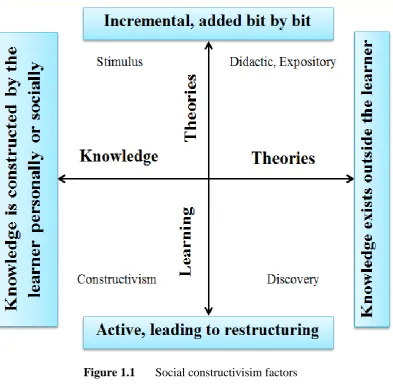
on an orthogonal continua. Constructivist educational theories occupy one quadrant
15
Figure 1.1 Social constructivisim factors
1.8.1 Active Learning
Several studies conducted last century asserted that humans construct
knowledge and that the human brain is actively engaged when it participates in a
learning activity. The field of developmental psychology demonstrated that humans
are not born with an innate ability to interpret their world. Meaning is gathered
gradually as the individual gains experience with their world. The immature
interpretation of the physical world was clearly illustrated by Piaget (1929) when he
interviewed young children. Educators who work with young children also report
that their young students interpret their world in highly idiosyncratic ways based on
their limited experiences (Rosebery & Warren, 1998). The charming stories retold by
parents and grandparents are frequently examples of how young children see their
meaning is further supported by the experiences of individuals denied the
opportunity to fully interact with their world. For example, Oliver Sacks studied
individuals who had been blind for most of their lives and then had their sight
restored. He found that these individuals faced emotional, intellectual, and sensory
challenges as they endeavoured to make sense of their new, visual reality. The
confusion experienced by these individual is difficult for a fully sighted person to
imagine as we have a life time of experience to fall back on as we interpret our reality. According to Sacks, “We are not given this world: we make our world
through incessant experience, categorization, memory, and reconnection” (Sacks,
1995, 114). The claims made by Sacks have been collaborated by cognitive
psychologists who claim that by studying how people learn and how the human brain
functions they can state that we construct knowledge (Bransford, Brown, &
Cocking).
1.8.2 Constructed Knowledge
In Figure 1.1, constructivism is located in the lower right hand quadrant. It
differs from traditional, didactic expository approaches and from other popular
educational approaches known as discovery approaches. Discovery educational
approaches acknowledge that learning is active but it also suggests that the
knowledge that is constructed as a result of active learning does not always correctly
reflect the physical world. Followers of constructivism argue that it is inevitable that
an individual will construct their own meaning of the world around them. They also
claim that the purpose of education is to guide the construction of knowledge and
meaning by accepting the needs of each individual. Since knowledge is the result of
active creation on the part of a learner (Von Glasersfeld, 1990), students must be
given the opportunity to experience, measure, observe their environment as well as
communicate their knowledge through drawing and performing as well as other
means. It is important that their attempts to communicated are validated and
evaluated in a way that does not rely on a ridged set of criteria (for implications of
these differing criteria for teaching science, see Duckworth et al., 1990). Table 1.1,
17
Table1.1: Meaning-Making and Educational Theory
Status of
Meaning-Making
Attitudes Towards Meaning-Making
Educational Theory
Meaning making is an inevitable consequence of human interaction with nature and culture.
Ignore or Suppress Traditional, Content-centred.
Tolerate or Accept Discovery, Active Learning, Learner-Centred
Encourage or
Embrace
Constructivism
1.9 Conceptual framework
In this section, the conceptual framework of Borg (2003) regarding teacher
cognition is presented as this directly refers to the teachers‟ performance and
instructional practices. The perceptions of teachers were investigated at length in
second language teaching investigations in previous years. According to Freeman
(2002), in the language teaching procedure, teachers are considered the main
decision makers. Since 1980s, several researchers in the field of second/foreign
language teaching worked on the experience of the teachers, and the effects of the content knowledge on the teachers‟ performances in their language instruction. Borg
(2003) conducted a literature review of over 64 experimental studies that were done
between 1976 and 2002, and he reported them in the shape of a conceptual
framework which is associated with „teacher cognition‟.
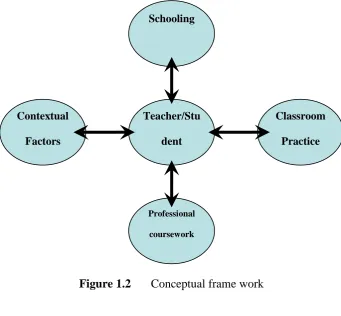
In Figure 1.2, the conceptual framework of Borg (2003) which has 5 main
elements is shown. The first factor/element refers to the teacher cognition that is
associated with the teaching perspective which is not visible and associated with
their knowledge, perceptions and their thinking styles (Borg, 2003). Based on Borg‟s
theory (2003) the concept of teacher/student cognition refers to the perception,
information, conceptions, metaphors, theories and images of the teachers regarding
their lives. The second element refers to the schooling which relates to the previous
formal and informal learning experiences of the teachers and students. According to
conceptualizations in second language instruction, and it affects their professional
teaching/learning career. The third one is professional coursework that relates to the
experiences of the teachers in both pre-service and in-service training programs, like
their training in undergraduate and postgraduate TESL courses, and in-service
training courses that take place during the academic year. According to Borg (2003) the professional course works and training can affect teachers‟ cognition, and if they
do not participate in those classes, their teaching cognition would not be changed
significantly. The fourth element refers to the contextual factors associated with the
context and condition of the classroom and society of the teacher/student. Those
contextual factors can affect perception and instructional practices of the
teachers/students to understand the principles that are considered compatible with
their teaching perceptions (Borg, 2003). The fifth element is classroom practice that
relates to the teaching experiences of the teachers that affect their classroom
practices. According to Borg (2003) classroom practice can be affected by
perceptions of the teachers and related contextual elements which happen to the
person unconsciously, and has conscious reflections.
In the current study, the researcher attempted to investigate both teachers‟ and students‟ perceptions regarding CLT and challenges in its implementation.
Unlike several studies that have been conducted in many countries before that merely investigated teachers‟ perceptions (e.g. Bums, 1990; Hird, 1995; Kamaradivelu,
1993; Karavas-Doukas, 1993 & 1996; Kuo, 1995; Lamb, 1995; Lersg, 1997; Li,
1998; Ng & Tang, 1997; Nunan, 1987; Thornbury, 1998: Wang, 2002), and they ignored students‟ perceptions, the researcher attempted to investigate both groups
perceptions and challenges. Consequently, the researcher adapted the Borg (2001)
framework for the students as well as teachers. To this aim two factors of this
framework which merely refers to the teachers namely professional coursework and
teaching experiences that refer to the teachers have been dropped for the students and
only two factors of schooling and contextual factors have been considered for the
19
Figure 1.2 Conceptual frame work
1.10 Scope of the study
In this study the researcher attempted to investigate students‟ and the instructors‟ perceptions, challenges and teachers‟ instructional practices of the
Communicative Language Teaching (CLT) in Malaysian secondary schools. To this
aim, the researcher investigated seven schools in Johor Bahru district, Malaysia to understand students‟ and teachers‟ perceptions, challenges, and instructional
practices of the CLT.
1.11 Overview of the Study
There are five chapters in the current dissertation. Chapter one includes
background of the study, problem statement, objectives of the study, research
questions, significance of the study, conceptual framework and scope of the study.
Chapter Two first introduces the relationship between contextual factors and teachers‟ instructional practices, and then discusses reflective practices in teacher
Schooling
Classroom
Practice
Professional
coursework
Contextual
Factors
Teacher/Stu
dent
student