Intelligence Student Advising System - An Implementation using
Object-Oriented C++
Dyg. Norhayati bte. Abg. Jawawi
Faculty o f Computer Science and Information System, Universiti Teknologi M alaysia,
Locked Bag 791, 80990 Johor Bahru, Johor
Abstract
This paper present an approach for developing a consistent student course-advising
system for undergraduate students using knowledge-based technology. A prototype
system has been implemented in object-oriented technique using C++. The prototype
system was designed for undergraduate Computing students. The prototype is able to
give consultation and advice on some important aspect of student advising problems.
Knowledgeable behaviour was produced where the ‘expert’ and ‘knowledge’ is stored
separately from the inference engine. Object-oriented programming technique was found
to enhance the development of the system.
Keywords : Intelligence Advising system, knowledge based system and
object-oriented programming
1.0 Introduction
Most academic institutions offers their students a variety of programs from which a
student can select one and satisfy the school requirements in order to be eligible for a
degree. This usually consists of choosing the required courses within the student’s major
and minor, elective courses, and satisfying general university requirements. Typically a
student has a certain amount of freedom to choose the right course and subjects which
suit them.
45
The problem arise when the students are not sure which course to choose, in
order to complete her/his degree successfully. This is because the student are not aware
o f the degree requirements, course descriptions and prerequisites. Advising is a very
important component in retention of students, since good advising detects problems in
early stages and prevents problems that would otherwise happen at the later stage.
The advisory process must address two areas: degree check requirements and the
student’s special interests. The role of the advisor is to suggest the offered courses when
the student is likely to pass the subjects in the course taking into consideration the
prerequisite requirements and minimizing the time to get a degree. Mature students can
specify their interest at the advanced level and take courses from the set of elective
courses.
The advising system often suffers from a number of shortcomings such as:
i. it creates a heavy burden on the academic staffs;
ii. the requirements often change, consequently it is difficult for the advisors to update
their own knowledge with sufficient frequency;
iii. the existing set of manual or guidance is often incomplete or inconsistent, which may
lead to misinterpretation of information;
iv. the overall process of advising is time consuming and complex ;
v. transfer student has different academic background and knowledge;
The layout of this paper is as follows. In Section 2 previous works related to student
advising system are reviewed. Section 3 describes the advantage of applying knowledge-
based technology to solve student advising problems. Section 4 describes an
implementation and testing of a student course advising system using object-oriented
C++ for undergraduate students at the School of Computing, Sheffield Hallam University
(SCAS).
2.0 Previous Works Related to Student Advising System
In recent years, several automated advising systems have been developed. These systems
have been developed for both undergraduate and post-graduate education and have a
wide variety of functionality. These systems have been developed by utilizing various
technologies including artificial intelligence, spreadsheets, as well as traditional
programming languages. A summary of these systems and their functionality is illustrated
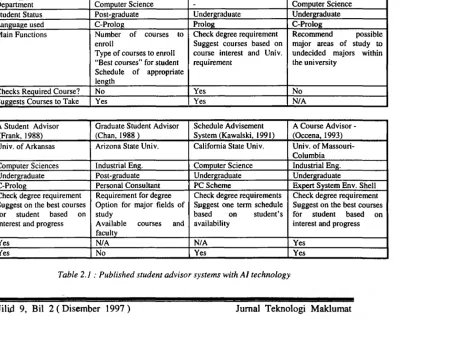
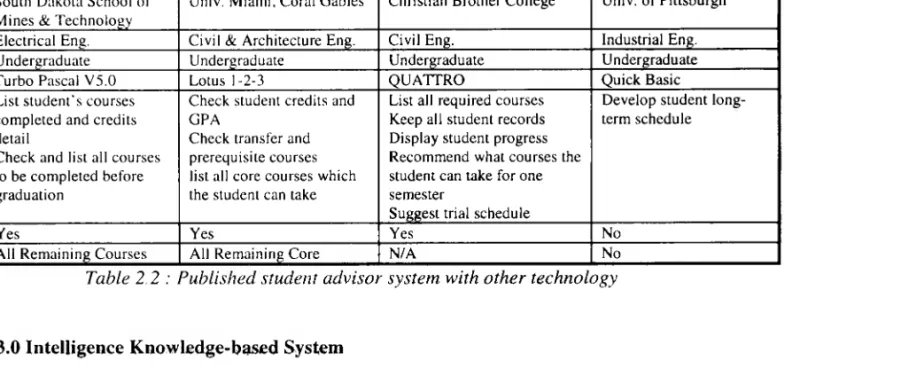
in Table 2.1 and Table 2.2. From these works, it was found that the student advising
domain is amenable to the knowledge-based system method.
Graduate Course Advisor - (Valtoria, 1984)
A Student Advisor (Golumbic, 1986)
A Course Advisor (Crook?, 1987)
Academic Institution Duke Univ. & Univ. of Carolina
Bar llan Univ. Texas Christian Univ.
Department Computer Science - Computer Science
Student Status Post-graduate Undergraduate Undergraduate
Language used C-Prolog Prolog C-Prolog
Main Functions Number of courses to enroll
Type of courses to enroll “Best courses” for student Schedule of appropriate length
Check degree requirement Suggest courses based on course interest and Univ. requirement
Recommend possible major areas of study to undecided majors within the university
Checks Required Course? No Yes No
Suggests Courses to Take Yes Yes N/A
A Student Advisor (Frank, 1988)
Graduate Student Advisor (Chan, 1988 )
Schedule Advisement System (Kawalski, 1991)
A Course Advisor - (Occena, 1993) Univ. of Arkansas Arizona State Univ. California State Univ. Univ. of Massouri-
Columbia Computer Sciences Industrial Eng. Computer Science Industrial Eng.
Undergraduate Post-graduate Undergraduate Undergraduate
C-Prolog Personal Consultant PC Scheme Expert System Env. Shell Check degree requirement
Suggest on the best courses for student based on interest and progress
Requirement for degree Option for major fields of study
Available courses and faculty
Check degree requirements Suggest one term schedule based on student’s availability
Check degree requirement Suggest on the best courses for student based on interest and progress
Yes N/A N/A Yes
Yes No Yes Yes
Table 2.1 : P ublish ed student a d viso r system s with A1 tech nology
47
In this paper a student course advising system using knowledge technique is presented.
The key feature of the developed system is the separation of ‘expert’ or ‘know ledge’
from the inference engine and the reasoning strategy. This paper will demonstrate how
C++ and character o f object oriented programming (OOP) can help in developm ent of
such system.
T h e A d v is o r's A ssistan t - (B a tc h eld e r, 1989 )
S tu d en t A dvising (M alasri. 1988)
S em i-A u to A d v isin g System (M alasri, 1990)
S tu d e n t A d v isin g sy stem (B illo , 1993 )
S ou th D ak o ta S ch o o l o f M in es & T ech n o lo g y
U niv. M iam i, C oral G ables C h ristia n B ro th er C o lleg e U niv. o f P ittsb u rg h
E lectrical Eng. C ivil & A rch ite ctu re Eng. C iv il Eng. In d u strial E ng. U n d e rg rad u a te U n d erg rad u ate U n d erg rad u ate U n d e rg rad u a te T u rb o Pascal V 5 .0 L o tu s 1-2-3 Q U A T T R O Q u ic k B asic L ist s tu d e n t's co u rses
c o m p le te d and cred its detail
C h e ck and list all co u rses to b e c o m p le te d before g ra d u atio n
C h eck stu d e n t cred its and G P A
C h eck tran sfer and p re re q u isite co u rses list all co re co u rses w hich the stu d en t can take
List all req u ire d co u rses K eep all stu d e n t reco rd s D isplay stu d e n t pro g ress R eco m m en d w h at co u rses the stu d e n t can tak e fo r one sem ester
S u g g est trial sch e d u le
D ev elo p stu d e n t lo n g term sch ed u le
Y es Y es Y es No
A ll R e m a in in g C o u rses All R em ain in g C o re N /A No Table 2,2 : Published student advisor system with other technology
3.0 Intelligence K nowledge-based System
The methods of knowledge-based systems are now being applied in many diverse areas.
This technology is useful for tasks where the knowledge of highly skilled human experts
can be represented explicitly and acted upon by inference procedures. The result is
intended to be a system which exhibits intelligent, knowledgeable behavior (Golumbic,
1986).
For the student advising problem, the knowledge-based system is preferred over
a conventional algorithmic system for several reasons :
I. It was desired to manage knowledge and not data. The is system required to advise
undergraduate students based on some domain expert’s specific rules and heuristics.
II. The system need to contain explanation facilities available to other faculty members,
thereby to understand the university advising process for undergraduate computing
students.
III. The system needed sufficient flexibility to be easily maintained and modified to
conform more to a particular discipline.
IV. A thorough analysis and understanding of the undergraduate advising process that
would come about as a by product of the knowledge-based system development.
V. The permanent storage of course-advising information.
4.0 Implementation of Student Course Advising System (SCAS)
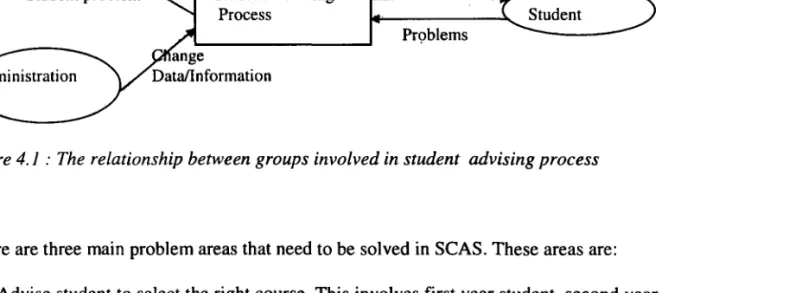
There are three groups of peoples involved in the student course advising problem:
student advisor, student and administration. Figure 4.1 shows the relationship between
the groups.
Figure 4.1 : The relationship between groups involved in student advising process
There are three main problem areas that need to be solved in SCAS. These areas are:
1) Advise student to select the right course. This involves first year student, second year
direct entry student and final year direct entry student.
49
2) Advise on to change course for student already began their course but decided to
change their course. It also involves providing information to students who have
problem in particular units
3) Advise to select the electives subjects for final year student.
4.1 The Design of SCAS
The design of SCAS involves two main areas: the knowledge design and the inference
engine design. The knowledge obtained through knowledge acquisition process can be
categorized into three main groups:
1) Course knowledge i.e. information related to the course which includes subjects,
course and unit prerequisites.
2) Evaluation knowledge i.e. knowledge related to evaluation process which includes
questions asked by the advisor to identify the student ability, the weighting factors
and reasoning statements.
3) Rule knowledge i.e. heuristics and decision rules.
For the purpose of flexibility and maintainability these three knowledge are stored in
three difference data files. Any changes in the information and knowledge will not affect
other components of the SCAS, especially the inference engine. Changes can be made in
these data files and therefore avoiding recompiling the whole system when there are
changes in the knowledge. Figure 4.2 shows how the above knowledge fit with the other
components in the SCAS.
B tH H s a e s e ^ ^ B s s s s s a s B e s s i^ a
Knowledge Base
Figure 4.2 : Course, evaluation and rule knowledge as components o f the SCAS
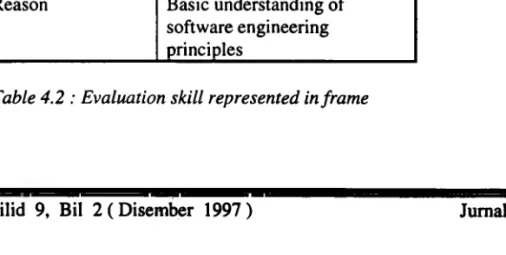
Course and evaluation knowledge represented in frame, refer table 4.1 and 4.2. Rule
knowledge represented in procedural rules, example of the rules are:
i. IF the student overall performance is suitable for software engineering course THEN
check for software engineering detail subject
ii. IF the student have no problem with all detail software engineering subject THEN
the student really suitable for the course.
Refer to figure 4.3 on how this rules used in SCAS.
Slot Fillers
Unit/subject 205
Title Software Tools and Evironment
Prerequisite 103
Course_taken SE, IT, El
Table 4 .I : Unit Frame fo r Course Information
Slot Fillers
Question_number 103 1
Question Do you have basic
understanding of software principle?
Weight_Factor 5
Reason Basic understanding of
software engineering principles
Table 4.2 : Evaluation skill represented in fram e
rule -SE0 : if rule_SE0l : if
level=2 and 103=60 and
o
II 105 = 50
then then
check = rule_S E 01 check = done
Figure 4.3 : Rules used in SCAS
The ability o f advisor in evaluating a student is presented in evaluation knowledge.
Within a unit/subject, certain attributes are more important than others in determining
whether a student understand a particular unit/subject or not. Weighting factor is used to
give indication or measurement associated with the attributes. The higher the weighting
factor the more important is the attribute.
Consider an example shown below for a subject named ‘Programming’. This
subject has four attributes, each attribute has a weighting factor represented by a number
in the bracket.
I. Unit 103 - Programming
A. Understand software engineering basic principles. (10)
B. Familiar with general idea about programming methods. (5)
C. Familiar with general idea about programming style. (5)
D. Know how to design program. (3)
Considering the unit named ‘Programming’, the attribute A ‘Understand software
engineering basic principles’ is more important than other attributes B - D in determining
whether a student understand the programming subject. The higher the weighting factor,
the greater is the importance. The weighting factor figures were determined by the
student advisor.
When an answer to a question is yes, the fact associated with the question also become
yes. In order to get a total score for each student , the sum of those weighting factors
initiated to yes is calculated. The score is called the total weighting facto r. If all the facts
are initiated to yes, the total weighting factor is called the maximum sum weighting
factor. Therefore the suitability level for each student can be calculated using the
equation
Suitability level - Total weighting fa c to r / total m a x im u m su m w eighting fa c to r
4.1.1 Inference Engine Design
The inference engine was designed using object-oriented approach.
O bject-Oriented design
Using the object-oriented design approach as specified by (Booch, 1991), the m ajor steps
involves are defines as:
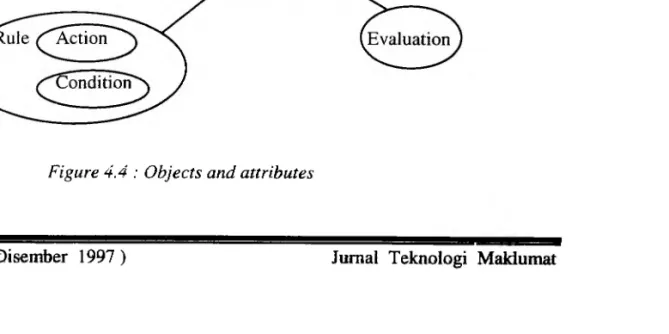
Step 1: Identify the object and their attributes
From the problem domain a number of class can be identified:
Figure 4.4 : Objects and attributes
53
From Figure 4.4 of SACS, five distinct objects can be found.
1) Student Advising Inference Engine (SAIE). This provide service for building the
advise process, reasoning process and user interface display.
2) Unit. This gives information about each unit/subject in the programme.
3) Course. This gives information about all courses in the programme.
4) Evaluation. Representing evaluation knowledge.
5) Rule. Representing advice knowledge.
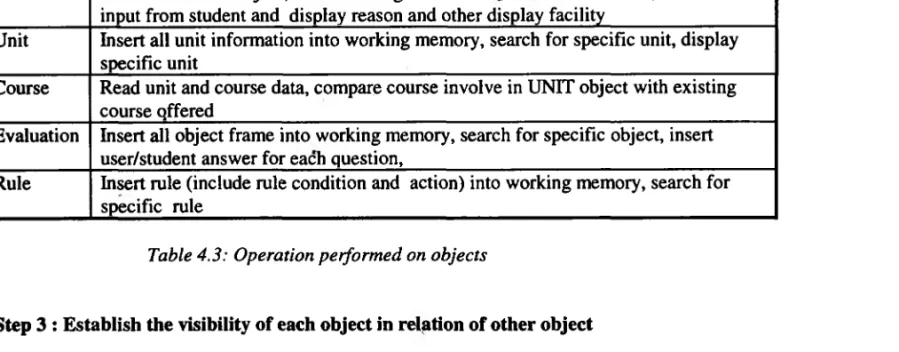
Step 2: Identify the operations suffered by and req u ired o f each object
This stage is concerned with identifying the operation that may be performed on an
object as listed in Table 4.3.
Object Operation
SAIE Get course and unit relevant for UNIT and COURSE object, Get the right
evaluation object from EVALUATION, Calculate suitability level, Get the right rule from RULE object, Select the right reason from EVALUATION, Get fact or input from student and display reason and other display facility
Unit Insert all unit information into working memory, search for specific unit, display
specific unit
Course Read unit and course data, compare course involve in UNIT object with existing
course qffered
Evaluation Insert all object frame into working memory, search for specific object, insert
user/student answer for each question,
Rule Insert rule (include rule condition and action) into working memory, search for
specific rule
Table 4.3: Operation performed on objects
Step 3 : Establish th e visibility of each object in relation o f o th er object
From Figure 4.15, it is clear that object SAIE establishing relation to other objects in the
system. Unit object need to refer to course object to identify whether a course is a valid
course in the system.
Step 4 : Establish the interface to each object: this step involves writing a structure
for the object
It can be seen at this point that there is one major object in the system which is the
inference engine. This object will use all other objects as part of it component, but SAIE
object cannot change any value in other object (can only use or read the object). This
provides both data hiding and encapsulation of the whole system.
Step 5 : Implementation of each object
The implementation step involves the use of a pseudo-code approach to design the
respective procedure for each object.
4.2 Implementation of Knowledge-base and Inference Engine Subsystem
The artificial intelligence (AI) programming language such as prolog provide some
building facilities for building inference engine, therefore developing an inference engine
using this type of language is trivial. Writing inference engine in C++ requires more
afford.
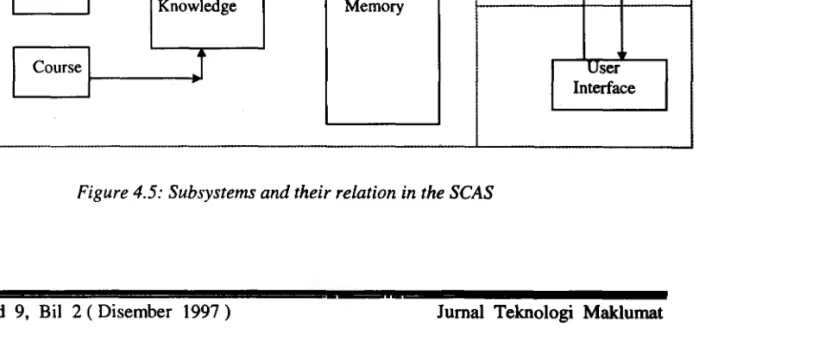
Figure 4.5: Subsystems and their relation in the SCAS
55
As can be seen from Figure 4.5, there are five blocks in this subsystem. The blocks
'R u l e ' E v a l u a t i o n ’, and ‘Course’ are configuration files which store the information,
rules and facts about courses and subjects in School of Computing. This three files are
implemented as plain ASCII files to store the information, facts and rules. Ideally, these
files should be protected to avoid unauthorised persons from tempering with the
information in the files. It should only allows the administration or the advisor to change
the files.
The task of the block named ‘Extract Knowledge’ is to read the three
configuration files , extract and store the information in the appropriate knowledge-base
dynamic memory. This feature make the system very flexible, where any changes in the
knowledge block does not need any changes of system or recompilation o f the whole
inference engine.
In this system the two main tasks of inference engine are giving requested
information about the courses to students, and advise student on selecting suitable course
and on changing to another course. In the advising tasks the major steps performed by the
inference engine are:
1) Ask. questions to get information from student
2) From the answers calculate student suitability level
3) From the suitability level check rules
4) Derive conclusion from rules
5) Give explanation/reasoning for the conclusion
The inference engine is implemented using forward chaning method and object-oriented
programming technique in C++ is used to write the implementation of the inference
engine. The knowledge and the information in the application environment of the student
advising system, can be easily represented as object, attribute and value. The used of
object-oriented language in this problem can make the representation of objects more
efficient. Object-oriented language like C++ has features built into the language to
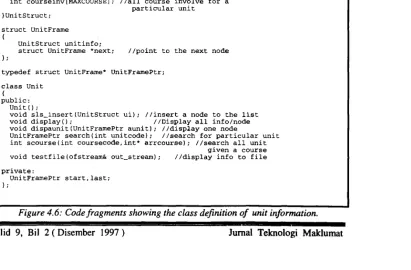
support objects. An instances of class is a data object that can be manipulated. The code
fragments shown in Figure 4.6 gives the definition of the class for the unit data structure
as was implemented in C++. The evaluation information and rules data structures are
defined similarly to the code fragments in Figure 4.6.
There are various other object-oriented programming languages such as Prolog,
Smalltalk, Object Pascal, Common Lisp Object system(CLOS) and Ada. However, what
distinguishes C++ from many other languages is the ability to define new data types in a
way that their use cannot be distinguished from the built-in types (Hekmatpour 1990).
Borland C++ was chosen for the development of the SCAS because it offers a good
development environment and it is widely available and easily accessible at the School of
Computing.
typedef struct UnitCourse {
int unit; //unit code
char unittitle[SHORTSTR];//unit full title
int nocourseinv;//number course involve might be not necessery int prerequisite[MAXPRESUB]; //prerequisite for a particular unit int courseinv[MAXCOURSE]; //all course involve for a
particular unit JUnitStruct;
struct UnitFrame {
UnitStruct unitinfo;
struct UnitFrame *next; //point to the next node
} ;
typedef struct UnitFrame* UnitFramePtr;
class Unit
{
public: U n i t ();
void sls_insert(UnitStruct u i ) ; //insert a node to the list
void display!); //Display all info/node
void dispaunit(UnitFramePtr aunit); //display one node
UnitFramePtr search(int unitcode); //search for particular unit int scoursefint coursecode,int* arrcourse); //search all unit
given a course void testfile(ofstreamt out_stream); //display info to file
p r i vate:
UnitFramePtr start,last;
} ;
Figure 4.6: Codefragments showing the class definition o f unit information.
57
4.3 System Testing SCAS
The testing process is intended to validate the working of the SCAS and to verify the
SCAS meets its specification. The main goals of the system testing are :
1) To verify the information and knowledge to be supplied to system are correct
according to the Student Guideline and expert/advisor knowledge. This process done
by human expert.
2) To check that the system read the knowledge, rules and facts in the configuration
files correctly and any changes in the configuration files will be registered by the
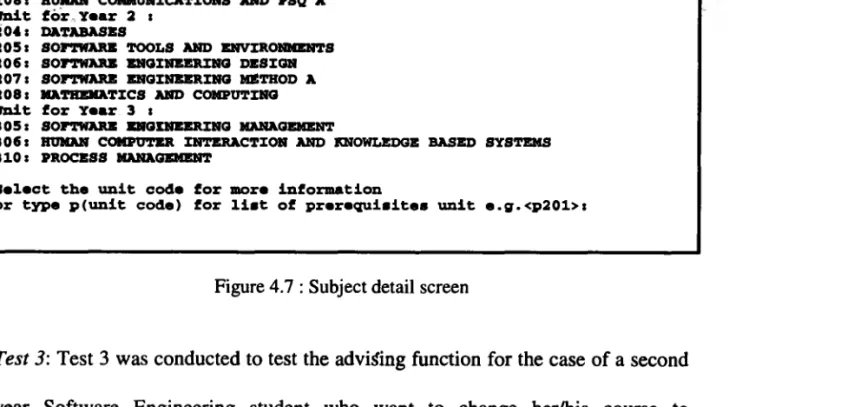
system. Figure 4.7 show example of correct facts print by the system.
3) To validate the advising functions of the system according to the SCAS functional
specification. Refer to example Test 3.
List of units for Software Engineering Unit for Year 1 : 101: SYSTEM
102: BUSINESS ORGANISATION, PLANNING) AND CHANGE 103: PROGRAMMING
104: TECHNOLOGY
105:.BASIC MATHEMATICS
108: HUMAN COMMUNICATIONS AND PSQ A Unit for Year 2 :
204: DATABASES
205: SOFTWARE TOOLS AND ENVIRONMENTS 206: SOFTWARE ENGINEERING DESIGN 207: SOFTWARE ENGINEERING METHOD A 208: MATHEMATICS AND COMPUTING Unit for Year 3 :
305: SOFTWARE ENGINEERING MANAGEMENT
306: HUMAN COMPUTER INTERACTION AND KNOWLEDGE BASED SYSTEMS 310: PROCESS MANAGEMENT
Select the unit coda for more information
or type p(unit code) for list of prerequisites unit e.g.<p201>:
Figure 4.7 : Subject detail screen
Test 3: Test 3 was conducted to test the advising function for the case of a second
year Software Engineering student who want to change her/his course to
Information Technology. The test data used in this test is shown in table 4.4. The
Current course Software Engineering New course Information Technology Student level Second year
Problems in subject Software Engineering Design Software Engineering M ethod A Academic background 1. Software Engineering
2. Programming 3. Discrete M athematics
4. Introduction to com puter system
Table 4.4 : Test data fo r use in test 3 in validating advising function
ADVISE SYSTEM - Reasons Cor system conclusion ************************************* *.*-*** * * *
Conclusion : Not suitable for course - Information Technology Reasons:
You score 19.84127% and the minimum score required is 50% You have problem with 210 COMMUNICATION ENGINEERING II
1. Understand the use of digital communication in local and wide area networks to quantify the description and processing of signals? 2. Ability to describe the limitations imposed upon IAN and WAN
by noise encoding and the methods of modulation. You have problem with 211 MICROELECTRONICS
1. Familiar with the various microprocessor technologies. 2. Familiar with the various microprocessor circuits types.
3. Familiar with the various microprocessor levels of integration.
4. Ability to design siiqple integrated circuit systems for amplification and signal processing.
5. Ability to synthesize combinational logic.
6. Familiar with the architecture and use of typical microprocessors.
Press any key to continue
ADVISE SYSTEM - Reasons for system conclusion ******* * * * * * * * * * * * * * * * * * * -* * * * * * * * * * * * * * ******
Conclusion : Not suitable for course - Information Technology Reasons:
You score 19.84127% and the minimum score required is 50% You have problem with 213 SOFTWARE ENGINEERING METHODS B
1. Understand the stages in the software development process. 2. Understand the relationship between the stages in the software
development process.
Below are all subjects you need to know for new root(not in current root): 1. 210 : COMMUNICATION ENGINEERING II
2. 211 : MICROELECTRONICS
3. 213 : SOFTWARE ENGINEERING METHODS B
Press any key to continue
Figure 4.8 : The result o f consultation screen fo r Test 3
59
There is a substantial amount of code in the SCAS to be tested and effective strategy is
needed to make sure it is tested thoroughly. In this system the bottom-up testing strategy
was adopted across the whole stages of testing process during the jdevelopment period.
Incremental approach was used in the testing process. Drivers were written in order to
test the unit, module and subsystems.
4.4 Sample consultation sessions with SCAS
The implemented SCAS provides the user with facilities which includes provide
information related to courses and giving advice to student for selecting and changing
course.
Figure 4.9 shows a screen shot of the main menu of SCAS.
• SHEFFIELD HALLAM UNIV. UNDERGRADUATE * Version 0.78 By Dayang Norhayati Abg.
COMPUTING PROGRAMME ADVICE SYSTEM * Jawawi 1996 *
1. Course Advice System 2. Quick Information 0. EZXT system
Select an option :
Figure 4 . 9 : SCAS Main Menu
Option ‘ 1 ’ offers the advising function for both new students and existing students.
Option ‘2 ’ lists all the subjects details o f a particular courses offered.
Table 4.5 shows an example data fed to the SCAS for a second year direct entry
software engineering student. Figure 4.10, shows the result of the consultation and this
result has been verified to be correct by the human expert.
D a ta field * D a ta value Course interested Software Engineering Student status Second year direct entry Academic background 1. Software Engineering
2. Programming 3. Discrete M athematics
4. Introduction to computer system
Table 4.5 : Example data 1
ADVISE SYSTEM - Reasons for system conclusion
Conclusion : Suitable for course - Software Engineering
Reason:
You score 80% and the minimum score required is 50%
Advise : But you still have some problem with following subjects You have problem with 105 BASIC MATHEMATICS
1. Understand the nature of the binary number system. 2. Ability to describe data using statistical measures and distributions.
3. Ability to apply and use a range of statistical distributions i
hypothesis testing.
Figure 4.10 : The result o f consultation screen f o r data 1
4.0 Conclusion
In this paper the used of knowledge based system in solving student course advising
problem has been described. An implementation of a Student Course Advising system
(SCAS) using object-oriented C++ has been discussed. Knowledgeable behaviour was
produced where the ‘expert’ and ‘knowledge’ is stored separately from the inference
engine. Object-oriented programming technique was found to enhance the development
of the system.
5.0 References
1) Batchelder M. J.:”The Advisor’s Assistant”, Proceedings o f the IEEE Frontiers in
Education Conference, 1989, 255
2) Billo R. E. and Bidanda B.: “A Student Advising System for Undergraduate
Engineering Curricular Scheduling”, Computer Education, 1994, 22(3), 205-213
3) B ooch, G ., O b je c t O rie n te d D esig n w ith A p p lica tio n s, The
B ejam in/C um m ings Publishing C om pany, inc., 1992
4) Chan D. and Cochran J. K.: “Using Expert-system Shells for Graduate Student
Advising”, Engineering Education, 1988, 310
5) Crooke D. E., Starks S. A. and Thorp D. S., “CSAD: A Course Advisor”, ASEE
Annual Conference Proceedings, 1987, 658
6) Frank J. L., Duffield C. A. and Swearingen C. A., “Mentor-I: An Expert Database
System for Student Guidance”, IEEE Expert, 1988, 3,40-46
7) Golumbic, M. C., Markovich M., Tsur S. and Schild U. J.: “A Knowledge-Based
Expert System for Student Advising”, IEEE Transactions on Education, 1986(5), E-
29(2), 120
8) Hekmatpour S., C++ A Guide fo r C Programmers, Prentice Hall,New Jersey, 1990
9) Kawalski K. and Ealy D.: “Schedule Advisement Expert System”, Computer
Education, 1991, 17(4), 259-265
10) Malasri S.: “Student Advising Using Spreadsheet Program”, International Journal
Appl. Engineering Education, 1988, 559
11) Malasri S.: “Semi-Automated Student Advising System Using Quattro Spreadsheet
Software”, Computer Education, 1990, 14(4), 317-324
12) Occena L. G. and Miller S. L.: “IEADVISE - An Undergraduate Course-Advising
Expert System in Industrial Engineering”, Expert Systems, 1993(8), 10(3), 139
13) Valtoria M., Smith B. and Loveland D.: “The Graduate Course Advisor: A Multi-
Phase Rule-Based Expert System”, Proceeding o f the IEEE Workshop on Principles
o f Knowledge-Based System, 1984, 53