THE EFFECTS OF PEER INSTRUCTION THROUGH SOCIAL LEARNING ENVIRONMENT TOWARDS STUDENTS’ COGNITIVE LOAD AND
LEARNING PERFORMANCE
BOSEDE IYIADE EDWARDS
A thesis submitted in fulfilment of the requirements for the award of the degree of Doctor of Philosophy (Educational Technology)
Faculty of Education Universiti Teknologi Malaysia
DEDICATION
To GOD,
the custodian of supreme knowledge and wisdom, who gives liberally to them that ask of Him
and
to the most important people in my life
My parents, Mr. Sunday Adeniyi Faniran and Mrs Esther Ajoke Faniran My husband, Olanrewaju Steve Edwards
and
ACKNOWLEDGEMENT
I give all glory to God, for the privilege to come to this point in my career. I owe the fulfilment of this dream of many decades to Him. Thank you Lord.
My foremost appreciation goes to all my supervisors for their guidance and encouragement throughout the period of this programme. I thank my main supervisor, Prof. Dr. Baharuddin Aris; for his kindness, and for his faith that challenged me to stretch my ‘wings’. Thank you for believing in me. I will never forget your kindness.
Dr. Nurbiha Shukor, words are not enough to express my utmost appreciation for your hard work and dedication. But for the roles you played at very critical times, I may not be putting these lines on paper now. Thank you for being there through thick and thin. May the Lord repay your kindness to many generations. I also thank Dr. Hasnah Mohammed, for her support and role. My story would be incomplete without it. Thank you for your time and understanding, and for supporting me.
A very big ‘thank you’ to all staff of Faculty of Education and other faculties, institutes and centers in UTM who rendered a helping hand during the course of my doctoral journey. Special thanks to Hajj Yahya Samian of Faculty of Mechanical Engineering; for his support and encouragement. I also appreciate UTM for providing a conducive environment for learning and development.
I appreciate my parents, my siblings, Adewumi, Adebimpe, Adebowale and Adesola with all other family members, especially my aunt, Eyitayo Oluyemisi, for their encouragement and prayers. I must not forget Mr. Ibikunle, former Ag.Provost, OSSCE, Ilesa, Nigeria for his part in the fulfilment of this dream. I couldn’t have done this without God and the love, support and prayers of every one of you.
TABLE OF CONTENTS
CHAPTER TITLE PAGE
DECLARATION ii
DEDICATION iii
ACKNOWLEDGEMENT iv
ABSTRACT v
ABSTRAK vi
TABLE OF CONTENTS vii
LIST OF TABLES xv
LIST OF FIGURES xvii
LIST OF ACRONYMS xx
LIST OF APPENDICES xxii
1 INTRODUCTION 1
1.1 Introduction 1
1.2 Background of the Study 4
1.2.1 Information Processing and Learning 4
1.2.2 Cognitive Load Theory 6
1.2.3 Implications of Social Media for Education 7 1.2.4 Reduction of Cognitive Load during
Learning on Social Media 8
1.2.5 Peer Instruction 9
1.2.6 Learning Performance 10
1.2.7 Research Gap 11
1.3 Statement of the Problem 13
1.5 Research Questions 14
1.6 Theoretical Framework 15
1.7 Conceptual Framework 18
1.8 Research Significance 19
1.9 Operational Definition 20
1.9.1 Social Media 20
1.9.2 Cognitive Load 21
1.9.3 Reducing Cognitive Load 21
1.9.4 Peer Instruction 22
1.9.5 Learning Performance 22
1.10 Summary 22
2 LITERATURE REVIEW 24
2.1 Introduction 24
2.2 Cognitive Load Theory 24
2.2.1 Intrinsic Load 26
2.2.2 Extraneous Load 27
2.3. Cognitive Theories of Information Processing 28 2.3.1 Stage Theory of Information Processing 29
2.3.1.1 Working Memory (WM) or
Short-Term Store 30
2.3.1.2 Long Term Memory (LTM) 31 2.3.2 Educational Implications of Information
Processing Theories 32
2.4 Cognitive Load Theory, Information Processing and Learning through Social Media 35
2.5 Measurement of Cognitive Load 36
2.5.1 Measurement of Cognitive Load
during Learning 40
2.5.1.1 Designing Instrument for Measuring Learning-related Workload 42
2.6 Reducing Cognitive Load 42
2.6.1.1 Expertise Reversal Effect 43 2.6.1.2 Segmenting and Pre-training Effects 43
2.6.1.3 Signalling Effect 44
2.6.2 Using CLT to Inform Instructional Design
and Delivery 44
2.7 Cognitive Load in Facebook 45
2.7.1 Facebook Interface, Tools, Functions
and Applications 46
2.8 Peer Instruction 47
2.8.1 Peer Instruction Elements 49
2.8.1.1 ConcepTests 50
2.8.1.2 Voting and Student Response in Peer
Instruction 50
2.8.1.3 Peer Discussion 51
2.8.1.4 Pre-class Reading 52
2.8.2 Using PI to Reduce Cognitive Load in
Social Learning through Facebook 52 2.9 Using Peer Instruction to Enhance Learning
Performance in Social Learning through Facebook 57
2.10 Summary of Literature Review 58
2.11 Report of Preliminary Study 60
2.11.1 Population and Sampling 60
2.11.2 Instrumentation and Data Collection 61 2.11.3 Findings from Stage 1 of the Study 62 2.11.4 Implications of Findings from Stage 1
of the Study 63
2.12 Summary 64
3 RESEARCH METHODOLOGY 65
3.1 Introduction 65
3.2 Research Design 65
3.2.3 Research Philosophy and Interpretive
Framework 68
3.2.4 Mixed Method Approach 68
3.2.4.1 Quantitative Methods 68 3.2.4.2 Qualitative Methods 71 3.2.4.3 Mixing in Mixed Methods 72
3.3 Population and Sample 73
3.4 Research Setting 74
3.5 Instrumentation 75
3.5.1 Facebook Distraction Survey (FB-DiS) 76
3.5.1.1 Piloting of FB-DiS 76
3.5.2 Facebook Platform 77
3.5.3 Performance Tests 78
3.5.3.1 Piloting of Performance Tests 78 3.5.4 Learning Activity Workload
Index (LAWIX) 79
3.5.4.1 Challenges with NASA-TLX and the need for Modification 81 3.5.4.2 Development of LAWIX 82
3.5.4.3 Piloting of LAWIX 84
3.5.5 ConcepTests for the Quiz and
Voting sessions 88
3.5.6 Observation Scheme 88
3.5.7 Focus Group Protocol 89
3.6 Research Procedure 90
3.6.1 The Design of the Study 90
3.6.1.1 Session on Facebook with no
Peer Instruction (FB) 93 3.6.1.2 Session on Facebook with
Peer Instruction (FBPI) 94
3.6.2 The Focus Group Session 94
3.6.3 Briefing and Ethical Issues 94
3.7.1 Quantitative Data Collection and Analysis 96 3.7.1.1 Learning Performance Tests 98 3.7.1.2 Measurement of Student Cognitive
Load Using LAWIX 98
3.7.2 Qualitative Data Collection and Analysis 99 3.7.2.1 Theoretical Basis of Coding Scheme 100
3.7.2.2 Unit of Analysis 102
3.7.2.3Development of the Coding Scheme 103 3.7.2.4 Flow of Procedures in the Open,
Axial and Selective Coding
Processes 105
3.7.2.5 Inter-coder Reliability 106 3.7.2.6 Other Qualitative Data 109 3.7.2.7 Confidentiality and Ethical Issues 111 3.8 Evaluating Quality in the Qualitative part of
the Study 111
3.8.1 Establishing Quality of Findings in this
Study 112
3.9 Summary 113
4 DEVELOPMENT OF FACEBOOK LEARNING
ENVIRONMENT FOR PEER INSTRUCTION 115
4.1 Introduction 115
4.2 Project Development Team 115
4.3 Project Setting 116
4.3.1 Course Content for the Educational
Technology and Research Course 116
4.4 Instructional Design (ID) 117
4.4.1 The Backwards Design ID Model 117 4.4.2 Facebook Group Development
for Peer Instruction 120
4.4.2.1 Stage 1: Identifying the desired outcome 120 4.4.2.2 Stage 2: Determining Acceptable Evidence
4.4.2.3 Stage 3: Planning the Process that brings about the Achievement of Desired Outcomes 125 4.5 Testing of the Facebook Group as Learning
Environment 127
4.6 Conducting Peer Instruction on the Facebook Group 131
4.7 Summary 132
5 RESULTS AND FINDINGS 133
5.1 Introduction 133
5.2 The Effect of Peer Instruction in Learning through Social Media for Enhancing
Students’ Learning Performance. 133
5.2.1 The Wilcoxon Signed-Rank Test of
Significance of the Learning Gains 137
5.2.2 Qualitative Findings 139
5.2.2.1 Initial or Open Coding Procedure 139 5.2.2.2 Axial Coding for Qualitative
Analysis 139
5.2.3 Summary of Analysis of Learning Gains 143 5.3 The Effect of Peer Instruction in Learning
through Social Media for Reducing Students’
Cognitive Load (CL) 143
5.3.1 Descriptive Information on Students’
Cognitive Load (CL) 149
5.3.1.1 The Wilcoxon signed-rank test for difference of cognitive load 150
5.3.2 Qualitative Findings 153
5.3.3 Summary of Analysis of Cognitive Load 154 5.4 Sources of Students’ Cognitive Load during
Learning on Social Media 155
5.5 Students’ Preferences on the Factors of PI that Reduce Cognitive Load during Learning
on Social Media 161
5.5.2 The Quiz Element (Conceptual Questions) 165
5.5.3 The Voting Element 167
5.5.4 Pre-class reading Element 168
5.6 The Modified Peer Instruction Implementation Framework for Reducing Cognitive Load
during Learning through Social Media 173 5.6.1 Theoretical Evaluation of Links between
Concepts (Theoretical Coding) 173 5.6.2 Summing Up Findings for Building an
Evidential Chain: Predicting Relationships 176 5.6.2.1 Summing Up the Mini-Models 176 5.6.2.2 Filling Up Gaps in the Mini-Models 178 5.6.3 Review and Refinement of the Framework 182
5.7 Summary 184
6 DISCUSSION, CONCLUSION, IMPLICATION OF STUDY,
AND RECOMMENDATIONS FOR FUTURE STUDIES 185
6.1 Introduction 185
6.2 Discussion of findings 186
6.2.1 Effect of Peer Instruction for Enhancing
Students’ Learning Performance 186 6.2.2 Effect of Peer Instruction for Reducing
Students’ Cognitive Load 188
6.2.3 Sources of cognitive load during learning
on social media 190
6.2.4 Students’ preferences on the Factors of Peer Instruction that reduce students’ Cognitive Load during learning on social media 195 6.2.4.1 Pre- and Post-class Discussions 196 6.2.4.2 Quizzes or ConcepTests 197
6.2.4.3 Voting 199
6.2.4.4 Pre-class Reading 200
Implementation for Reducing Cognitive
Load during Learning on Social Media 202
6.3 Conclusion of Study 205
6.4 Implications of the study 207
6.4.1 Theoretical Implications 208
6.4.1.1 Implications of Findings for the Theories of Cognitive Load, Information Processing
and Attention 208
6.4.1.2 Re-thinking Online Instructional
Design to Reduce Cognitive Load 209
6.4.2 Practical Implications 211
6.4.2.1 Implications for Curriculum and
Instructional Design 212 6.4.2.2 The Role of Peer Instruction
Elements in Supporting Learning 212 6.4.2.3 `The Modified Framework as a
Framework for Online Learning on
Social Media 213
6.4.3 Methodological Implications of Findings 213 6.5 Limitations and Suggestions for Further Studies 214
6.6 Summary 215
REFERENCES 217
LIST OF TABLES
TABLE NO TITLE PAGE
2.1 Educational Implications of Information Processing Theory 34
2.2 Criteria for Rating Mental Workload Measures 37
2.3 Choice of Instrument for Subjective Mental Workload (MW)
Measurement: A Review of Related Studies 38
2.4 Methods of Measuring Learning Outcomes 58
2.5 Position of Current Study within Past and on-going Research 58 2.6 Sample of Literatures Reviewed with respect to the
Focus of the Study 59
2.7 Psychometric Properties of FB-CLIX 61
2.8 FB-CLIX Items related to the Research Questions in
Phase 1 of Study 63
3.1 Description of Internal Validity Threats and Mitigating Factors 70 3.2 Assumptions of Qualitative Research and Link to the Study 72
3.3 Summary of Instrumentation for the Study 75
3.4 Reliability and Validity Analysis for FB-CLIX 76
3.5 Descriptive Information on Test-Retest Data 79
3.6 Suggested Items for Learning-focused Instrument for Subjective Workload Measurement (Leppink & van den Heuvel, 2015) 83
3.7 General Structure of LAWIX 84
3.8 Item and Person Statistics for LAWIX 85
3.9 LAWIX Items’ Order of Difficulty along the Latent Variable 87
3.10 Data Analysis Methods in Phase 2 95
3.11 Cohen’s Guidelines for ‘r’ (Cohen, 1977) 98
3.13 Format of the Conditional Relationship Guide for the Study 104 3.14 Acceptable Inter-coder Reliability Co-efficient for Content
Analysis 107
3.15 Sample Analysis of Reflection Data 110
3.16 Format of Observation Results for the Experimental Sessions 145 4.1 Course Content Covered within the Study Period 117 4.2 Facebook Secret Group Features in line with Design Objectives 120 4.3 Principles of CLT and PI and How they Reduce Cognitive Load 122 4.4 Integration of Cognitive Load Theory Principles, Peer
Instruction Elements and Assessment Methods in the Social
Media (Facebook) Learning Environment in the Study 126 4.5 Summary of Result for Testing of the Facebook LE 129 5.1 Normality Test for Learning Gains for FB and FBPI Sessions 137 5.2 Descriptive Statistics and Wilcoxon Signed-rank Test for
Learning Gains 139
5.3 Partitioning & Aggregation of Codes in Axial Coding 141
5.4 Frequency of Occurrence of Codes 141
5.5 Normality Test for the Difference of Cognitive Load 148 5.6 Rank Analysis of the Cognitive Load Scores in FB and
FBPI Sessions 150
5.7 Median Scores and Differences for Sub-loads and Total
Cognitive Load 151
5.8 Wilcoxon Signed-rank Test of the Difference of Cognitive Load 151 5.9 Summary of Researcher Observation of Face-to-Face
Class Sessions 155
5.10 Aggregation of Main and Related Codes into Categories
or Themes 157
5.11 Login Details of Participants on Institutional LMS (E-learning) 169
5.12 Linking Open, Axial and Selective Codes 173
5.13 Established Correlations among Constructs 175
LIST OF FIGURES
FIGURE NO TITLE PAGE
1.1 Information Processing Model 5
1.2 How Information Processing is related to Cognitive Load
Theory 6
1.3 Systematic Literature Review Process Flow and Findings 8
1.4 Theoretical Framework 16
1.5 Conceptual Framework 18
2.1 Stage Model and Information Holding Times at Different
Stages 29
2.2 Implications of Information Processing Models 33
2.3 Affective Cognitive Load and Effect on Memory 35
2.4 Cognitive Load Measurement Instrument Decision Tree 39 2.5 Progressive Decision on Measurement of Learning-related
Workload 41
2.6 Group Document List and Upload Interface 46
2.7 Group Survey/Poll Interface 46
2.8 Facebook Links to Other Survey Forms 47
2.9 Cognitive Load Management through Peer Instruction Elements 54
3.1 Mixed Method Design for the Study 67
3.2 Research Framework 73
3.3 Sample Selection Procedure 74
3.4 Sub-scales of the NASA-TLX 82
3.5 Observed Unscored Average Measures for Persons 86
3.6 Research Procedure 92
3.7 Process Flow for Administration, Data Collection and
Analysis of Quantitative Data 99
3.8 The Mazur PI Implementation Framework 102
3.9 Modified PI Implementation Framework for the Study . 102
3.10 Procedure for Data Analysis, Integration and Framework Development 106
3.11 Procedure for Establishing Inter-coder Reliability 108
3.12 NVivo 10 NCapture Plugin on Google Browser 109
3.13 Sample Observation Memo 110
4.1 The Backwards Design ID Model 118
4.2 Sample Pre-class Assignment Posted on Group Page 123
4.3 Facebook Poll Application Incorporating a CT 123
4.4 Sample Discussion Prompt in the FB Session 123
4.5 Sample Discussion Lead Using Multimedia Material 124
4.6 Pinned Post at the Top of the Group Page 125
4.7 Performance Test Using Google Form Links on Group Page 127
4.8 Appearance of Google Form Link before Testing 130
4.9 Appearance of Google Form Link after Testing 130
4.10 Message Viewed by Non-Members Receiving Group URL 131
4.11 Message Received by Non-Members Searching for Group or Members 131
5.1 Pretest and Posttest Scores in FB Session 135
5.2 Pretest and Posttest Scores in FBPI Session 135
5.3 Weekly and Overall Learning Gains in FB and FBPI Session 136
5.4 Normalized Learning Gains in FB and FBPI Sessions for 12 Participants 137
5.5 Normal Q-Q Plots of Learning Gains 138
5.6 Exploring Word Usage in Context 142
5.7 Word Location and Source in Data 142
5.8 Weekly Cognitive Load Scores for Sub-loads for FB Session 145
5.9 Weekly Cognitive Load Scores for Sub-loads for FBPI Session 146
5.10 Comparison of Total Cognitive Load Scores for the 5 Sub-loads for FB and FBPI Sessions 147
social media 157 5.13 Group Coding Query Output of FBPI for Improved Learning 161 5.14 Mini-model of FBPI for Improving Learning and Reducing CL 162 5.15 Text Search Query Output for ‘Idea’ in PI-related Responses 163 5.16 Mini-model of Discussion Element in FBPI 166 5.17 Mini-model of Conceptual Question or Quiz Element in FBPI 167 5.18 Mini-model of Voting Element in FBPI 169 5.19 Mini-model of Pre-class Reading in FBPI 172 5.20 Factors of PI that reduces CL in social media-based education 172 5.21 Inferences from Combined Data Sources Illustrated Graphically
as Mini-model of Cognitive Load Sources 174 5.22 Aggregation of Mini-models to Identify Intervening Variables 177 5.23 Structure of the Substantive model of PI for reducing CL 179 5.24 Further refined substantive model of PI for CL reduction 181 5.25 The Modified Peer Instruction Implementation Framework
LIST OF ACRONYMS
BCI - Brain-Computer Interface BDM - Backwards Design Model
CAQDAS - Computer Assisted Qualitative Data Analysis Software
CL - Cognitive Load
CLT - Cognitive Load Theory
CRG - Conditional Relationship Guide
CTs - ConcepTests
FB - Facebook without Peer Instruction FB-DiS - Facebook Distraction Survey FBPI - Facebook with Peer Instruction HCA - Human Cognitive Architecture HOTS - Higher Order Thinking Skills
ICT - Information Communications Technology
ID - Instructional Design
IPT - Information Processing Theory ISD - Instructional Systems Design LAWIX - Learning Activity Workload Index
LE - Learning Environment
LMS - Learning Management System LOTS - Lower Order Thinking Skills
LP - Learning Performance
MCQ - Multiple Choice Questions MKO - More Knowledgeable Other
NASA - National Aeronautics and Space Administration
NVivo - Nudist Vivo
OBE - Outcome Based Education
PI - Peer Instruction
Q-Q - Quartile-Quartile
SM - Sensory Memory
SRS - Student Response System
StD - Standard Deviation
SWAT - Subjective Workload Assessment Technique T&L - Teaching and Learning
TLX - Task Load Index TSQ - Text Search Query WFQ - Word Frequency Query
WM - Working Memory
WP - Workload Profile
LIST OF APPENDICES
APPENDIX TITLE PAGE
A List of Publications 249
B Cognitive Load Management through Collaborative
Learning Techniques 251
C Expert Validation: FB-DiS 252
D Facebook Distraction Survey (FB-DiS) 253
E Expert Validation: Performance Test (1) 254
F Expert Validation: Performance Tests (2) 255
G Performance Tests Items 256
H Expert Validation: LAWIX 266
I LAWIX Instrument 267
J Expert Validation: ConcepTests 269
K Comparison of Conceptual and Conventional Tests 270
L ConcepTest Items 271
M Code for Student Performance Measures (COSPERM) 276
N Expert Validation: Focus Group Protocol 278
O Focus Group Protocol 279
P Recommendation for Validating the Quality of Qualitative
Studies 281
Q Conditional Relationship Guide for Coding of Focus
CHAPTER 1
INTRODUCTION
1.1 Introduction
Technology in education holds the potential to enhance the productivity of both students and teachers by cutting down the required effort, time and cost for tasks. Research has emphasized the positive impact of Information Communications Technology (ICT) in education (Amali et al., 2012; Rashmi, 2011; Marshall, 2012) and reports abound of studies in diverse fields and across disciplines of the great ways old and new ICTs have enabled improved teaching and learning (T&L) directly or indirectly.
With the arrival of Web 2.0 tools however, systems not originally designed for educational purposes are being leveraged upon for learning. Facebook, for example has fostered interconnectedness of users in ways not previously known (Datko, 2015; Grant & Osanloo, 2010) and as such, have shown great educational benefits (Forgie, Duff, & Ross, 2013; Tess, 2013). Their advantages, including the ability to support multimedia learning has been well reported (Claros & Cobos, 2013; Lee & Sing, 2013) in addition to being able to serve as a platform for academic communication and cooperative learning (Irwin, Ball, Desbrow, & Leveritt, 2012).
consumption. He noted that the required fluency in the current education landscape is the ability to put those new forms of literacies together into what he described as the "way of being" in a digital culture. He noted particularly, the irreversible changes that emerging media and tools are effecting on current education. These realizations have led to the use of tools like Facebook in classrooms across the globe.
Employing these novel technologies in education is however not without challenges. There are reports on the adverse effects associated with their use; including academic-related ones like distraction and addiction (Dhaha, 2013; Jafarkarimi, Sim, Saadatdoost, & Hee, 2016; Richtel, 2010; Rosen, Mark Carrier, & Cheever, 2013). When these challenges are evaluated in terms of learning, the nature of the human memory system becomes a key issue that must be addressed.
The human memory system is composed of a Sensory Memory (SM) that receives information as various forms of stimuli; a short-term or Working Memory (WM) where information is believed to undergo processing, and a Long Term Memory (LTM) (Paas et al., 2008; Paas et al, 2004a, b) where processed information are stored permanently (Baddeley, 2010; Baddeley, 1992). The entire system layout is referred to as the Human Cognitive Architecture (HCA) (Byrne, 2003).
In cognitive activities including learning, the processing responsibility is measured as mental demand or Cognitive Load (CL) (Benassi, Overson, & Hakala, 2014; Paas, Renkl, & Sweller, 2003; Paas, van Gog, & Sweller, 2010). CL is thus related to mental tasks in the same way physical energy is related to physical tasks.
information at a later time may become ineffective, that is, learning may fail or become inefficient (Cavanagh & Alvarez, 2005).
Addressing these challenges to minimize demands on the working memory is therefore a key issue that instructors and instructional designers must give attention to (Sweller, van Merrienboer, & Paas, 1998). Strategies that improve processing and transfer and those that encourage schema formation are required in addressing these challenges. Pedagogical techniques that promote social and blended learning as well as metacognition and conceptual learning have been found to be very effective in this respect. Such techniques include peer instruction and other forms of collaborative and peer learning strategies that promote deeper processing. This is in line with Weimer’s (2009). In addition, Mao (2014) in her study on the affordances of social media for learning, concluded that for social media to be effectively engaged as useful learning tools ‘complicated efforts in designing, scaffolding, and interacting during the process are necessary’. Toland (2013) referred to the same concept as ‘best practices’ in the use of social media in education, though she offered no specific suggestions on what these might be.
1.2 Background of the Study
Social media have become inevitable tools in the twenty-first century classroom due to the great advantages that could be derived from their use in T&L. However, the challenge these tools pose to effective instruction remains a major issue with their use. These challenges are directly linked to information processing in the WM in terms of the limited capacity assumption. This is the ability of the WM to handle only a limited amount of information in parallel processing per time (Cowan et al., 2005; Yamamoto, Ito, & Watanabe, 1998). This amount of information represents the total cognitive capacity of the WM (Halford, Cowan, & Andrews, 2007). The information to be processed exerts a mental demand or total cognitive load (CLt) which is a sum of its sub-components (Sweller, Ayres, & Kalyuga, 2011; Sweller, 2010).
In learning with social media, the need for qualitative means of addressing these challenges are critical issues that instructors and instructional designers have to face (Rheingold, 2010). This calls for proactive strategies in the design of instruction, the use of appropriate pedagogies and a rethink of classroom collaboration (Mao, 2014) to achieve greater effectiveness in teaching and learning.
1.2.1 Information Processing and Learning
Instructional efforts should as such prioritize the reduction of cognitive demands on the brain’s processing capacity.
Materials processed in the working memory and successfully transferred into the long term memory become permanent there, stored as chunks of information on whole processes referred to as schemas (Recker, 1996; McLeod, 2009). Pankin (2013) describes schema as ‘an organized unit of knowledge for a subject or event’. It is made up of the entire known information associated with an item, entity or event. Schemas are based on past experiences. They are dynamic and change by accommodating new information gained on an ‘object’ or ‘subject’ represented.
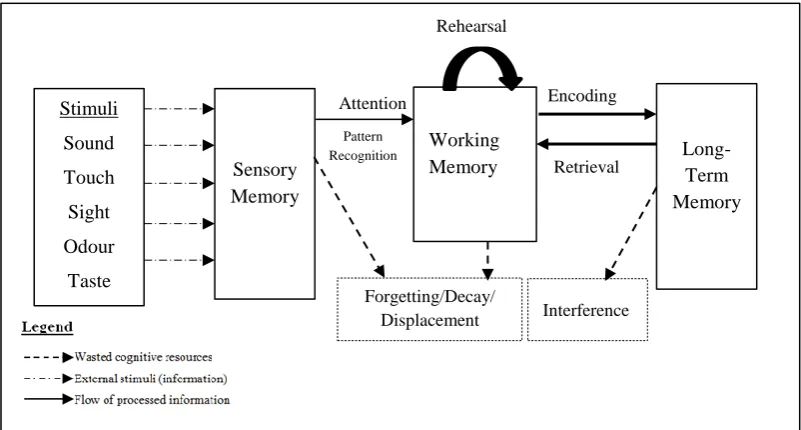
Ghosh and Gilboa (2014) confirming these, describe schemas in terms of four features including its lack of unit detail, its adaptability or dynamism, its associative network structure and its basis on multiple episodes. Information stored as schema is said to have become automated, requiring no further or continuous processing but retrievable for use whenever needed (Wallis, 2010; Paas et al., 2003). This represents the ultimate goal of instruction which is to bring about a rich store of prior knowledge from completely processed learnt information or schema which are stored as huge chunks of information that requires no future processing. Figure 1.1 shows the conceptual model of information processing in the HCA.
Figure 1.1: Information Processing Model
Encoding Rehearsal
Retrieval
Forgetting/Decay/
Displacement Interference Pattern
Recognition Sensory
Memory
Long-Term Memory Working
Memory Stimuli
Sound Touch Sight Odour
Taste
1.2.2 Cognitive Load Theory (CLT)
Cognitive Load Theory describes the components of total cognitive load (CLt) or total demand on the memory for the learning of a material. Initial descriptions (Mayer, 2004, Mayer & Moreno, 2003; Paas et al, 2003) conceptualized total CL as made up of three components, intrinsic load (CLint), extraneous load (CLext) and germane load (CLger), which are summative in nature. For instruction to be effective, this total amount, must not be greater than the working memory capacity (de Jong, 2010). Good instruction minimizes overall CL and especially, CLext (Paas et al., 2010)
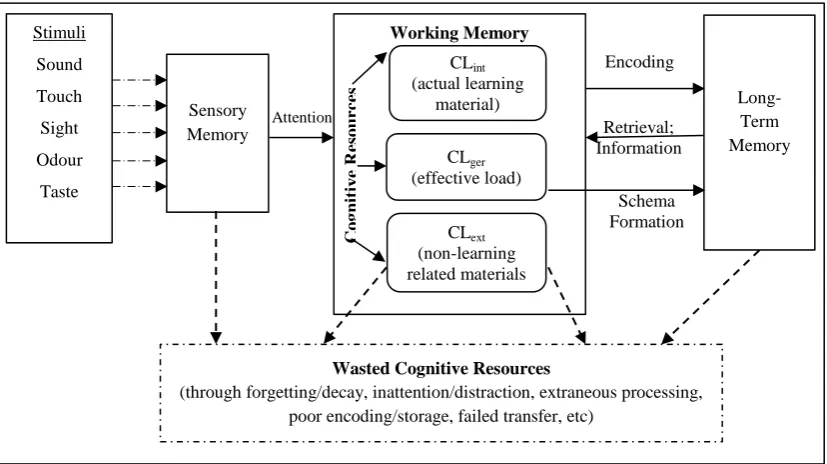
The actual learning material or intrinsic load, as well as the unnecessary materials associated with the learning material and/or the learning process (extraneous load) together compete for available cognitive resources (WM capacity). These total ‘load’ is the sum of all cognitive activities occurring during learning and it describes the link between information processing and CLT. Figure 1.2 shows the relationship of CLT to HCA and information processing in the WM. It shows allocation of cognitive resources, flow of information from reception to schema formation and how cognitive resources are wasted in extraneous processing.
Figure 1.2: How Information Processing is related to Cognitive Load Theory
Sensory Memory Long-Term Memory Working Memory Stimuli Sound Touch Sight Odour Taste Attention CLint (actual learning material) Schema Formation formation
Wasted Cognitive Resources
(through forgetting/decay, inattention/distraction, extraneous processing, poor encoding/storage, failed transfer, etc)
Information from Figures 1.1 and 1.2 show that cognitive resources are wasted in the instructional process through forgetting and decay which can be occasioned by extraneous processing, inattention, displacement and interference.
1.2.3 Implications of Social Media for Education
The implication of the status of information processing in the WM and the limited capacity for CL handling as discussed with respect to learning within the social media environment thus concerns the level of extraneous processing. This level can become very high as a result of the activities enabled on the platform, thereby compromising the learning process. For example, in one of their models of CL in relation to eLearning environments, Hollender, Hofmann, Deneke and Schmitz (2010) identified load due to software usage in addition to load induced by instructional design as contributing to extraneous load. Research also attests to the detrimental effect of distraction on the brain (Wallis, 2010) and the fact that ‘distractions make learning hard’ (Stevenson, 2006). These further strengthened the issues raised regarding the impact of social media-based education.
The implications of distractions on social media for education can also be evaluated from CL viewpoint. Studies by Edwards, Aris and Shukor (2015) and Lavie (2010) support the possibility that on social media, extraneous processing may override the actual learning material in the demand for cognitive resources and the significance of distractions during learning in terms of cognitive load. Lavie (2010) further observed that in conditions of high cognitive load on the working memory, attention deteriorates These observations have implications for education, implying the need for social media in education to employ the principles of Cognitive Load Theory. In particular, principles that promote essential and effective processing and those that reduce extraneous processing should be adopted.
as such, should exclude processes that clogs the memory or impose unnecessary demands on its processing capacity. It should employ strategies that free the memory capacity for effective processing which support efficient transfer and storage. These include processes that support collaborative and active learning, two-way communication, rapid feedback and diverse ways of learning (Project Flexner, 2012) which have also been found to have capacity for reducing cognitive load during learning (Gerjets, Scheiter, & Catrambone, 2004; Mayer & Moreno, 2003a) but they are unachievable through regular lectures and most other traditional pedagogies (Mazur, 2013).
1.2.4 Reduction of Cognitive Load (CL) during Learning on Social Media
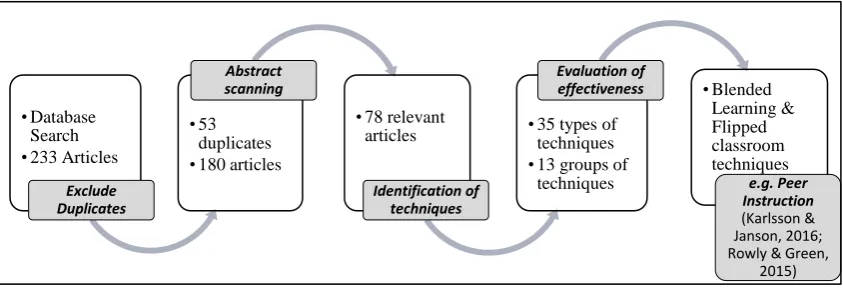
Figure 1.3: Systematic Literature Review Process Flow and Findings
These techniques are able to utilize a combination of several other techniques including Web 2.0 affordances, simulations, collaboration and ICT-supported learning modes. Others include peer- and discussion-based, role-play, mapping, problem-based and eLearning techniques. This is in line with Gilboy, Heinerichs, & Pazzaglia (2015). The study further discussed the usefulness of peer instruction (Mazur, 1997a, 1997b) as a technique that combines the advantages of blended and collaborative learning within the flipped classroom (Karlsson & Janson, 2016; Rowley & Green, 2015).
1.2.5 Peer Instruction
Peer Instruction is an active learning strategy that focuses on social and collaborative learning in addition to conceptual understanding. Peer instruction operates using four elements. These include the use of pre-class assignments aimed at giving learners early contacts with the to-be-learnt material. Conceptual questions known as ConcepTests (CTs) are posed to students to activate learning and provide feedback on students’ understanding and previous knowledge. Classroom voting for students’ choice of answers to the CTs shows students’ reasoning, conceptions and misconceptions and helps the teacher to focus instruction on areas that requires more attention. Peer discussion is done after the voting session in small groups to foster
• Database Search • 233 Articles
Exclude Duplicates
• 53 duplicates • 180 articles
Abstract scanning
• 78 relevant articles
Identification of techniques
• 35 types of techniques • 13 groups of
techniques
Evaluation of
effectiveness • Blended
Learning & Flipped classroom techniques
e.g. Peer Instruction
(Karlsson & Janson, 2016; Rowly & Green,
social and collaborative learning. This process in addition promotes self-reflection and metacognition. Kester, Lehnen, Van Gerven, & Kirschner (2006) reported on the reduction of cognitive load through Peer Instruction and just-in-time presentation of learning support.
PI has been used in many subjects by many instructors and researchers (Zingaro, 2010, 2012; Turpen & Finkelstein, 2010; Arnesen et al., 2013; Vaughan et al; 2011; Roth, 2012). Its effectiveness in promoting conceptual learning (Simon, Kohanfars, Lee, Tamayo, & Cutts, 2010) and meaningful learning (Cortright, Collins, & DiCarlo, 2005; Crouch & Mazur, 2001) has been validated. PI engages learners in the classroom (Fagen, 2002) in addition to increasing learners’ motivation (Dogru, 2013) and promoting active classroom atmosphere (Conderman, Bresnahan, & Hedin, 2011). PI also provides the instructor with information for instructional adjustment. Overall, discussions regarding the advantages of PI had been significant in recent academic discourse.
The advantages of PI are also reflected as discussed in its ability to promote students’ learning performance through its elements which contribute to the promotion of active and deeper learning, retention and transfer of learning.
1.2.6 Improving Learning Performance with Peer Instruction
Teaching proceeds with the objectives learners should achieve at the end of the learning process (Shepard, 2000). Measuring learning outcomes or performance is thus a significant concept in teaching and learning. It provides the teacher with feedback on students’ learning, helping the teacher evaluate own teaching in order to engage strategies required to assist learners (Brookhart, 2009). Measures of performance can also serve as an additional indication of students’ cognitive load in the sense that cognitive overload burdens the working memory and hinders processing, transfer and storage and consequently, performance. In this manner, learning performance can be viewed as directly linked to cognitive load.
Peer Instruction was designed to address the challenges of frustration and lack of motivation during traditional instruction (Mazur, 2013). Through its various elements, PI has been reported to contribute to increased motivation and students’ success (Dogru, 2013). ConcepTests improves students’ motivation and conceptual learning (Donovan, 2008; Mcconnell et al., 2006) and contribute to active learning (Piepmeier, 1998). Peer discussion promotes social and meaningful learning as well as problem-solving abilities (Cortright et al., 2005). PI has also been noted to improve learners’ self-efficacy and learning outcomes (Antimirova, Kulesza, Noack, & Stewart, 2015; Fagen, 2003; Zingaro, 2014).
1.2.7 Research Gap
2014; Rowley & Green, 2015). Based on these characteristics, this study proposes the employment of PI as a measure of addressing the problems of students’ CL during learning on social media.
Despite the significant advantages that PI offers, some challenges with implementation have been reported. ConcepTests (CTs) and clickers or Student Response Systems (SRSs) are central to PI implementation; however, the cost implication of providing clickers at whole-institution levels or in large classes does not seem practical (Crouch et al., 2004). Other issues highlighted in a global survey of instructors implementing PI include the time and effort demand for developing ConcepTests (CTs). The inadequacy of the available time for conducting the PI classroom procedure in a regular class session based on school time-table was also noted. The limitations of multiple choice question items in providing the teacher with adequate information on the concepts that underlie students’ thinking is also a key issue. The ability to engage all students in the PI classroom process and students’ resistance to active participation in discussions are other issues noted in addition to the traditional requirement for syllabus content coverage by institutions’ mangers.
Attempts at improving current PI model have not been too rigorous. A recent review by Antimirova, Kulesza, Noack and Stewart (2015) on reported the use of student-generated multiple-choice format questions instead of instructor-developed CTs. Carrington and Green (2007) also suggested that new technologies may be leveraged for integrating regular formative e-assessment into learning objects to provide instructors with feedback on students’ needs and knowledge gap for achieving more effective teaching. However, they did not go further to discuss how this may be done.
The challenges with CTs are currently being addressed through the development of databases of CTs across disciplines made freely available online. An example is the Force Concept Inventory by Mazur group which has been used by many instructors and in many research studies (Antimirova et al., 2015; Coletta & Phillips, 2005; Fagen, 2002). However, CTs databases are mostly focused on the mathematical and natural sciences. Attempts at CTs in the social and behavioural sciences and Arts are yet to receive serious attention. Review of literatures with regards to the focus of this study identified gaps in addressing the disadvantages of social media in learning especially in terms of cognitive load. Other gaps noted include the need for a revision/modification of current implementation model of Peer Instruction and the implications for instruction within various learning environments. Detailed information on the review of literatures is provided in Chapter 2.
1.3 Statement of the Problem
The emergence of social media as learning tools has transformed communication in all sectors including education. Social media however also constitute challenges to effective learning due to their ability to promote distraction, waste cognitive resources and induce cognitive load (Jackson, Kleitman, & Aidman, 2014; Lavie, 2010). These can frustrate the learning process as well as the long term instructional goals of transfer, storage and retrieval. However, due to the several advantages that social media provide, instructors appear carried away with the lure of these tools without much attention to the critical challenges they pose. There remains a gap in in the literatures on research in social media for education, especially as it concerns the specific implications of the features of the tools in relation to the mental demand or cognitive load associated with their use in education. The literatures have yet to address the problem despite the fact that many institutions of higher learning currently employ social media in instruction.
al., 2015; D. A. Mcconnell et al., 2006; Zingaro & Porter, 2014) and reduced CL (Kolfschoten, 2011; Quiroga, Crosby, & Iding, 2004; Yu, Chen, Kong, Sun, & Zheng, 2014). Though the benefits of the current model of Peer Instruction have been reported, a few challenges have also been identified with its implementation. Hence, this study will in addition propose a review of the current Peer Instruction implementation process for addressing CL during learning on Social Media.
1.4 Research Objectives
The study was carried out in two phases. Findings from phase 1 guided the main study (phase 2) which addressed the following objectives:
i. To design learning process in social media learning environment based on Peer Instruction for reducing students’ cognitive load.
ii. To assess the effect of Peer Instruction in learning through social media for: a. Enhancing students’ performance
b. Reducing students’ cognitive load
iii. To identify sources of students’ cognitive load during learning on social media
iv. To investigate student preferences on the factors of peer instruction that reduce students’ cognitive load during learning on social media.
v. To develop a modified framework of peer instruction implementation for reducing cognitive load during learning on social media.
1.5 Research Questions
Based on the above objectives, the following research questions are generated:
b. Reducing students’ cognitive load?
ii. What are the sources of students’ cognitive load during learning on social media?
iii. What are student preferences on the factors of peer instruction that reduce students’ cognitive load during learning on social media?
iv. What is the modified framework of peer instruction implementation for reducing cognitive load during learning on social media?
1.6 Theoretical Framework
This study is designed with a focus to address a learning problem (cognitive load) within a particular learning environment (social media) through the application of an instructional approach (peer instruction) that possesses an inherent capacity to address the problems identified. The noted problems stems from the limitation of the human working memory in handling huge amounts of information at any given time (information processing theory). For instruction to be effective, the cognitive capacity of the WM, that is, the maximum amount of information (CL or mental demand it can handle per time) must be more than the total CL of the learning material. The component of this maximum CL is described by the cognitive load theory.
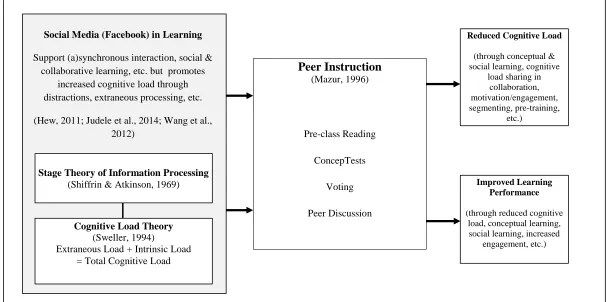
This study is therefore guided by the information processing and cognitive load theories as well as the peer instruction model. Figure 1.4 shows the interplay of these factors and principles in the theoretical framework of the study. The concepts are discussed briefly in the following sub-sections while more detailed discussions are provided in relevant sections in Chapter 2.
Peer Instruction
(Mazur, 1996)
Pre-class Reading
ConcepTests
Voting
Peer Discussion Social Media (Facebook) in Learning
Support (a)synchronous interaction, social & collaborative learning, etc. but promotes
increased cognitive load through distractions, extraneous processing, etc. (Hew, 2011; Judele et al., 2014; Wang et al.,
2012)
Cognitive Load Theory (Sweller, 1994)
Extraneous Load + Intrinsic Load = Total Cognitive Load
Reduced Cognitive Load
(through conceptual & social learning, cognitive
load sharing in collaboration, motivation/engagement, segmenting, pre-training,
etc.)
Improved Learning Performance
(through reduced cognitive load, conceptual learning, social learning, increased
engagement, etc.) Stage Theory of Information Processing
(Shiffrin & Atkinson, 1969)
16
However, because of the limitation of the human working memory in handling huge amounts of information per time (Baddeley, 2010; Kalyuga, 2007), the scenario also incorporates factors that are detrimental to learning. These include distractions, waste of cognitive resources in extraneous processing and increased cognitive load which are capable of compromising effective instruction (Edwards et al., 2015; Gupta & Irwin, 2014; Lavie, 2010b). These issues are captured in information processing and cognitive load theories.
Cognitive Load Theory (CLT) was developed by John Sweller in the early 1980s (Sweller, 1994). Cognitive load refers to the demand placed on the memory system for the achievement of a particular task and it is composed of the intrinsic, extraneous and germane cognitive loads which sum up to the total cognitive load induced by a learning material. While intrinsic load is native to the learning material and cannot be manipulated, extraneous load wastes cognitive resources and hence, undesirable. CLT is therefore concerned with the design of instruction with a focus on the efficient use of the limited cognitive capacity of the human working memory to ensure effective transfer and storage (Paas, Tuovinen, Tabbers, & Van Gerven, 2003). This will aid consequent automation or formation of schemas.
The peer instruction process involves conceptual learning, collaboration, self-evaluation, cognitive load sharing, increased motivation/interest, higher engagement and other factors that bring about improved attention and focus. The effect is that cognitive capacity is freed for allocation to deeper learning which results in effective transfer, storage and schema formation. Hence, employing peer instruction for instruction within the social media learning environment holds the promise of reduce total cognitive load.
1.7 Conceptual Framework
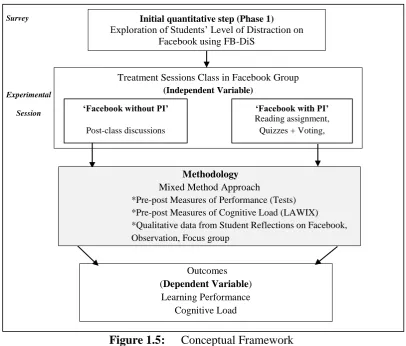
The conceptual framework presented in Figure 1.5 features the advantages derivable from and the challenges inherent in employing Facebook in education and how Peer Instruction contributes to addressing the challenges and promote effective learning. The research approach (mixed method) and how the different steps are leveraged in the two phases are indicated in addition to relevant information with respect to the research methodology.
Figure 1.5: Conceptual Framework
Two treatment procedures constituting the independent variables in the study were conducted as learning sessions on social media (Facebook). The main study objective is reducing cognitive load during learning on social media. The outcomes or dependent variables are measures on the independent variables. Quantitative as well as qualitative data were collected during the sessions. Information from the data are indicated in the outcomes which represent the dependent variables.
Outcomes
(Dependent Variable)
Learning Performance Cognitive Load
Treatment Sessions Class in Facebook Group
(Independent Variable)
‘Facebook without PI’
Post-class discussions
‘Facebook with PI’ Reading assignment,
Quizzes + Voting, Discussions
Methodology Mixed Method Approach
*Pre-post Measures of Performance (Tests) *Pre-post Measures of Cognitive Load (LAWIX)
*Qualitative data from Student Reflections on Facebook, Observation, Focus group
Initial quantitative step (Phase 1) Exploration of Students’ Level of Distraction on
Facebook using FB-DiS
Survey
Experimental
1.8 Research Significance
The 21st century classroom is becoming more tech-focused everyday with the emergence of new media and tools. The future of the classroom is undoubtedly greatly dependent on current and future gadgets and media. Instructors, instructional designers as well as learners cannot overlook the possible negative effects of these tools while continuing to take advantage of the positive opportunities they offer for enhancing learning.
Findings from the study have implications for theory, practice and methodology. On-going debates regarding Cognitive Load Theory and the components of total cognitive load (Debue and van de Leemput, 2014; Kalyuga, 2011; Leppink and van den Heuvel, 2015; ) are among issues that are addressed by findings from the study. The theories of information processing, attention and other issues theory-related issues are also addressed. In addition, important concepts in teaching and learning, and particularly online and distance learning are other relevant issues addressed in the study. The study also has significance for mixed methods research and cognitive load measurement. The instruments developed for use in the study as well as the findings present directions for future studies.
Results from the study will advise the proper use of social network and other web-based tools of the future for educational purposes. The model will represent best practices in social media-based education specifically and online/web-based learning in general. Findings from the study will shed light on the importance and benefits of Peer Instruction as an effective pedagogy in addition to validating its usefulness for reducing student cognitive load and enhancing effective learning. It will contribute to on-going global studies in PI implementation. Furthermore, PI on a social platform will simplify the PI implementation process. It will address key challenges with the use of ConcepTests, response systems and insufficient class time noted in previous studies (Carrington & Green, 2007; Crouch & Mazur, 2001; Fagen, 2003).
1.9 Operational Definition
This section provides a definition of the key terms used in this study. It provides general definitions as well as specific definitions as it applies to this study.
1.9.1 Social Media
1.9.2 Cognitive Load
Cognitive load refers to mental effort or the extent of demand placed on the mental system of a learner for a particular learning task (Windell &Wiebe, 2007; Paas et al, 2003). The total cognitive load is the sum of the intrinsic, that is, the load inherent difficulty of material, also referred to as element interactivity (Sweller, Ayres, & Kalyuga, 2011) and extraneous load, referring to all other demands external to the learning material including those generated by the learning environment, distractions and other unnecessary materials (Fong, 2013; John Sweller et al., 2011b). In this study, Cognitive Load refers to the mental demand on the learner required to cope with the requirements of learning within the social media environment on Facebook. It refers specifically to the distractions experienced by learners on Facebook due to multi-tasks and inattention, affective demands, as well as the mental demands placed by the difficulty of the actual learning tasks.
1.9.3 Reducing Cognitive Load
Reducing cognitive load refers to efforts at reducing the demand placed on a learner for a particular learning task (Bertolo, Vivian, & Dinet, 2014; Quiroga et al., 2004). This includes efforts at reducing both total cognitive load as well as either of intrinsic or extraneous load (Chong et al., 2012; Kalyuga, 2014). This can employ several measures including instructional design as well as the use of appropriate pedagogies (van Merrienboer, Kirschner, & Kester, 2003). In this study, reducing cognitive load refers to efforts at lowering the demand placed on the learner for learning on social media.
1.9.4 Peer Instruction
concepts of a particular subject as a means of fostering better understanding and performance among learners (Mazur, 1996). It is also defined as an instructional method that engages learners in knowledge sharing as a means of encouraging understanding and improving learning through teaching others (Fagen et al, 2002) and one that transforms a standard, passive lecture into an opportunity for students to answer questions individually and in groups (Zingaro, 2012). In this study, the term is used to refer to instructor-guided instruction, focused on students’ engagement and motivation through individual contributions from all participants.
1.9.5 Learning Performance
Learning performance refers to measures of learning outcomes which are usually taken during or immediately after instruction (Soderstrom & Bjork, 2015). It serves as a measure of the effectiveness of teaching and learning as well as of schools (Johnson, 2012) and a measure of the actual achievement at the end of a learning programme (Harden, Crosby, & Davis, 1999). In this study, learning performance refer to measures of students’ learning as evaluated through various outcomes measures including quantitative measures through graded and ungraded tests, and qualitative measures through student reflections, votes, peer discussions and focus group
1.10 Summary
capable of jeopardizing effective learning. The implication of this for the human memory system with respect to learning and transfer was highlighted.
REFERENCES
Abrantes, J. L., Seabra, C., & Lages, L. F. (2007). Pedagogical affect, student interest, and learning performance. Journal of Business Research, 60(9), 960– 964.
Ainley, M., Hidi, S., & Berndorff, D. (2002). Interest, learning, and the psychological processes that mediate their relationship. Journal of
Educational Psychology, 94(3), 545–561.
Akbulut, Y. (2007). Implications of two well-known models for instructional designers in distance education: Dick-carey versus Morrison-ross-kemp.
Turkish Online Journal of Distance Education, 8(2), 62–68.
Alba, J. W., & Hasher, L. (1983). Is memory schematic? Psychological Bulletin, 9(2), 203–231.
Ali, A. Z. M., & Madar, A. R. (2010). Effects of Segmentation of Instructional Animation in Facilitating Learning. Journal of Technical Education and Training, 2(2), 15–29.
Alloway, T. P. (2006). How does working memory work in the classroom ? Educational Research, 1(July), 134–139.
Amiel, T. E. L., & Orey, M. (2006). Do you have the time? Investigating online classroom workload. Journal of Educational Technology Systems, 35(1), 31– 43.
Anderson, L. W., & Krathwohl, D. R. (2001). A taxonomy for Learning, Teaching, and Assessing: A revision of Bloom’s Taxonomy of Educational Objectives. Theory into Practice, Complete Education, xxix, 352 p.
Antimirova, T., Kulesza, A., Noack, A., & Stewart, M. (2015). Evaluating the Effectiveness of Modified Peer Instruction in Large Introductory Physics Classes. Toronto: Higher Education Quality Council of Ontario.
Arnold-Garza, S. (2014). The flipped classroom teaching model and its use for information literacy instruction. Communications in Information Literacy, 8(1), 7–22.
Arteaga Sánchez, R., Cortijo, V., & Javed, U. (2014). Students’ perceptions of Facebook for academic purposes. Computers and Education, 70, 138–149. Artino, A. R., Holmboe, E. S., & Durning, S. J. (2012). Can achievement emotions
Aspire Public Schools. (2013). Blended learning 101: Handbook. Retrieved from http://aspirepublicschools.org/media/filer_public/2013/07/22/aspire-blended-learning-handbook-2013.pdf
Atkinson, R. C., & Shiffrin, R. M. (1968). Human Memory: A Proposed System and its Control Processes. Psychology of Learning and Motivation - Advances in Research and Theory, 2(C), 89–195.
Ayres, P. (2006). Impact of reducing intrinsic cognitive load on learning in a mathematical domain. Applied Cognitive Psychology, 20(3), 287–298.
Ayres, P. (2006b). Using subjective measures to detect variations of intrinsic cognitive load within problems. Learning and Instruction, 16(5), 389–400. Ayres, P., & Sweller, J. (2005). The Split-Attention Principle in Multimedia
Learning. The Cambridge Handbook of Multimedia Learning. Mayer, 135– 146. New York.
Baddeley, A. D. (1992). Working Memory. Science, 255(5044), 556–559. Baddeley, A. D. (2010). Working memory. Current Biology.
Bahari, S. F. (2010). Qualitative Versus Quantitative Research Strategies: Contrasting Epistemological and Ontological Assumptions. Jurnal Teknologi, (52), 17–28.
Bailey, B. P., & Iqbal, S. T. (2008). Understanding changes in mental workload during execution of goal-directed tasks and its application for interruption management. ACM Transactions on Computer-Human Interaction, 14(4), 1– 28.
Bailey, B. P., & Iqbal, S. T. (2008). Understanding changes in mental workload during execution of goal-directed tasks and its application for interruption management. ACM Transactions on Computer-Human Interaction, 14(4), 1– 28.
Banikowski, A. K. (1999). Strategies to Enhance Memory Based on Brain-Research.
Focus on Exceptional Children, 32(2).
Bao, L. (2006). Theoretical comparisons of average normalized gain calculations.
American Journal of Physics, 74(10), 917.
Barnes, D. (2010). Why talk is important. English Teaching, 9(2), 7–10.
Bartlett, F. C. (1932). Remembering : A Study in Experimental and Social Psychology. Cambridge, Social Psychology, 1–11.
Basahel, A. M., Young, M. S., & Ajovalasit, M. (2010). Impacts of Physical and Mental Workload Interaction on Human Attentional Resources Performance.
Proceedings of the 28th Annual European Conference on Cognitive Ergonomics - ECCE ’10.
Bazeley, P., & Jackson, K. (2013). Qualitative Data Analysis with NVivo. Sage Publications (Vol. 2nd).
Bazeley, P. (2007). Qualitative Data Analysis with NVivo (2nd ed.). London. Sage Beilock, S. L., Kulp, C. A., Holt, L. E., & Carr, T. H. (2004). More on the fragility of
performance: choking under pressure in mathematical problem solving.
Benassi, V. A., Overson, C. E., & Hakala, C. M. (2014). Applying Science of Learning in Education: Infusing Psychological Science into the Curriculum.
Annals of Anthropological Practice, 37(1), 303.
Bertolo, D., Vivian, R., & Dinet, J. (2014). Reducing Cognitive Workload During 3D Geometry Problem Solving with an App on iPad. In Science and Information Conference 2014 August 27-29, 2014 | London, UK (pp. 27–31). London. Bloom, B. S. (1969). Some theoretical issues relating to education evaluation.
Educational Evaluation: New Role, New Means, 68, 26–50.
Bode, M., Drane, D., Kolikant, Y. B. D., & Schuller, M. (2009). A clicker approach to teaching calculus. Notices of the AMS.
Boduszek, D. (2013). Exploring Psychological Explanations of Criminal Behaviour
(HIB1046). Oxford: University of Oxford.
Bond, T. G., & Fox, C. M. (2007). Applying the Rasch model: Fundamental measurement in the human sciences (2nd ed.). Lawrence Erlbaum Associates Publishers; US.
Borghini, G., Astolfi, L., Vecchiato, G., Mattia, D., & Babiloni, F. (2014). Measuring neurophysiological signals in aircraft pilots and car drivers for the assessment of mental workload, fatigue and drowsiness. Neuroscience and Biobehavioral Reviews.
Bowen, G. A. (2009). Supporting a grounded theory with an audit trail: an illustration. International Journal of Social Research Methodology, 12(4), 305–316.
Bower, G. H., & Forgas, J. P. (2001). Mood and social memory. Handbook of affect and social cognition.
Bower, G. H., Karlin, M. B., & Dueck, A. (1975). Comprehension and memory for pictures. Memory & Cognition, 3(2), 216–220.
Boyd, D. M., & Ellison, N. B. (2008). Social Network Sites: Definition, History, and Scholarship. Journal of Computer-Mediated Communication, 13(1), 210–230. Bracken, S. (2010). Discussing the importance of ontology and epistemology
awareness in practitioner research. Worcester Journal of Learning and Teaching, 4(4), 1–9.
Bradley-Radakovich, K. (2011). The Effects of Presentation Mode and Pace on Learning Immunology with Computer Simulation: A Cognitive Evaluation of a Multimedia Learning Resource. Doctoral Thesis. University of Central Florida. Orlando. Florida.
Bransford, J. D., & Johnson, M. K. (1972). Contextual Prerequisites for Understanding: Some Investigations of comprehension and Recall. Journal of Verbal Learning and Verbal Behaviour, 11, 711–726.
Breyer, Y. (2009). Learning and teaching with corpora: reflections by student teachers. Computer Assisted Language Learning, 22(2), 153–172.
Broadbent, D. (1957). A mechanical model for human attention and immediate memory. Psychological Review, 64(3), 205–215.
Brookhart, S. (2009). Promoting student ownership of learning through high impact formative assessment practices. Journal of Multidisciplinary Education, 6(12), 52–67.
Brookhuis, K. A, & de Waard, D. (2010). Monitoring Drivers’ Mental Workload in Driving Simulators using Physiological Measures. Accident; Analysis and Prevention, 42(3), 898–903.
Bruff, D. (2010). Multiple-Choice Questions You Wouldn’t Put on a Test: Promoting Deep Learning Using Clickers. Essays on Teaching Excellence, 21(3), 2009– 10.
Brunken, R., Plass, J., & Leutner, D. (2003). Direct Measurement of Cognitive Load in Multimedia Learning. Educational Psychologist, 38(1), 53–61.
Brunken, R., Plass, J., & Leutner, D. (2003). Direct Measurement of Cognitive Load in Multimedia Learning. Educational Psychologist, 38(1), 53–61.
Buckley, K. M., Beyna, B., & Dudley-Brown, S. (2005). Promoting Active Learning through On-Line Discussion Boards. Nurse Educator.
Bundick, M. J., Quaglia, R. J., Corso, M. J., & Haywood, D. E. (2014). Promoting Student Engagement in the Classroom. Teachers College Record, 116(April 2014), 1–34.
Butler, M. (2004). Outcomes Based / Outcomes Focused Education. Riyadh, Saudi Arabia.
Butler, M. B., & Zerr, R. J. (2005). The Use of Online Homework Systems to Enhance Out-of-Class Student Engagement. International Journal for Technology in Mathematics Education, 12(2), 51–58.
Byrne, M. D. (2003). Cognitive Architecture. In The Human-Computer Interaction Handbook: Fundamentals, Evolving Technologies and Emerging Applications (pp. 97–117).
Cahill, L., Gorski, L., & Le, K. (2003). Enhanced Human Memory Consolidation With Post-Learning Stress: Interaction With the Degree of Arousal at Encoding. Learning & Memory, 10(4), 270–274.
Cain, B. (2007). A Review of the Mental Workload Literature. Defence Research and Development. Toronto: The North Atlantic Treaty Organization (NATO). Cain, T. (2011). How Trainee Music Teachers Learn about Teaching by Talking to Each Other: An Action Research Study. International Journal of Music Education, 29(2), 149–154.
Calderon, O. (2013). Direct and Indirect Measures of Learning Outcomes in an MSW Program: What Do We Actually Measure? Journal of Social Work Education, 49(October 2011), 408–419.
Cameron, R. (2009). A sequential mixed model research design: Design, analytical and display issues. International Journal of Multiple Research Approaches, 3(2), 140–152.
Carcary, M. (2009). The research audit trial - enhancing trustworthiness in qualitative inquiry. Electronic Journal of Business Research Methods, 7(1), 11–24.
Carini, R. M., Kuh, G. D., & Klein, S. P. (2006). Student engagement and student learning: Testing the linkages. Research in Higher Education, 47(1), 1–32. Carrington, A., & Green, I. (2007). Just in time teaching revisited: Using
e-assessment and rapid e-learning to empower face to face teaching. In
Proceedings of ASCILITE (pp. 2006–2008).
Cavanagh, P., & Alvarez, G. A. (2005). Tracking multiple targets with multifocal attention. Trends in Cognitive Sciences, 9(7), 349–354.
Charles, T., Bustard, D., & Black, M. (2011). Experiences of Promoting Student Engagement through Game-Enhanced Learning. In Serious Games and Edutainment Applications (pp. 425–445).
Che Ku Mohd, C. K. N., & Shahbodina, F. (2015). Personalized Learning Environment: Alpha Testing, Beta Testing & User Acceptance Test. In World Conference on Technology, Innovation and Entrepreneurship (pp. 837–843). Elsevier Inc.
Chenail, R. J. (2012). Conducting qualitative data analysis: Reading line-by-line , but analyzing by meaningful qualitative units. The Qualitative Report, 17(1), 266–269.
Chong, Y. N., Wan, F. M., & Toh, S. C. (2012). Reducing Cognitive Load using RLOs with Instructional Strategies. International Journal of Scientific & Engineering Research, 3(8), 6–9.
Chongde, L., & Tsingan, L. (2003). Multiple Intelligence and the Structure of Thinking. Theory & Psychology, 13(6), 829–845.
Christ, T. J. (2007). Experimental control and threats to internal validity of concurrent and nonconcurrent multiple baseline designs. Psychology in the Schools, 44(5), 451–459.
Chu, H. (2014). Potential Negative Effects of Mobile Learning on Students’ Learning Achievement and Cognitive Load-A Formal Assessment Perspective. Educational Technology and Society, 17(1), 332–344.
Churches, A. (2009). Bloom’s digital taxonomy. Educational origami, 4.
Ciampa, K. (2014). Learning in a mobile age: An investigation of student motivation. Journal of Computer Assisted Learning, 30(1), 82–96.
Clare, A. S., Hart, C. S., & Cummings, M. L. (2010). Assessing operator workload and performance in expeditionary multiple unmanned vehicle control. 48th AIAA Aerospace Sciences Meeting Including the New Horizons Forum and Aerospace Exposition, (January), 1–10.
Claros, I., & Cobos, R. (2013). Social Media Learning: An approach for composition of multimedia interactive object in a collaborative learning environment. In Proceedings of the 2013 IEEE 17th International Conference on Computer Supported Cooperative Work in Design, CSCWD 2013 (pp. 570–575). Closson, D. (2012). Outcome Based Education (OBE). Retrieved from
http://www.leaderu.com/orgs/probe/docs/obe.html
Cohen, J. (1977). Statistical Power Analysis for the Behavioral Sciences. Elsevier.
http://doi.org/10.1016/B978-0-12-179060-8.50003-7
Cohen, J. (1988). Statistical Power Analysis for the Behavioral Sciences. L. Erlbaum Associates.
Coletta, V. P., & Phillips, J. a. (2005). Interpreting FCI scores: Normalized gain, preinstruction scores, and scientific reasoning ability. American Journal of Physics, 73(12), 1172–1182.
Coletta, V. P., & Phillips, J. A. (2005). Interpreting FCI