AN OVERVIEW OF RESEARCH ON EXPERTS AND NOVICE PROBLEM SOLVERS IN PHYSICS
Marlina Ali, Corrienna Abdul Talib and Norulhuda Ismail Department of Science, Mathematics and Creative Multimedia,
Faculty of Education, Universiti Teknologi Malaysia
[email protected], [email protected], [email protected]
ABSTRACT
Problem solving is regarded as one of the most important cognitive activities in our daily life and in professional contexts. There are differences between expert and novice in terms of their behaviour and knowledge organisation in solving physics problem. In terms of behaviour, usually experts employ planning, monitoring, evaluating and making qualitative analysis in their solution as compared to novices. Studies in problem solving usually compare behaviour between the two groups to see how these two groups performed. There were three criteria uses to select the group such as experiences, performances and background knowledge.
Keywords: physics problem solving, expert vs novice, more successful, less successful, physics
OVERVIEW OF PROBLEM SOLVING
Studies of problem solving in physics began in the late 1970s. Problem solving has been defined in many ways for example: it has been interpreted as a process of moving towards a goal when the path is uncertain (Martinez, 1998); inferential steps that lead from a given state of affairs to a desired goal state (Barbey & Barsalou, 2009); an investigative task whereby the solver explores the solution path to reach a goal from given information (Dhillon, 1998); a process, consists of a series of steps, and the problem solvers are involved in constructing the solution (Hollabaugh, 1995) and as a process, goal and basic skills (Branca, 1980). Apparently, many researchers defined problem solving as a process (Branca, 1980; Hollabaugh, 1995; Martinez, 1998) and goal (Barbey & Barsalou, 2009; Branca, 1980; Dhillon, 1998). Only Branca (1980) defined problem solving as a basic skill. This definition has advantages because everybody who lives in this world will be confronted with problems and require problem solving as basic skills.
According to Jonassen (2000), problem solving is regarded as one of the most important cognitive activities in our daily life and in professional contexts. In daily life, when someone decides what to wear, which routes to choose to go to work are regarded as solving a problem. Problem solving occurs in professional contexts as well. For example, problem solving occurs when teachers decide which techniques to use in order to attract students’ attention in the class. In particular with physics, problem solving occurs when students do not know how to answer physics questions. An overview of research in problem solving are as follows where earlier research in physics problem solving began with problem solving differences between experts and novices and at the same time, research had also been done on problem solving strategies.
PROBLEM SOLVING DIFFERENCES BETWEEN EXPERTS AND NOVICES
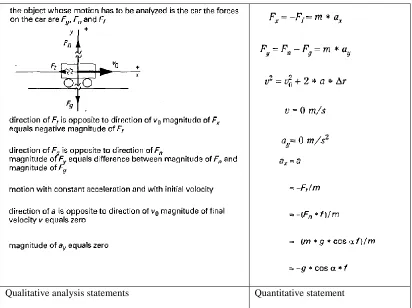
perform an initial qualitative analysis or make a redescription of the problems (Refer to Table 1) before using appropriate equations for the quantitative solution of the problems (Larkin, 1979). The experts’ qualitative analysis help reduces the chance of error because qualitative analysis is easy to check both against the original problem situation and against subsequent generated quantitative equations. This term however differ with Larkin use of typical physics problems that can be found at the end of an introductory calculus-based physics, (Larkin, 1981a, 1981b; Larkin et al., 1980; Larkin & Reif, 1979). One example of the problem (Larkin, 1981a) is “ A block of mass m starts from rest down a plane of length l inclined at an angle θ with the horizontal. If the coefficient of frictionbetween block and plane is µ, what is the speed of the block as it reaches the bottom of the plane?” (p. 535).
Table 1: Example of qualitative and quantitative statements
Qualitative analysis statements Quantitative statement
Refences: Ploetzner and Spada (1998) p. 101
specifically in the problems. In contrast, novices tend to classify problems based on surface features of the problems (objects such as springs and inclined planes; terms such as friction; similarities between diagrams). Problem solving behavior between expert and novice problem solvers can be concluded as below (Larkin, 1979; Larkin & Reif, 1979; Simon & Simon, 1978):
1. Experts complete the solution to a problem in less time than do novices
2. Experts perform an initial qualitative analysis of a problem before using appropriate equations(s) for the quantitative solution of the problems while novices immediately search for an equation and do this by matching the information given in the problems with terms in the equations. Qualitative analysis here means redescription of the problems. 3. Experts solve problems by a process of successive refinements, first describing the main
problem’s feature by seemingly vague words or pictures and only later considering the problems in greater detail in more mathematical language while novices solve a problem by assembling individual equations.
In addition, according to (Marlina et al., 2014a) more successful and less successful problem solvers did show clear differences in how they went about solving physics problem. The more successful problem solvers set clear goals, needed to reread the question less in order to understand each part of the test set, drew diagrams that reflected deeper levels of thinking and spent more time with qualitative analysis before and during the problem solving process. They used scientific representation to represent the variables operating in the task, they progressively monitored their thinking, when they changed approach it was because they identified a deficiency, and they evaluated their answers before finalising their response. On the other hand, less successful problem solvers, set less clear goals than more successful problem solvers and were less effective in achieving these because they prematurely leapt into substituting data into equations, spent less time on qualitative analysis, and frequently reread the question. They also used naïve representation to represent the variables, when they changed approach it was to select a different equation and they did not evaluate their answers before finalising their response.
Apart from differences in problem solving behavior, there are also other differences that have been discovered between experts and novices, namely knowledge organisation as follows (Chi et al., 1981; Dufresne et al., 1992; Hardiman & et al., 1988). These studies concluded that:
1. Experts tended to classify physics problems based on underlying concepts (laws of Physics such as Newton’s Laws) that were not mentioned specifically in the problems more than novices did, and novices tended to classify problems based on the surface features of the problems (objects such as springs and inclined planes; terms such as friction; similarities between diagrams) more than the experts did.
2. Experts used deep structure similarity in making problem categorization decisions. Experts were much more likely to judge that two problems could be solved similarly if they were similar in deep structure. Novices used surface feature similarity in making problem categorisation decisions. Novices often indicated that problems with similar surface features could be solved similarly.
included the value of each resistor in every circuit they redrew. Indeed, Rosengrant et al. (2009) demonstrated that novices also differed from experts when working with Ohms law. According to Rosengrant et al. (2009), “novices had difficulty relating current and resistance in two different ways. Some novices believed that there was a direct relationship between the two in which the higher the resistance the higher the current through that resistor; and the lower the resistance the higher the current. The former idea comes from the logic that one needs to have a higher current in order to get past the larger resistance and the latter idea was correct if potential difference is similar. However, the novices were applying this on a resistor-by-resistor basis (p. 251). The same difficulties arose when combining voltage and resistance: the higher the resistance the higher the voltage drop across the resistor regardless of the arrangement. Novices exhibited less of an understanding of potential difference across the resistors than about the current moving through the resistors.
EXPERTS, NOVICES, GOOD, POOR, MORE SUCCESSFUL, LESS SUCCESSFUL PROBLEM SOLVERS
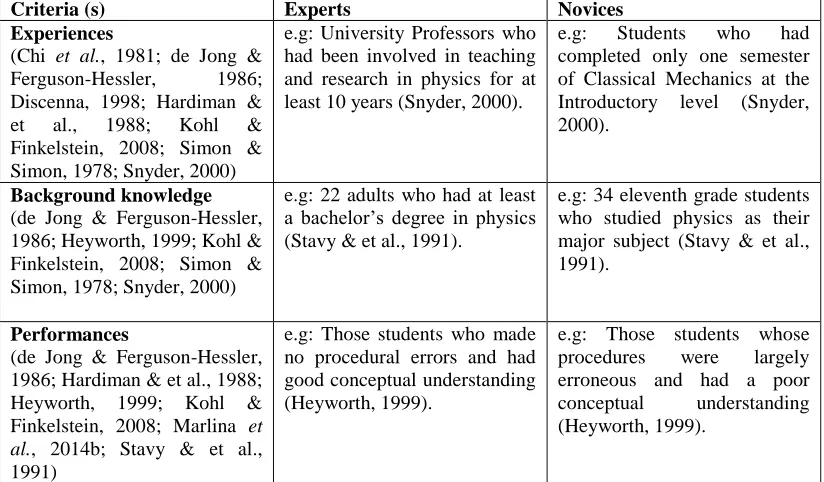
In physics problem solving, they were many terms used to refer to expert and novice problem solver. They include good problem solver, poor problem solver, more successful problem solvers and less successful problem solvers. The differences between experts, novices and so called good and poor problem solvers are best described by Saul (1998) who conducted an extensive review of the literature on this topic. Table 2 below demonstrates three prominent criteria that have been used by earlier researchers to select experts and novices in physics problem solving research.
Table 2: Criteria to select expert and novice subjects
Criteria (s) Experts Novices
Experiences
(Chi et al., 1981; de Jong &
Ferguson-Hessler, 1986;
Discenna, 1998; Hardiman &
et al., 1988; Kohl &
Finkelstein, 2008; Simon & Simon, 1978; Snyder, 2000)
e.g: University Professors who had been involved in teaching and research in physics for at least 10 years (Snyder, 2000).
e.g: Students who had
completed only one semester of Classical Mechanics at the Introductory level (Snyder, 2000).
Background knowledge (de Jong & Ferguson-Hessler, 1986; Heyworth, 1999; Kohl & Finkelstein, 2008; Simon & Simon, 1978; Snyder, 2000)
e.g: 22 adults who had at least a bachelor’s degree in physics (Stavy & et al., 1991).
e.g: 34 eleventh grade students who studied physics as their major subject (Stavy & et al., 1991).
Performances
(de Jong & Ferguson-Hessler, 1986; Hardiman & et al., 1988; Heyworth, 1999; Kohl & Finkelstein, 2008; Marlina et al., 2014b; Stavy & et al., 1991)
e.g: Those students who made no procedural errors and had good conceptual understanding (Heyworth, 1999).
e.g: Those students whose
procedures were largely
erroneous and had a poor
conceptual understanding
(Heyworth, 1999).
successful” problem solvers refers to students from undergraduate students. Saul’s definition has been supported by Simon & Simon (1978), which they refer to experts as more experienced and novice as less experienced. Nevertheless, Malone (2006) claimed good grades or performance are also a criteria to be an expert problem solver. For example, in order to select experts and novices, Heyworth (1999) conducted a problem solving test to students. Accordingly, those students that have good conceptual understanding and no procedural error in the test were selected as experts and those who made many procedural errors and poor conceptual understanding were selected as novices. Marlina et al. (2014b) also used performance as a criteria in selecting the group. She used 40 % as the cut off to rate the students. Those students who achieved 40% or above were categorised as “more successful” and those who achieved lower than 40% were categorized as “less successful”. In addition, the criteria for selecting the students were based on the respondent’s cooperation during thinking aloud. Students who showed lack of cooperation such as not trying to solve the problems and simply withdrew in answering the question also became a criteria in selecting the less successful students.
CONCLUSION
Studies of problem solving in physics began in the late 1970s. The earliest studies in physics problem solving were done by Larkin. In Larkin’s studies, mechanics was given emphasis. Most authors refer problem solving as a process. There are differences between expert and novice in terms of their behaviour and knowledge organisation in solving physics problem. In term of behaviour, usually experts employed planning, monitoring, evaluating and making qualitative analysis in their solution as compared to novices. Studies in problem solving usually compared behaviour between 2 groups to see how these two groups performed. There were three criteria used to select the group which are experiences, performances and background knowledge.
REFERENCES
Barbey, A. K., & Barsalou, L. W. (2009). Reasoning and problem solving: models. In L. Squire (Ed.), Encyclopedia of neuroscience (pp. 35-43). Oxford: Academic Press.
Branca, N. A. (1980). Problem solving in school mathematics. In S. Krulik & R. E. Reys (Eds.), Yearbook (National Council of Teachers of Mathematics) (pp. xiv, 241 p.). Reston, Va.: National Council of Teachers of Mathematics.
Chi, M. T. H., Feltovich, P. J., & Glaser, R. (1981). Categorization and representation of physics problems by experts and novices. Cognitive Science: A Multidisciplinary Journal, 5(2), 121 - 152.
de Jong, T., & Ferguson-Hessler, M. G. M. (1986). Cognitive structures of good and poor novice problem solvers in physics. Journal of Educational Psychology, 78(4), 279-288.
Dhillon, A. S. (1998). Individual differences within problem-solving strategies used in physics. Science Education, 82(3), 379-405.
Discenna, J. (1998). A study of knowledge structure in physics (pp. 47).
Dufresne, R. J., Gerace, W. J., Hardiman, P. T., & Mestre, J. P. (1992). Constraining Novices to Perform Expertlike Problem Analyses: Effects on Schema Acquisition. Journal of the Learning Sciences, 2(3), 307 - 331.
Heyworth, R. M. (1999). Procedural and Conceptual Knowledge of Expert and Novice Students for the Solving of a Basic Problem in Chemistry. International Journal of Science Education, 21(2), 195-211.
Hollabaugh, M. (1995). Physics problem solving in cooperative learning groups. (PhD PhD Thesis), University of Minnesota.
Jonassen, D. (2000). Toward a design theory of problem solving. Educational Technology Research and Development, 48(4), 63-85.
Kohl, P. B., & Finkelstein, N. D. (2008). Patterns of multiple representation use by experts and novices during physics problem solving. Physical Review Special Topics - Physics Education Research, 4(1), 1-13. doi: 10.1103/PhysRevSTPER.4.010111
Larkin, J. H. (1979). Processing information for effective problem solving. Engineering Education, 70(3), 285-288.
Larkin, J. H. (1981a). Cognition of learning physics. American Journal of Physics, 49(6), 534-541. Larkin, J. H. (1981b). Enriching formal knowledge: A model for learning to solve textbook physics problems. In J. R. Anderson (Ed.), Cognitive skills and their acquisition. Hillsdale, N.J: Erlbaum.
Larkin, J. H., McDermott, J., Simon, D. P., & Simon, H. A. (1980). Expert and Novice Performance in Solving Physics Problems. Science, 208(4450), 1335-1342.
Larkin, J. H., & Reif, F. (1979). Understanding and teaching problem solving in Physics. International Journal of Science Education, 1(2), 191-203.
Malone, K. L. (2006). A comparative study of the cognitive and metacognitive differences between modeling and non-modeling high school physics students. (Doctor of Philosophy), Carnegie Mellon University, Pittsburgh, PA.
Marlina, A., Abdul Halim, A., Nor Hasniza, I., Johari, S., & Nurshamela, S. (2014a). Physics problem solving strategies and metacognitive skills: force and motion topics. . Paper presented at the International Conference on Engineering Education (ICEED 2014), Berjaya Times Square Hotel, Kuala Lumpur. .
Marlina, A., Nor Hasniza, I., Abdul Halim, A., Johari, S., & Nurshamela, S. (2014b). Physics problem solving: Selecting more successful and less successful problems solvers. International Conference of Teaching, Assessment and Learning (TALE), 186-191. Martinez, M. E. (1998). What Is Problem Solving? The Phi Delta Kappan, 79(8), 605-609. Ploetzner, R., & Spada, H. (1998). Constructing quantitative problem representations on the basis
of qualitative reasoning. Interactive Learning Environment, 5, 95-107.
Rosengrant, D., Thomson, C., & Mzoughi, T. (2009). Comparing Experts and Novices in Solving
Electrical Circuit Problems with the Help of Eye-Tracking. Paper presented at the 2009 PHYSICS EDUCATION RESEARCH CONFERENCE, Ann Arbor (MI).
Saul, J. M. (1998). Beyond problem solving: Evaluating introductory physics courses through the
hidden curriculum. (Doctor of Philisophy), University of Maryland Retrieved from
http://www.physics.umd.edu/perg/dissertations/Saul/
Simon, D. P., & Simon, H. A. (1978). Individual Differences in Solving Physics Problems. In R. S. Siegler (Ed.), Children's thinking : what develops? (pp. 325-348). Hillsdale, N.J. New York: L. Erlbaum Associates ;.
Snyder, J. L. (2000). An investigation of the knowledge structures of experts, intermediates and novices in physics. International Journal of Science Education, 22(9), 979 - 992.