USING MULTI-CRITERIA ANALYSIS TO IDENTIFY
SUITABLE LIGHT RAIL TRANSIT ROUTE
Ahmad Nazri Muhamad Ludin, Siti Noor Haslinda Mohd Latip Email: [email protected]
Department of Urban and Regional Planning, Faculty of Built Environment, University Teknologi Malaysia, Skudai, Johor, Malaysia
ABSTRACT Public transportation planning and development are undergoing continuous changes often prompted by both external factors and policy-directed responses. The role of public transit, particularly rail transit, becomes increasingly importance with the changing demographic and economic pattern. The trend of returning to urban living for example, has significantly increased the demand for efficient public transportation in urban centers. However, the design and development of Light Rail Transit (LRT) route seldom takes into consideration land use changes and demand. This paper investigates how non-spatial and spatial data can be integrated within a multi criteria decision framework to formulate and evaluate land use development corridor to determine suitable route for LRT. A raster base multi-criteria analysis model was developed base on a set and specific objectives, criteria, indicator and data requirement. The set criteria and indicator proposed are in line with the objectives to improve public transportation as stipulated in the Kuala Lumpur Structure Plan. A case study approach is undertaken within a selected LRT railroad in Kuala Lumpur, Malaysia. The model, integrating GIS and external software, shows that suitable LRT alignment can be identified that take into account social, institutional and environmental objectives. The approach will assist in the planning and development of LRT network, and thus maximizing usage of rail-based public transport to serve the community.
Keywords: GIS, Light Rail Transport, Multi-Criteria Analysis.
Introduction
Public transportation planning and development are undergoing continuous changes
often prompted by both external factors and policy-directed responses. As such,
public transportation is a vital component in any urban area and often regarded as a
sustainable form of urban transportation. It serves as a promising solution to the
problem of transportation demand in most urban cities. Public transportation is also
considered as a tool used by transportation planners in solving various transportation
Most public transportation modes in an urban area are based on roads and rails.
Examples of road based transportation modes are buses and taxis, while rail
transportation modes are Light Railway Transit (LRT), train and monorail. It is
important to note that rail-based public transportation should be fast, efficient,
convenient and affordable, and able to carry a capacity which is higher than whatever
that can be accommodated by buses (Parkinson, 1989).
LRT is one of the public transportation modes that are popular in most developed
countries. There are more than 300 LRT systems of various types and sizes that
have been successfully implemented in 33 countries all over the world, including
Hong Kong, Manila, United Kingdom and Mexico (Bliss, 1989). The capability of LRT that can carry between 15,000-20,000 passengers per day or equivalent to
3,000-20,000 passengers per hour, makes the system as an effective public transportation
(Parkinson, 1989). In Asia, poor levels of service on public transportation often lead
to the vicious cycle in which the transportation system is shifted to automobile-biased
motorization. In addition, Asia also constitutes 85% of its inland surface passenger
transportation (in terms of million of kilometers) to public transportation (including
railway), which is almost double the world standard of around 45% (Wong & Lam,
2006). In effect, it is increasingly important to formulate an effective policy on the
planning, management and operation of the public transportation system including
LRT.
It should be noted however that the main problems that are usually identified are from
the aspect of integration i.e. mistakes in integrating LRT route alignment or the failure
in taking into account surrounding land uses, or the linkages between other public
transportation modes that are not properly planned. The lack of integration often
creates problems, such as minimum usage of the LRT services and contributes to the
financial loss incurred by the rail operators. These problems often arise from
inappropriate planning at different stages of the development and also neglecting the
macro and micro issues related to public transportation and the community (Bickel,
Thus, public transportation planners are often faced with a continuing challenge in
refining their ability to model the interactions between land uses and transportation
demand and supply. GIS as such is seen as a powerful tool to develop better public
transportation analysis techniques due to its ability to manage, recall and evaluate
information effectively. It is also regarded as a comprehensive approach due to its
ability to consider various inter-related criteria in the decision-making process. This
paper will highlight on the application of multi-criteria techniques incorporated with
GIS in identifying possible LRT railroad alignment that take into consideration
important and critical spatial and a spatial criteria.
Research Methodology
In this case study, analyses are carried out on two new growing centers in Kuala
Lumpur suburbs, the capital city of Malaysia. The selection of the research area is
based on the demand of existing railroad services coverage that need to be added
and extended to new populated area. In addition, the land use meets the criteria for
new railroad alignment. Since the location of the case studies, Bukit Jalil-Seputeh
and Bandar Tun Razak-Sungai Besi, are adjacent it will be practical to integrate the
allocation of route alignment in these two areas.
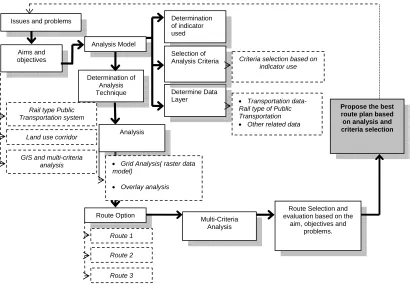
There are four main stages involves in the implementation of this research (Figure 1),
which are:
a) to identify the objectives and evaluation criteria
b) to implement the multi-criteria analysis,
c) the generation of alternative route
d) evaluation and selection of route
In creating the best possible route, the selection of criteria also has to be selected
thoroughly in order to meet the objectives set for the rail-based public transportation.
Determining an accurate and reliable criterion is crucial in the outcome of the
Figure 1: Research Methodology
Establishing Research Objectives and Selection of Criteria
Planning philosophy and policy formulation are vital for the development of a public
transportation system particularly in highly populated areas (Wong & Lam, 2006).
Therefore, one of the key aspects of the research is to establish the critical strategic
policies effecting the development of public transport in the study area. In
determining the LRT railroad development corridor, the transportation strategic
policies is translated into criteria to provide the basis for selecting suitable
development area that take into consideration various factors. This selected criterion
is also base on the strategic policies stipulated by the Kuala Lumpur Structure Plan
(PSKL) which will form the basis in generating scenario development for the case
study.
Issues and problems
Aims and objectives
Analysis Model
Determination of Analysis Technique
Route Selection and evaluation based on the
aim, objectives and problems.
Propose the best route plan based on analysis and criteria selection
Determination of indicator used
Route Option
Route 1
Route 2
Route 3
Determine Data
Layer • Transportation
data-Rail type of Public Transportation
• Other related data
Selection of
Analysis Criteria Criteria selection based on
indicator use
Analysis
• Grid Analysis( raster data model)
• Overlay analysis Rail type Public
Transportation system
Land use corridor
GIS and multi-criteria analysis
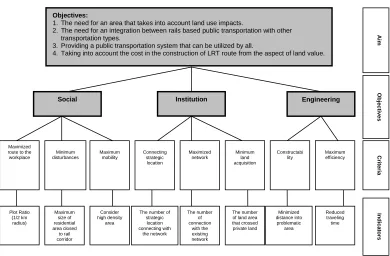
The objective based criteria are then further refined and detailed out into sub-criteria
and indicators. This is based on a study carried out by the Federal Town and
Country Planning on rail based public transportation, and agreed upon with various
stake holders in Klang Valley Region where the study area is located (Figure 2).
Figure 2: Hierarchy of Aims, Objectives, Criteria and Indicators
To carry out the analysis in GIS, the criteria is translated into a series of conditions
that meet the objectives explained earlier. These classifications of conditions are then
used in the spatial analysis using the required data, and the potential transportation
nodes and services can be identified (Table 3). The criteria are assumed to have
taken account all related rail transportation problems that have been identified in the
Kuala Lumpur Structure Plan and the study by the Town and Country Planning
Department.
Table 3: Relationship between Objectives, Indicators and Data
Social Institution Engineering
Ob je ctive s C rit e ria Maximized route to the workplace Minimum disturbances Maximum mobility Connecting strategic location Maximized network Minimum land acquisition Constructabi lity Maximum efficiency In dic a to rs Plot Ratio (1/2 km radius) Maximum size of residential area closed to rail corridor Consider high density area
The number of strategic location connecting with the network The number of connection with the existing network The number of land area that crossed private land Minimized distance into problematic area Reduced traveling time Aim Objectives:
1. The need for an area that takes into account land use impacts.
2. The need for an integration between rails based public transportation with other transportation types.
3. Providing a public transportation system that can be utilized by all.
OBJECTIVES CRITERIA INDICATORS DATA
Maximizing routes to workplace
Radius 0.5km from the LRT station
Minimizing disturbances
To limit the number and size of residential area located closed to LRT corridor
Residential area Industrial Area Commercial Area Institutional
To consider high and low density
residential area at suitable location (40-60 persons per acre) The need for an
area that consider land use impact (accessibility, type of activities, surrounding development)
Maximizing mobility To identify
concentrations of workplace in relation to industrial, commercial, place of worships and educational area.
Residential area Industrial Area Commercial Area Place of worships Educational area Institutional buildings
The need for an integration between rail type
transportation with other modes of public transportation
Maximizing network
To ensure existing network are connected with new rail network.
Public transport terminal
To provide a public transportation system that can be used by all levels of public
Connecting strategic location
The number of strategic locations linked to the rail network
Neighborhood Center
Residential Area Institutional buildings
To consider the planning process and operational cost of the development corridor
To consider land value
The number of intersections with private land Land Ownership To consider environmental needs Constructability Minimized intersections with constraint areas Land Ownership Environmental Sensitive Areas Model Analysis
Given reliable data and using a suitable method of analysis, Geographic Information
System (GIS) is seen as an effective tool to generate alternatives in the selection and
Decision Support System (DSS) multi-criteria approach is undertaken using a grid
base GIS data layer. The DSS using a combination of GIS data, urban model and
computer presentation technique has been proven to be an effective tool to improved
planning decisions (Ludin and Yaakup, 2006). By incorporating spatial data, the
Spatial Decision Support System (SDSS) structure and information access make
possible to visualize the world in ‘reality’ and support the capabilities for analyzing,
prediction and making planning decisions about development (Brail and Klosterman,
2001).
In this study, a DSS software DEFINITE is used to evaluate development alternatives
of the LRT railroad alignment and corridor. A 20m x 20m grid base data layers are
generated from the existing raw data to support the analysis. In general, the DSS
involve 4 basic steps, i.e. (1) identifying assessment criteria, (2) determining scale
measurement for criteria assessment, (3) the multi criteria analysis, and (4) sensitivity
analysis and uncertainties analysis. Steps (1) and (2) has been explained in 2.1,
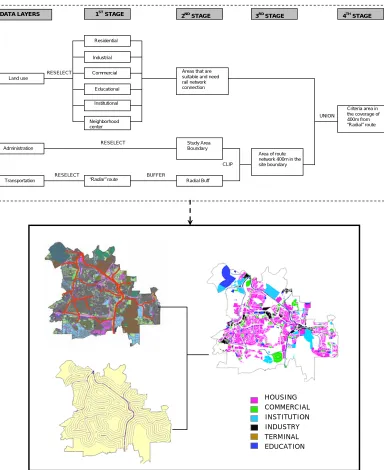
while steps (3) and (4) will be explain in 2.3 and 2.4. Figure 4 shows an example of
the model in generating the predetermined alternatives.
Generation of Alternatives
This study has selected three types of railroad layout which are ‘branch’, ‘loop’ and
‘radial’ in generating development alternatives. Using spatial analysis model, all
three types of routes will be tested on its effectiveness and sensitivity towards the
environment and other physical criteria in providing the necessary urban LRT railroad
services. The non-spatial analysis component will be analyzed in an external
environment. It is important to note however, that the analysis need to provide the
capability to maximized the output such as maximizing route to workplace,
connecting strategic locations and maximizing network. As such, all the three routes;
‘branch’, ‘loop’ and ‘radial’ will be evaluated against the set criteria that has been
selected. Constraint areas identified will also be analyzed with the criteria. An
optimal route will then be selected after rigorous and iterative analysis done on the
Evaluation and Selection of Alternatives
Figure 4: Example of a Model and Grid Analysis for ‘Radial’ Route.
DATA LAYERS 1ST
STAGE
Land use
Residential
Commercial
Educational
Institutional
Neighborhood center
Administration
Transportation “Radial” route
Areas that are suitable and need rail network connection
Study Area Boundary
Radial Buff
Criteria area in the coverage of 400m from “Radial” route RESELECT
RESELECT
RESELECT BUFFER
CLIP
UNION
Area of route network 400m in the site boundary 2ND
STAGE 3RD
STAGE 4TH
STAGE
Industrial
To facilitate in the evaluation and selection for an optimal rail route, as explained
earlier this research used DEFINITE 2.0, whereby it will be carried out in a
non-spatial analysis environment. Although ArcGIS application could not be used
interactively with DEFINITE software, it is capable to interpret the output of the
analysis (spatial data) to non-spatial data accurately to be interpreted into a table
format required for evaluation.
At this stage, the value set for the criteria and sub-criteria is crucial to the outcome of
the analysis. The criteria and sub-criteria unit are determined in quantitative value
(such as the land area and total population) or in qualitative form (‘+++ () ---‘). Each
criterion is also established whether it is in the form of cost (-) which means the
higher the value score, the lesser its contribution towards the route selection and vice
versa (Figure 5). Grid analysis in ArcGIS is used to determine each of the criteria
score. Each value is inserted to a map prior to the selection and evaluation analysis.
The final stage is to allocate weight-age to the criteria and sub-criteria according to its
strategic importance as described earlier. The results shows that ‘branch’ layout are
sensitive to social objectives, while ‘radial’ are significantly sensitive to institutional
objectives and environment objectives. Overall, the ‘radial’ design provides the
highest ranking (0.81) compared to ‘branch’ (0.70) and ‘loop’ (0.70) (Figure 6). The
analysis also shows that the outputs are sensitive to change in the value of the
weight-age in the main criteria and sub-criteria. Thus, the criteria are tested
iteratively using the Sensitivity Analysis and Uncertainties Analysis available in the software before the result is finalized.
Conclusion
The research demonstrates that multi-criteria analysis can be implemented in public
transportation planning to select the best railroad route plan for LRT. The research
that has been carried out also present the capability of ArcGIS to be integrated with
other non-spatial software applications. The databases can be extensively examined
to generate alternative solutions related to public transportation. This research
analysis model. The selected criteria need to be carefully examined, prioritized and
applied to the model.
Figure 5: Objectives, Criteria and Sub-Criteria Used in the Evaluation and Selection of Rail Route
It is important to note that, this technique is also applicable to other development
sectors such as in the selection of suitable land use or development proposal (Ludin
& Yaakup, 2006). This technique also provides a platform where spatial and
non-spatial data can be analyze together and provide a desirable and significant result to
the user that can be used by decision makers to locate optimal development nodes
and about the best use of land. In addition, there should also be a continuous effort
to search for innovative practices in the planning and development aspects of the
public transit schemes to ensure that it is in line with the ever changing demand of
the urban community.
References
Bickel, R.G., n.d, Key Issues Confronting Public Transportation Planning and Development,
Delaware Valley Regional Planning Commission.
Brail, R.K. and Klosterman, R.E. (2001) Planning Support System: Integrating Geographical
Information Systems, Models and Visualization Tools, ESRI Press, Redland.
Boerboom, L., M.A Sharifi, Kamalruddin Shamsuddin and Asanul Kabir (2004) Spatial
Multi-Criteria Evaluation To Enhance Governance: change in Malaysian Planning, GISDECO 2004: Seventh International on GIS in Developing Countries. Universiti Teknologi Malaysia 10-12 Mei 2004.
ESRI (1996), Using the Arc View Network Analyst, Environmental System Research Institute,
United States.
ESRI (1995), Understanding GIS the Arc Info Method, Environmental System Research
Institute, United States.
Jenssen, R.Herwijnen, dan Beinet E.. (2001). DEFINITE: Case Study and User Manual.
Report No.R-01/01, Institute for Environment Studies. Vrije Universitiet Amsterdam, The Netherland.
Kamalruddin Shamsuddin. (2002). Spatial Multi-Criteria Decision Making: A Methodology for
Generating and Evaluating Development Plans, World Town Planning Day Workshop, Kedah.
Ludin, A.N.M. and Yaakup, A. (2006) Scenario-based Spatial Modelling for Land Use Planning
and Evaluation, Map Malaysia 2006: Geospatial Information & Knowledge Economy, Kuala Lumpur.
Projek Usahasama Transit Aliran Ringan Automatik (1994), Light Rail Transit System Two for
Kuala Lumpur, Unpublished Report.
Transportation Research Board (1989), Light Rail Transit : New System Successes at Affordable Prices, National Conference on LRT, San Jose, California.
White.P.,(1995). Public Transport : Its Planning, management and operation, University of
Westminster.England.
Wong, S.C. and Lam, W.H.K., 2006, Planning and Policy of Public Transportation Systems in