• No results found

Comparing three methods of handling multicollinearity using simulation approach

N/A
N/A
Protected

Academic year: 2020

Share "Comparing three methods of handling multicollinearity using simulation approach"

Copied!
33
0
0

Loading.... (view fulltext now)

Full text

(1)

NORLIZA BINTI ADNAN

(2)

COMPARING THREE METHODS OF HANDLING MULTICOLLINEARITY

USING SIMULATION APPROACH

NORLIZA BINTI ADNAN

A thesis submitted in fulfilment of the

requirements for the award of the degree of

Master of Science (Mathematics)

Faculty of Science

Universiti Teknologi Malaysia

(3)

To

My loving and supportive parents,

Hj Adnan and Pn Ramnah

My siblings,

Hairil, Aizam, Haffiz and Sarah

and

(4)

iv

ACKNOWLEDGEMENT

“I

n

the name od ALLAH the All-Merciful, The All-Compassionate. All praise be to

ALLAH

f

or

gi

v

i

ng

me

t

he

s

t

r

e

ngt

h

and

c

our

age

t

o

c

ompl

e

t

e

t

hi

s

t

he

s

i

s

A very great gratitude and appreciation expressed to all those who make a part to

the successful cease of this thesis either directly or indirectly. Particularly, I wish to

express my sincere appreciation to my main thesis supervisor, Dr. Maizah Hura binti

Ahmad, for encouragement, guidance, critics and motivation. I am also very thankful to

my co-supervisor Dr. Robiah binti Adnan for her guidance, advices and motivation.

Without their continued support and interest, this thesis would not have been the same as

presented here. An appreciation also goes to the Universiti Teknologi Malaysia for

financial support.

(5)

ABSTRACT

(6)

vi

ABSTRAK

(7)

TABLE OF CONTENTS

CHAPTER

SUBJECT

PAGE

COVER

i

DECLARATION

ii

DEDICATION

iii

ACKNOWLEDGEMENT

iv

ABSTRACT

v

ABSTRAK

vi

TABLE OF CONTENTS

vii

LIST OF TABLES

x

LIST OF FIGURES

xiv

LIST OF SYMBOLS

xvii

LIST OF APPENDICES

xix

1

INTRODUCTION

1.1

Background

1

1.2

The Problem of Multicollinearity

2

1.3

Statement of Problem

5

1.4

Research Objectives

5

1.5

Scope of Research

5

(8)

viii

2

LITERATURE REVIEW

2.1

Introduction

7

2.2

Ordinary Least Squares Regression

7

2.3

Multicollinearity Problem in Regression Analysis

10

2.3.1

Explanation of Multicollinearity

10

2.3.2

Effects of Multicollinearity in Least Squares

Regression

13

2.3.3

Multicollinearity Diagnostics

23

2.3.3.1 Informal Diagnostics

24

2.3.3.2 Formal Methods

25

2.4

Concluding Remarks

32

3

METHODS FOR HANDLING MULTICOLLINEARITY

3.1

Introduction

34

3.2

Partial Least Squares Regression

35

3.2.1

The construction of

k

components

37

3.2.2

Regress the response into

k

components

40

3.3

Principal Components Regression

49

3.3.1

The construction of

k

components

50

3.3.2

Regress the response into

k

components

53

3.3.3

Bias in Principal Components Coefficient

54

(9)

4

SIMULATION AND ANALYSIS

4.1

Introduction

71

4.2

Generating Simulated Data Sets

72

4.3

Performance Measures

76

4.4

Simulation Results

78

4.4.1

Partial Least Squares Regression

82

4.4.2

Principal Component Regression

104

4.4.3

Ridge Regression

116

5

COMPARISONS ANALYSIS AND DISCUSSIONS

5.1

Introduction

125

5.2

Performance on Classical Data

125

5.3

Performance on Simulated Data Sets

127

5.4

Comparison Analysis

134

5.5

Discussions

142

6

SUMMARY, CONCLUSIONS AND FUTURE RESEARCH

6.1

Introduction

145

6.2

Summary

145

6.3

Significant Findings and Conclusions

147

6.4

Future Research

149

(10)

x

LIST OF TABLES

TABLE NO.

TITLE

PAGE

3.1

Tobacco Data

45

3.2

Variance Inflation Factors for Tobacco Data

46

3.3

PLS weights vectors, rk

for the PLS Components

46

3.4

Loadings for the PLS Components

47

3.5

PLS Components

47

3.6

RMSE values for

k

components

48

3.7

MSE values for

k

components

49

3.8

The correlation matrix

58

3.9

The eigenvalues of the correlation matrix

58

3.10

Matrix of eigenvectors

58

3.11

The principal components

59

3.12

Values of

C

and the regression coefficients for various

values of

69

4.1

Factors and levels for the simulated data sets

72

4.2

The specific values for

x

ip

for each sets of

p

regressors

74

4.3

The response variable,

y

for each sets of

p

regressors

74

4.4

The

VI

F’

s

va

l

ue

s

f

or

t

he

c

hoi

c

e

of

t

he

va

r

i

a

nc

e

,

for noise

matrix (

)

75

(11)

4.9

Regression model for

p

= 2 regressors for

n =

100

80

4.10

Regression model for

p

= 4 regressors for

n

= 100

80

4.11

Regression model for

p

= 6 regressors for

n

= 100

81

4.12

PLS weights,

r

i

for the PLS Components for

p

= 2 regressors 83

4.13

PLS weights,

r

i

for the PLS Components for

p

= 4 regressors 83

4.14

PLS weights,

r

i

for the PLS Components for

p

= 6 regressors 83

4.15

PLS weights,

r

i

for the PLS Components for

p

=50 regressors 84

4.16

PLS loadings,

p

i

for the PLS Components for

p

=2 regressors 85

4.17

PLS loadings,

p

i

for the PLS Components for

p

=4 regressors 85

4.18

PLS loadings,

p

i

for the PLS Components for

p

=6 regressors 85

4.19

PLS loadings,

p

i

for the PLS Components for

p=50 regressors 86

4.20

Correlations between each PLS components and

y

87

4.21

Correlation between each components

89

4.22

RMSE values for

p

= 2 data sets

97

4.23

RMSE values for

p

= 4 data sets

97

4.24

RMSE values for

p

= 6 data sets for first five

PLS components

97

4.25

RMSE values for

p

= 50 data sets for first five

PLS components

97

4.26

Regression model using all the PLS Scores for

p =

2

and

n

= 100

99

4.27

Regression model using all the PLS Scores for

p =

4

and

n

= 100

100

4.28

Regression model using selected PLS Scores

for

p

= 4 (kopt

= 1)

101

4.29

Regression model using selected PLS Scores (

kopt

= 5 )

for

p =

6 and

n

= 100

102

4.30

The eigenvalues of the correlation matrix

105

4.31

Matrix of eigenvectors

106

4.32

Percentage of variance explained and the eigen values

(12)

xii

4.33

Percentage of variance explained and the eigen values

of the

p

= 4

108

4.34

Percentage of variance explained and the eigen values

of the

p

= 6

108

4.35

Percentage of variance explained and the eigen values

of the

p

= 50

109

4.36

Regression model using all the PC scores for

p =

2

and

n

= 100

111

4.37

Regression model using selected PC scores (PC

1

) for

p =

2 and

n

= 100

111

4.38

Regression model using all the PC scores for

p =

4

and

n

= 100

112

4.39

Regression model using selected PC scores (PC

1

) for

p =

4 and

n

= 100

113

4.40

Regression model using all the PC scores for

p =

6

and

n

= 100

114

4.41

Regression model using selected PC scores (PC

1

) for

p =

6 and

n

= 100

114

4.42

Values of

,

C

and coefficient vectors employed for

p

= 2 and

n

= 100

119

4.43

Values of

,

C

and coefficient vectors employed for

p

= 4 and

n

= 100

120

4.44

Values of

,

C

and coefficient vectors employed for

p

= 6 and

n

= 100

121

5.1

Performance of PLS, PC and RR methods on

classical data sets

126

(13)

5.6

MSE values for

p

= 2 and specified

n

= 20, 30, 40, 60, 80

and 100

131

5.7

MSE values for

p

= 4 and specified

n

= 20, 30, 40, 60, 80

and 100

131

5.8

MSE values for

p

= 6 and specified

n

= 20, 30, 40, 60, 80

and 100

135

5.9

MSE values for

p

= 50 and specified

n

= 60, 80 and 100

135

5.10

Summary of the performances of the three methods

with

p

= 2

142

5.11

Summary of the performances of the three methods

with

p

= 4

142

5.12

Summary of the performances of the three methods

with

p

= 6

143

5.13

Summary of the performances of the three methods

(14)

xiv

LIST OF FIGURES

FIGURE NO.

TITLE

PAGE

1.1

Multicollinearity in simple linear regression

3

1.2

Multicollinearity in multiple linear regression

4

2.1

Picket Fences illustrations

15

2.2

The choice of VIF value against the R-square value.

29

3.1

Steps in SIMPLS algorithm

42

3.2

Steps in Principal Component Regression algorithm

56

3.3

The sampling distribution of biased and unbiased estimator

61

3.4

Steps in Ridge Regression algorithm

67

3.5

Plot of

C

against

70

4.1

Flowchart summarizing performance assessment

of methodology

77

4.2

Correlation between x1 and x2 for

p

= 2 regressors

88

4.3

Correlation between first and second components

for

p

= 2 regressors

89

4.4

Correlation between each components for

p

= 4 regressors

90

4.5

Correlation between each components for

p

= 6 regressors

92

4.6

X- and Y-scores for

p

= 2 regressors

(First and second components)

94

4.7

X- and Y-scores for

p

= 4 regressors (All components)

94

4.8

Correlation between first five components of

p

= 6

(15)

4.10

Plot of

against

C

for

p

= 4 and

n

= 100

117

4.11

Plot of

against

C

for

p

= 6 and

n

= 100

118

4.12

Plot of

against

C

for

p

= 50 and

n

= 100

118

5.1

Plot of regression coefficients against number of regressors

126

5.2

Plot of

R

2

against

m

= 100 replications for

p

= 2 for

specified

n =

20

128

5.3

Plot of

R

2

against

m

= 100 replications for

p

= 2 for

specified

n =

100

128

5.4

Plot of

R

2

against

m

= 100 replications for

p

= 4 for

specified

n =

20

131

5.5

Plot of

R

2

against

m

= 100 replications for

p

= 4 for

specified

n =

100

131

5.6

Plot of

R

2

against

m

= 100 replications for

p

= 6 for

specified

n =

20

132

5.7

Plot of

R

2

against

m

= 100 replications for

p

= 6 for

specified

n =

100

132

5.8

Plot of

R

2

against

m

= 100 replications for

p

= 50 for

specified

n =

60

133

5.9

Plot of

R

2

against

m

= 100 replications for

p

= 50 for

specified

n =

100

133

5.10

Plot of MSE values against

m

= 100 replications for

p

= 2 for

n =

20

138

5.11

Plot of MSE values against

m

= 100 replications for

p

= 2 for

n =

100

138

5.12

Plot of MSE values against

m

= 100 replications for

p

= 4 for

n =

20

139

5.13

Plot of MSE values against

m

= 100 replications for

p

= 4 for

n =

100

139

5.14

Plot of MSE values against

m

= 100 replications for

(16)

xvi

5.15

Plot of MSE values against

m

= 100 replications for

p

= 6 for

n =

100

140

5.16

Plot of MSE values against

m

= 100 replications for

p

= 50 for

n =

60

141

5.17

Plot of MSE values against

m

= 100 replications for

(17)

LIST OF SYMBOLS

y

Response (dependent) variable

x

Predictor (independent) variable

Parameter (regression coefficient), known constant

Error

2

Variance

Y

Matrix of observations

X

Matrix of predictors

β

Vector of parameters

ε

Vector of error matrix term

I

Identity matrix

ˆ

Estimate regression coefficient

β

ˆ

Vector of estimate regression coefficient

y

ˆ

Fitted value

H

Hat matrix

hii

ith diagonal element of hat matrix

e

Residual term

e

Vector of residual term

n

Number of observations

p

Number of regressors

Shrinkage parameter

(18)

xviii

P

Matrix of

x-loadings

r

PLS weight vectors

k

Number of components for PLS and PCR

R

2

Coefficient of Determination

Z

Components for Principal Component Regression

(19)

ABBREVIATIONS

MEANING

CI

Condition Indices

cov

Covariance

GCV

Generalized Cross Validation

LS

Least Squares

max

Maximum

MSE

Mean Square Error

OLS

Ordinary Least Squares

PCR

Principal Component Regression

PLSR

Partial Least Squares Regression

RMSE

Root Mean Square Error

RR

Ridge Regression

(20)

xx

LIST OF APPENDICES

APPENDIX

TITLE

PAGE

A

S-PLUS codes for data generating function

156

B

S-PLUS codes and simulation results for Partial Least

Squares Regression method in Chapter IV

162

C

S-PLUS codes and simulation results for Principal

Component Regression method in Chapter IV

182

D

S-PLUS codes and simulation results for Ridge

Regression method in Chapter IV

200

E

S-PLUS code for classical data set

215

(21)

INTRODUCTION

1.1

Background

Regression analysis is one of the most widely use of all statistical tools that

utilizes the relation between two or more quantitative variables so that one variable can

be predicted from the others. The relationship of each predictor to the criterion is

measured by the slope of the regression line of the criterion

Y

on the predictor. The

regression coefficients are the values of these slopes.

The multiple linear regression model relates

Y

to

X

1

,

X

2

,...,

X

p

and can be

expressed in terms of matrices as

y

X

β

ε

where

y

is the

nx1 vector of observed

response values,

X

is the

nxp

matrix of

p

regressors,

β

is the

px1 regression

(22)

2

linear regression model may be used to identify important regressor variables that can be

used to predict future values of the response variable.

The method of least squares is used to find the best line that on the average, is

closest to all points. In other words, to find the the best estimates of

s

wi

t

h

t

he

l

e

a

s

t

squares criterion which minimizes the sum of squared distances of all points from the

actual observation to the regression surface. The name least squares comes from

minimizing the squared residuals. From the Gauss-Markov theorem, least squares is

always the best linear unbiased estimator (BLUE) and if

is assumed to be normally

distributed with mean 0 and variance

2

, then least squares is the uniformly minimum

variance unbiased estimator.

1.2

The Problem of Multicollinearity

In the applications of regression analysis, multicollinearity is a problem that

always occurs when two or more predictor variables are correlated with each other. This

problem can cause the value of the least squares estimated regression coefficients to be

conditional upon the correlated predictor variables in the model. As defined by

Bowe

r

ma

n

a

nd

O’

Conne

l

l

(

1990)

,

mul

t

i

c

ol

l

i

ne

a

r

i

t

y

i

s

a

pr

obl

e

m

i

n

r

egr

e

s

s

i

on

a

na

l

ys

i

s

when the independent variables in a regression model are intercorrelated or are dependent

on each other.

(23)

using some method of estimation or some modifications of the method of least squares

for estimating the regression coefficients.

The problem of multicollinearity can occur in both simple linear regression and

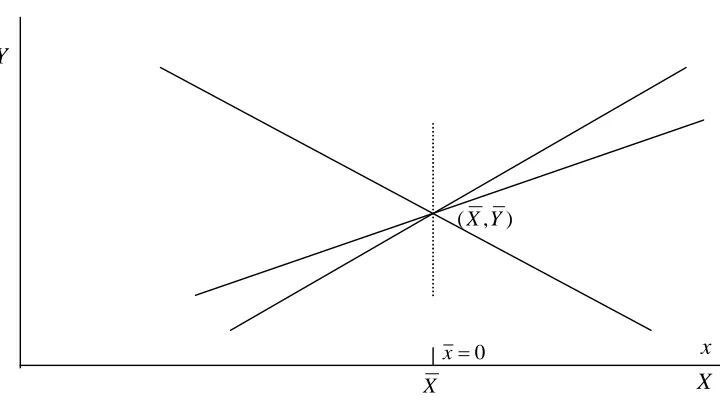
multiple linear regression. Figure 1.1 illustrates the problem of multicollinearity that

occur in simple regression (Wannacott and Wannacott, 1981). The figure shows how the

estimate

ˆ

becomes unreliable if the

Xi

s

wer

e

c

l

os

e

l

y

bunc

he

d,

t

ha

t

i

s

,

i

f

t

he

r

e

gr

e

s

s

or

X

had little variation. When the

Xi

s

a

r

e

c

onc

e

nt

r

a

t

e

d

on

one

s

i

ngl

e

va

l

ue

X

, then

ˆ

is not

determined at all. For each line, the sum of squared deviations is the same, since the

deviations are measured vertically from

(X,Y)

. If

XiX

, then all

xi

= 0, and the term

involving

β

ˆ

is zero. Hence, the sum of squares does not depend on

β

ˆ

at all. Therefore,

when the values of

X

show little or no variation, then the effect of

X

on

Y

can no longer

be sensibly investigated. The best fit for

Y

for data with multicollinearity was not a line,

but rather a point

(X,Y)

. In explaining

Y, multicollinearity makes the

X

i

s

l

os

e

one

dimension.

Figure 1.1

:

Multicollinearity in simple regression

X

0 

x

x

X

Y

(24)

4

Figure 1.2 illustrates the problem of multicollinearity in multiple regression

(Wannacott and Wannacott, 1981). All the observed points in the scatter plot lie in the

vertical plane running up through

L. In explaining

Y, multicollinearity makes the

Xi

s

l

os

e

one dimension and the best fit for

Y

is not a plane but instead the line

F.

Figure 1.2

:

Multicollinearity in multiple regression

(25)

1.3

Statement of Problem

This study will explore the following question :

Which method among Principal Component Regression, Partial Least Squares

Regression and Ridge Regression performs best as a method for handling

multicollinearity problem in regression analysis ?

1.4

Research Objectives

1.

To compare the use of Partial Least Squares Regression, Principal Component

Regression and Ridge Regression for handling multicollinearity problem.

2.

To study the degree of efficiency among the three methods and hence rank them

in terms of their capabilities in overcoming the multicollinearity problem using

simulated data sets.

1.5

Scope of Research

For this research, the problem is focused on the analysis of multicollinearity

problems in regression analysis using simulated data sets.

In Principal Component Regression, features from Principal Component Analysis

(PCA) and multiple regression are combined to handle multicollinearity. The principal

components computed a linear combinations of the explanatory variables (regressors).

The Partial Least Squares Regression method is similar to Principal Component

(26)

6

components called latent vectors that performs a simultaneous decomposition of

X

and

Y

with the constraint that those component explain as much as possible of the covariance

between

X

and

Y. This step generalizes PCA and it is followed by a regression step where

the decomposition of

X

is used to predict

Y.

The other method considered is the Ridge Regression. It is performed by adding a

small biased estimator to the elements on the diagonal of the matrix

(

X'

X

)

to be

inverted, that is modifications of the least squares estimator.

1.6

Summary and Outline of Research

The goal of this research is to find the best procedure and method to handle

multicollinearity problems by comparing the performances of the three methods to

determine which method is superior than the others in terms of its practicality and

efficiency. Practicality means how effective or convenient a method is in actual use while

efficiency means how well the methods work in producing the best regression model and

measured by a specified test discussed in Chapter 4. Basically three different methods are

put forward, two of which are the methods with two-step procedures where it computes a

component(s) and then regressed it on the response variable. The third method is a

modification of the least squares method that allows biased estimators of the regression

coefficients. The algorithms for each method used in this study are shown in Chapter 3.

(27)

variable. The advantages of PCR are that hypothesis testing can be performed, and that

complete optimisation is used in determining the PCs.

6.4

Future Research

The performance of the three methods can also be done by comparing the use of

all methods for high-dimensional regressors where

p

>

n.

It is known that the problem of

multicollinearity is present in the data set where the number of variables is high compared

to the number of observations.

(28)

150

REFERENCES

Abdi, H., (2003a).

Least Squares. In M. Lewis-Beck, A. Bryman, T. Futing (Eds):

Encyclopedia for research methods for the social sciences. Thousand Oaks (CA):

Sage.

Abdi, H., (2003b).

Partial Least Squares Regression (PLS regression). In M.

Lewis-Beck, A. Bryman, T. Futing (Eds):

Encyclopedia for research methods for the

social sciences. Thousand Oaks (CA): Sage.

Afifi, A.A. and Clark, Y., (1984).

Computer-aided multivariate analysis.

Lifetime

Learning Publications, Belmont, California.

Barker, M., (1997).

A Comparisons of Principal Component Regression and Partial

Least Squares Regression. Multivariate Project.

Bj

Ö

kstr

Ö

m, A., (2001).

Ridge Regression and Inverse Problem. Research Report.

Stockholm University, Sweden.

Bj

Ö

kstr

Ö

m, A. and Sundberg, R., (1999).

A Generalized View on Continuum

Regression.

Scandinavian Jornal Statistics

.

25

: 17

30.

Bowe

rman,

B.

L.

and

O’

Conne

l

l

,

R.

T.

(

1990)

.

Linear Statistical Models an Applied

(29)

Boeris, M.S., Luco, J.M. and Olsina, R.A., (2000).

Simultaneous Spectrophotometric

Determination of Phenobarbital, Phenytoin and Methylphenobarbital in

Pharmaceutical Preparations by Using Partial Least Squares and Principal

Component Regression Multivariate Calibration.

Journal of Phamaceutical and

Biomedical Analysis.

24

: 259

271.

De Jong, S. (1993),

SIMPLS: An Alternative Approach to Partial Least Squares

Regression.

Chemometrics and Intelligent Laboratory Systems.

18

: 251

263.

De Jong, S., Farebrother and R.W., (1994).

Extending the Relationship Between Ridge

Regression and Continuum Regression.

Chemometrics and Intelligent Laboratory

Systems.

25

: 179

181.

Dempster, A.P., Schatzoff, M. and Wermuth, N., (1977).

A Simulation Study of

Alternatives to Ordinary least Squares.

Journal of the American Statistical

Association.

72

: 77

91.

Dijkstra, T. (1983),

Some Comments on Maximum Likelihood and Partial Least Squares

Methods.

Journal of Econometrics.

22

: 67

90.

Dijkstra, T. (1985),

Latent Variables in Linear Stochastic Models: Reflections on

Maximum Likelihood and Partial Least Squares Methods.

Second Edition,

Amsterdam, The Netherlands: Sociometric Research Foundation.

Engelen, S., Hubert, M., Vanden B.K. and Verboven, S. (2003). Robust PCR and

Robust PLSR: a comparative study.

Theory and Applications of Recent Robust

Methods. edited by M. Hubert, G. Pison, A. Struyf and S. Van Aelst, Series :

Statistics for Industry and Technology, Birkhauser, Basel.

(30)

152

Filzmoser, P., Croux, C., (2002).

A Projection Algorithm for Regression with

Collinearity.

Classification, Clustering and Data Analysis, 227

234.

Filzmoser, P., Croux, C., (2003).

Dimension Reduction of the Explanatory Variables in

Multiple Linear Regression.

Pliska Studia Mathematica Bulgaria.

14

: 59

70.

Garthwaite, P.H., (1994).

An Interpretation of Partial Least Squares.

Journal of the

American Statistical Association.

89

: 122

127.

Geladi, P., Kowalski, B.R., (1986a).

Partial Least-Squares Regression: A Tutorial.

Analytica Chimica Acta.

185

: 1

17.

Geladi, P., Kowalski, B.R., (1986b). An Example of 2-Block Predictive Partial Least

Squares Regression with Simulated Data.

Analytica Chimica Acta.

185

:

19

32.

Gibbons, D.G., (1981).

A Simulation Study of Some Ridge Estimators.

Journal of the

American Statistical Association.

76

: 131

139.

Gruber, M.H.J., (1990).

Regression Estimators : A Comparative Study.

California :

Academic Press

Hair, J. F., Anderson, R.E., Tatham, R.L. and Black, W.C., (1998).

Multivariate Data

Analysis.

5th Ed., New Jersey : Prentice Hall.

Hansen, P.M. and Schjoerring, J.K., (2003).

Reflectance Measurement of Canopy

Biomass and Nitrogen Status in Wheat Crops Using Normalized Difference

Vegetation Indices and Partial Least Squares.

Remote Sensing of Environment.

86

: 542

553.

(31)

Hocking, R.R, (1996).

Methods and Applications of Linear Models : Regression and the

Analysis of Variance.

USA : John Wiley & Sons.

Hoerl, R.W., Schuenemeyer, J.H. and Hoerl, A.E., (1986).

A Simulation of Biased

Estimation and Subset Selection Regression Techniques.

Technometrics.

28(4)

:

369

380.

Hoerl, A.E., Kennard, R.W., (1970).

Ridge Regression : Biased Estimation to

Nonorthogonal Problems.

Technometrics.

12

: 56

67.

Hubert, M., Branden .K.V.,

(2003a).

Robust methods for Partial Least Squares

Regression,

Journal of Chemometrics.

17

: 537-549.

Hubert, M., Branden .K.V.,

(2003b).

Robustness properties of a robust Partial Least

Squares Regression,

Journal of Chemometrics. 17

: 537-549.

Hwang, J.T., Nettleton, D., (2000).

Principal Components Regression With

Data-Chosen Components and Related Methods.

Technometrics.

45

: 70

79.

Jennrich, R.I., (1995).

An Introduction to Computational Statistics : Regression Anaysis.

New Jersey : Prentice Hall.

Kvalheim, O. M. (1987).

Latent-structure decompositions (projections) of multivariate

data.

Chemometrics and Intelligent Laboratory Systems.

2

: 283

290

Kleinbaum, D.G., Kupper, L.L., Muller, K.E. and Nizam, A., (1998).

Applied

Regression Analysis and Other Multivariable Methods.

USA : DUXBURY Press.

Li, B., Martin, E.B. and Moris, A.J., (2001).

Box-Tidwell Transformation Based Partial

Least Squares Regression.

Computers and Chemical Engineering.

25

: 1219

1233.

(32)

154

Miller, A.J., (1990).

Subset Selection in Regression. Chapman & Hall, New York.

Myers, R.H.,

(1986).

Classical and Modern Regression With Applications.

2nd Ed.

USA : PWS-KENT Publishing Company.

Neter, J., Wasserman, W. and Kutner, M.H., (1985).

Applied Linear Statistical

Models. 2nd Ed. USA : IRWIN.

Neter, J., Wasserman, W. and Kutner, M.H., (1990).

Applied Linear Regression

Models. 3rd Ed. USA : IRWIN Book Team.

Neter, J., Kutner, M.H., Nachtseim, C.J. and Wasserman, W., (1996).

Applied Linear

Statistical Models.

4th Ed. USA : Irwin Bokk Team.

Ozcelik, Y., Kulaksiz S. and Cetin, M.C., (2002).

Assessment of the Wear of Diamond

Beads in the Cutting of Different Rock Types by the Ridge Regression.

Journal of

Materials Processing Technology.

127

: 392

400.

Rougoor, C.W., Sundaram, R. and Van Arendonk, J.A.M., (2000).

The Relation

Between Breeding Management and 305-day Milk Production, Determined via

Principal Components Regression and Partial Least Squares.

Livestock Product

Science.

66

: 71

83.

Serneels, S. and Van Espen, P.J., (2003).

Sample specific prediction intervals in

SIMPLS. In

PLS and related methods, Ed. Vilares, M., Tenenhaus, M., Coelho,

P., Esposito, V., Vinzi and Morineau, A., DECISIA, Levallois Perret (France),

219

233.

Stone, M. and Brooks, R.J., (1990).

Continuum Regression : Cross-Validated

(33)

Sundberg, R.,

(1993).

Continuum Regression and Ridge Regression.

Journal of Royal

Statistics Society.

55

: 653

659.

Sundberg, R.,

(2002).

Continuum Regression. Article for 2nd Ed. of

Encyclopedia of

Statistical Sciences.

Tobias, R.D., (1997).

An Introduction to Partial Least Squares Regression. Cary, NC :

SAS Institute.

Wannacott, T.H. and Wannacott, R.J., (1981).

Regression :A Second Course in

Statistics.

USA : John Wiley & Sons.

Wesolowsky, G.O., (1976).

Multiple Regression and Analysis of Variance.

USA : John

Wiley & Sons.

Wold, H. (1966), Estimation of Principal Components and Related Models by Iterative

Least Squares. In

Multivariate Analysis, Ed. Krishnaiah, P.R., New York :

Academic Press, 391

420.

Wold, S. (1994),

PLS for Multivariate Linear Modeling.

QSAR: Chemometric Methods

in Molecular Design. Methods and Principles in Medicinal Chemistry, ed. H. van

de Waterbeemd, Weinheim, Germany: Verlag-Chemie.

Xie, Y.L. and Kalivas, J.H., (1997a).

Evaluation of Principal Component Selection

Methods to form a Global Prediction Model by Principal Component Regression.

Analytica Chimica Acta.

348

: 19

27.

Xie, Y.L. and Kalivas, J.H., (1997b).

Local Prediction Models by Principal Component

Regression.

Analytica Chimica Acta.

348

: 29

38.

Figure

Figure 1.1:
Figure 1.2:

References

Related documents

The fixed point alternative methods are implemented to give generalized Hyers-Ulam-Rassias stability for the Pexiderized quadratic functional equation in the fuzzy version.. This

On a channel follow- ing C , the serving endpoint would be able to perform as many sequences of sending a memory cell and then waiting for an acknowledgment as it wishes, and

Furthermore, we show that the contract type used in vertical trading can play a crucial role in the timing of technology adoption: adoption can occur earlier under two-part

Resource Guide for Miami-Dade County Ryan White Program Medical Case Managers* Addiction/Substance Abuse Treatment………..… 1-2?.

I All data must be read from blocks stored on different disks I Processing is performed only within DBMS node (not distributed) I Distribution handled by operating system.

New England Economy Healthcare Uninsured Social Security Reform Taxes Deficit Jobs Employee Outsourcing Tort Reform Medical Malpractice Reform

Facilitation and management of the process (school leader 6 and innovation agent 1); involvement of the institutional leaders in the camps (intrapreneur 1,