STUDENT PARTICIPATION MODEL IN E-LEARNING
SHAFFIKA BINTI MOHD SUHAIMI
A thesis submitted in partial fulfillment of the requirements for the award of the degree of Master of Science (Computer Science)
Faculty of Computing Universiti Teknologi Malaysia
iii
This thesis is dedicated to…
Suami, Mohamad Azrul Izwan who always give me full of supports and spirit without failed.
My lovely daughter, Aisya Haffiya who is really being a good baby when her ummi on her work.
iv
ACKNOWLEDGMENT
Alhamdulillah, I managed to complete my thesis successfully within the time frame given. Thank you to Allah.
I want to express my thank to both my supervisors Dr. Mohd Shahizan and PM Dr. Norazah. They treated me like I am their daughter. Thank you also for the advices and guidance. Their supports from the beginning of my journey are touched and I am blessed with their persistence.
Special thanks to my family especially my imam, husband, friend and also my brother. Thank you for being here all the times, the encouragements, supports and the shoulder to cry on.
Thanks to my mama and abah for believe in me. Believe what I am working on and what I choose in my life. My siblings, thank you for the time and the spirit to cheer me up when I am about to take it down.
v
ABSTRACT
vi
ABSTRAK
vii
TABLE OF CONTENT
CHAPTER TITLE PAGE
DECLARATION ii
DEDICATION iii
ACKNOWLEDGEMENT iv
ABSTRACT v
ABSTRAK vi
TABLE OF CONTENT vii
LIST OF TABLES xi
LIST OF FIGURES xiii
LIST OF ABBREVIATIONS xv
LIST OF SYMBOLS xvi
LIST OF APPENDICES xvii
1 INTRODUCTION
1.1 Overview 1
1.2 Research Background 3
1.3 Problem Statements 6
1.4 Research Objectives 7
1.5 Research Scope 7
viii
1.7 Research Flow Guidelines 8
1.8 Thesis Chapter Organization 10
2 LITERATUR REVIEW
2.1 Introduction 11
2.2 Learning 11
2.2.1 Learning Theories 14
2.2.2 Meaningful Learning 16
2.2.3 E-Learning 20
2.2.3.1 E-Learning Application In Malaysia Education
21
2.2.3.2 E-Learning Features 23 2.2.3.3 E-Learning In UTM 24 2.2.4 Social Learning Theory 27
2.3 Collaborative Learning 35
2.3.1 Collaborative Learning Model 39 2.3.2 Measuring Collaborative Learning 44
2.4 Summary 49
3 RESEARCH METHODOLOGY
3.1 Introduction 51
3.2 Operational Framework 51
3.2.1 Exploration and Identification Phase 53 3.2.2 Design and Development of the Proposed
Model Phase
54
3.2.2.1 Social Learning Component 56 3.2.2.2 Collaborative Learning Process
Component
ix
3.2.2.3 Collaborative Learning Assessment Component
59
3.2.3 Evaluation and verification Phase 63 3.2.2.1 E-Learning Usage and Student
Participation
63
3.2.2.3 Assessment Method 63
3.3 Population and Sampling 64
3.8 Summary 64
4 IMPLEMENTATION
4.1 Introduction 66
4.2 Knowledge Construction Task Project 66 4.3 Contextual Application Task Project 74
4.4 Summary 81
5 VALIDATION AND ANALYSIS
5.1 Introduction 82
5.2 Assessment Method 82
5.2.1 Inter-rater Agreement 83 5.3 Raters Opinions Based on Interview Session 86
5.3.1 The Validity And Reliability of The Model
86
5.3.2 Students’ Participation – Active and Passive Attitude
87
5.3.3 Wiki Application in E-Learning Moodle 88 5.3.4 General Comments and Opinions 88
5.4 Modification of the Model 89
x
6 CONCLUSION
6.1 Introduction 93
6.2 Conclusion of The Study 93
6.3 Conclusion of The Model 95
6.4 Contribution of The Study 96
6.5 Future Works 96
6.6 Summary 97
REFERENCES 98
xi
LIST OF TABLES
TABLE NO.
TITLE PAGE
2.1 Meaningful learning elements 18
2.2 Effective pedagogy towards meaningful learning (Othman et al., 2012)
20
2.3 Categories universities and e-learning application (Embi and Adun, 2010)
23
2.4 E-learning election features 25
2.5 Role of people in social learning 30
2.6 Types of behaviors in social learning 31
2.7 Social learning environment 32
2.8 Level of Interaction in Learning Activities (Schone, 2005) 36 2.9 Weight for meaningful learning action (Octaviani et al.,
2012)
51
2.10 Wiki action categorized the weight and action 52
3.1 Weight scores for wiki actions 64
3.2 List of experts 67
3.3 List of respondent 68
4.1 Weight score for Wiki actions 73
xii
4.5 Log file data sorted based on group and action (Class B) 82
5.1 Kappa value 87
5.2 The element’s agreed between raters 88
5.3 Intra-class correlation coefficient 89
xiii
LIST OF FIGURES
FIGURE NO.
TITLE PAGE
1.1 Model of conceptual research framework 10 2.1 Learning evolution (Othman et al. 2012) 13 2.2 Modern learning theories (Huandong, et al., 2009) 15
2.3 Learning theories (Robert, 2008) 16
2.4 Learning domains and Learning theories (Siemens, 2005) 16 2.5 Fundamental of social learning (Bandura, 1980) 29
2.6 Social learning model 32
2.7 Social learning elements in E-learning (Mansur et al., 2011) 34 2.8 Social learning situations (Reed et al., 2010) 35 2.9 Collaborative learning phases and process (Chin et al., 2011) 38 2.10 Collaborative learning methods and approaches (Cerbin,
2010)
40
2.11 Collaborative learning model (Mota et al., 2011) 42 2.12 Collaborative learning model (Wang and Wang, 2010) 43 2.13 Wiki and Blog collaborative learning model (Zhang et al.,
2010)
44
2.14 Task-oriented collaborative learning model (Yu and Liu, 2009)
45
xiv
3.1 Operational framework 55
3.2 The Student Participation Model (SPM) in E-learning 58
3.3 Social learning component 59
3.4 Collaborative learning process component 61
3.5 Collaborative learning steps 62
3.6 Collaborative learning assessment component 63
4.1 Knowledge construction task project 70
4.2 E-learning log file for knowledge construction task-project 71 4.3 Log file that has been processed using the action formula
(Class A)
72
4.4 Log file that has been processed using the action formula (Class B)
72
4.5 Students’ graph participation level (Class A) 75 4.6 Students’ graph participation level (Class B) 75 4.7 Product produced for the knowledge construction task project 77
4.8 Contextual application task project 78
4.9 E-learning log file for contextual application task-project (Class A)
79
4.10 E-learning log file for contextual application task-project (Class B)
79
4.11 Product produced from the contextual application task project 83 5.1 The relationship among themes which identified in the
interview session
87
5.2 The Student Participation Model in E-learning after modification
xv
LIST OF ABBREVIATION
CICT Center for Information and Communication and Technology CTL Center of Teaching and Learning
HTML Hypertext Markup Language
ICT Information Communication and Technology K Kappa Value
xvi
LIST OF SYMBOLS
i Student
xvii
LIST OF APPENDICES
APPENDIX TITLE PAGE
A Techniques measuring collaborative learning 110 B Contextual application task project –
participation level for Class A
115
C Contextual application task project – participation level for Class B
120
D Interview Letter and Consent form for experts 125
CHAPTER 1
INTRODUCTION
1.1 Overview
Currently, the need of internet based in learning is undeniable. As rapidly technology changes, education in Malaysia also need to review their methods of learning. The Malaysian government speaks loud about e-learning (Rahman, 2006). Information and Communication Technology (ICT) infrastructure in schools and higher institution have been developed and improved. In October 2011, the Ministry of Education has launched a comprehensive review of the Malaysian education system.
The National Education Philosophy for Malaysia, enshrines the Ministry’s and Government’s vision of education as a mean for the holistic development of all children: intellectually, spiritually, emotionally, and physically. Generally the Malaysian National Education Philosophy is focusing on student’s individual to create them to be intellectual, spiritual, emotional and physically knowledgeable and competent. The philosophy also stressed on the ability of students in achieving high level personal capability by contributing a betterment in society which make them to be collaborated among nations. It is one of the vital learning processes to be gained in their education system.
2 ICT also has been practiced through a e-learning technology as medium of learning in Malaysia starting the year 2000.
ICT in educational field facilitated access to learning, real time communication and learning become fun in their ways. Example of ICT supported learning is through web learning. Munguatosha et al. (2011) mentioned that ICT also is benefit to improve interaction, better access to resources, reduce operating costs and reliable communication among user. The existing ICT that supported learning system are: WebCT, Scholar360, Blackboard and also Moodle. They also mentioned that current ICT-supported learning system is towards the collaborative, open, online, and interactive learning which enable sharing knowledge and content.
Nicholas and Anderson (2005) also mentioned that ICT provides new opportunity for education institutions to enhance the classroom based method of integrating the social learning method into traditional approaches. Social learning theories can enrich learning by supporting collaboration, personalization, information sharing, common interest, group work support and also active participation. The system also called as collaborative web-based due the capability of social learning concept.
Collaborative environment is essential to provide users of the rich learning environment and to achieve the learning target. Collaboration is a philosophy of interaction and personal lifestyle where each individual learner is responsible for his/her actions, including learning and respects the abilities and contribution of his/her peers (Panitz, 1999). Collaborative learning approach is applied from childhood class to the upper higher level of learning; university classroom – to teaching and assessing students. Current learning style which uses technology and social media in learning environment make collaborative learning become very important.
3 as well as give positive impact to the institution and the environment (Dublin, 2008). E-learning is a E-learning space where enable students to explore and expand the knowledge without any boundaries. It creates a learning platform without limitation of space and time.
Previous e-learning systems were based on content and instructional method that delivered on computer; CD-ROM, intranet or internet. These systems focused on the skills and knowledge of the students in computer-aided platform (Clark, 2008). Nevertheless, this system is not suitable to complete the needs of technology web for learning. Current e-learning is introduced with the compliments from social media tools and social e-learning concepts.
An analysis is important towards students to identify student’s performance and achievements. The effective of teaching and learning skills by instructors is measured by students result and outcomes of the learning (Gokhale, 1994). There are many methods of identify students outcome; exam result, student’s performance, student’s class grading and many more. Speedy (2014) has listed the generic skills for graduate level which are communication skills, teamwork skills, problem solving skills, technology skills, learning skills and many more. Its expected to be achieved by the graduate students.
1.2 Research Background
Generally e-learning has opened a new world in learning system which enable the knowledge to be transferred without limited to time and place. E-learning become the most popular platform used by many institutions around the world to encourage and motivate students to learn without boundaries. However e-learning application becomes a passive platform for learners and not interactive so that students do not use learning process effectively (Bowman, 2007).
4 that most lecturers use e-learning to deliver materials and the students actively upload and view the learning materials; not use as truly learning process. These practices are not a good indicator of a commitment and contribution to e-learning (Puteh, 2010). In order to stimulate and enrich the learning process, social learning is applicable.
Currently the e-learning systems have embedded social learning tools once the web 2.0 technology being introduced. These tools help the users to implement social learning activities as the potential to complement, enhance and add new collaborative dimension in learning (Fu ad Dong, 2012, Parker and Chao, 2007).
Social learning is the way where the students share and increase their knowledge as well as encourage students to be active in learning process. It can be supported by working collaboratively in learning environment. Collaboration is the mutual engagement of students in e-learning community to solve a problem together. The collaborative learning tools available in current e-learning system are Forum, Wiki, Message And Chat (Mansur et al., 2011). These tools can improve the usage of e-learning which encourage students to work collaboratively in learning process. However, Octaviani et al., (2013) reported that there is very low participation on Forum, Chat, Message and Wiki.
Wiki is a collaborative tool that collects and organizes content, create and revise by its user (Petterson, 2009). In Wiki environment, students could share and discuss their project ideas. Generally Wiki is a collection of web paged created by HTML which allow users to modify, add, edit and delete content (Vassila, 2008, Parker and Chao, 2007, and Stone, 2009).
5 Based on Ceasar et al. (2007) research on collaboration practice and process especially in computer aided learning is difficult. It is hard to measure collaboration for a number of reasons, stated as follows:
i. Collaborative learning technologies must go beyond generic groupware application, and even the basic technology is not yet well developed.
ii. Collaborative computed learning is difficult to assess because it must be used by groups, not individuals.
iii. Collaborative interaction measurement based on system tend to lose the collaborative content
iv. To be effective collaborative learning depends on subtle social factors and pedagogical structure, not just simple tasks and technologies.
It can be concluded from the problems listed above, collaborative learning must occur from group participation in the learning process. Yet the collaboration assessment is always lose to the collaborative content which tend to measure the collaborative interaction. In addition, collaborative processes have to include the pedagogy effort to ensure the learning process is in the learning context. Moreover, social features can be used to motivate students and group learners to get engaged and participating the learning process.
There are many techniques to measure students in collaborating learning nowadays, and the most popular is Social Network Analysis (SNA). Another technique to measure student collaboration activities is log file analysis techniques. The technique has been used by most researcher in order to identify students contribution in social learning tools; Wiki, forum and blog (Cesar et al., 2002; Strijbos and Fisher, 2007; Ruth et al., 2005, Kepp and Schorr, 2009; Gafner et al., 2003 and Kimmerle et al., 2011).
6 However, there is no work on log analysis technique that look into the details of student’s interaction.
Participation in collaborative learning lead to the better understanding, increase skills, increase learning contribution and also led to the positive changes in life (Bigman, 2000). It also promises gaining of information and achieving learning goals. Full participation is a key of engagement and enjoyment of students (Knight, 2004) while failure to participate in learning practice led to the existing of weak student/participant (Marsh et al. 2002).
Collaborative learning has positively give impact towards the learning outcome and increases the level of learning. There are some skills that effect towards the students and one of the skill is generic skills. Generic skills is referred to the employability skills, transferable skills, core skills, essential skills, soft skills, core compentencies skills and the critical enabling skills (Mohamad et al. 2011).
1.3 Problem Statements
The problems raise in this research are the student’s participation and usage in e-learning is low, the interactions among them are very poor in e-learning process, and the assessment technique for group participation of each student is not fair and tend to be biased.
These are five research questions in this study:
i. What are the potential e-learning tools that enable interactions among students in learning process and increase e-learning usage?
ii. What is the approach to increase and motivate student’s participation in the learning process?
7 iv. How to design a model that able to increase student’s participation,
e-learning usage and improve group participation assessment?
v. What is the analysis that should be done in order to measure the effectiveness of the proposed model?
1.4 Research Objectives
The aim of this research is to increase the student’s participation and the usage of e-learning as well as to improve the collaborative e-learning assessment.
The objectives that support the main aim in this study are listed as follows:
i. To investigate e-learning tools and the collaborative learning approach that able to increase student’s participations and e-learning usage, as well as to improve the assessment technique.
ii. To propose a Student Participation Model that promotes collaborative learning and group assessment that able to increase the e-learning usage. iii. To validate the model using experts validation and log analysis technique.
1.5 Research Scope
The research scope is focused on the statements below:
i. E-learning Moodle 2.3 UTM is used as a learning platform for class activities.
8 iii. This research also focus on log analysis method to to measure student’s
participation in e-learning.
iv. Two classes are used as main participants which are SCJ4553 (Computational Intelligence) and SCSJ2154 (Object Oriented Programming).
1.6 Significance Of The Study
This study has some important benefits towards the social computer concept and also in education concept. By providing new methods to identify student’s attitude is the one alternative for instructors and lectures in measuring students in learning environments. The process become shorter and use less of energy. The proposed technique also is improved in terms of the usage. The technique is added to become a tool that recognized student’s interaction.
The proposed model is useful to guide the instructors who uses e-learning tools to design effective courses by following the proposed model. Morover, the students are able to create the collaborative learning environment by exploring the Wiki tool in e-learning Moodle.
1.7 Research Flow Guidelines
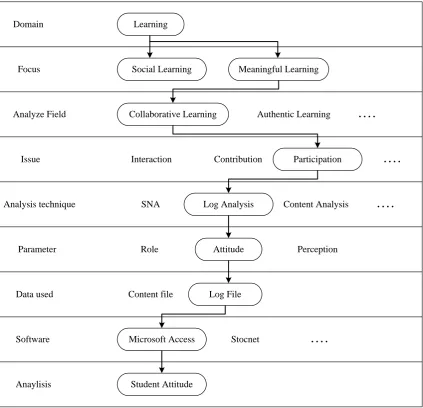
9 Analysis (SNA), log data analysis and content analysis. In order to identify the participation of student, log data analysis is applicable. The log data file is generated by the system and saved using Microsoft Access software. By applying some calculation technique, the student interaction in participation is identified. The conceptual research framework is shown in Figure 1.1.
Learning
Social Learning Meaningful Learning
Collaborative Learning Authentic Learning . . . .
Participation
Interaction Contribution
SNA Log Analysis Content Analysis . . . .
. . . .
Attitude
Role Perception
Content file Log File
Microsoft Access Stocnet
Student Attitude
. . . . Domain
Focus
Analyze Field
Issue
Analysis technique
Parameter
Data used
Software
Anaylisis
10 1.8 Thesis Organization
98
REFERENCES
Analysis Course. PRIMUS, 19(1), 18-28. Retrieved from ERIC database.
Anane R. (2004). eLearning Content Provision. IEEE 15th International Workshop on Database and Expert Systems Applications (DEXA’04). United Kingdom. 420-425. Andrew R. Brown and Bradley D. Voltz. (2005). Elements in Effective Learning. Retrieved
from: http://www.irrodl.org/index.php/irrodl/article/view/217/300
Aris B., Ali M. B., Harun J., Tasir Z., Atan N. A.and Noor N. M... (2006). Universiti Teknologi Malaysia’s e-learning research and development experiences related to learning computer science, Information Technology and multimedia subjects. Presented at INCULT, Shah Alam, Malaysia.
Bhattacharya, M. (2004). Conducting problem based learning online. In Proceedings International Conference on Computers in Education. 525-530.
Bowman, S. L. (2007). Wake 'em up!: 7 tips for interactive e-learning. Bowperson Publishing & Training Inc. Retrieved from:
www.bowperson.com/BOWPERSON/WakeEmUp.pdf.
Cakmak, M., DePalma, N., Arriaga, R. and Thomas, A.L. (2009). Computational benefits of social learning mechanism: stimulus enhancement and emulation. In IEEE 8th International Conference on Development and Learning. Shanghai, China.
Carla van Boxtel, Jos van der Linden and Gellof Kanselaar. (2000). Collaborative learning tasks and the elaboration of conceptual knowledge. Learning and Instruction. 10: 311–330. Retrieved from:
http://cmapspublic2.ihmc.us/rid=1182801987468_1109207844_6315/LearnInstruc
_2000_10_311.pdf
Cerbin, B. (2010). Collaborative Learning Techniques.
Center for Advancing Teaching & Learning, National Institute for Science Education.
Chai, C. S., Lim, W.Y. So H.J and Cheah M. H. (2011). Advancing Collaborative Learning with ICT: Cases and Design. Ministry of Education, Singapore.
99
Chui, P., S., Kuo, Y., H., Huang, Y., M. and Chen, T., S. (2008). A meaningful learning based u-Learning Evaluation Model. In 8th IEEE International Conference on Advance Learning Technologies.
Clark, R. (2008). Six principle of effective e-learning – what works and why. Best of the E-Learning Guild’s – learning solutions. Pfeiffer a Wiley Imprint, United States of
America.
Collazos, C. A., Guerrero, L. A., Pino, J. A., and Ochoa, S. F. (2002). Evaluating collaborative learning processes. In Groupware: Design, Implementation, and Use. Berlin Heidelberg: Springer. 203-221.
Collazos, C. A., Guerrero, L. A., Pino, J. A., Renzi, S., Klobas, J., Ortega, M., Redondo, M. A., and Bravo, C. (2007). Evaluating Collaborative Learning Processes using System-based Measurement. Educational Technology & Society, 10 (3): 257-274. Darren C. and Kathleen P. L. (2012). First steps towards a social learning analytics for online
communities of practice for educators. Proceedings of the 2nd International Conference on Learning Analytics and Knowledge. Washington, DC: American Institutes for Research. 69-72
de la Fuente Valentin, L., Pardo, A. ; Kloos, C.D. ; Asensio-Perez, J.I. and Dimmitriadis, Y.A.(2008). Collaborative Learning Models on Distance Scenarios with Learning Design: A Case Study. Eighth IEEE International -Conference on Advanced Learning Technologies, 2008. ICALT. 278-282.
Dickinson, M. (2008) Evolution of an e-learning developers guide – documenting decisions and intentions. Best of the E-Learning Guild’s – learning solutions. United States of America: Pfeiffer a Wiley Imprint.
Dong, W. and Fu, W., T. (2010). From collaborative indexing to knowledge exploration; a computational social learning model. In IEEE conference Urbana-Champaing, Urbana.
Dublin, L. (2008). Best of the eLearning Guild’s – learning solutions. Pfeiffer a Wiley Imprint, United States, America.
Ebner, M. (2007). E-learning 2.0 = e-learning 1.0 + Web 2.0?. The international conference on Availability, Reliability and Security Bridging Theory and Practice, ARES. Vienna.
100
Fischbach, Ronald. (2008). Social learning theory. Retrieved from www.csun.edu/~hchsc006/documents/SocialLearningTheory.ppt
Fu, W., T. and Dong, W. (2012). From collaborative indexing to knowledge exploration: A computational social learning model. IEEE Computer Science.
Gaßner, K., Jansen, M., Harrer, A., Herrmann, K., and Hoppe, H. U. (2003). Analysis methods for collaborative models and activities. In Designing for change in networked learning environments (pp. 369-377). Springer Netherlands.
Godfrey Maleko Munguatosha, Paul Birevu Muyinda and Jude Thaddeus Lubega, (2011). A social networked learning adoption model for higher education institutions in developing countries, On the Horizon, 19 (4): 307 – 320
Gokhale, A. A. (1995). Collaborative learning enhances critical thinking.
Gokhale, A. A. (1996). Effectiveness of computer simulation for enhancing higher order thinking.
Gokhale, Anuradha A. (1995). Collaborative learning enhances critical thinking. Journal of Technology Education. 7 (1): 1045-1064. Retreived from
http://scholar.lib.vt.edu/ejournals/JTE/v7n1/gokhale.jte-v7n1.html
Govindasami, T. (2001). Successful impelemntation of e-Learning: Pedagogical consideration. SOLE 2001: Exploring the Evolution of E-Learning, 4(3-4): 287-299. Hawland, J., Jonassen, D and Marra R. (2011). Meaningful learning with technology. 4th
Ed. United Kingdom: Pearson,.
Hiltz, S., R., Rotter, N. and , Turoff, M. (2000). Measuring the importance of collaborative learning for the effectiveness of ALN: A multi-measure, multi-method approach. Journal of Asynchronous Learning Networks. 4.
Huandong, C., Shulei, W., Chunhui, S., and Mingrui, C. (2009). Research on the Learning Theory of E-learning. Proceedings of the 2009 Fifth International Joint Conference on INC, IMS and IDC, IEEE Computer Society Washington, DC, USA. 1185-1187. Inaba, A., Tamura, T., Ohkubo, R., Ikeda, M., and Mizoguchi, R. (2001). Design and analysis of learners' interaction based on collaborative learning ontology. In Proceedings of Euro. CSCL01.
101
Jianguo, Y., and Shuanghong, L. (2009). Research and practice of task-oriented collaborative learning model in internet environment. In IT in Medicine & Education, 2009. ITIME'09. IEEE International Symposium on 1: 231-234. IEEE. Jonassen, D. H. (2000). Computers as mindtools for schools. Engaging critical thinking.
New Jersey: Prentice-Hall.
Jonassen, D. H. (2002). Learning as activity. Educational Technology, March-April, 45-51. Jonassen, D.H. (1995). Supporting communities of learners with technology: A vision for
integrating technology with learning in schools. Educational Technology. 35(4): 60-63.
Jonassen, D.H., Howland, J., Moore, J. and Marra, M. (2003). Learning to solve problems with technology. A constructivist perspective (2nd ed.). Upper Saddle River, New Jersey: Merrill Prentice Hall.
Kane, K., and Harms, J. (2005). Getting started: A guide to collaboration in the classroom. University of Hawaii at Manoa: The President’s Educational Improvement Fund. Retrieved October, 4, 2010.
Kane, O. K. and Hamrs, J. (2005). Getting started: a guide to collaboration in the classroom. The President’s Educational Impprovement Fund. Retrieved from
http://www.cte.hawaii.edu/publications/Collab_web.pdf
Karrer, T, (2007). eLearning 2.0 – ASTD OC – September 2007. Retrieves from
http://www.slideshare.net/akarrer/elearning-20-karrer-astd-oc-2007?src=related_normal&rel=1700233.
Kepp, S. J., and Schorr, H. (2009). Analyzing collaborative learning activities in Wikis using social network analysis. In CHI'09 Extended Abstracts on Human Factors in Computing Systems. 4201-4206. ACM.
Kim, W., and Jeong, O., R. (2009). On social e-learning. International Conference on Web-based Learning, Aachen, Germany.
Kimmerle, J., Moskaliuk, J., and Cress, U. (2011). Using Wikis for Learning and Knowledge Building: Results of an Experimental Study. Educational Technology & Society, 14(4): 138-148.
Kwok C.W. Ron and Khalifa Mohamed (1998), Effect of gss on knowledge acquisition, Information & Management, 34(6): 307-315.
102 Lai, Emily R. (2011). Collaboration: a literature review. Pearson’s Research Reports.
Retrieved from http://images.pearsonassessments.com/images/tmrs/Collaboration-Review.pdf
Liu,H., Y., and Meng, X., J. (2010). Research on network teaching platform based on knowledge construction teaching model. In 2nd International conference on education technology and computer (ICETC), Shanghai.
M Frydenberg, D Andone. (2011). Learning for 21st century skills. International Conference on Information Society (i-Society), IEEE. 314 - 318.
Maatta, E., Jarvenoja, H., and Jarvela, S. (2012). Triggers of students’ efficacious interaction in collaborative learning situations. Small Group Research, 43(4): 497-522.
Mansur, A. B. F., Yusof, N., and Othman, M. S. (2011). Analysis of social learning network for wiki in moodle E-Learning. 4th International Conference on In Interaction Sciences (ICIS), IEEE. 1-4.
Md Santo. (2010). Penjelasan sekitar sosial media, sosial networking-sosial learning. Knowledge Management for Development. Retrieve from
http://www.km4dev.org/group/km4dev_indonesia/forum/topics/penjelasan-sekitar-social. 2010
Mota, D., Vaz de Carvalho, C., and Reis, L. P. (2011). A conceptual model for collaborative learning activities design. In Global Engineering Education Conference (EDUCON), 2011 IEEE. 1026-1031. IEEE.
Naidu, S. (2006). E-Learning – A Guidebook of Principles, Procedures and Practices. CEMCA, Melbourne, Australia. Retreived from http://www.cemca.org/e-learning_guidebook.pdf
Nedev, D. and Nedeva, V. (2006). Aspects of multi-agent system application in e-learning, International Scientific Conference Computer Science. University Amsterdam, Netherlands.
Noor, N. K., Sulaiman, J., and Majid, A. M. (2008). Implementing a real time e-learning: why we need. Universiti Malaysia Pahang.
Ormrod, J.E. (1999). Human learning (3rd ed.). Upper Saddle River, NJ: Prentice-Hall. Retrieved from http://teachnet.edb.utexas.edu/~Lynda_abbot/Social.html
103
websites with learning activities. International Conference on Teaching & Learning in Higher Education (ICTLHE 2011).
Panitz, T. (1999). Benefits of cooperative learning in relation to student motivation, in Theall, M. (Ed.) Motivation from within: Approaches for encouraging faculty and students to excel, New directions for teaching and learning. San Francisco, CA: USA. Josey-Bass publishing.
Parker and Chao. (2007). Wiki as a teaching tool. Interdisciplinary of Journal and Learning Objects.
Peterson, E. (2009). Using a wiki to enhance cooperative learning in a real analysis course. Primus, 19(1), 18-28.
Puteh, M.(2010). E-Learning in Malaysian universities: a move forward; Lost in transition electronic learning in Malaysian universities. Universiti Teknologi Malaysia. Raitman, R. Augar, N. and Wanlei Zhou. (2005). Employing Wikis for Online Collaboration
in the E-Learning Environment: Case Study. Third International Conference on Information Technology and Applications, 2005. ICITA 2005. IEEE. 142-146 Raitman, R., Augar, N., and Zhou, W. (2005). Employing wikis for online collaboration in
the e-learning environment: Case study. In Information Technology and Applications, 2005. Third International Conference on ICITA 2005. IEEE. 2: 142-146).
Ranson, S., Martin, J., Nixon, J. and McKeown, P. (1996). Towards a theory of learning. British Journal of Educational Studies. 44 (1).
Reed, M. S., A. C. Evely, G. Cundill, I. Fazey, J. Glass, A. Laing, J. Newig, B. Parrish, C. Prell, C.Raymond, and L. C. (2010). What is social learning; Ecology and Society. Stringer. Retrieved from http://www.ecologyandsociety.org/volXX/issYY/artZZ/
Rohana, A. R. (2006). E- Learning Initiatives in Malaysian Schools. Educational Technology Division report. Ministry of Education, Malaysia. Retreived from
http://gauge.u-gakugei.ac.jp/apeid/apeid04/country_papers/malaysia.pdf.
Ruokamo, H. and Pohjolainen, S. (2000). Distance learning in multimedia networks project: Main results. British Journal of Educational Technology, 31(2): 117-125.
Ruokamo, H. (2001). The Solver learning environment and anchored instruction on mathematical word problem-solving. In C. Montgomerie & J. Viteli (Eds.), Proceedings of ED-MEDIA . Conference (CD). 1595-1600. Tampere, Finland. Ruth, A., and Houghton, L. (2009). The wiki way of learning. Australasian Journal of
104
Sammons, A. (2003). The social learning approach: the basics. Social learning theory, An Approaches to IPsychology. Retrieved from
http://www.psychlotron.org.uk/newResources/approaches/AS_AQB_approaches_S
LTBasics.pdf
Schone, B. J. (2005) Engaging interaction for e-learning: 25 ways to keep learners awake and intrigued.Retrieved from http://www.engaginginteraction.com
Seitzinger, J. (2008). Be constructive – blogs, podcats, and wikis as constructivist learning tools. Best of the E-Learning Guild’s – learning solutions. Pfeiffer a Wiley Imprint, United States of America.
Selwyn, N. (2011). Social media in higher education. The Europa World of Learning. Siemens, G. (2004). A Learning Theory for the Digital Age. eLearn System:
Self-Organization and the Semiotics of Evolutionary Systems. Retrieved from
http://www.ingedewaard.net/papers/connectivism/2005_siemens_ALearningTheor
yForTheDigitalAge.pdf
Sinha, N., L. Khreisat, and K. Sharma. (2009). Learner-interface interaction for technology-enhanced active learning. Innovate 5 (3). The Fischler School of Education and Human Services at Nova Southeastern University. Retrieved from http://www.innovateonline.info/index.php?view=article&id=622 (accessed January 2013).
Soini, H. (1999). Education students' experiences of learning and their conceptions about learning disabilities. Towards a comprehensive theory of learning. Acta Universitatis Ouluensis E Scientiae Socialum 40. Oulu, Finland: Oulu University Press.
Soller, Amy L. (2001). Supporting Social Interaction in an Intelligent Collaborative Learning System. International Journal of Artificial Intelligence in Education, (12). Stone, T. (2010). Web 2.0 and Social learning best practices: 100+ tips on the use of blogs,
wikis and forums in organization. Element K Publisher. Retrieved from
http://www.training-partners.com/downloads/elearning/Web2_bestpractices_0910v1.pdf
Strijbos, J. W., and Fischer, F. (2007). Methodological challenges for collaborative learning research. Learning and Instruction, 17(4), 389-393.
105
Tryloff, D. and Bowen, V. (2008). Integration of e-learning and knowledge management, Best of the eLearning Guild’s – learning solutions. United States of America:.Pfeiffer a Wiley Imprint.
Vassileva, J. (2008). Towards social learning environments. IEEE Transaction on Learning Technologies. 1 (4).
Wang, Q. (2010). Using online shared workspaces to support group collaborative learning. Computers & Education, 55(3), 1270-1276.
West, J. A., and West, M. L. (2008). Using wikis for online collaboration: The power of the read-write web. 15. John Wiley & Sons.
West, J., and West, M., L. (2009).Using wikis for online collaboration. Online e-book. Wiley Imprint.
William H., and Kevin N. L. (2011). Detecting Social Learning Using Networks: A Users Guide. American Journal of Primatology 72:1–11
Wu, B., Yi-fang and Xin, C., (2005). Elearning assessment through textual analysis of class discussion. Fifth IEEE, International Conference on Advanced Learning Technologies. 388 – 390
Yu, Jianguo & Liu, Shuanghong. (2009, August). Research and practice of task-oriented collaborative learning model in internet environment. IEEE International Symposium on IT in Medicine & Education, 2009. ITIME'09. (Vol. 1, pp. 231-234). IEEE.
Yunianta, A., Yusof, N., Othman, M. S., & Octaviani, D. (2012). Analysis and categorization of e-learning activities based on meaningful learning characteristics. World Academy of Science, Engineering and Technology, 69, 811-816.
Yusof, N., Octaviani, D., Othman, M. S., Suhaimi, S., and Mohamad, N. (2013). Clustering of Learners’ E-learning Usage Based on Meaningful Learning Characteristics. Research In Engineering Education Symposium (REES2013).
Tasir Z., Harun J. and Md Noor N.. (2005). Problem-Based Learning and e-Learning : A Case Study in Faculty of Education, Universiti Teknologi Malaysia, International Symposium on E-Learning 2005, 25-26 July 2005, UMS Sabah, Malaysia.