VAN NGOC SANG
.
DESIGN AND DEVELOPMENT OF E- CHAM APPLICATION INDIGENOUS LANGUAGES IN VIETNAM
SEPTEMBER 2017 Faculty of Education
Universiti Teknologi Malaysia A thesis submitted in fulfilment of the
requirements for the award of the degree of
iii
DEDICATION
The results of this study are truly dedicated to the loving memory of my mother
Nguyen Thi Kham
And to my beloved father
Van Ngoc Anh
You have successfully made me the person I am becoming
You will always be remembered.
To my brother and sister, and my best friends for all there support, encouragement, sacrifice, and especially for there love.
Assalamuaalaikum w. b. t.
In the name of Allah, the Most Gracious, the Most Merciful. First, praise to Allah, the God of all universe. Second, my deepest gratitude to my supervisor Associate Professor Dr. Mohamad Bin Bilal Ali, whose guidance, careful reading, helpful comments and endless support throughout my entire doctoral program. You always stood by me and faith in me. You have allowed me to grow at my own space. I would also like to thank to my external supervisor Associate Professor Dr. Po Dharma from the EFEO (l'École française d'Extrême-Orient) Paris France for his invaluable advice and supervision. And Prof. Dr. Ahmad Fauzi Ismail, Deputy vice - chancellor, who helped me overcome difficulties to pursue my studies at UTM.
I am also wish to thank the Faculty of Education, its leadership and the staff for providing me with an academic base, which has enabled me to take up this study. I am particulaly thank to Associate Professor Dr.Azlina Mohamad Kosnin, who helped and welcomed me to continue my studies at the Faculty and the UTM.
I also thank to Professor Dr. Ali Selamat, Faculty of Computer Science and staff, who have mentored me and helped me in the first three semesters.
Finally, I am graceful to all my family members for understanding me all the times, to my wife Tuyet Nhung Buon Krong, my children Kauthara Podam and Wijaya Podam.
v
Cham is the language of Cham people in Vietnam and the traditional Cham script is no longer taught in schools. Efforts to preserve the language has to be done, thus, the main purpose of this research is to explore the most preferable Cham script, and Cham Latin scripts to be preserved. The research was conducted to develop applications to preserve Cham script which will include Cham fonts, Cham font conversion tool and Cham electronic dictionary based on the preferred Cham script and Cham Latin. Besind the application produced for ease of use, convenience, and quality was evaluated by different respondent including religious group, university student, working people, and others. Two types of survey were implemented whereby religious group filled the questionnaire personally, and university students, working people and others did the online survey. A quantitative research method was employed to collect and analyse the research data. The findings revealed that almost all the respondents selected the traditional Cham script (Cham Akhar Thrah) and EFEO Cham Latin to be preserved. All of them stated that they agreed or strongly agreed that there is a need for application products to provide a Cham font, Cham font conversion and a Cham electronic dictionary. FontCreator software was used to develop Cham font, Visual Basic.NET was used to develop Cham electronic dictionary and JavaScript was used to develop Cham font conversion application. All of the application products were developed using the ADDIE model. In conclusion, these research results have shown that there is a need for the Cham community to conserve, preserve and promote the value of traditional Cham script in practice. Simultaneously, the application products will serve as useful tools that will contribute to the heritage and conservation of the Cham language and is the first application product for this purpose.
Cam merupakan bahasa bagi masyarakat Cam di Vietnam dan skrip tradisional Cam tidak lagi digunakan di sekolah-sekolah. Usaha pemeliharaan Bahasa ini perlu dilakukan, oleh itu tujuan utama kajian ini adalah untuk meneroka skrip Cam dan Latin Cam yang menjadi pilihan untuk dipelihara. Kajian dilakukan bagi membangunkan aplikasi bagi memelihara skrip Cam seperti jenis fon Cam, penukaran jenis tulisan Cam, dan kamus elektronik Cam berdasarkan skrip Cam dan Latin Cam yang dipilih. Selain itu kajian bagi menilai aplikasi produk dari aspek mudah untuk digunakan, memudahkan dan kualiti dilakukan dikalangan berbagai responden termasuk kumpulan ugama, pelajar universiti, kumpulan pekerja dan lain-lain. Dua jenis kaji selidik dilakukan iaitu kumpulan ugama melalui kajian bersemuka, manakala pelajar universiti, kumpulan pekerja, dan lain-lain secara atas talian. Kaedah kajian kuantitatif digunakan dalam pengumpulan dan menganalisis data kajian. Dapatan menunjukkan bahawa hampir semua responden memilih skrip Cam tradisional (Cam Akhar Thrah) dan EFEO Latin Cam untuk dipelihara. Kesemua mereka menyatakan persetujuan pada skala setuju dan sangat setuju untuk aplikasi produk bagi jenis tulisan Cam, penukaran jenis tulisan Cam dan kamus elektronik Cam. Perisian FontCreator digunakan untuk membangunkan fon Cam, Visual Basic.NET digunakan untuk membangunkan kamus elektronik Cam dan JavaScript bagi membangunkan aplikasi penukaran jenis tulisan Cam. Kesemua produk aplikasi di atas dibangunkan berpandukan model ADDIE. Kesimpulannya, dapatan kajian menunjukkan terdapat keperluan masyarakat Cam dalam memelihara, mengekalkan dan menggalakkan nilai tradisional skrip Cam dipraktikkan. Pada masa yang sama, aplikasi produk akan menjadi alat yang menyumbang kepada warisan dan pemeliharaan bahasa Cam dan menjadi produk pertama yang dihasilkan bagi tujuan ini.
vii
TABLE OF CONTENTS
CHAPTER TITLE PAGE
DECLARATION ii
DEDICATION iii
ACKNOWLEDGEMENT iv
ABSTRACT v
ABSTRAK vi
TABLE OF CONTENTS vii
LIST OF TABLES xii
LIST OF FIGURES xvi
LIST OF ABBREVATIONS xviii
LIST OF APPENDICES xix
1 INTRODUCTION 1
1.1 Introduction 1
1.2 Background of the Problem 3
1.3 Statement of the problem 6
1.4 Aims of the study 9
1.5 Objectives of the study 9
1.6 Research questions 10
1.7 Research framework 10
1.8 Coneptual research framwork 13
1.9 Significance of the research 14
1.10 Contribution of the Research 17
1.11 Operational definitions 18
2 LITERATURE REVIEW 24
2.1 Introduction 24
2.2 Conservation of ethnic minorities languages in Vietnam 25 2.2.1 Teaching ethnic minority languages in Southeast Asia 25 2.2.2 Teaching ethnic minority languages in Vietnam 27
2.2.2.1 Vietnamese government‟s opinion on teaching ethnic minority languages 27
2.2.2.2 Opinions on teaching Cham script in Vietnam 29 2.3 History and development of the Cham language in Vietnam 30 2.3.1 Language and ancient Cham script 31
2.3.1.1 Ancient Cham script 31
2.3.1.2 Sanskrit language 34
2.3.1.3 Ancient Cham language 54
2.3.2 Language and traditional Cham script 35
2.3.2.1 Traditional Cham script 36
2.3.2.2 Traditional Cham language 44
2.3.2.3 Cham language vocabulary 48
2.3.3 Language and modified Cham script 52
2.3.3.1 Modified Cham Akhar Thrah 53
2.3.3.2 Limitations of modified Cham Akhar Thrah 56
2.3.4 Formation of Cham Latin system 59
2.3.4.1 Cham Latin systems in Vietnam 60
2.3.4.2 EFEO Cham Latin system 68
2.4 IT applications in Cham language conservation 71 2.4.1 IT aplications in conservation of indigenous languages 71 2.4.2 IT applications in the Cham script conservation 73
2.4.2.1 Cham font development 75
2.4.2.2 Cham font conversion 78
2.4.2.3 Cham electronic dictionaries 82
2.4.3 Model and interaction 89
2.4.3.1 Application development models 89 2.4.3.2 Human computer interaction (HCI) 94
2.4.4 Dephi method 97
ix
2.4.4.2 Fuzzy delphi method 98
2.4.4.3 Fuzzy delphi in analyzing quantitative data 98
2.5 Summary 102
3 RESEARCH METHODOLOGY 103
3.1 Introduction 103
3.2 Research design 104
3.3 Sample 107
3.4 Research instrumentation 110
3.5 Procedures for item development 113
3.6 Pilot study 113
3.7 Data collection 115
3.8 Validity and realibity 117
3.9 Data analysis 120
3.9.1 Analysis on Preferable Cham script and Cham Latin 121
3.9.2 Analysis on preferable keyboard 123
3.9.3 Analysis on Cham font typeface evaluation 124 3.9.4 Analysis on Cham font conversion algorithms evaluation 125 3.9.5 Analysis on Cham electronic dictionary function evaluation 125 3.9.6 Analysis level of acceptance from respondents 126 3.9.7 Analysis level of acceptance from experts 128
3.10 Summary 130
4 DESIGN AND DEVELOPMENT 131
4.1 Introduction 131
4.2 The ADDIE model 132
4.3 Cham font 133
4.3.1Cham font analysis 133
4.3.2Cham font design 135
4.3.3Cham font development 138
4.3.4Cham font implementation 142
4.3.5Cham font typeface evaluation 144
4.4 Cham font conversion 146
4.4.2Cham font conversion design 148 4.4.3Cham font conversion development 149 4.4.4Cham font conversion implementation 152
4.4.5Cham font conversion evaluation 153
4.5 Cham electronic dictionary 156
4.5.1Cham electronic dictionary analysis 156 4.5.2Cham electronic dictionary design 158 4.5.3Cham electronic dictionary development 160 4.5.4Cham electronic dictionary implementation 171 4.5.5Cham electronic dictionary evaluation 172
4.6 Summary 175
5 RESULTS AND FINDING 176
5.1 Introduction 176
5.2 Preferred Cham script, Cham Latin script and Cham keyboard
platform 176
5.2.1Preferred Cham script 177
5.2.2Preferred Cham Latin script 181
5.2.3Keyboard plaform 183
5.3 Acceptance level of application software 185
5.3.1The Cham font 185
5.3.1.1 Acceptance level from respondents 185 5.3.1.2 Acceptance level from experts 188
5.3.2Cham font conversion tool 191
5.3.2.1 Acceptance level from respondents 191
5.3.2.2 Acceptance level from experts 194
5.3.3Cham electronic dictionary 197
5.3.3.1 Acceptance level from respondents 197
5.3.3.2 Acceptance level from experts 200
5.4 Summary 203
6 DISCUSSION, CONCLUSION AND RECOMMENDATION 204
6.1 Introduction 204
xi
6.2.1The choice of Cham script 205
6.2.2The choice of Cham Latin 207
6.2.3The choice of keyboard platform 209
6.2.4Development of application product 210
6.2.4.1 The Cham font 210
6.2.4.2 The Cham font conversion tool 211 6.2.4.3 The Cham electronic dictionary 213
6.3 Implications of the research 214
6.3.1Implications for students 215
6.3.2Implications for teachers 216
6.3.3Implications for Cham community 217 6.3.4Implications for Cham cultural research center 218 6.3.5Implications for Ministry of education 219
6.4 Limitations of the study 221
6.5 Recommendations for further studies 223
6.6 Summary 225
REFERENCES 226
LIST OF TABLES
TABLE NO. TITLE PAGE
2.1 Ancient Cham script and EFEO transliteration 32
2.2 Akhar Thrah consonants group 37
2.3 Akhar Thrah final consonant group 38
2.4 Akhar Thrah vowel group 38
2.5 Akhar Thrah semi-vowels group 38
2.6 Akhar Thrah diphthong group 39
2.7 Akhar Thrah numeral group 39
2.8 Original Cham vocabulary 48
2.9 Original Malayo-Polynesian vocabulary 49
2.10 Original Sanskrit vocabulary 50
2.11 Original Malay vocabulary from Ulang Jawa Haok 51
2.12 Original Arabic vocabulary 52
2.13 Misspelled of Cham script 59
2.14 Malay and Cham in E.Aymonier and A.Cabaton's dictionary
comparison 62
2.15 Malay and Cham in Gerard Moussay's dictionary comparison 64 2.16 Malay and Cham in Bui Khanh The's dictionary comparison 65 2.17 Malay and Cham in Inrasara and Phan Xuan Thanh's
dictionary comparison 66
2.18 Cham script and Latin transcription by EFEO 68
2.19 Malay in Ulang Jawa haok and Cham comparison 70
xiii
2.21 Basic features of database management system 86
2.22 Examples of responses based on fuzzy Delphi method 100 3.1 Research to explore the preferable Cham script 106 3.2 Application development for Cham script preservation 106
3.3 Sample selected for the study 108
3.4 Sample selected for evaluation of fonts typeface, conversion
algorithm and dictionary function 108
3.5 Sample selected for evaluation application products 109
3.6 Description of experts 109
3.7 Items survey for Cham script, Cham Latin and keyboard platform 111 3.8 Items survey for evaluating fonts typeface, conversion
algorithm and dictionary function 112
3.9 Items survey for evaluating the application products 112
3.10 A rule of Cronbach‟s alpha 118
3.11 Case processing summary for Cham font 118
3.12 Reliability statistics for Cham font 119
3.13 Case processing summary for Cham font conversion 119 3.14 Reliability statistics for Cham font conversion 119 3.15 Case processing summary for Cham electronic dictionary 120 3.16 Reliability statistics for Cham electronic dictionary 120
3.17 Summary of data analysis methods 121
3.18 Sample the preferable of Cham script and Latin by religious group 122 3.19 Sample the result of Cham script by religious group 122 3.20 Sample the choice of Cham script by online voting 122
3.21 Sample result of Cham script by Google Docs 123
3.22 Sample result of keyboard platform by Google Docs 123 3.23 Sample of data collection for Cham font typeface evaluation 124
3.24 Sample of Cham font typeface result 124
3.25 Sample the choice of Cham font conversion algorithms evaluation 125 3.26 Sample of Cham electronic dictionary function evaluation 126 3.27 Sample level acceptance of application products 126 3.28 Sample number of respondents and total score 127 3.29 Sample level of total score of application products 127
3.31 Likert 5-point scales and the triangular fuzzy numbers 128
3.32 Sample of experts based on Fuzzy Delphi 129
3.33 Threshold value and percentage consensus by experts 129
4.1 Total characters to create Cham font 134
4.2 Code point values corresponding to each Cham script character 135
4.3 Location extra of diphthongs and semi-vowels 137
4.4 Location of diphthong and semi-vowels 137
4.5 Minimum requirements for Cham font application 143
4.6 The typeface of Cham font results 144
4.7 Result ofCham font evaluation 145
4.8 Tools used to develop the Cham font conversion application 148 4.9 Data collection for Cham font conversion algorithm evaluation 153
4.10 Results of algorithm survey 154
4.11 Minimum requirement for the Cham electronic dictionary 158 4.12 Data collection for Cham font conversion algorithm evaluation 172 4.13 Survey result of electronic dictionary functions 173
5.1 Choice of Cham script among religious group 177
5.2 Choice of Cham script by online voting 178
5.3 Choice of Cham script by online questionnaire 179 5.4 Choice of Cham Latin script by religious group 181 5.5 Choice of Cham Latin via online questionnaire 182 5.6 Choice of keyboard platform via online questionnaire 184
5.7 The level acceptance of new Cham font 186
5.8 Number of respondents and total score for Cham font 187
5.9 Categories of total score for Cham font 187
5.10 Data collection from experts for Cham font 188
xv 5.19 Threshold value and percentage consensus for Cham font conversion 196 5.20 Level of acceptance of the Cham electronic dictionary 197 5.21 Respondent and total scores for Cham electronic dictionary 198 5.22 Categories of total score for Cham electronic dictionary 199 5.23 Data collection from experts for Cham electronic dictionary 200 5.24 Average for feedback of experts for Cham electronic dictionary 201 5.25 Threshold value and percentage consensus for Cham electronic
LIST OF FIGURES
FIGURE NO. TITLE PAGE
1.1 Research framework 12
1.2 Research activities and Cham script application development 15
2.1 Helvetica type family font 75
2.2 Cham AA00 – AA5F in Unicode standard version 9.0 78 2.3 Converting from Cham Latin EFEO to Cham Akhar Thrah 79 2.4 Classification of electronic dictionries by Lehr 83 2.5 Framework of electronic dictionary development 87
2.6 ADDIE model 91
2.7 HCI components 94
2.8 The general interaction framework 96
2.9 Fuzzy triangle 99
4.1 Overview of the Fontcreator screen 138
4.2 Design glyph
c
contour direction 1394.3 The
c
character on fill outline view 1404.4 EFEO Panrang code point location 140
4.5 EFEO Panrik code point location 141
4.6 EFEO Udong code point location 141
4.7 Cham font in MS Word application 142
4.8 Cham font on website kauthara.org 145
4.9 Algorism 4.1 and Algorism 4.2 146
xvii
4.14 Applicaions of Website on iOS system 154
4.15 Cham font conversion applicaion on Android system 155
4.16 The diagram of entries‟ structure 159
4.17 General diagram of coding and decoding database 160 4.18 Interface of Vietnamese - Cham and Cham - Vietnamese dictionary 160
4.19 Meanings of icons 161
4.20 Interface add new entry function 161
4.21 Function add new entry "alin" 163
4.22 Interface update entry 163
4.23 Confirm deletion of an entry from the dictionary 165
4.24 Sequence diagram to search entry 166
4.25 Windows showing previously searched entries 167
4.26 The optional dictionary properties functions 169
4.27 Dictionary applicaions on Android system 174
4.28 Dictionary applicaions on personal computer 174
5.1 Graph of the choice of Cham script among the religious group 177 5.2 Graph of the choice of Cham script by online voting 178 5.3 Graph of the choice of Cham script by online questionnaire 179 5.4 Graph of choice of Cham Latin by religious group 181 5.5 Graph of choice of Cham Latin via online questionnaire 182 5.6 Graph of the choice of keyboard platform via online questionnaire 184 5.7 Graph of number of respondents and total score for Cham font 187 5.8 Graph of number of respondents and total score for Cham font
conversion 193
LIST OF ABBREVATIONS
ACS - Ancient Cham Script
TCS - Traditional Cham Script
MCS - Modified Cham Script
CTCC - Cham Textbook Compiling Committee
xix
LIST OF APPENDICES
APPENDIX TITLE PAGE
A Cham Alphabet of Aymonier and Cabaton 238
B Combination of consonants and vowel in Aymonier
and Cabaton dictionary 240
C Transliteration Cham alphbet of Gerard Moussay 242
D Transcription Cham alphbet of Gerard Moussay 243
E Akhar Thrah alphabet and transliteration into Latin
letters, Bui Khanh The 244
F Akhar Thrah transliterated into Latin in Bui Khanh
The dictionary 245
G Transcription Cham alphabet by EFEO 1996 247
H Ancient Cham script transliteration 250
I Cham Latin letters comparision in dictionaries 253
J Questionnaire for religious people 254
K Questionnaire for Cham script online voting 255
L1 Questionnaire for online GooGle Docs 256
L2 Result for online GooGle Docs 258
M Questionnaire about the products: Cham fonts,
Cham font conversion, Cham electronic dictionary 262 N Questionnaire for Cham script and Cham Latin 265
O Questionnaire evaluation of Cham font 269
Q1 Questionaire for Cham font design evaluation –
EFEO PanRang 274
Q2 Questionaire for Cham font design evaluation –
EFEO PaRik 278
Q3 Questionaire for Cham font design evaluation –
EFEO Udong 282
Q4 Typeface evaluation for EFEO Panrang 286
R Questionnaire for conversion algorithm evaluation 295 S Questionnaire for dictionary functions evaluation 297
T Cham font conversion source code 298
U1 Champa and Dai Viet 332
U2 Panduranga – Champa 333
U3 Champa and the Malay world 334
1
CHAPTER 1
INTRODUCTION
1.1 Introduction
Indigenous heritage, especially language, has provided the most important tool for human progress, and as such, it may well be man‟s greatest invention. Language is necessary for thinking and communicating with others, and distinguishes humans from all other creatures. The language of indigenous people has been the major carrier of traditional beliefs, customs and history for many centuries. The indigenous languages are a powerful way to communicate and are the key to open the doors of civilization, as well as being important tools to enhance awareness in order to develop community; Language is at the root of the culture of each ethnic background and contributes to the diversity of culture in the world. However, humanity today is facing a massive extinction: languages are disappearing at an unprecedented speed. When happens language is lost, a unique vision of the world is lost with it (Lynch 2012). An enormous cultural heritage will be lost when a language dies in a community, such as scientific, medical and botanical knowledge; in particular, we also lose the expression of communities‟ humour, love and life. Indigenous languages help people to understand the intricate knowledge of their community, acquired over generations.
alternative perspectives of knowledge (Seepe 2001). Information technology is also a means to introduce the knowledge and culture of a community to others and a powerful means of education for everyone. Some of the enormous benefits of IT include its ability to deliver the fastest and most extensive information to others, as well as to save data safely and the fact that it is easy to search quickly, accurately and efficiently. Therefore, people are currently making widespread and effective use of information technology to preserve indigenous culture in general and indigenous language in particular.
About Cham language, the Cham people are ethnic groups of the Champa kingdom, which was established in the second century in central Vietnam and disappeared from the world map in the 19th century as a result of the war with the Dai Viet in the North. However, Champa had a consistent culture influenced by Hindu civilization, and Cham script is typical evidence of this (Lafont 2011). Ancient Cham script first appeared on the inscription on the Vo Canh stone stele (NhaTrang, Vietnam) in the second century (Filliozat 1969). In the 17th century, Po Rome, a King of the Champa kingdom, unified Cham script, called traditional Cham script, which was widely used in Royal documents and to exchange experiences or knowledge of many aspects of life. It is still circulating in villages, among elders, intellectuals, students and Cham community.
However, the big problem is that traditional Cham script (TCS) has become an endangered language, as the Cham young generation are studying modified Cham script (MCS), which was developed by a Cham organization in 1978 but is not based on TCS. The conflicts between Cham groups appeared when they recognized that Cham young generations were unable to read the old documents, which were written in TCS (Han 2006).
3 i) The Government need to make the subject related to the TCS is
compulsory to all students in Vietnam.
ii) The Government encourage people to translate foreign books to TCS books.
iii) Using information technology to create a number of applications to support and promote the research for teaching and learning the traditional Cham easier.
1.2 Background of the Problem
Every ethnic group‟s indigenous language is formed and developed over many centuries. Language is a unique symbol of the nation, and is also a key part of its cultural identity and cultural heritage, and its purpose transfers the experience and knowledge from old generations to the next generation. The conservation of indigenous languages has become a critical issue, about 2,500 languages of approximately 6,900 languages are being used around in the world, and the others are in danger of disappearing (UNESCO 2010). India is top of the list of countries with endangered languages, as most of the 196 endangered languages are counted in this country. In Vietnam, there are 54 different ethnic languages that have been formed and developed during the ups and downs of the historical process (Cuong 2013). Some of these languages are well developed and have become popular. Others have been used only in more local communities and have become minority languages.
strongly desire to conserve the TCS (Dharma 2006; Phan 2006) because they not only the value their heritage from the ancient sources but also because they see TCS as the main key to open the door to understand Cham Royal documents or old text materials, which are written in TCS. If the young generation continues to use MCS, then TCS will face extinction. This valuable linguistic heritage will soon be lost and conditions will be created for the rapid occurrence of the phenomenon of acculturation. Cham ethnic minority groups will not remain as a unique culture but will turn their backs on the traditions and values that the older generations have left for Cham society. This will also lead to other enormous and harmful repercussions, as valuable documents will be destroyed because no one can read them (Phan, 2015). The Cham culture in general and the TCS will be forgotten, and it will be hard to conserve them again when people eventually recognize the great worth of this language heritage.
Although several workshops have been organized with a focus on the Cham language, most of the studies conducted to date have discussed the origins, historical development and challenges in the preservation of the Cham language. None of them have discussed how we can use information technology to conserve and develop the Cham language. However, an international workshop was organized in Kuala Lumpur in 2006 with the topic of “History of Language and Cham Script”. This workshop presented many scientific findings pertaining to Cham languages and declared that the TCS should be preserved in the Cham community (Bienban, 2006).
5 problem caused by the CTCC‟s mistakes, as pointed out by author, is that many lessons contain differences between the content and the illustrated textbooks, and thus have a negative influence on the conservation of the Cham culture. All of the authors who contributed to this book also raised the big question of preserving the TCS as a matter of urgency.
For many reasons as mentioned above, the CTCC does not implement the policy of Cham indigenous language preservation as expected, meaning that it does not teach the traditional Cham script, a script are using by the Cham community. On the contrary, the CTCC has been teaching the Cham language under the modified Cham script at primary level, which has caused conflict and controversy among the Cham community. From that, the study try to give some solutions to bring the favorable conditions for the Cham children in leaning Cham language based on the role of Education to understand the conflict, finding the caused and give solutions as follows: The Vietnamese Educational Ministry should have a study to assess again of the modify Cham Akhar Thrah which is used in present schools, look deeply on opinions from other side group; Organization of public dialogue or scientific workshops with participants presented by the Ministry of Education, Department of Heritage, CTCC, the Cham elders, Imam, intellectuals and students to unify the curriculum and Cham textbooks for Cham children learning; Expanding and improving the programs to lower secondary school and high school. Implementation and experimental teaching continues to gradually revised annually complete; Except that, teachers and students should be encouraged to participate in researches to develop and preserve the purity of Cham akhar Thrah inside and outside the school.
The use of technology to preserve indigenous language is not a new topic; as IT can provide useful and effective tools for convey information to everyone. (Delgado 2003) described the introduction of technology within native American communities as a double-edged sword, explaining the effects of machines that are consuming, complex, powerful, and socially accepted without consideration of the consequences. Many native people have considered the dark side of technology: the invasion of privacy, the use of the digital public domain for personal gain, the misuse of control, and manipulation. Research has further revealed that ever since the establishment of audio-lingual and audiovisual methods, communication technologies have influenced the process of education. TV, radio, books, newspapers, computers, the internet etc. have transformed teaching methods and techniques. Among several teaching aids, tape recorders or video tapes are the most common aids used in the classroom, especially in foreign language classes. „Educational technologies have great promise and can change learning, but only if those involved give themselves the means to do so‟ according to the UNESCO Education Report (2010).
In order to preserve the Cham script, information technology is one of the solutions to create application products like Cham font, Cham font conversion, Cham electronic dictionary and many other applications to support Cham people for reading, studying the Cham script contributes to preserve the Cham language and script.
1.3 Statement of the Problem
7 Firstly, there are several conflicts in Cham community about the conservation of the Cham language. Which kind of Cham script should be chosen for teaching and learning in schools when there are two different kinds, namely TCS and MCS (Mon 2006). The MCS, created by the CTCC, is supported by the local authorities. The biggest mistake made by the Akhar Thrah CTCC is that they have added some new characters to the modified Cham writing system, which makes it different from a lot of TCS (Han 2011). Therefore, the Cham young generation learning this form will not be able to read documents written in TCS by their fathers‟ generation, containing a lot of valuable material on culture and history. In contrast, the older generation of Cham people cannot understand what the young generation writes. As a result, most scientists suggest that the Cham people should be using the TCS unified by Royal decree in the 17th century for communication and teaching in schools for the young generation.
According to Han (2011), the TCS system is a popular language in writing. It is very stable and follows a rule-based system, handed down from generation to generation from the 16th to the 21th century. When the CTCC developed the MCS, it became a “hybrid” script, and not based on any rules. This leads to the result that Cham children learning the Cham script from CTCC become “illiterate”. It means that they cannot read traditional Cham documents and that in a few generations, the valuable treasures they contain in terms of literature, history, religion, and etc. will be buried in the past because nobody will be able to read them. This has also created serious splits in Cham communities, causing conflicts between generations, especially among opposing ranks: priests, elders and intellectuals always use the TCS, while the Cham young people today must learn Cham script from CTCC's textbooks.
ways to support people‟s learning and studying, for which information technology is one useful solution.
A second key point is that in order to facilitate the use of the current written TCS, the Cham people use more Latin characters instead of Cham script characters. However, the reality is that there are many different Latin encoders, and to date, there is no unified Cham Latin. This leads to difficulties in publishing Cham documents and in some workshops. A research team at the EFEO (l'École française d'Extrême-Orient) has recently introduced a transcoding Latin character system for the Cham language based on Latin in the Malay system. This new system has resolved the shortcomings of the old system in domestic and its use is now widely agreed.
It is therefore necessary to investigate the use of information technology for transferring this approach to the community. Information technological applications in the form of Cham fonts, Cham font online application conversion and a Cham electronic dictionary will encourage and facilitate people‟s learning and use of the Cham language. Some of the utility‟s applications are presented as follows:
Cham fonts: The use of a font to type Cham script on the computer has become an essential issue to help compiling in textbooks, data storage, Champa research, teaching and learning of the Cham script.
9 Cham electronic dictionary: Language is a special signal system, the basic means of communication and the most important element of the community. In life, not everyone can understand the concept or the meaning of a particular word, so to make it easier to look up the word‟s concept; its terminology and linguistics must be codified words in the form of a dictionary. Hence, in facilitating searching for entries in Cham language and contributing effectively to the preservation and promotion of Cham traditional culture, the building of a Cham-Vietnamese electronic dictionary has practical significance. In addition, the application is also a tool for individuals, agencies, departments compiling documents, curriculum planners and bilingual education programs, and will serve as a basis for research on language, culture and Cham society.
The Cham language and Cham script will be preserved better if information technology applications are used in the Cham community. The Cham younger generation has the opportunity to learn their forefathers' script, engage in self-study and better contribute to the preservation of the Cham script.
1.4 Aims of the study
The aim of this study is to develop some information technology applications, such as a Cham font, a Cham font conversion tool and a Cham electronic dictionary, for the preservation of the Cham language.
1.5 Objectives of the study
In order to achieve this aim, the objectives of the research are as follows: (i) To explore the most preferable script of Cham Thrah, Cham Latin and
(ii) To develop applications for Cham script preservation based on the preferred Cham Thrah, Cham Latin and keyboard platform.
(iii) To evaluate the Cham fonts, Cham font conversion tool and Cham electronic dictionary.
1.6 Research Questions
The research questions of this study are:
(1) What is the most preferable of the script related to i) Cham Thrah
ii) Cham Latin
(2) What is the most preferable of keyboard platform that should be created for Cham fonts?
(3) What are the level of acceptance of Cham font, Cham font conversion, and Cham electronic dictionary?
1.7 Research Framework
11
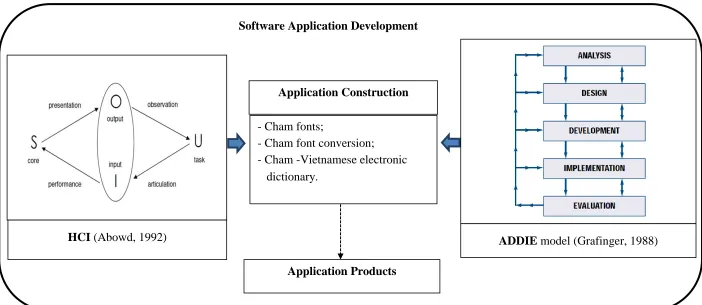
Human-computer interaction (HCI) is the physical and conceptual interaction between the user and the input or output devices of a computer. It is through this interface that the human gives instructions or supplies data to the computer and receives feedback or information from the computer. Most interfaces are dynamic and involve an interaction between the human and the computer (Norman 2014). HCI is a socio-technological discipline whose goal is to bring the power of computers to people in ways and forms that are both accessible and useful in working, learning, communicating etc. It also concerns how people – both individuals and groups – use and are affected by computers and communication systems. Toward this end, technologies such as the graphical user interface, speech recognition, virtual environments, multimedia presentation and cognitive models of human learning and understanding are developed and applied as part of HCI research (Foley 2014).
In the present study, the researcher will construct a series of applications, including Cham fonts, Cham font conversion and a Cham - Vietnamese electronic dictionary. During the processing for each module, these applications will be constructed using the ADDIE model, developed by the Grafinger (1998), which includes five main phases and illustrates the connection of these five phases for application construction and learners will develop their application construction when they are able to see the connection between the five phases in the ADDIE model. During the implementation process, these applications will also be connected with HCI in the process of selecting the application interface (Foley 2014).
Figure 1.1: Research Framework
Software Application Development
HCI (Abowd, 1992)
Application Products
- Cham fonts;
- Cham font conversion;
- Cham -Vietnamese electronic dictionary.
Application Construction
13
1.8 Conceptual Research Framework
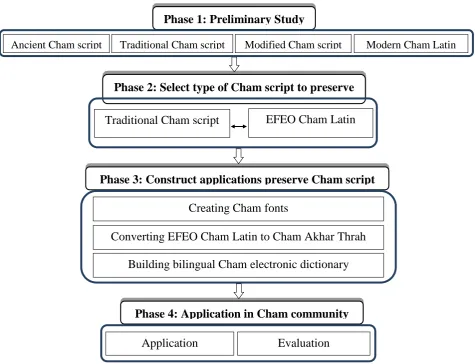
The conceptual research framework must be concise, simple and easy to observe, and must guide the researcher to achieve the objectives of the project. Figure 1.2 describes the development process of the Cham script and the choice of the Cham script to preserve through the survey and evaluation. Based on the results of the survey, the researcher will use a number of software applications to develop tools such as Cham fonts, Cham font conversion, and a Cham – Vietnamese electronic dictionary in order to preserve the Cham language and script. There are four phases involved in developing the application products to preserve the Cham language.
Phase 1: Preliminary Study
First, researcher will synthesize materials related to the Cham script, and study and systematise all the basic contents. Currently, Cham people are using three types of script, derived from Sanskrit, Jawi script and Latin script. In this study, to choose the Cham script teaches in school as well as preservation of the Cham script the researcher will focus only on scripts originating from Sanskrit and Latin. The Cham scripts derived from Sanskrit are divided into three styles, namely ancient Cham script, traditional Cham script and modified Cham script. The Latin scripts include EFEO Cham Latin and CTCC Latin.
Phase 2: Select Types of Cham Script to Preserve
documents. With regard to Latin script, the researcher has decided to use the Latin script from the Malay system by EFEO applied to the Cham language.
Phase 3: Construct Applications to Preserve Cham Script
To preserve Cham script effectively, the researcher will implement solutions using technological applications for the preservation of the Cham language. Some interesting applications are: Creating Cham font for Windows and Macintosh platforms; Converting EFEO Cham Latin to Cham script (Akhar Thrah); Building a Cham electronic dictionary.
Phase 4: Application in Cham Community
To ensure that each application can be used well, these applications should first be assessed through a forum to verify their feasibility and completeness before introducing them into the community for wider use.
1.9 Significance of the Research
15
Figure 1.2: Research activities and Cham script application development
1.9.1 Students
Students can enhance their knowledge of Cham language through the literature review, and can give their opinions on which kind of Cham language should be used, studied and developed. Other than that, they can use application software, such as Cham font, Cham font conversion, and the Cham – Vietnamese electronic dictionary. Furthermore, this study will increase attention and concerns towards preserving and developing traditional Cham language in the Cham young generation.
Phase 1: Preliminary Study
Ancient Cham script Traditional Cham script Modified Cham script Modern Cham Latin
Phase 2: Select type of Cham script to preserve
Traditional Cham script EFEO Cham Latin
Phase 4: Application in Cham community
Application Evaluation
Phase 3: Construct applications preserve Cham script
Creating Cham fonts
1.9.2 Teachers
In responding to individual differences among students, teachers should use their knowledge of Cham language through the literature review provided in this study in their teaching activities. Based on this knowledge, they will be confident to select which of the various kinds of Cham language that currently exist in Vietnam they should use and teach to their students. In addition, they can use application software, such as the Cham font, Cham font conversion, or the Cham electronic dictionary, to design more effective teaching activities to strengthen the process of teaching the Cham language.
1.9.3 Religious Leaders
Religion is one of the most important components in the social construction of the Cham community. Religious people play an important role not only in belief functions but also in spiritual management of any aspects for the stability of Cham society. To date, all prayer-books, literary materials, historical documents, etc. that are in current use have been written in Traditional Cham Script (Cham Akhar Thrah). Therefore, this study is meaningful for religious leaders and groups and for believers, as using Cham language through application software, including Cham fonts, Cham font conversion and the Cham electronic dictionary will contribute to the preservation of these documents.
1.9.4 Cham Community
17 enormous benefits for community development in multi aspects, such as education, culture, communicate information. Furthermore, they can use application software, such as Cham font, Cham font conversion, Cham electronic dictionary in using and strength effective in communicating process for their own purpose. This contributes technology products to preserve Cham language, culture and general developing social-economic in Cham community. In addition, this study help local authorities develop policies in teaching, or implementing software to bring benefits to all people in community. These raises of perceptiveness and concerns to the preserving and developing traditional Cham language as well as Cham culture when it is facing many challenges to preserve before an effect on another mega-culture.
1.10 Contribution of the Research
In this part, the contribution of the research review focuses on three application as Cham font, Cham font conversion, and Cham electronic dictionary which have a direct and immediate relationship with the contribution made by new application products to students and Cham community using. The findings of this research will contribute in the following:
(i) Research, classification, synthesis and evaluation of the literature on the history of formation and development of the Cham language, which will serve as a basis for theoretical studies on related topics. This study will present the results of surveys on the real situation regarding the need to use the Cham script, as well as the aspiration to choose the type of Cham script to be learned, taught and conserved in the community.
(ii) Creating a new type of Cham font to adapt the demands of different uses, such as:
The EFEO Panrang, Cham font typeface based on drawings in the Cham-Vietnamese-French dictionary by G. Moussay, published in 1971;
The EFEO Udong, Cham Font typeface based on the ancient style of the Cham people in Cambodia, and based on the Cham documents language in Cambodia currently stored in the French library.
In particular, these new Cham fonts will be design for use with both Windows and Macintosh platform. In addition, the researcher will also design a Jawi Cham font to support Imams (dignitaries of Cham Awal), to be used to spread and teach the Qu'ran. They must currently use handwritten texts because these fonts do not exist on the computer.
(iii) After completing the survey to choose the preferable Cham script and Cham font, the researcher will apply these results to create a Cham font conversion application to convert EFEO Cham Latin to traditional Cham script (Cham Akhar Thrah).
(iv) A Cham - Vietnamese electronic dictionary will be created to facilitate favourable conditions for searching, learning, teaching and preserving the Cham script.
1.11 Operational Definitions
Champa
19 south to Dong Nai (Bien Hoa). Champa was at its height during the 7th to the 10th century, but then declined, especially in the face of the threats from the Vietnamese Nam Tien (Maspero 1928; Dharma 1999).
The people of Champa
The people of Champa (urang Campa) include Chams living in coastal provinces, and Raglai, Ra-nde, Churu, Koho, Ma, Stieng, Kotu and others living in the highlands of present day Southern Vietnam. These people shared many common features in their culture and religion (Gray 1987).
The Chams
The Chams were the people who founded the kingdom of Champa during the 2nd century A.D. After a series of military defeats by the Vietnamese, the Chams were finally defeated in 1832 (Dharma 1987; Dharma 1999). Nowadays the Chams live scattered across many regions, including Vietnam, Cambodia, Thailand, Malaysia, America, and France. Most of the Chams live in certain provinces in Vietnam, such as Ninh Thuan, Binh Thuan, Dong Nai, An Giang, Tay Ninh and Ho Chi Minh City.(Mon 2003).
Dai Viet
Vietnam
Situated at a longitude of 1020 10‟ to 1090 30‟ east and latitude of 800 30‟ to 230 22‟ north. Vietnam today is the rugged part of the Indochina Peninsula. Leaning back against the Asian continent, it looks out on the South China Sea on one side, and is framed by China to the north and by Laos and Cambodia to the west and south. In the southwest of Vietnam, separated by the Gulf of Siam, stands the Malaysia Peninsula, which extends 460 miles from the Malay state of the Perlis in the north to the Straits of the Johor in the south, which, together with the two northern Boneo states of Sabah and Sarawak, make up Malaysia. Historically, Vietnam is part of mainland Southeast Asia. Today, Vietnam is a multi-ethnic nation that includes ethnic groups such as the Kinh, Tay, Hmong, Cham, Raglai, Ra-nde, Kaho, Ma, Stieng, etc. Vietnam has a population of 85,262,356 people, of whom 85% are Kinh, who number over 70 million, making them the largest group in the country (CIA 2008).
Cham Ahier
The Cham group was influenced by Brahmanism. They worship Gods in Hindu-influenced temples, their kings and their ancestors.
Cham Awal
The Cham group was influenced by Islam. They worship Gods (Allah) and divinities in Sang Magik or Masjid (Mosques), their kings and their ancestors.
Ancient Cham Script
21
Traditional Cham Script
Traditional Cham script (Cham Akhar Thrah) is derived from the ancient Cham script but its character style is simpler and it has fewer consonants than the ancient Cham Script. Cham Akhar Thrah appeared from the XV century in communication, but it first appeared in the inscriptions of Po Rome temple in the XVII century.
Modified Cham Script
Modified Cham Script was created by CTCC through adding and removing some characters from Cham Akhar Thrah and is used in teaching and learning in primary schools for Cham children.
Cham Textbook Compiling Committee
The Cham Textbook Compiling Committee (CTCC) is an organization founded by decision number 104/QDUB, dated 23/05/1978 of Thuan Hai province. Its duties involve compiling Cham textbooks for teaching and learning Cham language for children in primary school (grades 1 to 5).
12/12 (Formal education in Vietnam)
There are twelve years of formal education, which are divided into the following stages:
Primary school: From first to fifth grade, usually for children from the ages of 6 to ages of 11.
Secondary school: From sixth to ninth grade, usually for teenagers from the ages of 12 to 15.
École française d'Extrême-Orient (EFEO)
The École française d'Extrême-Orient (EFEO) is a French institute for the study of Asian societies. It was founded in 1900 with headquarters in Hanoi-Vietnam in what was then French Indochina. After the independence of Vietnam, its headquarters were transferred to Paris. Its main fields of research are archaeology, philosophy and the study of modern Asian societies.
Human Computer Interaction (HCI)
Human Computer Interaction (HCI) sometimes called Man-Machine Interaction is a field in which the developer makes a user-friendly system in which the user can interact with the computer system without using any conventional peripheral devices. The importance of computer vision is its freedom (Shah, 2014).
ADDIE Model
The ADDIE model is one of the most popular development models used in application development, and also a set of guidelines for designers that include five main phases: analysis, design, development, implementation and evaluation (Grafinger, 1988).
Fuzzy Delphi
226
REFERENCES
Al-Ahmadi, A. R. (1988). Campa dengan alam Melayu. Alam Melayu: Sejarah dan Kebudayaan Campa, Kementerian Kebudayaan dan Pelancongan &, EFEO. Kuala Lumpur. p 73.
Al-Rabi‟i, S. M. e. a. (2001). Al-Mukjam al-Syamil li Mustalahaat al-Hasib al-Aali wa al- Internet (A complete dictionary for terminologies in computers and internet). Riyadh: Maktabah al Abikan.
Aymonier, É., & Cabaton, A. (Eds.). (1906). Cham - French dictionary. Imprimerie Nationale, Paris.
Ba, T. P. (2006). Su chinh ly Akhar Thrah Cham qua cac giai doan (The stages of Cham Akhar Thrah correction). Paper presented at the Conference Proceedings of the 2006 History of language and Cham script. 21-22 September. Kuala Lumpur, EFEO & Tokyo University of Foreign Studies, Kuala Lumpur, 2007 (CD-Rom).
Barbour, M. K., & Mulcahy, D. (2008). How are they doing? Examining student achievement in virtual schooling. Education in Rural Australia, 18(2), 63-74. BBSSCC. (2003). Ong Dot - Bo truyen Cham song ngu Viet Nam (Ong Dot - Cham
bilingual stories in Viet Nam). Ha Noi: Ministry of Education and Training. Bienban. (2006). Bien ban hoi thao ve lich su ngon ngu va chu viet Cham (Reports of
script. 21-22 September. Kuala Lumpur, EFEO & Tokyo University of Foreign Studies, Kuala Lumpur, 2007 (CD-Rom).
Burns, A. C., & Bush, R. F. (2006). Marketing Research (5th ed). Upper Saddle River: Pearson Prentice Hall.
Canh, T. S. (1972). Noi San Panrang (Intramural magazine Panrang). Noi san gom 8 so, moi so 50 tap, thuc hien tu 9/1972 den 5/1974 tại Phan Rang.
Casparis, J. G. d. (1956). Prasasti Indonesia II: Selected Inscriptions from the 7th to the 9th Century A.D. Bandung: A.C. Nix & Co.
Castells, M. (1999). Information Technology, Globalization and Social Development. United Nations Research Institute for Social development, No. 114.
Champaka. (1999). Phien am tieng Cham (Cham language transcription) (Vol. 1). USA: IOC-Campa.
CIA, S. (2008). CIA Fact Book. Retrieved on September 12, 2013, from http://theodora.com/
Coedes, G. (1939). La plus ancienne inscription en langue chame. Eastern and Indian Studies in Honour of F.W. Thomas. New Indian Antiquary Extra Series I. Po Dharma, " History of language and Cham script",Conference Proceedings on 21-22 September, 2006. Kuala Lumpur, EFEO & Tokyo University of Foreign Studies, Kuala Lumpur, 2007 (CD-Rom). 46-49. Coedes, G. (1940). The date of the sanskrit inscription of Vo-canh. The Indian
Historical Quarterly, XVI-3, 484-488; E. Gaspardonne, “La plus ancienne inscription d'Indochine”, in Journal Asiatique (1953), CCXLI, 477-485; J. Filliozat, “L'inscription dite "de Vo-canh"”, in BEFEO (1969) LV-1, 107-116; C. Jacques “Notes sur la stèle de Vo-canh”, in BEFEO (1969), LV-1, 117-124.
228
Crewswell, J. W. (2008). Educational Research: Planning, Conducting, and Evaluating Quantitative and Qualitative research. (3rd ed). Upper Saddle River: NJ:Merrill.
Cuong, L. K. (2013). Viec Nghien Cuu Ngon Ngu Cac Dan Toc Thieu So Tai Viet Nam (The study of ethnic minorities languages in Vietnam). Paper presented at the Nghien cuu so sanh nhan van Dai Loan - Viet Nam (Comparative study of humanities Taiwan - Vietnam), Taiwan.
David, M. K., Cavallaro, F., & Coluzzi, a. P. (2009). Language Policies – Impact on Language Maintenance and Teaching:Focus on Malaysia, Singapore, Brunei and the Philippines. The Linguistics Journal.
Delgado, V. (2003). Technology and Native America: a double-edged sword. In G.Solomon, N. Allen, & P. Resta (Eds.), Toward digital equity: Bridging the digital divide in education (pp. 88-98). Boston, MA: Allyn and Bacon. Dharma, P. (1987). Le Panduranga (Campa). Paris: EFEO, Vol. I, 1-15. Dharma, P. (1998). Cham font. EFEO, France.
Dharma, P. (1999). So luoc Lich su Champa (A servey of the history of Champa). Champaka, Paris- San Jose: Monographs of the International Office of Champa., No.1, p9.
Dharma, P. (2006a). Ngon ngu chu viet Cham trong qua trinh lich su (Cham language and script in historical process). Paper presented at the Conference Proceedings of the 2006 History of language and Cham script. 21-22 September. Kuala Lumpur, EFEO & Tokyo University of Foreign Studies, Kuala Lumpur, 2007 (CD-Rom).
Dharma, P. (2006b). Van đe ngon ngu chu viet Cham sau nam 1975 (Issues of language and Cham script after 1975). Workshop proceedings: Written Cultures in Mainland Southeast, Osaka Japan.
Dharma, P., Karim, A., Weber, N., & Yunos, M. (2003). Reproduction des Manuscrits Cam N. 1: Contes, Epopeùes. Textes versifieùs. Ministry of Culture, Art and Tourism. Malaysia & Ecole Française d‟Extreâme-Orient, Kuala Lumpur.
Dick, W., & Carey, L. (1978). The Systematic Design of Instruction. Glenview, IL.: Scott, Foresman.
Dick, W., & Carey, L. (2001). The systematic design of instruction (5th ed.). New York: Longman.
Dix, A., Finlay, J., Abowd, G. D., & Beale, R. (1992). Human Computer Interaction, (2nd ed.). Prentice Hall, ISBN 0-13-239864-8.
Duffy , M. E. (1985). Designing research the qualitative – quantitative debate. Journal of Advanced Nursing, 11, 3, 225-232.
EFEO. (1977). Essai de translittération raisonnée du Cam. BEFEO LXIV - Paris, 243-255.
EFEO (1977), Groupe de recherche Cam. X. Etudes cam. I. Essai de translittération raisonnée du cam par le groupe de recherches cam. In: Bulletin de l'Ecole française d'Extrême-Orient. Tome 64, 1977. pp. 243-255.
Filliozat Jean (1969). VI. L'inscription dite "de Vo-çanh". In: Bulletin de l'Ecole française d'Extrême-Orient. Vol. 55, No.1, pp.107-116. DOI: 10.3406/befeo.1969.4856,http://www.persee.fr/doc/befeo_0336 -1519 _1969 _num_55_1_4856
Foley, J. D. (2014). Human - Computer Interaction. Retrieved on July 4, 2014, from http://www.wtec.org/loyola/hci/c1_s1.htm.
Fontsnthings. (2014). Fonts & Things. Retrieved on May 2, 2015, from http://www.fontsnthings.com/tools/conversion.shtml.
Gagne R. M., Wager W. W., Golas K. C., & M., K. J. (2005). Principle of Instructional Design. (5th ed.). Belmont: Wadsworth Cengage Learning. Gillham, B. (2005). Research Interviewing the range of Techniques. England: Open
230
Grafinger, D. J. (1988). Basics of instructional systems development. INFO-LINE Issue 8803. Alexandria: American Society for Training and Development. Gray, B. (1987). New Perpectives on the Ethnic Composition of Champa. Paper
presented at the seminar on the Champa of Copenhagen University. Denmark, 43-44.
Grenoble, L. A., & Whaley, L. J. (2006). Saving languages: An introduction to language revitalization. Cambridge, UK: Cambridge University Press. Grimes, B. F. (2000). Ethnologue: languages of the world. (14th ed.). Vol. 1. Dallas:
Summer Institute of Linguistics.
Guyot, W. M. (1978). Summative and Formative Evaluation. The Journal of Business Education. 54(3):127-129.
Han, P. V. (2006). Akhar Thrah voi viec cai tien cua Ban Bien Soan sach chu Cham (Akhar thrah with the improvement of Ban Bien Soan Soan Chu Cham). Paper presented at the Conference Proceedings of the 2006 History of language and Cham script. 21-22 September. Kuala Lumpur, EFEO & Tokyo University of Foreign Studies, Kuala Lumpur, 2007 (CD-Rom).
Han, P. V. (2011). Viec su dung chu Cham truyen thong Akhar Thrah (Using traditional Cham script - Akhar Thrah) Ngon ngu Cham, thuc trang va giai phap (Cham language, reality and solutions). TP.HCM: NXB Phu Nu.
Hannafin, M. J., & Peck, K. L. (1988). The design, development and evaluation of instructional software. New York: Longman.
Harkness, J. A. (2010). Towards Guidlines on Survey Adaption . Paper presented at the XVII ISA World Congress of Sociology, Gothenburg Sweden.
Hinze-Hoare, V. (2007). Review and Analysis of Human Computer Interaction (HCI) Principles. Southampton University.
IBM. (1996). Font Summary. IBM AFP Fonts, G544-3810-03.
Issac, S., & Michael, W. B. (1995). Handbook in Research and Evaluation. San Diego: CA: Edits.
Jernudd, B. (1999). Language education policies – Asia. In Spolsky, B. (Ed.), Concise encyclopedia of educational linguistics (pp. 116-122): Amsterdam: Elsevier.
Karam. M., & Schraefel, M. C. (2005). A Taxonomy of Gestures in Human Computer Interaction, ACM Transactions on Computer-Human Interactions 2005, Technical report, Electronics and Computer Science, University of Southampton, November 2005. Retrieved on April 2, 2016, from
http:/eprints.ecs.soton.ac.uk/11149/01/GestureTaxonomyJuly21.pdf.
Karim, A. (2002). Inrasara va Phan Xuan Thanh, Tu dien Viet - Cham (Viet - Cham dictionary by Inrasara and Phan Xuan Thanh). Retrieved on October 2, 2013, from http://champaka.info/index.php?option=com_content&view= article&id=328:inrasara&catid=53:quan-im-vn-hoa&Itemid=60
Karim, A. (2006). Van de chu viet Cham ngay nay (Issues of Cham script today). Paper presented at the Conference Proceedings of the 2006 History of language and Cham script. 21-22 September. Kuala Lumpur, EFEO & Tokyo University of Foreign Studies, Kuala Lumpur, 2007 (CD-Rom).
Karray, F., Alemzadeh, M., Saleh, J. A., & Arab, M. N. (2008). Human-Computer Interaction: Overview on State of the Art. International journal on Smart Sensing and Intelligent system. 1 (1).
Kosonen, K. (2005). Vernaculars in literacy and basic education in Cambodia, Laos and Thailand. Current Issues in Language Planning. École française d'Extrême-Orient - EFEO (Conference in Kuala Lumpur). 6 (2), 122-142. Kothari, C. R. (2004). Research Methodology: Method and Techniques. Delhi: New
Age International (p) Limited.
232
Lafont, P. B. (2011). Vuong Quoc Champa: Dia Du, Dan Cu va Lich Su (Kingdom of Champa: Geography, Population and History) (Vol. Champaka No. 11). San Jose, USA: International Office of Champa.
Lafont, P. B., Dharma, P., & Vija, N. (1977). Catalogue des manuscrits cams des bibliothèques francaises. Paris, Publications de l'Ecole Francaise d'Extrême-Rrient , Vol CXIV, P 2, 6-8 (International Office of Champa).
Lehr, A. (1996). Electronic Dictionaries. In Lexicographica 12:310-17.
Lynch, E. (2012). The Endangered Languages Project. An Online Initiative to Save Languages Facing Extinction.
Ma, H. V. (2002). Ngon ngu dan toc thieu so Viet Nam - Mot so van de quan he coi nguon va loai hinh hoc (Language minorities Vietnam - Some issues related source and typology) Nxb Khoa hoc xa hoi, Hanoi, Vietnam.
Mall, R. (2010). Fundamentals of Software Engineering (3rd edition ed). New Delhi: Rajkamal Electric Press.
Maspero, G. (1928). Le Royaume de Champa. Paris: Van Oest. 1-26.
McDaniel, C., & Gate, R. (2006). Marketing Research Essentials (5th ed). New York:John Wiley &Sons.
McDaniel, C., & Gates, R. (2006). Marketing Research Essentials (5th ed.). New York: John Wiley &Sons.
Mohd Ridhuan, Shariza Said, & Mohd Ibrahim K. Azeez. (2014). Kompetensi Guru Terhadap Pengurusan Pengajaran dan Pembelajaran: Suatu Pendekatan Teknik Fuzzy Delphi. Jurnal Kepimpinan Pendidikan, 1(3), 77-88.
Mohd Yusri Ibrahim. (2010). Bimbingan cepat, Analisis data penyelidikan, untuk pendidikan & Sains Sosial. Bandar Ilmu, Kuantan.
Molenda, M., Pershing, J., & Reigeluth, C. (1996). Designing instructional systems. In: Craig RL (ed) The ASTD Training and Development Handbook (4th ed.). 266-293. New York: McGraw-Hill. .
Mon, T. V. (2006). Giao trinh day chu Cham va hau qua cua viec cai bien ngon ngu va chu viet cua BBSSCC Ninh Thuan Viet Nam (Cham script curriculum and consequences of the modified Cham language and script of BBSSCC in Ninh Thuan Vietnam). Paper presented at the Conference Proceedings of the 2006 History of language and Cham script. 21-22 September. Kuala Lumpur, EFEO & Tokyo University of Foreign Studies, Kuala Lumpur, 2007 (CD-Rom).
Moussay, G. (1972). Khao Luc Nguyen Cao Cham va cac ban sao tieng Cham. Trung Tam Van Hoa Cham truoc 1975.
Moussay, G., Bo, N. T., Canh, T. S., Hien, L. N., Phuong, D. N., Sang, L. Q., . . . Ton, T. V. (Eds.). (1971). Trung tam Van hoa Cham (Cham cultural center): Phan Rang.
Muijs, D. (2011). Doing Quantitative Researchin Education with SPSS (2nd ed). London: Sage publication.
Murdock, E. (2004). History of computers in education. Retrieved on Nov 19, 2008, from http://www.csulb.edu/~murdock/histofcs.html.
Nai, L., Ken, C. V., Ban, P. G., & Ton, T. V. (1980). Agar Panuec Cem Pabak Ilimo, Nxb Giao duc.
Nenty, H. (2009). Writing a Quantitative Research Thesis. International J. Educ. Sci.1 (1):19-32. Retrieved on October 20, 2012, from
http://www.krepublishers.com/02-Journals/IJES/IJES-01-0-000-09-Web/IJES-01-1-000-09-Abst-P...
Nesi, H. (1999). A User‟s Guide to Electronic Dictionaries for Language Learners. International Journal of Lexicography 12.1: 55–66.
Nhieu_tac_gia. (2011). Ngon ngu Cham Thuc trang va giai phap (Cham Language real situation and Solutions). Nha xuat ban Phu Nu.
234
Oulasvirta, A., & Tamminen, S. (2004). Temporal Tensions and Human-Computer Interaction CHI'04 Workshop on Temporal Aspects of Work. Retrieved on October 5, 2014, from http://www.cs.bath.ac.uk/%7Epwild/TICKS/chi-2004-workshop/Papers/Oulasvirta.pdf.
Parasuraman, A., Grewal, D., & Krishman, R. (2004). Marketing Research. Boston: Houghton Mifflin Company.
Penfield, S., Cash, P. C., Galla, C. K., Williams, T., & ShadowWalker, D. (2006). Technology-enhanced language revitalization (2nd ed.). Tucson, AZ: University of Arizona.
Phan, T. (2006). Su phat trien Ngon ngu va chu viet trong cong dong Cham Awal (The development of language and Cham script in community of Cham Awal). Paper presented at the Conference Proceedings of the 2006 History of language and Cham script. 21-22 September. Kuala Lumpur, EFEO & Tokyo University of Foreign Studies, Kuala Lumpur, 2007 (CD-Rom).
Phan, T (2015). Dac diem van tu cua nguoi Cham. Bon muoi nam nghien cuu van hoa Cham. (Characteristic of Cham script. Forty years of Cham culture study) (pp. 278-288). Nha xuat ban Van hoa Dan Toc.
Phong, N. P. (2001). Vietnam Chu viet, Ngon ngu va Xa hoi (Vietnam script, Language and society). Ha Noi, vol 13. pdf file.
Rizo-Rodriguesz, A. (2004). Current Lexicographical Tools in EFL: Monolingual Resources for the Advanced Learners. Language Teaching, 37, 29-46.
Sang, V. N. (2007). Building Viet-Jrai; Jrai-Viet Electronic Dictionary, Scientific research projects and technology, Ministry Level, Vietnam.
Sang, V. N. (2010). Xay dung phan mem tu dien dien tu Stieng - Viet, Viet - Stieng, De tai nghien cuu Khoa hoc và Cong nghe cap Bo. (Building Stieng - Viet, Viet - Stieng electronic dictionary). Scientific research projects and technology, Province Level, Tay Nguyen University, Vietnam.
Sang, V. N., & Bilal, A. M. (2014). Designing Cham fonts for Windows and Macintosh. The 2nd International Conference on Internet Services Technology and Information Engineering 2014 (ISTIE 2014). Indonesia, 31 May – 01 June, 2014. Advanced Science Letters, ISSN: 1936-6612 (Print): EISSN: 1936-7317. Vol. 20, No. 10-12 October 2014, pp. 1833- 1836 (4). [doi: http://dx.doi.org/10.1166/asl.2014.5639]. Publisher: American Scientific Publishers.
Sang, V. N., & Bilal, A. M. (2015). Preserving Cham Font through Online Conversion Application. International Education Studies. ISSN 1913-9020 (Print). ISSN 1913-9039 (Online). Vol. 8, No. 13 July 2015. [DOI: http://dx.doi.org/10.5539/ies.v8n13p60]. Publisher: Canada Center of Science and Education.
Sastri, K. A. N. S. (1935). L'origine de l'alphabet du Champa BEFEO, XXXV (1935), pp. 233-241. (Cham language and script in historical process). Conference Proceedings of the 2006 History of language and Cham script. 21-22 September. Kuala Lumpur, EFEO & Tokyo University of Foreign Studies, Kuala Lumpur, 2007 (CD-Rom).
Savidis, A., & Stephanidis, C. (2006). Inclusive development: Software engineering requirements for universally accessible interaction., Interacting with Computers. 18 (1), 71–116, Retrieved on January 27, 2014, from www.elsevier.com/locate/intcom.
Seels, B., & Glasgow, Z. (1998). Making instructional design decisions (2nd ed.). Upper Saddle River, NJ: Merrill/Prentice Hall.