WAN, FENG. Commitment-Based Business Process Modelling and Enactment. (Under the direction of Professor Munindar P. Singh.)
Business process management faces challenges in dealing with business abnormalities and ever-changing business requirements. Traditional business process management ap-proaches evolved from software engineering and workflow management where activities, messages and control logic are given prominence. The resulting models specify low-level details of execution and coordination. However, difficulties arise when modelling long-lived business transactions involving information updates and execution exceptions. To handle such situations, current approaches implement excessive activities without suitable abstractions, thereby arbitrarily fragmenting the business requirements.
We propose a commitment-based approach for business process modelling that formu-lates business processes as multiagent systems. Organizational structure and its effect on interactions are described using commitments and causality. Agents act as process ex-ecutors and maintain the commitments made to each other. Updates and exceptions yield commitment operations under which processes are updated and reexecuted.
COMMITMENT-BASED BUSINESS PROCESS
MODELLING AND ENACTMENT
BY
FENG WAN
A DISSERTATION SUBMITTED TO THE GRADUATE FACULTY OF
NORTH CAROLINA STATE UNIVERSITY
IN PARTIAL FULFILLMENT OF THE
REQUIREMENTS FOR THE DEGREE OF
DOCTOR OF PHILOSOPHY
DEPARTMENT OF COMPUTER SCIENCE
RALEIGH
JANUARY 2005
APPROVED BY:
DR. JAMES C. LESTER DR. ROBERTST. AMANT
DR. MUNINDARP. SINGH DR. PETER R. WURMAN
I was born on April 16, 1972 in Beijing, China. Both my parents are professors at Peking University and I naturally became a student of every school attached to the Peking Univer-sity including kindergarten, elementary, middle, high, undergraduate and graduate. I am very proud that in my high school year, because of my academic excellence, I was chosen into an experimental class which finished the high school education in two years instead of three. After obtaining my Master degree of Computer Science in July, 1997, I started pur-suing my PhD degree in North Carolina State University and worked as a research assistant under Dr. Munindar P. Singh.
Due to personal reasons, I joined SimpliCTI Software Solutions, Inc. in January, 2000. However, I continued my graduate studies part time. I was a CTI (Computer Telephony In-tegration) consultant for SimpliCTI providing professional services for various customers. In five years, I have travelled to most of the states in USA and have worked for quite a few Fortune 500 companies. I have learned many cutting edge technologies and gained useful industrial experience which has helped motivate my PhD work. Due to my excellent work for SimpliCTI, I was promoted to Principal Architect in 2004.
Since year 2002, I started publishing more papers and gradually built up the foundation of my dissertation. I passed my PhD defense in November, 2004 and expect to graduate in May 2005.
Acknowledgments
I want to first thank my parents for their spiritual encouragement and support. Being univer-sity professors, they influenced me to always pursue higher academic achievement. I would also like to thank my wife, Hong, for her making the other half of my life meaningful.
My great thanks go to Dr. Munindar P. Singh, my advisor, mentor and good friend. I have learned so much from him on how to read and write academically, how to study and master my field of study, and how to improve and refine myself. I feel so lucky as being one of his students and am grateful for whatever he has done to me.
I also thank my committee members, Dr. Lester, Dr. St. Amant, and Dr. Wurman, for their valuable comments on my dissertation and enlightenment to me in many ways. To my school colleagues, particularly, Sudhir Rustogi, Jie Xing, Ashok Mallya, Amit Chopra, and Nirmit Desai, for their constructive discussions and comments which helped my work more solid.
And last, I want to thank SimpliCTI, the company I have been working for these years, for their financial support for me to pursue the Ph.D. Besides, the industrial experience that SimpliCTI provides me has helped motivate my research in many ways.
List of Tables vii
List of Figures viii
List of Algorithms ix
1 Introduction 1
1.1 Challenges to Today’s eBusiness Applications . . . 3
1.2 Existing Approaches . . . 6
1.3 Proposed Approach . . . 10
1.3.1 Agents and Multiagent Systems . . . 11
1.3.2 Benefits of Commitments . . . 12
1.3.3 Applying Commitments . . . 16
1.4 Contributions . . . 18
1.5 Outline of this Dissertation . . . 19
2 Technical Framework 20 2.1 Commitments . . . 20
2.1.1 Definitions . . . 21
2.1.2 Commitment Operations and Lifecycle . . . 21
2.1.3 Commitment Patterns . . . 24
2.2 Agent Interactions and Dooley Graphs . . . 25
2.2.1 Speech Acts . . . 25
2.2.2 Example Conversation Table . . . 27
2.2.3 Dooley Graph Elements . . . 28
2.2.4 Example Dooley Graph . . . 29
2.3 Workflow Management System . . . 30
2.4 Business Process Execution Language . . . 32
2.5 Coordination and Transactions . . . 33
3 Building Process Models 35
3.1 Deriving Commitments . . . 35
3.2 Deriving Causal Relations . . . 40
3.2.1 Commitment Update Domain . . . 45
3.2.2 Accommodating Commitment Patterns . . . 46
3.3 Generating Agent Models . . . 47
3.4 Computational Complexity Results . . . 47
3.4.1 Generate a List of Commitments . . . 49
3.4.2 Generate a Commitment Causality Diagram . . . 49
3.4.3 Generate Statechart for an Agent . . . 50
3.5 Completeness and Soundness . . . 50
3.6 Convert CCD to XML Specifications . . . 55
3.7 Incorporating Commitment Semantics into BPEL . . . 57
3.8 Case Study . . . 65
4 Formalization in theπ-Calculus 70 4.1 π-Calculus Overview . . . 70
4.2 Formulating the Model . . . 71
4.2.1 Characters . . . 72
4.2.2 Roles . . . 73
4.2.3 Agents . . . 74
4.2.4 Conversations . . . 74
4.2.5 Conversation Segments . . . 75
4.2.6 Reentrant Connectors . . . 76
4.3 Reasoning on the Formulations . . . 80
4.3.1 Behavior Derivation . . . 80
4.3.2 Adding Business Logic . . . 82
4.3.3 Verifying Model Consistency . . . 82
5 Applying the Approach: Building Multiparty Agreements 84 5.1 Representing Multiparty Agreements using Commitments . . . 86
5.1.1 Derivation Rules . . . 87
5.1.2 An Example Derivation . . . 88
5.2 Building CCD from Commitment Sets . . . 89
5.3 Building Satisfiable Agreements . . . 89
6 Discussion 97 6.1 Literature . . . 99
6.2 Directions . . . 104
List of Tables
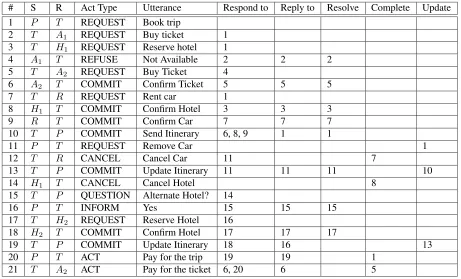
2.1 Possible annotated interactions in the trip planning example . . . 28
1.1 FSM Example . . . 7
1.2 Sequence Diagram Example . . . 8
1.3 Workflow Example . . . 9
1.4 Commitment Example . . . 13
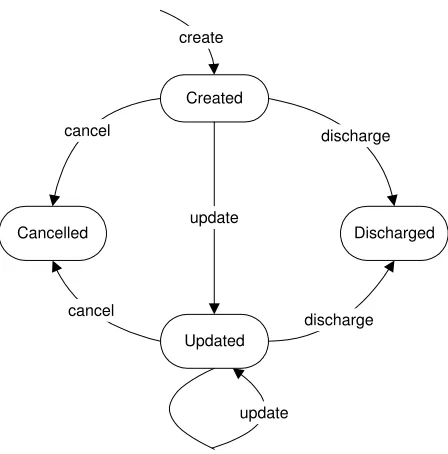
2.1 Commitment lifecycle . . . 24
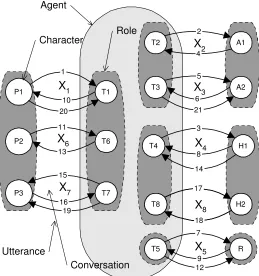
2.2 Dooley graph for trip planning . . . 30
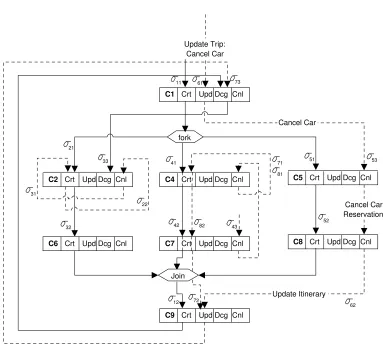
3.1 Commitment causality diagram for trip planning. . . 42
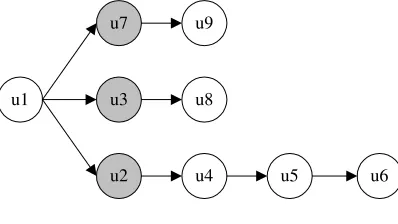
3.2 Responds tree of utteranceu1 . . . 43
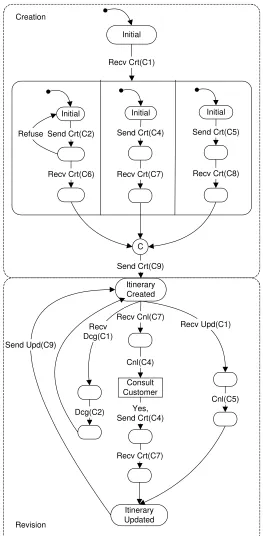
3.3 Travel agent behavior model statechart . . . 67
3.4 Commitment-based business process UML . . . 68
3.5 Case study . . . 69
4.1 Reentrant connectors . . . 78
5.1 An Example of Commitment Causality Diagram . . . 90
5.2 A deadlocking agreement . . . 92
List of Algorithms
1 Generate a list of commitments . . . 37
2 Generate a commitment causality diagram . . . 41
3 Generate statechart for an agent . . . 48
4 Building CCD from Commitment Sets . . . 90
5 2PC protocol . . . 94
6 Unconditional yield protocol . . . 95
7 Conditional yield protocol . . . 96
Introduction
One of the main goals of today’s eBusiness applications is to help companies produce value by improving customer and business partner satisfaction. To accomplish this goal, besides requirements developed by managers, a sophisticated and reasonable business process de-sign plays an important role. A good dede-sign need not only specify domain-level business processes, but must also deal with the abnormalities arising around those processes. These abnormalities can be described as below.
Exception handling. Dealing with exceptions is one of the most common functions of process management. For example, in a travel system, a customer may cancel his trip, an airline may cancel or delay its flight, a hotel may over-sell its rooms. Although, there may be a low chance that an exception would happen, a good design must cover every one of them to avoid system failure. Researchers and practitioners are seeking efficient representations of exceptions to reduce the burden of exception handling.
Process revision. This often happens in long-lived transactions where some of the partici-pants may re-execute their processes before the entire transaction ends. For example,
2
in a travel booking system, upon receiving a trip booking request from a customer, a travel agent sends individual requests to airlines, hotels, and car rental compa-nies. However, before those agents send confirmations back to the travel agent, the customer may want to change his flight time or hotel location, which would trigger another request to be sent to his travel agent. This is allowed in travel booking sys-tems, although different designs may treat it differently. While some systems require the travel agent wait for the results to be sent back from the airline and hotel agents before sending the customer’s change request, others require that the travel agent can-cel the corresponding initial request and send the change request as a fresh request afterwards. Most existing approaches treat each case as independent processes, ig-noring the relationship among them, which makes the designs very inefficient and not expandable.
words, companies will select a strategy to bring about the best value. A good pro-cess design should allow different execution paths under the same propro-cess to realize different values.
1.1 Challenges to Today’s eBusiness Applications
The potential for abnormalities in business process execution poses major challenges for today’s eBusiness design methodology. These challenges are described below.
Maintain long-lived transactions. Long-lived transactions are usually composite activ-ities that can potentially last days or weeks. During such period, exceptions and process updates may occur within subactivities. The so-called ACID properties (atomicity, consistency, integrity and durability), which are essential for maintain-ing database integrity in conventional settmaintain-ings, of individual transactions, may not hold [Kaye, 2003]. Many existing approaches have developed specific ways to deal with exceptions such as executing compensation tasks, re-executing the failed tasks, or rolling back to the last checkpoint [BPEL, 2003]. However, these methods are highly task-specific, which makes their models quite complex. What we need is to declaratively specify task dependencies so that the exception handling processes can be automatically generated by participants instead of being statically specified in the design flow.
4
From this point of view, the participants’ promises should become manipulable ob-jects and be controlled by participants themselves to ensure a successful execution of the long-lived transactions.
Allow autonomy among business partners. eBusiness partners are autonomous entities that engage in business to promote their own interests, such as reducing operational costs or deriving maximum value out of a transaction. To maximize autonomy, par-ticipants may change their intermediate goals at runtime, resulting in different execu-tion paths. This presupposes that the models should allow autonomy to the business partners so that they can flexibly choose different paths or even initiate new requests in the middle of the execution. However, existing approaches tend to impose static flows on the process execution and treat participants merely as task executors instead of as self-motivated agents. What kinds of specifications will enable autonomous execution is an interesting topic for research.
Accommodate ever changing business requirements. Nowadays companies keep refin-ing their business requirements to increase business process efficiency and robustness as well as to bring more value to their customers. The requirement changes often lead to design changes. Industrial practitioners have devised a few approaches to mini-mize the potential impact, for example, building adaptable workflow systems [Buhler and Vidal, 2005]. However, few approaches are capable of reducing the effort dealing with the exceptions introduced by the new requirements since the new exception han-dling steps usually complicate the existing design. What we need is a modular model in which new interactions can be easily added with exception handling automatically incorporated.
6
1.2 Existing Approaches
Various modelling approaches have been used to specify eBusiness systems. These range from statecharts [Harel et al., 1987], which specify transitions within a standalone sys-tem, to workflows which coordinate multiple business activities [WfMC], to Web services standards which build the interfaces among communicating parties across the Web [W3C] [WSDL, 2002], and finally to the business process modelling languages which orchestrate participants to successfully do business with each other [BPEL, 2003] [Cabrera et al., 2003] [Cabrera et al., 2002]. However, these approaches yield complicated specifications when facing dynamically changing business requirements. In particular, the effort of dealing with autonomy and system abnormalities grows rapidly as the requirements change and grow. Below we describe the limitations of some existing models.
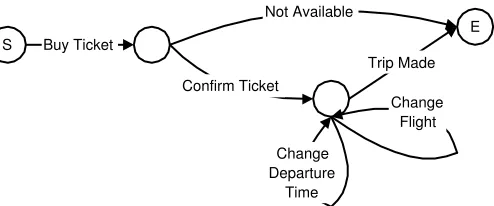
FSM-Based Models. An FSM-based model specifies how a system transitions from one state to the next, and what actions to perform upon receiving any internal or exter-nal events. This approach is useful for building a standalone sequential system, but has difficulty in specifying the interactions among multiple parties because of the exponential complexity of a global FSM in which all the participants execute.
In addition, an FSM-based model must cover every event and action to prevent its execution from breaking down. The majority of such events and actions are excep-tions and their corresponding handlers. This inevitably imposes a heavy burden on designing a valid system whose requirements are changing.
The limitations of FSM-based models render them not appropriate to specify a com-plex distributed system where multiple parties interact autonomously.
S Buy Ticket
Confirm Ticket
E
Trip Made
Change Departure
Time
Change Flight Not Available
Figure 1.1: FSM Example used, changed or cancelled.
8
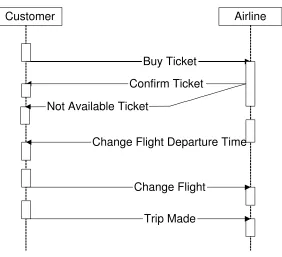
Buy Ticket
Customer Airline
Confirm Ticket Not Available Ticket
Change Flight Departure Time
Change Flight
Trip Made
Figure 1.2: Sequence Diagram Example
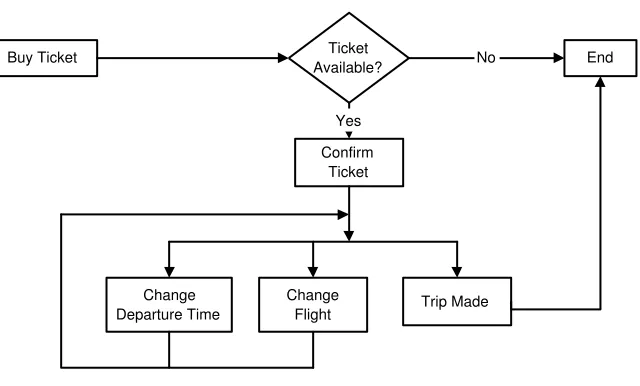
Workflows. Workflow systems focus on task execution and control coordination. Unlike FSM-based systems, workflows do not model the states of a system, but validate the result of a task execution and how to chain a task’s output to another next task’s input. A workflow system is more useful to specify a pipeline system where a global task is processed piece by piece among consecutive task executors. Figure 1.3 shows how the previous example is designed using workflows.
Buy Ticket Ticket
Available? No End
Confirm Ticket
Yes
Change Departure Time
Change
Flight Trip Made
Figure 1.3: Workflow Example
On the other hand, in an eBusiness system, the participants are not the same type of workers within a given organization; they are different types of business entities and have their own interests for doing business. We cannot expect all the partici-pants to follow a predefined execution path without giving them autonomy to choose when, where, and how to execute these tasks. In the extreme, the participants can even spawn new requests to trigger additional task executions. Therefore, workflow systems are not flexible and expressive enough to specify today’s eBusiness applica-tions.
10
[BPEL, 2003]), BPML (Business Process Modelling Language [BPML]), and WSCI (Web Service Choreography Interface [WSCI, 2002]).
Coordination and Transactions. WS-Coordination specifies the transactional protocols used in business process models. It generally involves a coordinator to handle pro-tocol registration and enactment. Business participants must first register with a coordinator before interacting with other business partners. Built on the top of WS-Coordination, WS-Transaction specifies various type of transactional protocols. These protocols are divided into two categories, atomic transaction and business ac-tivity, which will be described in detail in Chapter 2.
1.3 Proposed Approach
Specifying detailed transactional protocols is good at ensuring a reliable process execu-tions, however, it does not allow protocol flexibility and participants’ autonomy. In other words, the process execution paths are statically specified at design phase, and participants cannot change the courses of interaction due to business abnormalities arisen at runtime. The problem here is that the business process specification still stay at lower level process coordination and message passing, and there is no higher level abstraction on how these processes and messages relate to the domain-level business requirements and obligational relations among participants.
needs to find another available flight or refund the ticket. All these process are just specific action sequences when participants fulfill their obligations. The transactional protocols can handle them, but in a rigid manner within a narrow scope. In our view, capturing obligations among participants in business process design can yield a rich variety of interactions which not only generate flexible executions, but also maximizing participants’ autonomy which may produce more value out of business engagements.
Based on the limitations of today’s modelling approaches to meet the above challenges, we require a concept that supports process updates, on-the-fly conversations, and obligation fulfillments. We introduceagentsandcommitmentsfrom multi-agent theory into business process modelling.
1.3.1 Agents and Multiagent Systems
Agents have been widely studied as intelligent software entities that can perceive, reason and act proactively. Agents are designed to be autonomous and heterogeneous. By auton-omy, we mean an agent is allowed to make its own decisions on what execution path it takes and what messages it sends. By heterogeneity, we mean an agent is not restricted by the environment in which it resides and the way it behaves in order to communicate with others. These two features distinguish agents from other software entities and help model a flexibly collaborative system.
12
Commitments (also known as social commitments) are widely recognized as a key rep-resentation for the interactions in a multiagent system. A commitment is an abstraction of an obligation made by a debtor to a creditor. Agent interactions can be naturally un-derstood in terms of the commitments the agents make, fulfill, cancel, or modify. Once a commitment is created, it ties its debtor and creditor agents together until it is fulfilled. The lifecycle of a commitment captures an interaction history between two agents. Also by analyzing the relations among commitments, we can capture the behaviors of a group of agents. Commitments enable us to model and analyze the behavior of autonomous agents and help establish agreements among these agents.
By introducing commitments into business process modelling, we endow process par-ticipants with autonomy and heterogeneity as would exist in a pure multiagent system. Our approach shifts the focus of system design from coordination and messaging protocols to commitment causality relations and lets the participants decide how to manipulate these commitments. In such a way, the participants can proactively accomplish their local and global tasks and flexibly handle task revisions and exceptions.
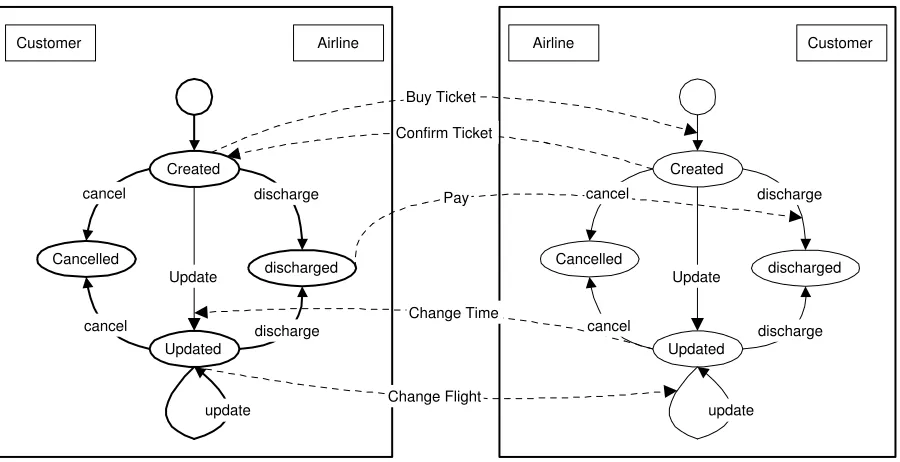
Figure 1.4 shows how we describe the previous example process using commitments. We use two commitments, one made from the customer to the airline, and the other made from the airline to the customer. All the actions or events seen in the previous approaches are generated by commitment operations and its lifecycle state machine. The dependencies among these actions and events are specified by a Commitment Causality Diagram (CCD), which is described in later chapters.
1.3.2 Benefits of Commitments
Created discharged Updated Cancelled cancel cancel discharge discharge update Customer Airline Buy Ticket Confirm Ticket Update Change Time Change Flight Pay
C(Customer, Airline, Confirm Ticket --> Pay) C(Airline, Customer, Confirm Ticket) Created discharged Updated Cancelled cancel cancel discharge discharge update Airline Customer Update
Figure 1.4: Commitment Example
14
Commitments can help since they can simplifies delivering consistency, satisfaction, and trust. If an agent sends a message to another agent to change some data, the for-mer tells the latter that he will make sure the data will be eventually changed and the change will be correct and consistent. If it is not, the former will repeatedly deliver an update until the latter gets satisfied, or the former may change the commitment but still achieve the same goal agreed upon by the latter. In this paradigm, the above messages can be grouped into the same commitment. Each message represents a different stage of the commitment. The first message could be the creation of the commitment and each update or exception handling message represents an update of the commitment. If the commitment eventually satisfies the creditors, then the commitment will be discharged. The commitment can also be cancelled or released because the first agent wants to revoke the message he sends to the second agent.
In this manner, commitments essentially put threads of related messages and pieces of protocols together, which make the system interaction more expressive in terms of the business logic that a designer is implementing.
Preserve Autonomy and Heterogeneity. By communicating using commitments, agents tell each other what, but not how. Agents expose their commitments but not their behaviors. Agent-oriented programming differ from the object-oriented paradigm, which can also hide implementation details but has hard-coded interfaces. Agents can freely express themselves by commitments that can potentially change protocol execution and flexibly react to any unexpected events. By doing this, we preserve agent autonomy and heterogeneity. In other words, any party could potentially talk to another without a complex and rigid protocol being imposed.
multiagent system, we mainly deal with the local and global goals. A commitment can be considered as an operational element that contains the goals to achieve, the preconditions and postconditions to satisfy these goals, as well as the reference to re-lated parties. By manipulating commitments, we could potentially eliminate the need to specify a message-oriented protocol. In other words, the message causality can be extracted into commitments, making the actual protocol execution requirement-driven and controlled by the lifecycle of the commitments involved. The runtime message sequence could vary depending on how the commitments evolve. In this way, the hurdle of handling exceptions and revisions can be overcome and the au-tonomy of agents can be maximized to achieve flexible implementations and interac-tions.
16
1.3.3 Applying Commitments
Based on the foregoing, the main idea of this research is to analyze agent interactions in terms of causally linked commitments, and to develop a methodology (with significant algorithmic components) using which commitment-based agents can be inferred. The ad-vantage of doing so is to produce richly structured multiagent systems whose members interact flexibly.
Our main research focuses on how to incorporate commitments semantics into existing business process models so that business process specifications become requirement driven. The protocols become less restrictive and allow conversations among producer agents and consumer agents. The types of business applications that our approach applies to are:
• Long-lived and persistent business activities.
• Input can be updated and results can be reproduced. • Business constraints are dynamically formed. • Participants have allowed autonomy.
• Negotiation for optimal results is required. • Compliance validation is required.
The philosophy behind our approach is summarized as follows:
• During design phase: commitments+causality=business agreements • At run time:commitment lifecycle+connectors=execution sequences
where the commitment lifecycle results in both domain-level processes and exception handling; and connectors are the runtime coordination logic, which follow the causality rules.
the commitment operations, which manipulate commitments and execute underlying com-mitment protocols. We study how to obtain the CCD in two ways, from low-level agent conversations and from business requirement specifications. Also from the base technol-ogy, we convert one of the existing business process models into our CCD and prove that the conversion not only preserves the original coordination requirements but also enables conversations among agents.
Our model is complementary to existing industrial approaches and gives designers an-other view of business process. We add commitment objects and conversation structures to the existing business process specification so that each business process has its associ-ated commitments along with the conversations that manipulate these commitments. All participants involved in a business process must agree on maintaining these commitments but are allowed to flexibly use any of the corresponding conversations. For example, a cancellation of a flight from an airline may result in two possible conversations. One, the travel agent may seek a new flight or a new airline without inquiring his customer. Two, the travel agent may consult with the customer if the latter wants to cancel the trip or seek an alternative flight or airline. Based on the travel agent’s flexibility and policies, either conversation could be used but the final goal should be the same, that is the travel agent keeps his commitment to the customer to buy a ticket.
18
to achieve agent autonomy. Thus, an agent designer will put more focus on the business requirements and agreements instead of on coordination protocols.
1.4 Contributions
The main questions addressed by this research are the following.
• What is the basis for grouping multiple processes under the same commitment? • How are long lived transactions represented under commitment semantics? • How can we prove that the proposed approach is correct?
The following summarizes our main contributions:
1. Engineering Methodology
(a) Representing agent interactions using CCD.
(b) Designing CCDs based on business agreements.
(c) Generating agent execution models from CCDs.
(d) Proving the correctness of CCD.
2. Formalization
(a) Expressing the proposed model using theπ-calculus. (b) Deriving system behaviors.
(c) Extending business logic.
(d) Verifying model consistency.
(a) Incorporating the model into BPEL-like specifications.
(b) Formulating multiparty agreements using commitments.
(c) Detecting and resolving agreement deadlocks.
1.5 Outline of this Dissertation
Chapter 2
Technical Framework
This chapter describes the technical background behind our proposed methodology and theory. It includes the concepts of commitment, speech acts, agent conversations and Doo-ley Graphs. We illustrate these concepts by demonstrating a running example, which also forms the study domain of our methodology and the theories presented in the later chapters.
2.1 Commitments
Commitments are a key element of the semantics of agent communications [Singh, 2000a]. Recent work operationalizes commitments. Fornara and Colombetti develop an opera-tional semantics that models the lifecycle of a commitment [Fornara and Colombetti, 2002]. Economouet al. show how deontic states and commitments can be detected from agents’ finite state machines and how communications rely upon the protocols as executed by each agent [Economou et al., 2001]. Yolum and Singh show how protocols among agents can be encoded as commitment machines and automatically executed [Yolum and Singh, 2002].
2.1.1 Definitions
A commitment is an obligation from a debtor to a creditor about a particular condition. For debtorx, creditory, and conditionp, the relevant commitment is notatedC(x, y, p).
• Unconditional commitment. A commitment whose condition is a simple propo-sition. If the condition specifies an action happening at once, then we called it an immediate commitment.
• Conditional commitment. A commitment of the formC(x, y, e → p), where
e is a condition (possibly interpreted as an event) and p is a condition to be brought about (possibly interpreted as an action). Herepis activated when e becomes true.
Any unconditional commitment that has a temporal proposition specifying an action happening in the future or a conditional commitment, are called non-immediate commit-ments.
2.1.2 Commitment Operations and Lifecycle
Commitments support the following operations and combine to capture mutual and multi-party scenarios.
• Creation, Crt(C(x,y,p)). Agent X commits to Y regarding P first time. This is an initial state of a commitment. It puts both agents into a significant local state since from then on, agent X should eventually fulfill what he commits and agent Y needs to monitor and verify whether the former has accomplished what he promises or not.
22
time he creates it and both parties will be released from this obligatory rela-tion. However, if P is a non-immediate commitment, both the parties will keep track of the evolution of the commitment within a reasonable time range or before the end of the conversation, at which moment whether the commitment is fulfilled or violated will be judged.
• Update, Upd(C(x,y,p)). Agent X updates a commitment made to Y. This oper-ation only applies to a non-immediate commitment. It occurs when something arising from X’s internal or external world causes X intentionally to change the conditions or actions in P. If the changes are agreed upon by both parties and do not violate X’s original promise to Y in nature, the commitment will continue to be held; otherwise Y will reject the operation which may result in the cancellation of the original commitment.
This operation is an enhancement to previous research [Xing et al., 2001], in which to make such changes, a new commitment has to be created and the old one has to be cancelled, which breaks otherwise linked transactions into independent ones and makes it difficult to keep track of the ongoing interaction between two agents.
• Cancel, Cnl(C(x,y,p)). Agent X cancels the commitment he makes to Y be-cause he is not able to or he is not allowed to fulfill the commitment. This may happen when agent X’s internal system breaks down or someone else does not fulfill its commitments to X. The cancellation usually incurs penalties on X or a corresponding compensation action from X, such as creating a new commitment to Y. This operation reflects the exceptions raised during agent interactions. To identify the chain of effects it makes on the other agents or the whole system is one of the interesting topics in this research.
• Release, Rls(C(x,y,p)). The commitment is released without being discharged. This could happen when the fulfillment of the commitment is not relevant to the ongoing business transactions any more. Both creditors and debtors do not depend on this commitment for to perform future actions. It is different from discharge and cancel since it never fulfill or violate the underlying agreement. • Delegate, Dlg(C(x,y,z,p)). The creditor of the commitment has been changed from y to z. For example, a customer may transfer his flight ticket to his friend so that the travel agent needs to ensure his friend gets the ticket.
• Assign, Asn(C,(x,y,z,p)). The debtor of the commitment has been changed from x to z. For example, an airline may cancel a flight due to engine problem, then they could transfer their passengers to their partner airlines.
24
Discharged Cancelled
Created
Updated
cancel discharge
update
cancel discharge
update create
Figure 2.1: Commitment lifecycle
2.1.3 Commitment Patterns
Our previous research [Xing et al., 2001] has studied the combination patterns of the above commitment operations. It generalizes the following scenarios in which agents manipu-late commitments to achieve the maximum autonomy and heterogeneity. Agent behavior models are also generated to accommodate these patterns.
• Entertain Request: A consumer role will accept requests from another role and perform its task about the request.
• Notify the Consumer: This comes into effect when a producer role has just completed its tasks for the first time. It informs another role of the computed data values, and becomes committed to the specified predicates.
consumer.
• Renotify Consumer: This comes into effect when a producer role has just pleted its tasks for the second or a later iteration, and some of its existing com-mitments are violated by the recently completed task. The violation would typically occur because the predicates to which the agent had committed have been falsified by the results just obtained. The producer role will send the new results to its consumer.
• Dissatisfy the Consumer: This comes into effect when a consumer role is dis-satisfied with the results. It sends a reject request to its producer role.
• Abort from the Producer: A producer role may cancel its commitment by send-ing an abort message to the other role.
2.2 Agent Interactions and Dooley Graphs
Dooley graphs segment agent interactions into courses of conversations [Parunak, 1996]. Each independent conversation reflects a fragment of agents’ models and shows how agents behave in different stages of their interactions. Singh showed how to generate coordination requirements based on the agent skeletons created from a Dooley graph [Singh, 2000b].
2.2.1 Speech Acts
26
simply enables a requester or a requestee to cancel his request or commitment, respec-tively. We also treat Request as a conditional commitment (defined in Section 3.1) made by a requester.
Parunak defined four relationships among pairs of utterances, namely, respond, reply, resolve, and complete. We add a fifth relationship, termed update. The following is the complete set of possible relationships between message ui anduj (hereSi andRi are the
sender and receiver ofui):
• ui responds to uj iff Si receivesuj and uj causesSi to send ui. This simply
denotes a causal relation and indicates that messages must follow the given order.
• uireplies touj iffui responds toujandRi =Sj. This tells us that the receiver
of the Reply message is also the sender of the message to which it responds. It does not express more meaning but helps identify the characters in the conver-sations.
• ui resolves uj iff ui replies to uj andui is an Inform, Refuse, Commit, or an
ACT. This means that something significant has occurred to the conversation initiator because it informs, commits, refuses, or acts. It is implied that ui
follows the “rules of engagement” defined inuj.
• uicompletesuj iffuj is a Commit or a Request anduieither cancels or fulfills
the commitment made in the Commit or Request message.
• ui updatesuj iffuj is a Commit or a Request andui updates the commitment
made in the Commit or Request message. One “Updates” may update another “Updates” message.
the above five relations help identify conditional commitments (Requests) and causal rela-tions among them.
2.2.2 Example Conversation Table
As our running example, consider a travel planning scenario. A customer (or passenger P) calls his travel agent (T) to book a trip. He makes a commitment that if T books the trip for him, he will pay for the trip as well as any processing costs. Upon receiving the order, T sends requests to airline (A), hotel (H), and car rental (R) agents to reserve air tickets, hotels, and cars, respectively. T also makes commitments that ifA,H,Raccept his requests and ifP purchases the trip, then he will pay them. IfA finds an available flight, he will make a commitment to reserve it. So will H andR, if they have available spots. Eventually, if all goes well,T will make a commitment toP to confirm the trip. However, P may cancel all or part of the trip. For instance,P may cancel the car rental if he will get a ride with a colleague. In this case,P updates his request; that is, he updates his original commitment. This update may causeT to update and cancel some of his commitments.
28
# S R Act Type Utterance Respond to Reply to Resolve Complete Update
1 P T REQUEST Book trip
2 T A1 REQUEST Buy ticket 1
3 T H1 REQUEST Reserve hotel 1
4 A1 T REFUSE Not Available 2 2 2
5 T A2 REQUEST Buy Ticket 4
6 A2 T COMMIT Confirm Ticket 5 5 5
7 T R REQUEST Rent car 1
8 H1 T COMMIT Confirm Hotel 3 3 3
9 R T COMMIT Confirm Car 7 7 7
10 T P COMMIT Send Itinerary 6, 8, 9 1 1
11 P T REQUEST Remove Car 1
12 T R CANCEL Cancel Car 11 7
13 T P COMMIT Update Itinerary 11 11 11 10
14 H1 T CANCEL Cancel Hotel 8
15 T P QUESTION Alternate Hotel? 14
16 P T INFORM Yes 15 15 15
17 T H2 REQUEST Reserve Hotel 16
18 H2 T COMMIT Confirm Hotel 17 17 17
19 T P COMMIT Update Itinerary 18 16 13
20 P T ACT Pay for the trip 19 19 1
21 T A2 ACT Pay for the ticket 6, 20 6 5
Table 2.1: Possible annotated interactions in the trip planning example
2.2.3 Dooley Graph Elements
The following defines the elements used in Dooley Graphs.
• Characters. These are the vertices in a Dooley graph. They represent the indi-vidual entities at different stages of the modelled interaction. In our example, the list of characters is{P1–P3,T1–T8,A1–A2,H1–H2,R}
• Conversation. A sequence of utterances between two characters derived from a Dooley Graph. A character can only participate in one conversation. In Figure 2.2, the set of conversations is{χ1={1,10,20},χ2={2,4},χ3={5,6,21}, χ4={3,8,14},χ5={7,9,12},χ6={11,13},χ7={15,16,19},χ8={17,18}}. • Conversation initiator. The sender of the first utterance in a conversation; e.g.,
• Causality. If the send or receive of an ui precedes uj then ui is a potential
cause ofuj. For a given conversation, the causes are annotated via the
vari-ous relations among utterances. The internal conditions that enable the causes are not explicitly specified to preserve the autonomy and heterogeneity of the participants.
• Context-related conversations. Let utterancesuianduj occur in conversations
χi and χj, respectively. If ui updatesuj thenχi is context-related toχj. For
example,χ1 andχ6 are context-related conversations.
• Role. The abstraction of capabilities used by characters who deal with same type of transactions or are involved in context related conversations. In Fig-ure 2.2, the characters inside a dotted circle belong to the same role.
• Agent. A concrete party who can play one or more roles. Our example has agents{P,T,A1,A2,H1,H2,R}. Notice that agentT plays 4 roles and has 8 characters, andA1 andA2play the same role, which has characters,A1andA2.
2.2.4 Example Dooley Graph
30 P1 T1 10 1 14 T4 H1 8 3 T3 A2 6 5 T5 R 9 7 T2 A1 4 2 P2 T6 13 11 12 P3 T7 16 15 A B1 T8 H2 18 17 19 20 21 Role Character Agent X2 X3 X1 X4 X5 X8 X6 X7 Utterance Conversation
P: Customer
T: Travel Agent
A: Airline Agent
H: Hotel Agent
R: Rental Car Agent
Figure 2.2: Dooley graph for trip planning
However, the above approaches concentrate on low-level interactions, such as the order-ings of events. They do not study how high-level abstractions, such as commitments, can be induced. This dissertation demonstrates how commitments and relations among them can be derived from Dooley graphs and what the advantages are of looking at the models at commitment level.
2.3 Workflow Management System
The following are the basic elements involved in a typical workflow management system. Task. A process or a transaction that accepts inputs, executes, and produces outputs.
compound, which is comprised of a set of small subtasks.
Actor. A software module, a Web service, or an agent that executes a task. An actor is not only responsible for processing the task but also in charge of communi-cation, such as receiving input from or sending output to other executors. In the context of our research, we uses agents as our actors. This naturally cap-tures the autonomy, heterogeneity, and proactiveness of each component of a business process.
Capability. A set of functions or skills that are required to execute particular tasks. A capability specifies what input it can take and what output it can produce. It checks the preconditions and postcondition of tasks to ensure data consistency and integrity. The agents must have the matched capabilities before they are assigned to those tasks.
Role. The abstraction of the agents who have common capabilities. One role may own more than one capability and one agent may adopt more than one role which enable agents to execute several different tasks or a compound task. Data Container. An abstract data storage from which an agent receives input and to
which the agent sends output. The contents in data containers can be sent di-rectly with the messages such as XML contents or can reside at an independent location such as in a database or maintained by third-party servers. In the latter case, correlation IDs are used by agents to reference those data.
32
one outgoing edge which connects to a receiving agent. An outgoing connector has one incoming edge which connects to a sending agent and multiple outgo-ing edges. In this categorization, no connector connect multiple input tasks to multiple output tasks since we restrict every message to have only one source and one destination. The following is the list of connectors.
• AndJoin (Incoming): All its incoming edges must be triggered be-fore its outgoing edge can be triggered.
• OrJoin (Incoming): Its outgoing edge can be triggered if one of its incoming edges is triggered.
• Fork (Outgoing): If its incoming edge is triggered then all of its outgoing edges must be triggered.
2.4 Business Process Execution Language
BPEL4WS is a service composition specification jointly developed by several industry leader companies such as IBM, Microsoft and BEA. It composes services described by WSDL into a compound business process with a flow control logic. Transaction protocols are also incorporated by adding the WS-Coordination and WS-Transaction frameworks. Because BPEL is increasingly recognized as an industry standard for specifying service compositions, it becomes an important counterpart to our approach. The following is a list of language elements used by BPEL4WS. These elements have similar concepts as workflow but with more expressiveness such as structured activities, which provides more programmable controls.
• PartnerLink. Mapped to capabilities in workflow. Only the roles specified in partner links can invoke the corresponding process.
• Variable. Mapped to Data containers in workflow. • CorrelationSet. To correlate messages into sessions.
• Basic and Structured Activities. Used to implement process and flow control logic.
• faultHandlers, compensationhandler and eventHandlers. Activities triggered to handle fault, compensations and events.
2.5 Coordination and Transactions
Atomic Transaction. Atomic transactions achieve the “all or none” property in which an overall activity fails if one of its participating activities fails; or the overall activity succeeds only when all of its participating activities succeed.
1. CompletionWithAck Protocol. A participant sends its completion result to the coordinator and also receives a notification from the coordinator regarding the overall result.
2. Completion Protocol. A participant sends its completion result to the coordi-nator but without a notification from the latter.
3. PhaseZero Protocol. Participants wait for a notification from the coordinator before completing their processes.
34
5. OutcomeNotification Protocol. Each participant sends an outcome to the co-ordinator after finishing its execution.
Business Activity. Business activity protocols handle long-lived transactions and specifi-cally deal with the business exceptions occurring within these transactions. Scopes are used to abstract different levels of process executions and exception handling.
1. BusinessAgreement Protocol. A nested scope participant registers for this protocol with its parent scope coordinator. A nested scope must know when it has completed all work for a given business activity.
Building Process Models
This chapter applies the framework of Chapter 2 to build a commitment-centric business process model. As illustrated in Chapter 1, commitments are specified in the design phase and manipulated during runtime. Our focus is on how to model long-lived transactions as persistent commitment objects by abstracting the low-level messages and activities into commitment operations. Our modelling technique is based on a deep analysis of agent interactions (based on speech acts) from which we can derive commitments, commitment causality, and agent execution models.
3.1 Deriving Commitments
Our communicative acts map to the following commitment operations: create,update, dis-charge, andcancel.
• Request (without Update). CreateC(x, y, e→p). A conversation initiator
usu-ally requests a particular information or service. The antecedentecorresponds to a condition potentially satisfied by the requestee, e.g., a commitment to do
36
something. The consequentpcorresponds to what the requester will do if the requestee satisfiese. Therefore, this action forms a conditional commitment. • Request and Update. Update C(x, y, e → p). This is a commitment update
sent by a request creator. Either e or p could be changed, but the modified commitment still follows the original organizational rules.
• Commit and Resolve. Create C(x, y, p). If a Commit resolves an utterance,
then it creates a commitment for the first time following the applicable rules. This may caused by a request sent from a conversation initiator and is also decided by the willingness of the commitment creator.
• Commit and Update. UpdateC(x, y, p). If a Commit updates an utterance, then
it updates its original commitment. It is equivalent to cancelling the previous commitment and creating a new one while still following the original rules. • Act and Complete. DischargeC(x, y, e→p)orC(x, y, p). If an act (i.e., a
non-communicative act) completes an utterance, then the action performer fulfills and discharges the commitment made in that utterance. Since a commitment need not be fulfilled in one message, several (Act and Complete) utterances may exist to complete the same utterance.
• Act and Resolve. Create and dischargeC(x, y, p). If a non-communicative act
resolves an utterance, then the action performer creates and fulfills a commit-ment at same time.
• Cancel and Complete. CancelC(x, y, e → p) orC(x, y, p), if a Cancel
com-pletes an utterance, then it cancels a conditional commitment (Request) or an unconditional commitment (Commit) made in that utterance.
both debtor and creditor are characters in a same conversation. Algorithm 1 below gener-ates a complete list of commitments.
CommitList ={}; foreachui do
switchuido
caseRequest w/o Update:
Add C(Si, Ri, ei → pi) to CommitList, where ei = true and pi =
T oBeDecided.
case(Commit and Resolve) or (Act and Resolve) w/o Update:
Add C(Si, Ri, pi) to CommitList, where pi is an action or a condition
thatSi commits toRi to perform or keep true.;
caseAct and Complete:
uj ←the utterance thatui completes;
ifuj is a Requestthen
letC(Sj, Rj, ej →pj)be the corresponding commitment ofuj;
pj ←the Act;
foreachukthatuiresponds todo
switchukdo
caseCommit + Resolve w/o Update: ej ←ej∧C(Sk, Rk, pk);
caseAct + Resolve w/o Update: ej ←ej∧theAct;
caseUpdate:
ul ←the original Resolve utterance thatukupdates
fol-lowing the update chain; ej ←ej∧C(Sl, Rl, pl);
caseAct + Complete: ej ←ej∧theAct;
Algorithm 1:Generate a list of commitments
38
for a Resolve message, e.g.,C(A2,T, Confirm) for utteranceu6. To decide the antecedent and consequent in a conditional commitment, the algorithm looks for an Act and Complete messageui that completes a Request utteranceuj. If there is one, then the Act decides the
consequent. For any utteranceuk thatui responds to, the corresponding commitments or
acts ofukconstructs the antecedent.
By executing the algorithm on Table 2.1, we obtain the following list of commitments. Here TBD indicatesto be decided. All conditions of the formtrue→qare simplified toq.
• C1 =C(P, T,C(T, P, SendItinerary)→Pay(P, T)) • C2 =C(T,A1,TBD)
• C3 =C(T,A2,C(A2, T, Confirm)∧Pay(P, T)→Pay(T,A2)) • C4 =C(T,H1,TBD)
• C5 =C(T, R, TBD) • C6 =C(A2, T, Confirm) • C7 =C(H1, T, Confirm) • C8 =C(R, T, Confirm) • C9 =C(T, P, SendItinerary) • C10=C(T,H2, TBD) • C11=C(H2, T, Confirm)
owed, e.g., if a passenger is a no show. Any such domain policies can be added during the final design.
Many commitment instances are derived from the conversation table. Some commit-ments update the others and some replace the others, but they essentially relate to the same debtors and creditors and deal with the same transactions. We treat all these related com-mitments as instances of the samecommitment class. They are merely the results of oper-ations performed on the same class. Next, we give the definition of a commitment class. Two commitments C(x1, y1, p1)and C(x2, y2, p2)belong to same class if and only if they
satisfy the following requirements:
1. Role(x1) = Role(x2) and Role(y1) = Role(y2)
2. p1andp2 deal with the same transaction, goods, or information (possiblyp1 =p2). Based on this definition, we can put commitment C2 andC3 into same class, because the only difference between them is that different instances of the same role A (A1 and A2) are involved. Likewise,C4 andC10are classified together. For each class, we use the commitment with the lowest subscript as the representative of the class but with bold font. The following lists each commitment class and its commitment instances in the example.
40
For a commitment class, any characters involved in its instance commitments are re-placed by their corresponding roles. For example, in commitment class C2, character A1 andA2are both replaced withA, and in classC4,H1 andH2are replaced byH.
If a commitment class is a conditional commitment, then the antecedent of the class is the conjunction of the antecedents of the constituting commitments, and the consequent is the list of consequents of those commitments. For example, C2 = C(T, A, (C(A, T, Confirm)∧Pay(P, T))→Pay(T, A))andC4=C(T, H, TBD). This is appropriate because the commitments in a class involve the same transactions.
3.2 Deriving Causal Relations
Causal relations among commitments are crucial to understanding the chain of commit-ment operations, because they drive an interaction along significant states where the real transactions of domain value occur. A commitment causality diagram (CCD) is a graph showing potential causality between each pair of commitment operations. A CCD high-lights the important stages within the information flows and hides details of the interaction protocols that can vary depending on the actual implementation. From a designer’s stand-point, a CCD reflects the high-level business logic that specifies what agreements should be achieved. From a CCD, we can infer the agent conversations needed to achieve and modify the commitments underlying these agreements. Once the commitments and their relations are identified, designers can always choose an optimal conversation that flows between any related pair of commitment operations.
Figure 3.1 shows a CCD derived for our running example. Each node consists of five elements, namely, the commitment class identifier and its associated four operations:create
is causally related to another operation, then there is a directed edge from the causing operation to the caused operation. For example, if the creation of commitmentC1 causes the creation of commitmentC2, then there is an edge from Crt(C1) to Crt(C2).
If the source operation of an edge is an update or cancel, then we use a dotted line which represents an abnormal activity occurring in the process execution. In this example, an update ofC1, which represents the customer’s request to update his trip by cancelling the car rental, leads to Cnl(C5), Cnl(C8), and Upd(C9), which represent the travel agent’s can-cellation of the car, the car rental company’s cancan-cellation of the car, and the travel agent’s update of the itinerary, respectively. By using different line types, we can conveniently differentiate the abnormal activities from normal activities thus providing useful layered designs.
1 Construct the Responds graph for the entire conversations; 2 foreachui that involves a commitment operationdo
3 foreach path in theui’s Responds graphdo
4 if∃uj that involves a commitment operationsthen
5 uj ←the first utterance that involves commitment operation in the path;
6 Add a directed edge fromui’s operation touj’s operation;
7 Mark the edge with the set of conversations that each utterance (except
uj) in the path belongs to;
8 foreach commitment operationdo
Use dotted line to link an incoming edge to an outgoing edge if the conversations on the two edges are same or are causally related (e.g., Crt(C7));
Algorithm 2:Generate a commitment causality diagram
42
C1 Crt Upd Dcg Cnl
C4 Crt Upd Dcg Cnl C5 Crt Upd Dcg Cnl
C6 Crt Upd Dcg Cnl C8 Crt Upd Dcg Cnl
C9 Crt Upd Dcg Cnl
Cancel Car
Update Itinerary
32
C2 Crt Upd Dcg Cnl
C7 Crt Upd Dcg Cnl
Cancel Car Reservation Join fork Update Trip: Cancel Car 31 21 33 22
42 82 43 11 61 73
71 81 51 53 52 62 12 72 41
Figure 3.1: Commitment causality diagram for trip planning.
of a new instance of C4 forH2, which automatically voids the instance ofC4 for H1. A dotted edge is added from Cnl(C4) to Cnl(C7) to indicate this. The new instance ofC4then triggers a new instance ofC7. The above scenario is reflected in the edges labeledχ8 and the dotted lines within the Crt(C4) and Crt(C7) blocks.
u1
u2 u4 u5 u6
u3 u8
u7 u9
Figure 3.2: Responds tree of utteranceu1
A CCD illustrates how the commitments evolve during the interaction among the roles. For example, in Figure 3.1, P’s initial request, which corresponds to the creation of C1, triggers the creation ofC2, C4, and C5. This is a simple request, which follows a travel domain rule that causesT to create three subsequent requests without further negotiation.
44
or change the schedule of the trip.
Let us look at another case in whichP updates the trip order by cancelling the car rental. This corresponds to the update ofC1, which leads to the cancellation ofC5 and update of C9. There is no edge between Cnl(C5) and Cnl(C8). However, to model a travel domain rule that the cancellation of car rental request will cancel any car rental confirmation, we add a dotted edge between those two cancellation operations.
The last case we study is the cancellation ofC7. This leads to the creation of another instance of C4 by going through the conversation χ7 in which case T asks P for an al-ternative hotel. This case tells us that between each pair of commitment operations, there may be more conversations and roles involved to decide whether the conditions behind the potential causal relation are satisfied at run time.
Here is a summary of how each type of path in CCD represents the actual business process scenario.
• The creation paths reflect the business logic and specify the interdependencies among business processes.
• The update paths enable revisions of business processes. Each update has to be made within update domain. The update domain evaluates each update and triggers different causal links.
• The discharge paths terminate each causally related commitments. If the dis-charge links are not present in a CCD, we may consider it an incomplete busi-ness process model.
• The cancel paths handle failures and exceptions. The causal links and commit-ment operations along the cancel paths reflects how exceptions are treated at the domain-level.
and discharged in a normal business flow and how they are cancelled because of exceptions or revoked requests. This view is not complete since the original conversation table pro-vides only partial case scenarios. We can either provide more complete agent interactions or try to complete and refine the diagram by hand. The first option is obviously not ac-ceptable, since you have to provide many low-level messages and can be easily confused in trying to capture causal relationships among all the messages. The second option is more appealing since we would already have captured significant transactions and events at the commitment level—the only things remaining would be additional causal edges between some pairs of commitment operations.
3.2.1 Commitment Update Domain
Commitment update facilitates transaction reentrance and exception handling. What can be updated within a commitment is an interesting topic. Here we introduce a concept called “Commitment Update domain” which specifies the invariants that the activation condition, discharge condition and predicate of a commitment do not violate. It also defines the scope within which the agreement can be adjusted and adds flexibility to agent interactions.
For example, an agreement between a customer and a travel agent may state that, the travel agent must look for a flight ticket on a given date (9/10) and within a given price range (< 700 USD). Initially, the travel agent confirms the first choice, 8am, on 9/10 for
650 USD. He holds the ticket for the customer before the latter pays him. However, for some reason the flight gets cancelled, but the travel agent finds another one, at 2PM, on 9/10 for 680 USD, which still satisfies the original agreement. The customer is notified of this change and still pays for the ticket.
46
then the customer may cancel his commitment to the travel agent without any obligation. In a business process specification, we could derive these kinds of update domains from domain-level policies. The research on this aspect will focus on the formalization of domain invariants and detection of update violations. This topic is beyond the scope of this dissertation.
3.2.2 Accommodating Commitment Patterns
In previous research, we proposed a small number of commitment patterns so as to stream-line the interactions among agents [Xing et al., 2001]. The main patterns are Entertain Request, Notify the Consumer, Entertain Update, Renotify the Consumer, Satisfy the Con-sumer (Retry), and Resign (Section 2.1.3 summarize these patterns). These patterns are the behaviors of a single agent. However, by applying them to a CCD, we can state that any operation performed on one commitment needs to be propagated to the operation of another commitment to which the first one is causally related. For example, if the creation of one commitment causes the creation of another one, then updating or cancelling the first one should affect the second one too.
In the CCD of Figure 3.1, there is no out-edge from the cancellation of C1, which corresponds to the request cancellation from P. We can add three edges connecting this node to the cancellations ofC2,C3, andC4, respectively. If this cancellation happens after the discharge ofC1(in which caseP has paid for the flight ticket), then a new conversation may be involved between Cnl(C1) and Cnl(C2) that will resolve a refund or surcharge.
email round trip or a phone call.
Please note that any additional conversations may spawn new commitments. We don’t allow commitment operations on the causality edge between two other commitment oper-ations. Therefore, we need to repeatedly regenerate the CCD whenever new conversations are added.
3.3 Generating Agent Models
The last step of our approach is generating agent models. The agent models are represented in commitment-centric statecharts and are derived from the commitment causal relation di-agram. Each statechart is composed of two parts, dealing with creation and revision, respec-tively. The creation phase represents the negotiation of initial agreements and the formation of commitment chains, while the revision phase represents the update and cancellation of the agreements and any subsequent effects on the commitment chains. Algorithm 3 gener-ates a statechart for an agent. For reasons of space, the algorithm is not as detailed as the others, but highlights the major steps. Figure 3.3 is the example statechart forT.
3.4 Computational Complexity Results
In this section we analyze the complexities of these algorithms. Throughout the proofs, we use the following notation:
k = the number of agents
n = the number of utterances
m = the number of conversations
48
1 foreach operationαon each commitment created by agent Ado
2 Create a new states1;
3 Create a new transition tos1and mark it as “Sendα”;
4 foreach incoming edge toαdo
5 β ←The source operation of the edge;
6 Create a new states2;
7 Create a new transition tos2 and mark it as “Receiveβ” or any communi-cation involved on the edge;
8 Construct the “creation” part of the statechart by linking and merging the states and
transitions that involve only the creations of commitments;
9 Construct the “revision” part of the statechart by Linking and merging the states
and transitions that involve update, cancel, discharge or the second creations of commitments;
10 Connect these two statecharts together by the state where the last commitment is
created;
11 Put any concurrent states and transitions into AND states and merge their common
transitions;
12 Use AND connector to converge transitions leading to a same state if these
transi-tions are the AND preconditransi-tions of the state;
Algorithm 3: Generate statechart for an agent pA = the number of commitments created by agent A
l = the maximum length of theResponds to paths in which only
the begin and end utterance involve commitment operations
Since one utterance can respond to an arbitrary number of utterances that are sent by the same agent, which makes an unrealistic upper bound of the time cost (O(n2
an assumption that, if ui responds to both uj and uk, then Sj 6= Sk. This assumption
ensures that the number of utterances that one utterance can respond to is not greater than the number of agents.
3.4.1 Generate a List of Commitments
Theorem 1. The time cost of Algorithm 1 isO(p+km)and the space cost isO(p).
Proof. 1. In each “Case Request” or “Case Commit and Resolve or Act and Resolve,” we create one commitment, so both the total time and space cost should beO(p),
where p is the number of commitments.
2. In each “Case Act and Complete,” since ui only completes a Request utterance uj
whose number should be less than m (the number of conversations), and also the number of uk is less than k (the number of agents), the total time cost is O(km).
Since there is no memory allocated here, the space cost should be 0.
3. Summing the results in the above two lines, the total time cost isO(p+km)and the
total space cost isO(p).
3.4.2 Generate a Commitment Causality Diagram
Theorem 2. The time cost of Algorithm 2 isO(kln)and the space cost isO(kn).
Proof. 1. To construct theResponds to graph, we scan each utterance and find the ut-terances that it responds to. Since the maximum Responds to messages should be less than the number of agents, the time cost isO(kn). We also allocate one unit of
50
2. In the loop between line 3 and line 7, we scan through each utterance that involves commitment operations and find the closest utterancesuj in each of itsResponds to
path that involves commitment operations. Since the length of the paths betweenui
and uj should be less than l, the total time cost is O(kln). There is no new space
allocated here so the cost is 0.
3. Summing the results in the above steps, the total time cost is O(kln) and the total
space cost isO(kn).
3.4.3 Generate Statechart for an Agent
Theorem 3. The time cost of Algorithm 3 isO(kpA)and the space cost isO(kpA).
Proof. 1. For line 2 and line 3, both the time and space cost isO(1)
2. For lines 4 through 7, since the maximum number of incoming edges for each oper-ation should be less thank, both the time and space cost isO(k)
3. The outermost loop repeats at most4pAtimes.
4. Based on the above, both the time and space cost isO(kpA)