Student‟s Opinions on Online Educational Games for
Learning Programming Introductory
Roslina Ibrahim, Nor Zairah A. Rahim, Doris Wong H. Ten, Rasimah C.M Yusoff, Nurazean Maarop, Suraya Yaacob
Advanced Informatics SchoolUniversiti Teknologi Malaysia
Jalan Sultan Yahaya Petra, 54100, Kuala Lumpur, Malaysia
Abstract—Use of educational games is an approach that has
potential to change the existing educational method. This is due to games popularity among younger generation as well as engagement and fun features of games compared to conventional learning method. In addition, games are among the most widespread media amongst younger generation or so-called “digital natives” apart from movie, music and internet technology. Game play activities is an important issue to be thoroughly understood due to the facts that many of them are addicted to game play activity. In contrast, conventional learning approaches are not interesting enough to the younger generation. Thus, integration of games technology into education is potentially believed to increase student interest and motivation to learn. This study developed and evaluates an online educational game for learning Programming Introductory course at a university in Malaysia. A total of 180 undergraduate students from computer and engineering background participate in the study. Findings shows that about 80% of students have positive attitude towards the games with around 84% of them find that the games is a fun way to learn, at the same time, an average of 80% agreed that the game provide them with opportunity to learn. Furthermore, about 75% of the students agreed that the game make them able to do self-assessment for Programming course. It was interesting to find that almost 85% of the student said that they will want to use educational games as their future learning approach. Despite many more evidence will be needed especially in Malaysia context, this study is important to rationalize that games can be one of the new learning approaches in the future.
Keywords—Educational games; programming introductory; undergraduate; games evaluation
I. INTRODUCTION
The advent uses of video and computer games have gained enormous interest among researcher to study how it is possible to be use as one of the learning approach [1]-[4]. It was stated that the growth of educational games studies is very rapid especially in the last decade [5]. Many studies were conducted from numerous perspectives including educational games design, games development, learning effectiveness and retention, how students learn by using the games and so on [6]-[9]. This, among others is due to games characteristics that are immersive, challenging, fun, engaging and highly motivated [10]-[12]. Those criteria are not easily found in any other conventional learning approach. Besides, [5] have associated game play as one of activities for digital native – generation X and millennial whose grow up with the technology. Games also have been said to have many potential
learning benefits for 21st century skills such as communication skills, high order thinking skills, problem solving and able to prepare new generation for new kind job of challenges as well as new skills [13]. Furthermore, games are suggested to be able to cover diverse learning principles as suggested in [14] that revealed that good games incorporated as many as 16 learning principles including:
Identity: Players will have a character that they need to play as someone in a game to accomplish any game task.
Interaction: The games provide substantial interaction with players. It will become idle if player does not interact with it.
Challenge and Consolidation: Games can offer a set of challenge or problems and require the players solve it. Difference with school system, poorer students sometimes doesn‟t get enough opportunity to consolidate while good students do not get ample challenge to solve.
Well order problems: Problems or hurdles in games are design to be in order so that the earlier ones will lead to the next problems.
Pleasantly frustrating: Failure is an options in games that provides challenge for players to accomplish. Games are also avoiding player feeling humiliated if they fail the challenges. School, on the contrary does not really provide failure or learning by mistake as provided in games.
Explore, Think Literally, And Rethink Goals: Games can inspire players to carefully discover the options, think and used such discovery to think in order to achieve one‟s goals.
Due to potential of educational game as the new learning approach, interesting features of games and interest of new generation towards games and computer technology, it is important to have thorough study on how games can help students to learn and how students perceived game as their learning approach.
II. PAST STUDIES ON EDUCATIONAL GAMES IN MALAYSIA Based on literature gathered, many studies on educational games were done in developed countries especially in US, UK and European countries [17]-[20]. USA, for example have its summit on educational games as well as many associations, conferences and websites to handle issues regarding using games for educational purposes [21]. In Asia, most studies also were done in China, Taiwan, Korea and Japan [22]-[27]. However, Malaysia has rather a limited number of papers and research regarding games based learning. Fortunately, the activity has started and growing number of studies were found in literatures. Besides, Malaysia needs to have more study and evidences about the use of educational games in our educational environment in order to establish our very own educational policy on the use of these recent technologies [28].
Generally, there are two types of educational games studies conducted in Malaysia so far, one is development of games and testing its effectiveness towards student, the other is development of new framework or tools in assisting games development and evaluation process. This paper mostly covers studies that use games and its evaluation on the students. Study by [29] integrated educational games within a courseware application. The study designed a courseware that combines games and storytelling for 7 and 8 years old school students with the topic “Morality”. Students found the courseware fun and interesting with good usability features. The game inside the courseware was also found effective in delivering learning content and increased their motivation to learn.
Study by [30] reviewed and proposed a framework for evaluation of educational games from user experience perspectives. The framework can be used by game designers to design and evaluate user experiences of educational games. Study by [31] proposed and evaluate a model to measure the determinants of games actual use. Data were collected among students from a public university in Malaysia. Several factors were found to influence the use of games including enjoyment, behavioural control, subjective and attitude. Meanwhile [32] study the associations between game play and academic achievement among form 1 students in a Malaysia secondary school. It was found that about 75% respondents of were active gamers. Students spent an average of 8.4 hours a week to play games. Interestingly, it was also found that game play activity is weakly associated with student academic achievement. Another study done to enhance students creative perception through teaching of games development [33]. It was found that group of students who develop games shows significant different compared to group who use ordinary teaching method.
Another study done by [34] about educational game for learning Islamic Education among primary school students.
Samples were taken from 50 primary school students and 3 teachers. The study developed an adventure games prototype titled “Adventure with Ibrahim” based on National Primary School Curriculum (KBSR) with the topic “Morality”. A usability test was using several usability criteria namely student concentration on the games, thoughtful of the quizzes given, knowledge and favourites parts on the games and student reaction about the games. Interestingly, majority of the student agree to use games in all topics of the subject because of games fun features. All teachers are also agreed if the more topics were taught by using the game.
A study done by [35] on the background and game experience of a Malaysian primary and secondary school students. It was found that almost 100% of male student are playing computer games while about 90% of female said so. It was also found that Malaysian students are acquainted with most of the genres of computer games including strategy, role playing games, action, adventure, multiplayer online games, simulation, puzzle and trivia as well as game for learning. Computer is the most popular platforms (80%) followed by Sony PlayStation 1 and Sony PlayStation 2 (41%), and mobile phone (33%). Generally, both male and female students accept the idea of using computer games as their learning medium. In addition, it was found that game play encourages social skills among the students.
A study investigated the potential of educational games to learn History subject [1]. Data was collected at a secondary school in Bangi Malaysia. It was found that more than 90% of the students have experience in playing computer games. As a matter of fact, more than 30% of the student plays game more than 3 hours per week. About the popular platforms., around 60% students plays game using console followed by using computer, handheld and other devices. The most popular genres are adventure games (more than 60%), trailed by fighting games, puzzles and sports games. Asking about the reason why they play the games, about 70% says they play game for fun while more than 60% because they need to fill up free time, fantasy features in games (46%), followed by adventurous features and challenge. Most student think that the advantage of game plays are fun, improving electronic skills, calming themselves down, fill up free time as well as inducing their creativity. He suggested that educational games have high potential to be used as the substitute approach to the subject considered as boring such as history subject.
Meanwhile in another study, [36] have reviewed studies on history games based learning and games features that are most effective in promoting engagement and supporting the process of learning history subject. It was found that gaming experience, learning experience, adaptivity and usability are the important features in supporting good user experience in learning history using games.
students feel that the games help them in their learning. All students were found to be more motivated to learn the subject while about 90% says the games generate their interest to study. Student also likes the games fun activities, styles, user interface and easy to use features. Teacher also found the games is interesting compared to ordinary ways of teaching. The games were found interesting enough in providing interactive and fun learning environment for the kids.
Another study use computer games to introduce programming subject to children between age 5 to 7 years old [38]. It was suggested that use of games might help the children to understand the basic concept of programming given that it is a complex subject. Furthermore, educational games provide a unique opportunity for integrating the cognitive, affective, and social aspects of learning. The finding indicates that students found the games as very interesting and they do grab basic concept of programming data types (integer, float and character).
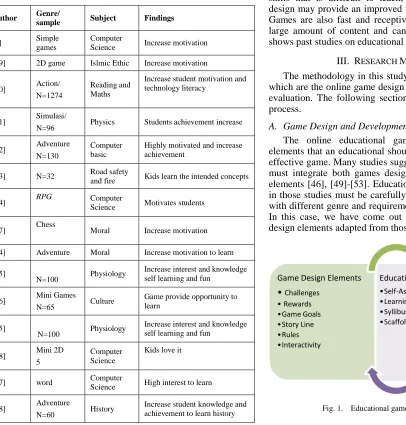
TABLE I. PAST STUDIES ON EDUCATIONAL GAMES AND ITS EFFECTIVENESS
Author Genre/ sample Subject Findings
[3] Simple games
Computer
Science Increase motivation [29] 2D game Islmic Ethic Increase motivation
[40] Action/ N=1274
Reading and Maths
Increase student motivation and technology literacy
[41] Simulasi/
N=96 Physics Students achievement increase
[42] Adventure N=130
Computer basic
Highly motivated and increase achievement
[43] N=32 Road safety
and fire Kids learn the intended concepts
[44] RPG Computer Science Motivates students
[37] Chess Moral Increase motivation
[34] Adventure Moral Increase motivation to learn
[45]
N=100 Physiology
Increase interest and knowledge self learning and fun
[46] Mini Games
N=65 Culture
Game provide opportunity to learn
[45]
N=100 Physiology
Increase interest and knowledge self learning and fun
[38] Mini 2D 5
Computer Science
Kids love it
[47] word Computer
Science High interest to learn
[48] Adventure
N=60 History
Increase student knowledge and achievement to learn history
A study on why educational games matters to the future of education [39] proposed a framework of educational games that shows the relationship between educational game engagement and motivation to clear goals, rules, feedback, playability and control. It analyse the game attributes and its correlation with the theory of play that form the basis of educational games. It was found that games can motivate and encourage learners as well as able to provide powerful learning environments especially for kids. In some case, it can encourage students to learn on certain subjects that they may not have interest at all.
On different note, [28] did a review on use of computer games for learning indicate that games have a great prospective as teaching and learning tools. The amazing elements in computer games such as fun, interactive, curiosity, challenging, fantasy, competition, clear goal, and encouraging feedback made games as one of the highly potential and flexible technology for learning. He further added that 21st century skills such as adaptability, risk-taking, self-direction, interactive communication, planning and managing are the skills that is difficult to teach; therefore, a proper games design may provide an improved way in teaching those skills. Games are also fast and receptive as well as able to handle large amount of content and can be easily updated. Table I shows past studies on educational games and its effectiveness.
III. RESEARCH METHODOLOGY
The methodology in this study was divided into two parts which are the online game design and development, and game evaluation. The following section discuss in details for both process.
A. Game Design and Development
The online educational game was design based on elements that an educational should have in order to make an effective game. Many studies suggested that educational game must integrate both games design elements and educational elements [46], [49]-[53]. Educational games elements discuss in those studies must be carefully chosen to ensure suitability with different genre and requirement for an educational game. In this case, we have come out with the educational games design elements adapted from those studies (Fig. 1).
Fig. 1. Educational games design elements. Game Design Elements
• Challenges • Rewards •Game Goals •Story Line •Rules •Interactivity
Challenges is referring to things need to be overcome by the player. It was stated in [54] that good games must integrate suitable challenges to the target players as well as the games feature. The challenges must be carefully design with the precaution that it is neither too easy nor too hard. Challenge scan be between player versus computer or player versus other players. Rewards is referring to things that the player will get after passing certain challenges or achieving certain games goals. Among the examples are games score, health status and things that can be used to proceed further in the games. Rewards can be given during the game play session or at the end of the session [50]. Game goal is the main thing need to be achieved by the player of any games. It is the final point of playing the games. Goals can engage player to the games because it connects the player to their inner motivation to achieve things and feeling satisfied about it.
Story line is the flow of the game event that connects the game cycles into complete sequences. Good games need to have good story that relate the whole things together [55]. Apart from that, games also need to contain rules to be adhering by the players similar as physical games such as football, golf and so on. It‟s a set of procedure that must be following in order to proceed within the same levels or to the next game levels. Interactivity refers to interaction between the players with the games characters, environment and feedback or message during the gameplay session.
This online game designed to include educational elements as listed in Fig. 1. Self-assessment refers to integration of educational content into the assessment form. It can be in many forms depending on the games type. The game is also design to achieve certain learning outcomes of a topic or course. A course or topic normally have its own learning outcomes ready, designers can adapt the content so that it will meet the outcomes of a topic content or things to be achieved by the player by the end of the game session. Another important educational element is syllabus matching [52] whereby the games content should follow an authentic syllabus that match the learners need. This includes their school syllabus or any knowledge that they are acquiring. Feedback is another important element in education whereby learners will be given the information about what they have done or achieved. Feedback can help learners learn their mistakes or confirming their knowledge gained during the gameplay session.
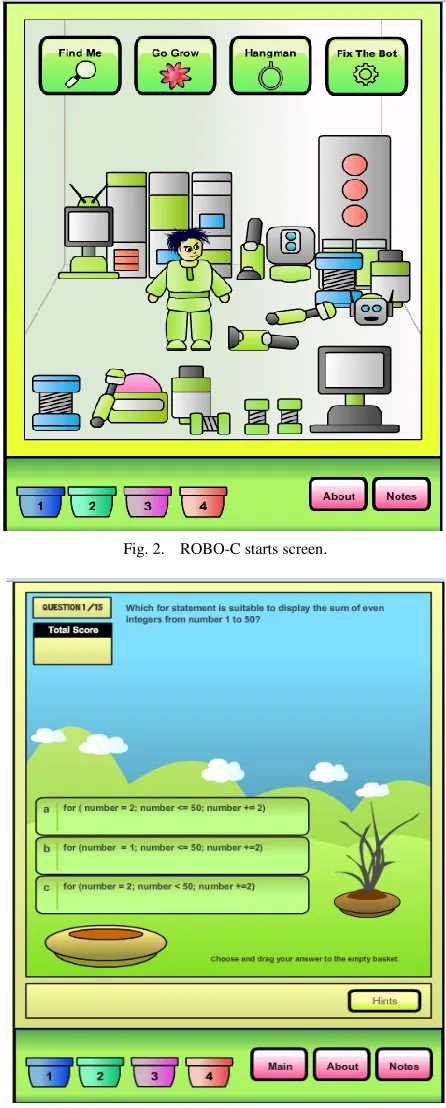
Using the elements discuss above; we have design and developed an online educational games prototype called ROBO-C purposely for learning C Programming Introductory. It contains four game modules together with a note module. The game modules are Find Me, Go Grow, Hangman and Fix the Bot. Each game has its own levels with different presentation of learning content. The game design went through several processes including content design, games genre design, content matching to games and levels and also notes design. The game content focusing on Programming topic called as Looping. This includes Introduction to Looping, Types of Looping, continue and break Statement, do-while Statement, for Statement and while Statement. Fig. 2 and 3 shows the game screen shot.
Fig. 3 shows the screen for one of the game module which is Go Grow. This module has 3 levels with 15 self-assessment questions provided in each level. The flower tree will grow into a nice flowering plant depend upon the correct answer and score the player will get. It also has Hints button to helps player get the clue for every question. ROBO-C Prototype was hosted in local server for testing and data collection purpose.
Fig. 2. ROBO-C starts screen.
B. Game Emprirical Evaluation
Game evaluation was done using instrument developed from analysis of past studies on acceptance theories [56], [57] [24], [58]. It was then modified to meet the educational games technology. Six components were used for game evaluation purposes which are Ease of Use [56] Usefulness [56], [57], [59] Attitude [56], [57], Self-Efficacy [57], Anxiety [24], [57] Enjoyment [60] and Intention to Use [56]-[58].
Using above as the references, the following text describe the meaning of each construct. Usefulness is defined as how the respondents think that the application can help them to perform the task they are doing. Ease of Use is defined as how easy the application can be use and learn by them. Attitude is overall affective reaction towards the use of application while self-efficacy describes the judgement of one‟s ability to use the application. Anxiety defined as emotional fear, apprehension and phobia felt by individuals in using the application. Enjoyment describe as state of mind or an individual trait. Intention to Use defines as the plan that individual have in using the application.
A total of 27 items were derived and modified from the studies and design into Likert‟ scale of 5 scales ranging from 1 (strongly disagree) until 5 (strongly agree). Respondents were asked to play the game for about an hour or until they are ready to answer the survey question. 180 students took part in the data collection session with all of them play the game for about an hour and fill up the question afterwards. All of them stay until the session finished. All respondents do not have any formal experience using educational games in their study.
IV. DATA ANALYSIS AND RESULT
Data were analysed using statistical packages IBM SPSS 20 for both reliability analysis and descriptive analysis. The respondents consist of 180 undergraduates student from IT (62%) and Engineering (38%) background with 88 male (49%) and 93 female (51%) students. All respondents owned personal laptops and have access to internet in campus. The survey includes several items about game habits among the students. The items are i) experience with online game play, ii) Reasons to play games, iii) Preferred games genre and iv) Agreement of using game to learn. Result and discussion for game habits are shown in Fig. 4, 5, 6 and 7, respectively.
Fig. 4. Online game experience among students.
Fig. 3 shows result for online game play experience. The figure is about the frequency of respondents and their game experience in years. Almost 60% or more than of the students have played game for more than 5 years with only about 10% play in for less than a year or not playing. This shown that the students have vast experiences with online gameplay.
Fig. 5. Reasons to play games.
Most students play games to fill up their free times (49%) while 35% of them play because games are fun, the rest of them play game because it is challenging and have nice graphic.
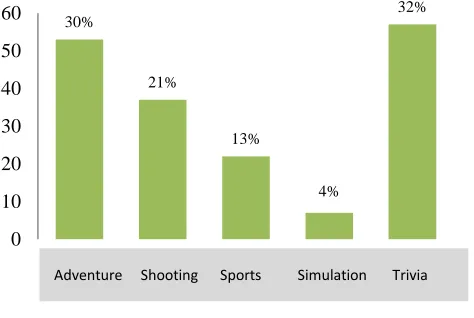
Fig. 6. Preferred games genre.
Fig. 5 shows the most preferred games genre among students. The most popular genres are trivia games (board, card, mini games and the like) and adventure games. Shooting is also the popular genre followed by sports and simulation games. Trivia games can be popular because it is easy to play and have a short time to finish the games. It is also easy to open due to small file size and does not need require lots of preparation in order to play the games.
On the student‟s agreement to use games for learning purposes, Fig. 6 shown the findings. More than 80% of them agree to use game for their learning with equal number between male (48%) and female (52%) students. The rest of the students are not sure about it (12%) while 5% are not agree to use games for learning. Refer Fig. 7.
59%
21%
8% 6% 6%
0 20 40 60 80 100 120
>5 years 3-5 years 1-2 years < I year Not playing
49%
35%
13%
3% 0
20 40 60 80 100
Fill up free time Fun Challenge Graphic
30%
21%
13%
4%
32%
0 10 20 30 40 50 60
Fig. 7. Agreement to use game for learning.
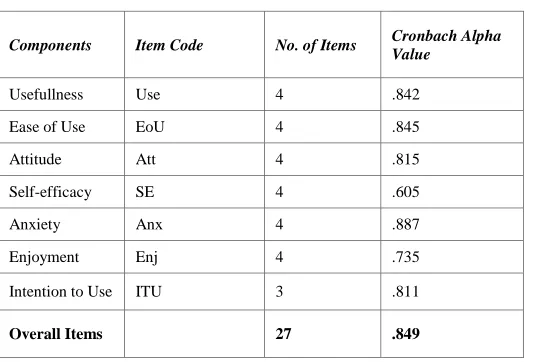
The following paragraph discusses the findings for descriptive analysis of the items. Table II shows number of items for each component together with value for Cronbach Alpha reliability analysis. All constructs have value of more than 8 except for self-efficacy and enjoyment. Overall value for all constructs is .849.
TABLE II. NUMBER OF ITEMS AND RELIABILITY VALUE
Components Item Code No. of Items Cronbach Alpha
Value
Usefullness Use 4 .842
Ease of Use EoU 4 .845
Attitude Att 4 .815
Self-efficacy SE 4 .605
Anxiety Anx 4 .887
Enjoyment Enj 4 .735
Intention to Use ITU 3 .811
Overall Items 27 .849
The following paragraph present the descriptive result of study based on constructs and items. Table III shows the constructs and items use in this study. Total of 27 items with 7 constructs were used for data collection.
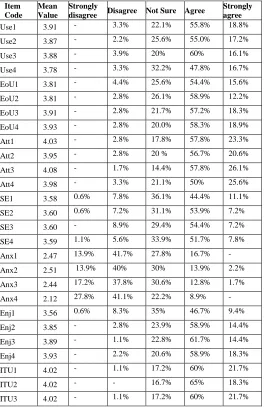
Table IV shows the result based on mean value together with percentage for every item. Items range from strongly disagree (1) until strongly agree (5). The mean value and percentage of response is presented in the table. For construct Usefulness, almost 75% found the game is useful in their study while about 76% agreed the game can increase their learning productivity. About similar percentage also agreed the games can help them to learn the subject more quickly. Similarly, result for Ease of Use is also positive with overall of 75% respondents agreed that the game is easy to learn. Despite the game is new to them, most of the student agreed that they can use and interact with the game by themselves (more than 70%).
TABLE III. NUMBER OF ITEMS AND RELIABILITY VALUE Code Items
Construct: Usefulness
Use1 I find the educational game useful in my study.
Use2 Using the educational game enables me to learn the subjects more quickly.
Use3 Using the game increases my learning productivity. Use4 If I use the educational game, I will increase my chances of
getting good grade. Construct: Ease of Use
EoU1 My interaction with the games is clear and understandable. EoU2 It would be easy for me to become skillful at using the games. EoU3 I would find the games easy to use.
EoU4 The game is easy to learn. Construct: Attitude
Att1 Using the game is a good idea.
Att2 The games make C Programming Subject more interesting. Att3 Learning with educational games is fun.
Att4 I like learning with the educational games. Construct: Self Efficacy
I can learn the subject using the games…
SE1 If there was no one around to tell me what to do as I go. SE2 If I could call someone for help if I got stuck. SE3 If I had a lot of time to learn the content of the games. SE4 If I had just the built- in help facility for assistance.
Construct: Anxiety
Anx1 I feel apprehensive about using the games
Anx2 It scares me to think that I could lose a lot of information using the games by hitting the wrong key.
Anx3 I hesitate to use the games for fear of making mistakes I cannot correct.
Anx4 The game is somewhat intimidating to me. Construct: Enjoyment
Enj1 When using the educational games, I will not realize the time elapsed.
Enj2 Using educational games will give enjoyment for my learning. Enj3 Using educational games will stimulate my curiosity. Enj4 Using educational games will lead to my exploration.
Construct: Intention to Use
ITU1 I intend to play educational games in the future. ITU2 I predict I will play educational games in the future. ITU3 I plan to play educational games in the future.
Students were found to have a very positive attitude towards the use of educational game with almost 85% agree that learning with educational game is fun and is a good idea (81%). This is a positive finding about the idea of using games as their future educational medium. Observation during data collection session also shows that students are highly attached to the computer screen playing the game throughout the session. They are also enthusiast to use the game to learn the subject. For self-efficacy, students were found able to use the 83%
5% 12%
0 20 40 60 80 100 120 140 160
games without much help from outside. More than half agreed that they will be able to learn the subject better if given more times to play the games. Overall students were found having acceptable level of self-efficacy despite the newly introduce application to them.
Anxiety is the fear that user may have while using the application. Generally, students were found not apprehensive in using the game, they were also not fear about making any mistake while using the game and they found that the game is not at all intimidating to them. Students are also enjoying in using the game with more than 75% found the game will provide enjoyment in their learning and stimulate their curiosity. This is a good indicator for learning since the game promotes fun aspect as well as make the students curious about the subject the are learning. Conventional way of learning is somewhat boring to these so-called digital native generations [10]. Therefore, use of educational game can be the learning approach of the future due to the fun features of games technology.
TABLE IV. RESULT OF DESCRIPTIVE ANALYSIS Item
Code
Mean Value
Strongly
disagree Disagree Not Sure Agree
Strongly agree Use1 3.91 - 3.3% 22.1% 55.8% 18.8% Use2 3.87 - 2.2% 25.6% 55.0% 17.2%
Use3 3.88 - 3.9% 20% 60% 16.1%
Use4 3.78 - 3.3% 32.2% 47.8% 16.7% EoU1 3.81 - 4.4% 25.6% 54.4% 15.6% EoU2 3.81 - 2.8% 26.1% 58.9% 12.2% EoU3 3.91 - 2.8% 21.7% 57.2% 18.3% EoU4 3.93 - 2.8% 20.0% 58.3% 18.9% Att1 4.03 - 2.8% 17.8% 57.8% 23.3% Att2 3.95 - 2.8% 20 % 56.7% 20.6% Att3 4.08 - 1.7% 14.4% 57.8% 26.1%
Att4 3.98 - 3.3% 21.1% 50% 25.6%
SE1 3.58 0.6% 7.8% 36.1% 44.4% 11.1% SE2 3.60 0.6% 7.2% 31.1% 53.9% 7.2% SE3 3.60 - 8.9% 29.4% 54.4% 7.2% SE4 3.59 1.1% 5.6% 33.9% 51.7% 7.8% Anx1 2.47 13.9% 41.7% 27.8% 16.7% - Anx2 2.51 13.9% 40% 30% 13.9% 2.2% Anx3 2.44 17.2% 37.8% 30.6% 12.8% 1.7% Anx4 2.12 27.8% 41.1% 22.2% 8.9% - Enj1 3.56 0.6% 8.3% 35% 46.7% 9.4% Enj2 3.85 - 2.8% 23.9% 58.9% 14.4% Enj3 3.89 - 1.1% 22.8% 61.7% 14.4% Enj4 3.93 - 2.2% 20.6% 58.9% 18.3%
ITU1 4.02 - 1.1% 17.2% 60% 21.7%
ITU2 4.02 - - 16.7% 65% 18.3%
ITU3 4.02 - 1.1% 17.2% 60% 21.7%
V. DISCUSSIONS AND CONCLUSION
This study developed and evaluates an online educational game for self-learning of programming concept. From the survey conducted, it was found that students show a highly positive attitude towards the game despite not much of exposure to such technology prior his study. The game is also found useful for them despite the lack of content due to prototype version. Students were also thinking that the game is easy to use even though they were only introduced to the game for about 30 minutes to one hour. This is a good sign that the students are rather well versed with the games technology with more than half of them have experience of more than 5 years with games.
Among the interesting findings is student‟s attitude towards game. They agreed that using the game is a good idea and making the learning of subject more interesting. The game is also fun and generates their interest to learn. At the same time, they also think that they can use the game by themselves without much help needed to assist them. Students were also found not feeling anxious in using the game. They can play the games without much fear to lose information or making mistakes. Programming subject is important for any computer science students as well engineering students, but it was found as a boring subject and many students struggle to learn the subject in many studies, therefore some enjoyment element is needed in order to make more interesting and fun.
Game is one of the technology full of fun aspect, thus we proposed games for learning. For enjoyment aspect, students agreed games provide enjoyment for their learning as well stimulates their curiosity to learn. Game were also found lead them to more exploration. This is a good sign of games and prompt more studies for better conclusion. In general, students have a very good intention to use games in the future with more than 80 per cent stated agree to use the application for their learning. Therefore, game is among the application for new way of learning, however many more studies needed to ensure all aspects of educational game design, development and effectiveness were thoroughly investigated and known.
Future works will be conducting evaluation of the games usability features as well as its effectiveness in improving student‟ knowledge on Programming Introductory by doing pre-test and post-test evaluation. We hope to provide more understanding and information on how games can helps students to learn especially in Malaysia context.
ACKNOWLEDGMENT
This study is funded by research grant under Universiti Teknologi Malaysia (UTM) Research University Grant (RUG) with Vote No. 18H63. Thank you also to the Ministry of Higher Education Malaysia and UTM Research Management Team for the continuous supports.
REFERENCES
[1] Nor Azan, M. and S. Wong, Game Based Learning (GBL) Model for History Courseware: A Preliminary Analysis, in International Symposium on Information Technology (ITSIM). H.e.a. (Eds.), Editor. 2008, UKM: Kuala Lumpur, Malaysia. p. 253-260.
[3] Roslina, I., C.Y. Rasimah, O. Hasiah, and J. Azizah, Students Perceptions of Using Educational Games to Learn Introductory Programming. Computer and Information Science, 2011. 4(1): p. 205 - 216.
[4] Becker, K., Video Games pedagogy: Good Games = Good Pedagogy in Lecture Notes in Computer Science S. Link, Editor. 2008, Springer Verlag Heidelberg. p. 73-125.
[5] Fedwa Laamarti, Mohamad Eid, and A.E. Saddik, An Overview of Serious Games. International Journal of Computer Games Technology, 2014. 2014: p. 1-15.
[6] Rozana, I. and I. Roslina. PDEduGame: Towards Participatory Design Process for Educational Game Design in Primary School. in 5th International Conference on Research and Innovation in Information Systems. 2017. Langkawi: IEEE.
[7] Roslina Ibrahim, Suraya Masrom, Rasimah C.M Yusoff, N.M.M. Zainuddin, and Z. Rizman, Student Acceptance of Educational Games in Higher Education. Journal of Fundamental and Applied Sciences, 2017. 9(3a): p. 809-829.
[8] Fedwa, L., E. Mohamad, and E.S. Abdulmotaleb, An Overview of Serious Games. International Journal of Computer Games Technology, 2015. 2014: p. 1-15.
[9] Trevi, G.N. and C. Pomales-García. How can a serious game impact student motivation and learning? in In Industrial and systems engineering research conference. 2014. Montreal. Norcross: IIE. [10] Prensky, M., Digital Game-Based Learning. 2001, New York: Mc Graw
Hill.
[11] Nacke, L., Facilitating the education of game development, in Department of Computer Science. 2004, Otto-von-Guericke University Magdeburg: Magdeburg.
[12] Kirriemuir, J. and A. McFarlane, Literature review in games and learning, in Futurelab Series, Futurelab, Editor. 2004, University of Bristol: Bristol.
[13] Gee, J.P., What video games have to teach us about learning and literacy. 2003, New York: Palgrave MacMillan.
[14] Gee, J.P. Good Video Games and Good Learning. 2006 10 September 2010].
[15] Oblinger, D.G., Games and learning :Digital games have the potential to bring play back to the learning experience. Educause quarterly 2006(3): p. 5-7.
[16] Olga, S., V. Pavel, K. Alexander, and T. Alexey, Game based approach in IT education. International Book Series "Information Science and Computing", 2009. 12: p. 63-70.
[17] Martinovic, D., Ezeife, C. I., Whent, R., Reed, J., Burgess, G. H., Pomerleau, C. M.. Critic-proofing of the cognitive aspects of simple games. Computers & Education, 2014. 72(2014): p. 132-144.
[18] Baniqued, P.L., Lee, H., Voss, M. W., Basak, C., Cosman, J. D., DeSouza, S, Selling points: what cognitive abilities are tapped by casual video games? Acta Psychologica, 2013. 142(1): p. 74-86.
[19] Yolanda, A.R., M. McKenzie, W.S. Marcus, and G. Bruce, User centered game design: evaluating massive multiplayer online role playing games for second language acquisition, in Proceedings of the 2008 ACM SIGGRAPH symposium on Video games. 2008, ACM: Los Angeles, California.
[20] David, P., W. Nelson, and S. Tadeusz, Heuristic evaluation for games: usability principles for video game design, in Proceeding of the twenty-sixth annual SIGCHI conference on Human factors in computing systems. 2008, ACM: Florence, Italy.
[21] F.A.S. Harnessing the power of video games for learning. 2006 8 May 2010].
[22] Song, M. and S. Zhang, EFM: A Model for Educational Game Design, in Lecture Notes in Computer Science, S. Link, Editor. 2008, Springer US. p. 509-517.
[23] Hsu, C.-L. and H.-P. Lu, Consumer behavior in online game communities: A motivational factor perspective. Computers in Human Behavior, 2007. 23(3): p. 1642-1659.
[24] Shin, D.H. and Y.J. Shin, Why do people play social network games? Computers in Human Behavior, 2011. 27(2).
[25] Chuang, T.Y., Chen, W.F, Effect of Computer-Based Video Games on Children: An Experimental Study. Educational Technology & Society, 2009. 12(2): p. 1-10.
[26] Kuang Chao Yu, H.S.H., Fu Hsing Tsai, The Implementation and Evaluation of Educational online gaming system. IEEE, 2005.
[27] Hye, S.K.S., Baeg Kim. An Integrated Course Based on Educational Games. in Proceedings on the International Conference in Information Technology: Coding and Computing (ITCC'05). 2005. IEEE Explore. [28] Teh, C.L., M.F.W.I. Wan, and S.C. Toh, Why use computer games for
learning?, in 1st International Malaysian Educational Technology Convention (IMETC). 2007: Johor, Malaysia. p. 835-843.
[29] Norizan, M.D., Pendekatan Bercerita dan Permainan dalam Pembangunan Perisian Kursus Akhlak Islamiah. 2003, UKM: Bangi. [30] Vansiri Nagalingam and R. Ibrahim. Finding the Right Elements User
Experience Elements for Educational Games. in ICEEG 2017. 2017. Turku, Finland: ACM.
[31] Alzahrani, A.I., I. Mahmudb, T. Ramayah, O. Alfarraj, and N. Alalwan, Extending the theory of planned behavior (TPB) to explain online game playing among Malaysian undergraduate students. Telematics and Informatics, 2017. 34(2017): p. 239-251.
[32] Eow, Y.L., W.Z.W. Ali, R. Mahmud, and R. Baki, Form one students‟ engagement with computer games and its effect on their academic achievement in a Malaysian secondary school. Computers & Education, 2009. 53(2009): p. 1082-1091.
[33] Eow, Y.L., W.Z.b.W. Ali, R.b. Mahmud, and R. Baki, Computer games development and appreciative learning approach in enhancing students‟ creative perception. Computers & Education, 2010. 54(1): p. 146-161. [34] Izam Shah, B., Perisian Pengembaraan Multimedia :Edutainment Dalam
Pendidikan Agama Islam Sekolah Rendah, in Fakulti Teknologi dan Sains Maklumat. 2007, Universiti Kebangsaan Malaysia: Bangi, Malaysia.
[35] Rubijesmin, A.L. Understanding Malaysian students as gamers: Experience. in Proceedings of the 2nd International Conference on Digital interactive Media in Entertainment and Arts 2007. Perth, Australia: ACM.
[36] Wong, S.Y. and S. Ghavifekr, User experience design of history game: An analysis review and evaluation study for Malaysia context. International Journal of Distance Education Technologies, 2018. 16(3): p. 46-63.
[37] Zuhaira, M.Z., Pembangunan Perisian Permainan Multimedia untuk Sains Prasekolah: Dam Cuaca. 2007, UKM: Bangi.
[38] Jaspaljeet, S., L.W. Ling, S. Mohana, S.G. Saraswathy, and K.D. Siva, Designing Computer Games to Introduce Programming to Children, in Information Technology and Multimedia at UNITEN (ICIMU‟ 2008), Uniten, Editor. 2008: Selangor, Malaysia. p. 643-647.
[39] Noor Azli, M., M. Nor Azan, and C. Shamsul Bahri. Digital Games Based Learning. in International Symposium on Information Technology (ITSIM). 2008. Kuala Lumpur, Malaysia.
[40] Rosas, R., M. Nussbaum, P. Cumsille, V. Marianov, M. Correa, et al., Beyond Nintendo, design and assessment of educational video games for first and second grade students. Elsevier Computers and Education, 2003. 40: p. 71-94.
[41] Squire, K., M. Barnett, J.M. Grant, and T. Higginbotham. Electromagnetism Supercharged! in International Conference of the Learning Sciences 2004. 2004. Los Angeles.
[42] Natvig, L.L., Steiner. Age of Computers − Game-Based Teaching of Computer Fundamentals. in ITiCSE. 2004. Leeds, United Kingdom: ACM.
[43] Coles, C.D., Dorothy C. Strickland, Lynne Padgett, and L. Bellmoff, Games that „„work‟‟: Using computer games to teach alcohol-affected children about fire and street safety. Science Direct Research in Developmental Disabilities, 2007. 28: p. 518-530.
[44] Barnes, T., E. Powell, A. Chaffin, A. Godwin, and H. Richter. Game2Learn: Building CS1 Learning Games for Retention. in ITiCSE. 2007. Dundee, Scotland: ACM.
[46] Garzotto, F. Investigating the Educational Effectiveness of Multiplayer Online Games for Children. in Interaction Design and Children (IDC 2007). 2007. Aalborg, Denmark: ACM Press.
[47] Roslina, I. and J. Azizah. Using educational games for learning introductory programming: initial study on student perceptions. in IADIS International Conference Game and Entertainment Technologies 2010. 2010. Freiburg Im Breisgau, Germany.
[48] Wong, S., Reka bentuk dan penilaian permainan pendidikan mutimedia interaktif Sejarah (PPMIS) 2012, Universiti Kebangsaan Malaysia: Bangi, Selangor.
[49] Hirumi, A. and C. Stapleton, Applying pedagogy during game development to enhance game based learning, in Book Technologies for E-Learning and Digital Entertainment 2008, Springer Verlag Berlin Heidelberg. p. 509-517.
[50] Overmars, M. and J. Habgood, The Game Maker's Apprentice: game development for beginners. 2006, Berkeley, California: Apress. 86-91. [51] Leemkuil, H., Is it all in the game? Learner support in an educational
knowledge management simulation game. 2006, University of Twente. [52] Fisch, S.M., Making Educational Games "Educational", in Conference
on Interaction Design and Children IDC 2005, ACM, Editor. 2005, ACM: Colorado, USA. p. 56 - 61.
[53] Fu, F.L., R.C. Su, and S.C. Yu, EGameFlow: A scale to measure learners‟ enjoyment of e-learning games. Computers and Education, 2009. 52: p. 101-112.
[54] Novak, J., Game Development Essentials: Second Edition. 2008, New York: Thomson Delmar Learning.
[55] Grassioulet, Y., A Cognitive Ergonomics Approach to the Process of Game Design and Development. 2002, University of Geneva.
[56] Davis, F.D., Perceived usefulness, perceived ease of use, and user acceptance of information technology. MIS Quarterly, 1989. 13(Sep 1989): p. 319-340.
[57] Venkatesh, V., M.G. Morris, G.B. Davis, and F.D. Davis, User acceptance of information technology: Toward a unified view. MIS Quarterly, 2003. 27(3): p. 423 - 478.
[58] Bourgonjon, J., M. Valcke, R. Soetaert, and T. Schellens, Students‟ perceptions about the use of video games in the classroom. Computers and Education, 2010. 54(2010): p. 1145-1156.
[59] Davis, F.D., User acceptance of information technology: system charateristics, user perceptions and behaviroal impacts. International Journal of Man Machine Studies, 1993. 38(1993): p. 475-487.