REQUIREMENT ENGINEERING BEST PRACTICES FOR MALAYSIAN PUBLIC SECTOR
AZLENA BINTI HARON
A thesis submitted in fulfilment of the requirements for the award of degree of Doctor of Philosophy (Computer Science)
Faculty of Computing Universiti Teknologi Malaysia
iii
DEDICATION
Dedicated to :
My beloved husband Haji Hasbullah Haji Ali, My beloved daughters,
Ain Syazwani, Auni Syazwina, Amna Syazwana and Alya Syazihah, My Mothers,
Hajjah Habibah Abdullah and Hajjah Misgiah Abd Hamid, My Late Fathers,
Allahyarham Haji Haron bin Jana and Allahyarham Haji Ali Hamid, My Brothers,
Aminduddin Haron, Azhar Haron, Allahyarham Azlan Haron and Azman Haron My Sisters
Azizah Haron, Azurah Haron, Azila Haron and Azwin Haron, My Best Friend,
Hafidzah Md Nadzir, Dr. Hajjah Norma Sabtu, Haji Anuar Bachik, Raja Fauziah Raja Abdul Hamid, and Hajjah Zoraidah Ahmad,
and My Relatives especially Allahyarham Haji Ismail Jana
ACKNOWLEDGEMENTS
In the Name of Allah, the Most Gracious and the Most Merciful. With His permission, I am finally able to produce a thesis as a requirement for my graduation. This had given me the opportunity to be able to gain knowledge and experience that are very much valuable. I am very grateful for the opportunity that had been given to me by my employers, in Jabatan Perkhidmatan Awam (JPA) to pursue my studies up to the highest level, PHD. I am truly blessed to be given this opportunity.
I would like to say thank you to many people whom had contributed towards the completion of my thesis and my studies. Firstly, to my supervisor, Professor Dr. Shamsul Sahibuddin for being patient and very understanding towards my abilities in performing the duties assigned. Your words of encouragement had inspired me and had been the source of my strength that had made me come this far. Secondly, to my Co-Supervisor, Dr. Mazlan Harun, who had always encouraged me to continue studies and always lend me his wisdom upon completing the study. I would also like to extend my gratitude to the experts whom have commented on the research that I have conducted. Thank you for the insights and the inputs that you had given me
Finally, to my beloved husband and family who had always understood and the time constraints that I had undergone as a post-graduate student, who took care of me and the children when I was in my exhaustion.
To all of you, may Allah bless and bestow his Rahmat towards you, and may he grant me success in whatever I worked for.
v
ABSTRACT
ABSTRAK
vii
TABLE OF CONTENTS
CHAPTER TITLE PAGE
DECLARATION ii
DEDICATION iii
ACKNOWLEDGEMENTS iv
ABSTRACT v
ABSTRAK vi
TABLE OF CONTENTS vii
LIST OF TABLES xvii
LIST OF FIGURES xviii
LIST OF ABBREVIATIONS AND TERMINOLOGY xxiii
LIST OF APPENDICES xxv
1 INTRODUCTION 1
1.1 Introduction 1
1.2 Motivation 1
1.3 Background of the Problem 3
1.3.1 The complexity of Requirement Engineering 4 1.3.2 The complexity of requirement process in
Malaysian Public Sector 5
1.3.3 The complexity of Requirement Engineering in
Malaysian Public Sector 7
1.3.4 Gap Analysis for the Complexity 8
1.4 Statement of the Problem 10
1.5 Research Question 11
1.6 Objectives of the Research 12
1.8 Significance of Research 13
1.9 Thesis Organisation 13
1.10 Summary 15
2 LITERATURE REVIEW 16
2.1 Introduction 16
2.2 Analysis of Requirement Engineering 17 2.2.1 Knowing what is Requirement Engineering 17 2.2.2 Requirement Engineering Process 25
2.2.2.1 Analysis of Requirement Engineering
Process Model 26
2.2.2.2 The relationship between defined
Requirement Engineering Process 32 2.2.3 Determined Requirement Engineering Technique
for Requirement Engineering Process Activity 37 2.2.4 Gap Analysis of Requirement Engineering 38
2.2.5 Summary 42
2.3 Requirement Engineering in Malaysian Public Sector 44 2.3.1 ICT in Malaysian Public Sector 45
2.3.1.1 Information Communication
Technology Projects 46
2.3.1.2 Key Players for the Successor of ICT
Projects 47
2.3.1.3 Identification of Software Project
Component for ICT Project 50 2.3.1.4 Identification of Software Project Issues
for ICT Project 53
2.3.1.5 Identification of Software Project
Success Factor for ICT Project 56
2.3.2 The Challenges 61
ix
2.3.4 Identification of Requirement Engineering Critical
Issues 64
2.3.4.1 What are the constraints? 65 2.3.4.2 What causes a change? 66 2.3.4.3 How can they facilitate the
requirement? 67
2.3.4.4 What are their needs? 68 2.3.4.5 How can they understand the needs? 69 2.3.4.6 What are their decisions? 70 2.3.5 The relation of Requirement Engineering Critical
Issues with Requirement Engineering Process and Software Project Success Factor 71 2.3.6 Gap Analysis of People, Process and Technology 72
2.3.6.1 The strength analysis from people
perspective 76
2.3.6.2 The weakness analysis from people
perspective 76
2.3.6.3 The strength analysis from process
perspective 79
2.3.6.4 The weakness analysis from process
perspective 80
2.3.6.5 The strength analysis from technology
perspective 81
2.3.6.6 The weakness analysis from technology
perspective 82
2.3.7 Summary 84
2.4 Requirement Engineering Best Practices Framework 86 2.4.1 Overview of Requirement Engineering Best
Practices 86
2.4.2 The Development Process of Requirement
Engineering Best Practices Framework 88 2.4.2.1 The Requirement Engineering Practices
2.4.2.2 The Implementation of Current
Requirement Engineering Practices 89 2.4.2.3 Requirement Engineering Practices
Model 90
2.4.2.4 Organisation 91
2.4.2.5 Requirement Engineering 92
2.4.2.6 Key Player 93
2.4.3 The weaknesses of Requirement Engineering Best
Practices framework 94
2.5 Overall View 94
3 RESEARCH METHODOLOGY 98
3.1 Introduction 98
3.2 Research Methodology 98
3.2.1 Data Collection Design 100
3.2.2 The Requirement Engineering Best Practice
Guideline Research Framework 101
3.2.2.1 Study 1: Deriving the Baseline 102 3.2.2.2 Study 2: Detail Analysis of Selected
Issues 105
3.2.2.3 Study 3: Confirmation of Selected
Issues 106
3.2.2.4 Study 4: Confirmation of the Practices 107 3.2.3 Data Collection Analysis and Interpretation 108
3.2.4 Research Report 108
3.3 Research Procedure 108
3.4 Summary 111
4 THE DEVELOPMENT OF THE REQUIREMENT
ENGINEERING BEST PRACTICES FRAMEWORK 112
4.1 Introduction 112
4.2 The Deriving of Requirement Engineering Best Practices
xi
4.2.1 A Requirement Engineering Best Practices
Framework for Malaysian Public Sector 113 4.2.2 Public Sector ICT Strategic Plan 114 4.2.3 Software Project Success Factor 114 4.2.4 Requirement Engineering Process 115 4.2.5 Requirement Engineering Practices Baseline 115 4.3 Mapping process in Requirement Engineering Best
Practices 116
4.3.1 Requirement Engineering Critical Issues “how
they can facilitate?” 118
4.3.2 Requirement Engineering Critical Issues “what are the constraints?”
118
4.3.3 Requirement Engineering Critical Issues “what
causes a change?” 119
4.3.4 Requirement Engineering Critical Issues “what are
their needs?” 119
4.3.5 Requirement Engineering Critical Issues “how can
they understand the need?” 120
4.3.6 Requirement Engineering Critical Issues “what are
their decisions?” 120
4.4 Requirement Engineering Best Practices Framework 121 4.4.1 Review of Requirement Engineering Best
Practices Framework 121
4.4.2 The Requirement Engineering Best Practices
Structure 122
4.5 Requirement Engineering Pratices for the Requirement
Engineering Best Practices 123
4.5.1 Requirement Engineering Best Practices for
Elicitation 125
4.5.2 Requirement Engineering Best Practices for
Analysis and Negotiation 125
4.5.3 Requirement Engineering Best Practices for
4.5.4 Requirement Engineering Best Practices for
Management 126
4.5.5 Requirement Engineering Best Practices for
Verification and Validation 127
4.6 Summary 127
5 THE DEVELOPMENT OF REQUIREMENT
ENGINEERING BEST PRACTICES GUIDELINE 128
5.1 Introduction 128
5.2 Requirement Engineering Best Practices Guideline
Motivation 128
5.3 Requirement Process 129
5.3.1 Investigation of the Software Requirement
Specification Process Flow 129
5.3.2 Software Project Approval Process 132 5.3.3 The Software Requirement Specification Process
Flow 135
5.3.4 The Software Requirement Specification
Development Procedure 136
5.3.5 The Software Requirement Specification Activity
Diagram 139
5.4 The Reliability of Requirement Engineering Best Practices 141
5.4.1 Pilot Test 141
5.4.2 Actual Survey 142
xiii
5.4.6 An Implementation of Requirement Engineering
Best Practices for Software Project Success Factor 159 5.4.6.1 An Implementation of Requirement
Engineering Best Practices for Business
Rules 161
5.4.6.2 An Implementation of Requirement Engineering Best Practices for Business
Process 162
5.4.6.3 An Implementation of Requirement Engineering Best Practices for
Technology 163
5.4.6.4 An Implementation of Requirement Engineering Best Practices for
Stakeholders 164
5.4.6.5 An Implementation of Requirement Engineering Best Practices for
Developers 165
5.4.6.6 An Implementation of Requirement Engineering Best Practices for
Managers 166
5.4.6.7 Overall Mean for Requirement
Engineering Best Practices 167 5.5 The Development of Requirement Engineering Best
Practices Guideline 171
5.5.1 Elicitation 173
5.5.2 Analysis and Negotiation 174
5.5.3 Documentation 175
5.5.4 Management 177
5.5.5 Verification and Validation 178
6 REFINING AND VALIDATION OF THE REQUIREMENT
ENGINEERING BEST PRACTICES GUIDELINE 181
6.1 Introduction 181
6.2 Objective of Requirement Engineering Best Practices
Guideline Refinement 181
6.3 Refinement of Requirement Engineering Best Practices
Guideline 182
6.4 Expert Review Method 184
6.5 Section 1: Overview of Requirement Engineering Best
Practices Guideline 187
6.6 Section 2: Malaysian Public Sector 188 6.6.1 Software Project Success Factor 188 6.6.2 Software Project Approval Process 189 6.6.3 Software Requirement Specification Approval
Process 191
6.6.4 Software Requirement Specification Development
Procedure 193
6.6.4.1 Project Director 194
6.6.4.2 Project Manager 195 Project Manager Project Manager
6.6.4.3 Team Leader 196
6.6.4.4 Team Member 196
6.7 Section 3: Requirement Engineering Best Practices 197 6.7.1 Requirement Engineering Process 197 6.7.2 Requirement Engineering Best Practices
Framework 197
6.7.3 Requirement Engineering Activities 199 6.7.4 Requirement Engineering Best Practices Model 201 6.7.5 Requirement Engineering Best Practices 202
6.7.5.1 Overview of Requirement Engineering
Best Practices 203
xv
6.7.5.3 Requirement Engineering Best Practices during Elicitation Process 211 6.7.5.4 Requirement Engineering Best Practices
during Analysis and Negotiation
Process 215
6.7.5.5 Requirement Engineering Best Practices during Verification and Validation
Process 218
6.7.5.6 Requirement Engineering Best Practices during Documentation
Process 222
6.7.6 Summary of Requirement Engineering Best
Practices Guideline Refining 227
6.8 Validity of Requirement Engineering Best Practices
Guideline 229
6.8.1 The Completeness of Requirement Engineering
Best Practices Guideline 231
6.8.2 The Reliability Software Project Success Factor 233 6.8.3 The Requirement Process in Software
Requirement Specification Development 234 6.8.4 The Sufficient of Requirement Engineering Best
Practices 234
6.8.5 Summary 236
6.9 Benchmarking on the existing Requirement Engineering
Best Practices Framework 237
7 CONCLUSION AND SUMMARY 241
7.1 Introduction 241
7.2 Research Summary 241
7.4 Discussion on the Research Contribution 253
7.4.1 Identify the Gap 253
7.4.2 Requirement Processes 254
7.4.3 A proposed guideline for Software Requirement
Specification 254
7.5 Research Limitation and Future Work 255
7.5.1 Research Limitation 255
7.5.2 Future Work 256
7.6 Conclusion 257
REFERENCES 259
xvii
LIST OF TABLES
TABLE NO. TITLE PAGE
1.1 SWOT of Requirement Engineering, People, Process and
Technology 10
2.1 Comparison of Requirement Engineering Process Model 28 2.2 Relation of defined Requirement Engineering Process with the
Deliverable and Indicators 35
2.3 Relation of defined Requirement Engineering Process with the
Activity and Techniques 38
2.4 Gap Analysis of Requirement Engineering 39
2.5 An Analysis of People, Technology and Process 74
5.1 A software life cycle process (SLCP) 144
5.2 Total of Dev. Requirement Engineering Best Practices 173
6.1 Expert Review Method (Round 1) 185
6.2 Expert Review Method (Round 2) 186
6.3 Expert Review Method (Round 3) 187
6.4 Classification Expert Review comments 203
6.5 Total of Final Requirement Engineering Best Practices 228 6.6 Selected Respondents for Validation Phase 229 6.7 The comparison of Current Requirement Engineering Best
Practices Framework and Proposed Requirement Engineering Best
LIST OF FIGURES
FIGURE NO. TITLE PAGE
1.1 The complexity of Requirement Engineering Process in
Malaysian Public Sector 3
1.2 Research Gap 9
2.1 Knowing what is Requirement Engineering 18
2.2 The RCMM vs RCMMi 22
2.3 The differentiation between RCMM with RCMMi 24 2.4 The relationship between defined Requirement Engineering
Process Dev. Ver. 1 33
2.5 Malaysian Public Sector ISP/MAMPU 44
2.6 The Process, Method, Tools and Environment 49 2.7 An analysis of the structure of software-development
(Oktaba et al., 2007) 50
2.8 The relationship of the Software Projects Component 51 2.9 Identification of Software Project Issues 53 2.10 Software Project Success Factor categories 57 2.11 Deriving Software Project Success Factor Issues to
Requirement Engineering Critical Issues 63 2.12 Relations of Software Project Success Factor with
Requirement Engineering Critical Issues 64 2.13 Requirement Engineering Best Practices Dev Ver. 1 72 2.14 Three main component in the Software Project
Development 73
2.15 Improving Plan for Requirement Engineering Best
xix
2.16 The comparison among Requirement Engineering Practice
Framework 90
2.17 An overall literature of Requirement Engineering Best
Practices Guideline 96
3.1 Research Design 99
3.2 Requirement Engineering Best Practices Guideline
Research Framework 102
3.3 Research Procedure 109
4.1 A Requirement Engineering Best Practices Framework
Dev. Ver. 1 113
4.2 Requirement Engineering Best Practices Dev. Ver. 1.1 for (a) “how they can facilitate?” (b)“what are the constraints?” (c) “what causes a change?(d)“what are their needs?” e) “how can they understand the need?”(f) what are their
decisions?” 117
4.3 A Requirement Engineering Best Practices Framework
Dev. Ver. 2 121
4.4 Requirement Engineering Best Practices structure 123 4.5 Requirement Engineering Best Practices Dev. Ver. 1.2 for
(a) Elicitation (b) Analysis and Negotiation (c) Documentation (d) Management (e) Verification and
Validation 124
5.1 The development of Software Requirement Specification
Process Flow Dev. Ver. 1.0 130
5.2 Software Requirement Specification Process Flow Diagram 131 5.3 Software Project Approval Process Dev. Ver. 1.0 133 5.4 Software Requirement Specification Process Flow Dev
Ver. 1.1 135
5.5 The Software Requirement Specification Development
Procedure Dev. Ver. 1.0 137
5.6 Software Requirement Specification Activity Diagram Dev.
5.7 Mean of Software Project Issues in (a) Overall Software Project Success Factor (b) Business Rules (c) Business Process (d) Technology (e) Stakeholders (f) Developers (g)
Managers 146
5.8 An Implementation of Requirement Engineering Best Practices for (a) Business Rules (b) Business Process (c)
Technology (d) Stakeholders (e) Developers (f) Managers 160 5.9 Overall of Mean for Requirement Engineering Best
Practices 167
5.10 Summary of Requirement Engineering Best Practices
(Dev) 171
5.11 Overview of Requirement Engineering Best Practices for
Requirement Engineering Best Practices Guideline 172 5.12 The Requirement Engineering Best Practices Dev. Ver 1.3
for Elicitation 173
5.13 The Requirement Engineering Best Practices Dev. Ver 1.3 for Negotiation
175
5.14 The Requirement Engineering Best Practices Dev. Ver 1.3
for Documentation 176
5.15 The Requirement Engineering Best Practices Dev. Ver 1.3
for Management 177
5.16 The Requirement Engineering Best Practices Dev. Ver 1.3
for Verification and Validation 179
5.17 Requirement Engineering Best Practices Guideline 180 6.1 Requirement Engineering Best Practices Guideline
Structure 183
6.2 Software Project Approval Process Final Ver 1 190 6.3 Software Project Approval Process Final Ver. 2 191 6.4 Software Requirement Specifiaction Approval Process
Final Ver. 1 192
6.5 Software Requirement Specification Approval Process
xxi
6.6 Software Requirement Specification Development
Procedure Final Ver. 1 194
6.7 Software Requirement Specification Development
Procedure Final Ver. 2 195
6.8 Requirement Engineering Best Practices Framework Final
Ver. 1 198
6.9 Requirement Engineering Best Practices Framework Final
Ver. 2 199
6.10 Software Requirement Specification Activity Diagram
Final Ver. 1 200
6.11 Software Requirement Specification Activity Diagram
Final Ver. 2 201
6.12 Requirement Engineering Process Model 202
6.13 Overview of Requirement Engineering Best Practices Final
Ver. 1 204
6.14 Overview of Requirement Engineering Best Practices Final Ver. 2
205
6.15 Requirement Engineering Best Practices Final Ver. 1 in
Management Process 207
6.16 Requirement Engineering Best Practices Final Ver. 2 in
Management Process 208
6.17 Requirement Engineering Best Practices Final Ver. 1 in
Elicitation Process 211
6.18 Requirement Engineering Best Practices Final Ver. 2 in
Elicitation Process 212
6.19 Requirement Engineering Best Practices Final Ver. 1 in
Analysis and Negotiation 215
6.20 Requirement Engineering Best Practices Final Ver. 2 in
Analysis and Negotiation 217
6.21 Requirement Engineering Best Practices Final Ver. 1 in
Verification and Validation Process 220 6.22 Requirement Engineering Best Practices Final Ver. 2 in
6.23 Requirement Engineering Best Practices Final Ver. 1 in
Documentation Process 223
6.24 Requirement Engineering Best Practices Final Ver. 2 in
Documentation Process 226
6.25 Summary of Requirement Engineering Best Practices
(Final) 226
6.26 (a) Measuring of the completeness of Requirement
Engineering Best Practices Guideline (b) The reliability of Software Project Success Factor and Requirement
Engineering Critical Issues (c) Requirement Process for Software Requirement Specification (d) The Sufficient of
Requirement Engineering Best Practices 230 6.27 Requirement Engineering Best Practices Guideline Pull Out
Process 232
6.28 Summary of Requirement Engineering Best Practices
Guideline Validation 237
xxiii
LIST OF ABBREVIATIONS AND TERMINOLOGY
ICTSC - Information Communication Technology Steering Committee
ICTSP - Information Communication Technology Strategic Planning
INTAN - National Institute of Public Administration
JTICT - Government IT and Internet Committee
JUSA - Jawatan Utama Sektor Awam
MPS - Malaysian Public Sector
PTM - Information Technology Officer (Pegawai Teknologi Maklumat)
RCMM - Requirement Capability Maturity Model
RCMMi - Requirement Capability Maturity Model improvement
RE - Requirement Engineering
REC - Requirement Engineering Capability
REP - Requirement Engineering Process
REP-MPS - Requirement Engineering Process for Malaysian Public Sector
RES - Requirement Engineering Standard
RET - Requirement Engineering Technique
SDLC - Software Development Life Cycle
SPD - Software Project Development
SPI - Software Process Improvement
SRS - Software Requirement Specification
SPAP - Software Project Approval Process (SPAP) is a set of processes that are required to get an approval from the management to implement software projects proposed from an organisation or agency.
SRSPF - SRS Process Flow (SRSPF) is a set of processes for developing SRS for software projects that have been approved in SPAP. SRS have to endorse by the Committee.
SRSEP - SRS Evaluation Process (SRSEP) is a component in SRSPF
SRSAP - SRS Acceptance Process (SRSAP) is updated from SRSEP and replace with the SRSPF.
SPIs - Software Project Issues (SPIs) are a group of issues that always appear during requirement gathering and faced by IT Manager. These issues were classed as SPSF.
SPC - Software Project Components (SPC) is component that related to the development of software projects. The determined SPC is people, process and technology.
SPSF - Software Project Success Factor (SPSF) contains of SPC that involved in every of SPD. The successor of a software project depends on how we manage the SPC.
SRSAD - SRS Activity Diagram (SRSAD) is a roles been implemented in SRSDP by key IT Personnel or related people appointed by the management for the requirement gathering.
SRSDP - SRS Development Procedure (SRSDP) contains of steps should follow by the key IT Personnel in order to develop the SRS. SRSDP is part of SRSPF.
RECI - Requirement Engineering Critical Issues (RECI) are issues related with the SPSF and REP-MPS
xxv
LIST OF APPENDICES
APPENDIX TITLE PAGE
A Publication 274
B Supported letter from TKPPA (O) 278
C List of related circular 279
D Investigation of problem 280
E Requirement Engineering Best Practices 282
F Pilot Test 285
G Actual survey 288
H Refinement and Validation of Requirement Engineering
CHAPTER 1
INTRODUCTION
1.1 Introduction
The aim of the research is to create Requirement Engineering Best Practices Guideline for Malaysian Public Sector. The research gap found there is complexity during software project development. The complexity are in implementing Requirement Engineering in Malaysia Public Sector, complexity of the implemented Requirement Process and complexity of applying the Requirement Engineering model/framework/standard in Malaysian Public Sector. The problem statement has no standardization in implementing requirement engineering in Malaysian Public Sector. This research implementation is based on the research question and is to achieve the objective based on the research objective within the scope that has been defined. The significance of the research defined should align with the research contribution.
1.2 Motivation
The aim of the research is to create Requirement Engineering Best Practices Guideline as a guideline for software requirement specification for software projects.
2
original needs of the user (Saiedian & Dale, 2000). The software requirement specification is referred if there are any changes needed to update during the testing phase. Ideally, the software requirement specification is referred as a documentation checklist at the end of the software development project. The developers help a well-written software requirement specification. Software Engineering offers the structured stage in the development process. The specific field is requirement engineering which is needed in software development process. Requirement Engineering is a branch of Software Engineering concerned with the real-world goals to and constraint on software systems (Wan et al., 2010). The use of Requirement Engineering Process structured the IT Personnel working style. Requirement Engineering is well established as a part of system engineering and it is also part of a feasibility study in the System Development Life Cycle.
1.3 Background of the Problem
Software projects involve very high cost, but provide a good investment for high-growth industries in many countries. They also involve a costly element in improving the capability of government to serve the people (Tessler, Barr, & Hanna, 2003). The government ICT services usually are criticised, especially the counter service as poor in quality (Muhammad Rais, 1995). The quality of service delivery gave the positive impact to the public perceptions. Nowadays, the Malaysian Government combined the services in software project development as a one stop portal in improving the services. Data is the basis of a live electronic government application. Good and secure data indicate the security level of the application (Omar & Mohd. Yusof, 2006).
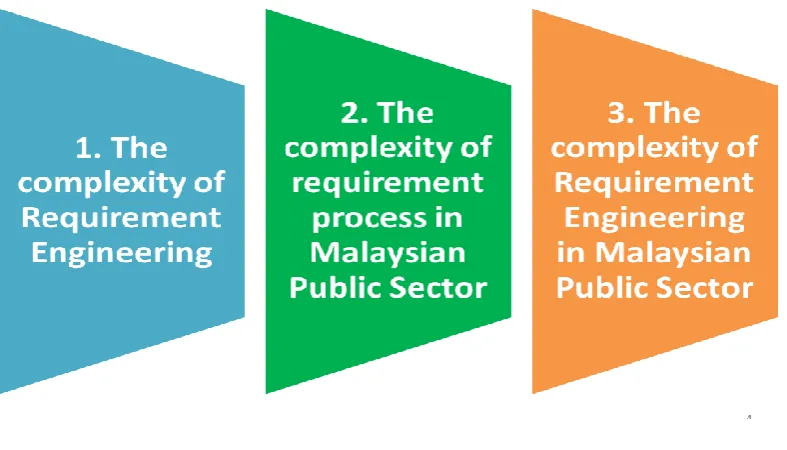
Figure 1.1 The complexity of Requirement Engineering Process in Malaysian Public Sector
4
communication amongst developers, stakeholders and managers (Charette, 2005). Badly defined system requirements of immature technology will give impact to the level of accessibility and availability of system application. Information will not be accurate caused by poor project managements, inability to handle the project's complexity, poor reporting of the project’s status, unmanaged risks, and inaccurate estimates of needed resources (Charette, 2005).
Issues that are often overlooked is the complexity of the processes involved during the development of a software project. A proposed software project must undergo several stages of approval. In addition, it must refer to some guideline has been provided both in terms of requirements for business and ICT. The complexity has been classed into three groups as shown in Figure 1.1.
1.3.1. The complexity of Requirement Engineering
RCMM with RCMMi. Constraints of personnel in understanding the standards made the implementation to be in an inappropriate way, and most of the outsourcing project implements the method that was proposed by the vendor consultant.
The developer is the most important personnel that must understand the Requirement Engineering Process. The requirement should define and determine the generic and specific requirement. Both requirements have their own goals to achieve in making the software project a success. A good requirement will decrease the degree of failure of software projects. However, sometimes the software project fails because of an uncompleted requirement process, no controlling of requirement changes and monitoring system design. The changes of requirement influence the changes of the business process, changes of ICT infrastructure, and cause the business process to reorganise, restructure, and react on new opportunities for improvement. The requirement is more complex and complicated especially for the large application system. The developer will need to struggle and understand the stakeholder’s needs. While, the stakeholders continue gaining new insights into the problem, it will somehow lead to changes in the requirements. This problem, requirements gathering, should be resolved through the use of the guideline.
1.3.2. The complexity of requirement process in Malaysian Public Sector
6
will affect the changes of policy of the business process. The proposed concept paper will be presented to the committees involve in ICT Steering Committee and Government IT and Internet Committee.
The proposed concept paper should align with the e-Governance. The governing organization also should align with ICT regulation or standard. The IT Personnel is responsible to ensure the conformity and accountability of the rules. Currently, the problem is lacking the appropriate guidance and support in managing within the relevant information systems. This study shows that, there is little support to manage the requirements and their relationships to various policies and regulations (Breaux, Antón, & Spafford, 2006).
The proposed software project should be advised by the IT Department and align with the role and responsibility of the IT Department such as Data Center, Network and Security. Then, the proposed papers have to get the approval from ICT Steering Committee in the organization, followed by ICT Steering Committee ministry, and finally by the Government IT and Internet Committee which is chaired by MAMPU. This process will take about three months without correction, and sometimes will go beyond six months as shown in Chapter 6–Software Project Approval Process. Besides that, the team has to follow the schedule plan of the committee, which sometimes affects the implementation schedule plan. This situation shows the complex role of the committee that should be facing by the IT Personnel. IT Personnel not only should have the technical knowledge and project management, but also need to have the soft skills in order to convince the committee. Otherwise, the proposed software project development is not important for the committee.
software project development and the agencies have different understanding or just use their assumption. Sometimes the vendor proposes a methodology, which needs involvements from other parties such as consultants during the implementation. The proposed methodology needs to be customised by the personnel that really have experience and supported by the training which usually is not included in the earlier plan. Otherwise, it will raise other issues such as rescheduling the implementation phase or extending the schedule planned.
1.3.3. The complexity of Requirement Engineering in Malaysian Public Sector
The Software Project Development involves many disciplines, this research identifies issues happened during the implementation of some of the Software Project Development in the Public Sector as shown in Chapter 2-Identification of Software Project Issues for ICT Project. The purpose is to ensure the problem early at the requirement gathering stage. These issues are grouped as Software Project Success Factor. Every factor is dependent on each other and the main factor is the business process. Business process directly relates to the stakeholder and the developer and finally, compacted into three main components, people, process and technology.
This research determines the complex role of the actor in between the requirement engineering process as shown in Chapter 2 - The relationship between the defined Requirement Engineering Process. Due to the constraints of people and skills, most of the software project development is outsourced. The complex role will make the conflict of task, communication and understanding between Government Project Team and Vendor Project Team. The roles of Project Director from the vendor are more difficult and messy because he has to manage different projects, which have different views, needs, goals, and objectives. Some of the issues cannot be managed urgently such as commercial issues because they involve the management’s decision. A part of their task is given to the Project Manager.
8
implementation. As mentioned earlier, the personnel involved in software project should have experience in software project management. Lack of the soft skills, knowledge, expertise, and decision making give impact to the software project implementation, and the capability of Project Manager will be questioned. Project Manager often lacks visibility of the project team and resources, shares team members with the other projects, depends on the third party, uses incompetent principles to resolve the issues and is not serious in meeting the project objectives.
1.3.4. Gap Analysis for the Complexity
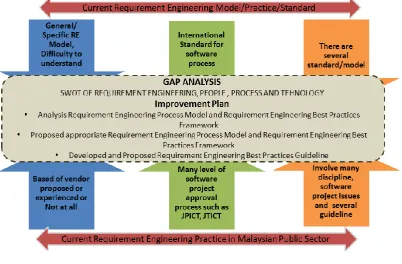
The involvement of several committees, rules and guidelines, and the methodology in software project development raises critical issues such as constraints in applying and aligning the rules and guidelines, changes in the requirement, facilitation of ICT infrastructure, identification and understanding of needs, and decision making. Figure 1.2 shows the research gap that has been defined in Malaysian Public Sector. The gap defined is based on current Requirement Engineering Model/Practice/Standard and Current Requirement Engineering Practice in Malaysian Public Sector. The research gap is divided into three components; Requirement Engineering Model, software process and Requirement Engineering Standard.
Currently, there are many Requirement Engineering Models that have been introduced or developed. The problem is how to evaluate the best Requirement Engineering Model and which is appropriate for the software project. The owner of the software project lets the vendor proposes the appropriate Requirement Engineering Model as the solution. The impact of this solution, the developer too, depends on the vendor when applying the model, even after the software project commissioning. This working culture continues to the next software project
software process. The Malaysian Public Sector created several committees to review the proposed ICT project requirements before giving the approval. The role of these committees is either to evaluate the proposed software projects that have been approved or suggest some modification should be done to meet the organisation’s objectives. The committee members are appointed based on their experience and expertise. The issue is to manage the ideas into one concrete solution.
Figure 1.2 Research Gap
10
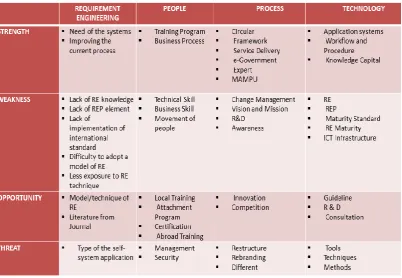
The gap analysis also shows the weaknesses of people, process and technology as presented in Chapter 2-Gap Analysis of People, Process and Technology.
Table 1.1: SWOT of Requirement Engineering, People, Process and Technology
1.4 Statement of the Problem
Generally, Requirement Engineering is implemented in the Malaysian Public Sector. The implementation of Requirement Engineering in organisations is different from the Malaysian Public Sector, even though in the same section. This situation happens because of the constraints that will be discussed in Chapter 2.The project team has to depend on the method proposed by the vendor.
Government IT and Internet Committee. And, most importantly, Software Project Development has to be approved in the Cabinet Meeting.
The current standard that has been developed for the Malaysian Public Sector or International Standard cannot be adapted directly to the software project development. A lot of tailoring or customisations have to done to the standard. This process needs expert personnel that understand the standard or method. The International Standard such as RCMMi developed for the SME, ISO/IEC 122007 focuses on software life cycle process.
The Malaysian Public Sector needs a standard regulatory guideline for IT Personnel in order to guide them in the software project development approval process, followed by the activity after getting the software project development approval, and the development of the software requirement specification. The proposed guideline is to ensure that the technical specification proposed for acceptance is aligned with the Public Sector ICT’s Vision.
1.5 Research Question
Our research study is based on the following research question:
i. What are the activities involved in determining requirements of software project development? The researcher lists the related activities based on literature and fieldwork.
ii. What is the most appropriate guideline for software project development in the Malaysian Public Sector? The researcher makes a comparison of requirement engineering process model, standard and requirement engineering practice framework.
12
1.6 Objectives of the Research
The research objective was determined based on the problem statement as follows:
i. To evaluate the current practices of requirements for software project development;
ii. To develop the Requirements Engineering Best Practices as an appropriate guideline in developing software projects in the Public Sector; and
iii. To evaluate the proposed Requirement Engineering Best Practices for requirements using Software Project Development in the Public Sector as case study.
1.7 Scope of the Research
The following statement covers the scope of this research:
i. Business: Focuses on related ICT fields for the software project that is implemented in Malaysia’s Public Sector. The respondents will be selected among software practitioners (Pegawai Teknologi Maklumat, Level F48 and above) in Malaysian Public Sector;
1.8 Significance of Research
The significances of the study are as follows:
i. Gap Analysis: Analysis of Requirement Engineering Practices implement by the IT Managers during the requirement gathering. Analysis includes the determination of methodology and standard that is usually referred by the IT Manager. In making it reliable to the organisation, the analysis should involve SWOT analysis of people, process and technology. The software project issues are a part of the requirements in this research.
ii. Requirement Process: There are several processes involved during the acceptance of Software Requirement Specification. The proposed Software Requirement Specification is gathered by the Project Team, managed by Project Manager, and lead by the Project Director. And, this process is controlled by the ICT steering committee and management of the organisation.
iii. A proposed guideline for software requirement specification: This research proposesa guideline for software requirement specification which is Requirement Engineering Best Practices Guideline in the Malaysian Public Sector. This Requirement Engineering Best Practices Guideline must be understood by IT Personnel and can be implemented in requirement gathering. A model/method/tools and technique that is suitable in this research.
1.9 Thesis Organisation
This thesis is organised into seven chapters as detailed below:
14
scope of the research, significance of the research, and finally, thesis organisation.
ii. Chapter 2 Literature Review. This chapter elaborates the literature of Requirement Engineering, the related issues to Requirement Engineering such as a Requirement Engineering Process, Requirement Engineering Techniques Requirement Engineering Standard, and Requirement Engineering Capability. This chapter also describes the Malaysian Public Sector, the Requirement Engineering in the Malaysian Public Sector and the comparison Requirement Engineering Best Practices Framework in the Public Sector.
iii. Chapter 3 Research Methodology. This chapter describes the methodological aspects of the research for the development of Requirement Engineering Best Practice Guideline, a process flow of Requirement Engineering Best Practices Guideline. This chapter also presents how we conduct the research study for Requirement Engineering Best Practices Guideline based on the Requirement Engineering Best Practices Guideline research framework, and describes the research procedure.
iv. Chapter 4 The development of Requirement Engineering Best Practices. This chapter starts the deriving of Requirement Engineering Best Practices, the mapping process of the Software Project Success Factor, Requirement Engineering Process Model and Requirement Engineering Critical Issues. The reviewed and redesigned Requirement Engineering Best Practices and also presents the summary of the practices based on the Requirement Engineering Process.
Procedure and Software Requirement Specification Activity Diagram. This chapter also describes the reliability of Requirement Engineering Practices.
vi. Chapter 6 Refinement and Validation of Requirement Engineering Best Practices Guideline. This chapter explains the refining and validating of Requirement Engineering Best Practices Guideline. This chapter provides results of the proposed Requirement Engineering Best Practices Guideline, which is done through the Expert Review Process.
vii. Chapter 7 Discussion and Conclusion. This chapter discusses the journey of the research with the summarization diagram, research objective and the achievement, discussion on research contribution. Finally, this chapter also presents the limitation and future work.
1.10 Summary
REFERENCES
Abd Manan, A., & Mohd Yusoff, M. S. (2006, October 1). E- Learning for the Malaysian Public Sector. National Institute of Public Administration (INTAN) Malaysia.
Abd Rashid Zaharah. (2006). E-Perolehan- A Breakthrough for E-Commerce in the Malaysian Government. Public Sector ICT Management Review, Vol.1 No.1(Implementation of Electronic Government (EG) Project).
Alawneh, L., Debbabi, M., Hassaine, F., Jarraya, Y., & Soeanu, A. (2006). A unified approach for verification and validation of systems and software engineering models. In Engineering of Computer Based Systems, 2006. ECBS 2006. 13th Annual IEEE International Symposium and Workshop on
(pp. 10–418).
Altendorfer, S., Aschauer, T., Dauenhauer, G., & Pree, W. (2010). Alignment: a new software architecture approach to support streamlining business processes.
Antón, A. I., Earp, J. B., Potts, C., & Alspaugh, T. A. (2001). The role of policy and stakeholder privacy values in requirements engineering. In Proc. Fifth IEEE Int. Symposium on Requirements Engineering (pp. 138–145).
Aurum, A., & Wohlin, C. (2005). Aligning requirements with business objectives: A framework for requirements engineering decisions. In Proceedings of Requirements Engineering Decision Support Workshop.
Azevedo, L. G., Santoro, F., Baião, F., Souza, J., Revoredo, K., Pereira, V., & Herlain, I. (2009). A method for service identification from business process models in a SOA approach. Enterprise, Business-Process and Information Systems Modeling, 99–112.
Banica, L., Rosca, D., & Stefan, C. (2009). A software for project management process. Munich Personal RePEc Archive (MPRA), Paper No. 15237.
Barney, S., Aurum, A., & Wohlin, C. (2006). Quest for a silver bullet: Creating software product value through requirements selection. In Software
Engineering and Advanced Applications, 2006. SEAA’06. 32nd
EUROMICRO Conference on (pp. 274–281).
Barney, S., Aurum, A., & Wohlin, C. (2008). A product management challenge: Creating software product value through requirements selection. Journal of Systems Architecture, 54(6), 576–593.
Barreto, A., Barros, M. O., & Werner, C. M. L. (2008). Staffing a software project: A constraint satisfaction and optimization-based approach. Computers & Operations Research, 35(10), 3073–3089.
Beecham, S., Hall, T., Britton, C., Cottee, M., & Rainer, A. (2005). Using an expert panel to validate a requirements process improvement model. The Journal of Systems & Software, 76(3), 251–275.
Beecham, S., Hall, T., & Rainer, A. (2003). Assessing Requirements Process Strengths and Weaknesses: A first step to prioritising requirements process implementation.
Beecham, S., Hall, T., & Rainer, A. (2005). Defining a requirements process improvement model. Software Quality Journal, 13(3), 247–279.
Bhat, J. M., Mayank Gupta, & Murthy, S. N. (2006). Overcoming Requirements Engineering Challenges: Lessons from Offshore Outsourcing. Software, IEEE, 23(5), 38–44.
Bieger, A., Borges, G., Kranz, S., McGowan, C., Meehan, K., Mancuso, L. G., … de Macedo Guimaraes, L. B. (2009). Increasing the efficiency of a Brazilian Emergency response Call Center. In Systems and Information Engineering Design Symposium, 2009. SIEDS’09. (pp. 125–130).
Bjarnason, E., Wnuk, K., & Regnell, B. (2011). Requirements are slipping through the gaps—A case study on causes & effects of communication gaps in large-scale software development. In Requirements Engineering Conference (RE), 2011 19th IEEE International (pp. 37–46).
261
Boehm, B. W. (2009). Software engineering economics. Software Engineering, IEEE Transactions on, (1), 4–21.
Breaux, T. D., Antón, A. I., & Spafford, E. H. (2006). A distributed requirements management framework for compliance and accountability. North Carolina State University Computer Science Technical Report TR-2006-14, Raleigh,
NC.
Britton, C., Jones, S., Myers, M., & Sharif, M. (1997). A survey of current practice in the development of multimedia systems. Information and Software Technology, 39(10), 695–705.
Burgaud, L. (2006). A Novel development framework combining requirement driven and model based engineering processes. In 4ème Conférence Annuelle d’Ingénierie Système« Efficacité des entreprises et satisfaction des
clients». TOULOUSE (pp. 2–4).
Castro, J., Pinto, R., Castor, A., & Mylopoulos, J. (2003). Requirements traceability in agent oriented development. Lecture Notes in Computer Science, 57–72. Catanio, J. T. (2006). Requirements Analysis: A Review. Advances in Systems,
Computing Sciences and Software Engineering, 411–418.
Cerpa, N., & Verner, J. M. (2009). Why did your project fail? Communications of the ACM, 52(12), 130–134.
Chang, G. S., Perng, H. L., & Juang, J. N. (2008). A review of systems engineering standards and processes. Journal of Biomechatronics Engineering, 1(1), 71– 85.
Charette, R. N. (2005). Why software fails. IEEE Spectrum, 42(9), 36.
Cheng, B. H. ., & Atlee, J. M. (2007). Research directions in requirements engineering. Future of Software Engineering, 2007. FOSE’07, 285–303. Chua Yan Piaw. (2006). Kaedah dan Statistik Penyelidikan : Kaedah Penyelidikan.
Mc Graw Hill.
Cleland-Huang, J. (2005). Software Requirements. Software Engineering: The Development Process, 113.
Damian, D., & Zowghi, D. (2003). Requirements Engineering challenges in multi-site software development organizations. Requirements Engineering, 8(3), 149–160.
Davey, B., & Cope, C. (2008). Requirements Elicitation- What’s Missing? Issues in Informing Science & Information Technology, 5, 543–551.
Decker, B., Ras, E., Rech, J., Jaubert, P., & Rieth, M. (2007). Wiki-based stakeholder participation in requirements engineering. IEEE Software, 28– 35.
Delbecq, A. L., Van de Ven, A. H., & Gustafson, D. H. (1975). Group techniques for program planning: A guide to nominal group and Delphi processes.
Scott, Foresman Glenview, IL.
De Lemos, R., Giese, H., Müller, H. A., Shaw, M., Andersson, J., Litoiu, M., others. (2013). Software engineering for self-adaptive systems: A second research roadmap. In Software Engineering for Self-Adaptive Systems II (pp. 1–32). Springer.
Dorfman, M. (1977). Requirements engineering. Software Requirements, 7–21. Dutoit, A. H., McCall, R., Mistrik, I., Paech, B., & service), S. (Online. (2006).
Rationale Management in Software Engineering. Springer.
Ebert, C. (2006). Understanding the product life cycle: Four key requirements engineering techniques. Software, IEEE, 23(3), 19–25.
Ebert, C. (2007). The impacts of software product management. Journal of Systems and Software, 80(6), 850–861.
E. Damian, D., & Zowghi, D. (2003). RE challenges in multi-site software development organisations. Requirements Engineering, 8(3), 149–160. Egorova, E., Torchiano, M., Morisio, M., Wohlin, C., Aurum, A., & Svensson, R.
B. (2009). Stakeholders’ Perception of Success: An Empirical Investigation.
In Software Engineering and Advanced Applications, 2009. SEAA’09. 35th
Euromicro Conference on (pp. 210–216).
El Emam, K., & Madhavji, N. H. (2005). A field study of requirements engineering practices in information systems development. In Requirements Engineering, 1995., Proceedings of the Second IEEE International
263
Elizabeth Hull, & Ken Jackson. (2005). Requirement Engineering (Second Edition.). Springer.
Estefan, J. A. (2007). Survey of model-based systems engineering (MBSE) methodologies. Incose MBSE Focus Group, 25.
Fernandes, J. M., Braga, P., Machado, R. J., Guimaraes, P., & Seidman, S. B. (2009). A Requirements Engineering and Management Training Course for Software Development Professionals. In Proceedings of the 2009 22nd Conference on Software Engineering Education and Training-Volume 00
(pp. 20–25).
Foorthuis, R. M., & Brinkkemper, S. (2008). Best Practices for Business and Systems Analysis in Projects Conforming to Enterprise Architecture. Enterprise Modelling and Information Systems Architectures, 3(1), 36–47.
Fricker, S., Gorschek, T., & Myllyperki\ö, P. (2007). Handshaking between software projects and stakeholders using implementation proposals. Requirements Engineering: Foundation for Software Quality, 144–159.
Fuggetta, A. (2000). Software process: a roadmap. In Proceedings of the Conference on the Future of Software Engineering (pp. 25–34).
Glinz, M., & Wieringa, R. J. (2007). Guest Editor’s Introduction: Stakeholders in Requirements Engineering. IEEE SOFTWARE, 18–20.
Gomes, C. F., Yasin, M. M., & Small, M. H. (2012). Discerning Interrelationships among the Knowledge, Competencies, and Roles of Project Managers in the Planning and Implementation of Public Sector Projects. International Journal of Public Administration, 35(5), 315–328.
Gonzalez, P., White, J., & Christie, B. (2011). Applying Systems Engineering Principles to the Development of Transportation Communication Standards.
Gorschek, T., & Davis, A. M. (2008). Requirements engineering: In search of the dependent variables. Information and Software Technology, 50(1-2), 67–75. Gorschek, T., & Wohlin, C. (2006). Requirements abstraction model. Requirements
Engineering, 11(1), 79–101.
Gruenbacher, P., & Briggs, R. (2001). Surfacing tacit knowledge in requirements negotiation: Experiences using easy win win. In Proceeding of the Annual Hawaii International Conferrence on System Sciences (pp. 35–35).
negotiation: Experiences using easy win win. In Proceeding of the Annual Hawaii International Conferrence on System Sciences (pp. 35–35).
Habich, D., Richly, S., Demuth, B., Gietl, F., Spilke, J., Lehner, W., & Assmann, U. (2010). Joining Business Rules and Business Processes. In Proceedings of the 16th International Conference on Information and Software
Technologies (IT 2010, April 21st-23rd, Kaunas, Lithuania) (pp. 361–368).
Hall, T., Beecham, S., & Rainer, A. (2002). Requirements problems in twelve software companies: an empirical analysis. In Software, IEE Proceedings (Vol. 149, pp. 153–160).
Hoorn, J. F., Konijn, E. A., Van Vliet, H., & Van der Veer, G. (2005). Goal-oriented RE for handling change requirements: an explanation of what stakeholders try to avoid and what they try to achieve. In Proceedings of the International Workshop on Requirements Engineering for Business Need
and IT Alignment (REBNITA’05) in Conjunction with the Thirteenth IEEE Requirements Engineering Conference (RE’05)(Paris, France).
Huang, S.-J., & Han, W.-M. (2008). Exploring the relationship between software project duration and risk exposure: A cluster analysis. Information & Management, 45(3), 175–182.
Hussain, S. J., Rashid, K., Ahmad, H. F., & Hussain, S. F. (2007). Effective software management: where do we falter? In Proceedings of the 6th WSEAS International Conference on Software Engineering, Parallel and
Distributed Systems (pp. 13–18).
Jafarinezhad, O., & Ramsin, R. (2012). Development of Situational Requirements Engineering Processes: A Process Factory Approach. In Computer Software and Applications Conference (COMPSAC), 2012 IEEE 36th Annual (pp.
279–288). IEEE.
Jiang, J. J., Klein, G., Hwang, H. G., Huang, J., & Hung, S. Y. (2004). An exploration of the relationship between software development process maturity and project performance. Information & Management, 41(3), 279– 288.
265
Conference and Workshops on the (pp. 269–278).
Jiang, L., Eberlein, A., & Far, B. H. (2005). Combining requirements engineering techniques - theory and case study. In Engineering of Computer-Based Systems, 2005. ECBS ’05. 12th IEEE International Conference and
Workshops on the (pp. 105–112). doi:10.1109/ECBS.2005.25
Jiang, L., Eberlein, A., Far, B. H., & Mousavi, M. (2008). A methodology for the selection of requirements engineering techniques. Software and Systems Modeling, 7(3), 303–328.
Jonathan Sidi, & Syahrul Nizam Junaini. (2006). Credibility Review of the Malaysian States E-Government Web Sites. Public Sector ICT Management Reviw, Vol. 1 No. 1(Implementation of Electric Government (EG) Project).
Jureta, I., Mylopoulos, J., & Faulkner, S. (2008). Revisiting the core ontology and problem in requirements engineering. In Proceedings of the 2008 16th IEEE International Requirements Engineering Conference (pp. 71–80).
K\äk\öl\ä, T., & Taalas, A. (2008). Validating the Information Systems Design Theory for Dual Information Systems. In Proceedings of the 29th International Conference on Information Systems, Paris.
Kaliannan, M., & Awang, H. (2008). ICT to enhance administrative performance: a case study from Malaysia. International Journal of Business and Management, 3(5), P78.
Kapočius, K., & Danikauskas, T. (2006). The use of business rules for the specification of dynamic aspects of IS. Information Technology and Control, Kaunas: Technologija, 35(3A), 327–332.
Kapuruge, M., Han, J., & Colman, A. (2010). Support for business process flexibility in service compositions: An evaluative survey. In 21st Australian Software Engineering Conference (pp. 97–106).
Karlsson, L., Dahlstedt, \AA. G, Regnell, B., Natt och Dag, J., & Persson, A. (2007). Requirements engineering challenges in market-driven software development-An interview study with practitioners. Information and Software Technology, 49(6), 588–604
Karsai, G., Krahn, H., Pinkernell, C., Rumpe, B., Schindler, M., & Völkel, S. (2009). Design guidelines for domain specific languages. In The 9th OOPSLA workshop on domain-specific modeling (pp. 7–13).
Kauppinen, M., Aaltio, T., & Kujala, S. (2002). Lessons learned from applying the requirements engineering good practice guide for process improvement. Software Quality—ECSQ 2002, 73–81.
Kauppinen, M., Vartiainen, M., Kontio, J., Kujala, S., & Sulonen, R. (2004). Implementing requirements engineering processes throughout organizations: success factors and challenges. Information and Software Technology, 46(14), 937–953.
Kuhn, T. S. (2012). The structure of scientific revolutions. University of Chicago press.
LaToza, T. D., Venolia, G., & DeLine, R. (2006). Maintaining mental models: a study of developer work habits. In Proceedings of the 28th international conference on Software engineering (pp. 492–501).
Lázaro, M., & Marcos, E. (2006). An approach to the integration of qualitative and quantitative research methods in software engineering research. In 2nd International Workshop on Philosophical Foundations of Information
Systems Engineering (PHISE’06) LNCS. Springer-Verlag, Berlin.
Lim, S. L., Quercia, D., & Finkelstein, A. (2010). StakeNet: using social networks to analyse the stakeholders of large-scale software projects. In Software Engineering, 2010 ACM/IEEE 32nd International Conference on (Vol. 1,
pp. 295–304).
Liu, K., Valerdi, R., & Laplante, P. A. (2010). Better requirements decomposition guidelines can improve cost estimation of systems engineering and human systems integration 8th Annual Conference on Systems Engineering Research. Hoboken, NJ.
Liu, L. L. (2006). Software Maintenance and CMMI for Development: A Practitioner’s Point of View. Journal of Software Engineering, 1(2), 68–77. Lochmann, K., & Goeb, A. (2011). A unifying model for software quality. In
Proceedings of the 8th international workshop on Software quality (pp. 3–
267
Louis A. Poulin. (2006). A Comparative Analysis of Process Maturity Level and Quality. In Electrical and Computer Engineering, 2006. CCECE ’06. Canadian Conference on (pp. 2401–2404).
Luna-Reyes, L. F., & Gil-García, J. R. (2011). Using institutional theory and dynamic simulation to understand complex e-government phenomena. Government Information Quarterly, 28(3), 329–345.
Makolm, J. (2006). A Holistic Reference Framework for e-Government: The Practical Proof of a Scientific Concept. In System Sciences, 2006. HICSS’06. Proceedings of the 39th Annual Hawaii International Conference on (Vol.
4, p. 77a).
Maseri, W., & Mohd, W. (2006). Categorizing users in requirement engineering process: A case study in e-university project. In Computing & Informatics, 2006. ICOCI ’06. International Conference on (pp. 1–6).
McConnell, S. (2009). Software project survival guide. Microsoft press. Retrieved from http://books.google.com.my/.
McEuen, S. F. (2001). How fluent with information technology are our students. Educause Quarterly, 24(4), 8–17.
McPhee, C., & Eberlein, A. (2002). Requirements engineering for time-to-market projects. In Proceedings of the 9 th Conference and Workshop on the Engineering of Computer-based Systems, ECBS, Sweden.
Mishra, D., Mishra, A., & Yazici, A. (2008). Successful requirement elicitation by combining requirement engineering techniques. In Applications of Digital Information and Web Technologies, 2008. ICADIWT 2008. First
International Conference on the (pp. 258–263).
Mohamed, N., Hussin, H., & Hussein, R. (2006). Enabling change factors and IT success in the Malaysian e-government implementation. In Proceedings of the 10th Pacific-Asia Conference on Information Systems, Kuala Lumpur
(pp. 6–9).
Mohamed Othman Rosita, & Musa Nadianatra. (2007). E-Recruitment Practice : Pros vs Cons.
Muhammad Rais, A. K. (1995). Improving the efficiency of the Public Sector: A case-study of Malaysia. Department for Development Support and Management Services of the United Nations Secretariat.
Mutschler, B., Reichert, M., & Bumiller, J. (2008). Unleashing the Effectiveness of Process-Oriented Information Systems: Problem Analysis, Critical Success Factors, and Implications. IEEE Transactions on Systems, Man, and Cybernetics, Part C: Applications and Reviews, 38(3), 280–291.
Nadianatra Musa, & Syahrul Nizam Junaini. (2006). Success of E-Learning initiative in Sarawak. Public Sector ICT Management Review, Vol 1 No 1. Nasir, M. H. N., & Sahibuddin, S. (2011). Critical success factors for software
projects: A comparative study. Scientific Research and Essays, 6(10), 2174– 2186.
Niazi, M., Wilson, D., & Zowghi, D. (2005). A maturity model for the implementation of software process improvement: an empirical study. Journal of Systems and Software, 74(2), 155–172.
Norshidah, M. (2008). Internal users’ self-assesment of Malaysia E-Government flagship application in lead implementation agencies I. Public Sector ICT Management Reviw, Vol 2 No 1(Electronic Service Delivery), 13–21.
Nurmuliani, N., Zowghi, D., & Powell, S. (2005). Analysis of requirements volatility during software development life cycle. In Software Engineering Conference, 2004. Proceedings. 2004 Australian (pp. 28–37).
Nurmuliani, N., Zowghi, D., & Williams, S. P. (2006). Requirements volatility and its impact on change effort: Evidence-based research in software development projects. In Proceedings of the Eleventh Australian Workshop on Requirements Engineering.
Nuseibeh, B., & Easterbrook, S. (2000). Requirements engineering: a roadmap. In Proceedings of the Conference on the Future of Software Engineering (pp.
35–46).
Okot-Uma, R. W. ., & London, C. S. (2000). Electronic Governance: re-inventing good governance. Commonwealth Secretariat, London.
269
Olsson, T., Doerr, J., Koenig, T., & Ehresmann, M. (2005). A Flexible and Pragmatic Requirements Engineering Framework for SME.
Omar, M. A., & Mohd. Yusof Mokhtar. (2006). Pelaksanaan Projek Kerajaan Elecktronik (Electronic Government-EG) - S atu Penilaian, Vol 1 No 1. Pacheco, C., & Garcia, I. (2008). Stakeholder Identification Methods in Software
Requirements: Empirical Findings Derived from a Systematic Review. In Software Engineering Advances, 2008. ICSEA ’08. The Third International
Conference on (pp. 472–477).
Paech, B., Dorr, J., & Koehler, M. (2005). Improving requirements engineering communication in multiproject environments. IEEE Software, 22(1), 40–47. Paetsch, F., Eberlein, A., & Maurer, F. (2003). Requirements engineering and agile
software development. In Proceedings of the Twelfth International Workshop on Enabling Technologies: Infrastructure for Collaborative
Enterprises (p. 308).
Pandey, D., Suman, U., & Ramani, A. (2010). An Effective Requirement Engineering Process Model for Software Development and Requirements Management. In Advances in Recent Technologies in Communication and Computing (ARTCom), 2010 International Conference on (pp. 287–291).
Pandey, D., Suman, U., & Ramani, A. K. (2010). Performance Measurement of Different Requirements Engineering Process Models: A Case Study. International Journal of Computer Engineering & Technology (IJCET),
1(2), 1–15.
Pandey, U. S., & Ramani, A. K. (2009). Social-Organizational Participation difficulties in Requirement Engineering Process-A Study. In National Conference on Emerging Trends in Software Engineering and Information
Technology, Gwalior Engineering College, Gwalior.
Panian, Z. (2009). User Requirements Engineering and Management in Software Development. In Proceedings of the European Computing Conference (pp. 609–620).
Power, N., & Moynihan, T. (2003). A theory of requirements documentation situated in practice. In Proceedings of the 21st annual international conference on Documentation (pp. 86–92).
Prause, C. R., Scholten, M., Zimmermann, A., Reiners, R., & Eisenhauer, M. (2008). Managing the iterative requirements process in a multi-national project using an issue tracker. In Global Software Engineering, 2008. ICGSE 2008. IEEE International Conference on (pp. 151–159).
Rainer, A., & Hall, T. (2002). Key success factors for implementing software process improvement: a maturity-based analysis. The Journal of Systems & Software, 62(2), 71–84.
Rao, T. P. . (2004). ICT and e-Governance for Rural Development. Institute of Rural Management, Anand, Gujarat.
Roger, A. E., Marcel, F. N., & Lopez, A. C. (2010). Business Process Requirement Engineering. International Journal on Computer Science and Engineering, 2(9).
Ross, D. T., & Schoman Jr, K. E. (1977). Structured analysis for requirements definition. Software Engineering, IEEE Transactions on, (1), 6–15.
Sabaliauskaite, G., Loconsole, A., Engström, E., Unterkalmsteiner, M., Regnell, B., Runeson, P., Feldt, R. (2010). Challenges in aligning requirements engineering and verification in a large-scale industrial context. Requirements Engineering: Foundation for Software Quality, 128–142.
Sahni, D., Van den Bergh, J., & Coninx, K. (2010). CoFra: Towards structurally selecting ICT tools and methods in multidisciplinary distributed projects. In Collaborative Technologies and Systems (CTS), 2010 International
Symposium on (pp. 188–197).
Saiedian, H., & Dale, R. (2000). Requirements engineering: making the connection between the software developer and customer. Information and Software Technology, 42(6), 419–428.
Salimi, M., Hadjali, H. R., & Sorooshian, S. (2012). Critical success practices (CSP) toward implementing lean production among international companies in Malaysia. African Journal of Business Management, 6(27), 8118–8125. Scheller, R. M., Sturtevant, B. R., Gustafson, E. J., Ward, B. C., & Mladenoff, D. J.