Experimental Investigation on Compressive Strength of
Concrete with Partial Replacement of Cement with
Silica Fume
M. Shasha Vali1, M. Mujahid Ahmed2
1
P.G. Scholar, 2Guide, Head of the Department
1,2
Department : Structural Engineering 1,2
Geetanjali College of Engineering and Technology
Email id: [email protected], [email protected]
ABSTRACT
The purpose of this experimental
investigation is to study the behavior of short columns produced from Silica fume concrete (SFC). In this investigation SFC was manufactured by usual ingredients such as cement, fine aggregate, coarse aggregate, water and mineral admixtures such as Silica Fume (SF) at various replacement levels. When coarse aggregate and fine aggregate ratio (ca/fa ratio) of the mix is varied and various percentage replacement of cement with silica fumes in the concrete. The percentage of silica fume varied are 0%,
11%,13%,15%, and 17% as equal
replacement of ordinary Portland cement. The water binder ratio (w/b) adopted is 0.42 and 0.50. The ca/fa ratios range from1.50 to 1.75. After demoulding, the concrete specimens from each mix will be moist cured in water for 28 days. The compressive and tensile strength will be determined after each curing period.
Mix M25 are cast with 0%, 11%, 13%, 15%, and 17% replacement of SF to study
the mechanical properties such as
compressive strength of concrete at 28 days. Totally 10 columns were cast for mix M25. The column specimens were tested in 1000kN loading frame at 28 days.
INTRODUCTION
Lime waste is an industrial waste which is obtained from the lime stone polishing industry in the form. The waste is produced at Dhone and surrounding areas of Kurnool. Total waste produced by all industries may be approximately 2000 tones per week. This waste is easily carried away by the air and hence causing problems to human health and environmental pollution. The lime waste generated by the industry has accumulated over years, and it has been
dumped unscrupulously resulting in
environmental problem. Hence we are using lime waste as a cement replacement in
different percentages and we have
determined the compressive strength of concrete.
EFFECTS OF DISPOSAL OF LIME WASTE:
With the enormous increase in the quantity of waste needing disposal, acute shortage of dumping sites, sharp increase in the transportation and dumping costs affecting
the environment, prevents sustainable
development. The waste disposal problem is becoming serious. As it is a fine material, it will be easily carried away by the air and will cause nuisance causing health problems and environmental pollution. The major effect of air pollution are lung diseases, inhaling problems, the people who are living in and around are suffering from these problems.
OUR PROPOSAL:
In this present work, it is aimed at developing a new building material from the lime scrap, an industrial waste as a
replacement material of sodium
polyacrylate and partial replacement of cement. Moreover, Sodium polyacrylate is very expensive wasting a very expensive material is not good engineering practice and hence Sodium polyacrylate is replaced by some amount of lime waste in certain percentages. By doing so, the objective of reduction of cost construction can be met and it will help to overcome the environmental problem associated with its
disposal including the environmental
problems of the region. POLYMERS:
Chain of monomers are called Polymers. Generally, polymers are used in Self curing
concrete are Sodium polyacrylate,
Polyethylene Glycol, Polyacrylamide. SODIUM POLYACRLATE:
Sodium polyacrylate, also known as waterlock, is a sodium salt of polyacrylic acid with the chemical formula [-CH2-CH(COONa)-]n and broad application in consumer products.It has the ability to absorb as much as 200 to 300 times its mass in water. Sodium polyacrylate is anionic polyelectrolytes with negatively charged
carboxylic groups in the main chain. Sodium polyacrylate is a chemical polymer that is widely used in a variety of consumer products for its ability to absorb several hundred times its mass in water. Sodium polyacrylate is made up of multiple chains of acrylate compounds that possess a positive anionic charge, which attracts water-based molecules to combine with it, making sodium polyacrylate a super-absorbent compound. Sodium polyacrylate is used extensively in the agricultural industry and is infused in the soil of many potted plants to help them retain moisture, behaving as a type of water reservoir. Florists commonly use sodium polyacrylate to help keep flowers fresh. For fast absorption a slight increase of sodium polyacrylate can be used for demonstration purposes.
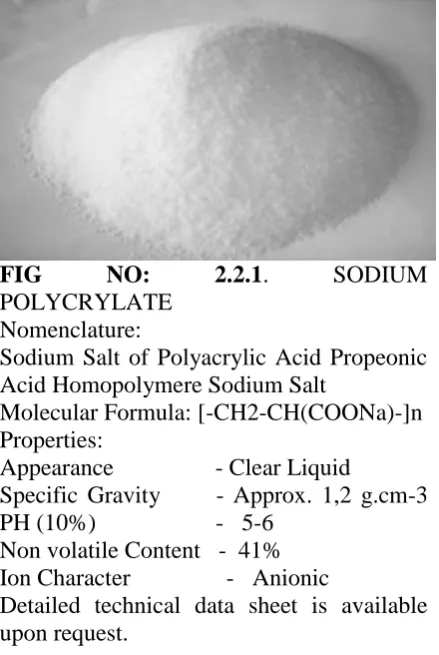
FIG NO: 2.2.1. SODIUM POLYCRYLATE
Nomenclature:
Sodium Salt of Polyacrylic Acid Propeonic Acid Homopolymere Sodium Salt
Molecular Formula: [-CH2-CH(COONa)-]n Properties:
Appearance - Clear Liquid
Specific Gravity - Approx. 1,2 g.cm-3 PH (10%) - 5-6
Non volatile Content - 41% Ion Character - Anionic
Detailed technical data sheet is available upon request.
Description:
with low foaming properties and compatibility with all synthetic emulsion.
EFFECT OF SODIUM
POLYACRYLATE ON PROPERTIES OF FRESH AND HARDENED CONCRETE:
Sodium polyacrylate is used as a superabsorbent polymer in concrete. This study focused on the strength and shrinkage of concrete. If we concluded that the shrinkage of concrete due to loss of water to the surroundings is the cause of cracking both in the plastic and in the hardened stage. This type of cracking can effectively mitigated by slowing down the water loss. The superabsorbent polymers use in concrete has the potential to reduce concrete cracking.
They concluded that the autogenous shrinkage may lead to cracking and affect concrete strength and durability, which is also, can be considered as technological challenge of high performance concrete. Addition of superabsorbent polymer in the ultra-high-performance concrete can be used to control the autogenous shrinkage. They also conducted tests that show that the shrinkage reduction due to superabsorbent polymer. We studied the use of Sodium Polyacrylates as SAP in concrete. The study focused on determining the optimum amount of SAP to be added to the concrete in order to maximize the strength and durability of concrete. We concluded in his study that the optimum amount of SAP is 0.11 percent of cement by weight, which he showed to be the most effective amount to be used in concrete.
LIME STONE POWDER:-
A high quality lime stone powder generally permits a reduction in water content of a
concrete mixture, without loss of
workability. Lime stone powder obtained from India‟s cement Limited, Tirunelveli was used for the study. Specific gravity of
Lime stone powder used was 1.39.
Limestone is used in virtually all
construction materials. Limestone is added in with clay and heated to form cement, which can be made into mortar by adding sand and water. Mortar is used to set bricks and act as an adhesive when it dries. Limestone is also used in concrete and asphalt filler. The very pure limestone located in Sammalut formation Elminea governorate 200 km south Cairo, this formation has the high purity due to the microfossiles which lived in the past on the marine environment(biological depositions).
Physical properties and chemical
composition of Lime stone powder.
Clinkers:
The incombustible residue, fused into an
irregular lump,that remains after the combustion of coal.
A mass of incombustible matter fused
together, as in the burning of coal.
A clinker is an incombustible fragment
that can be found in ash residue after burning heating fuels such as coal or wood.
more easily disposed of or recycled, or to
reduce the size of a solid mix.
THEORETICAL ANAYSIS ON MATERIALS
An experimental study is conducted on lime powder produced from lime industry is mixed with cement concrete in partial replacement of cement. Normal strength grade concrete of M30 design mix with various percentages of lime powder and polymer replacing cement has been made use in the investigation. Experimental study is carried out to investigate the compressive strength of concrete with replacement of cement by polymer and lime powder.
CEMENT:
Ordinary Portland cement 53 grade Dalmia Brand conforming to B.I.S
standards is used in the present
investigations. The cement is tested for its various properties as per IS 4031-1988 and found to be conforming to the requirements as per IS 8122-1989.
LIME STONE POWDER:
A high quality lime stone powder generally permits a reduction in water content of a concrete mixture, without loss of workability. Lime stone powder obtained from India‟s cement Limited, DHONE was used for the study. Specific gravity of Lime stone powder used was 1.39.
FINE AGGREGATE:
The sand obtained from Hundri River near Kurnool is used as fine aggregate in this project investigation. The sand is free from clayey matter, silt and organic impurities etc. The sand is tested for specific gravity, in accordance with IS 2386-1963 and it is 2.65, where as its fine modulus is 2.31. The sieve analysis results are presented in table. The sand conforms to zone- III.
COARSE AGGREGATE:
Machine crushed angular Basalt metal from Tamma rajupalle near panyam used as coarse aggregate. The coarse aggregate is free from clayey matter, silt and organic impurities etc. The coarse aggregate is also tested for specific gravity and it is 2.72. Fineness modulus is 4.20.
Aggregate of nominal size 20mm
downgraded 50% retained on 12.5mm (passing) and 4.75mm (retained) is used in the experimental work, which is acceptable according to IS 383-1970.
WATER:
This locally available potable water, which is free from concentration of acid and organic substances .Is used for mixing the concrete
NOTE: all the above parameters are within
permissible limits, as mentioned in IS 456-2000.
PLASTICIZER DEFINITION:
Plasticizers are combination of organic and inorganic substances which allow a reduction in water content for the given workability at the same water content, are termed as plasticizing admixtures. PURPOSE OF PLASTICIZER:
concrete having a slump equal to 200mm or more, a compaction factor of 0.98. Plasticizing admixtures are added to a concrete mixture to make plastic concrete extremely workable without additional water and corresponding loss of strength which makes it ideal for use in ready mixed concrete where workability is an important factor especially in places of congested reinforcement like beam column junction, heavy rafts and machine foundation, foundation of heavy structures.
As with conventional workability or plasticizing admixtures one can take advantage of the enhanced workability state to make reductions in water cement ratio of plasticized concrete while maintaining workability levels, namely 50 to 70mm slump concrete in this state is sometimes referred to as ‟water produced‟ or „high strength concrete‟. The use of plasticizers in ready mixed concretes and construction reduces the possibility of detoriation of concrete for its appearance, density and strength. On the other hand, it makes the placing of concrete more economical by increasing productivity and reducing cost of labour in concrete handling and moving operations at the construction site.
Plasticizer used in the present project is Conplast SD 110
Description:
In the production of concrete blocks, CONPLAST will increase strength, improve rheological flow without increased slump, produce a denser block with better finished sides and corners and reduce the unit cost of the block Conplast SD110
chloride-free admixture is specially
formulated for optimum cost saving across a wide range of static and mobile (egg-laying) block paving and masonary production equipment. It is supplied as a brown solution which instantly disperses in water. Conplast SD110 disperses the fine particles in the mix, improving cement dispersion and compaction to maximize the
strength obtained from the cement used. The improved performance can then be used to allow reductions in cement content without
loss of performance. Controlled air
entrainment maintains yield and improves surface finish while providing improved resistance to frost attack.
Properties
Appearance : Brown liquid
Specific gravity : Typically 1.16 at 20 C Chloride content : Nil to BS 5075
Alkali content : Typically less than 5.0 g. Na2O
Conplast SD110 is suitable for use with all types of Ordinary Portland cements and cement replacement materials such as Lime powder and polymers.
Advantages:
Increase in strengths, density and yield
of semi-dry concrete units.
It can be maintained at lower cement
contents.
Allows higher early and later age
strengths to be obtained without additional cement.
Improves strength, resulting in fewer
losses due to breakage.
Air entrainment improves resistance to
frost attack.
Improved mix cohesion allows
economical use of a wide range of aggregates.
Typical dosage
The optimum dosage of Conplast
SD110 to meet specific requirements should always be determined by trails using the materials and conditions that will be experienced in use.
This allows the optimization of
Fig 3.6.1 CONPLAST SD 110 Mix design for M30 grade of concrete
Design stipulation:- (as per IS 10262-2009 and IS 456-2000)
a)
Grade designation -M30b)
Type of cement - OPC 53gradec)
Maximum nominal size ofaggregate - 20mm
d)
Maximum water-cement ratio- 0.45(IS 456)
e)
Workability - 100mm(Slump)f)
Exposure condition - Severe(forR.C.C)
g)
Degree of super vision - Goodh)
Type of aggregate - Crushed angleaggregate
i)
Chemical admixture - Plasticizerj)
Minimum cement content(for severe)- 320 kg/m3 (IS 456:2000) Test data for materials:
a) Cement specific gravity- 3.1
b) Compressive strength of cement at 7
days - 26.8
c) Specific gravity of coarse aggregate
- 2.72
d) Specific gravity of fine aggregate - 2.65
e) Water absorption coarse aggregate
- 0.5%
f) Water absorption fine aggregate
- 1%
g) Free(surface) Moisture of coarse
aggregate - Nil
h) Free(surface) Moisture of fine
aggregate - Nil
Target mean strength for mix proportioning(M30):
Ft = f ck + 1.65s Where
Ft = Target average compressive mean strength at 28 days
f ck = Characteristic compressive mean strength at 28 days
s = Standard deviation= 5n/mm2 for M30 grade of concrete (from table 1 of IS 10262-2009)
Target mean strength ft = 30+1.65(5) = 38.25 N/mm2
Selection of water-cement
ratio:-From table 5 of IS 456-2000
Maximum water-cement ratio
= 0.45
Based on experience adopt water-cement ratio = 0.39
Strength of water content: From table 2 of IS 10262-2009 Maximum water content = 186 lit (This is for 25 to 50 mm slump range) Estimated water content for 100 mm slump = 186 + 6% of w. c
Clause 4.2 of IS 10262-2009)
= 186 + 6% (186) = 197 lit
As plasticizer is used the w. c can be reduced up to 20% and above. Based on trails with plasticizer water content reduced of 29% has been achieved hence the arrived w. c 197-29% (197) = 139.87 lit = 140 lit Calculation of cement content:
Water-cement ratio =0.39
Cement content = 140/0.39=358.97 =360 kg/m3 From table 5of IS 456-2000 minimum
cement content for severe exposure
condition =320 kg/m3 360 kg/m3 > 320 kg/m3 Hence ok
From table 3 of IS 10262-2009
Volume of coarse aggregate corresponding to 20mm size aggregate and fine aggregate (zone-III) for Water-cement ratio of 0.5=0.64
In present case Water-cement ratio is 0.39 Volume of coarse aggregate is required to be increased to decrease the fine aggregate content.As the water-cement ratio is lowered by 0.11 the proportion of volume of coarse aggregate is increased by 0.022 The corrected proportion of Volume of coarse aggregate for Water-cement ratio 0.39= 0.64+0.022 = 0.662
The Volume of coarse aggregate = 0.66 Volume of fine aggregate = 1-0.66 =0.34 Mix Calculations:
The mix calculations are per unit volume of concrete shall be follows
a) Volume of concrete = 1m3
b) Volume of cement = mass of cement/sp. gravity of cement*1/1000 = 360/3.1*1/1000= 0.115 m3
c) Volume of water = mass of water/sp. gravity of water*1/1000 = 140/1*1/1000 = 0.140m3
d) Volume of chemical admixture
(plasticizer)@ 2% of mass of cementious material
= mass of admixture/sp. gravity of admixture *1/1000
= 7.2/1.01*1/1000 = 0.0071m3
e) Volume of all aggregates = [a-(b +c +d)] =[1-(0.116+0.14+0.0070)] = 0.737
Mass of coarse aggregate = (Volume of all aggregate)*(Volume of coarse
aggregate)*(sp. gravity of coarse aggregate)*1000
= 0.738*0.662*2.71*1000= 1319.98kg Mass of fine aggregate =
0.738*0.34*2.65*1000= 664.93kg
= 665kg Final Mix
0.39 : 1 : 1.84 : 3.68 Water Cement Fine Agg Coarse Agg
EXPERIMENTAL TESTS ON
MATERIALS
TEST ON CEMENT Fineness of cement:-
AIM:To determine the fineness of the
cement by dry-sieving method APPARATUS:
I.S. Sieve No.9 (90 microns), Weighing balance capacity 5kg OBSERVATIONS:
Brand of cement: OPC 53 grade
Table 4.1.1 Fineness of cement
RESULT: Fineness of the cement = 2.8% 4.2. STANDARD CONSISTENCY OF CEMENT PASTE
AIM:
To determine the normal
consistency and initial and final setting time
of cement paste APPARATUS:
Vicat‟s apparatus with plunger and
needles, stopwatch etc
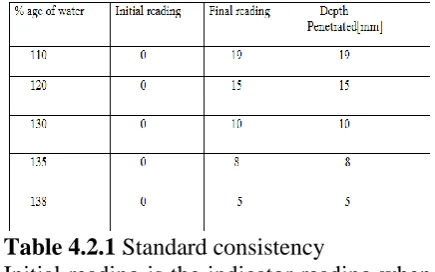
Table 4.2.1 Standard consistency
Initial reading is the indicator reading when the lower and of the plunger touches the bottom non-porous paste.
RESULT: Standard consistency of cement :( 138/400)*100 = 34.5
SOUNDNESS OF CEMENT (BY LECHATLIER METHOD):-
AIM:
Lechatlier apparatus is used for the determination of soundness of cement. It consists of a small split cylinder of spring brass of 0.5mm thickness, forming a mould 30mm internal diameter and 30mm high. On either side of split are attached two indicators with pointed ends the distance from these ends to centre of the cylinder being 165mm.The mould should be kept in good condition with the jaws more than 0.5mm apart.
OBSERVATIONS: Type of cement: OPC 53 grade
Normal consistency= 34.5%
Water required for soundness test = 0.78*p=27ml
Initial distance =10mm Final distance = 11mm Expansion of cement = 1mm RESULT:
Soundness of the cement: 1mm
SPECIFIC GRAVITY OF CEMENT: AIM:
To determine the specific gravity of cement of the cement paste
APPARATUS:
Le-chatlier flask, weighing balance, water bath, kerosene, thermometer
OBSERVATIONS:
Brand of cement: DALMIA OPC 53 grade Liquid used: kerosene
Density of liquid at room temperature: 0.8 Weight of cement taken: 64g
Table 4.4.1 Specific gravity of cement RESULT:
Specific gravity of the given cement : 3.04@ room temp.
COMPRESSIVE STRENGTH OF CEMENT:-
AIM:
This method of tests covers the procedure for determining the compressive strength tests on mortar cubes compacted by means of a standard vibration machine
STANDARD SAND:
The standard sand to be used in the
test shall conform to IS:
650-1966(specification for standard sand for testing of cement)
CALCULATIONS:
Weight of cement taken = 200g Weight of sand taken =600g
Water added = (p/4+3)%of(cement,
sand)=34.5
Average compressive strength of cement under loading for 7 days=26.8
Average compressive strength of cement under loading for 28 days=34.2
RESULT:
Characteristic compressive strength of given cement sample is 34.2
TESTS ON AGGREGATES:-
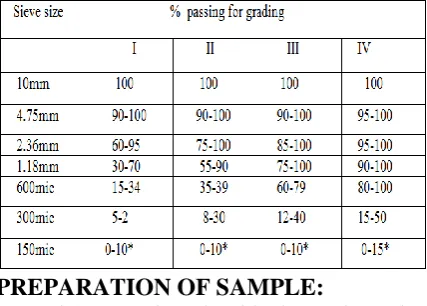
GRAIN SIZE DISTRIBUTION OF FINE AGGREGATE:
AIM:
To study the particle size distribution of the given fine aggregate by doing sieve analysis and to draw the grading Curve.
APPARATUS:
Set of sieves consists
4.75mm,2.36mm,1.18mm,600micron,300mi c,150mic and pan, lid, weighing balance with accuracy up to 0.1grms , weights and sieve shaker.
PREPARATION OF SAMPLE:
and due. Two opposite quarters are taken and mixed makes the sample.
If any further reduction of quantity is required the process may be repeated. Weight retained on each sieve shall not exceed the limits specifies by the IS code.
Table: 4.6.1 Sieve analysis for fine aggregate
CALCULATIONS:
Fineness modulus=240.5/100=2.4
SPECIFIC GRAVITY OF COARSE
AGGREGATE AND FINE
AGGREGATE: AIM:
To determine the specific gravity of coarse aggregate and fine aggregate
APPARATUS:
Weighing balance(capacity not less than 3kg), pycnometer ,drying oven, shallow metal tray(area 32500mm2) air tight container and dry absorbent clothes each not less than 77*45cms
OBSERVATIONS: For 20mm size:
Weight of pycnometer (w1) =420g Weight of pycnometer +coarse aggregate (w2) = 925g
Weight of pycnometer+ coarse aggregate + water (w3) = 1760g
Weight of pycnometer + water (w4) = 1440g
For 10mm size:
Weight of empty pycnometer (w1) = 420g
Weight of pycnometer + coarse aggregate (w2) = 875g
Weight of pycnometer + coarse aggregate + water (w3) = 1680g
Weight of pycnometer + water (w4) = 1395g
For fine aggregate:
Weight of pycnometer (w1) = 420g Weight of pycnometer + fine aggregate (w2) = 1000g
Weight of pycnometer + fine aggregate + water (w3) = 1760g
Weight of pycnometer + water (w4) = 1445g
CALCULATIONS:
Specific gravity = W2-W1/ (W2-W1)-(W3-W4)= (925-420)/ (925-420)-(1760-1440) = 2.72
Specific gravity = W2-W1/ (W2-W1)-(W3-W4) = (875-420)/ (875-420)-(1680-1395) = 2.72
Specific gravity = W2-W1/ (W2-W1)-(W3-W4) = (1000-495)/ (1000-495)-(1760-1445) = 2.65
RESULT:
Specific gravity of the coarse aggregate of 20mm, 10mm size and fine aggregate is 2.72, 2.72, 2.65 respectively.
TESTS ON FRESH CONCRETE Slump cone test
AIM:
To determine the slump of the given material
APPARATUS:
Mould, tamping rod, trowel PROCEDURE:
Fill the concrete into frustum of a steel
cone in three layers.
Hand tap concrete with 25 strokes in
each layer
Lift come up without lateral or torsion
motion
Immediately measure the difference
between the height of the mould and the highest point of the specimen being test.
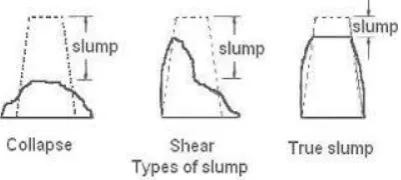
Slump test that shear or collapse must
Fig 4.8.1 Slump cone test
TEST RESULT:
Slump in terms of millimeters to the nearest 5mm = 165mm
Shape of the slump: true
Referring to the selection of data, we have a
slump value within the range
(60-180mm)
COMPACTION FACTOR TEST: AIM:
To determine the compaction factor by using compaction factor test
APPARATUS:
Two hoppers, one cylinder
PROCEDURE:
Concrete is placed in an upper hopper
Dropped into lower hopper to bring it to
a standard state and then allowed to fall into a standard cylinder
The cylinder and concrete
weighed(partially compacted weight)
Concrete is placed in the cylinder in 6
layers and compacted each layer with 30 strokes of the tamping rod.
Weigh the concrete and cylinder(fully
compacted weight)
Fig 4.9.1 compaction factor apparatus
Partially compacted concrete: Cylinder weight=5.833kg
Cylinder+ concrete weight=17545.2
Weight of concrete=17.545-5.833=11.66kg Fully compacted concrete:
Cylinder compacted concrete eight=17750g Weight of concrete=17.750-5.833=11.867kg Compaction factor=Weight of partially
compacted concrete/Weight of fully
compacted concrete =11.61/11.867=0.98 RESULT:
Compaction factor = 0.98
TESTS ON HARDENED CONCRETE Compressive strength test:
Concrete is primarily meant to
withstand compressive stresses.
Cubes, cylinders and prisms are the
three types of compression test
specimens used to determine the compressive strength.
Cubes of size 150×150×150mm are
used in the present work.
The specimens are casted as follows:
The mould is applied with oil for
lubrication.
Concrete is laid in the mould in a layer
up to some height and compacted with a tamping rod.
In this way, the concrete is laid in three
layers and the procedure is repeated.
The next step is vibration on a vibrating
machine.
The above procedure is the same for all
the mixes with different percentage of admixture replacement.
The cubes are cured for 28 days.
After 28 days of curing, the cubes are
tested in a compression testing machine (CTM).
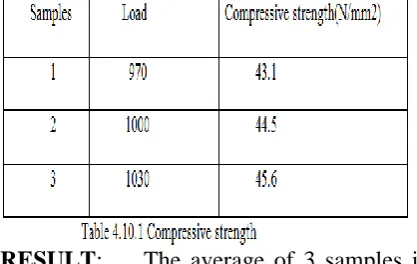
The values obtained are tabulated.
Compressive strength of a cube
RESULT: The average of 3 samples is taken as the compressive strength of cube=
44.4 N/mm2
Flexural Strength:
The determination of flexural strength is
essential to estimate the load at which
the concrete members may crack.The flexural strength at failure is the modulus of
rupture.The modulus of rupture is
determined by testing standard test
specimens of size 100×100×500 mm over a span of 400 mm under Two point loading. Bending Tensile stress or Flexural Strength
= PI/bd 2 when a> or = 40/3 cm
3Pa/bd 2 when 40/3 ≥ a ≥ 11cm
Beam under loading in UTM Fig: 4.11.1 Flexural strength of beam before
testing
Beam after loading
Fig: 4.11.2 Flexural strength of beam after testing
Load (P) = 2600 KN , a =17.5 cm
Flexural Strength = PI/bd2 = 960×40 /
10×100 = 38.4 kg/cm2
= 38.4×9.81/100 = 3.71 N/mm2
RESULT :- Flexural Strength = 3.71
N/mm2
Split tensile strength:
Due to the difficulties invovled in conducting the direct tension tension test, a no. of indirect methods has been developed to determine the tensile strength.
Splitting tests are well-known indirect tests used for determining the tensile strength of concrete, sometimes reffered to as the splitting tensile strength of concrete.
Tensile Stress = 2p/πId = 2×200×1000 /
π×150×300 = 2.83 N/mm2
Cylinder under loading in UTM
0 10 20 30 40 50
0 0.1 0.2 0.3 0.4
Fig 5.1.1 Compressive strength Vs %of cement replacement by Sodium polyacrylate
Table 5.1.1 Compressive strength Vs %of cement replacement by Sodium polyacrylate
of cement up to a maximum of 20%. The
compressive strength for different
percentage of sodium poly acrylate and percentage increase or decrease in strengths with respect to M30 grade concrete listed in the table. By taking normal M30 grade as referring percentage, percentage of increase or decrease in compressive strength other percentage is calculated. Considering the
normal M30 with zero percentage
admixtures the compressive strength is 35.8 N/mm2. When 0.1% replacement is used, the compressive strength is 42.2 N/mm2.
Considering 0.2% replacement, the
compressive strength is 43.7 N/mm2. And there is an increase in the strength 22.06 N/mm2. With 0.3% replacement, the compressive strength is 44.8 Nimm2 and there is a increase in strength 25.13 N/mm2. With 0.4% replacement, the compressive strength is 38.1 and there is a little increase in the strength. However, 0.4% can be taken as optimum dosage which can be mixed in cement concrete for giving optimum possible compressive strength at any stage.
Replacement of cement by Lime stone powder, Clinkers and Super plasticizer
(b) Influence of Lime stone powder,
Clinker and Super plasticizer on
compression strength
Compressive strength Vs %of cement replacement by Lime stone powder, Clinkers and Super plasticizer
0 10 20 30 40 50
0 5 10 15 20
Fig 5.2.1 Compressive strength Vs %of cement replacement by Lime stone powder,
Clinkers and Super plasticizer
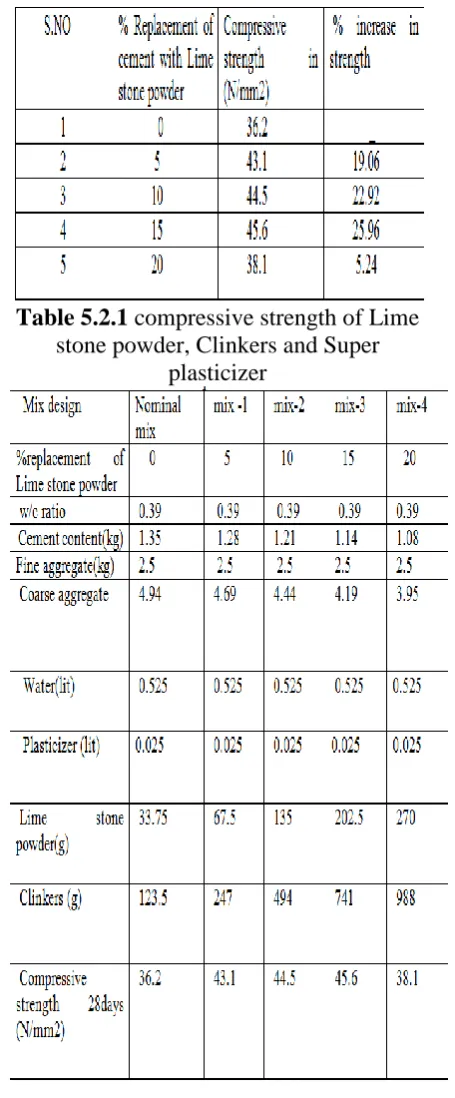
Table 5.2.1 compressive strength of Lime stone powder, Clinkers and Super
plasticizer
In the present investigation Lime stone powder has been used as replacement of cement up to a maximum of 20%. The
compressive strength for different
referring percentage, percentage of increase or decrease in compressive strength other percentage is calculated.
Considering the normal M30 grade with zero percentage admixtures the compressive
strength is 36.2N/mm2. When 5%
replacement is used, the compressive strength is 43.1 N/mm2 and increase in strength is 19.06 N/mm2.
Considering 10%
replacement, the compressive strength is 44.5N/mm2. And there is an increase in the strength is 22.92 N/mm2. With 15% replacement, the compressive strength is 45.6 N/mm2 and there is a increase in
strength 25.96 N/mm2 .With 20%
replacement, the compressive strength is 38.1 and there is a little increase in the strength. However, 15% can be taken as optimum dosage which can be mixed in cement concrete for giving optimum possible compressive strength at any stage.
Split tensile Strength
(c) Influence of both Sodium polyacrylate
and lime stone powder on split tensile strength
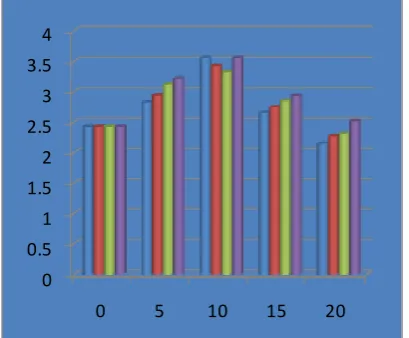
0 0.5 1 1.5 2 2.5 3 3.5 4
0 5 10 15 20
Fig 5.3.1 Split tensile Strength Vs % of combination of sodium polyacrylate and lime stone powder
Table 5.3.1 Split tensile strength of both sodium polyacrylate and lime stone powder
Flexural Strength
(d) Influence of both sodium polyacrylate and lime stone powder on flexural tensile strength
0 1 2 3 4 5
0 5 10 15 20
Fig 5.4.1 flexural strength Vs% of combination of sodium polyacrylate and lime stone powder
Table 5.4.1 flexural strength of both sodium polyacrylate and lime stone powder
CONCLUSIONS
Based on limited experimental
investigations conducted the following Conclusions are made
From observations it can be concluded
that Lime stone powder as a substitute giving better strength than Sodium polyacrylate or a Combination of Sodium polyacrylate and Lime stone powder.
With partial replacement of 0-15% of
Lime stone powder by cement the compressive strength increases.
It may be economical by using Lime
stone powder instead of Sodium poly acrylate, Since Sodium Polyacrylate is a costliest material.
It can be concluded that method of
curing has considerable effect on the
mechanical properties including
compressive, flexural and shear
strength of SCC.
If we use Lime waste in concrete cost
of the project can be reduced to some extent.
By using the Lime stone powder waste
as filler in concrete or replacement in cement will reduce environmental pollution.
FUTURE SCOPE OF WORK
The effect of different curing methods on mechanical properties of self compacted
concrete is studied i.e. effect on
Compressive, Flexural & Shear strength
was studied. The following
recommendations are suggested for the future research:
Effect of curing on other properties like
Modulus of Elasticity, Bond etc.
The curing mechanism may be studied
by study of microstructure in more details.
Effect of change of molecular weight of
PEGs on self curing capacity.
Other methods of self curing may be
(natural and synthetic), LW Sand, Super-absorbent Polymers etc.
The durability performance of
SCSCCC such as resistances to corrosion, alkali-aggregate reaction, sulfate attack, and freezing and thawing should be investigated.
Effect of natural climate factors such as
sunlight, ambient temperature and humidity during self curing on the
properties may be studied.
REFERENCES Text Books
N. Krishna Raju,” Design of Concrete Mixes” , Year 2005
A.M.Nevile,” Properties of concrete” ELBS with Longman 1987
M.S.Shetty, “Concrete Technology”, Year 2008.
Journal
B.Ma Cusson, D., and Hoogeveen, T., “Internally-Cured High- Performance Concrete under Restrained Shrinkage and Creep,” CONCREEP 7 Workshop on Creep, Shrinkage and Durability of Concrete and Concrete .
Structures, Nantes, France, Sept. 12-14, 2005, pp. 579-584. ther,” Concrete-Year 2000,Revisited”,ACI journal,vol-144,pp31-40,1994.
Tawian,” Concrete International,vol-17,pp 71-76,1995etc.
Dhir, R.K. Hewlett, P.C. Dyer, T.D., “Mechanisms of water retention in cement pastes containing a self-curing agent,” , Vol No 50, Issue No 1, 1998, pp85-90.
IS codes
IS 456-2000 code of practice for plain& reinforced cement concrete
IS 12269-1987 Specification for OPC 53 grade
IS 10262-2009 recommended guide line for concrete mix design
IS 9103-1999 Concrete
admixture-specifications.
IS 9013-1978 Accelerating curing
IS 383-1970 Specification for coarse aggregate and fine aggregate from natural sources
IS 650-1966 Specification for standard sand for testing of cement