From Fragmentation and
Division Towards Unification:
An Analysis of a Decade of
Post-14 Qualifications Reform
Ken Spours
Thesis submitted for the Degree
of Doctor of Philosophy
Institute of Education
University of London
Abstract
This thesis explores the reform of 14+ qualifications in England and
Wales over the last decade.' I argue that the qualifications system has moved through different phases of development and is emerging, in the
late 1990s, as a 'linked system'.
Using a historical approach to periodising qualifications change, I argue
that the 14+ qualifications system has moved through six phases of
national policy development since the late 1970s - a precursor two-track
phase, a prevocational phase, dualist strategy phase, a triple-track
phase, a review phase and now a linkages phase.
I go on to argue that these policy phases should also be viewed as
constituting three 'overlapping eras' - the New Vocationalism, formally
divided systems and unification. The concept of overlapping eras shows
how there can be a co-existence of different policy initiatives and
debates.
The thesis goes on to argue that the dynamics of change, which move
policy between phases and eras, are caused by external factors, internal
system factors (reactions to of previous reforms and system weaknesses and the knock-on effect of reforms in other parts of the education and
training system) and through the role of ideological interpretation. Using
this approach to policy change, I argue that as the education and training
system expands, internal system factors become more important than
external factors as determinants of change.
I conclude the thesis with three arguments: first, that the English
qualifications system is currently poised between a flexible multi-track
system and a unified system; second, there is a strong momentum
building within the education and training system to move further towards
unification; and third, there is a debate taking place about the type of
unification strategy most appropriate to the English context and which
can respond to the growing policy emphasis on lifelong learning.
Table of Contents
9
Introduction
15 Methodology - Annex to the Introduction
Chapter 1: The periodisation of post-14 qualifications
reform: a historical framework (1976-1998)
26
Part 1:
The importance of qualifications reform
30
Part 2:
Towards a periodisation of qualifications
reform
41
Part 3:
The dynamics of the six phases of policy
development
53
Part 4:
The role of contextual factors, policy
developments and debates
59
Part 5:
Overlapping eras: a complementary model of
periodisation
66
Part 6:
The periodisation frameworks and issues for
the thesis
Chapter 2: Fragmentation of 14+ qualifications and
problems of progression (1986-1991)
68
Part 1:
A contextual analysis
86
Part 2:
Historical Case Study No 1: The politics of
progression: problems and strategies in the
14-19 curriculum (Spours 1991)
Chapter 3: A critique of the triple-track qualifications
system (1991-1995)
122
Part 1:
130
Part 2 :
150
Part 3:
The implications of the 1991 White Paper
Education and Training for the 21st Century
Historical Case Study No 2: The Reform
of Qualifications within a Divided System
(Spours 1993)
Debates about the early GNVQ model
155
Part 4:
Historical Case Study No 3: The Strengths and
Weaknesses of GNVQs: Issues of Design
(Spours 1995c)
177
Part 5:
Historical Case-Study No 4 Problems of
performance of the triple-track qualifications
system: a statistical analysis (Spours 1995b)
205
Part 6:
Problems of the triple-track qualifications
system - towards the phase of review
Chapter 4: The unification of 14+ qualifications:
towards an analytical framework (1990-1997)
208
Part 1:
212
Part 2:
238
Part 3:
250
Part 4:
The terminology of unification
Approaches to unified and overarching
certification in England & Wales
Unification: key qualifications and
curriculum debates
Unification: towards an analytical
framework
Chapter 5: Towards a linked system or a framework
stage?
271
Part 1:
Introduction
274
Part 2:
Dearing and Qualifying for Success
288
Part 3:
Dissecting linkages - linked system or
framework stage?
308
Part 4:
Conclusion
311 Appendix: Letters of permission from Dr Ann
Hodgson and Professor David Raffe
314 References
Table of Figures
37 Figure 1
A multi-dimensional model of tracked, linked and unified systems
39 Figure 2:
Six phases of qualifications policy development
61 Figure 3:
Overlapping eras of qualifications development
75 Figure 4:
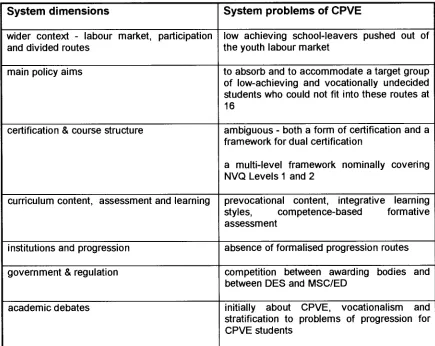
System problems of CPVE
166 Figure 5:
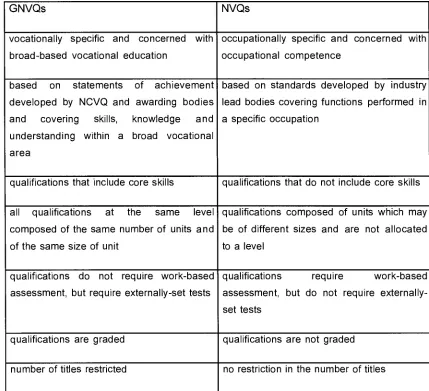
Differences between GNVQs and NVQs
181 Figure 6:
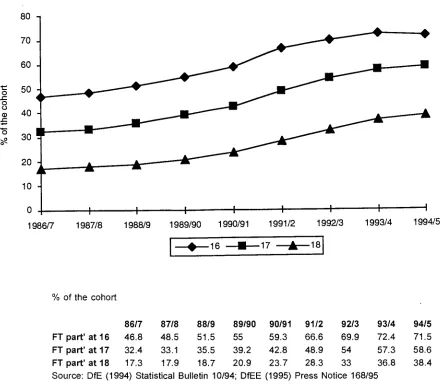
Full-time participation at 16, 17 and 18 (1987-95)
183 Figure 7:
Growth in full-time participation at 16, 17 & 18 (1987/8-94/5)
186 Figure 8:
A-Level attainment (1988/9 - 94/5)
188 Figure 9:
BTEC National and Advanced GNVQ successful completion rates
191 Figure 10:
Full-time participation in Advanced Level courses at 16+ and 17+
193 Figure 11:
Advanced vocational attainment rates (1987/8-94/5)
196 Figure 12:
Summary of attainment growth rates (1987/8-94/5)
198 Figure 13:
215 Figure 14:
Unified and overarching certification proposals 1990-1997
230 Figure 15:
A comparison of features of equivalence frameworks, unitised frameworks and unified grouped awards
253 Figure 16:
The English and Scottish systems prior to the current reforms
255 Figure 17:
The English and Scottish systems following the current reforms
263 Figure 18:
Two approaches to unified certification: open and grouped
285 Figure 19:
Dearing and 'Qualifying for Success' a comparison of approaches to distinctiveness and commonality
290 Figure 20:
Dissecting the concept of linkages
295 Figure 21:
Acknowledgments
I would like, first of all, to thank my family - Shirley, Joe, William, Lucy and Katie - for their continued support, not only in relation to this past
year in which the thesis was written, but over the years of work on qualifications reform which, so often, took away time which should have
been spent together. I have told them it will be different in the future but
they are not entirely convinced.
Secondly, I would like to thank Michael with whom I have had a
long-standing theoretical partnership. This thesis is about unification and its
arguments for change arise as much from his work as they do from
mine.
Thirdly, I would like to thank Denis, my supervisor, who, with his vast
experience of thesis supervision, made the whole process seem
manageable and straightforward.
Fourthly, I would like to thank Ann. Her achievement of her own
doctorate; her meticulous approach to writing and her constant support
has been an inspiration.
I would also like to thank the Institute of Education for providing me with
study leave during the Summer Term of 1998 to complete the writing of
Introduction
This thesis focuses on the reform of 14+ qualifications in England and Wales during period 1976-1998. The main chapters, however, are concerned with the development of the national qualifications framework since the mid-1980s and this emphasis is reflected in the title of the thesis.
I have structured the thesis around five chapters. Chapters 2 and 3 use personally-authored published work in the form of 'historical case-studies' to illustrate debates taking place during phases of policy development.2 These historical case-studies are surrounded by contextual analysis and by comparisons with other literatures. Following each of the historical case-studies, I critically reflect upon my past work and assess its impact in terms of the debates being conducted in the chapters. The historical case-studies, containing extracts of previously published work, are highlighted by shaded text so as to be easily distinguished from the surrounding analysis. A small proportion of the published work in Chapter 4 is co-authored and permission to use extracts from this work, or to draw substantially on these texts, has been obtained from these colleagues. Permission to use the work in this way is contained in two letters in the Appendix.
In Chapter 1, The Penodisation of Post-14 Qualifications Reform: A Historical and Analytical Framework, I build the components of the historical and analytical framework based on evolution of my own theoretical work over the last decade. I argue that the development of
2
14+ qualifications can be interpreted by way of a historical framework based on six phases of policy development and three 'overlapping eras' of reform. The six phases of national policy development, which have emerged since the late 1970s, are:
• phase 1 (mid-1970s to early 1980s): a precursor two-track phase and initial responses to youth unemployment;
• phase 2 (mid to late 1980s): pre-vocational qualifications and the New Vocationalism;
• phase 3 (mid 1980s to 1991): the emergence of a national qualifications system based on a dualist strategy involving the attempted reform of the academic track and the introduction of the NVQ vocational framework;
• phase 4 (1991 to 1994): the creation of a formalised triple-track system based on A Levels, GNVQs and NVQs;
• phase 5 (1995 to 1997): the triple-track system under review; • phase 6 (1998 -) a possible linkages system.
I then arrange these policy phases into three 'overlapping eras':
• the era of the New Vocationalism (in which I focus on prevocational certification) (1976-91);
• divided national qualifications systems (1986 - present); • unification (1990 - present).
phase of a divided national qualifications framework and early unification 'blueprints'.
I argue that the historical and analytical framework, consisting of policy phases and overlapping eras, is shaped by the relationship between three factors; by policy responses to external factors, reactions to previous reforms and system weaknesses (which I term internal system factors) and the role of ideological interpretation. I then argue that the movement between qualifications phases and eras, resulting from the dynamic inter-relationship of these three factors, is producing a shift from a tracked system to a linked system and, possibly, to a unified qualifications system. Finally, I argue that shifts between these three system types take place along different dimensions of the education and training system including certification, progression pathways and government and organisation. A total of eleven dimensions are identified. Some dimensions may belong to a tracked system while others may be located in a unified system. These different aspects of the historical and theoretical framework are explored throughout the five chapters in differing proportions. Chapters 2 and 3 are more historically-based and Chapters 4 and 5 are more conceptually-based.
Chapter 2, Fragmentation of 14+ Qualifications and the Problems of Progression, explores a phase of qualifications policy during the period 1986-1991. It argues that the end of the 1980s gained a reputation for qualifications complexity because of the overlap of three different eras of reform - the final phase of prevocationalism; a dualist strategy based on reforming the academic track and establishing a NVQ national vocational qualifications framework; and by local unified experiments supported by TVEI Extension.
develop an NVQ-based qualifications framework. I argue that this overlap of reform processes led to an unprecedented confusion of qualifications initiatives. It was in this context that my work focused on the need for progression strategies. The critical reflections, which follow the historical case-study, analyse the reasons for my shifting emphasis from a focus on progression strategies, related to prevocational qualifications, to system-wide reform and support for a unified modular framework. This shifting focus at the end of the 1980s, from issues of prevocational qualifications to whole-system modular frameworks, was to lead to my contribution to A British Baccalaureate in 1990.
Chapter 3, A Critique of the Triple-Track System, analyses of the period following the 1991 White Paper Education and Training for the 21st Century. I argue that the 1991 White Paper had a profoundly negative effect on the qualifications system because of its emphasis on qualifications distinctiveness. This approach attempted to reverse innovations in the late 1980s which had attempted to bridge the academic/vocational divide.
important to incorporate 'progressive' aspects of GNVQ practices into a unified qualifications model.
The third part of the chapter consists of data and narrative from a personally-authored paper Post-Compulsory Education and Training:
Statistical Trends (published in 1995) which charted the performance
problems the triple-track qualifications system as they began to emerge in 1994/5. This historical case-study made an early identification of the problems of the plateauing of participation and attainment trends. I argued that, in the light of these performance trends, there would have to be a fundamental review of qualifications policy if National Targets were to be met. Arising from the analysis of participation and attainment trends, this section of the chapter develops the idea of the English education and training system becoming trapped as a 'medium participation system'. The chapter concludes with critical reflections on the statistical analysis of 1994/5 and the impact of this context for the Dearing Review of
Qualifications for 16-19 Year Olds.
Chapter 4, The Unification of 14+ Qualifications: Towards an
Analytical Framework, explores theories of unification and unified
analysing different types of unified systems - 'open' and 'grouped' models of unification - through international comparative analysis and through recent debates within the English system.
Chapter 5, Towards a Linked System or a Framework Stage?, uses all aspects of the historical and analytical framework developed in the previous chapters, to explore the outcomes from the Dearing and
Qualifying for Success reviews. I argue that the English qualifications
system is currently poised between a flexible multi-track system and movement towards a more unified system through a 'framework stage'.
Throughout the five chapters, I analyse the process of policy shifts between phases and eras. I argue that qualifications policy has changed because of a three-fold dynamic: the impact of external factors; the impact of internal system factors (either in the form of reactions to weaknesses of previous policies or the domino-effect of reforms in one part of the system on other parts of the system) and the impact of ideological interpretation. I use the concept of system `multi-dimensionality' to show how developments in particular dimensions of the system affect developments in other dimensions. I also argue that, as the education and training system expands, there is a decline in the power of external influences and a rise in the power of internal system factors.
Methodology
Annex to the Introduction
In this Methodology Annex I explore three related methodological issues in relation to the thesis. First, I consider the historical approach towards qualifications policy which constitutes the core structure of the thesis. Second, I examine the role of case-studies in understanding how I have used previously researched and published work within the earlier chapters. Third, I explore the use of critical reflections on the changing nature of my own role during the period of research.
The approach to education and qualifications policy
The focus of the thesis is policy development with regards to post-14 qualifications. In this methodology annex, I will reflect upon my theoretical approach to education policy and its role within the post-compulsory education and training system. I will then compare and contrast this approach with other approaches to education policy development.
Two complementary historical approaches with regard to qualifications policy
"systematic and objective location, evaluation and synthesis of
evidence in order to establish facts and draw conclusions about
past events" (Cohen & Manion 1994: 45).
This historical and causal approach was the main aim of the
periodisation methodology in Chapter 1, which looks at the evolution
of qualifications policy and reform over the last two decades.
linkages can be seen as a more flexible approach to tracking and as
a stage to unification). The concept of overlapping eras, with its
emphasis on 'interpretation' and the role of debates within systems,
also provides a way of situating elements of my previously published
work within the context of qualifications reform.
Education and training system multi-dimensionality
Comparison with other conceptual approaches to policy
Stuart Ranson, writing on 'Education Policy' (Ranson 1996), argues
that the debate about education policy has gravitated around two
positions - the 'pluralist' and 'Marxist' analysis of education. He
argues that the pluralist approach to education policy is rooted in the era of public administration, assumptions about partnerships and
complex poly-centred divisions of power involving interest groups.
This approach was dominant in the late 1960s and early 1970s. The
Marxist approach, on the other hand, has stressed the deeper
structural influences on decision-making emanating from the
economy, social class and the State and becomes more prominent
during the 1980s. Throughout the last two decades, both
perspectives have developed hybrids - neo-Marxist and neo-Pluralist
approaches. The neo-Marxist approach has been attempting to
understand and to explain the role of a strong State steer on education policy in the late 1970s and early 1980s, while accepting
that policy can have a relatively autonomous position in relation to
fundamental class forces (e.g. Dale 1984). The neo-pluralist
approach (e.g. Ball & Shilling 1994), on the other hand, has been
trying to understand and to explain the relative chaos and complexity of the education system.
My approach lies at various points between the Marxist and
neo-Pluralist positions. On the one hand, my historical policy approach
has a strong strand of neo-Marxist analysis by locating qualifications
policy in relation to the influence of crisis of the youth labour market,
class elitism and the influence of
A Levels. Furthermore, there is an assumption that government
policy, reflecting the power of the governmental state, plays a crucial
shaping role within the system. However, I have also used strands of
neo-pluralist analysis. The methodology I have employed to analyse
sometimes relatively autonomous effects of system dimensions (e.g.
the effects of 'system inconsistencies' located in the different system
dimensions) or the effects of state forces pulling in different directions
(e.g. the often contradictory roles of the DES and Employment
Department during the 1980s). I also allocate power to 'debates',
particularly when system features are in various conditions of
unstable equilibrium (see Chapter 5). This could be seen to be a
feature of both neo-Marxist and neo-pluralist approaches.
I attempt to understand the changing and evolving balance of
relations between the steering role of the governmental State and
more relatively autonomous factors, such as institutional behaviour
and the role of practitioners, through the complementary models of
periodisation of the qualifications system. I do this by suggesting that
the different phases of qualifications represent different balances of
national and local relations. I have argued that, during the late 1980s
and early 1990s, the post-compulsory education system moved from
a "nationally reactive/locally dynamic system to a nationally
proactive/locally reactive system" (Hodgson & Spours 1997b: 5), and,
in doing so, reflected a movement away from the interpretative power
exercised by practitioners.
The 'nationally reactive/locally dynamic phase' was exemplified by
prevocationalism in general and TVEI Extension in particular which,
despite being originally seen as a top-down imposed policy initiative
(Dale et a/. 1990), allowed considerable room for practitioner
interpretation and even 'teacher appropriation' (Bowe et al. 1992). It
is this process and its relationship to qualifications fragmentation
which I explored in Historical Case Study No 1: The Politics of
Progression. The 'nationally proactive/locally reactive phase', on the
other hand, emerged in the early 1990s as a result of a combination
of whole-system approaches and an ideological shift to the Right in
post-compulsory education. This relationship, and its effect on the
Reform of a Divided System and Historical Case Study 3: The
Strengths and Weaknesses of GNVQs.
An important conclusion drawn from Reform of a Divided System was
the limits of local reform. I argued that local unification experiments
(e.g. the Wessex A Modular Level Project, BTEC Y-models and the
Hamlyn Unified Curriculum Project) stood little chance of survival
without a reciprocal national policy or, at least, the provision of more
`space' within which to develop. Furthermore, I concluded in The
Strengths and Weaknesses of GNVQs, that practitioners had little
chance of developing creative practices in heavily prescriptive
assessment regimes such as those promoted by the Mark I GNVQ
model and, therefore, that the best curriculum features of GNVQs
could only be realised within a more open and unified national
curriculum and qualifications model.
This conclusion is also supported by the Leeds University 14-19
Research Group who sought to draw parallels between TVEI
Extension and GNVQs (Yeomans 1996). Despite looking for common
features, they concluded that they were, in fact, very different.
Moreover, their ESRC research project, Constructing a New
Curriculum: The Rise of General National Vocational Qualifications,
sought to explore the development of GNVQs from a 'social
constructionist' perspective, which focuses on how the curriculum is
being "constantly being constructed and reconstructed at different
levels and different sites" (Higham et al. 1997: 10). They concluded
that, while they found evidence of how teachers had brought their
own professional approaches to their GNVQ work, the original
assessment model of GNVQs " was over-regulated and failed to take
account of the realities of college, school and classroom life" (Higham
et al. 1997: 10). In other words, the top-down and 'controlling' nature
of GNVQs, which was contrasted to the more 'open' BTEC National
model, restricted space for local action and reinterpretation.
Here the evidence is mixed. There are still signs of continued strong
top-down steers in terms of external assessment approaches
associated with the 'standards' agenda. On the other hand,
approaches to qualifications structure (alignment of 6- and 3-unit
blocks) and the deployment of key skills is more open and this may
have created more space for institutional interpretation. New Labour
is also very keen to ensure that qualifications innovation does not
move too far ahead of more conservative constituencies and would
prefer that the whole process be slowly evolving and carefully
constructed (DfEE 1998b). This may herald a new era of
top-down/bottom up system co-ordination.
The role of the 'historical case-studies' within the
thesis
A second set of methodological reflections concerns the role of the
four historical case studies within the thesis. I maintain that the four
instances using previously published work conform to accepted use
of the terms 'historical' and 'case-study'. They are 'historical' insofar
as they are located in the past and can form the focus of critical
reflection. They also constitute a form of evidence by virtue of
adopting the essential characteristics of a case-study which seeks to
"probe deeply and analyse intensely multifarious phenomena"
(Cohen & Manion 1994: 106)3.. Robson (1993), argues that
case-studies can be carried out on a group, an institution, on an innovation
and on many other things. Furthermore, he argues that case-studies
should constitute a `case' which warrants such an investigation.
Within this thesis, the four historical case-studies are instances of previously published analysis. In each of the four historical
case-studies I have sought to analyse the complex phenomenon of a
phase of qualifications by analysing a 'vertical slice' of different
dimensions of the education and training system and of the complex
interaction of factors which have arisen in each of the three
overlapping eras. In each case-study I have established a 'case'
which is central to the core argument of the thesis (e.g. concerns
about qualifications fragmentation in the late 1980s; qualifications
division and track-based developments in the early 1990s and the
problem of system performance in the mid-1990s). Furthermore, I
have attempted to contextualise each historical case-study by a
comparison between my perspectives and other literatures. Finally,
by a process of critical and historical reflection, I have attempted to
evaluate the contribution of my previously published work to the
debates taking place at the time.
In the first instance, the reasons for taking a historical case-study
approach were essentially pragmatic - I wanted to use some of my
previously published work within the thesis to support its historical
analysis. However, as I constructed each case-study I had to choose
which of the published extracts constituted the most useful way of
illustrating the complexity of developments at the time. I also had to
situate this work in a wider analysis of complementary literatures
which I had not undertaken at the time of the original analysis. I
began, therefore, to understand more fully the contribution which my
previously published work had made to the educational debate. In
effect, I was engaging in a form of 'triangulation' which tries to explain
the "richness and complexity of human behaviour by studying it from
more than one standpoint" (Cohen & Manion 1994: 233).
Finally, I began to understand more fully the limitations of the
historical case-study accounts; how they were rooted in a particular
set of assumptions and how these become challenged both by other
perspectives and by the passage of time. In other words, I have
become much more appreciative and more critical of my own past
Reflections on my different research, development and
policy roles throughout the period of research
Another issue which arose out of the historical case-study approach
was reflections on my own role as a researcher, developer, policy
analyst and political actor over the last decade. During this period I
have occupied several different positions: first, as a development
officer at the Post-16 Education Centre (1987-90); second, as a
theoretical critic of the triple-track system (1990-1994); and third, as
an academic involved in both education policy analysis and as
`adviser' in the policy process.
The role of developer-researcher (1987-90)
During the period 1987-1990, I wrote various versions of the Politics
of Progression, following intensive consultancy and development
work prior to writing the published version in 1991. During this period I had two roles. My first role was as a curriculum adviser and
development officer working with institutions and practitioners and
funded by London Region TVEI, though based at the Institute of
Education. This was essentially a continuation of my previous role as
a curriculum adviser with ILEA between 1985 and 1987. The second role was as an `academic'. In this reflective role, I started to publish
Post-16 Education Centre Papers and then chapters in books. This
dual role is best understood through the perspective of
`practitioner-researcher' (Robson 1993), `reflective professional' (Schon 1983) or
perhaps, more accurately, the notion of 'developer-researcher
(Hodgson 1997).
There were a number of strengths in this dual role. I was able to
engage directly with problems as they existed in practice and to see
these from a 'bottom-up' perspective. As I explained in Chapter 2, I was critical of academics who, during the 1980s, made distant
critiques of the education and training system without experiencing close forms of engagement with system problems. A second
'vertical slice' analysis which looked at a range of problems across
the system as they affected progression opportunities and
progression strategies.
At the same time, the strengths of a development-led role also
harboured weaknesses. My early progression work reflected a
voluntaristic approach. I shared with others during this period the
assumptions of TVEI Extension and the possibilities of 'bottom-up'
reform. It was only by engaging with the more contextual problems
that I began to understand why local progression strategies were not producing the results we had originally hoped they might. This led, by
late 1988, to arguments for wider system reform which is articulated
towards the end of the first historical case study, The Politics of
Progression.
The role of unification advocate and system critic (1990-94)
During the period 1990-1994, I essentially took the role of 'system
critic', due to the 'political postponement' of unified system proposals
by Labour's 1992 General Election defeat. The first part of the period
was dominated by being a member of A British Baccalaureate writing
team. This was to act as my ideological orientation for the next four
years or so. As far as further research work was concerned, my role
during this period was determined by these national system issues
and, more locally, by the fact I was working in Tower Hamlets as an
Inspector for TVEI and 14-19 education. At one and the same time, I
wrote critiques of the triple-track qualifications system from the point
of view of unification and I was involved in trying to make TVEI make
a local contribution to raising levels of participation, attainment and
progression. So my conversion to 'system critic' was by no means a
complete one. In fact, the work of this period still had a strategic and practical thread; it was aimed at understanding national changes so
that their contradictions could be fully understood. It was this form of
engagement with local issues which contributed to my more strategic
this perspective of 'critic' that I wrote the three published pieces,
extracts of which constitute the historical case-studies in Chapter 3.
The role of academic and policy strategist (1994-98)
My work from 1994 to the present has been framed by my role as a
research officer on the 'Learning for the Future Project' and the
ESRC 'Unified Learning Project'. The LFTF Project is most
well-known for its arguments for steps and stages of reform of 14-19
qualifications from a divided system to a unified system. For me, it
marked a transition from advocating unification blueprints and system
criticism to a more strategic perspective of understanding how the
process of change might be brought about. This period also
coincided with work with the Labour Party on Aiming Higher and the
compilation and co-editing of a book Dearing and Beyond. Since then
I have been involved in theoretical work on unification and
comparative system analysis, together with advisory work with the
DfEE and QCA. This work is reflected in Chapters 4 and 5.
Apart from its policy orientation, historical work on unification hat IBA
me to take a more pluralistic perspective than in the early 1990t. I
can now appreciate not only the virtues of gradual transformations,
but also the fact that other perspectives have enriched and will
continue to shape the unification debate. It is for this reason that I
have more recently focused on the debates within unification and the
role of different perspectives in relation to a changing context; in
particular, the growing policy emphasis on lifelong learning, as well as
Chapter One
The Periodisation of Post-14 Qualifications
Reform: An Historical Framework
PART 1: THE IMPORTANCE OF QUALIFICATIONS REFORM
The reform of 16+ qualifications has constituted a major policy focus in education and training in England and Wales throughout the 1980s (Lasonen 1996, Howieson et al. 1997).4 This importance has continued into the 1990s with repeated policy statements about the continued development of a national qualifications framework and the role it can play in promoting parity of esteem between academic and vocational education, in achieving National Targets and in guaranteeing educational standards (DES/ED/WO 1991, DTI 1994, DTI 1995, DfEE 1996a, DfEE 1997a, DfEE 1997b, DfEE 1997c).
Pressures to develop a national qualifications framework can be traced back to the mid-1970s. During the past two decades, the role of qualifications has continued to grow in importance because of a range of factors: new groups of learners staying on in full-time education; international comparisons which have stressed the role of qualifications and skills in international economic competitiveness and the growing emphasis on education standards. Later in this chapter these factors will be placed within a historical framework.
4 . National policy on qualifications to date has been conceived within the boundaries of 14-16 and 16-19. However, from the point of view of debates about qualifications, since the late 1980s and TVEI Extension, there has been a broad acceptance within the education profession and research community of the 14-19 continuum. Furthermore, there is growing support for this perspective due to the increasing importance of the issue of progression. This thesis, in order to encompass both policy developments and debates, is written from a 14-19 perspective.
In this next section I outline briefly the types of changes which have taken place in 14-19 qualifications since the mid-1970s and the underlying influences. The first factor which impacted on the education and training system was the onset of economic crisis in the mid-1970s and the beginning of what was to be a dramatic rise in youth unemployment in the early 1980s. The decline of the youth labour market created demand for initiatives to provide a bridge between school and work for school leavers. The result was a number of different schemes including the Work Experience Programme, the Job Creation Programme and Community Industry Scheme. In 1977, the MSC undertook an urgent review of these arrangements and the Holland Working Party Report (Holland 1977) ushered in the Youth Opportunities Programme (Chitty 1991).
The development of work-based and college-based initiatives during the late 1970s and early 1980s, in turn, created pressure for the development of a curriculum framework to encompass these disparate initiatives. This became known as 'vocational preparation' (FEU 1979, FEU 1981a, 1981b). The manifestation of a new curriculum approach came two years later in the form of a new 17+ examination - the Certificate of Prevocational Education (CPVE). CPVE was designed principally to respond to the increased participation of low achievers in full-time initial post-compulsory education.
qualifications system (Richardson 1991). This approach included the establishment of NCVQ and the NVQ vocational qualifications framework, the introduction of GCSEs, the creation of the National Curriculum and the attempted reforms of A Levels. In contrast to the policy emphasis of the early 1980s with its focus on youth unemployment, these could been seen as 'whole system' initiatives.
By the early 1990s, the government sought to introduce a national qualifications framework based on A Levels, GNVQs and NVQs (DES/ED/WO 1991). It was the first attempt at creating a national framework covering different types of qualifications. By the mid-1990s however, this model of the national qualifications framework came under scrutiny due to three factors. First, problems of the inefficiency of qualifications within the framework reflected in low successful completion rates (Audit Commission/OFSTED 1993). Second, the realisation that the national qualifications framework had developed unforeseen rigidities (Dearing 1996). Moreover, these problems were becoming apparent at the same time as the adoption of revised National Targets which proposed that by the Year 2000, 60 per cent of 21 year olds should have achieved a Level 3 qualification. These three factors triggered a period of review of the triple-track qualifications system in 1995/6 through the Dearing Review of Qualifications for 16-19 Year Olds (1996), the Capey Review of GNVQ Assessment (Capey 1996) and the Beaumont Review of 100 NVQs/SVQs (Beaumont 1995).
attempting to outline an agenda of reform beyond the 16-19 age group. While building on the reform agendas of the previous government, these reform processes are marking out new territory.
While qualifications have played an important role in shaping the education and training system, especially for 16-19 year olds, it would be mistaken to see them as being the absolutely dominant influence throughout all of the period under consideration. Many important policy initiatives did not, in the first instance, directly involve qualifications issues. These include the Youth Training Scheme, the Technical and Vocational Education Initiative (TVEI), local management of schools and school opting out, college incorporation, the introduction of league tables, the Modern Apprenticeship Scheme and, more recently, the effects of funding reform.
Closer analysis shows, however, that even when qualifications issues are not at the top of a particular policy agenda they, nevertheless, play an important role. This often comes in the form of a later response to the effects of these initiatives or as the result of reflections on their weaknesses e.g. the Modem Apprenticeships Scheme, and its emphasis on qualifying to NVQ Level 3, can be seen as an example of a reaction to the lack of qualifications outcomes in Youth Training (Spours 1995a).
PART 2: TOWARDS A PERIODISATION OF QUALIFICATIONS REFORM
In Part 2 I will argue that the development of qualifications over the
last two decades can be understood by way of historical
periodisation. First, I will explain, how through my theoretical and
policy work in the early 1990s, I arrived at a six-phase approach to
qualifications policy development for the period 1977-1998 (see
Figure 2). Second, I will argue that while historical periodisation of
qualifications, based on policy phases, is useful way to understand
different government policy priorities in their wider context, this
approach is not able to adequately deal with overlapping or
co-existing policy developments or the existence of debates
representing different policy tendencies. I go on, therefore, to argue
for an approach to qualifications periodisation based on 'overlapping
eras' of reform (see Figure 3).
Looking back on the period between the end of the 1970s and the
mid-1990s, it is clear that 14+ qualifications have gone through
different phases of development as more qualifications have been
created, others have been replaced and attempts have been made
to place them into a national framework of types and levels. One way
in which the continued development of the national qualifications
framework can be understood is by way of historical periodisation.
The changes in qualifications have been caused primarily by policy
developments, that is to say, decisions by governments to change
qualifications arrangements in various ways.5 However, these policy
developments have been affected by the complex inter-relationship
of several factors including:
• changes in the labour market and changes in patterns of
• perceptions about the role of qualifications in economic competitiveness;
• the nature of existing qualifications and how they are perceived to meet new situations;
• ideological shifts by successive Conservative governments or the election of new governments;
• shifts in policy focus either towards or away from qualifications; • reflections on how the qualifications system is evolving and what
its next stage of development might be.
I will argue that all of these factors have played a role at some point during the last two decades in the evolution of the national qualifications framework. A model of periodisation should be able to locate, therefore, not only different phases of development but should also help in the understanding of factors at work, their relative importance and how they have brought about change.
The youth labour market and periodisation
Historically the most fundamental factor which has affected the education and training system and, in turn, the qualifications system in England and Wales, is the changing labour market. There is a widespread consensus amongst analysts that the mid-1970s marked a critical turning point (Roberts 1984, Roberts, Dench & Richardson 1990, Roberts & Chadwick 1991, Raffe 1992a). The period between 1976 and 1980 saw the start of what turned out to be a rapid and irreversible decline of the youth labour market. It was a period which also saw a questioning of the role of liberal and general education in relation to the economy (Salter & Tapper 1985) and the beginning of what has been termed the 'New Vocationalism' (Dale 1985). These changes set in motion during the 1980s a "restructuring of
Policy periods of the 1980s
Another factor, which has been the subject of previous attempts at
periodisation, was policy developments throughout the 1980s. By the
end of that decade, sufficient time had elapsed for analysts to be
able to make sense of changes since the mid-1970s. The first
published attempt was by Finegold and Soskice (1988) which
focused specifically on Conservative education and training policy.
They identified three phases of policy development during the period
1979-87:
• phase 1: preparation in the period 1979-81 with the dismantling of
industrial training boards (ITBs) and collapse of apprenticeships;
• phase 2: the New Training Initiative (NTI), the focus on 14-18 and
youth effects of youth unemployment;
• phase 3: expanding the focus to adults and development of the
National Curriculum.
A further attempt at policy periodisation was made by Richardson
(1991) who saw the period from the mid-1970s to the early 1990s in
terms of the phases in building a national system of vocational
education and training. The period from the late 1970s to the
mid-1980s is seen as a one of ad-hoc initiatives followed by the search
for national coherence in the period 1986 -1991. The Richardson and
Finegold/Soskice analyses, despite differences of time-scale, share
similar assumptions. The period up until 1981 is seen as reactive and
without a clear policy framework. The period from NTI in 1981 until
1986 and the creation of NCVQ saw attempts to create a series of
national initiatives though still overwhelmingly reactive to the problem
of youth unemployment. The period from 1986 onwards, on the other
hand, is seen as representing a 'gear change' towards creating more
Participation periodisation
By the early 1990s, significant rises in full-time participation rates
were being recorded which were greater and more consistent than
the earlier rises at the end of the 1970s (Gray & Sime 1990, Gray et
al. 1993, Spours 1995a, Spours 1995b). Rising full-time participation
could not be linked directly to youth unemployment which was in
decline towards the end of the 1980s (Gray et aL 1993). The focus of
explanation shifted to other changes which had taken place during
this period, notably the introduction of GCSE (Ashford et a/. 1993).
The rises in post-16 full-time participation and their relationship with
qualifications prompted further reflections on the role that changes in
participation were having on the education and training system as a
whole (Raffe 1992a) and on the qualifications system in particular
(Spours 1995a, 1995b). Evidence was emerging that the internal
dynamics of the education and training system (in the form of
previous innovations), as well as the external labour market, were
affecting the performance of the education system, which, in turn,
could affect qualifications policy.
By the mid-1990s it became possible to periodise patterns of
participation (Spours 1995a). Full-time participation, measured by
staying-on rates at 16, appeared to be settling into a wave-like
pattern of rises and peaks.
• Phase 1: the mid-1970s to 1981 was marked by a steady decline
of the youth labour market and initial rises in full-time staying on at
16.
• Phase 2: 1981-1987 saw the continued decline of the youth
labour market and the rise of YTS. This period, however, could
itself be divided into two parts: the years 1981-84 and a rapid
collapse of the youth labour market and the years 1984-6 when
this decline appeared to level out.
• Phase 3: 1987-1994 were years of rapid rises in full-time
participation at 16, the annual rise averaging about 4 per cent.
year 1990/91 (7 per cent) which suggests that the economic recession did have a limited effect on participation rates in this period.
• Phase 4: 1994/5 revealed the first signs of a peaking trend in 16+
staying-on rates (Spours 1995b) and by 1996 this had spread to staying-on rates at 17+ and 18+ (DfEE 1997d).
Following the focus on participation trends, attention began to shift more specifically to the role of qualifications and achievement. In the context of the development of National Education and Training Targets, there was a growing emphasis on qualifications levels and the issue of progression routes (NACETT 1994, Payne 1995a, 1995b, Green & Ainley 1995, Spours 1995a) and problems of student course completion (Audit Commission/OFSTED 1993).
The development of qualifications periodisation
My own research at this time was concerned, not only with developments in participation and qualifications rates, but, with the effects of the 1991 White Paper Education and Training for the 21st
Century on the national qualifications framework. In a paper, The Reform of Qualifications Within a Divided System (Spours 1993), I
argued that there appeared to be three phases of qualifications development:
• phase 1 which was confined to the early 1980s and associated with the 'New Vocationalism' and pre-vocational initiatives;
• phase 2 which saw the attempts to establish a national system of vocational qualifications (NVQs) and to diversify the academic track through GCSEs and modular initiatives;
During the next two years, my approach to the periodisation of qualifications gradually became more detailed. As time progresses, so it is possible to identify new and emerging phases as the period under review expands (in this case from the late 1970s to the mid-1990s). This tends to lead to time-based models becoming more complex.
By 1996, it became clear that the Dearing Review of Qualifications
for 16-19 Year Olds was trying to bring about some sort of
'adjustment' to the triple-track qualifications system established in 1991 to make the qualifications system more accommodating of a wider range of learners. The Capey Review of GNVQ Assessment and the Beaumont Review of 100 NVQs/SVQs also took place during 1995/6. Taken together, these reviews could be interpreted as constituting a 'review phase' of the national qualifications framework.
The election of a Labour Government in May 1997 led to further developments. The Qualifying for Success consultation process (DfEE 1997c) kept policy very much within the Dearing strategy of creating 'linkages' between the qualifications tracks. On the other hand, there was emerging evidence of a new political agenda of social and educational inclusion which is bringing debates about the participation and achievement of both younger and older learners much closer together than had previously been the case (Hodgson
1998 forthcoming).
These developments resulted in a periodisation of qualifications based on six phases (Howieson et al. 1997):
• phase 1 (mid-1970s to early 1980s): a precursor two-track phase with initial responses to youth unemployment;
• phase 3 (mid 1980s to 1991): the emergence of a national qualifications system based on a dualist strategy involving the attempted reform of the academic track and the introduction of the NVQ vocational framework;
• phase 4 (1991 to 1994): the creation of a formalised triple-track system based on A Levels, GNVQs and NVQs;
• phase 5 (1995 to 1997): the triple-track system under review; • phase 6 (1998 -) a possible linkages system.
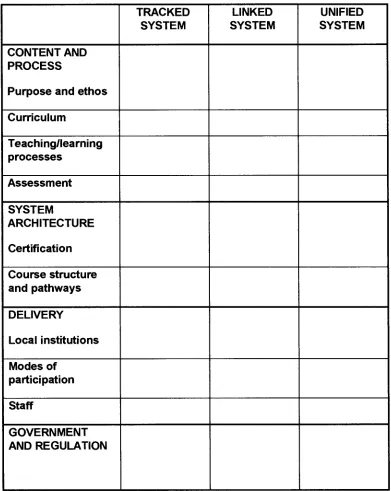
Figure 1: A multi-dimensional model of tracked, linked and unified systems
TRACKED SYSTEM
LINKED SYSTEM
UNIFIED SYSTEM
CONTENT AND PROCESS
Purpose and ethos
Curriculum
Teaching/learning processes
Assessment
SYSTEM
ARCHITECTURE
Certification
Course structure and pathways
DELIVERY
Local institutions
Modes of participation
Staff
To arrive at more comprehensive periodisation model, I merged the six qualifications phases with a selection of the ULP dimensions to produce a two-dimensional matrix (see Figure 2). I adapted the ULP dimensions to assist with qualifications periodisation by reducing these from eleven to seven - context, policy aims, certification and course structure, curriculum content and assessment, institutions and funding, government and regulation and debates. These were selected on the grounds that they constitute a range of factors that have, over the period in question, most affected the development of a national qualifications framework or have come to reflect its changing character.
Fig
u
re
2:
Six
p
hases
o
f q
u
a
lifica
tions
p
o
licy
dev
e
lop
men
0 .71-
2:
Six
p
hases
o
f q
u
a
lifica
tions
p
o
licy
dev
e
lop
men
t (
con
t...
PART 3: THE DYNAMICS OF THE SIX PHASES OF POLICY DEVELOPMENT
In this part of the chapter I discuss the main factors at work within each of the phases of qualifications reform outlined in Figure 2. While each phase has different sets of factors at work, a more general dynamic can be identified. I will argue that qualifications policy is propelled between phases due to the interaction of three factors:
• responses by policy-makers to external factors, such as changes in the youth labour market, patterns of education participation, or the effects of international comparisons of education and training systems (e.g. by introducing new qualifications or rationalising existing qualifications);
• reactions to internal system factors (e.g. to weaknesses of the previous phase of qualifications reform such as the proliferation of different types of qualifications or the design weaknesses of a particular qualification);
• ideologicaYpolitical interpretation that policy-makers place on the relationship between the external factors and internal system factors (e.g. a decision in 1991 to restrict participation in A Levels and to establish a new alternative vocational qualification - GNVQ).
This means that internal system factors are becoming more important determinants of policy than external factors.
Phase 1: Precursor phase and the initial response to
youth unemployment (1976-1982)
From the perspective of the periodisation of qualifications and the role of the three dynamics outlined above, this first phase could be characterised as a 'precursor phase'. It was a phase in which it was assumed that the majority of young people made a transition from school to work. In this context, issues of participation and qualifications were not taken seriously (Tomlinson 1997a). The most important factor in this phase is the 'external context' of rising youth unemployment. This phase did not focus particularly on qualifications as such; the policy response was to develop a range of provision for the growing number of young unemployed. Ideological interpretation came in the form and a criticism of a lack of preparation of many young people for the world of work (Callaghan 1976, DES 1976) and the need for programmes of vocational preparation (Holland 1977).
Phase 2: The New Vocationalism (1983-1991)
An era of the 'New Vocationalism' was opened by the New Training
Initiative (MSC 1981). The factor promoting change continued to be
youth unemployment but the Conservative Government now sought to organise a more co-ordinated response than in the late 1970s. This came through three vocationalising initiatives. The first was the Youth Training Scheme, which grew out of the Youth Opportunities Programme (YOPs) and which aimed to provide one year of work-based training for 16 and 17 year olds. The second, arising out of a
Basis for Choice (FEU 1979), was the Certificate of Pre-vocational
the Technical and Vocational Education Initiative (TVEI), which sought to vocationalise aspects of the secondary curriculum (Gleeson 1987). Overlaying these initiatives, and the first significant discussion about qualifications reform, were proposals for 'vocational preparation' to operate as a 'coherent curriculum framework' to contain and relate a wide range of courses and initiatives and to provide a means of progression (FEU 1979, 1981a, 1981b).
It can be argued that policies connected with `vocationalism' in the 1980s can be divided into two phases. The first consisted of programmes and curriculum initiatives (e.g. YTS, CPVE and TVEI) aimed at particular groups of young people who were low achievers or who could not directly enter the labour market. By 1984, these national programmes had sparked a debate which later became known as the discussion of the 'New Vocationalism' (Bates et a/. 1984, Dale 1985). The debate consisted of 'critiques' of its instrumentalism (Holt 1987); that this expansion of education and training represented an ideology of control and of socialisation of young people for the dole (Bates et al. 1984) and the 'cooling out' of aspirations (Gleeson 1985); that it was giving rise to a new form of stratification - tertiary tripartism - (Ranson 1984, Green 1986) and that it was training without jobs (Finn 1985, 1987).
The expansion of focus to vocationalise the whole curriculum will be referred to later as `progressive vocationalism'.
During the early phase of the New Vocationalism, the dynamics of change remained broadly similar to the precursor phase. The external context of youth unemployment continued to be a very dynamic factor. The policy focus was broadly of the same character as the previous phase but in response to its obvious ad hoc nature, it became more organised and system-wide in the form of NTI, YTS, CPVE and TVEI. Ideological interpretation, however, became more complex; it combined an argument for opening up education and training opportunities to a wider range of young people with an ideological argument for vocational curriculum and training programmes (MSC 1981, Holland 1986). This, in turn, provoked a widespread `critique' from the educational community and the concept of the New Vocationalism. The second phase of vocationalism was also related to attempts to create a national qualifications framework.
Phase 3: The emerging national qualifications
framework (1986-91)
By the mid-1980s and the beginning of the 'Lawson Boom' the problems of youth unemployment had begun to be contained. More young people were entering training schemes and the economic activity of 16-19 years olds had increased (Spours 1995b). Policy concerns turned to problems of low levels of skill, participation and achievement which had been highlighted by a number of influential international comparative reports (IMS 1984, Coopers and Lybrand Associates 1985). Between 1986 and 1991, policy on the curriculum and qualifications went through a 'gear-shift' with the aim of developing a national system (Richardson 1991).
which, at Key Stage 4, was to overlap the area of national qualifications. Second, the formation of NCVQ and the creation of a vocational qualifications framework based on NVQs (NCVQ 1987). Third, the Extension Phase of TVEI intended to cover all full-time learners 14-18 and fourth, increased co-operation by the Department for Education and Science and the Employment Department (DES/ED 1986).
I will argue that the most dynamic factor of the period between 1986 and 1991 was the development of a more co-ordinated national policy focus. This was not a unified approach but it was one which aimed to co-ordinate a divided system by bringing together the ad
hoc strands of initiatives of the previous phase and to extend them
further. The influence of the external context moved from that of youth unemployment to international comparison of skills and achievement. In fact the decade was to end with concerns about the `demographic timebomb' and the threat of a shortage of youth labour (NEDO 1989).
by BTEC awards, would cease to exist by virtue of the spread of NVQs and their adaptation to the NVQ vocational framework.
This dualism was not, however, reflected in academic debates, since it was not fully understood at the time. Only later, in the early 1990s, with the formation of a formalised triple-track system based on A Levels, GNVQs and NVQs did the differences with the previous phase become more apparent (Spours 1993). Debates during the period 1986 -1991 continued to be informed by critiques of the New Vocationalism (Gleeson 1985, Holt 1987). Added to this were arguments about the problems of proliferation of qualifications and in particular the status and role of CPVE (Spours 1988a). At the same time, the debate took a fundamental turn towards whole-system analysis. In a seminal piece The Failure of Training in Britain:
Analysis and Prescription (1998), Finegold and Soskice located
deep-seated problems of education and training in a series of economic, societal and system factors termed the low skills equilibrium'. Elsewhere, developments in the NVQ framework (e.g. unitisation) and in the academic track (the effects of GCSE, considerations of broadening A Levels and the gradual introduction of modular syllabuses) stimulated debates on the possibility of overarching modular frameworks linking academic and vocational courses (Burgess 1993).
for change - the beginnings of a movement for unification of the 14+ curriculum.
Phase 4: The triple-track national qualifications
framework (1991-95)
The 1991 White Paper Education and Training for the 21st Century (DES/ED/WO 1991) signalled the formalisation of a track-based qualifications system based on A Levels, GNVQs and NVQs. This redrawing of qualifications division took place within a newly-formed national qualifications framework based on distinct qualifications though linked by notional equivalence of levels (Hodgson & Spours 1997a). The 1991 White Paper also laid the basis for the Further and
Higher Education Act (DES 1992) which removed the higher
education binary divide and established the 1992 Universities. It also proposed the formation of the FEFC and ushered in the incorporation of further education colleges.
The period between 1987 and 1991 had seen full-time participation at 16+ rise from 48 percent to 66 per cent of the age group. Participation in A Levels had actually risen from 22 per cent to 34 per cent of the age group. By 1990 the Conservative Government had become concerned that A Level standards were being diluted by this rapid expansion. As a result, they called a halt to the policy of diversification of A Levels, which, following the rejection of the
Higginson Report (DES 1988a), had proceeded quietly during the
The centre-piece of qualifications policy in this phase was GNVQs. The new award was developed to fill a three-fold qualifications vacuum. First, GNVQs provided a means of participation and achievement for those not taking a three-A level programme which was, as a result of assessment changes, to become more difficult. Second, they were a means of responding to the shortcomings of occupationally focused and competence-based NVQs and their inability to cater for time students, which, following the rise in full-time participation, constituted the majority of the 16-19 age group (Watson & Wolf 1991). The third role of GNVQs was to fill gaps left by BTEC awards and a range of 'traditional vocational qualifications' which existed in some vocational areas, but not in others. GNVQs, like NVQs, were designed as national qualifications to constitute distinctive tracks within the triple-track national qualifications framework.
Alongside the formation of a divided national qualifications framework, another powerful policy influence was emerging - funding methodologies and institutional competition (Elliott 1996). While its role is not the focus of this thesis, the effects of funding methodology were to be felt within the area of qualifications, as FEFC funding methodology drove down course contact time on full-time courses (Spours & Lucas 1996). By 1997, the Kennedy Report went as far as to state that funding was the most important influence in terms of `widening participation' (Kennedy 1997).