(will be inserted by the editor)
A Preliminary FPGA Implementation and Analysis of Phatak’s
Quotient-First Scaling Algorithm in the Reduced-Precision Residue
Number System
Christopher D. Nguyen · Dhananjay S. Phatak · Steven D. Houston · Alan T. Sherman
Received: date / Accepted: date
Abstract We built and tested the first hardware implemen-tation of Phatak’s Quotient-First Scaling (QFS) algorithm in the reduced-precision residue number system (RP-RNS). This algorithm is designed to expedite division in the Residue Number System for the special case when the divisor is known ahead of time (i.e., when the divisor can be considered to be a constant, as in the modular exponentiation required for the RSA encryption/decryption). We implemented the QFS al-gorithm using an FPGA and tested it for operand lengths up to 1024 bits. The RP-RNS modular exponentiation algo-rithm is not based on Montgomery’s method, but on quotient estimation derived from the straightforward division algo-rithm, with substantial amount of precomputations whose results are read from look-up tables at run-time.
Phatak’s preliminary analysis indicates that under rea-sonable assumptions about hardware capabilities, a single modular multiplication’s (or QFS’s) execution time grows logarithmically with respect to the operand word length. We experimentally confirmed this predicted growth rate of the delay of a modular multiplication with our FPGA imple-mentation. Though our implementation did not outperform the most recent implementations such as that by Gandino, et al., we determined that this outcome was solely a conse-quence of tradeoffs stemming from our decision to store the lookup tables on the FPGA.
C.D. Nguyen
E-mail: [email protected]
D.S. Phatak
E-mail: [email protected]
S.D. Houston
E-mail: [email protected]
A.T. Sherman Cyber Defense Lab
University of Maryland, Baltimore County 1000 Hilltop Circle, Baltimore, MD 21250 E-mail: [email protected]
Our work provides useful design information for future hardware implementations and we interpret our results as promising for the RP-RNS algorithms.
Keywords Reduced-Precision Residue Number System· Residue Number System (RNS)·modular exponentiation· Quotient-First Scaling (QFS) algorithm · computer arithmetic·FPGA hardware
1 Introduction
Modular exponentiation is a key operation in many of to-day’s public-key cryptography and digital signature algo-rithms. Recently, Phatak has introduced a new modular ex-ponentiation algorithm based on a reduced-precision residue number system (RP-RNS) [10–13]. RP-RNS is attractive for its inherent parallelism and time-space tradeoff achieved by augmenting computation with pre-stored approximations in intermediate calculations. To quickly perform the modular multiplications of the RP-RNS modular exponentiation al-gorithm, Phatak developed a novel method for dividing by a constant in RP-RNS called Quotient-First Scaling (QFS) [11]. Using an FPGA, we implemented Phatak’s RP-RNS QFS algorithm and experimentally confirmed the logarith-mic growth of its execution time with respect to the operand word length. For additional background and explanation about our work, see Nguyen [8].
Area(Lookup-Table 1 Algorithm Notation
ˆ
x approximation ofx
mi ith modulus
K number of moduli
M {m1,m2, . . . ,mK}; the RNS base
M ∏Ki=1mi
ˆ
m ∑Ki=1mi/K
N lgM; word size of the operands
ρ0,RcZ reconstruction coefficient ofZ
Z Zin RP-RNS form
Zi,[Z]mi ith residue ofZ Mi M/mi
M−i1 inverse ofMimodulomi
ρi ZiMi−1modmi
fi ρi/mi
tables) vs. speed tradeoff (which can yield further speedup beyond currently known methods), makes modular expo-nentiation in RNSs an interesting subject of research.
Currently, there are two approaches to RNS-based mod-ular exponentiation. Most approaches are based on Mont-gomery’s method [7], and have focused on improving the speed of the base extension operation [1–4, 6, 9, 5] since that is the limiting step in the algorithm when deployed in RNSs. Alternatively, Phatak’s RP-RNS approach uses reduced precision to perform a fast scaling [11] without resorting to base extensions or Montgomery’s method (as long as the RP-RNS moduli are chosen properly). As detailed in Sec-tion 3, Phatak’s RP-RNS approach requires fewer residue operations but uses additional precomputed storage.
We experimentally verify Phatak’s preliminary analysis of the RP-RNS Quotient-First Scaling algorithm, claimed to run in O(lgN) cycles, where N is the word length of the operands. Since QFS is performed in each of the O(N) it-erations of the RP-RNS modular exponentiation algorithm, evidence of the QFS algorithm’s run-time will give credence to the claimed O(NlgN)run-time for the modular exponen-tiation algorithm [12].
We adopt notation consistent with Phatak (see Table 1). For clarity, we will sometimes useρ0in lieu ofRcZ. We refer to the RNS moduli set as the RNS base.
An RP-RNS uses the RNS base consisting ofK consecu-tive prime numbers starting at either 2 or 3 together with an additional 1- or 2-bit redundant modulus respectively, de-notedme. The RP-RNS has integer range[0,M−1]. A num-berZ in RP-RNS form consists of its residues overMand me. The RNS as defined motivates our need for custom hard-ware since the number of moduli needed for cryptographic purposes exceeds the parallelism offered by conventional hardware. For example, the RP-RNS modular exponentia-tion algorithm uses 234 moduli for 1024-bit divisors and over 1500 moduli for 4096-bit divisors.
Our contributions include experimental data and analy-ses, which support Phatak’s preliminary analyses; and the
lessons learned; which should benefit future hardware im-plementations of the RP-RNS algorithms. Implementing Phatak’s algorithms in hardware is non-trivial because the RP-RNS base includes moduli of varying non-standard word lengths (i.e., the smallest primes).
2 Algorithms
Assuming a fixed divisorD, instead of performing Mont-gomery multiplication, the QFS algorithm performs regular modular multiplication and directly uses the division algo-rithm (Equation 1) to perform the reductions moduloD:
Z=QD+R, (1)
whereQandRare the quotient and remainder ofZdivided byDrespectively. The quotient-first scaling (QFS) algorithm (stated in full as “Algorithm 1” in the Appendix below; for details see [11, 13]) computes a quotient estimate ˆQ∈ {Q−1,Q}. This calculation yields a remainder estimate ˆR∈ {R,R+D} respectively, which is congruent toZmodD. The QFS algo-rithm depends on the partial reconstruction algoalgo-rithm [10, 13].
Phatak makes the following assumptions, which we sat-isfy:
– chooseMsuch that 9D2<M;
– beginning with 2 or 3, useKconsecutive prime numbers forM; and
– chooseme=2 if 2∈/M, andme=4 otherwise.
The reason for the first assumption is that if 9D2<Mthen we can chain modular multiplications using ˆRwithout per-forming magnitude comparison and correction until the very end of a modular exponentiation.
The QFS algorithm lookup tables require O N3lg lgN bits of storage whereNis the word length of the operands. Under Phatak’s hardware assumptions, the QFS algorithm should run in O(lgN) time. We have replicated the algo-rithm for reference in Appendix A; see Phatak [10–13] for proofs of correctness and detailed analyses.
3 Performance Comparison
Table 2 Performance of Phatak’s ME algorithm [11] (without correc-tion)
Operation Total Count
Residue multiplications Θ(NK)
Residue additions Θ(NK2)
Small-bit additions Θ(NK)
Precomputation storage (bits) Θ(NKmˆ)
Table 3 Performance of Kawamura et al.’s ME algorithm [6] (without correction)
Operation Total Count
Residue multiplications Θ(NK2)
Residue additions Θ(NK2)
Small-bit additions Θ(NK)
Precomputation storage (bits) Θ(NK)
Table 4 Performance of Bajard et al.’s ME algorithm [4, 5] (without correction)
Operation Total Count
Residue multiplications Θ(NK2)
Residue additions Θ(NK2)
Small-bit additions 0
Precomputation storage (bits) Θ(NK)
used in the performance tables is consistent with Table 1, withKbeing the number of moduli, ˆmbeing the average of the modulli, andNbeing the word size of the operands. As can be seen, Phatak’s RP-RNS approach, in theory, offers a useful tradeoff by requiring fewer expensive residue mul-tiplications at the expense of additional precomputed con-stants.
The fastest implementation of RNS-based modular ex-ponentiation to our knowledge is an optimized Cox-Rower implementation by Gandino, et al. [5] (2012) using their ω(ci)≤3 architecture. It executed an RNS Montgomery multiplication in 78 cycles with a cycle delay of 1.12, which approximates to 88 ns. In theory, by relying on additional precomputations, a hardware implementation of Phatak’s QFS algorithm should be faster.
4 RP-RNS Hardware
We developed our implementation on the Xilinx Spartan-3E FPGA (XC3S500E) running with a 50 MHz clock. For de-sign synthesis, we used the vendor’s toolchain, Xilinx ISE v14.5. We did not create a gate-level VLSI design. To opti-mize execution time, we specified the connections between the arithmetic and memory components and left their instan-tiation to the vendor’s synthesis tool. We used an FPGA for our implementation fabric because it is lower risk and cost compared to fabricating a custom ASIC.
4.1 Hardware Design Decisions
Phatak suggests a design that uses parallel-access storage and adder trees. This yields a design optimized for speed. We naively stored the lookup tables on the FPGA, which led us to minimizing logic utilization as our design strategy. In hindsight, we should have put the lookup tables in external memory.
Since the parallel-access storage and adder trees used a high number of logic cells, to allow more residue channels, we replaced them with equivalent sequential hardware. This carries a (relatively) hefty execution time penalty leading to an execution delay of O(N)(instead of O(lgN)).
Implementing the design on an FPGA provided the ad-vantage that we could test our hardware design using arbi-trary divisor sizes.
4.2 Hardware Architecture
Our hardware architecture comprises four components: the controller, the hardware channels, the redundant residue chan-nel, and the fraction channel.
The controller contains logic for performing five oper-ations: forward conversion, partial reconstruction, scaling, modular exponentiation, and reverse conversion.
A hardware channel executes residue operations for each residue channel – possibly multiple channels. We divided the moduli equally across all hardware channels such that each hardware channel supports at mostdK/peresidue chan-nels wherepis the number of hardware channels. Each hard-ware channel stores the lookup tables for its respective residue channels. The redundant residue channel is roughly identical to the hardware channels, but dedicated to the extra modulus me.
The fraction channel is similar to the redundant residue channel, except dedicated to the approximated fractional val-ues. The channel’s arithmetic logic must support word lengths ofwTbits wherewT =wI+wF. The valuewI=dlgKe sup-ports the overflow of adding the truncated fractions. The valuewFis the fractional precision specified in the RP-RNS algorithms.
5 Testing Methodology
4 5 6 7 8 9 10 11 12 13 14 RNS Base Size
0 2000 4000 6000 8000 10000
Number of LUTs
LUT Growth Trend
Max # LUTs (9312)
#LUT(K) = 151.094*K*lg(K) + 663.406
Fig. 1 FPGA logic utilization exhibits a superlinear growth as a func-tion of the RNS base size when it should be approximately linear. We suspect the precomputed lookup tables (LUTs) are the factor.
The amount of testing we could conduct on the physical FPGA was limited. The synthesized hardware was limited to divisors no larger than 20 bits, which was a result of our naive decision to store the lookup tables on the FPGA.
6 Results
We collected metrics on FPGA logic utilization and execu-tion time. We tracked only logic utilizaexecu-tion for the synthe-sized hardware. We collected execution time as cycle counts using all three test apparatuses. The results here summarize data from Nguyen [8].
6.1 Logic Utilization
Figure 1 illustrates the dependence of logic utilization on RNS base size. We consider the utilization to depend solely on the size of the RNS base because the growth in moduli size is negligible (≈lg lgM). For example, a 4096-bit divi-sor requires 16-bit moduli at most. We expected the growth to be linear in the RNS base size, but a regression using the Levenberg-Marquardt algorithm found in most statisti-cal packages yielded a superlinear growth rate:
# LUT(K)≈151.094Klog(K) +663.406. (2)
Based on the toolchain’s synthesis report, we believe our decision regarding the lookup table storage caused the su-perlinear growth rate. When we excluded the lookup tables, logic utilization grew at a rate approximately linear. Further-more, the quantity of logic cells wasted for routing was neg-ligible.
200 400 600 800 1000
Divisor Length (bits) 0
100000 200000 300000 400000 500000 600000
C
lo
ck
C
y
cl
e
s
RP-RNS MM Average and Worst Case Performance in Cycles
p=1 (sequential) p=3 (semi-parallel) p=K (full parallel)
Parallel PR/QFS computation (predicted)
Full Parallel and Predicted curves merged with axis.
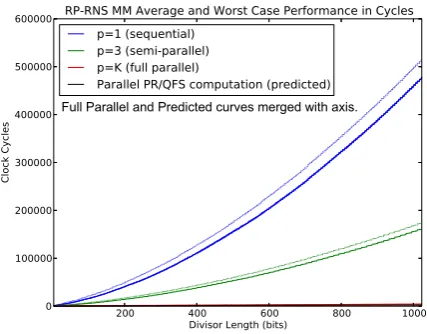
Fig. 2 A graphical summary of our cycle count data. Cycle counts for divisors up to 1024-bits using four varieties of parallelization.
6.2 Execution Time
We tested our hardware using divisors between 20 and 1024 bits. In contrast to the literature, we did not optimize our im-plementation for a specific divisor nor did we optimize for speed. As such, our cycle count data applies only to our im-plementation and we feel our data are not suitable for direct comparison against existing implementations.
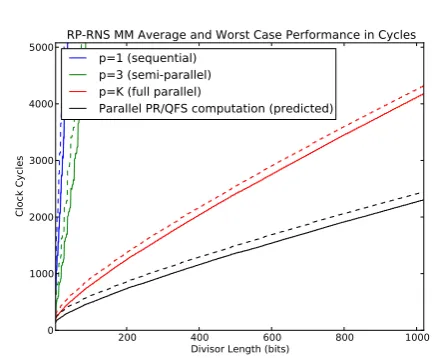
Figure 2 summarizes our cycle count data for comput-ing a scomput-ingle multiplication modulo-D(a single scaling by a constant). The graph depicts four types of data pairs. Each pair includes average-case and worst-case cycle counts. The first three types represent different levels of parallelism: se-quential, three hardware channels, and fully parallel. The fourth type is a theoretical modification that attempts to in-clude Phatak’s design decisions (see Section 4) into our soft-ware simulation of the hardsoft-ware. We accomplished this by substituting the iterative table look-ups with a parallel ta-ble look-up in our software simulation and iterative adders with adder trees. For the average case data, the confidence interval around the mean is quite small. The 95% confidence interval around the mean was within±3 cycles for small di-visors and no more than±10 cycles for 1024-bit divisors.
200 400 600 800 1000 Divisor Length (bits)
0 1000 2000 3000 4000 5000
Clock Cycles
RP-RNS MM Average and Worst Case Performance in Cycles p=1 (sequential)
p=3 (semi-parallel) p=K (full parallel)
Parallel PR/QFS computation (predicted)
Fig. 3 Our hardware simulation shows that modifying our hardware to comply with Phatak’s assumptions would enable us to execute in O(lgN)time for a single modular multiplication as promised by Phatak’s analyses. (Close-up of Figure 2)
7 Conclusion
Using our implementation, we experimentally confirmed Pha-tak’s performance analysis of the RP-RNS Quotient-First Scaling algorithm, which for a single modular multiplication is O(lgN)whereNis the word length of the operands. Be-cause QFS is performed in O(N)iterations of the RP-RNS modular exponentiation algorithm, experimental confirma-tion of the RP-RNS scaling algorithm (QFS) gives strong evidence for the claimed O(NlgN)modular exponentiation run-time [12].
Though our implementation fails to outperform recently developed hardware such as discussed in Gandino, et al. [5], we believe lessons learned during our experience will be valuable for future implementations. Based on our prelim-inary experimental data and Phatak’s analyses, we believe an implementation of the RP-RNS modular exponentiation algorithm, using all of Phatak’s hardware assumptions and design decisions, will outperform implementations based on Montgomery’s method.
As a new system, RP-RNS provides several open re-search problems. We highlight a few:
1. a speed-optimized implementation of RP-RNS modular exponentiation and repetition of our experiments; 2. a gate-level VLSI implementation of the RP-RNS
mod-ular exponentiation algorithm;
3. an ASIC implementation to determine if a custom cir-cuit with all of Phatak’s hardware assumptions can out-perform other RNS algorithms;
4. a focused study on the partial reconstruction algorithm; 5. a method for selecting optimal RP-RNS bases.
Acknowledgements We thank Chintan Patel, Ryan Robucci, and David DeLatte for providing technical support and helpful comments on ear-lier drafts. Sherman and Nguyen were supported in part by the National Science Foundation under SFS grant 1241576.
References
1. Bajard, J.C., Didier, L.S., Kornerup, P.: An IWS Montgomery modular multiplication algorithm. In: Proceedings of the 13th Symposium on Computer Arithmetic (ARITH ’97), ARITH ’97, pp. 234–239. IEEE Computer Society, Washington, DC, USA (1997). URL http://dl.acm.org/citation.cfm?id=786448.786561 2. Bajard, J.C., Didier, L.S., Kornerup, P.: An RNS
Mont-gomery modular multiplication algorithm. IEEE Trans. Com-put. 47(7), 766–776 (1998). DOI 10.1109/12.709376. URL http://dx.doi.org/10.1109/12.709376
3. Bajard, J.C., Didier, L.S., Kornerup, P.: Modular multiplication and base extensions in residue number systems. In: Proceedings of the 15th IEEE Symposium on Computer Arithmetic, ARITH ’01, pp. 59–. IEEE Computer Society, Washington, DC, USA (2001). URL http://dl.acm.org/citation.cfm?id=872021.872466
4. Bajard, J.C., Imbert, L.: A full RNS implementation of RSA. IEEE Trans. Comput.53(6), 769–774 (2004). DOI 10.1109/TC.2004.2. URL http://dx.doi.org/10.1109/TC.2004.2
5. Gandino, F., Lamberti, F., Paravati, G., Bajard, J., Montuschi, P.: An algorithmic and architectural study on Montgomery exponen-tiation in RNS. Computers, IEEE Transactions on61(8), 1071– 1083 (2012). DOI 10.1109/TC.2012.84
6. Kawamura, S., Koike, M., Sano, F., Shimbo, A.: Cox-Rower ar-chitecture for fast parallel Montgomery multiplication. In: Pro-ceedings of the 19th international conference on Theory and application of cryptographic techniques, EUROCRYPT’00, pp. 523–538. Springer-Verlag, Berlin, Heidelberg (2000). URL http://dl.acm.org/citation.cfm?id=1756169.1756220
7. Montgomery, P.L.: Modular multiplication without trial division. Mathematics of Computation44, 519–521 (1985)
8. Nguyen, C.D.: Fast modular exponentiation using residue domain representation: A hardware implementation and analysis. Master’s thesis, University of Mary-land, Baltimore County, CSEE Dept. (2013). URL http://pqdtopen.proquest.com/pubnum/1551346.html
9. Nozaki, H., Motoyama, M., Shimbo, A., Kawamura, S.i.: Imple-mentation of RSA algorithm based on RNS Montgomery multi-plication. In: Proceedings of the Third International Workshop on Cryptographic Hardware and Embedded Systems, CHES ’01, pp. 364–376. Springer-Verlag, London, UK, UK (2001). URL http://dl.acm.org/citation.cfm?id=648254.752572
10. Phatak, D.S.: RNS-ARDSP: A novel, fast residue number system using approximate rational domain scaled precomputations, Part I RP-PR: Reduced precision partial reconstruction and its applica-tion to fast RNS base extensions and/or base-changes. Tech. Rep. TR-CS-10-01, University of Maryland, Baltimore County, CSEE Dept. (2010). UMBC Technical Report TR-CS-10-01. Revised: November, 2013
11. Phatak, D.S.: RNS-ARDSP: A novel, fast residue number system using approximate rational domain scaled precomputations, Part II: SODIS (sign and overflow detection by interval separation) algorithm, the quotient first scaling/division-by-a-constant algo-rithm and their applications to expedite modular reduction and modular exponentiation. Tech. Rep. TR-CS-10-02, University of Maryland, Baltimore County, CSEE Dept. (2010). UMBC Tech-nical Report TR-CS-10-02. Revised: November, 2013
other potential enhancements to RNS and their applications. Tech. Rep. TR-CS-10-03, University of Maryland, Baltimore County, CSEE Dept. (2010). UMBC Technical Report TR-CS-10-03. Re-vised: November, 2013
13. Phatak, D.S.: Residue number systems methods and apparatuses. Patent Application (2011). US 2011/0231465 A1
14. van Rossum, G., Drake, F.L.: The Python Language Reference Manual. Network Theory Ltd. (2011)
15. Shenoy, A., Kumaresan, R.: Residue to binary conversion for RNS arithmetic using only modular look-up tables. Circuits and Sys-tems, IEEE Transactions on35(9), 1158–1162 (1988). DOI 10.1109/31.7577
16. Shenoy, A., Kumaresan, R.: Fast base extension using a redundant modulus in RNS. Computers, IEEE Transactions on38(2), 292– 297 (1989). DOI 10.1109/12.16508
A RP-RNS Quotient-First Scaling Algorithm
This appendix states the RP-RNS quotient-first scaling algorithm for reference purposes. See Phatak [10–13] for explanations and discus-sions. Though the following design features have appeared separately in other RNS algorithms, the novelty emerges in how RP-RNS com-bines these features and the speed gained:
– the usage of approximation [6];
– the 1- or 2-bit redundant modulus [15, 16];
– the usage of rational equations over integer equations [6]; – the precomputed lookup tables [1–3, 6, 15, 16]; and – the choice of many small moduli as the RNS base.
The precision of the approximations stored in the lookup tables is cho-sen to bound the error such that the final result is one of two candidates. Recently, it has come to our attention that Phatak’s sign-detection al-gorithm contains an error. Since we did not implement the final sign-detection step (used to choose among the two candidates), our imple-mentation is unaffected.
The QFS algorithm is based on the following rational form of the division algorithm:
Q=Z
D− R
D. (3)
The algorithm determines a quotient estimate, ˆQ, ofZdivided byD. Despite the fact that the output of the QFS algorithm is not always exact, this poses no problem for the RP-RNS modular exponentiation algorithm as noted by Phatak [11].
The QFS algorithm uses the RP-RNS partial reconstruction algo-rithm which is described in detail in [10]. The partial reconstruction algorithm is based on the following form of the Chinese Remainder Theorem:
Z= K
∑
i=1
ρiMi−RcZM. (4)
Denoting the summation in Equation 4 asZT, Phatak defines partial
re-construction as computation of the rere-construction coefficientRcZ
with-out fully computingZT.
The QFS algorithm accepts as its input a numberZin RP-RNS form and outputs the quotient estimate ˆQin RP-RNS form and an ex-actness flag. The algorithm asserts the flag only if ˆQ=Q. The QFS algorithm uses two lookup tables. The first lookup table uses theρ val-ues from the partial reconstruction algorithm as its indices. The second lookup table usesRcZas its index. The equations for the lookup table
entries are
Qi=
jM iρi
D
k
Ri=
jM iρi−QrD
D 2
wF k
Qrc=
jMRc Z
D
k
Rrc=
lMRc Z−QrcD
D 2
wFm.
(5)
The QFS algorithm invokes the partial reconstruction algorithm to cal-culate the lookup table indices. TheQiandQrcvalues are the integer
part of the quotient. TheRiandRrcvalues are the approximated
frac-tional part of the quotient. The chosen rounding modes lead to a quo-tient underestimate, similar to the partial reconstruction algorithm. The fractions are truncated towFbits wherewF≥ dlgK+1e. Together the
tables require O N3lg lgN
bits of storage.
Algorithm 1:RP-RNS QFS Quotient Estimation Input : An integerzin RP-RNS form
Output: ˆQin RP-RNS form and the exactness flagQExact. ˆQ is an approximation toQ=z/D modN, whereDis a pre-defined fixed divisor. IfQExact= True, then
ˆ
Q=Q. Otherwise, ifQExact= False, then either ˆ
Q=Qor ˆQ=Q+D. 1 begin
2 /* The QFS lookup tables have multiple columns. Though we identify the columns, we omit the structure and refer the reader to [13, 11]. The lookup tables are populated based on the fixed divisor D. The call to PartialReconstruction is used to determine the reconstruction
coefficient and is described in detail by
Phatak [10]. */
3 Rcz,(ρ1,ρ2, . . . ,ρK),n←PartialReconstruction(z);
4 /* Quotient integer part computation. */ 5 Qi←QuotientTable1(i,ρi,5)for 1≤i≤K;
6 QRcz←QuotientTable2(Rcz,4); 7 Q←
K
∑
i=1
Qi−QRcz;
8 [Qi]me←QuotientTable1(i,ρi,4)for 1≤i≤K;
9 [QRcz]me←QuotientTable2(Rcz,3);
10 [Q]m
e←
K
∑
i=1
[Qi]me−[QRcz]me;
11 /* Quotient fractional part computation. */ 12 Ri←QuotientTable1(i,ρi,6);
13 RRcz←QuotientTable2(Rcz,5); 14 Qf←
K
∑
i=1
Ri−RRcz;
15 /* Quotient exactness assessment. */ 16 QL←RightShift Qf,wF
;
17 QH←RightShift Qf+n,wF
; 18 QExact←(QL==QH);
19 /* Combine to form the quotient estimate. */
20 Qˆ←Q+QL;
21 Qˆm
e←[Q]me+ [QL]me; 22 returnQˆ,ˆ
Q
me,QExact
![Table 3 Performance of Kawamura et al.’s ME algorithm [6] (withoutcorrection)](https://thumb-us.123doks.com/thumbv2/123dok_us/7902419.1311895/3.595.42.213.214.272/table-performance-kawamura-et-al-s-algorithm-withoutcorrection.webp)