VME–based DAQ system for the Deuteron Spin Structure
setup at the Nuclotron internal target station
AlexanderIsupov1,∗
1Laboratory of High Energy Physics, Joint Institute for Nuclear Research, Dubna 141980, Russia
Abstract. The new powerful VME–based data acquisition (DAQ) system has
been designed for the Deuteron Spin Structure setup [1] placed at the Nuclotron
Internal Target Station [2]. The DAQ system is built using the netgraph–based
data acquisition and processing frameworkngdp[3,4]. The software dealing
with VME hardware is a set ofnetgraphnodes in the form of the loadable
kernel modules. The specific for current implementation nodes are described,
while specific software utilities for the user context are the following. Theb2r
(binary–to–ROOT) server converts raw data into per trigger and per accelerator
spill representations, which are based on C++classes derived from theROOT
framework [5] ones. This approach allows us to generalize the code for
his-tograms filling and polarization calculations. Theb2roptionally storesROOT
events asROOTTTree in file(s) on HDD, and supports the design of some
express offline. ThehistGUIsoftware module provides an interactive online
ac-cess for human operator to histograms filled by ther2h(ROOT–to–histograms)
server, which obtains theROOTevent representations fromb2r. Ther2h
sup-ports the calculation and histograming of runtime configurable variables as well
as raw data variables, and optionally storesROOThistograms in file(s) on HDD.
Since the spin studies at the Nuclotron require fast and precise determination of the deuteron and proton beam polarization, the polarization calculator
soft-ware module is introduced. This calculator based on runtime configurabler2h
code allows us to compute polarization values online and integrate them into
the Web–based scheme of representation and control of the polarimeters [6,7].
1 Introduction
The new powerful VME–based data acquisition (DAQ) system has been designed for the Deuteron Spin Structure (DSS) setup [1], [8], [9], [10] placed at the Nuclotron Internal Target Station (ITS) [2]. The DSS studies the polarization observables in thed pelastic scattering for several years [11], [12], [13], [14]. Vector and tensor polarizations of the deuteron and proton beams from the LHEP–JINR polarized ions source (SPI) [15], as well asAy,Ayy,Axx analyzing powers of the reactions have been successfully measured in the beam energy range from 135 MeV/nucleon to 900 MeV/nucleon. The DAQ system which will be described in this report is built using thenetgraph–based data acquisition and processing framework ngdp[3,4]. The software dealing with VME hardware is a set ofnetgraphpackage nodes in the form of the loadable kernel modules to work in the kernel context of the operating
fifo: fifos [444]:
output1 input
fifo2: fifos [448]:
output1 input vmectl:
vmectl [ab0]:
ctl0 melink0:
melink [ab1]:
sl10 data ctl sl8 sl6
<unnamed>: trighwmod [b94]:
sl <unnamed>:
u40hwmod [b95]:
sl <unnamed>:
tqdchwmod [b96]:
sl
ngput01491: socket [bcd]:
out mm1:
mm [bcf]:
in
mm9: mm [bd7]:
in
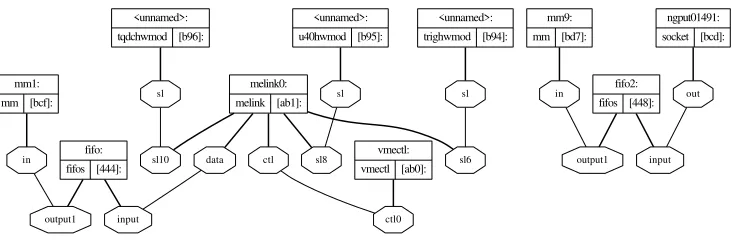
Figure 1. The simplifiednetgraphgraph used by DSS DAQ system to deal with VME hardware and manage the produced data streams. Rectangles are nodes with: name (up), type (left), ID (right); octagons represent hooks with their names inside
system. The user context utilities implement Graphical User Interfaces (GUI) for interaction with human operator as well as data representation converters both are based on C++classes derived from theROOTframework [5] ones.
Through the presented text the file and software package names are highlighted asitalic text, while constructions of C and other languages — astypewriter text. Reference to the manual page with name “qwerty” in the 9thsection is printed asqwerty(9). All the mentioned trademarks are properties of their respective owners.
2 Dealing with VME hardware
The heart of DSS DAQ system —ngdpgraph to deal with VME hardware and manage the produced data streams — is presented in Fig.1. This picture was automatically generated by thedotcommand ofngctl(8)utility from the graph was really built, and manually simplified by stripping out both nodes non–essential for understanding and details of the too technical nature. Thengdpgraph like anynetgraph(4)graph works in the operating system (OS) kernel context and contains the nodes (rectangles in Fig.1) connected by graph edges, which are produced by pairs of the so called hooks (octagons in Fig.1). The data messages flow along the edges while the control messages are delivered to the corresponding nodes directly. For reasons to use thenetgraphpackage as some data streams implementation in the OS kernel, see [3]. The nodes are implemented in the form of the loadable kernel modules (KLD), whose approach simplifies and essentially speeds up the debugging. The data processing code execution in the kernel context allows us to handle the data obtained from the VME master in the fastest possible way [3]: out of the preemptive scheduling scope and without data copying overhead.
The VME hardware handling scheme is as follows. Each kind of VME master (with embedded CPU or adapter card for computer interconnection) and VME hardware module is represented by the correspondingnetgraphnode type — VME driver and handler of VME hardware module (lets name it VME node below), respectively. Each node type should be instantiated as many times as needed to reflect the existing quantity of the corresponding hardware units.
kernel threads kthread(9)to serve requestsqueue(3)and process data in parallel, and is a netgraphnode simultaneously.
The VME node is a KLD module in thenetgraphstyle intended to deal with some VME hardware module (or imitate one for debug purposes asng_genhwmod(4)do) by mediation of VME driver. Currently we support: the trigger TTCM/FVME2TMWR modules [16] with PCB 2.0/2.0 and firmware version 1.1.14136 (final)/1.1.20532 – by theng_trighwmod(4) node type; the trigger logic U40VE modules [16] with PCB 2.1 and DSS firmware version 2.0.22585 – by the ng_u40hwmod(4)node type; and the TQDC16 time– and charge–to– digital converter modules [16] with PCB 2.1, 3.0, 4.1 and firmware version up to 2.0.21992 – by theng_tqdchwmod(4)node type.
Interconnections in the DAQ graph (see Fig.1) are the following: VME driver in<M>th crate is connected by ownctlhook toctl<M>hook of special control nodeng_vmectl(4) node while VME node in<N>thslot — by ownslhook tosl<N>hook of VME driver of the corresponding VME crate.
The full data flow scheme of the DSS DAQ system is as follows:
ng_melink→ng_fifos
%ng_mm6→ngget|writer
→ng_mm6→ngget|b2r|ngput6→ng_socket→
&ng_mm6→ngget|b2r(EoB counts)
→ng_fifos
%ng_mm6→ngget|r2h − −− →histGUI
\ − −− →histGUI
&ng_mm6→ngget|r2h(polar. calc.) · · ·
where:
→ packet(9)[17] data stream in the kernel context (along graph edges);
6→ context boundary crossing by the data stream;
| packet(3)[17] data stream in the user context (so called pipe);
−− → socket connection (hereTServerSocket/TSocketfromROOTframework [5]);
· · · number of the same elements.
Thenetgraph(kernel context) part of this scheme can be seen in Fig.1.
Theng_melink(4)VME driver node namedmelink0in Fig.1is the source of data pack-ets stream which supplied to theng_fifos(4)node [4] namedfifothrough the pair of hooks
dataandinput. Thefifoprovides the own copy of the obtained data stream for each of
its consumers (in Fig. 1 for simplicity only one of them connected through pair of hooks
output1andinis depicted). In the DSS DAQ thefifofeeds theb2r(1)forROOTevents
production [4] by the full (or possibly downscaled) data stream of trigger events (as well as all Begin–of–Burst (BoB) and End–of–Burst (EoB) events), while theb2r(1)specially compiled for EoB counts viewing — by all the EoB events only. (Here the Burst means accelerator spill.) Theng_mm(4)node [4] is used for data transfer over the contexts boundary (kernel to user) as a replacement for thenetgraphstandardng_socket(4)node due to more handful bufferization and better performance.
Theb2r(1)directsROOTevents tofifo2node through the pair of hooksoutandinput (see Fig.1right part) with mediation ofngput(1)utility andng_socket(4)node. Thefifo2 feeds both the r2h(1) for histograms filling [4] and r2h(1) specially compiled to support r2h.conf(5) objects for polarization calculations (see section3.1) by the full (or possibly downscaled) stream ofROOTrepresentations of trigger events as well as all BoB and EoB events in theROOTrepresentation (in Fig.1for simplicity only one of consumers connected through pair of hooksoutput1andinis depicted).
bound-ary usingng_mm(4)orng_socket(4)nodes andngget(1)(for transfer from kernel context to user one) orngput(1)(vice versa) utilities.
The ngdpgeneric node types ng_fifos(4),ng_mm(4)are explained in [4]. For the net-graphgeneric nodesng_socket(4),ng_ksocket(4)description see the corresponding online manual pages.
The high level control over DAQ graph is performed by special ng_vmectl(4)control node type intended to issue commands (in the form ofnetgraphcontrol messages) to VME drivers and VME nodes. ng_vmectl(4)obtains responses to commands as control messages from VME nodes and as data messages from VME drivers, thus supplies the next command from the own queue in time. Instantiation of this node (which is singleton) leads to building of the graph like pictured in Fig.1.
3 User context utilities
Lets describe only software utilities specific for DSS DAQ system. Thengdpgeneric ones used here are: writer(1)[17] of packet stream to files on hard disk, ngget(1)packet stream extractor from netgraphgraph, ngput(1)packet stream injector to netgraphgraph, b2r(1) (binary–to–ROOT) converter,r2h(1)(ROOT–to–histograms) converter, andhistGUI(1) stan-dalone client forr2h(1)(see [4]). According to the scheme of events representation byROOT classes [4] the specific classes for trigger, BoB, EoB events as well as required helper classes are designed. These classes are linked intob2r(1)andr2h(1)as well as provided in the li-bElinpol.sostandalone shared library form to be used by the express–offlineROOTscripts and offline processing utilities. Theb2rreads raw data packets and for each of them produces ROOTevent representation in the form of some compiled-inROOTclass. ThisROOT repre-sentation is serialized usingTBufferFileand encapsulated into a packet of other type with the same number.
The r2h reads the data packets with events in the ROOT representation produced by b2r(1), extracts them, fills some histograms configured by <cfgfile>in the r2h.conf(5) format [4], sends requested histogram(s) to registered client(s) byROOTTMessage(s), and optionally writes all configured histograms toROOTTFile <outfile>.
The r2h.conf(5)protocol [4] allows us to configure the r2h(1)andhistGUI(1) as well as to establish the conversation between them online. This means we need not to recompile r2h(1)each time when we calculate other values and book and fill other histograms. Instead we edit the configuration file and restartr2h(1), which anyway should be restarted at each run if we need to save histograms into per–run files.
The EoB events viewer (so called dumperb2r_dump) is a specially compiled form of the b2r(1)converter, which outputs to terminal instead of thesyslog(3)facility and executed with command line option-D0x13to produce textual output instead ofROOTevents representa-tion.
3.1 Polarization calculator
A specially compiled r2h(1) converter (so called r2h_calc) supports additional entities CalcvpandCalctpin the configuration file formatr2h.conf(5)[4]. This allows it to calcu-late polarizations instead ofROOThistograms filling. Currently the polarization calculator produces textual output of calculation results at each EoB event arrival. In the future these results could be output in the HTML form to be included into Web–based representation scheme described in [6] and [7].
below) from the eight ones available for deuterons (or two for protons), as well as the unpo-larized beam (so called “0” polarization mode). The corresponding polarization marks are distributed to polarimeters by SPI electronics.
The polarimetry part [8] of the DSS setup allows us to use coincidences of “proton” and “deuteron” scintillation counters in the complementary arms — LD-RP, RD-LP, UD-DP, DD-UP. Lets name these coincidences as Left, Right, Up, and Down arm scaler counts. We have 9 (4) “proton” (“deuteron”) counters in Left, Right, and Up arms, and 4 (1) – in Down arm (due to lack of space). So we can kinematically cover the 18◦–60◦angle range in the lab. system for a wide range of the beam energies. These pairs could be chosen for each beam energy by kinematics and statistics conditions. The LPP–RPP coincidences of the dedicated counters for quasi–elastic ppscattering at 90◦ in the c.m. are used as monitor counts. For tensor polarimetry we use counts of 4 or 3 coincidence pairs, for vector one — 2. The Calcvp vector polarization calculation object uses Left and Right arm scaler counts (of course, at each polarization mode) as well as monitor counts and number of polarized burstsNbmand Nbp. All the mentioned arm scaler counts should be either declared in terms of raw data (Var) or calculated (Cvar) from already knownVars by the so called universal calculation mechanismcell(3)(see [4] for details). This allows us to organize polarization calculations very flexibly without recompilation of ther2h(1) executable itself. We do not explain too huge details of these counts preparation (at least counts should be normalized to the number of bursts), however, this procedure could be revised easily and quickly. For example, at beam energy change we can operatively replace the scintillation counters combination producing any arm counts, as well as the analyzing power values (which should be already known from some previous measurements). Also the data cuts in terms of 1D–ranges on the time and/or amplitude 1D– and 2D–histograms applied during the counts preparation could be revised. Of course, this is true for additional counts used by theCalctptensor polarization calculation object.
3.2 sv(1)supervisor utility
For the human operator convenience the sv(1)supervisor utility with GUI expected to be self–explanatory is implemented. The main window allows us to perform base DAQ oper-ations like start/stop run, change output filenames, load/unload software components, etc. The VME hardware configuration is represented for human operator by additional windows. To perform base DAQ commands, the supervisor relies on configuration filelinpolsv.mkin the so called makefile format (seemake(1) for syntax description). This file contains the named targets (i.e. continue, pause,init, etc.) and for each of them it provides some actions in terms of shell commands, while the supervisor simply executes something like make -f linpolsv.mk continue. To perform VME hardware configuration, the super-visor uses thenetgraph(3)application program interface (API) to send thenetgraphcontrol messages to VME nodes. The configuration is represented to human operator by additional windows and is stored in per hardware module files oftermcap(5)format, from which it also could be loaded into GUI. To download the whole hardware module(s) configuration from these file(s) to the VME hardware, a specialized command–string utilityhwmod_conf(1)is implemented, which shares sources with supervisor.
4 Conclusions
•The explained DSS DAQ system was successfully used during the 53rd(December 2016), 54th(March 2017), and 55th(March 2018) Nuclotron runs.
designed express–offline software in theROOTscripts form.
• For the SPI modes interesting for DSS project the deuteron polarizations for 135 MeV/nucleon beam were calculated by DAQ online in satisfactory agreement with offline data analysis results obtained later [18].
• As SPI methodic studies the polarizations were also measured for other SPI modes [18] with satisfactory agreement between theoretically expected and experimentally obtained val-ues.
• In the future the polarizations could be determined online by the polarization calculator utility using the already known analyzing powers and data cuts in terms of 1D–ranges on the time and amplitude 1D– and 2D–histograms. The polarization calculation results could be integrated into Web–based representation scheme (see [6,7]). So the DSS DAQ system is suitable for online polarimetry.
• The first measurements of the 500 MeV proton beam polarization were also performed during the 54thrun [13].
Acknowledgments. The author has the pleasure to thank V.P.Ladygin for initiation of
the polarization calculations development for DSS setup, S.G.Reznikov — for fruitful dis-cussions about VME hardware, and all the DSS collaboration — for permanent support and assistance. The author is grateful to V.V.Fimushkin, A.S.Belov, A.V.Butenko, and all the SPI and Nuclotron teams for cooperation during the runs. The present work could not be done without background provided by LHEP NOAFI team.
The work has been supported in part by the RFBR under grant 16-02-00203a.
References
[1] V.P. Ladygin, Y.V. Gurchin, S.M. Piyadin, A.A. Terekhin, A.Y. Isupov et al., Few Body Syst.55, 709 (2014)
[2] A.Y. Isupov, V.A. Krasnov, V.P. Ladygin, S.M. Piyadin, S.G. Reznikov, Nucl. Instr. and Meth. in Phys. Res. A698, 127 (2013)
[3] A.Y. Isupov, arXiv:1004.4474 [physics.ins-det] (2010) [4] A.Y. Isupov, arXiv:1004.4482 [physics.ins-det] (2010)
[5] R. Brun, F. Rademakers, ROOT – An Object Oriented Data Analysis Framework, inProc. of the AIHENP’96 Workshop (Lausanne, Switzerland, 1996), Nucl.Instr.and Meth.in Phys.Res. A389, 81-86 (1997). See alsohttp://root.cern.ch/
[6] A.Y. Isupov, Czech. J. Phys. Suppl. A55, A407 (2005) [7] A.Y. Isupov, Czech. J. Phys. Suppl.C56, C385 (2006)
[8] P.K. Kurilkin, V.P. Ladygin, T. Uesaka et al., Nucl.Instr.and Meth.in Phys.Res. A642, 45 (2011)
[9] Y.V. Gurchin et al., Phys.Part.Nucl.Lett.8, 950 (2011) [10] S.M. Piyadin et al., Phys.Part.Nucl.Lett.8, 107 (2011) [11] P.K. Kurilkin et al., Phys.Lett.B715, 61 (2012) [12] V.P. Ladygin et al., JPCS938, 012007 (2017)
[13] V.P. Ladygin, Y.V. Gurchin, A.Y. Isupov et al., JPCS938, 012008 (2017)
[14] M. Janek, V.P. Ladygin, Y.V. Gurchin, A.Y. Isupov et al., JPCS938, 012005 (2017) [15] A.S. Belov, D.E. Donets, V.V. Fimushkin et al., JPCS938, 012017 (2017)
[16] http://afi.jinr.ru/
[17] K.I. Gritsaj, A.Y. Isupov, JINR Communications E10–2001–116 (2001)