_____________________________________________________________________________________________________
*Corresponding author: E-mail: [email protected];
24(9): 1-5, 2017; Article no.JAMMR.38125 ISSN: 2456-8899
(Past name: British Journal of Medicine and Medical Research, Past ISSN: 2231-0614, NLM ID: 101570965)
A Rare Case of Complex Occult Spinal Dysraphism
with Association of Asymptomatic Tethered Cord
Syndrome
Naif Bin Nwihadh
1*1College of Medicine, Prince Sattam bin Abdulaziz University (PSAU), P.O.Box 422, Al-Kharj 11942,
Saudi Arabia.
Author’s contribution
The sole author designed, analyzed and interpreted and prepared the manuscript.
Article Information
DOI: 10.9734/JAMMR/2017/38125 Editor(s): (1)Fatima Mubarak, Department of Radiology, Aga Khan University, Karachi, Pakistan. Reviewers: (1)Pedro Luis Bazán, National University of La Plata, Argentina.
(2)Kadir Oktay, Gaziantep Medical Park Hospital, Turkey. Complete Peer review History:http://www.sciencedomain.org/review-history/22206
Received 13th November 2017 Accepted 27th November 2017 Published 8th December 2017
ABSTRACT
We present the case of a 62-year-old female housewife who reported non-specific back pain for the past 35 years. Without neurological symptoms, A complex occult spinal dysraphism and a tethered cord syndrome was diagnosed.
Keywords: Dysraphism; Tethered Cord; spine; asymptomatic.
1. INTRODUCTION
The tethered cord syndrome (TCS) is a developmental abnormality of the neural axis that results from the stretching and downward situation of the spinal cord by inelastic, rigid structures and can be combined with various forms of spinal dysraphism. Multiple anomalies
owing to the errors of embryonic development in the 3rd–4th weeks can lead to tethering of the spinal cord and restrict its physiological ascent [1].
Spinal dysraphic lesions are uncommon
dysraphic malformations often leads to termination of pregnancy, thus diminishing the number of children with spina bifida aperta. In contrast, patients with occult spinal dysraphism are often overlooked, even though their disease is usually far from occult given the cutaneous manifestations in many of them with early diagnosis of these lesions. However, there
remains an ongoing debate of whether
asymptomatic patients with a tethered cord should undergo prophylactic surgery [2].
The patient with tethered cord syndrome may reach adulthood with their disease undiagnosed,
despite obvious cutaneous anomalies or
orthopedic deformities. The development of new symptoms (especially pain) or the progression of previously inconspicuous deficits leads the patients to medical attention. There is a large amount of data concerning TCS in children, on the other hand, the surgical management is controversial and the condition itself remains poorly understood in adults [3-4].
2. CASE HISTORY
A 62 year old female reported non-specific mild low back pain that had recurred at irregular intervals for the past 35 years and was exacerbated by physical exertion and relieved by rest, she also mentioned an increase in the pain for the past 5 years.
2.1 The Clinical Exam
2.1.1 General examination
Normal gait, no dysmorphic features, no deformity at neck, thoracic, lumbar and sacral spine.
There is small dimple on her lower back with scar, spine movement forward flexion, extension and lateral pending within normal.
2.1.2 Neurovascular examination
All upper limb sensation was normal with power 5/5 overall.with normal reflexes.
No sensory level at thoracic and abdomen. with normal reflexes.
All lower limb sensation was normal with power 5/5 overall with normal reflexes.
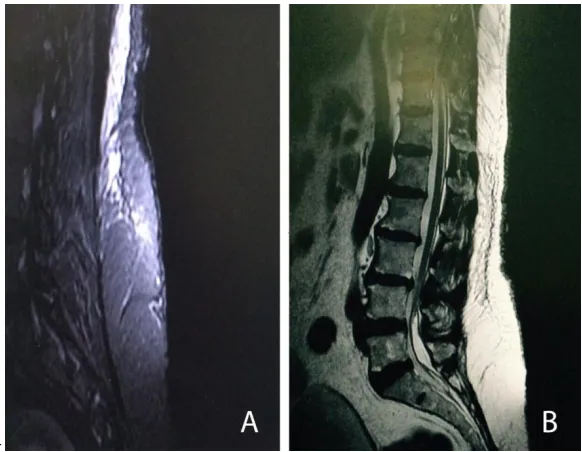
No bowel or bladder dysfunction was found. Diagnosis based on a survey radiograph and MRI as shown A, B (Figs. 1 & 2).
3. DISCUSSION
Although tethered cord syndrome TCS has been described in 1950s, it was regarded as a pediatric problem. In 1980, Pang and Wilberger performed the first systemic review of their experience in treating adult patients who presented with TCS [5]. Most cases of idiopathic spinal cord tethering with a thickened filum are considered congenital [6].
Spinal malformations are midline phenomena
ascribable to developmental disturbances
occurring at various stages [7]. TCS is a disorder involving an abnormal stretching of the
tethered spinal cord caused by several
pathological conditions and presents with a variety of neurological symptoms. Untethering (tethered cord release) is the gold standard treatment for TCS. However, untethering carries risks of spinal cord injury and postoperative re-tethering. Patients who never undergo treatment for TCS will likely have an elevated risk of developing symptoms with advancing age [7-9].
Symptoms related to a congenital tethered cord occur most commonly in childhood, hence it was regarded initially as a disease of childhood; in many patients, the diagnosis is not documented until symptoms manifest in adulthood. It is well established that early surgical intervention of
congenital TCS in children prevents
neurosurgical deterioration. The number of adults in whom congenital TCS was diagnosed continues to grow as a result of better imaging and recognition of this syndrome. Pediatric TCS has been well studied in the literature, but much of the information regarding the adult population is still being defined [2].
Surgical management in adults and especially in asymptomatic adults remains controversial. Results of recent clinical studies of surgical intervention in adulthood are encouraging [4].
In the case under consideration, the patient was 62 years old when diagnosis was made, although she reported having suffered from non-specific back pain for over 35 years, she denied any previous neurological, bowel and urologic symptoms. The patient had attributed the back pains to physical exertion.
indicative of spinal dysraphism are dermal changes such as areas with marked hirsutism or pigmentation on and surrounding the area and level of the spinal dysraphism, however, they are not as common in adults as they are in children, accounting for 35.6% in adult cases [1,5,10]. Based on these findings and the mild pain which improved with analgesia, either conservative treatment was determined in combination with clinical symptoms or further diagnostic measure such as Somatosensory evoked potentials was Ordered and the result was. Presenting
complaints of TCS are non-specific,
encompassing lower back pain, sensory deficits, motor weakness, and sphincter incompetence [1,3,5-8]. Adult onset TCS is usually precipitated by physical exertion, such as back flexion, washing dishes, or receiving trauma to the back [9,10]. Furthermore, spine abnormalities such as degenerative spinal stenosis are an aggravating factor for the emergence of TCS symptoms [11]. Suspicion of TCS as a differential diagnosis is low, due to the subtle and non-specific presenting complaint, insidious and chronic
onset, and deficits not respecting the
dermatomoal and myotomal distribution pattern; hence they are initially diagnosed as one of the
common orthopedic, neurological, or
genitourinary complaint such as lumbosacral degenerative disc herniation [12]. The initial complaint is usually lower back pain, which radiated to the lower limbs in a non-dermatomal pattern chronically; radicular pain distribution is
rarely encountered in such a clinical setting [5, 13].
Surgery is controversial in the adult onset TCS, due to the complexity of associated lesions and difficulty of the procedure. According to a literature review by Aufschnaiter et al. [1] most authors recommend a pre-emptive surgery prior to the development of significant neurological deficits [14]. On the other hand, some authors advocate the use of physiotherapy once evidenced by patient satisfaction [15]. The most responsive symptom after surgery is pain relief (83.2%). Sensory and motor improvement is also
established with a 43% and a 58.6%
improvement respectively, especially if surgery is done in less than 6 months after the onset of symptoms [1]. In contrast, sphincter response to surgery is less responsive, ranging from 45.6% improvement to complete resistance. Early diagnosis and treatment in less than a 1 year period of symptoms emergence in general has been listed as the most important prognostic factor, in addition to the type and localization of
associated lesions, such as
lipomyelomeningocele, split cord malformation,
previous surgery, and intradural fibrous
adhesions have low prognostic outcomes due to difficulty of successful untethering [14-16].
Complete retethering and removal of associated lesions is known to be associated with notable worse results than those who perform filum
←
Fig. 2. T2 MRI shows corss section tethered cord
terminale dissection with a possible reduction of associated lesions [8,17]. Risk of re-tethering after a successful operation is nevertheless possible sequelae, with a reported rate of deterioration between 25% and 47%, noteworthy; the re-emergence of pain symptoms is the most common documented sequelae [14,18]. Most authors blame the post-operative adhesion and fibrosis for the recurrence of symptoms, recommending MRI follow-up once a rebound of symptoms is documented [18].
4. CONCLUSION
Tethered cord syndrome is an uncommon entity in the adult population. Presenting complaints are ambiguous and non-specific, consequently, adding to the difficulty of diagnosis. Management wise, there is a controversy regarding the timing of surgery; incomplete reduction has been shown to be associated with less side effects compared to complete reduction.
CONSENT
As per international standard or university standard written patient consent has been collected and preserved by the authors.
ETHICAL APPROVAL
It is not applicable.
COMPETINGINTERESTS
Author has declared that no competing interests exist.
REFERENCES
1. Aufschnaiter A, Fellner F, Wurm G.
Surgery in adult onset tethered cord syndrome (ATCS): Review of literature on
occasion of an exceptional case.
Neurosurg Rev. 2008;31:371–384.
2. Klekamp J. Tethered cord syndrome in
adults Clinical article. J Neurosurg Spine. 2011;15:258–270.
3. Iskandar B, Fulmer B, Hadley M, Oakes J.
Congenital tethered spinal cord syndrome in adults. Neurosurg Focus. 2001;10(1): Article 7.
4. Romagna A, Suchorska B, Schwartz C,
Tonn JC, Zausinger S. Detethering of a congenital tethered cord in adult patients: An outcome analysis. Acta Neurochir. 2013;155(5):793-800.
5. Lee GY, Paradiso G, Tator CH, Gentili F, Massicotte EM, Fehlings MG. Surgical management of tethered cord syndrome in adult: indication, technique, and long term outcome in 60 pateints. J Neurosurgery. 2006;4:123-131.
6. Donmez FY, Basaran C, Ulu EM, Guvenc
Z, Tarhan NC. Unusual association of tethered cord, filum terminale lipoma, and
myxopapillary ependymoma. Spine.
2008;33(22):E849-851.
7. Freund M, Thale A, Hutzelmann A.
8. Kokubun H, Ozawa H, Aizawa T, Ly NM, Tanaka Y. Spine-shortening osteotomy for patients with tethered cord syndrome
caused by lipomyelomeningocele. J
Neurosurg Spine. 2011;15:21–27.
9. Pang D, Wilberger JE Jr. Tethered cord
syndrome in adults. J Neurosurg. 1982; 57(1):32-47.
10. Salvati M, Orlando Ramundo E, Artico M, Martini S, Caruso R, Fortuna A. The tethered cord syndrome in the adult. Report of three cases and review of the literature. Zentralbl Neurochir. 1990;51:91– 93.
11. Yamada S, Siddiqi J, Won DJ, Kido DK,
Hadden A, Spitalieri J, Everett BA, Obasi CG, Goldenberg TM, Giles LG, Yamada SM. Symptomatic protocols for adult tethered cord syndrome. Neurol Res. 2004;26:741–744.
12. Yamada S, Lonser RR. Adult tethered cord
syndrome. J Spinal Disord. 2000;13:319– 323.
13. Gokay H, Barlas O, Hepgul KT,
Hicdonmez T. Tethered cord in the adult
mimicking the lumbar disc syndrome: report of two cases. Surg Neurol. 1993; 39:440–442.
14. Klekamp J, Raimondi AJ, Samii M. Occult dysraphism in adulthood: Clinical course and management. Child’s Nerv Syst. 1994;10:312–320.
15. Haro H, Komori H, Okawa A, Kawabata S,
Shinomiya K. Long-term outcomes of surgical treatment for tethered cord
syndrome. J Spinal Disord Tech.
2004;17:16–20.
16. Gupta SK, Khosla VK, Sharma BS,
Mathuriya SN, Pathak A, Tewari MK. Tethered cord syndrome in adults. Surg Neurol. 1999;52:362–369.
17. Kirollos RW, Van Hille PT. Evaluation of surgery for the tethered cord syndrome using a new grading system. Br J Neurosurg. 1996;10:253–260.
18. Van Leeuwen R, Notermans NC,
Vandertop WP. Surgery in adults with tethered cord syndrome: Outcome study
with independent clinical review. J
Neurosurg Spine. 2001;94:205–209. _________________________________________________________________________________
© 2017 Bin Nwihadh; This is an Open Access article distributed under the terms of the Creative Commons Attribution License (http://creativecommons.org/licenses/by/4.0), which permits unrestricted use, distribution, and reproduction in any medium, provided the original work is properly cited.
Peer-review history: