A New Encoding Framework for Predicate Encryption with
Non-Linear Structures in Prime Order Groups
Jongkil Kim1, Willy Susilo1, Fuchun Guo1, Joonsang Baek1, and Nan Li2
1
Institute of Cybersecurity and Cryptology School of Computing and Information Technology,
University of Wollongong, Wollongong, Australia
jongkil, wsusilo, fuchun, [email protected]
2
School of Electrical Engineering and Computing The University of Newcastle, Newcastle, Australia
Abstract. We present an advanced encoding framework for predicate encryption (PE) in prime order groups. Our framework captures a wider range of adaptively secure PE schemes such as non-monotonic attribute-based encryption by allowing PE schemes to have more flexible structures. Prior to our work, frameworks featuring adaptively secure PE schemes in prime order groups require strong structural restrictions on the schemes. In those frameworks, exponents of public keys and master secret keys of PE schemes, which are also referred to as common variables, must be linear. In our work, we introduce a modular framework which includes non-linear common variables in PE schemes. First, we formalize non-linear structures which can appear in PE by improving Attrapadung’s pair encoding framework (Eurocrypt’14). Then, we provide a generic compiler that features encodings under our framework to PE schemes in prime order groups. Particularly, the security of our compiler is proved by introducing a new technique which decomposes common variables into two types and makes one of them be shared between semi-functional and normal spaces on processes of the dual system encryption to mitigate the linear restriction. As instances of our new framework, we introduce new attribute-based encryption schemes supporting non-monotonic access structures, namely non-monotonic ABE, in prime order groups. We introduce adaptively secure non-monotonic ABE schemes having either short ciphertexts (if KP-ABE) or short keys (if CP-ABE) for the first time. Additionally, we introduce the first non-monotonic ABE schemes supporting both adaptive security and multi-use of attributes property in prime order groups.
Key words: pair encoding, non-monotonic access structure, attribute-based encryption, prime order groups, dual system encryption
1
Introduction
Water’s dual system encryption [29] is a widely used proof methodology for adaptively secure PE. After the seminal introduction by Waters, it becomes one of the most popular tools to prove the adaptive security of PE. Subsequently, many PE schemes [21, 18, 7, 28, 15] use the dual system encryption to prove their security. Later, Lewko and Waters [22] introduced a new technique for the dual system encryption. Their novel technique (also referred to as a doubly selective technique in [2]) shows that adaptive security of PE can be achievedcomputationally using selective techniques via the dual system encryption. In detail, prior to their technique, a critical part of the dual system encryption was proved only by information theoretical arguments, but they showed that it can be proved by two selective proofs using the information delivered from the adversary’s queries. This significantly extends the usage of the dual system encryption to a wider range of encryption schemes.
system encryption and formalize them through encoding frameworks. They also introduced generic constructions applicable to those encodings and proved that they are adaptively secure only using the properties defined in the frameworks. Therefore, these frameworks give a new insight to the dual system encryption and make proving adaptive security of an encryption scheme much easier since its security can be simply proved by showing that the corresponding encoding scheme of the encryption scheme satisfies the properties that the frameworks required. In particular, Attra-padung’s pair encoding framework suggested in [2] generalizes the doubly selective technique into their framework.
Recently, the dual system encryption has been evolved in prime order groups via encodings [11, 4, 1, 16]. However, their generic constructions for encoding scheme commonly impose a structural restriction on PE in prime order groups. In particular, they require exponents of public keys and master secret keys (as also referred to as common variables) to be linear. This also results that keys and ciphertexts of PE schemes to be linear in those variables. For example, we use
h1, ..., hmto denote common variables of a pair encoding scheme. The linearity of pair encoding framework requires that public keys and master secret keys to be setg, gh1, ..., ghm where g is a group generator and cannot have as parameters group elements of which exponents are not linear inhi such asgh
2
1 or gh1h2.
Hence, the usage of encoding frameworks is significantly limited by this structure restriction. Morevoer, the restriction cannot be simply addressed by including non-linear exponents into the encoding framework because (1) it is not clear how the dual system encryption can be used to prove the security of PE having non-linearity in prime order groups. Moreover, it still remains an interesting question (2) whether we can define an encoding framework to capture non-linearity of PE.
1.1 Our Contribution
The contribution of this paper is two-fold.
Improved framework. We introduce a modular framework which is applicable to PE schemes having non-linear common variables in prime order groups. Prior to our works, existing frameworks [11, 4, 1, 16] in prime order groups enforce PE schemes to have a simple linear structure. Our new framework overcomes this barrier by suggesting a new framework and a new proof technique.
To mitigate the structural restriction and effectively express non-linearity of PE schemes, we improve Attrapadung’s pair encoding framework [2] which is one of most popular encoding frameworks for PE and provide a new compiler that features encodings in our improved framework to an real PE schemes in prime order groups. Unlike the pair encoding framework, we decompose common variables which are exponents of public keys and master secret keys into two types, which are shared common variablesw and hidden common variableshand restricted only hidden common variables to be linear. We, then, define public keys (and master secret keys) of PE using monomialsbwhich consists of elements ofw andh. This refinement flexibly describes even non-linear exponents since there is no structural restriction onw unless it is a monomial. At the same time, we set PE schemes still to be linear in hidden common variables, which we call relaxed linearity in hidden common variables so that the dual system methodology can be applied for the security analysis. Secondly, we provide a new generic compiler in prime order groups for our framework and prove its security under simple static assumptions which were introduced by Lewko and Waters [20]. We prove security of our new compiler usingcomputational arguments based on the doubly selective technique but we provide an additional refinement of the doubly selective technique to handle non-linearity in PE schemes using both types of common variables. We show that our refinement is still feasible by showing multiple new attribute-based encryption schemes as instances.
Instances. As instances of our new encoding, we introduce two new attribute-based encryption (ABE) schemes supporting a non-monotonic access structure as follows:
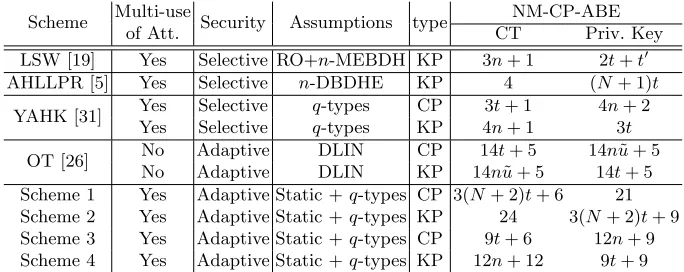
Table 1.Comparisons of NM-CP-ABE schemes in prime order groups
Scheme Multi-use Security Assumptions type NM-CP-ABE
of Att. CT Priv. Key
LSW [19] Yes Selective RO+n-MEBDH KP 3n+ 1 2t+t0
AHLLPR [5] Yes Selective n-DBDHE KP 4 (N+ 1)t
YAHK [31] Yes Selective q-types CP 3t+ 1 4n+ 2
Yes Selective q-types KP 4n+ 1 3t
OT [26] No Adaptive DLIN CP 14t+ 5 14nu˜+ 5
No Adaptive DLIN KP 14nu˜+ 5 14t+ 5
Scheme 1 Yes Adaptive Static +q-types CP 3(N+ 2)t+ 6 21 Scheme 2 Yes Adaptive Static +q-types KP 24 3(N+ 2)t+ 9 Scheme 3 Yes Adaptive Static +q-types CP 9t+ 6 12n+ 9 Scheme 4 Yes Adaptive Static +q-types KP 12n+ 12 9t+ 9
t: the number of attributes in an access policy,t’: the number of negated attributes in an access policy, n: the number of attributes in attribute sets, N: the maximum number of attributes in attribute sets ˜
u: the maximum number of appearances of an attribute in an access policy. Static: ’Static’ in Assumptions implies thatLW1,LW2 and DBDH
• Unbound Non-monotonic CP-ABE (Scheme 3). • Unbound Non-monotonic KP-ABE (Scheme 4).
We introduce new ABE schemes having short parameters which are either short keys (Scheme 1) or short ciphertexts (Scheme 2). Prior to our work, non-monotonic KP-ABE scheme with short ciphertexts [5] is only selectively secure and there is no scheme supporting short keys. Also, we introduce two new unbounded ciphertext-policy ABE schemes supporting a non-monotonic access policy. The new unbounded schemes are truely unbounded since it supports arbitrary attributes and multi-use of attributes at the same time. Existing ABE schemes supporting non-monotonic access structures are restricted by selective security [31, 19] or one-use of attributes [26] where one-use of attributes means that an attribute does not appear more than once in an access policy.
1.2 Our Technique
Syntax of Pair Encoding Framework [2].Before we explain our technique, we briefly introduce Attrapadung’s pair encoding framework.
In pair encoding, instances for a predicate Rκ :X × Y → {0,1} consist of four deterministic algorithms which areParam,Enc1,Enc2andPair.
Param(κ) → ω: It takes as input an indexκ and outputs the number of common variablesω of b= (b1, ..., bω). The common variables are shared withEnc1andEnc2.
Enc1(x)→ (k := (k1, ..., km1);m2): It takes as x∈ X and outputs a sequence of polynomials of
{ki}i∈[m1] with coefficient in Zp and m2 which is the number of variables. Every ki is a linear
combination of monomialsα,rk,bjrk wherek∈[m2] and α, r1, ..., rm2 ∈Zp are variables.
Enc2(y) → (c := (c1, ..., cw1);w2) It takes as y ∈ Y and outputs a sequence of polynomials of
{ci}i∈[1,w1] with coefficient in Zp and w2 which is the number of variables. Every ci is a linear
combination of monomialss,sk, bjs,bjsk where k∈[w2] ands, s1, ..., sw2∈Zp are variables.
Pair(x, y)→Etakes as inputsxandyand outputs a reconstruction matrixE such thatkEc>=
αs.
The instances of the pair encoding framework satisfy multiple properties, namely linearity in random variables, parameter vanishing and computational or perfect αhiding. Those properties are also required to our new encoding. We discuss them further in Section 4.
stricter structural restrictions. They defines the scheme satisfying those restrictions as a regular encoding. For example,hihi0 cannot be used and computed in their framework. The work of Kim et al. [16, 1] also explicitly defines linearity in common variables of keys and ciphertexts as a new property for their security analysis. Also, the techniques suggested in [11, 1] assume that linearity in common variables and use them for their proofs, implicitly using the structural definition of pair encodings. As described in the overview of pair encoding, the pair encoding was not defined only by properties, but also required to have a certain structure which is linear in common variables.
Our Solution.Our solution largely adopts the notion of the pair encoding framework. However, the pair encoding framework cannot properly describe non-linear common variables. Therefore, we improves the syntax of pair encoding. The most significant change in our framework is that we decompose variables used as exponents of public keys and master secret keys into two types hidden common variablesandshared common variablesto express non-linearity in PE schemes as follows:
• Hidden common variables are variables projected into semi-functional space without being correlated with its original values. Moreover, the semi-functional values of hidden common variables must be hidden before they are projected. These variables required by the dual system encryption technique. To satisfy these requirements, the hidden common variables must be linear. All common variables in existing frameworks [11, 4, 1, 16] are hidden common variables.
• Shared common variables are also projected into the semi-functional part but their projected values are exactly same as their original values in normal parts. In other words, these vari-ables are shared both in semi-functional parts and normal parts in semi-functional keys or ciphertexts.
In detail, the exponents of public keys and master secret keys in our encoding framework are composition of those two types common variables. We useb(w, b0,h) = (b1, ...., bω) to denote the exponents of those parameters and also use w = (w1, ..., wω1) and h = (h1, ..., hω2) to denote
shared common variables and hidden common variables, respectively.biis defined as a monomial which isbi =b0fi(w) orfi(w)hj wherefi(w) is a monomial consisting of the elements ofw and
j∈[ω2] andb0 is a variable adopted for linear operation. This setting makesb(w, b0,h) linear in (b0,h). More formally, by the definition ofb, for allb0, b00 ∈Zpand h,h0∈Zω2
p b(w, b0,h) +b(w, b00,h
0) =b(w, b
0+b00,h+h
0).
We call this propertyrelaxed linearity in hidden common variables.
NotationPrevious notation of pair encoding framework cannot properly describe the linearity of common variables. This deficiency makes us adopt a new variableb0in our encoding framework as Kim et al. does in their work [16]. In detail, even if hidden common variables ofbare linear form (i.e. the maximum degree of those variables is set to be 1), the relaxed linearity in hidden common variables ofbcannot properly be notated if some coordinates of bdo not have an element of h. Therefore, we use a new variableb0to denote the change the values during the addition and place
b0 where an element of hdoes not appear. Therefore, all coordinates ofbmust contain eitherb0 orhi and linear in those variables.
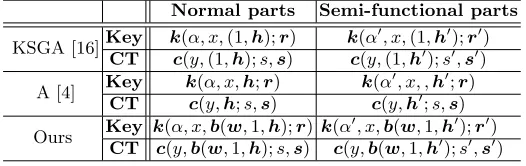
Normal parts Semi-functional parts
KSGA [16]Key k(α, x,(1,h);r) k(α 0
, x,(1,h0);r0)
CT c(y,(1,h);s,s) c(y,(1,h0);s0,s0) A [4] Key k(α, x,h;r) k(α
0
, x, ,h0;r)
CT c(y,h;s,s) c(y,h0;s,s) Ours Key k(α, x,b(w,1,h);r) k(α
0
, x,b(w,1,h0);r0)
CT c(y,b(w,1,h);s,s) c(y,b(w,1,h0);s0,s0)
Fig. 1.Comparisons of normal and semi-functional pars in encoding frameworks
generatorg such as gd in the instances of an assumption andh0 andh00 are values generated by
the simulator. This setting is essential to hide the values of h0 which are projected and forms common variables in semi-functional parts. However, it is available only if the linear operation in common variables such as addition is possible because the simulator cannot explicitly computeh as the valuedis only given as a form ofgd. For example, a normal ciphertextgc(·,(·,h),·)can only be computed by (gd)c(·,(·,h0),·)gc(·,(·,h00),·) using the linearity in common variables.
In our framework, the exponents of public parameters are more complex monomials, but the simulator still can hide common variable before they are projected into semi-functional parts using therelaxed linearity in hidden common variables property. For example, we can define therelaxed linearity forEnc1usingrelaxed linearity in hidden common variables as
k(α, x,b(w, b0,h);r) +k(α0, x,b(w, b00,h
0);r) =k(α+α0, x,b(w, b
0+b00,h+h
0);r)
where x is a predicate; α and α0 are values denote master secret; and r are random values for the security anlaysis. Therefore, this property allows the simulator to set a monomial fi(w)hj =
dfi(w)h00j+fi(w)h0j similarly to Kim et al.’s compiler and projectsfi(w)h0jinto the semi-functional space to form a semi-functional key as shown in Fig. 1.
There exists another compiler potentially work in our encodings from Attrapadung [4]. Their compiler is secure under the matrix DH assumption which can be reduced to the standardDLIN. In their security analysis, the common values can be projected without correlating with their original values, but random variables are shared between normal parts and semi-functional parts as we show in Fig. 1. Due to this limitation, they redefined the pair encoding toregular encoding with extra structural restrictions. Due to these restrictions, considering non-linearity with the regular encoding is quite complex and our motivation is easing the structural restrictions of pair encoding. Because Kim et al.’s technique provides more flexible structure to PE and their security is also secure under static and simple assumptions, we utilize their compiler as a backbone of our compiler.
Refined computational αhidingIn our setting, the values ofware not hidden. Those values are projected into semi-functional parts byfi(w), but the projected values are identical with their original values as shown in Fig. 1. Sharingwis not typical in the dual system encryption because it means w must be defined and fixed when a system sets up, which is not required in the dual system encryption.
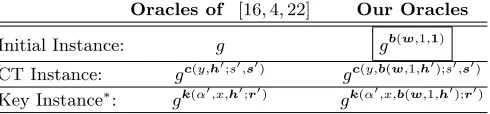
We address this problem by redefining computationalαhiding property of pair encoding frame-work. We use two oracles which are indistinguishable to each other to simulate the refined compu-tational hiding property. In our setting, the oracles output shared common variablesw by include
gb(w,1,1) in initial instances so that the simulator create public keys and normal parts of private keys usingw. It is worth noting that the oracles in the other techniques [16, 4] only output a group generatorgin an initial instance. Fig. 2 shows that the difference of our oracles.
Oracles of [16, 4, 22] Our Oracles
Initial Instance: g gb(w,1,1)
CT Instance: gc(y,h0;s0,s0) gc(y,b(w,1,h0);s0,s0)
Key Instance∗: gk(α0,x,h0;r0) gk(α0,x,b(w,1,h0);r0)
∗
:α0 is either a random value or 0
Fig. 2.Our Refined Computationalα-hiding
However, we observed that, even in selective security proofs, some common variables can be set without using any information of the target predicate or some existing selective security proofs can be easily modified to set a part of common variables without knowing the target predicate. This allows us to use the variables independently created from the target predicate as shared common variables and build the oracles because selecting which common variables to be hidden or shared is quite flexible in our framework. This implies that we still can prove the refined computationalα
hiding property based on existing selective proofs as the other existing pair encoding schemes do. We show that achieving those oracles is feasible providing new instances such as attribute-based encryption schemes supporting non-monotonic access structures .
2
Related Work
Conjunctive schemes with ABE with monotonic access structures and identity based revocation systems were introduced for a revocation [6, 23] to fill the gap between practice and theory when a practical ABE scheme with non-monotonic access structures was absence. In those schemes, only a special attribute such as identity can be used to revoke users and the attribute for the revocation cannot be reused in an access policy. Inner product encryption [14, 24, 7, 25] naturally achieves a non-monotonic access structure using polynomials. However, expressing a Boolean formula using inner product is less efficient than ABE schemes. A technique to feature encryption schemes in composite order groups into prime order groups were introduced by Lewko [17] using Dual Pairing Vector Spaces (DPVS) [24, 25]. However, their conversion technique is not generic and the efficiency of a converted scheme linearly increases in the size of vector it uses. Dual System Groups (DSG) [12] were recently introduced. Chen and Wee showed that DSG can be utilized to construct a wide range of encryption schemes in prime order groups. Many generic constructions [11, 1, 4] for encoding schemes in prime order groups utilize DSG except Kim et al.’s work [16]. Instead of using DSG, Kim et al.[16] generalized the Lewko and Waters’ IBE [20] to construct the general construction.
3
Preliminary
3.1 Bilinear Maps
LetG be a group generator which takes a security parameterλas input and outputs (p,G1,G2,
GT,e), G1,G2 andGT are cyclic groups of prime orderp, ande:G1×G2→GT is a map such that e(ga, hb) = e(g, h)ab for allg ∈ G
1 h ∈ G2 and a, b∈ Zp and e(g, h) 6= 1 ∈ GT whenever
g6= 1 andh6= 1. We assume that the group operations inG1,G1 andGT as well as the bilinear mapeare all computable in polynomial time with respect toλ. It should be noted that the map
eis symmetric ifG1=G2. IfG16=G2, the mapeis asymmetric.
3.2 Non-monotonic access Structure
Definition 1(Access Structure) [9] Let{P1, ..., Pn}be a set of parties. A collectionA⊂2{P1,...,Pn} is monotone if∀B, C: ifB∈AandB ⊂C, thenC∈A. A monotonic access structure is a mono-tone collectionAof non-empty subsets of {P1, ..., Pn}, i.e.,A⊂2{P1,...,Pn}\ {}. The sets in
called the authorized sets, and the sets not inAare called the unauthorized sets.
Definition 2(Linear Secret-Sharing Schemes (LSSS)) [9] A secret sharing schemeΠ over a set of partiesP is called linear (over Zp) if (1) The shares for each party form a vector overZp. (2) There exists a matrixA called the share-generating matrix for Π. The matrix A has mrows and
` columns. For all i= 1, ..., m, the ith row of A is labeled by a party ρ(x) (ρ is a function from {1, ..., m}toP). When we consider the column vectorv= (s, r2, ..., r`), where s∈Zp is the secret to be shared and r2, ..., r` ∈ Zp are randomly chosen, then Av is the vector of m shares of the secret s according toΠ. The share(Av)i belongs to party ρ(x).
Moving from monotone to non-monotonic access structures For a non-monotonic access structure, we adopt a technique from Ostrovsky, Sahai and Waters [27]. They assume a family of linear secret sharing schemes{ΠA}A∈A for a set of monotonic access structuresA∈ A. For each access structure A∈ A, the set of parties P underlying the access structures has the following properties: The names of the parties may be of two types: either it is normal (like x) or primed (likex0), and ifx∈ P thenx0∈ P and vice versa. They conceptually associate primed parties as representing the negation of normal parties.
We let ˜Pdenote the set of all normal parties inP. For every set ˜S⊂P,˜ N( ˜S)⊂ Pis defined by
N( ˜S) = ˜S∪{x0|x∈P˜\S˜}. For each access structureA∈ Aover a set of partiesP, a non-monotonic access structureN M(A) over the set of parties ˜P is defined by specifying that ˜S is authorized in
N M(A) iff N( ˜S) is authorized in A. Therefore, the non-monotonic access structureN M(A) will have only normal parties in its access sets. For each access setX ∈N M(A), there will be a set in Athat has the elements in X and primed elements for each party not inX. Finally, a family of non-monotonic access structures ˜Ais defined by the set of theseN M(A) access structures.
3.3 Computational Assumptions
Our compiler needs three simple static assumptions which are also used in [16, 20]. For the following assumptions, we define G = (p, G1, G2, GT, e)
R
←− G and let f1 ∈ G1 and f2 ∈ G2 be selected randomly.
Assumption 1(LW1) Leta, c, d∈Zp be selected randomly. Given
D:={f1, f1a, f ac2 1 , f
c 1, f
c2 1 , f
c3 1 , f
d 1, f
ad 1 , f
cd 1 , f
c2d 1 , f
c3d
1 ∈G1, f2, f2c∈G2}, it is hard to distinguish betweenT0=fac
2d
1 and T1 R ←−G1.
Assumption 2(LW2) Letd, t, w∈Zp be selected randomly. Given
D:={f1, f1d, f d2
1 , f tw 1 , f
dtw 1 , f
d2t
1 ∈G1, f2, f2c, f d 2, f
w 2 ∈G2}, it is hard to distinguish betweenT0=f2cw andT1
R ←−G2.
Assumption 3 (Decisional Bilinear Diffie-Hellman (DBDH) Assumption) Let a, c, d ∈ Zp be selected randomly. Given
D:={f1, f1a, f c 1, f
d
1 ∈G1, f2, f2a, f c 2, f
d 2 ∈G2}, it is hard to distinguish betweenT0=e(f1, f2)acd andT1
R ←−GT.
3.4 Predicate Encryption
We adopt the definition of PE and its adaptive security of [2].
Setup(1λ, κ)→(P K, M SK): The algorithm takes in a security parameter 1λand an indexκwhich is allocated uniquely for the function R. It outputs a public parameter P K and a master secret keyM SK.
Encrypt(x, M, P K)→CT: The algorithm takes in a predicatex∈ X, a public parameterP Kand a plaintextM. It outputs a ciphertextCT.
KeyGen(y, M SK, P K) → SK: The algorithm takes in a predicate y ∈ Y, M SK and P K. It outputs a private keySK.
Decrypt(P K, SK, CT) → M: the algorithm takes inSK for y andCT forx. IfRκ(x, y) = 1, it outputs a messageM ∈ M. Otherwise, it aborts.
Correctness.For all (x, y)∈ X ×Ysuch thatRκ(x, y) = 1, ifSKis the output ofKeyGen(y, M SK, P K) andCT is the output ofEncrypt(x, M, P K) whereP K andM SKare the outputs ofSetup(1λ, κ), Decrypt(SK, CT)outputsM for allM ∈ M.
Definition of Adaptive Security of Functional Encryption [2]. A functional encryption for a functionRκ is adaptively secure if there is no PPT adversaryAwhich has a non-negligible advantage in the game betweenAand the challenge Cdefined below.
Setup :C runsSetup(1λ, κ) to create (PK, MSK). PK is sent toA.
Phase 1 :Arequests a private key foryi ∈ Yandi∈[q1]. For eachyi,CreturnsSKi created by runningKeyGen(yi, M SK, P K).
Challenge : WhenArequests the challenge ciphertext ofx∈ X, forRκ(x, yi) = 0;∀i∈[q1], and submits two messagesM0 andM1,C randomly selectsbfrom{0,1}and returns the challenge ciphertextCT created by runningEncrypt(x, Mb, P K).
Phase 2 : This is identical with Phase 1except for the additional restriction that yi ∈ Y for
i=q1+ 1, ..., qtsuch thatRκ(x, yi) = 0;∀i∈ {q1+ 1, ..., qt}
Guess :Aoutputsb0 ∈ {0,1}. Ifb=b0, thenAwins.
We define an adversaryA’s advantage asAdvP E
A (λ) :=|Pr[b=b0]−1/2|.
4
Our Encoding Framework
In this section, we introduce our new encoding framework. We largely take a notion of pair encoding framework to describe our encoding. However, our encoding framework can capture the predicate family that requires non-linear parameters.
4.1 Syntax
Our encoding scheme for a predicateRκin prime orderpconsists of four deterministic algorithms Param,Enc1,Enc2andPair.
Param(κ) →(b := (b1, b2, ..., bω);ω1, ω2, ω): It takes as input a predicate family κ and outputs integersω1, ω2, ω∈pand a sequence of monomials{bi}i∈[ω]∈Zpwith the sequence of variables of{b0, hj;hj∈h}and functionsfiwhereb0∈Zp,h∈Zω2
p andfi(w) is a monomial consisting of the elements ofw ∈Zω1
p . That is, for all i∈[ω], bi =b0fi(w) orfi(w)hj.bshared by the following two algorithms Enc1 andEnc2. We letw= (w1, ..., wω1) denote the shared common
variables and h = (h1, ..., hω2) denote the hidden common variables. b0 is a variable for the
linearity? ? ?.
Enc1(x ∈ X) → (k := (k1, k2, ..., km1);m2): It takes as inputs a predicate x and outputs a
sequence of polynomials {ki}i∈[m1] with coefficients in Zp, and m2 ∈ Zp where m2 is the
number of random variables. Every polynomialkiis a linear combination of monomials of the form α, rib0, αbj, ribj in variablesα, r1, ..., rm2 andb0, b1, ..., bω. In more detail, fori∈[m1],
ki:=δiα+Pj∈[m2]δi,jrjb0+Pj∈[m2],k∈[ω]δi,j,krjbk
? ? ? b
where δi, δi,j, δi,j,k∈Zp are constants which defineki.
Enc2(y∈ Y)→(c:= (c1, c2, ..., cm˜1); ˜m2): It takes as inputs a predicateyand outputs a sequence
of polynomials {ci}i∈[ ˜m1] with coefficients in Zp, and ˜m2 ∈ Zp where ˜m2 is the number of
random variables. Every polynomial ci is a linear combination of monomials of the form
sb0, sib0, sbj, sibj in variabless, s1, ..., sm˜2 andb0, b1, ..., bω. In more detail, fori∈[ ˜m1],
ci :=φis b0+Pj∈[ ˜m2]φi,jsjb0+
P
j∈[ ˜m2],k∈[ω]φi,j,ksjbk
where φi, φi,j, φi,j,k∈Zp are constants which defineci.
Pair(x, y)→E: It takes inputsx∈ X andy∈ Y. It outputsE∈Zm1×m˜1
p .
Correctness: The correctness holds symbolically whenb0= 1. if Rκ(x, y) = 1, for every (x, y)∈ X × Y such thatRκ(x, y) = 1, there exists E ∈ Zm1×m˜1
p satisfyingkEc> =αswhere kEc> = P
i∈[m1],j∈[ ˜m1]Ei,jkicj. 4.2 Properties
We describe properties that our encodings have.
Property 1. (Relaxed linearity in hidden common variables)Supposew,r,s ands are fixed, our encodings are linear in α and h for all (α, b0,h) ∈ Zp×Zp ×Zω2
p . That is, for all
α, α0, b
0, b00∈Zp,h,h0∈Zω2
p , the followings hold:
k(α, x,b(w, b0,h);r) +k(α0, x,b(w, b00,h0);r) =k(α+α0, x,b(w, b0+b00,h+h0);r) c(y,b(w, b0,h);s,s) +c(y,b(w, b00,h
0);s,s) =c(y,b(w, b
0+b00,h+h
0);s,s)
Property 2. (Linearity in random variables)Supposew andhare fixed, our encodings are linear in α, s, r and s for all (α, s, r, s)∈ Zp×Zp×Zm2
p ×Zmp˜2. That is, for all α, α0, s, s0 ∈ Zp,r,r0∈Zm˜2
p and s,s0∈Zmp˜2, the followings hold:
k(α, x,b(w, b0,h);r) +k(α0, x,b(w, b0,h);r0) =k(α+α0, x,b(w, b0,h);r+r0)
c(y,b(w, b0,h);s) +c(y,b(w, b0,h);s0) =c(y,b(w, b0,h);s+s0) wherew, b0,h∈Zω1
p ×Zp×Zω2
p .
Property 3. (Parameter Vanishing) For all α, b0, b00 ∈ Zp,w,w0 ∈ Zω1
p ,h,h
0 ∈
Zω2
p , there exists0∈Z2k+1p which makes following two distributions are statistically identical:
k(α, x,b(w, b0,h);0) andk(α, x,b(w, b00,h
0);0).
Property 4. (Computational α hiding) We let g1 ∈ G1 and g2 ∈ G2 be selected randomly. For all (x, y)∈ X × Y such thatRκ(x, y) = 0, the following two distributions arecomputationally indistinguishable:
{g1b(w,1,1), g2b(w,1,1), g1c(y,(b(w,1,h);s,s), g2k(α,x,b(w,1,h);r)} ≈ {g1b(w,1,1), g2b(w,1,1), g1c(y,(b(w,1,h);s,s), g2k(0,x,b(w,1,h);r)} whereα, s←R−Zp,w
R ←−Zω1
p ,h R ←−Zω2
p ,r R ←−Zw2
p ands R ←−Zm2
p . To prove the computational α hiding, we define oracles OCos
β and OSelβ where β = {0,1}. OCos
β and O Sel
β simulates computational α hiding for Phase I (Co-selective Security) and Phase II (Selective Security) of the adaptive security model, respectively. The responses of oracles are defined following:
• c-type response:g1c(y,b(w,1,h);s,s)
Oracles for co-selective SecurityOCos
β : When the oracle receives an initial query before it receives any other query, it outputs the initial instance After the initial instance, the oracle only can respond to thek-type query. When the oracle receives the k-type query for a predicatex, it sends thek-type response. After it responds, it can respond to thec-type query for a description
y ifRκ(x, y) = 0. When the oracle receives thec-type query fory, it outputs thec-type response.
Oracles for selective SecurityOSel
β : This oracle is identical to OCosβ except the order of the responses. This oracle first outputs the initial instance. Then, it outputs thek-type response before thec-type response.
4.3 The Compiler
For a predicate familyRκ:X ×Y → {0,1}and its encodingE(Rκ, p), A PE schemeP E(E(Rκ, p)) consists of four algorithmsSetup,KeyGen,EncryptandDecrypt. We use subscripts to denote where group elements belong (e.g.g1∈G1,g2∈G2).
• Setup(1λ, κ)→ hP K, M SKi. The setup algorithm randomly chooses bilinear groups G= (p, G1, G2, GT) of prime orderp >2λ. It takes group generatorsg1
R ←−G1, g2
R
←−G2 fromG. It executes (b, ω1, ω2, ω) ← Param and sets b0 = 1. It randomly selectsα, a, yu, yv, yf ∈Zp, w∈Zω1
p andh∈Zωp2. It setsτ =yv+a·yu. It publishes public parameters (PK) as {e(g1, g2)α, g1, g1a, g
τ 1, g
b(w,1,h)
1 , g
a·b(w,1,h)
1 , g
τ·b(w,1,h)
1 }.
It sets MSK as {α, g2, g
b(w,1,h) 2 , f2=g
yf
2 , u2=f yu 2 , v2=f
yv 2 }.
• KeyGen(x, M SK)→SK. The algorithm takes as inputs x∈ X andM SK . To generate SK, it runs (k;m2)← Enc1 and randomly selects r∈Zm2
p and z ∈Zmp1 where m1 =|k|. It parsesαfrom MSK and outputsSK:= (D1,D2,D3) following:
D1=gk2(α,x,b(w,1,h);r)vz
2, D2=uz2,D3=f
−z
2 .
• Encrypt(M, y, P K)→CT. The algorithm takes as inputs y ∈ Y, a messageM and P K. It runs (c; ˜m2) ← Enc2 and randomly selects s ∈ Zp and s ∈ Zm˜2+1
p . The algorithm sets
C0=M·e(g1, g2)αs and outputsCT := (C0,C1,C2,C3) following: C1=g
c(y,b(w,1,h);s,s)
1 ,C2= (g1a)c(y,b(w,1,h);s,s),C3= (gτ1)c(y,b(w,1,h);s,s).
• Decrypt(x, y, SK, CT)→M. It takes as inputsSK forx∈ X andCT for y ∈ Y. It runs
E←Pair(x, y) and computes
A1=e(CE >
1 ,D1), A2=e(CE >
2 , D2), A3=e(CE > 3 ,D3). SupposeRκ(x, y) = 1,A1·A2·A3=e(g1, g2)αs. It outputsM =C0/e(g1, g2)αs.
Correctness For (x, y)∈ X × Y such that Rκ(x, y) = 1,E is a reconstruction matrix E such thatcEk> =αsbecauseb0= 1. Therefore, we can compute followings:
A1=e(CE >
1 ,D1) =e(g1, g2)cE >k>
e(g1, v2)cE >z>
=e(g1, g2)αse(g1, v2)cE >z>
A2=e(CE >
2 ,D2) =e(g1, u2)a·cE >z>
, A3=e(CE >
3 ,D3) =e(g1, f2)−τ·cE >z>
Theorem 1. Suppose the assumptions LW1, LW2 and DBDH hold inG, for all encodingE(Rκ, p) with a predicate family Rκ and a primep,P E(E(Rκ, p))is adaptively secure. Precisely, for any PPT adversary A, there exist PPT algorithms B1,B2,B3,B4 andB5, whose running times are the same asAsuch that, for any λ,
AdvAF E(P)(λ)≤wt·AdvB1LW1(λ) + 2·mt·AdvLWB2 2(λ) +AdvLWB3 3(λ)
+q1·AdvOB4CM H(λ) +q2·AdvB5OSM H(λ)
whereq1 andq2are the numbers of key queries in phases I and II, respectively, and mtis the total number of random variables used to simulate all private keys and wt is the number of random variables used in the challenge ciphertext.
5
Security Analysis
We define the semi-functional (SF) algorithms to security proofs. To create various types of keys and the challenge ciphertext, the simulator first randomly selects h0 ∈ Zω2
p which is shared in semi-functional algorithms.
SFKeyGen(x, M SK,h0, j, α0) → SK : The algorithm takes as inputs the master secret key
M SK, x∈ X andj ∈[m2]. Then, the algorithm selects α0 R
←−Zp and ˜rj R ←−Zm2
p of which the firstj elements are random variables and the others are 0. It also creates a normal key (D1,D2, D3) usingKeyGen. It outputsSK:=hD01,D02,D03ifollowing:
D01=D1·f−ak(α
0,x,b(w,1,h0);˜r j)
2 ,D
0
2=D2·f
−τk(α0,x,b(w,1,h0);˜rj)
2 ,D
0
3=D3 We define the type of SK as follows:
The type of SK :
Nominally semi-functional (NSF) ifα0 = 0
Temporary semi-functional (TSF) ifα0 6= 0 andj6= 0 Semi-functional (SF) ifα0 6= 0 andj= 0
In particular, in SF keys, ˜r0 equals the zero vector 0 by the definition. Due to the parameter vanishing property, it does not requireh0 as the inputs and we can rewrite SK as follows:
D01=D1·f−ak(α
0,x,b(w,0,00);0)
2 ,D
0
2=D2·f
−τk(α0,x,b(w,0,00);0)
2 .
SFEncrypt(M, y, P K,h0, j)→CT : The algorithm takes as inputs a messageM, the public key
P K and a descriptiony∈ Yandj∈[w2+ 1]. It setsf1=g yf
1 andu1=f1yu. It generates a normal ciphertext (C0,C1,C2,C3). Ifj= 0, it selects ˜s
R
←−Zp. The algorithm setsC00 =C0 and outputs
CT following:
C01=C1, C02=C2·f
c(y,b(w,1,h0);˜s,0)
1 , C
0
3=C3·u1c(y,b(w,1,h 0);˜s,0)
.
If j > 0, it selects a random value ˜s ←R−Zp and a random vector ˜sj R ←− Zw2
p where the first j elements are random variables and the others are 0. The algorithm then setsC00 =C0and outputs
CT :=hC00,C01,C02,C03iwhere C01=C1, C02=C2·f
c(y,b(w,1,h0);˜s,˜s j−1)
1 , C
0
3=C3·u1c(y,b(w,1,h 0);˜s,˜s
j−1).
In particular, we callCT a semi-functional (SF) ciphertext ifj= ˜m2.
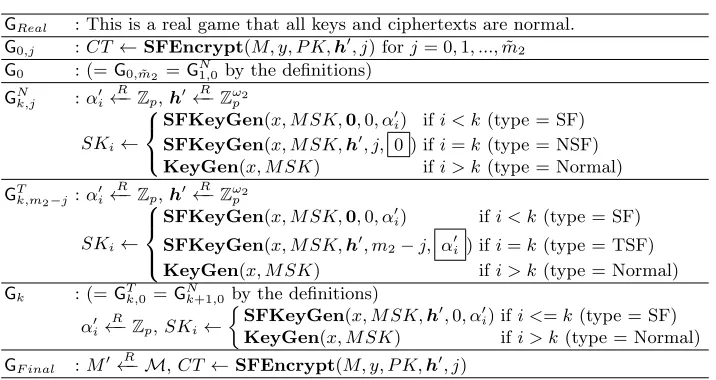
We describe the security games that we use for the security proof in Table 2. In the proof, we will show that all games in Table 2 are indistinguishable.
The most critical part among them is the invariance between games GN
k,m2 and G
T
k,m2 where
Table 2.Games for Security Analysis
GReal : This is a real game that all keys and ciphertexts are normal. G0,j :CT←SFEncrypt(M, y, P K,h0, j) forj= 0,1, ...,m˜2 G0 : (=G0,m˜2 =G
N
1,0 by the definitions) GN
k,j :α
0 i
R
←−Zp,h0 R
←−Zωp2
SKi←
SFKeyGen(x, M SK,0,0, α0i) ifi < k(type = SF) SFKeyGen(x, M SK,h0, j, 0 ) ifi=k(type = NSF)
KeyGen(x, M SK) ifi > k(type = Normal) GTk,m2−j:α
0 i
R
←−Zp,h0 R
←−Zωp2
SKi←
SFKeyGen(x, M SK,0,0, α0i) ifi < k(type = SF) SFKeyGen(x, M SK,h0, m2−j, α0i ) ifi=k(type = TSF)
KeyGen(x, M SK) ifi > k(type = Normal)
Gk : (=GTk,0 =G N
k+1,0 by the definitions)
α0i R
←−Zp, SKi←
SFKeyGen(x, M SK,h0,0, α0i) ifi <=k(type = SF) KeyGen(x, M SK) ifi > k(type = Normal) GF inal :M0←R− M,CT ←SFEncrypt(M, y, P K,h0, j)
k≤q1 or k > q1 where the q1 is the number of key queries that the adversary requests before it requests the challenge ciphertext. We provide the proofs of those two cases in Lemmas 3 and 4.
Lemma 1.1.Suppose there exists a PPTAwho can distinguishGRealandG0,0with non-negligible advantage. Then, we can build an algorithm B which breaks LW1 with the advantage using A.
Proof:In this proof, given instance fromLW1
{f1, f1a, f ac2 1 , f
c 1, f
c2 1 , f
c3 1 , f
d 1, f
ad 1 , f
cd 1 , f
c2d 1 , f
c3d
1 , T ∈G1, f2, f2c∈G2},
B will simulate eitherGameReal or Game0,0 depending on the value of T using A to break the assumption.
Setup:For the predicate family with an index κ,B runParam(κ)to generate b, ω1, ω2 and ω. It, then, randomly selectsα, yg, yu∈Zp,w∈Zw1
p ,h
0,h00∈
Zw2
p and it sets
g1=fc
2
1 f yg 1 , g
h
1 = (f c2 1 )
h0fh00
1 , g a 1 =f
ac2 1 (f
a 1)
yg, ga·h 1 = (f
ac2 1 )
h0(fa 1)
h00
g2α= (f2c2)αfαyg
2 , g2=fc
2
2 f yg 2 , g
h
2 = (f c2
2 )
h0fh00
2 , g b
2=f2, v2=f2c, u2=f yu 2 . The values ofhare set implicitly bygh
1 =f
(c2h0+h00)
1 since the simulator does not know the value ofc2. Also, it implies that τ=c+ay
u,yv=c andyf−1=c2+yg. It publishes public parameters as follows:
P K :={e(g1, g2)α=e(fc
3
1 , f c 2)
αe(fc2
1 , f2)2α·yge(f1, f2)α·y
2
g, g1, ga 1,
g1τ =f1c3(f1ac2)yu(fc 1)
yg(fa 1)
yuyg, gb(w,1,h)
1 = (f
c2
1 )
b(w,1,h0)
fb(w,yg,h00)
1 ,
g1a·b(w,1,h)= (f1ac2)b(w,1,h0)(f1a)b(w,yg,h00),
gτ1·b(w,1,h)= (f1c3)b(w,1,h 0)
(f1c)b(w,yg,h 00)
(f1ac2)yu·b(w,1,h 0)
(f1a)yu·b(w,yg,h 00)
}.
Becausefc2
2 is not given,Bcannot explicitly generateM SK. But, we show thatB still properly-generates a privates key forx∈ X only usingfc
2 inPhase I/II.
Phase I/II:To generate a normal private key for x∈ X,Brandomly selectsz0∈Zmk
p andr∈ Rr wheremk =|k(α, x,b(w,1,h0);r)|. It, then, implicitly sets
z is randomly distributed due toz0.Bcan create normal key as follows:
K0=fk(αyg,x,b(w,yg,h00);r)
2 ·(f
c 2)
z0
K1=fyuz0 2 (f
c 2)
−yuk(α,x,b(w,1,h0),r),K2=f−z0 2 (f
c 2)
k(α,x,b(w,1,h0),r).
K0,K1 andK2 can be calculated sincef2c is given. Also, they are properly distributed since
K0=fk(αyg,x,b(w,yg,h00);r)
2 ·f
cz0
2
=fk(αyg+αc2,x,b(w,yg+c2,h00+c2h0);r)
2 ·f
−k(αc2,x,b(w,c2,c2h0);r)
2 f
cz0
2 (1)
=g2k(α,x,b(w,1,h);r)·fc(z
0−k(αc,x,b(w,c,c·h0),·r))
2 (2)
=g2k(α,x,b(w,1,h);r)·vz2.
The equalities (1) and (2) hold because of relaxed linearity in hidden common variables prop-erty.
Challenge: When the adversary asks the challenge ciphertext with messagesM0 and M1. B ran-domly choosesβ∈ {0,1}and randomly selectss1, ..., sm˜2 ∈Zp. It setss=dands= (s1, ..., sm˜2).
The value ofdhas never been used. Therefore, settings=dis hidden to the adversary. It creates the challenge ciphertext as
C=Mβ·e(fc
3s
1 , f c 2)
αe(fc2s
1 , f2)2α·yge(f1s, f2)α·y
2
g, C0=(fc
2
1 )
c(y,b(w,1,h0);0,s)
fc(y,b(w,yg,h00);0,s)
1 (f
c2d
1 )
c(y,b(w,1,h0);1,0) ·(f1d)c(y,(b(w,yg,h00);1,0)
C1=(fac
2
1 )c(y,b(w,1,h 0);0,s)
Tc(y,b(w,1,h0);1,0)(f1a)c(y,b(w,yg,h 00);0,s) ·(f1ad)c(y,b(w,yg,h00);1,0)
and setsC2=Cc0·Cyu
1 .C0andC1can be calculated by the given instances. Also,C2is calculable sincefc
1, f1cd, fc
3
1 andfc
3d
1 are given in the instance. If T = fac2d
1 , the challenge ciphertext is normal and generated using KeyGen. Hence, the algorithm has properly simulatedGameReal. Otherwise, ifT is a random value, we useT =fac
2d
1 f1s˜ to denote it. Then, fc(y,b(w,1,h
0);˜s,0)
1 appears in the challenge ciphertext, which is identical with the output ofSFEncrypt(M, y, P K,h0,0) and Game0,0has been simulated.
2
Lemma 1.2. Suppose there exists a PPT A who can distinguish G0,i−1 and G0,i for i ∈ [ ˜m2] with non-negligible advantage where w2 is the number of random variables that the challange ciphertext has. Then, we can build an algorithmBwhich breaksLW1 with the advantageusing A.
Proof:This lemma is almost identical with Lemma 1.1. except Challenge.B simulatesChallenge as follows:
Challenge: When the adversary asks the challenge ciphertext with messagesM0 and M1. B ran-domly chooses β ∈ {0,1} and randomly selectss, s1, ..., si−1, si+1, ..., sm˜2, s
0, s0
1, ..., s0i−1 ∈Zp. It sets s = (s1, ..., si−1, d, si+1, ..., sm˜2) and s
0
as
C=Mβ·e(fc
3s
1 , f c 2)
αe(fc2s
1 , f2)2α·yge(f1s, f2)α·y
2
g, C0=(f1c2)c(y,b(w,1,h0);s,s−d·1i)(fc2d
1 )
c(y,b(w,1,h0);0,1i)fc(y,b(w,yg,h00);s,s−d·1i)
1 ,
·(f1d)c(y,(b(w,yg,h00);0,1i)
C1=(f1ac2)c(y,b(w,1,h0);s,s−d·1i)Tc(y,b(w,1,h0);0,1i)(fa 1)
c(y,b(w,yg,h00);s,s−d·1i) ·(f1ad)c(y,b(w,yg,h00);0,1i)fc(y,b(w,1,h
0),s0,s0 i−1)
1 and setsC2=Cc0·C
yu
1 where 1i is a vector of which only theith coordinate is 1 and all other coordinates are 0. It should be noted thats−d·1iis equal to (s1, ..., si−1,0, si+1, ..., sm˜2). Hence,
it does not havedas a coordinate. Therefore,C0andC1can be calculated by the given instances. Also,C2 is calculable sincefc
1, f1cd, fc
3
1 andfc
3d
1 are given in the instance. •IfT =f1ac2d, the challenge ciphertext is the normal challenge ciphertext since
C1= (fac
2
1 )
c(y,b(w,1,h0);s,s−d·1 i)fac
2dc(y,b(w,1,h0);0,1i)
1 (f
a 1)
c(y,b(w,yg,h00);s,s−d·1i) ·(f1ad)c(y,b(w,yg,h00);0,1i)fc(y,b(w,1,h
0),s0,s0 i−1)
1
=f1a·c(y,b(w,c2,c2h0);s,s)fa·c(y,b(w,yg,h00);s,s)
1 f
c(y,b(w,1,h0),s0,s0i−1) 1
=fa·c(y,b(w,c
2+y
g,c2h0+h00);s,s)
1 f
c(y,b(w,1,h0),s0,s0 i−1)
1 =g1a·c(y,b(w,1,h),s,s)fc(y,b(w,1,h
0),s0,s0 i−1)
1 (3)
•IfT is random value and we letT =fac2d
1 f
γ 1,
Tc(y,b(w,1,h0);0,1i)=fac
2d·c(y,b(w,1,h0);0,1i)
1 f
c(y,b(w,1,h0);0,γ·1i) 1
Therefore,fc(y,b(w,1,h
0);0,γ
·1i)
1 is multiplied to (3). It means that C1=g1a·c(y,b(w,1,h),s,s)fc(y,b(w,1,h
0),s0,s0 i−1)
1 f
c(y,b(w,1,h0);0,γ·1i) 1
=g1a·c(y,b(w,1,h),s,s)fc(y,b(w,1,h
0),s0,s0 i−1+γ1i) 1
=ga1c(y,b(w,1,h),s,s)fc(y,b(w,1,h0),s0,s0i) 1
wheres0i= (s01, ..., s0i−1, γ,0, ...0). Therefore, ifT=fac2d
1 , the challenge ciphertext is generated usingSFEncrypt(M, y, P K,h
0, i
− 1) and Game0,i−1 has been simulated. Otherwise, the challenge ciphertext is generated using SFEncrypt(M, y, P K,h0, i) andGame0,i has been simulated. 2
Lemma 2.Suppose there exists a PPTAwho can distinguishGNk,j−1 andGNk,j forj∈[m2] with non-negligible advantagewherem2 is the size of random variables that thekth key uses. Then, we can build an algorithmB which breaksLW2 with the advantageusingA.
Proof:Using the given instance{f1, f1d, fd
2
1 , f1tw, f1dtw, fd
2t
1 ∈ G1, f2, f2c, f2d, f2w, T ∈G2},B will simulate eitherGameN
k,j−1or GameNk,j usingAto breakLW2. Setup: B randomly chooses α ∈ Zp, a, y0v ∈ Zp,w ∈ Zωp1,h
0,h00 ∈
Zωp2. It implicitly sets yv =
d−aw+y0v,yu=w,b= 1/dandτ =d−aw+yv0 +aw=d+y0v. It publishes a public key as
P K =:{e(g1, g2)α=e(f1d, f2d)α, g1=f1d,
gb1(w,1,h)= (f1d)b(w,1,h0)fb(w,0,h
00)
1 , g
a 1, g
a·b(w,1,h)
1 , g
τ 1 =f
d2 1 (f
d 1)
g1τ·b(w,1,h)= (f1d2)b(w,1,h0)(f1d)b(w,0,h00)(f1d)y0vb(w,1,h 0)
(f1)y 0 vb(w,0,h
00) }.
Then, it sets
M SK:={g2=f2d, g α 2 = (f
d 2)
α, gb(w,1,h)
2 = (f
d 2)
b(w,1,h0)fb(w,0,h00)
2 ,
v2=f2d(f w 2)
−afy0v
2 , u2=f2w, f2}.
Phase I and II:The algorithm knows all MSK. Therefore, it can create the normal keys for (> k). For the firstk−1 key (< k),Bfirst generates a normal key. Then, it randomly selectsα0 fromZp and creates an SF key. This is possible sinceBknowsa, α0, xandf2.
For the kth key, it randomly selects z0 from
Zmk
p where mk = |k| and sets z = z0 +c· k(0, x,b(w,1,h0);1j) where 1j is a vector of which only the jth coordinate is 1 and all other coordinates are 0. Then, it randomly chooses r00 from Rr and sets r = r00−c·1j. z and r are randomly distributed because of z0 and r00. It also generates r10, ..., rj0−1 from Zp and sets r0j−1= (r10, ..., rj0−1,0,0,0)∈ Rr.
K0=(f2d)k(α,x,b(w,1,h 0);r00)
fk(0,x,b(w,0,h
00);r00)
2 (f
c
2)−k(0,x,b(w,0,h 00);1j) ·(f2d(f2w)−afy
0 v 2 )
z0T−ak(0,x,b(w,1,h0);1j)(fc 2)
yv0k(0,x,b(w,1,h0);·1j) ·f−ak(0,x,b(w,1,h
0);r0 j−1)
2 ,
K1=(f2w)z0Tk(0,x,b(w,1,h0);1j)fk(0,x,b(w,1,h
0);r0 j−1)
2 ,
K2=f−z 0 2 (f
c 2)−
k(0,x,b(w,1,h0),1j) IfT =fcw
2 , then this key is a properly distributed nominally semi-function (NSF) key created usingSFKeyGen(x, M SK,h0, j−1,0) since
K0= (f2d)
k(α,x,b(w,1,h0);r00)fk(0,x,b(w,0,h00);r00)
2 (f
c 2)−
k(0,x,b(w,0,h00);1j) ·(f2d(f2wa)−1fy0v
2 )
z0
(fcw)−ak(0,x,b(w,1,h0);·1j)(fc 2)
y0
vk(0,x,b(w,1,h0);·1j) ·f−ak(0,x,b(w,1,h
0);r0 j−1)
2
=f2d·k(α0,x,b(w,1,h0);r00)fd·k(0,x,b(w,1,h
0);
−c·1j)
2 f
k(0,x,b(w,0,h00);r00) 2
·fk(0,x,b(w,0,h
00);
−c·1j)
2 f
(d−wa+y0v)(z0)
2 f
d·k(0,x,b(w,1,h0);c·1j) 2
·f−wa·k(0,x,b(w,1,h0);c·1j)
2 f
y0
v·k(0,x,b(w,1,h0);c·1j)
2 f
−a·k(0,x,b(w,1,h0);r0j−1)
2 (4)
=fdk(α
0,x,b(w,1,h0);r)
2 f
k(0,x,b(w,0,h00);r)
2 f
(d−wa+yv0)(z0+k(0,x,b(w,1,h0);c·1j)) 2
·f−ak(0,x,b(w,1,h
0);r0 j−1)
2 (5)
=f2k(dα0,x,b(w,d,dh0+h00);r)f(d−wa+y
0 v)(z
0+k(0,x,b(w,1,h0);c
·1j)) 2
·f−ak(0,x,b(w,1,h
0);r0 j−1)
2 (6)
=gk(α
0,x,b(w,1,h);r)
2 v
z
2f
−ak(0,x,b(w,1,h0);r0j−1)
2 ,
K1= (f2w)
z0(fcw 2 )
k(0,x,b(w,1,h0);1j)fk(0,x,b(w,1,h 0);r0
j−1)
2
= (f2w)z0+k(0,x,b(w,1,h0);c·1j)fk(0,x,b(w,1,h
0);r0 j−1)
2 =uz2fk(0,x,b(w,1,h
0);r0 j−1)
This implicitly setsr=r00−c·1
j andz=z0+k(0, x,b(w,1,h0);c·1j). The second equality (4) in above equation holds by the linearity over random values. The third equality (5) holds because of the definition ofr(=r00−c·1j) and linearity over random values. The equality (6) holds due to relaxed linearity over hidden common variables.
Otherwise, if T is a random and we let f2cw+γ denote T, this is also a properly distributed (NSF) key but it was created using SFKeyGen(x, M SK,h0, j,0) since this implicitly setsr0j = r0j−1+γ·1j. It is worth noting that r0j is uniformly random becauseγ is randomly distributed. Challenge: When the adversary requests the challenge ciphertext with two message M0 and M1, B randomly selectsβ from {0,1}. Then, it randomly selectss00,˜s∈Zp and s00,˜s∈ Rs. Then, it implicitly setss=wts˜+s00,s0 =−d2t˜s,s0 =wt˜s+s00 ands0 =−d2ts˜. Because of s00,s˜, ˜sand
s00, they are randomly distributed.BsetsC=Mβ·e(f1dwt, f2d)α˜se(f1d, f2d)αs 00
and the others as
C0= (f1dwt)
c(y,b(w,1,h0);˜s,˜s)(fd 1)
c(y,b(w,1,h0);s00,s00)(fwt 1 )
c(y,b(w,0,h00);˜s,˜s) ·f1c(y,b(w,0,h00);s00,s00),
C1= (C0)a(fd
2t
1 )−c(y,b(w,1,h 0);˜s,˜s)
,
C2= (fd
2
1 )
c(y,b(w,1,h0);s00,s00)(fdwt 1 )
c(y,b(w,yv0,h00+y0vh0);˜s,˜s) ·(f1d)c(y,b(w,yv0,h
00+y0 vh
0);s00,s00)
(f1wt)c(y,b(w,0,yv0h 00);˜s,˜s)
fc(y,b(w,0,y
0 vh
00);s00,s00)
1 .
The challenge ciphertext is also properly distributed because
C0= (f1dwt)c(y,b(w,1,h0);˜s,˜s)(f1d)c(y,b(w,1,h0);s00,s00)(f1wt)c(y,b(w,0,h00);˜s,˜s) ·fc(y,b(w,0,h
00);s00,s00) 1
= (f1wt)c(y,b(w,d,dh0);˜s,˜s)(f1)c(y,b(w,d,dh 0);s00,s00)
(f1wt)c(y,b(w,0,h00);˜s,˜s) ·fc(y,b(w,0,h
00);s00,s00)
1 (7)
=fc(y,(d,dh
0);wt˜s+s00,wt˜s+s00)
1 f
c(y,(0,h00);wt˜s+s00,wt˜s+s00)
1 (8)
=f1c(y,b(w,d,dh0+h00);wt˜s+s00,wt˜s+s00) (9) =gc1(y,b(w,1,h);s,s)
C1= (C0)a(fd
2t
1 )
−c(y,b(w,1,h0);˜s,˜s)=gac(y,b(w,1,h);s,s)
1 f
c(y,b(w,1,h0);s0,s0) 1
C2= (f1d2)c(y,b(w,1,h0);s00,s00)(f1dwt)c(y,b(w,yv0,h 00+y0
vh 0);˜s,˜s) ·(f1d)c(y,b(w,yv0,h
00+y0 vh
0);s00,s00)
(f1wt)c(y,b(w,0,yv0h 00);˜s,˜s)
fc(y,b(w,0,y
0 vh
00);s00,s00) 1
= (f1d2)c(y,b(w,1,h0);wt˜s+s00,wt˜s+s00)(f1d2)c(y,b(w,1,h0);−wt˜s,−wt˜s) ·(f1d)c(y,b(w,y0v,h
00+y0 vh
0);wt˜s+s00,wt˜s+s00)
fc(y,b(w,0,y
0 vh
00);wt˜s+s00,wt˜s+s00)
1 (10)
=fc(y,b(w,(d+y
0 v)d,d(d+y
0 v)h
0+(d+y0 v)h
00);wt˜s+s00,wt˜s+s00) 1
·(f1w)c(y,b(w,1,h0);−d2t˜s,−d2t˜s) (11) =g1τ·c(y,b(w,1,h);s,s)uc(y,b(w,1,h
0);s0,s0)
1 .
2
Lemma 3.Suppose there exists an Awho can distinguishGNk,m
2 and G
T
k,m2 with non-negligible
advantagefor anyk < q1. Then, we can build an algorithmBwho can distinguish betweenO0Cos andOCos
1 withusingA.
Proof: Given a PPT adversary A who can distinguish GN
k,m2 and G
T
k,m2 with a non-negligible
advantage for k < q1, we will build an algorithm B to distinguish between OCos0 and OCos1 . B works with either OCos
0 or OCos1 . Depending on the oracleB works with, it will simulate GNk,m2
andGT
k,m2 withA.
Setup: When A requests the PK, B requests the initial instance the oracle, it works with then receives{ω1, ω2, ω, g
b(w,1,1)
1 , g
b(w,1,1)
2 }. Then, it randomly createsα, a, yf, yu, yv∈Zpandh∈Zω2
p . It setsu1=g
yfyu
1 ,f1=g yf
1 andτ =yv+a·yu, and publishes the public parameters: {e(g1, g2)α, g
b(w,1,h)
1 , g
a·b(w,1,h)
1 , g
τ·b(w,1,h)
1 }.
It sets MSK as{α, gb2(w,1,h), f2=g yf
2 , u2=g yfyu 2 , v2=g
yfyv
2 }.It should be noted that all elements of the public key and the master secret key can be computed sinceB knows all exponents unless they do not containwand b(w,1,h) is linear inh.
Phase I: For the firstk−1 keys forSi,Bgenerates a normal key (D1,D2,D3) usingKeyGen. It randomly createsα0
i∈Zpand sets D01=D1·f
−ak(α0i,xi,b(w,0,0);0)
2 ,D
0
2=D2·f
k(α0i,xi,b(w,0,0);0)
2 ,D
0
3=D3
f−ak(α0i,xi,b(w,0,0);0)
2 and f
k(α0
i,xi,b(w,0,0);0)
2 can be computed since it knows α0i. It sends a semi-functional key (D01,D02,D03). For the key queries after the kth key including keys in Phase II, B sends normal keys usingKeyGen.Bcan computeKeyGen since it knows allP K andM SK.
To create the kth key for x
k, it sends k-type query for xk to the oracle it works with. After receiving g2k(β·α0,S,b(w,1,h0);˜r) from the oracle, B generates a normal key for (D1,D2,D3) using
KeyGenand sets
D01=D1·(g
k(β·α0,S,b(w,1,h0);˜r)
2 )
−a·yf,D0
2=D2·(g
k(β·α0,S,b(w,1,h0);˜r)
2 )
yf,D0 3=D3. If the simulator works withOCos
0 ,BsimulatesSFKeyGen(xk, M SK,h0, m2,0). Therefore, this properly simulatesGN
k,m2. If the simulator works withO
Cos
1 ,BsimulatesSFKeyGen(xk, M SK,h0, m2, α0). This properly simulatesGT
k,m2.
Challenge:The adversary requests the challenge ciphertext for a message M and a predicatey.B generates the normal ciphertext (C0,C1,C2,C3) by running Encrypt using the public key. It sends thec-type query foryto the oracle which it works with and receivesg1c(y,b(w,1,h0);˜s,˜s).Bsets
C00 =C0,C01=C1 and C02=C2·(g
c(y,b(w,1,h0);˜s,˜s)
1 )yf,C
0
3=C3·(g
c(y,b(w,1,h0);˜s,˜s) 1 )yf·yu. It outputs the semi-functional challenge ciphertextCT0= (C00,C10,C02,C03).
2
Lemma 4.Suppose there exists an Awho can distinguishGNk,m
2 and G
T
k,m2 with non-negligible
advantage and the kth key query is given after the challenge ciphertext query (k > q
1). Then, we can build an algorithmB who can distinguish betweenOSel
0 andO1Sel withusingA.
works with OSel
1 , B simulates SFKeyGen(xk, M SK,h0, m2, α0). This properly simulates GTk,m2.
2
Lemma 5.Suppose there exists a PPTAwho can distinguishGT
k,j−1 andG T
k,j forj∈[m2] with non-negligible advantage wherem2 is the size of random variables that the kthkey uses. Then, we can build an algorithmB which breaksLW2 with the advantageusingA.
Proof: The proof of this lemma is identical with that of Lemma 2 except that the kth key is temporary semi-functional (TSF) and outputs from eitherSFKeyGen(x, M SK,h0, j−1, αk) or
SFKeyGen(x, M SK,h0, j, αk) whereα0k is a random value fromZp. The simulator can randomly selectα0i and use it to simulate the games. Hence, IfT =fcw
2 , this simulateGTk,j−1. Otherwise, if
T is a random, this simulateGTk,j . 2
Lemma 6.Suppose there exists a PPTAwho can distinguishGqt andGF inal with non-negligible advantage. Then, we can build an algorithmBwhich breaksDBDH with the advantageusing A.
Proof:The proof of this lemma is providing in the supplementary material. 2
6
Instance
We introduce a Non-monotonic Ciphertext-Policy Attribute-Based Encryption (NM-CP-ABE) with short keys and a Non-monotonic Key-Policy Attribute-Based Encryption (NM-KP-ABE) with short ciphertexts, an unbounded NM-CP-ABE and an unbounded NM-KP-ABE as new instances of our encodings. Particularly, we first introduce two NM-CP-ABE schemes, NM-CP-ABE with short keys unbounded NM-KP-ABE. Then, we convert them into corresponding NM-KP-ABE schemes using duality of ABE introduced in [8]. All our schemes are adaptively secure in prime order groups.
6.1 Adaptively Secure Unbounded NM-CP-ABE
Assumptions for NM-CP-ABE with multi-use of attributes We define assumptions A1-(n) and A2-(n) for our instances. Those assumptions are based onn-(A) andn-(B) assumptions introduced in [31], respectively. We prove the security of our assumptions in the generic group model in the supplementary material.
Assumption 4.(A1-(n))If a group generatorGand a positive integernare given, we define the following distribution
G= (p, G1, G2, GT, e) R
←− G, c, d, x, y, z, a1, ..., an, b1, ..., bn R ←−Zp,
g1 R ←−G1, g2
R
←−G2, D:={g1, g2, g1c, gc2} ∪ {g z1
1 , g z2
2 |z1∈Z1, z2∈Z2} where
Z1 ={ dc, x, y, z,(dcz)2,
∀i∈[n1], dczai, dcz/ai,(dc)2zai, y/a2i, y2/a2i
∀(i, j)∈[n1, n1], i6=j, dczai/aj, dcyzai/aj2,(dcz)2ai/aj, dcybi/b2j, dcyb2i/b2j
∀(i, j)∈[n1, n1], bi, xbi, bibj, dcy/b2i, dcxy/b2i, dcxybi/b2j
∀(i, j, k)∈[n1, n1, n1], i6=j}, dcybibj/b2k },
Z2 ={ ∀i∈[n1], ai, dcz/ai
∀(i, j)∈[n1, n1], i6=j, yai/a2j, zbibj
∀(i, j)∈[n1, n1], bi, xbi, xzbi, zbi, bibj }.
Given the instances, distinguishing betweenT0=g2dyz andT1 R
Assumption 5. (A2-(n)) If a group generator G and a positive integer n are given, we define following distribution
G= (p, G1, G2, GT, e) R
←− G, c, d, a, b1, ..., bn R ←−Zp,
g1 R
←−G1, g2 R
←−G2, D:={g1, g2, gc1, g c 2} ∪ {g
z1
1 , g z2
2 |z1∈Z1, z2∈Z2} where
Z1 ={ ∀(i, j)∈[n, n], dc, a, bj, dcbj, dcbibj, ai/b2j
∀(i, j, j0)∈[2n, n, n], j=6 j0, aibj/b2j0
∀(i, j, j0)∈[n, n, n], j6=j0, dcaibj/bj0, dcaibj/b2j0 ∀(i, j, j0, j00)∈[n, n, n, n], j=6 j0, j06=j00}, dcaib
jbj0/b2j00 },
Z2 ={ ∀(i, j)∈[n, n], dc, ai, aibj, ai/b2j
∀(i, j)∈[2n, n], i6=n+ 1,ai/bj
∀(i, j, j0)∈[2n, n, n], j6=j0,aib
j/b2j0 }.
Given the instances, distinguishing betweenT0=gda n+1
2 andT1 R
←−G2 is hard. We define the advantage of an algorithm Ain breakingA1-(n)andA2-(n)to be
Adv{GA1-(n),A2-(n),A }(λ) =|P r[A(D, T0) = 1]−P r[A(D, T1) = 1]|
Now, We introduce Unbounded NM-CP-ABE which utilizes two selective schemes Two mode Identity Based Broadcast Encryption (TIBBE) and NM-CP-ABE from Yamada et al. [31].
Encoding scheme for Unbounded-NM-CP-ABE Our encoding scheme for Unbounded-NM-CP-ABE consists of the following four algorithms:
Param(κ): It sets ω1 = 1, ω2 = 7 and ω = 11. It selects α R
←− Zp, w = (η) R
←− Zp, h = (δ, ν, ζ, yh, yw, yx, yy)
R
←−Z7p. It setsb(w,1,h) = (η, η·yx, η·yy, δ, ν, ζ, yh, yw, yx, yy).
Enc1(S): The algorithm selects r, r0, r1, ..., rk R
←− Zp. It then selects r01, ..., rk0 R
←− Zp such that
r=r10+...+r0kand setsr= (r0, r1, ..., rk, r10, ..., r0k)†. It setsd1=α+δr+νr0, d2=−r0, d3=r. For allwi∈S={w1, ..., w|S|}such thatS is not an empty set. It sets
di,1=−ζr+ri(wiyh+yw), di,2=ri, d0i,1=ηri0(wiyx+yy), d0i,2=ηr0i It defines k(α, S,b(w,1,h);r) := (d1, d2, d3, di,1, di,2, d0i,1, d0i,2∀i∈[|S|]).
Enc2( ˜A): For the non-monotonic access structure ˜A, there exists a monotonic access structure ˜
A = N M(A) where A = (A, ρ) and A is an `×m access matrix. The algorithm randomly selects s, s2, ..., sm, t1, ..., t`
R
←− Zp and sets s = (s2, ..., sm, t1, ..., t`) and λi = Ai ·φ where
Ai is the ith row of A and φ= (s, s2, ..., sm). It sets c1 =s, c2 =νs. For all i ∈[`], it sets c( ˜A,b(w,1,h);s,s) := (c1, c2, ci,1, ci,2, ci,3∀i∈[`]) as follows:
ci,1=δλi+ζti, ci,2=−ti(xiyh+yw), ci,3=ti ifρ(i) =xi;
ci,1=δλi+ηyxti, ci,2=−ti(xiyx+yy), ci,3=ti ifρ(i) =x0i
where the attribute corresponding to the ith row ofAby the mappingρis denoted byxi (or
x0i, if it is an negated attribute).
†
Pair(S,A˜): IfS satisfies ˜A, there existsS0=N(S) which satisfies an access structure
A= (A, ρ) such that ˜A=N M(A). We defineI={i|ρ(i)∈S0}. It computesµ= (µ1, ..., µ|I|) such that
µ·AI = (1,0, ...,0). We setγthe index such thatwγ =xi. To compute the share ofi∈I, for
Λi∈I∀i∈I, it sets
Λi=ci,1·d3+ci,2·dγ,2+ci,3·dγ,1=λiδr ifρ(i) =xi;
Λi=ci,1·d3+ X
j∈[1,k] c
i,3·d0j,1+ci,2·d0j,2
xi−wj
=λiδr ifρ(i) =x0i.
Finally, the algorithm computes c1·d1+c2·d2−Qi∈[I]µiΛi=αs.
Remark 2. In our scheme, w which causes non-linearity is corresponding to b in the selectvely secure NM-CP-ABE of [31]. One may thinkη is redundant in the construction, but it is essential in the security proof both in ours and [31].
We can prove thecomputationαhiding using Yamada et al.’s selective security proofs of Two-mode Identity Based Broadcast Encryption (TIBBE) and NM-CP-ABE [31]. The major difference in our proofs is that we setηwhich causes non-linearity independently from any information given by the adversary. Therefore, we can includegη1 andgη2 along withg1andg2in the initial instance. This causes some change in the selective proofs, but we still can use the many parts of the selective proofs because we still can select the rest of public parameters after seeing the target predicate. We provecomputational αhiding formally in Lemmas 7 and 8. It should be noted that the other properties trivially holds in our encodings of NM-CP-ABE.
Lemma 7 Suppose there exists a PPT adversary A who can distinguish between OCos
0 (n1) and OCos
1 (n1) with non-negligible advantage . Then, we can build an algorithm B breaking A1-(n1) with usingAwith an attributes set of size k≤n1.
Proof:The proof of this lemma is providing in the supplementary material. 2
Lemma 8. Suppose there exists an A who can distinguish between two oracles OSel
0 (n2) and OSel
1 (n2) with a non-negligible advantage . Then, we can build B breaking A2-(n2) with using Awith an access matrix of size `×m where`, m≤n2.
Proof:The proof of this lemma is providing in the supplementary material. 2
6.2 Adaptively Secure NM-CP-ABE with short keys
We introduced an NM-CP-ABE with short keys. The co-selective security proved in Lemma 9 is inspired by the selective NM-KP-ABE scheme of [5].
Assumptions for NM-CP-ABE with short keys We definen-DBDHE in asymmetric pairing a for our instances. We prove the security of our assumptions in the generic group model in the supplementary material.
Assumption 6. ((Asymmetric)n-DBDHE) If a group generator G and a positive integern are given, we define the following distribution
G= (p, G1, G2, GT, e) R
←− G, b, c, d,←R−Zp,
g1 R ←−G1, g2
R
←−G2, D:={g1, g2, g1c, g c 2} ∪ {g
z1
1 , g z2
2 |z1∈Z1, z2∈Z2} whereZ1=Z2:={dc, bi| ∀i∈[2n], i6=n+ 1}.
Given the instances, it is hard to distinguish betweenT0=gdb n+1
2 andT1 R ←−G2. We define the advantage of an algorithm Ain breakingn-DBDHE to be