Advances in Medical Education and Practice
Dove
press
O r i g i n A l r E s E A r c h
open access to scientific and medical research
Open Access Full Text Article
Designing and developing a continuing
interprofessional education model
leila safabakhsh1 Alireza irajpour2 nikoo Yamani3
1Medical Education Department,
isfahan University of Medical sciences, isfahan, iran; 2critical care nursing
Department, Faculty of nursing and Midwifery, nursing and Midwifery care research center, social Determinants of health research center, isfahan University of Medical sciences, isfahan, iran; 3Medical
Education research center, Medical Education Development center, isfahan University of Medical sciences, isfahan, iran
Background: Interprofessional education is considered as one of the approaches in educating learners in the health system that increases interprofessional collaboration and improves the quality of patient care.
Purpose: This study sought to design an interprofessional continuing education model.
Methods: This study was conducted in three stages. In the first stage, a systematic review of liter-ature and search of databases were conducted to identify the common models of interprofessional continuing education and to extract the elements used in these models. In the second stage, specialists in interprofessional continuing education were interviewed in relation to the fea-tures of elements derived from the first stage. In the third stage, the model of interprofessional continuing education was designed using the results of the first and second stages.
Results: Seven models were obtained. Five themes, including the subject of interprofessional continuing education, objectives, content, learning strategy, and evaluation strategies, were extracted from them. Specialists stated interprofessional collaboration, needs of community and learners, focus on patient, using interactive teaching methods, and feedback as the main features of these five themes.
Conclusion: The results of this study showed that providing a framework and model regulated in interprofessional continuing education programs can help design these programs.
Keywords:continuing education, interprofessional education, interprofessional learning, post-registration
Introduction
According to the World Health Organization (WHO’s) definition, interprofessional education is the method in which two or more groups of students or learners of differ-ent professionals of health system are trained to provide health services, prevdiffer-ention, treatment, rehabilitation, disease improvement, and promotion of health with the important objective ofcreating an interaction andparticipation among them in a specific period and place.1–4 An interprofessional team is composed of professionals in various
health sciences who have knowledge, attitudes, skills and special capabilities in the form of a team with a common objective based on clients’ needs and their special-ties are applied for patient’s objectives in an effective and constructive relationship.5
Specialization of health care and increasing advancement in its technology add to the complexities of health services delivery more than ever and make provision of safe and favorable treatment based on community depending on the participation of members of various medical professions in interprofessional teams. The fact is that members of these teams are rarely trained. In addition, they come from various disciplines and correspondence: Alireza irajpour
critical care nursing Department, Faculty of nursing and Midwifery, nursing and Midwifery care research center, social Determinants of health research center, isfahan University of Medical sciences, isfahan 8174673461, iran
Email [email protected]
Journal name: Advances in Medical Education and Practice Article Designation: Original Research
Year: 2018 Volume: 9
Running head verso: Safabakhsh et al
Running head recto: Designing a continuing interprofessional education model DOI: http://dx.doi.org/10.2147/AMEP.S159844
Advances in Medical Education and Practice downloaded from https://www.dovepress.com/ by 118.70.13.36 on 19-Aug-2020
For personal use only.
Dovepress
safabakhsh et al
have different educational programs and, in principle, are less able to work in teams.6–8 Teamwork is very important
for patient safety. Particularly when the members of a team know their responsibilities well, they make fewer mistakes than others. In so doing, they need to be trained together to understand their role in the team. It seems that the solution to this problem is interprofessional education.9
Currently, continuing education programs are planned based on professional needs. Research has shown that con-tinuing education programs that are tailored to a particular profession cannot empower provider with the challenges they face in the workplace.10,11 Therefore, there is a weak
evidence of effective strategies such as teamwork in solving the challenges of treatment in the country.12 In the context
of interprofessional education programs in Iran, research on interprofessional education has expanded; however, it has not so far reached the level of application at the university level and educational centers.13 In this regard,
interprofes-sional executive model in health sciences was designed at the university level according to the available contexts in the educational system of Iran in 2014 by Vafadar et al. This model provides an appropriate framework for the development of morality and the evolution of human and professional identities among the health system’s students to provide a basis for patients.14 Irajpour examined the status of
medical education in the country in terms of preparation for interprofessional education, cooperative learning, and the required capacities.12 The results of the study highlighted the
favorable conditions and readiness for the development of interprofessional education programs in medical education of the country.12 However, in recent years, the attitude and
readi-ness of students in the country’s medical education have been investigated in the field of development of interprofessional education using Readiness for Interprofessional Learning Scale (RIPLS).15,16 The results indicated the positive attitude
of the majority of medical students toward the necessity to use this educational approach and its outcomes for improving the provision of health services to clients and promoting the quality of interactions among staff in the health system.17–19
Despite few decades of the emergence and growth of interprofessional education in the field of health, this approach is still unknown for many professors and edu-cational planners due to inadequate knowledge and poor evidence. Currently, interprofessional education research is increasing in Iran’s educational system.20 In 2011, Yamani
et al developed a diabetic patient care program based on interprofessional education. Thirty-four doctors and nurses received the necessary training through a 3-day workshop.
The questionnaire was used to evaluate the Team Climate Inventory Questionnaire and Diabetes Questionnaire, which were administered pre- and posttest. The findings of the study assessed the quality of care provided for diabetics and improved knowledge and practice of learners positively.21
An interprofessional education post-registration model was designed by Ontario in 2009. This model was pro-grammed in three stages: getting started; gaining mastery and continuous mastery at each stage; and teaching, learning, and evaluation of methods to assess the learners.22 Designing and
evaluating a new model of interprofessional education were done with an emphasis on the use of asthma drugs in 2014 by Bosnic-Anticevich. In this study, three models of continuing education including face-to-face education, e-learning, and a new interprofessional education model were implemented.23
In order to develop interprofessional education and improve continuing education of the health community, it is neces-sary to provide a suitable model for the country’s cultural and educational context and its implementation to achieve the abovementioned objectives. Using an implementation model will pave the way for achieving these goals. To this end, this study sought to design an interprofessional continu-ing education model.
Methods
This study was conducted in three stages. In the first stage, the systematic review of literature was done to identify models common in interprofessional education and to identify the constituent elements in each model.
First, the search for literature was started with the key-word of interprofessional continuing education. Other key-words were used to combine with the original word using “AND” and “OR”. These terms included interprofessional educa-tion models, interprofessional continuing educaeduca-tion models, interprofessional education postgraduation models, and interprofessional education post-licensure models.
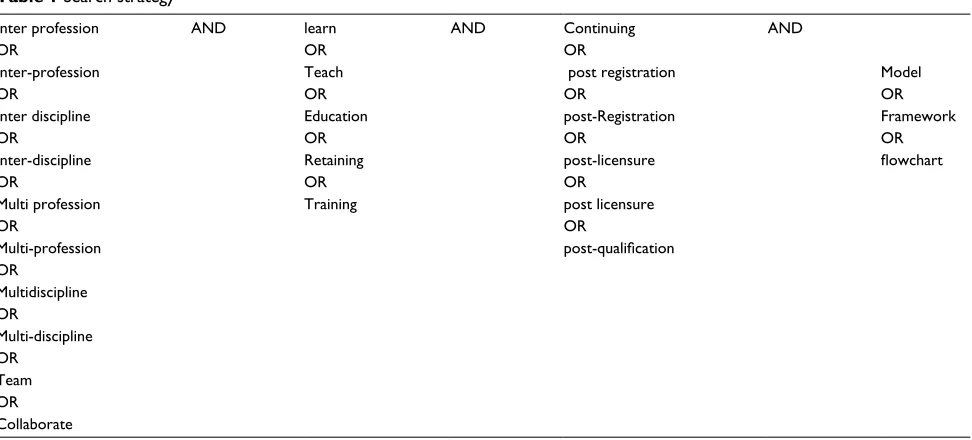
Advanced search was done based on title, summary, and keywords in English in years from 1990 to 2015. The results were simultaneously transferred to EndNote software. Given the accessibility to different databases and the coverage of the available studies in this field, the search was conducted in several specialized databases of health science studies includ-ing Science Direct, PubMed, Eric, Cochrane Library, Ovid, and Google Scholar. Search strategy is shown in Table 1. The titles and abstracts of the obtained articles were examined in relation to the research question. Then, the irrelevant articles were excluded based on the inclusion and exclusion criteria, and the relevant articles were entered into the qualitative
Advances in Medical Education and Practice downloaded from https://www.dovepress.com/ by 118.70.13.36 on 19-Aug-2020
Dovepress Designing a continuing interprofessional education model
assessment process. Based on the components derived from these articles, the features of this component were explained by experts.
The following criteria were used to identify papers of interprofessional education models post-registration in order to develop the detailed case studies:
1. All case studies should be considered examples of models interprofessional education post-registration or continu-ing interprofessional education
2. All participants are health professionals
3. The purpose of continuing interprofessional educations is expressed
Articles that were editorial report, bulletin, commentary, book review, and introductory report and articles whose purpose was not specified and the attendees were not health professionals were excluded from the study.
In the second stage, interviews with experts in continuing education and interprofessional education were conducted. Before the interview, e-mails were sent to the experts, and written informed consent and the time of the interview were obtained. Ethical approval was granted by Isfahan University of Medical Sciences. Since the adaptation of the interprofes-sional education model to health education is an important part of modeling design, the study of the sociocultural and social context of educational approaches to health science and, in particular, recognition of the experiences of continuing education officials are of particular importance in designing the model. At this stage, based on the components derived from these papers, the characteristics that these components
have to offer in interprofessional training are explained by specialists through semi-structured interviews. Considering that the patterns of continuing interprofessional education patterns are the most basic part of the model. In order to analyze the articles, first, the article’s description on execu-tive search methodology was reviewed repeatedly to obtain a general understanding of the subject. The text was read by line. Then, by repeated and frequent comparisons between them, the codes that were the most frequent in the texts were explained and combined, and descriptive themes were identified.
In the third stage, the interprofessional continuing edu-cation model was designed. The draft of this model was presented to a group of interprofessional education experts, and the applied model was finalized based on the results of their comments and corrective suggestions.
Results
Seven models were obtained from the findings of the first stage in interprofessional continuing education (Table 2).22-24,25-28 These models were studied repeatedly, and
five constructs were extracted out of them.
subject
The first structure that came from interprofessional educa-tion models was the subject of interprofessional educaeduca-tion, which included articles on health, hygiene, care, treatment, and education. From the point of view of specialists, the title or subject of interprofessional education should have the features of interprofessional collaboration, teamwork, and Table 1 search strategy
inter profession Or
inter-profession Or
inter discipline Or
inter-discipline Or
Multi profession Or
Multi-profession Or
Multidiscipline Or
Multi-discipline Or
Team Or collaborate
AnD learn
Or Teach Or Education Or retaining Or Training
AnD continuing
Or
post registration Or
post-registration Or
post-licensure Or
post licensure Or
post-qualification
AnD
Model Or Framework Or
flowchart
Advances in Medical Education and Practice downloaded from https://www.dovepress.com/ by 118.70.13.36 on 19-Aug-2020
Dovepress
safabakhsh et al
patient centeredness. According to the theory of adult educa-tion, the subject of continuing education and interprofessional education programs should be the needs of the learners and should be achieved through the needs assessment of learners to be effective on the attitude and knowledge of learners.
Objectives
The second construct obtained from the models is the goals of interprofessional education. The studies identified the objectives of interprofessional education programs, interprofessional communication, recognition of the role and responsibilities of other professionals in the team,
and mutual respect in the team. Professionals outlined the characteristics of interprofessional education goals such as relevance to continuing education, practice, participating professions, and audiences. The objectives should also be based on the need of the learner, patient, professions, and community.
content
Professional commonalities should be considered in the formulation of the content. Professors of the professions involved in the program should participate in content devel-opment. It should be learner-based, profession-based, and Table 2 continuing interprofessional education models
Author/year Article Model Teaching strategy Evaluation
strategy
Competency
Medves et al (2009)22
interprofessional education curricula models for health care providers in Ontario
Ontario post- registration iPE model role-playing, patient-centered care, workshop Performance evaluation, rating scale, behavioral checklist Role clarification, conflict management, inter-professional communication, team leadershippatient/client/ family/community centered Villarreal et al
(2011)28
A model for increasing palliative care in the intensive care unit: enhancing interprofessional consultation rates and communication
consultative model AnD ‘‘integrative model” clinical round discussion Patient/family feedback and participant feedback Patient-centered care, interprofessional communication, teamwork, consultation, interprofessional collaboration
Bosnic-Anticevich et al (2014)23
Development and evaluation of an innovative model of interprofessional education focused on asthma medication use
An innovative model of inter-professional education Workshop, group interactions semi-structured interviews and focus groups collaboration scale interprofessional communication, interprofessional collaboration
Toner et al (2009)26
continuing interprofessional education in geriatrics and gerontology in medically underserved areas Program for Outreach to interprofessional services and Education Model (POisE) role-playing exercises and small group discussions
Questionnaires were developed by the consortium of new York Education centers
Team leadership skills, communication, systematic problem solving, decision making, team management, team maintenance
lundon et al (2009)25
The Advanced clinician Practitioner in Arthritis care program: an inter professional model for transfer of knowledge for advanced practice practitioners
– Didactic, practical,
case-based, and self-directed learning, interactive learning
A traditional and retrospective self-evaluation, practice-focused survey, quantitative and qualitative analysis Work collaborative system
expanded scope of practice roles and responsibilities
Bonwell et al (2014)24
An interprofessional educational approach to oral health care in the geriatric population
case-based learning riPls and the iEPs questionnaire
improvement in patient care
gooding et al (2016)27
case-based teaching for interprofessional postgraduate trainees in adolescent health
case-based learning Kirkpatrick level 2 interprofessional collaboration
Abbreviations: iPE, interprofessional education; riPls, readiness for interprofessional learning scale; iEPs, interdisciplinary Education Perception scale.
Advances in Medical Education and Practice downloaded from https://www.dovepress.com/ by 118.70.13.36 on 19-Aug-2020
Dovepress Designing a continuing interprofessional education model
patient-based care and cover all educational goals. Adult education should be problem centered and function oriented, rather than content centered.
learning strategies
The interactive-based, learner-based, and problem-based learning methods (seminars, workshops, group discussions) are among the most widely used ones in studies. From the experts’ point of view, teaching methods should be learner based, create learning synergy, share experiences, and be implemented in formative-summative method.
Evaluation strategies
Evaluation is one of the most difficult and complex parts of interprofessional education model. The patient is the center of the professional system, and the health outcomes will be affected by the performance of the interprofessional team, whereas the learner is the center of the educational system, whose consequences are affected by the educational process.
In the articles reviewed, the most important instruments used in evaluation were knowledge, attitude, and practice questionnaires, RIPLS questionnaire, interviews with experts, and feedback from families and patients. Experts said that evaluation should be based on goals. It should also be based on evidence-based and patient-center.
Development of continuing
interprofessional education model
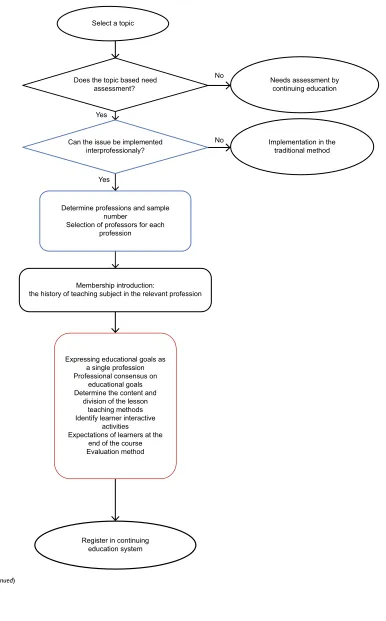
From the findings of the first and second stages, the continu-ing interprofessional education model was developed in three stages: design, implementation, and evaluation (Figure 1).
At the design stage, first, the needs assessment is done by the Continuing Education Center, and the subject of the program is selected based on the needs assessment. Then a panel of experts is formed on whether the selected topic has the ability to run interprofessional education. If it can-not be implemented using an interprofessional approach, it will be implemented in a traditional method. If it can be implemented using an interprofessional approach, it will be selected in the same panel of participating professionals and professors.
In the second session of the panel, the professors of each profession are introduced and then the common learning objectives among the professions, the common content, teaching methods, interactive activities, and assessment of the learners are identified.
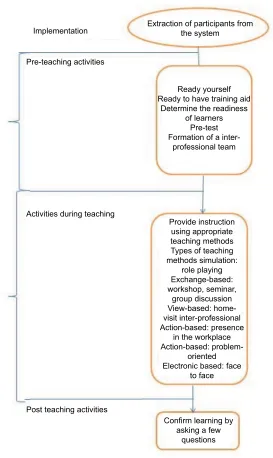
The implementation phase is divided into three sections: pre-teaching activities, while-teaching activities, and post-teaching activities.
At the stage of pre-teaching activities, the characteris-tics of learners and their readiness for implementation of interprofessional education are determined using the RIPLS questionnaire. Also, a pretest related to the curriculum is implemented.
At the stage of teaching activities, learning methods that suit the interprofessional training are used. During the post-teaching activities, the materials are collected, and the learning is fixed through questions and answers.
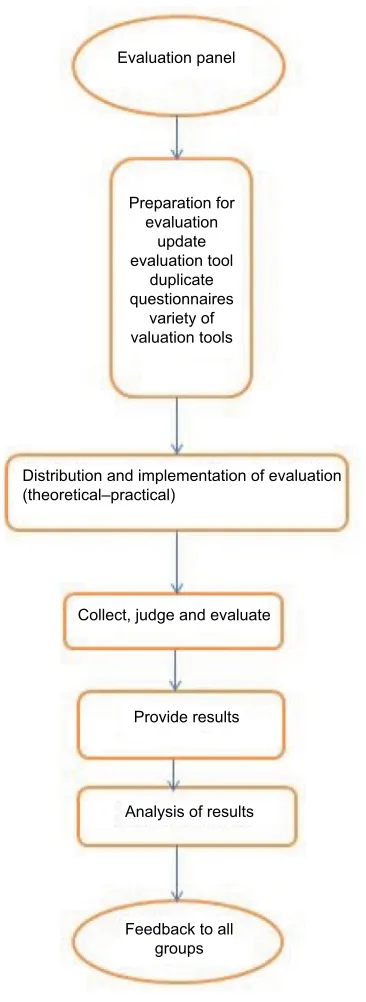
Evaluation stage
At this stage, questionnaires and other evaluation tools are kept ready. The determined evaluation methods appropriate to the program and objectives are used. The results are col-lected, judged, and analyzed. At the end of the report, the results are presented, and the feedback is given to all groups.
Discussion
The results of this study showed that providing a framework and model for continuing interprofessional education pro-grams can help design these propro-grams.
The basis of this design was the implementation of con-tinuing education programs based on the interprofessional training. The characteristic of this model, which distinguishes it from other patterns, is the step-by-step explanation of the implementation of the interprofessional continuing educa-tion program.
The designed model in Ontario has been developed in three stages of the start-up phase, the stage of excellence and continuous mastery, and emphasized the learning and evaluation methods in three stages. In other articles, the interprofessional training program has not been designed and implemented on the basis of interactions between the professions. The model we have designed is also applicable to all educational systems in other countries, and its mentation stages are clear. There are resistances to imple-menting interprofessional training programs. Planning and coordinating the implementation of these programs is hard. The differences in the culture of every individual and conflicts of interest are the basis of these resistances.
The lack of formal and academic experience in interpro-fessional continuing education and the lack of familiarity with respect to interprofessional training among the con-tinuing education officials were the limitations of this paper.
Advances in Medical Education and Practice downloaded from https://www.dovepress.com/ by 118.70.13.36 on 19-Aug-2020
Dovepress
safabakhsh et al
Figure 1 (Continued)
Select a topic
Needs assessment by continuing education
Implementation in the traditional method Yes
No No
Yes
Does the topic based need assessment?
Register in continuing education system Can the issue be implemented
interprofessionaly?
Determine professions and sample number
Selection of professors for each profession
Membership introduction:
the history of teaching subject in the relevant profession
Expressing educational goals as a single profession Professional consensus on
educational goals Determine the content and
division of the lesson teaching methods Identify learner interactive
activities
Expectations of learners at the end of the course Evaluation method
Advances in Medical Education and Practice downloaded from https://www.dovepress.com/ by 118.70.13.36 on 19-Aug-2020
Dovepress Designing a continuing interprofessional education model
Figure 1 (Continued)
Confirm learning by asking a few
questions Provide instruction
using appropriate teaching methods Types of teaching methods simulation:
role playing Exchange-based: workshop, seminar,
group discussion View-based: home-visit inter-professional Action-based: presence
in the workplace Action-based:
problem-oriented Electronic based: face
to face Ready yourself Ready to have training aid
Determine the readiness of learners
Pre-test Formation of a
inter-professional team Extraction of participants from
the system Implementation
Pre-teaching activities
Post teaching activities Activities during teaching
Advances in Medical Education and Practice downloaded from https://www.dovepress.com/ by 118.70.13.36 on 19-Aug-2020
Dovepress
safabakhsh et al
Figure 1 The model designed for continuing interprofessional education.
Note: (A) designing interprofessional program; (B) implementing interprofessional program; and (C) evaluating interprofessional program. Evaluation
Evaluation panel
Preparation for evaluation
update evaluation tool
duplicate questionnaires
variety of valuation tools
Distribution and implementation of evaluation (theoretical–practical)
Collect, judge and evaluate
Provide results
Analysis of results
Feedback to all groups
Conclusion
The most important feature of this template is the transpar-ency of the steps and step-by-step description in three stages of design implementation and evaluation. It is suggested that interprofessional training programs should be conducted not solely for theoretical training but should also be implemented in the clinical setting according to this model.
Acknowledgments
This study is supported by the Department of Medical Education, Medical Education Research Center at Isfahan University of Medical Sciences, as part of a thesis.
Disclosure
The authors report no conflicts of interest in this work.
Advances in Medical Education and Practice downloaded from https://www.dovepress.com/ by 118.70.13.36 on 19-Aug-2020
Advances in Medical Education and Practice
Publish your work in this journal
Submit your manuscript here: http://www.dovepress.com/advances-in-medical-education-and-practice-journal Advances in Medical Education and Practice is an international, peer-
reviewed, open access journal that aims to present and publish research on Medical Education covering medical, dental, nursing and allied health care professional education. The journal covers undergraduate education, postgraduate training and continuing medical education
including emerging trends and innovative models linking education, research, and health care services. The manuscript management system is completely online and includes a very quick and fair peer-review system. Visit http://www.dovepress.com/testimonials.php to read real quotes from published authors.
Dovepress
Dove
press
Designing a continuing interprofessional education model
References
1. Gilbert JH, Yan J, Hoffman SJ. A WHO report: framework for action on interprofessional education and collaborative practice. J Allied Health. 2010;39(Suppl 1):196–197.
2. WHO. Interprofessional education case study. Human Resources for Health Observer. 2014.
3. Baker PG. Framework for Action on Interprofessional Education and Collaborative Practice. Geneva, Switzerland; 2010.
4. Irajpor A, Alavi M. Setting up a virtual network of cooperation between education and professional development. IJME. 2013;13(11):999–1000. 5. Barr H. Interprofessional Education: Yesterday, Today and Tomorrow.
Higher Education Academy, LTSN Health Sciences and Practice Subject Centre. CAIPE. 2002.
6. Irajpour A, Alavi M, Izadikhah A. Situation analysis and designing an interprofessional curriculum for palliative care of the cancer patients. IJME. 2015;14(12):1047–1056.
7. Yan J, Gilbert J, Hoffman S. WHO Study Group on interprofessional edu-cation and collaborative practice. J Interprof Care. 2007;21(6):587–589. 8. Yildirim A, Domac S. Interprofessional Education Model for the Health
and Life Science Faculties.
9. Lapkin S, Levett-Jones T, Gilligan C. A systematic review of the effec-tiveness of interprofessional education in health professional programs. Nurse Educ Today. 2013;33(2):90–102.
10. Masoomi R, Yamani N. A review on interprofessional education in health professionals’ training. IJME.. 2012;11(9):1231–1240. 11. Thistlethwaite JE. Interprofessional education: implications and
devel-opment for medical education. Educación Médica. 2015;16(1):68–73. 12. Irajpour A. Inter-professional education: a reflection on education of
health disciplines. IJME 2011;10(4):452–463.
13. Vafadar Z, Vanaki Z, Ebadi A. Inter-professional education: the necessity for ethical growth in health domain. J Med Educ Dev. 2014;9(3):18–34. 14. Vafadar Z, Vanaki Z. design a practical interprofessional education
model in the health sciences [doctoral thesis]. 2015.
15. Reid R, Bruce D, Allstaff K, McLernon D. Validating the Readiness for Interprofessional Learning Scale (RIPLS) in the postgraduate context: are health care professionals ready for IPL? Med Educ. 2006;40(5):415–422. 16. Amini B, Bigdeli S, Shirazi M, Mirshahvalad SM. Validity and reli-ability of the “Readiness for Interprofessional Learning Scale (RIPLS)” in Iranian context. J Payavard Salamat. 2016;10(1):51–58.
17. Irajpour A, Alavi M. Readiness of postgraduate students of Isfahan University of Medical Sciences for inter professional learning. IJME. 2012;11(9):1050–1056.
18. Vafadar Z, Vanaki Z, Ebadi A. The readiness of postgraduate health sciences students for interprofessional education in Iran. Glob J Health Sci. 2015;7(4):190.
19. Dalooei RJ, Moonaghi HK, Yamani N, Irajpoor AR, Saadatyar FS. Interprofessional education: the strategy to improve health care. Res Med Educ. 2015;7(1):54–62.
20. Vafadar Z, Vanaki Z, Ebadi A. Interprofessional education; a response to health system challenges. IJME. 2014;14(2):148–164.
21. Yamani N, Asgarimoqadam M, Haghani F, Alavijeh AQ. The effect of interprofessional education on interprofessional performance and diabetes care knowledge of health care teams at the level one of health service providing. Adv Biomed Res. 2014;3:153.
22. Medves J, Saxe-Braithwaite M, Aylward D, et al. Interprofessional Education Curricula Models for Health Care Providers in Ontario. 2009.
23. Bosnic-Anticevich SZ, Stuart M, Mackson J, et al. Development and evaluation of an innovative model of inter-professional education focused on asthma medication use. BMC Med Educ. 2014;14(1): 72.
24. Bonwell PB, Parsons PL, Best AM, Hise S. An interprofessional educa-tional approach to oral health care in the geriatric population. Gerontol Geriatr Educ. 2014;35(2):182–199.
25. Lundon K, Shupak R, Reeves S, Schneider R, McIlroy JH. The Advanced Clinician Practitioner in Arthritis Care program: an interprofessional model for transfer of knowledge for advanced practice practitioners. J Interprof Care. 2009;23(2):198–200.
26. Toner JA, Ferguson KD, Sokal RD. Continuing interprofessional edu-cation in geriatrics and gerontology in medically underserved areas. J Contin Educ Health Profs. 2009;29(3):157–160.
27. Gooding HC, Ziniel S, Touloumtzis C, et al. Case-based teaching for interprofessional postgraduate trainees in adolescent health. J Adolesc Health. 2016;58(5):567–572.
28. Villarreal D, Restrepo MI, Healy J, et al. A model for increasing pal-liative care in the intensive care unit: enhancing interprofessional consultation rates and communication. J Pain Symptom Manage. 2011;42(5):676–679.
Advances in Medical Education and Practice downloaded from https://www.dovepress.com/ by 118.70.13.36 on 19-Aug-2020