Methodologies for preprocessing of Handwritten and Printed
Devnagari text Documnet
Priyanka N. Bhoge
ME-EXTC, SSBT COET
Bambhori, Jalgaon.
30TU
[email protected]
U30TS. P. Ramteke
SSBT COET
Bambhori, Jalgaon.
ABSTRACT
Recognition techniques for printed and handwritten text in Scanned documents are significantly different. In this paper, method used to identify the skew of the Scanned document images with the binarization, filtration, segmentation of the devanagri Printed and handwritten document. A horizontal and vertical projection algorithm is used to segment the document into a number of patches, with the nilaback Sauvola’s and wolfs binarization with the linear Otsu thresholding for filter. The scan line method is used for the skew detection and correction with adaptive histogram algorithm for image enhancement. Various Printed and handwritten text document are scan for the different preprocessing methods. In the binarization various different algorithms are explain and used the best nilback algorithm for the further process with the help of filter. For the Line, word, character segmentation used the separate algorithms. Also for the skew detection and correction in skew line method gives the better accuracy comparing with the other algorithms with the enhancement of the skew image. Documents and files that were once stored physically on paper are now being converted into electronic form in order to facilitate quicker additions, searches, and modifications, as well as to prolong the life of such records. Because of this, there is a great demand for software, which automatically extracts, analyze, recognize and store information from physical documents for later retrieval.
Keywords
Filtering, Pre-processing, Segmentation, skew detection and correction.
1.
INTRODUCTION
Integration of new technologies and inventions leads us towards the achievement of paperless office and paperless society. Document image analysis is one of the import steps in automating the offices. Every activity of the office involves papers, which are in the form of petitions, application forms, reports, letters and accounts. In most of the situations we come across with numerous documents presenting a mixture of handwritten and printed text. For example, railway reservation forms, bank cheques, memorandums etc. Often we notice that interlacing of handwritten and printed text is at word level, line level and character level. The recognition of such documents is a challenging task for OCR designers. To optimize the OCR accuracy, separation of handwritten and printed text from such documents is very essential prior to activation of the OCR engine. Handwritten and printed text separation leads to reduce the search space of the OCR and it also facilitates the retrieval of Handwritten and Printed text documents.
Skew refers to the text which neither parallel nor at right angles to a specified or implied line. Character recognition is very sensitive to the page skew, skew detection and correction in document images are the critical steps before layout analysis. Skew detection is used for text line
position determination in Digitized documents, automated page orientation, and skew angle detection for binary document images, skew detection in handwritten scripts, in compensation for Internet audio applications and in the correction of scanned documents.
There are two steps for detecting and correcting the skew. The first step is detecting the skew; it is the process of decreasing the size of image pixels of features and finding another feature with lower dimensions. It includes transformation of initial set to other set for retaining maximum information. This will extract the initial set first and will generate missing information in it. After transformation, select an optimal subset of features based on an objective function. There are different dimension reduction methods, which we can use in skew detection of document images. The best subset includes all of the strongly relevant and weakly relevant but non redundant features. In the second step, skew is corrected. Here, the deviation corresponding to the highest and the lowest value of the function is usually considered as the skew.
2.
LITERATURE SURVEY
Document image segmentation to text lines and words is a critical stage towards unconstrained handwritten document recognition. Variation of the skew angle between text lines or along the same text line, existence of overlapping or touching lines, variable character size and non-Manhattan layout are the challenges of text line extraction. Due to high variability of writing styles, scripts, etc., methods that do not use any prior knowledge and adapt to the properties of the document image, as the proposed, would be more robust. Line extraction techniques may be categorized as projection based, grouping, smearing and Hough-based. [5]. This paper is implementation of preprocessing steps for the handwritten and printed text document .As the name suggest, implementation of preprocessing methodologies mean it have the number of preprocessing methods are use and chose the best method with less time with good results Data preprocessing describes any type of processing performed on raw data to prepare it for another processing procedure. Hence, preprocessing is the preliminary step which transforms the data into a format that will be more easily and effectively processed. Therefore, the main task in preprocessing the captured data is to decrease the variation that causes a reduction in the recognition rate and increases the complexities.[4] The main objective of the preprocessing stage is to normalize and remove variations in the handwritten and printed text document. In character recognition systems most of the applications use grey or binary images, since processing color images is computationally high. Such images may also contain non-uniform background and/or watermarks making it difficult to extract the document text from the image without performing some kind of preprocessing. Few or some of these techniques or others may be used at different stages of the OCR system by Dan WANG, Xichang WANG in A Skew Angle Detection
IJISET - International Journal of Innovative Science, Engineering & Technology, Vol. 2 Issue 9, September 2015. www.ijiset.com
ISSN 2348 – 7968
Algorithm based on Maximum Gradient Difference in 2011. [13] In 2009, Vassilis Papavassilioua, ThemosStafylakisa, VassilisKatsourosa, GeorgeCarayannis proposed Handwritten document image segmentation into text lines and words, in that the line segmentation algorithm is based on locating the optimal succession of text and gap areas within vertical zones by applying Viterbi algorithm. Then, a text-line separator drawing technique is applied and finally the connected components are assigned to text lines. Word segmentation is based on a gap metric that exploits the objective function of a soft-margin linear SVM that separates successive connected components. The algorithms tested on the benchmarking datasets of ICDAR07 handwriting segmentation contest and outperformed the participating [11] In 2011, QI Xiaorui, MA Lei, SUN Chang jingo and LIU Jiang, proposed Fast Skew Angle Detection Algorithm for Scanned Document Images based on digital identification systems, the reliability of recognition is closely related to the quality of image data. Therefore, in most real-time document image processing, skew angle should be confirmed quickly and accurately to improve the accuracy of collection and entry for document information, meanwhile, to reduce the rejection rate and improve reliability and adaptability of systems. Most scanners have the capabilities of automatic de-skew which can segment the skew document images from the background, However, skew is often happened due to print in practice, the result is that the images can’t be de-skewed correctly. Therefore, the research about de-skew algorithm content-based of document images could better reflect the nature of the problem and have a great significance in document image processing. [1]
In 2012, Upasana Patil1, Masarath Begum proposed, word level handwritten and printed text separation based on shaped features. In this method the discriminating handwritten and printed text from document images based on shape features. The separation of handwritten and printed text from document image is essential to optimize the OCR accuracy and to activate an appropriate OCR engine. It leads to reduce the search space of the OCR and it also facilitates the retrieval of Handwritten and Printed text from document images. The used of IAM dataset 3.0 and with morphological transformations segmented 74 pages and obtained 10768 words and 2000 were used for experimentation and achieved average accuracy of 98.57% with only seven features. The proposed method is simple, have promising discrimination accuracy and less time complexity. [5] In 2013, Ruby Singh, proposed Skew detection in image processing many researchers proposed different methodologies for the text skew estimation in binary images/gray scale images. They have been used widely for the skew identification of the printed text. There exist so many ways algorithms for detecting and correcting a slant or skew in a given document or image. Some of them provide better accuracy 70% but are slow in speed, others have angle limitation drawback. So a new technique for skew detection in the paper will reduce the time and cost. [2] In 2013, Utkarsh Mathur, Rohit Sharma,
Naveen Srivastava proposed, script independent angular skew Detection and correction algorithms, document digitalization is done in a large scale for hand written and printed documents, where the documents are scanned and stored in a digital form. Maximum numbers of these documents are hand written, and hence, they comprise of various errors like angular skew of words, or sentence as a whole. Before the document can be digitalized using OCR software, it is pre processed for angular skew detection and their removal from the scanned document. Detection and correction of angular skewness of the words is the most difficult task for the
process, which must be carried out as this skewness is present in almost all of the hand written words. [10]
3.
DEVELOPMENT OF SYSTEM
In the textual processing, it required number of preprocessing steps, in this context document scanning is first and important step. During document scanning, skew is inevitably introduced into the incoming document image and skew affects the overall recognition of text document. The skew angle detection algorithm needs to extract the straight lines correctly, and increase the reliability of the estimate angle according to statistical properties. Document images are more complex and have different classification criteria. There have the differences of language as well as the differences of printed font and handwriting font, and the text size, color also have a larger difference in different application areas.
There are different preprocessing steps like binarization, filtering, skew angle detection and correction. In binarization, Research is done in large extent. In different types of binarization algorithms are discussed .In last decade, Grey scale binarization is focused. Niblack method of gray scale binarization with its results is explained but in results of Niblack noise is in large amount. This drawback is removed in Sauvola’s. Drawbacks of Sauvola’s are removes in wolf and feng’s binarization algorithm. Then using hybrid approach, by combining niblack and Sauvola’s another combinational approach is come in to existence. For different values of parameter, in formula of calculating threshold, this hybrid approach is implemented. Otsu is binarization techniques based on histogram based technique. Another combinational approach is implemented. Skeletonization of gray scale character image using pixel superiority index is implemented and thresholding is done using Sauvola’s algorithm. [8] As compared to scanners, cameras offer fast, flexible and non-contact document imaging, but with distortions like uneven shading and warped shape. Therefore, camera-captured document images need preprocessing steps like binarization, skew detection, perspective distortion removal and text line detection for dewarping so that traditional document image processing steps can be applied on them.
3.1 Image acquisition
Acquire image of any document with the help of camera or scanner. Image acquisition is used to Acquire/obtain the image of document in color, gray level or binary format.
3.2 Image preprocessing
These are the pre-processing steps often performed in OCR.
3.2.1Binarization
The simplest way to use image binarization is to choose a threshold value, and classify all pixels with values above this threshold as white, and all other pixels as black. Selecting proper threshold is very important task. In many cases, finding one threshold compatible to the entire image is very difficult, and in many cases even impossible. Binarization is processing of converting color image in to binary image. There are various Binarization methods and in that various different algorithm such as Nilback, Sauvola, Wolfs, Otsu etc used for the exact and accurate output. By comparing all components used the Nilback algorithm for the binarization of the document for the better result.
Niblack Algorithm
The calculation of threshold value is depending on the local mean m and the standard deviation s of all the pixels in the window and threshold is given by formula.
∑
−+
= 2
2
m N P k m T
• Where NRpR is the number of pixel in the Pi gray
image
• m is the average value of the pixels and k= -0.2
Steps for Nilback Algorithm:
1. The input image is successively sub sampled to different scales.
2. Calculate the local mean value for the current pixels 3. Calculate the local standard deviation for the
neighbor pixels.
4. From both these calculates the threshold for different part of the image.
5. From the threshold image, the input image is binarized.
Sauvola’s algorithm
Threshold value for sauvola method is given by,
Where k is set to 0.5 and R is the threshold value to 128. M is the average value.
Steps for Sauvola’s Algorithm:
1. The input image is successively sub sampled to different scales.
2. Object selections at each scale. Sub sample images are binarized, labeled, and, object components are selected.
3. Selected objects are merged into a single scale image. A threshold image is deduced from the scale image.
4. From the threshold image, the input image is binarized.
Wolf’s Algorithm
Threshold is given as below,
Where k is fixed to 0.5, M is the minimum gray value of the image.
Steps for Wolfs Algorithm:
1. The input image is successively sub sampled to different scales.
2. Sub sample images are binarized, labeled, and, object components are selected.
3. A threshold image is deduced from the scale image. 4. Calculate the mean grey value for the current pixels 5. Calculates the threshold for different part of the
image.
6. From the threshold image, the input image is binarized.
3.2.2 Filtering
Linear filtering technique is used for reducing random noise, sharpening the edges and correcting unequal illuminations. The procedure is carried out by filtering the image by correlation with an appropriate filter. The value of output pixel is calculated as a weighted sum of neighboring pixels.
Steps for Linear Otsu thresholding Algorithm:
1. Compute histogram and probabilities of each intensity level
2. Set up initial X and Y
3. Step through all possible thresholds t=1 maximum intensity
1. Update x and y 2. Compute w
4. Desired threshold corresponds to the maximum W
5. You can compute two maxima (and two corresponding thresholds). P is the greater max and Q is the greater or equal maximum
6. Desired threshold =
3.3 Segmentation
Document image segmentation to text lines and words is a critical stage towards unconstrained handwritten document recognition. Line extraction techniques may be categorized as projection based, grouping, smearing and Hough-based. [5]. The proposed algorithms that address the above-mentioned processing stages come mainly from the fields of image processing, computer vision, machine learning and pattern recognition. Actually, some of these algorithms are very effective in processing machine printed document images and therefore they have been incorporated in the workflows of well-known OCR systems. Text line segmentation is a critical stage in layout analysis, upon which further tasks such as word segmentation, grouping of text lines into paragraphs, characterization of text lines as titles, headings, footnotes, etc. may be developed. Segmentation is the process of partitioning a digital text image into multiple segments. The goal of segmentation is to simplify or change the representation of an image into something that is more meaningful and easier to analyze. It will be divided in to three parts as for the segmentation of the text, Line segmentation, Word segmentation, Character segmentation
3.3.1Line Segmentation
Steps for line segmentation algorithm:
It is nothing but Separate line from the text document. We compute the horizontal projection of the document image box.[11]
1. Use the horizontal projection method for segmenting lines from text.
2. Count the white pixel in each row.
3. Find minimum and maximum values of the rows 4. Find minimum and maximum values of the columns 5. The values of rows and columns give no white pixels 6. Replace all such rows and columns by 1
7. Invert the image to make empty rows as 0 and text lines will have original pixels.
8. Crop the line from the min and max values of rows and columns.
3.3.2word Segmentation
It is nothing but separate word from the line.
Steps for word segmentation Algorithm:
1. Label and count connected components
2. Use the vertical projection method for segmenting word from each line.
3. Count the white pixel in each row.
4. Find minimum and maximum values of the rows 5. Find minimum and maximum values of the columns 6. The values of rows and columns give no white pixels 7. Replace all such rows and columns by 1
8. Invert the image to make empty rows as 0 and text lines will have original pixels.
9. Crop the word.
10. Save the word in the file.
3.3.3Character Segmentation
It is nothing but separate character from the word.
Steps for character segmentation Algorithm:
− ∗ − ∗ = R s k m
Tsauvola 1 1
( )
(
( )
)
M
m
R
s
k
M
k
m
k
T
wolf−
IJISET - International Journal of Innovative Science, Engineering & Technology, Vol. 2 Issue 9, September 2015. www.ijiset.com
ISSN 2348 – 7968
1. Label and count connected components
2. Use the vertical projection method for segmenting characters from word.
3. Count the white pixel in each row.
4. Find minimum and maximum values of the rows 5. Find minimum and maximum values of the columns 6. The values of rows and columns give no white pixels 7. Replace all such rows and columns by 1
8. Invert the image to make empty rows as 0 and text lines will have original pixels.
9. Crop the character.
10. Save the characters in the file.
3.4 skew detection and correction
Document skew is a distortion that often occurs during document scanning or copying. This mainly concerns the orientation of text lines and with no skew the lines are horizontal or vertical, depending on the language. Skew can also be intentionally designed to emphasize important details in a document. Therefore, this effect is unavoidable in many real cases and it should be eliminated because it dramatically reduces the accuracy of the subsequent methods, such as page segmentation/classification.[2]
When the skew of the document image is zero degrees, the projection profile peak times will be longer. To understand the reason, consider the scan lines are drawn on two document image with 5 and zero degrees of skew. Here, the scan line means a row of the image. Scan lines plotted on document image with 5 degrees of skew, include white areas between text lines, and while most of scan lines plotted on document image with zero degrees of skew, include a text line and no white areas between text lines. So, in those rows of the image with zero degrees of skew, the number of black pixels is higher and the projection profile peaks are longer. Therefore, the projection profile can be used as a suitable feature for skew detection. It is needed to create a feature to describe which one is more peaked for comparing peaks of projection profiles. So employing a criterion function provides a numerical description of the peaks. [12] Thus the scan line method for the skew detection and correction is as follows,
Mathematical Analysis
The text lines’ starting point and ending point of the objective marked with “t” are (Xs, Ys), (Xe, Ye), and then the skew angle of the text lines can be estimated as,
Ɵt = (Ye – Ys) / (Xe - Xs) --- (7)
Defining the angle energy of text lines, assuming the skew angle of the objective marked with t is t, Ɵt, and the length of a text line (the number of the objective pixels) is Ct. and then the angle energy of the text lines is:
Pt = Ɵt * Ct--- (8)
There are M text lines characteristics of a document image. Then the skew angle of the document image is eventually defined as:
θ=∑M−1t=0 Pt⁄∑M−1t=0 Ct--- (9) Using the largest text lines characteristic as the skew angle of a document image is reasonable. The longer the length of a text line is, the higher the accuracy. [2]
If θ<0,
θ=θ+180……… (10) Or if θ>85,
Rotate the image with its correct angle.
Steps for skew detection and correction Algorithm
1. Select the input image. 2. Convert to grey scale image.
3. Apply the Horizontal gradient method.
4. Calculate text line character. 5. Calculate text line objective tracking. 6. Calculate the skew angle for the input image.
7. Apply the block transformation with filling to correct the skew.
8. If the skew angle is >85 then it will rotate the image with the rotated angle.
9. Display Skew corrected image
3.5Image Enhancement
Enhancement is the modification of an image to alter impact on the viewer. In this paper, adaptive histogram equalization method is used for the enhancement.
Steps for adaptive histogram thresholding Algorithm
1. Obtain all the inputs: Image, Number of regions in row and column directions, Number of bins for the histograms used in building image transform function, normalized from 0 to 1. 2. Pre-process the inputs: Determine real clip limit from the normalized value if necessary, pad the image before splitting it into regions.
3. Process each contextual region thus producing gray level mappings: Extract a single image region, make a histogram for this region using the specified number of bins, clip the histogram using clip limit, and create a mapping for this region
4. Interpolate gray level mappings in order to assemble final image: Extract cluster of four neighboring mapping functions, process image region partly overlapping each of the mapping tiles, extract a single pixel, apply four mappings to that pixel, and interpolate between the results to obtain the output pixel; repeat over the entire image.
4. RESULT AND CONCLUSION
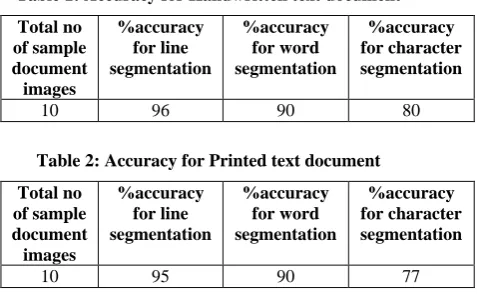
By using this methodology it has been able to detect and correct the skew for the scan document by using the different methods of binarization, segmentation. So it can be conclude that, by using different methodologies we can enhance any scan document for the devnagri language. Results got through the methods used are mention in table no. 1 2 and 3.
Table 1: Accuracy for Handwritten text document
Table 2: Accuracy for Printed text document
Table 3: Error calculation for text document
Sr. No.
Original skew Corrected skew Error
1 4.00 3.73 0.27 2 4.12 3.16 0.96 3 -5.00 -3.77 1.23 4 -3.00 -2.24 0.76 5 4.00 3.68 0.32
Total no of sample document images
%accuracy for line segmentation
%accuracy for word segmentation
%accuracy for character segmentation
10 96 90 80
Total no of sample document images
%accuracy for line segmentation
%accuracy for word segmentation
%accuracy for character segmentation
d
5. FIGURES
Fig. 1: System Diagram
Fig. 2: Output for the binarization with filtration for handwritten and printed text document
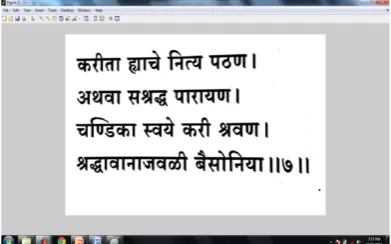
Fig.3: Example for segmentation in handwritten and printed text document
Fig. 4: line segmentation for handwritten and printed text document.
Input text
Document
Pre-processing
Segmentation
Slew angle
detection
&correction
Output
processed
document
IJISET - International Journal of Innovative Science, Engineering & Technology, Vol. 2 Issue 9, September 2015. www.ijiset.com
ISSN 2348 – 7968
Fig. 5: word segmentation for handwritten and printed text document.
Fig.6: character segmentation for handwritten and printed text document.
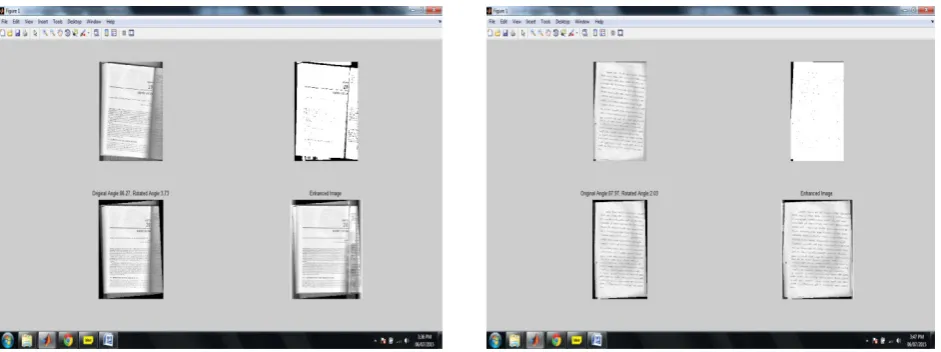
Fig. 7: skew detection and correction with enhancement in printed and handwritten text document.
6. FUTURE ABSTRACTION
Though we have achieved an accuracy of 90% by optimizing various parameters for the segmentation as well as skew detection and correction, it is required that for the task as sensitive as capturing the images for accurate results, security an accuracy of 100% cannot be compromised with. Therefore to achieve this, further optimization is required. Also, the issues like stains, blurred regions & different font style and sizes are needed to be taken care of. This work can be further extended to minimize the errors due to them.
REFERENCES
[1] Qi Xiaorui, Ma Lei, Sun Changjiang, Liu Jiang “Fast skew angle detection algorithm for scanned document images” vol.32,no.21,2011,pp.194-196.
[2] Ruby singh1, Ramandeep kaur2, “Skew detection in image processing”, Int.J.Computer
Technology &Applications,Vol 4 (3),478-485 IJCTA | May-June 2013.
[3] NamishaModi,Khushneet Jindal “Text Line detection and Segmentation in Handwritten Gurumukhi Scripts” Volume 3, Issue 5, May 2013 Page | 1076-1079.
[4] MortezaValizadeh, Ehsanollahkabir, “An adaptive water flow model for binarization of
degraded document images”, IJDAR (2013)
16:165–176 doi 10.1007/s10032-012-0182.
[5] Upasana Patil1, Masarath Begum “word level handwritten and printed text separation based on shaped features” ISSN 2250-2459, Volume 2, Issue 4, April 2012 590-592.
[6] P. Mathivanan, B. Ganesamoorthy and P. Maran “Watershed algorithm based segmentation for handwritten text identification” Ictact journal on image and
video processing, february 2014, volume: 04, issue: 03 767-787.
[7] A S N Chakravarth, Penmetsa V Krishna Raja, Prof. P S Avadhani “handwritten text image Authentication using back Propagation” IJNSA, Vol.3, No.5, Sep 2011 121-127.
[8] A. Papandreou and B. Gatos “A Coarse Fine Skew Estimation Technique for Handwritten Words” 1520-5363/13 $26.00 © 2013 IEEE DOI 10.1109/ICDAR.2013.52.
[9] Irfan Ahmad “A technique for skew detection of printed Arabic documents” 978-0-7695-5051-0/13 $26.00 © 2013 IEEE DOI 10.1109/CGIV.2013.21 2013.
[10] UtkarshMathur, Rohit Sharma, Naveen
Srivastava “script independent angular skew Detection and correction algorithms” 9781 -4799-1 607-8/1 3/$31 .00©201 3 IEEE 2013
467-472.
[11] VassilisPapavassilioua, ThemosStafylakisa, VassilisKatsourosa, GeorgeCarayannis “Handwritten document image segmentation into text lines and words” Pattern Recognition 43 (2010) 369 -- 377 in 14 May 2009.
[12] SepidehBarekatRezaei,
AbdolhosseinSarrafzadeh, and JamshidShanbehzadeh,” Skew Detection of
Scanned Document Images” Vol I, IMECS 2013, March 13 - 15, 2013, Hong Kong. [13] Dan WANG, Xichang WANG, Jiang LIU “A
Skew Angle Detection Algorithm based on Maximum Gradient Difference” 2011 International Conference on Transportation, Mechanical, and Electrical Engineering (TMEE)December 16-18, Changchun, China. [14] FirasAjilJassim, Fawzi H. Altaani,”
Hybridization of Otsu Method and Median Filter for Color Image Segmentation” IJSCE) ISSN: 2231-2307, Volume-3, Issue-2, May 2013 69- 73.
[15] Er. MandeepKaurEr.Kiran Jain ErVirenderLather,”Study of Image Enhancement Techniques: A
Review”International Journal of Advanced Research in Computer Science and Software Engineering Volume 3, Issue 4, April 2013 ISSN: 2277 128X 847-853.