Towards Breaking the Exponential Barrier for
General Secret Sharing
Tianren Liu MIT∗
Vinod Vaikuntanathan MIT†
Hoeteck Wee CNRS and ENS‡ February 21, 2018
Abstract
A secret-sharing scheme for a monotone Boolean (access) function F : {0,1}n → {0,1}
is a randomized algorithm that on input a secret, outputs n shares s1, . . . , sn such that for
any (x1, . . . , xn) ∈ {0,1}n, the collection of shares {si : xi = 1} determine the secret if
F(x1, . . . , xn) = 1 and reveal nothing about the secret otherwise. The best secret sharing
schemes for general monotone functions have shares of size Θ(2n). It has long been conjectured
that one cannot do much better than 2Ω(n)share size, and indeed, such a lower bound is known for the restricted class of linear secret-sharing schemes.
In this work, werefute two natural strengthenings of the above conjecture:
• First, we present secret-sharing schemes for a family of 22n/2
monotone functions over {0,1}n with sub-exponential share size 2O(√nlogn). This unconditionally refutes the stronger conjecture that circuit size is, within polynomial factors, a lower bound on the share size.
• Second, we disprove the analogous conjecture for non-monotone functions. Namely, we present “non-monotone secret-sharing schemes” forevery access functionover{0,1}nwith
shares of size 2O(√nlogn).
Our construction draws upon a rich interplay amongst old and new problems in information-theoretic cryptography: from secret-sharing, to multi-party computation, to private information retrieval. Along the way, we also construct the firstmulti-partyconditional disclosure of secrets (CDS) protocols for general functions F : {0,1}n → {0,1} with communication complexity
2O(√nlogn).
∗
[email protected]. Research supported in part by NSF Grants CNS-1350619 and CNS-1414119.
†
[email protected]. Research supported in part by NSF Grants CNS-1350619 and CNS-1414119, Alfred P. Sloan Research Fellowship, Microsoft Faculty Fellowship, the NEC Corporation, a Steven and Renee Finn Career Development Chair from MIT. This work was also sponsored in part by the Defense Advanced Research Projects Agency (DARPA) and the U.S. Army Research Office under contracts W911NF-15-C-0226 and W911NF-15-C-0236.
‡
Contents
1 Introduction 1
1.1 Our Results . . . 1
1.2 Overview of Our Constructions . . . 3
1.2.1 A general framework for CDS. . . 4
1.2.2 PIR-Encodings from Matching Vector (MV) Families. . . 5
1.3 Related Work . . . 6
1.4 Discussion . . . 7
1.5 Organization . . . 7
2 Preliminaries and Definitions 8 2.1 k-party Conditional Disclosure of Secrets (CDS) . . . 8
2.2 k-party Private Simultaneous Messages (PSM) . . . 9
3 A Framework for Multi-Party CDS 10 4 PIR Encoding from Decomposable Matching Vectors 13 4.1 PIR Encodings from Matching Vector Families . . . 13
4.2 Decomposable Matching Vector (DMV) Families . . . 14
5 A Special-Purpose PSM Protocol 16 6 Putting Together 17 6.1 Multi-party CDS for INDEXkN+1 . . . 18
6.2 From CDS to Non-Monotone Secret Sharing . . . 18
6.3 From Non-Monotone to Monotone Secret Sharing . . . 19
7 Linear CDS and Secret Sharing 20
References 22
1
Introduction
Secret sharing [Sha79,Bla79] is a powerful cryptographic technique that allows a dealer to distribute shares of a secret to n parties such that certain authorized subsets of parties, and only they, can recover the secret. The original definition of secret sharing is what we now call an (n, t)-threshold secret sharing scheme, where any set of t or more parties can recover the secret, and no subset of fewer thantparties can learn any information about the secret whatsoever.
Later on, this was generalized in [ISN89] to the notion of a secret-sharing scheme realizing a monotone function F : {0,1}n → {0,1}. This is simply a randomized algorithm that on input
a secret, outputs n shares s1, . . . , sn such that for any (x1, . . . , xn) ∈ {0,1}n, the collection of
shares {si :xi = 1} determine the secret ifF(x1, . . . , xn) = 1 and reveal nothing about the secret
otherwise.1 It is easy to see that (n, t)-threshold secret sharing corresponds to the special case whereF is the (monotone) threshold function that outputs 1 if and only if at leasttof theninput bits are 1.
While the landscape of threshold secret sharing is relatively well-understood, even very basic information-theoretic questions about the more general notion of secret sharing remain embar-rassingly open. It is simple to construct a secret sharing scheme realizing any monotone function
F :{0,1}n→ {0,1}where each share is at most 2nbits; the share size can be improved toO(2n/√n)
bits [ISN89]. We also know that there is an (explicit) monotone functionF :{0,1}n→ {0,1} that
requires a total share size of Ω(n2/logn) bits [Csi97], a far cry from the upper bound. No better lower bounds are known (except for the restricted class of linear secret-sharing schemes, cf. Sec-tion 1.3), even in a non-explicit sense.
Closing the exponential gap between the afore-mentioned upper bound or lower bounds is a long-standing open problem in cryptography. The general consensus appears to be that the upper bound is almost tight, as formalized in a conjecture of Beimel [Bei11]:
Conjecture (main). There exists a family of monotone functions {Fn : {0,1}n → {0,1}}n∈N s.t. the total share size of any secret sharing scheme realizing Fn is 2Ω(n)
bits.
Note that this is a purely information-theoretic statement with no reference to the computational complexity of sharing or reconstruction.
1.1 Our Results
In this work, werefute two natural strengthenings of the main conjecture by presenting new secret sharing schemes. The first variant of the main conjecture considers a lower bound on share size that depends on the representation size of the function F as is the case for the state-of-the-art upper bounds, and the second variant considers a natural generalization of secret-sharing to non-monotone functions.
The representation size barrier. To construct a secret-sharing scheme for a function F, we would need some representation of the functionF, e.g., as a boolean formula or as a circuit or as a
1The typical formulation of secret-sharing refers to a dealer that holds a secret distributing shares tonparties,
span program [KW93]. The most general approach we have for constructing secret-sharing schemes with small share sizes yields share sizes that are linear in the size of the monotone Boolean formula (more generally, the monotone span program) [BL88]. Recall that there are most 2O(slogs) circuits or formulas or span programs of size s. The following conjecture then captures the intuition that any secret-sharing scheme must yield share sizes that is polynomial in the representation size:
Conjecture 1. For any collection Fn of monotone functions over {0,1}n such that |Fn| ≥ 2ω(nlogn), the total share size of any secret-sharing scheme realizing Fn is at
least (log|Fn|)Ω(1). 2
Note that there are 2Θ(2n/
√
n) monotone functions over{0,1}n, so the main conjecture is a special
case of Conjecture 1. In addition, by a counting argument, the number of unbounded-fan-in circuits withsgates is no more than 2O(s(n+s)), thus the collectionFncontains functions whose circuit (and
thus formula) size at least Ω(plog|Fn| −n). This means that if our intuition that the share size is polynomial in the representation size (as a formula or even a circuit) is correct, then the share size for Fn must be at least (log|Fn|)Ω(1), as captured by the conjecture. Indeed, we refute this
conjecture.
Theorem 1 (informal). For any s= s(n) ≤ 2n/2, there is a collection ˆFn,s of 2s(n)
monotone functions over {0,1}n and a secret-sharing scheme for ˆFn,s where each share
is 2O(
√
logslog logs)= (log|Fn,sˆ |)o(1) bits.
In particular, Theorem 1 has the following, we believe surprising, consequences.
First, our result implies that there are secret sharing schemes whose share size is much better than what the “representation size intuition” would suggest. In one extreme case, taking s(n) = 2n/2, our result implies a family ˆFn,2n/2 of 22
n/2
= 22Ω(n) monotone functions and a secret sharing scheme for ˆFn,2n/2 with share size only 2
˜
O(√n). Whereas, by simple counting arguments, there must
be a function in this class with circuits (or formulas or monotone span programs or essentially every other natural computational model we can think of) of size 2Ω(n). As another reference point, takings(n) =nlogn, it follows that there exists monotone functions over{0,1}nthat require
quasi-polynomial (inn) size circuits (and formulas and monotone span programs), but which admit sharing schemes with polynomial share size. This in particular implies that existing secret-sharing schemes with share sizes linear in the formula size are far from optimal.
Second, our result implies that “non-linear reconstruction” totally dominates “linear reconstruc-tion”. Secret-sharing schemes with linear reconstruction are known to be equivalent to monotone span programs [KW93], whereas the scheme from Theorem 1 has anon-linearreconstruction algo-rithm. In particular, our results shows that for share size poly(n) (resp., 2
√
n), there are 2quasipoly(n)
(resp., 22Ω(n)) access structures that can be realized by secret sharing schemes with non-linear reconstruction, compared to 2poly(n) (resp., 22Ω(
√ n)
) by linear schemes.
Prior to this work, such a statement was only known under intractibility assumptions pertaining to number-theoretic and combinatorial problems like quadratic residuosity and graph isomorphism [BI01,VV15], whereas our result is unconditional.
2
Non-monotone secret sharing. A further generalization called non-monotone secret sharing was defined in the work of Beimel and Ishai [BI01] and further studied in [BIKK14,VV15]; this is a natural extension of secret sharing to any arbitrary, possibly non-monotoneF. A non-monotone secret-sharing scheme for a function F : {0,1}n → {0,1} is a randomized algorithm that on
input a secret, outputs npairs of shares (si,0, si,1)i∈[n] such that for any (x1, . . . , xn), the nshares
(s1,x1, . . . , sn,xn) determine the secret if F(x1, . . . , xn) = 1 and reveal nothing about the secret
otherwise. Standard monotone secret-sharing correspond to the special case whereF is monotone and s1,0 =· · ·=sn,0 =⊥. Non-monotone secret sharing schemes are natural candidates for use in
advanced cryptographic schemes such as attribute-based encryption [GPSW06,OSW07].
It is easy to see that we can construct non-monotone secret-sharing schemes for all functions
on n bits starting from standard secret-sharing for all monotone functions on 2n bits, with a small polynomial blow-up in the share size. This might suggest that the best share sizes for non-monotone secret-sharing and standard secret-sharing are polynomially related, motivating the following strengthening of the main conjecture that we formalize below:
Conjecture 2. There exists a family of functions{Fn:{0,1}n→ {0,1}}n∈N such that
the total share size in any non-monotone secret sharing scheme forFn is 2Ω(n) bits.
Indeed, we also refute this conjecture:
Theorem 2 (informal). There is a non-monotone secret-sharing for the family of all functionsF :{0,1}n→ {0,1}where each share is 2O˜(√n) bits.
1.2 Overview of Our Constructions
We derive both Theorems 1 and 2 from the construction of a more general cryptographic primitive, namely that of conditional disclosure of secrets (CDS) [GIKM00], which is a generalization of non-monotone secret-sharing to general, non-boolean inputs. Informally, conditional disclosure of secrets allows a set of parties to disclose a secret to an external party Charlie, subject to a given condition on their joint inputs. Concretely, we consider (k+ 1)-party CDS for INDEXN, where
Alice holds D∈ {0,1}N, parties P
1, . . . , Pk “jointly” hold an index i∈[N]3, and all of them hold
a secret µ∈ {0,1}, and Charlie knowsD, i and should learn µ iff D[i] = 1. To enable this, Alice and all the parties should share randomness that is hidden from Charlie (akin to the random coins used in a secret-sharing scheme). Our goal is to minimize the communication complexity in CDS, that is, the total number of bits sent by Alice and thek parties to Charlie.
Our main result is as follows:
Theorem (main). For any 1≤k≤logN, there is a (k+ 1)-party CDS forINDEXN
where the total communication complexity is 2O(
√
logN·log logN) bits.
Previously, such a result was only known for k= 1 [LVW17]. Before describing our (k+ 1)-party CDS, we briefly explain how Theorems 1 and 2 follow from the CDS.
Our non-monotone secret-sharing scheme for all functions F :{0,1}n → {0,1} in Theorem 2
follows from the special case k = logN, where N = 2n. Concretely, the non-monotone secret-sharing scheme forF is derived from the (n+ 1)-party CDS forINDEX2n as follows: Alice holds 3We will make the precise sense of how the parties “jointly” hold the index clear in a little bit, but roughly
the truth tableD∈ {0,1}2n
of a functionF :{0,1}n→ {0,1}and each partyP
i, i= 1, . . . , nholds
a single bit of the indexi∈[2n], and the messages sent byP
i in the CDS corresponds to the shares.
Going from the (n+1)-party CDS to Theorem 1 requires an additional folklore transformation which transforms a non-monotone secret-sharing scheme for any F : {0,1}n → {0,1} into a monotone
secret-sharing scheme with roughly the same share size for a related function F0; see Section 6.3
for details.
1.2.1 A general framework for CDS.
We proceed to provide an overview for our (k+ 1)-party CDS protocol. We begin with a general framework for constructing CDS protocols, and then sketch how to instantiate the underlying building blocks to obtain our main result.
The LVW17 framework. We begin by sketching the 2-party CDS protocol, i.e. k = 1, from [LVW17] (which in turn builds upon [BIKK14, DG15]). The starting point of their protocol is a notion of (N, `)-PIR encoding, which encodes i ∈ [N] as vector ui ∈ Z`6 and D as a function
HD:Z`6 →Z`6 such that for alli,D,w, we have
D[i] =hHD(ui+w),uii − hHD(w),uii.
This immediately implies that for allµ∈ {0,1}, we have
µD[i] =hHD(µui+w),uii − hHD(w),uii. (1)
[LVW17] constructed a two-party CDS protocol with communicationO(`) starting from any (N, ` )-PIR encoding, and also gave a construction of a (N,2O˜(
√
logN))-PIR encoding. The two-party CDS
protocol is as follows:
• Alice andP1 share randomnessw,r (hidden from Charlie);
• Alice sendsm1A:=HD(w) +r.
• P1 sends m1B :=µui+wand m2B:=hui,ri.
• Charlie can now compute µD[i] (and thusµ) given D, i,(m1A,m1B, m2B) using the relation
µD[i] =hHD(µui+w | {z }
m1 B
),uii − hHD(w) +r
| {z }
m1 A
,uii+hr,uii | {z }
m2 B
which follows readily from (1).
The multi-party setting. We show how to extend the [LVW17] construction to the multi-party setting with k parties, for any k≥ 1. Here, the indexi is distributed across k parties P1, . . . , Pk.
The key idea is to have thesek parties jointly emulateP1 in the two-party CDS via secure
multi-party computation (MPC); in fact, because of communication constraints, we will use a private
simultaneous messages protocol [FKN94,IK97] in this setting, where each of thek parties sends a
single message to Charlie. That is, these k parties jointly hold inputs i,w,r, µ and they will run an MPC protocol with Charlie so that Charlie learns
(µui+w,hui,ri), (2)
upon which Charlie can proceed as in the two-party CDS to recover µD[i]. Moreover, security of the MPC protocol ensures that what Charlie learns in the k-party CDS is the same as that in the two-party CDS. Correctness and security then follow readily from those of the two-party CDS and the MPC protocol.
Recall that our goal is to obtain a protocol with total communication complexity 2o(n), and we need to make sure that the MPC protocol does not blow up the communication by too much. The key insight is that the total size of the inputs for the MPC protocol is O(logN +`) and is in particular independent of D. Therefore, it suffices to design an MPC protocol for computing (2) with polynomial communication for the (N,2O˜(
√
logN))-PIR encoding in [LVW17], upon which we
will derive a k-party CDS protocol with total communication poly(`) = 2O˜(
√
logN).
Minimizing communication via decomposability.
Prior works on MPC tells us that the communication cost for securely computing (2) is essentially dominated by the cost of (non-securely) computing thek-ary functionality
i= (i1, . . . , ik)7→ui.
In fact, it suffices to construct PIR-encodings where ui ∈Z`6 may be derived by applying a simple
function to vectors ui1, . . . ,uik ∈ Z
`
6, each of which is derived from some local (and possibly
complex) computation on i1, . . . , ik respectively. In this work, we considerui that are given by
ui=u1,i1 ◦ · · · ◦uk,ik
where◦corresponds to point-wise product of vectors. We refer to this property ask-decomposability. Usingk-decomposable ui, the computation in (2) can be written as
(i1, . . . , ik,w,r, µ)7→(µu1,i1◦ · · · ◦uk,ik+w,hu1,i1◦ · · · ◦uk,ik,ri)
which is essentially a degreek+ 1 computation over the inputs; concretely, it can be written as the sum of a small number of monomials over (ui1, . . . ,uik,w,r, µ). Following [IK00,IK02,CFIK03],
such a computation admits a non-interactive MPC protocol satisfying perfect, information-theoretic security, and total communication polynomial in `, k,logN.
This brings us to the final building block: a (N,2O˜(
√
logN))-PIR encoding that isk-decomposable.
1.2.2 PIR-Encodings from Matching Vector (MV) Families.
The key tool in the (N,2O˜(
√
logN))-PIR encoding in [LVW17] is matching vector (MV) families,
MV families. A (mod 6) MV family is an explicit collection of vectors {(ui,vi)}i∈[N] such that
ui,vi∈Z`6 where `= 2O(
√
logN·log logN) and:
hui,vii= 0,
hui,vji ∈ {1,3,4} fori6=j.
where all computations are done mod 6.
At this point, it may seem like we are abusing notation as we are using ui to denote both the
vectors in a MV family and those in a PIR encoding. Fortunately, they are essentially the same thing in the [LVW17] construction, and therefore, it suffices to construct MV families where the underlyingui’s are k-decomposable.
Prior constructions. We begin with an overview of Grolmusz’s MV families [Gro00]. Fix any integers h, w so that wh
≥N. Pick any distinct x1, . . . ,xN ∈ {0,1}h of Hamming weight exactly w. Observe that for all i, j∈[N]:
kxi◦xjk1
(
=w ifi=j < w ifi6=j
The vectorsui will have length`=hO( √
w) indexed by subsetsS of [h] of size at mostO(√w) and
defined as follows:
ui[S] = Y
i0∈S
xi[i0]
The reason for defining ui this way is that for any fixed polynomial f of degree O( √
w) from
{0,1}h →
Z6, we can write f(xi ◦xj) as hui,vji where vj depends only on f and xj. (Roughly
speaking, the polynomialf checks whether the Hamming weight of its input is equal to or less than
w.) We can then seth= 2 logN, w= logN, which yields `= 2O(
√
logN·log logN).
Our construction. In our setting, the index i= (i1, . . . , ik) is divided equally amongstkparties
and want ui to be of the form
ui =u1,i1◦ · · · ◦uk,ik.
To achieve this property, it suffices to modify the choices of x1, . . . ,xN in the prior construction.
Concretely, we pickw, hto be multiples ofksuch that w/kh/kk
≥N. Then, we choosex1, . . . ,xN so
that eachxican be decomposed intokblocks (xi1k · · · kxik) each of weight exactlyw/k. Recall that
each entry ofuiis a product ofO( √
w) entries ofxi, which means we can writeui=u1,i1◦ · · · ◦uk,ik
where each u1,i1, . . . ,uk,ik depends on xi1, . . . ,xik respectively. We can still set h = 2 logN, w =
logN as before, since w/kh/kk≥((wh)w/k)k =N for any 1≤k≤logN.
1.3 Related Work
are essentially optimal, due to their connection to a computational model called monotone span programs defined by Karchmer and Wigderson [KW93].
Using this connection, we know the following results about linear secret-sharing schemes. We know there exist access functions that need 2Ω(n)share size for linear secret sharing via a counting argument [KW93, Bei11]. As for explicit functions, we have nlogn/log logn lower bounds for lin-ear secret sharing realizing some explicit access functions [BGP95,BGW99]. Quite recently, this was improved by Pitassi and Robere [RPRC16, PR17] who showed an exponential lower bound for monotone span programs realizing some explicit access functions. Therefore, to beat these exponential bounds, as we do in this work, we need to turn to general, non-linear secret-sharing schemes.
1.4 Discussion
Our work highlights new connections and exploits the rich interplay amongst old and new problems in information-theoretic cryptography: from secret-sharing (70s), to multi-party computation (80s), to private information retrieval (90s), and brings forth strong evidence against the conjectured optimality of the classic constructions for monotone secret-sharing.
While we do not construct secret-sharing schemes with sub-exponential share sizes for all mono-tone functions over {0,1}n, as would be necessary to refute the main conjecture, we do achieve
sub-exponential 2O(
√
nlogn) share sizes for a large number of these functions, namely 22n/2
out of
22n−O(logn) of them. There are several very exciting new research directions at this point, and we
highlight two specific questions related to the main conjecture:
• Does there exist a family containing 1% of all monotone functions over {0,1}n that admit a
monotone secret-sharing scheme of total share size 2o(n)? Here, 1% can be replaced by any constant. One way to resolve this question would be to extend our construction to a larger
set of monotone functions.
• Does there exist a family of 22Ω(n) functions over {0,1}n that admit a monotone
secret-sharing scheme of total share size 2o(
√
n)? One way to resolve this question would be to
improve the communication complexity of 2-party CDS, which in turn seems closely related
to the problem of improving the communication complexity of the state-of-the-art 2-server private information retrieval.
On another thread, we note that the work of Beimel, Ishai, Kumaresan and Kushilevitz [BIKK14] showed ways to use improved PIR schemes to obtain protocols for various information-theoretic multiparty tasks improving their communication complexity or randomness complexity. Our work continues this line of thought. We mention that the problem of improving the communication com-plexity of private simultaneous messages (PSM) protocols, a a generalization of CDS, for general functions to a sub-exponential number remains wide open.
1.5 Organization
Section 4 shows there exists a succinct PIR-encoding that is also decomposable (Theorem 4.6). Section 5 shows there exists an efficient PSM for the special functionality if the PIR-encoding is decomposable (Theorem5.1). An immediate combination of the above results gives an good multi-party CDS protocol (Theorem6.1, which is a restatement of the main theorem in the introduction). Section6also presents our applications to secret sharing. A good multi-party CDS protocol implies non-monotone secret sharing for all functions (Theorem6.4, which is a restatement of Theorem 2 in the introduction). It also implies monotone secret sharing for a large class of functions (Theorem6.6, which is a restatement of Theorem 1 in the introduction). In addition, Section 7 shows similar results for linear CDS and linear secret sharing.
2
Preliminaries and Definitions
We start with some notation that we will use throughout the paper.
• LetRdenote a generic commutative ring,Z denote the integer ring, andZm denote the ring
of integers modulo m. Let F denote a generic finite field. When q is a prime power, let Fq
denote the finite field of size q. For an integerm, let [m] :={1, . . . , m}.
• We will let boldface letters, such as x, denote vectors. Whenxis a vector, let x[i] denote its
i-th element.
• For vectors x∈ R`,y∈ R`0, let xky∈ R`+`0 denote their concatenation.
• Call a vector x∈ R` a zero-one vector if its entries are either 0 or 1. For a zero-one vector
x, letkxk1 denote the number of 1’s in x.
Definition 1 (point-wise product). For any two vectors x,y ∈ R`, their point-wise product,
denoted byx◦y, is a vector in the same linear space whosei-th element is the product of thei-th elements of x,y, i.e. (x◦y)[i] =x[i]·y[i].
This is also known in the literature as the Hadamard product or Schur product, typically used in the context of matrices.
2.1 k-party Conditional Disclosure of Secrets (CDS)
In ak-party CDS scheme, there are kparties who know a secret messageµand jointly hold input
x. These parties cannot communicate with each other, but instead they have access to a common random string (CRS). Their goal is to send a single message to the CDS referee Charlie, at the end of which Charlie, who already knowsx, should learnµif and only ifP(x) = 1, for a fixed predicate
P.
Definition 2 (conditional disclosure of secrets (CDS) [GIKM00]). Let input spaces X1, . . . ,Xk, secret spaceM and randomness spaceW be finite sets. Fix a predicateP :X1× X2×. . .× Xk →
{0,1}. A cc-conditional disclosure of secrets (CDS) protocol for P is a tuple of deterministic
functions (B1, . . . ,Bk,C)
Transmitting functionsBi :M × Xi× W → {0,1}cc
Reconstruction functionC:X1×. . .× Xk× {0,1}cc×k → M
(reconstruction.) For all (x1, . . . , xk)∈ X1×. . .× Xksuch that P(x1, . . . , xk) = 1, for allw∈ W,
and for allµ∈ M:
C(x1, . . . , xk,B1(µ, x1;w), . . . ,Bk(µ, xk;w)) =µ .
(privacy.) There exists a randomized algorithmSsuch that for all input tuple (x1, . . . , xk)∈ X1×
. . .× Xksatisfying P(x1, . . . , xk) = 0, the joint distribution of B1(µ, x1;w), . . . ,Bk(µ, xk;w)
is perfectly indistinguishable fromS(x1, . . . , xk), where the randomness are taken overw← Wr
and the coin tosses of S.
Predicates. We consider the following predicates:
• Index INDEXkN+1: An index i ∈ [N] is distributed amongst the first k parties. Let X1 =
· · ·= Xk := [√k
N], Xk+1 ={0,1}N and under the natural mapping [N]3 i7→ (i
1, . . . , ik) ∈
([√kN])k,
PINDEX(i1, . . . , ik,D) = 1 iff D[i] = 1
Note thatD can also be interpreted as the characteristic vector of a subset of [N].
• All (“worst”) predicatesALLkN: An indexi∈[N] is distributed among thekparties as before and the predicate is specified by a truth table. LetX1 =. . .=Xk:= [√kN] and there is a fixed public functionF : [N]→ {0,1}. under the natural mappingi∈[N]7→(i1, . . . , ik)∈[k
√ N]k,
PALL(i1, . . . , ik) :=F(i).
ALLkN is an easier predicate (family) thanINDEXkN+1, as any CDS protocol forINDEXkN+1
implies a CDS protocol forALLkN with the same total communication complexity (e.g. [LVW17, Section 2.3]).
The definitions of both predicates inherently require N to be a perfectk-th power. In the case whereN is not ak-th power, we can pad N to the nearest largerk-th power. Whenk≤logN, it’s guaranteed that the nearest largerk-th power is no greater than N2. For the sake of our result, a square blowup onN doesn’t matter.
2.2 k-party Private Simultaneous Messages (PSM)
In a k-party PSM scheme, there are k parties who jointly have inputx, and they cannot commu-nicate with each other, but have access to a common random string (CRS), as in the case of CDS. There is also the PSM referee Charlie who wants to learn F(x), for a fixed functionality F. In the PSM scheme, every party sends a single message to Charlie based on its piece of input and the CRS. Given these messages, Charlie should be able to learnF(x) and nothing else about x.
Definition 3 (private simultaneous message (PSM)). Let Xt be the input space of thet-th party,
let X ⊆ X1×. . .× Xk be the input space, and let M be the output space. Fix a functionality
F:X → M. Acc-bitsprivate simultaneous message (PSM)protocol forFis a tuple of deterministic functions (B1, . . . ,Bk,C):
Transmitting functionsBi:Xi× W → {0,1}cc,
Reconstruction functionC:{0,1}cc×k→ M
(reconstruction.) For all (x1, . . . , xk)∈ X:
C(B1(x1;w), . . . ,Bk(xk;w)) =F(x1, . . . , xk)
(privacy.) There exists a simulator S, such that for any input tuple (x1, . . . , xk) ∈ X, the joint
distribution (B1(x1;w), . . . ,Bk(xk;w)) is perfectly indistinguishable from S(F(x1, . . . , xk)),
where the distributions are taken overw← Wr and the coin tosses of S.
Common Input. In the PSM functionalities we care about in this work, a part of the input is shared among all parties. That is, the input of thet-th party is of the formx0t= (xt, y), wherextis
t-th party’s exclusive input, andyis shared input known by all parties but the referee Charlie. This can be formalized by lettingXt0 =Xt× Y as thet-th party’s input space and by defining the global
input space X as consisting of vectors ((x1, y1), . . . ,(xk, yk)) wherey1 =. . . =yk. For notational
simplicity, let F(x1, . . . , xk;y) denotes F((x1, y), . . . ,(xk, y)) and let the transmission functions be
denoted as Bi(xi;y;w).
Functionality. We consider the following functionalities of interest:
• Affine functionsAFFINEk: For vectorsx1, . . . ,xk∈ Rnand any affine functionf :Rkn→ R
FAFFINE(x1, . . . ,xk;f) =f(x1, . . . ,xk).
• Branching Program BPkm: A mod-R branching program is a directed acyclic graph with a source s and a sink t, where every edge is labeled with an affine function. Given an input vectorx, the value of an edge is the value of its label function when applied to x; the value of an (s, t)-path is the product of the values on its edges; and the value of the branching program is the sum of the values of all (s, t)-paths.
To formalize the branching program problem as a PSM functionality: let the branching program be the shared input; split input vectorxamong the parties as their exclusive input. More precisely, inBPkm, there arekparties and a branching program with mnodes. Let fi,j
(1≤i < j≤m) denote the affine function assigned to edge (i, j). Thet-th party’s input is
xt∈ Rn and {fi,j}i<j. The functionality BPkm is defined as
FBP(x1, . . . ,xk;{fi,j}i<j) = X
s-tpathp
Y
edge (i, j) inp
fi,j(x1, . . . ,xk).
The affine function functionality AFFINEk is the special case of BPk when the associated graph has only two nodes and one edge.
3
A Framework for Multi-Party CDS
PIR encoding. We define an (N, `)-PIR encoding as a family ofN vectors (ui)i∈[N] where each
ui ∈ Z`6, along with a mapping HD : Z`6 → Z`6 for every table (string) D ∈ {0,1}N. The PIR
encoding property requires that for any index i∈[N] and any vector w∈Z`6,
ui, HD(w+ui)−HD(w)
=D[i]·φw,i (3)
whereφw,i6= 0.
As the name suggests, any PIR encoding scheme can be used to construct a 2-server information theoretic private information retrieval (PIR) scheme. Indeed, the 2-server PIR schemes of [CKGS98,
WY05,DG15] can all be viewed as instances of this paradigm.
A Special-Purpose PSM Protocol. A PIR encoding scheme can also be used to construct the following CDS protocol as described in [LVW17]. Alice holds a databaseD, and Bob holds an indexiand a secret messageµ. Bob sends the pair (w+µui,hui,ri), and Alice sendsHD(w) +r
to Charlie. Here, wand rcome from the CRS. Charlie now has enough information to compute
ui, HD(w+µui)−HD(w)
=D[i]·µ·φw,i
which reveals the secretµ if and only ifD[i]6= 0.
In (k+ 1)-party CDS for INDEXN, the index i = (i1, . . . , ik) is divided equally among the
firstk parties and the (k+ 1)th party holds the databaseD. Our plan is to have the firstk parties simulate what Bob did in the 2-party CDS. We describe our CDS protocol in Figure 1, which assumes a PSM protocol for computing the k-party functionality
Faux: [
k √
N]×. . .×[k
√
N]×({0,1} ×Z`6×Z`6)→Z`6×Z6
whereFaux(i1, . . . , ik; (µ,w,r))7→(w+µui,hui,ri)
(4)
Here, w,rand µare common inputs and the index i is divided equally among the firstk parties. This, in particular, will enable the k parties to simulate the Bob in the 2-party CDS setting, and jointly sendw+µuiandhui,rito Charlie without revealing any extra information. More precisely,
our construction requires a PIR encoding such that there is a PSM for this functionality with communication complexityccPSM(N, `, k) that is as small as possible.
Theorem 3.1. Assume that there is an(N, `)-PIR encoding scheme (ui)i∈[N] and a PSM forFaux
in (4) with communication complexity ccPSM(N, `, k), then there is a (k+ 1)-party CDS protocol
for INDEXkN+1 (Figure 1) with communication complexity `+ccPSM(N, `, k).
Proof. By the definition of PIR encoding, for any table D ∈ {0,1}N, there exists a mapping
HD :Z`6 →Z`6 that satisfies equation (3). We now show correctness, privacy and efficiency of the
protocol.
Correctness. The correctness of the PSM protocol tells us thatm1B =w+µuiandm2B =hui,ri.
Equation (3) then directly implies that
CDS for INDEXkN+1
Building blocks: An (N, `)-PIR encoding scheme (ui)Ni=1
and a PSM protocol (B1, . . . ,Bk+1,C) forFaux in (4).
Input of Pt (1≤t≤k): it∈[N1/k]
Input of Pk+1 (Alice): D∈ {0,1}N.
Shared Randomness: w,r∈Z`
6,µ∈ {0,1} and randomnesssfor the PSM.
The protocol proceeds as follows.
• For 1≤t≤k, thet-th party sends mpsm,t :=Bt(it; (µ,w,r);s). • Pk+1 (Alice) sends mA:=r+HD(w).
• Charlie computes (m1B, m2B) :=C(mpsm,1, . . . ,mpsm,k).
• Charlie outputs 1 ifhui, HD(m1B)i − hui,mAi+m2B 6= 0, and outputs 0 otherwise.
Figure 1: (k+ 1)-party CDS forINDEXkN+1 from PIR encodings and PSM.
whereµ∈ {0,1} is the secret message. Charlie learns
hui,HD(m1B)i − hui,mAi+m2B
=hui, HD(w+µui)i − hui,r+HD(w)i+hui,ri
=hui, HD(w+µui)i − hui, HD(w)i
=D[i]·µφw,i,
which, sinceφw,i6= 0, gives µif and only if D[i] = 1.
Privacy. Privacy follows by putting the following observations together.
• First, the joint distribution ofm1B andmA is uniformly random, since we are using (w,r) as
one-time pads;
• Secondly, when D[i] = 0, we have hui, HD(w+µui)i − hui, HD(w)i = 0. This means that m2B =hui,mAi − hui, HD(m1B)i and thus can be simulated knowing only mA and m1B (and,
of course,D and i);
• Finally, the joint distribution ofmpsm,1, . . . ,mpsm,kcan be perfectly simulated from (m1B, m2B),
due to the privacy of the PSM.
Efficiency. Each party except Alice sends a PSM message of size at most ccPSM(N, `, k). Alice
4
PIR Encoding from Decomposable Matching Vectors
These two ingredients used to construct multi-party CDS, namely PIR encodings and the special-purpose PSM protocol are connected by the property ofdecomposability.
Definition 4 (k-decomposability). Let N0 := √kN. A family of vectors (ui)Ni=1 isk-decomposable
if there exist vector families (u1,i)N
0
i=1, . . . ,(uk,i)N
0
i=1 such that under the natural mapping i 7→
(i1, . . . , ik)∈[N0]k
ui=u1,i1 ◦. . .◦uk,ik
for all i∈ [N]. Here, ◦ denotes the component-wise multiplication operation. A family of vectors (ui)i∈[N]is called ak-decomposable PIR encoding if it is a PIR encoding and it isk-decomposable.
In this section, we construct a k-decomposable (N, `)-PIR encoding with`= 2O(
√
logNlog logN).
In section 5, we show an efficient PSM for functionality (4) as long as (ui)i∈[N] isk-decomposable.
Put together, they fulfill the assumptions in Theorem 3.1 and give us a communication-efficient multiparty CDS protocol.
4.1 PIR Encodings from Matching Vector Families
First, we define matching vector families and show that they give rise to PIR encodings. Our exposition here follows [LVW17] and uses techniques from [DG15].
Definition 5 (Matching vector family). For integers N, `, a collection of N pairs of vectors
{(ui,vi)}Ni=1 where all vectors are inZ`6, is an (N, `)-matching vector family if
• for any i∈[N], hui,vii= 0,
• for any i6=j ∈[N], hui,vji ∈ {1,3,4}.
where all operations are done overZ6.
This definition is a specialization of the one from [Yek08, Efr12], and is sufficient for our pur-poses. The magical fact about matching vector families is that they exist for values of ` that are significantly less than N. (In contrast, if one replaces Z6 with Zp for a prime p, we know that `≥N1/(p−1) [BF98,BDL12]. It is thus a surprise that one can do much better when the modulus is a (small) composite number.
Lemma 4.1([Gro00]). For every integerN, there is a(N, `)-matching vector family{(ui,vi)}i∈[N]
of length `= 2O(
√
logNlog logN)=No(1).
We now show that any MV family gives rise to a PIR encoding scheme. This lemma was observed in the current form in [LVW17] and is implicit in the 2-server PIR protocol of [DG15].
Lemma 4.2 ([LVW17]). If {(ui,vi)}Ni=1 is an (N, `)-matching vector family, then the family of vectors {1kui}Ni=1 is an (N, `+ 1)-PIR encoding.
Proof. Define ˆui = 1kui ∈ Z6`+1 and ˆvi = 0kvi ∈Z
`+1
6 for all i∈[N]. Then {(ˆui,vˆi)}Ni=1 remains
an (N, `+ 1)-matching vector family since
Given a database D ∈ {0,1}N, an index i ∈ [N], and randomness w ∈
Z`6, define auxiliary
functions G, G0 :{0,1} →Z6, Following [DG15]. (G and G0 implicitly depend on i,D and w). G
and G0 are defined as follows.
G(µ) := X
j∈[N]
D[j]·(−1)hµuˆi+w,vˆji, and
G0(µ) := X
j∈[N]
huˆi,vˆji ·D[j]·(−1)hµuˆi+w,ˆvji. (5)
A straightforward computation shows the following (see [LVW17, Theorem 4.2]):
G0(1)−G(1) +G0(0)−G(0) =D[i]·(−1)hw,vˆii. (6)
For each D∈ {0,1}N, defineH
D:Z`6 →Z`6 by
HD(z) := (−1)z[1]·
X
j∈[N]
(ˆvj −e1)·D[j]·(−1)hz,vˆji
where e1 = (1,0, . . . ,0) is the first vector in the standard basis. Recalling that ˆui[1], the first bit
of ˆui, equals 1, we have
huˆi, HD(µuˆi+w)i= (−1)µuˆi[1]+w[1]· X
j∈[N]
huˆi,vˆj −e1i ·D[j]·(−1)hµuˆi+w,vˆji
= (−1)µ+w[1]· X j∈[N]
(huˆi,vˆji −1)·D[j]·(−1)hµuˆi+w,vˆji
= (−1)µ+w[1]·G0(µ)−G(µ).
Combined with equation (6), we see that:
huˆi, HD(ˆui+w)i − huˆi, HD(w)i= (−1)1+w[1]·(G0(1)−G(1) +G0(0)−G(0))
= (−1)1+w[1]·D[i]·(−1)hw,vˆii
=D[i]·φw,i.
whereφw,i:= (−1)1+w[1]+hw,vˆii. This completes the proof.
4.2 Decomposable Matching Vector (DMV) Families
The main contribution of this section is the definition and construction of a decomposable matching vector family and thus, decomposable PIR encoding schemes.
Definition 6 (Decomposable Matching Vector Family). For integers N, ` andk≤logN, a collec-tion of vectors u1, . . . ,uN,v1, . . . ,vN ∈Z`6 is a k-decomposable(N, `)-matching vector family if it
is an (N, `)-matching vector family and (ui)Ni=1 isk-decomposable (as in definition 4).
Lemma 4.3. For integers N, `andk≤logN, if {(ui,vi)}Ni=1 is a k-decomposable(N, `)-matching
vector family, then the family{1kui}iN=1 is a k-decomposable(N, `+ 1)-PIR encoding.
Proof. By Lemma4.2,{1kui}Ni=1 is a (N, `+ 1)-PIR encoding.
LetN0 = √kN and let{u1,i}N
0
i=1, . . . ,{uk,i}N
0
i=1be thek-decomposition of{ui}Ni=1, then{1kui}Ni=1
is ak-decomposable and {1ku1,i}N
0
i=1, . . . ,{1kuk,i}N
0
i=1 is ak-decomposition of it.
Thus, our main goal is to construct a decomposable matching vector family (whose parameters are slightly worse than that of the [Gro00] matching vector family). To this end, we build on the construction of MV families from the work of Grolmusz [Gro00].
Lemma 4.4 (implicit in [Gro00]). For integers h, w, N and any distinct vectors x1, . . . ,xN ∈
{0,1}h of Hamming weight exactly w. Then, there exists a matching vector family of N vectors
where the vectors have length `=hO(
√
w). In particular, the vectors u
i are indexed by subsets S of
[h]of size at most O(√w) and defined as follows:
ui[S] = Y
j∈S
xi[j]
Proof. (Sketch.) Observe that for all i, j∈[N]:
kxi◦xjk1
(
=w ifi=j < w ifi6=j
Let thresw :{0,1}h →Z6 denote the function which maps 0-1 vectors of Hamming weight exactly
w to 0, and those of weight less thanw to{1,3,4}. This means that
thresw(xi◦xi) = 0
thresw(xi◦xj)∈ {1,3,4} ifi6=j
The choices of Z6 and {1,3,4} come from the work of Barrington, Beigel and Rudich [BBR94]
which tells us that thresw can be computed by a multilinear polynomial over Z6 of total degree
O(√w).
Next, we will construct the vectors ui and vj of length`=hO( √
w) from x
i andxj respectively
so thathui,vji=thresw(xi◦xj) for alli, j. The bound on`comes from the fact that we can write
the evaluation of a multilinear polynomial of total degreeO(√w) inhvariables as the inner product of two vectors of length `=hO(
√
w). In particular, u
i will be defined as above and vj will be the
coefficient vector of the degreeO(√w) multilinear polynomialfjwhich mapsx7→thresw(x◦xj).
In our setting, the index i= (i1, . . . , ik)∈[k
√
N]× · · · ×[√kN] is divided amongstk players, as described in Section 2.1.
Lemma 4.5. For integers N andk≤logN, there exists ak-decomposable(N, `)-matching vectors family where `= 2O(√logN·log logN).
Proof. Let h, w be multiples of k such that w/kh/kk
≥ N. Let y1, . . . ,y√k
N be distinct vectors in {0,1}h/k, each of Hamming weight w/k. For eachi= (i
1, . . . , ik)∈[N], we define
xi :=yi1k · · · kyik ∈ {0,1}
Clearly,x1, . . . ,xN is a collection of distinct vectors with Hamming weightw, and by Lemma4.4,
there exists a matching vector family{(ui,vi)}i∈[N], where theui’s are indexed by subsetsS⊆[h]
of size at most O(√w) and satisfies
ui[S] = Y
j∈S
xi[j] = k Y
t=1
Y
j∈St
xi[j].
whereSt:=S∩ {(t−1)·hk + 1, . . . , t·hk}. Now, if we define
ut,it[S] := Y
j∈St
xi[j] = Y
j∈St
yit[j−(t−1)·
h k],
we have ui =u1,i1◦. . .◦uk,ik, giving us ak-decomposition.
Set w=dlogN/ke ·kand h= 2w (so that h, w are multiples of k). Then,
h/k w/k
k
≥((h/w)w/k)k= 2w ≥N
Also, we have`=hO( √
w) = 2O(√logN·log logN).
As a result, we have the main theorem of this section:
Theorem 4.6. For integers N and k≤logN, there exists a k-decomposable (N, `)-PIR encoding
where `= 2O(
√
logN·log logN).
5
A Special-Purpose PSM Protocol
Given the decomposable PIR encoding from Section 4.2, the final piece required to instantiate the framework in Section 3 is a special purpose PSM protocol for the functionality described in Equation 4.
Theorem 5.1. For integers N, `and k≤logN, if(ui)Ni=1 isk-decomposable, then there is a PSM for the functionality
Faux: [k
√
N]×. . .×[k
√
N]×({0,1} ×Z`6×Z`6)→Z`6×Z6 where Faux(i1, . . . , ik; (µ,w,r))7→(w+µui,hui,ri)
(4)
with communication complexity O(`k2) per party.
In order to construct a efficient PSM protocol for this specialized functionality, we show that (a) this functionality can be written as an affine mod-6 branching program of sizeO(k·`) and (b) use the fact that there are efficient PSM protocols that compute affine branching programs over rings [IK00, IK02, CFIK03] where the total communication is polynomial in the size of the branching program.
Lemma 5.2. There is a PSM protocol for the k-party affine branching program functionalityBPkm
Proof. A mod-Z6 branching program can be locally decomposed into a mod-F2 branching program
and a mod-F3branching program using Chinese remainder theorem. [IK02] show acc=O(m2logp)
PSM protocol for mod-Fp branching program when pis a prime.
Moreover, [IK02] can be immediately extended to branching programs over any commutative rings; see Appendix Afor more details. It is further extended by [CFIK03] to branching programs over any rings.
Proof of Theorem 5.1. Let {u1,i}
k
√ N
i=1, . . . ,{uk,i}
k
√ N
i=1 ⊆ Z`6 be the decomposition, then under the
natural mapping i7→(i1, . . . , iN)∈[
k √
N]k, we have
ui=u1,i1 ◦. . .◦uk,ik
for all i∈[N]. For the functionality
Faux(1)(i1, . . . , ik;µ,w) =µui+w∈Z`6,
its j-th output bit can be written as
(µui+w)[j] =µu1,i1[j]u2,i2[j]. . .uk,ik[j] +w[j].
Since thet-th party (1≤t≤k) can computeut,it locally, thej-th bit ofµui+wcan be computed
by a mod-Z6 branching program with O(k) nodes. By Lemma 5.2, there exists a PSM scheme
evaluating the j-th output bit using O(k2) communication per party. Thus, all ` outputs can be computed with communication complexityO(`k2) per party.
For the functionality
Faux(2)(i1, . . . , ik;r) =hui,ri ∈Z6,
let s ∈ Z`6 be a random vector sampled from CRS such that
P`
j=1s[j] = 0. Then, instead of
computing the functionality, the parties compute together the functionality
Faux(2)0(i1, . . . , ik;r,s) =ui◦r+s∈Z`6,
It is easy to see that ui◦r+s reveals hui,ri and nothing more. Thej-th bit ofui◦r+s can be
written as
(ui◦r+s)[j] =u1,i1[j]u2,i2[j]. . .uk,ik[j]r[j] +s[j],
which can again be computed by a simple affine branching program with O(k) nodes. By Lemma
5.2, there exists a PSM scheme evaluating this withO(k2) bits of communication per party. Thus,
to compute all the bits, we needO(`k2) bits of communication.
Clearly, once Charlie learnsui◦r+s, he can add up all the bits to gethui,ri.
6
Putting Together
6.1 Multi-party CDS for INDEXkN+1
We obtain the multiparty CDS protocol by instantiating our general framework in Section3 with the decomposable PIR encodings in Section4.2 and the PSM protocol in Section5.
Theorem 6.1. For 1 ≤k ≤ logN, there is a (k+ 1)-party CDS protocol for INDEXkN+1 whose
communication complexity is 2O(
√
logNlog logN).
Proof. Theorem3.1gives us ak+1-party CDS protocol forINDEXkN+1assuming ak-decomposable
PIR encoding scheme and a PSM protocol for the associated functionality Faux. Theorem 4.6
constructs such a k-decomposable (N, `)-PIR encoding scheme with ` = 2O(
√
logNlog logN) and
Theorem5.1 constructs a PSM protocol for the associated functionality Faux with communication
complexity O(k2·`). Put together, applying Theorem 3.1, we get a (k+ 1)-party CDS protocol with communication complexity O(`+k2`) = 2O(
√
logNlog logN).
Because CDS for ALLkN is easier than CDS forINDEXkN+1, we also get:
Corollary 6.2. For 1≤k≤logN, there is ak-party CDS protocol forALLkN whose communica-tion complexity is 2O(
√
logNlog logN).
6.2 From CDS to Non-Monotone Secret Sharing
A non-monotone secret-sharing scheme for access function F is a randomized algorithm that on input a secret bit, outputsn pairs of shares (si,0, si,1)i∈[n] such that for any (x1, . . . , xn)∈ {0,1}n,
the n shares (s1,x1, . . . , sn,xn) determine the secret if F(x1, . . . , xn) = 1 and reveal nothing about
the secret otherwise.
Definition 7 (Non-monotone Secret Sharing). Given a function F : {0,1}n → {0,1}, a
non-monotone secret-sharing scheme for access function F is a randomized algorithm
nmSS:M × W →({0,1}cc)2n
that on input a secret bit, outputs npairs of sharess1,0, s1,1, . . . , sn,0, sn,1 ∈ {0,1}cc satisfying the
following properties:
(correctness.) There exists a reconstruction algorithmC :{0,1}n×({0,1}cc)n → M such that
for all (x1, . . . , xn)∈ {0,1}n thatF(x1, . . . , xn) = 1 and for all µ∈ M, w∈ W,
nmSS(µ;w) = (s1,0, s1,1, . . . , sn,0, sn,1) =⇒ C(x1, . . . , xn, s1,x1, . . . , sn,xn) =µ.
(privacy.) There exists a simulator S such that for all tuple (x1, . . . , xn) ∈ {0,1}n satisfying F(x1, . . . , xn) = 0, the joint distribution of (s1,x1, . . . , sn,xn) is perfectly indistinguishable
from S(x1, . . . , xk), where (s1,0, s1,1, . . . , sn,0, sn,1) := nmSS(µ;w) and the randomness are
taken overw← Wr and the coin tosses of S.
Standard monotone secret-sharing correspond to the special case where F is monotone and
s1,0=· · ·=sn,0 =⊥. In such case, lets1, . . . , sn denotess1,1, . . . , sn,1 respectively.
Lemma 6.3. For any access function F :{0,1}n→ {0,1}, there is a non-monotone secret-sharing
scheme forF with share sizeccif and only if there is a CDS scheme forALLn2n with communication
complexitycc when the predicate is F.
Proof. Assume (B1, . . . ,Bn) is a CDS forALLn2n with predicate functionF, a non-monotone secret
sharing scheme forF can be defined as
nmSS(µ;w) = (B1(µ,0;w),B1(µ,1;w), . . . ,Bn(µ,0;w),Bn(µ,1;w)).
AssumenmSSis a non-monotone secret sharing scheme for access functionF. Then (B1, . . . ,Bn)
is a CDS for ALLn2n with predicate function F if Bt(xt;w) outputs st,xt and st,xt is defined as
(s1,0, s1,1, . . . , sn,0, sn,1) :=nmSS(µ;w).
Thus, we obtain the following theorem, disproving Conjecture 2.
Theorem 6.4. There is a non-monotone secret-sharing for the family of all access functions F :
{0,1}n→ {0,1} with total share size 2O(√nlogn) bits.
6.3 From Non-Monotone to Monotone Secret Sharing
We describe the following folklore transformation which transforms anon-monotone secret-sharing scheme for anyF :{0,1}n→ {0,1} into a monotone secret-sharing scheme with roughly the same
share size for a related functionF0.
Lemma 6.5. For any function F :{0,1}n → {0,1}, a non-monotone secret sharing scheme for
F with share size cc implies a monotone secret sharing scheme for a monotone access function
F0 :{0,1}2n→ {0,1} with share size cc+ 2, where F0:{0,1}2n→ {0,1} is defined as
F0(x01, . . . , x02n) =
1 if ∃isuch that x02i−1 =x02i= 1
0 else if ∃isuch that x02i−1=x02i = 0
F(x02, x04, . . . , x02n) otherwise.
Proof. It is easy that F0 is monotone. Let nmSS be the non-monotone secret-sharing scheme for
F, we construct a monotone secret sharing schememSSfor F0 as follows: On input µ∈ {0,1}
1. Sample bitsb1, . . . , bn, r1, . . . , rnand w∈ W uniformly at random.
2. Let (s1,0, s1,1, . . . , sn,0, sn,1) :=nmSS(µ⊕r1⊕. . .⊕rn;w).
3. Output (s01, . . . , s02n) where
s02i−1 := (si,0, ri, bi) s02i:= (si,1, ri, bi⊕µ).
The reconstruction algorithm formSSeither computesµfrom (bi, bi⊕µ), or runs the one fornmSS
to recoverµ⊕r1⊕ · · · ⊕rn and thusµ. More precisely, we argue correctness and privacy via a case
analysis. For any (x01, . . . , x02n)∈ {0,1}2n, given the shares (sj) x0
Case 1: ∃i s.t. (x02i−1, x02i) = (1,1). Here, F0(x01, . . . , x02n) = 1, and the reconstruction algorithm can recoverµfrom bi, bi⊕µ given ins02i−1, s02i.
Case 2: ∃i s.t. (x02i−1, x02i) = (0,0). Here, F0(x01, . . . , x02n) = 0, and privacy follows from the fact thatri is perfectly hidden, and thereforeµ is also perfectly hidden.
Case 3: ∀i,(x02i−1, x20i)∈ {(0,1),(1,0)}. So F0(x01, . . . , x02n) = F(x02, x04, . . . , x02n). First, observe that the shares (sj)x0
j=1= (s
0
2i−1+x0
2i)i∈[n] and reveal exactly
s1,x0 2, s2,x
0
4, . . . , sn,x 0
2n, r1, . . . , rn.
Now, ifF(x02, x04, . . . , x02n) = 1, correctness ofnmSSenables Charlie to recoverµ⊕r1⊕. . .⊕rn
and thus µ. Otherwise, privacy ofnmSShides µ⊕r1⊕. . .⊕rn, thusµis perfectly hidden.
This completes the proof.
As for non-monotone secret sharing, there are double exponential different access functions. Under the mapping specified in Lemma 6.5, they are mapped to different monotone functions. Thus, we obtain the following theorem, disproving Conjecture 1.
Theorem 6.6. There is a collection Fnˆ of 22n/2 monotone functions over {0,1}n, such that there
is monotone secret sharing scheme for Fˆn with share size 2O(
√
nlogn) bits.
To obtain the more general statement in Theorem 1 (informal), we just apply the above con-struction to the first logsbits of the input.
7
Linear CDS and Secret Sharing
A CDS protocol is linear if the transmitting functions are linear on the secret and randomness (not necessarily linear on the inputs). A secret sharing scheme is linear if the share generation algorithm is linear on the secret and randomness.
We present a linear non-monotone secret sharing scheme (equivalently, a multiparty CDS pro-tocol) for every access function over{0,1}nwith shares of size O(2n/2). It is sufficient to construct
a linear (n+ 1)-party CDS forINDEXn2n+1 where each party sendsO(2n/2) bits. The construction
will follow our general framework for building multi-party CDS from 2-party CDS.
In CDS for INDEXn2n+1, each of the first n parties holds a bit of i ∈ {0,1}n, the last party
holds a truth-table D∈ {0,1}2n
, the secret is disclosed if and only if D[i] = 1. As a warm-up, we recap the 2-party linear CDS for INDEX22n with total communicationO(2n/2).
2-party CDS [GKW15]. Bob holdsi∈ {0,1}n and split it into higher half jH ∈ {0,1}n/2 and
lower halfjL∈ {0,1}n/2. The shared randomness isw,r∈ {0,1}2n/2
. Bob sends
m1B :=µejL+w∈ {0,1}2 n/2
, m2B :=r[jH]
to Charlie. Alice holds the truthtable D ∈ {0,1}2n
which can be viewed as a 2n/2×2n/2 matrix, sends
mA:=Dw+r∈ {0,1}2
n/2
Charlie computes
ejH ·D·m1B−ejH ·mA+m2B
=ejH ·D·(µejL+w)−ejH·(Dw+r) +r[jH]
=µejH ·D·ejL
=µD[i].
(7)
PSM building block. Following our general framework for building multi-party CDS from 2-party CDS, the crux is to construct a “linear” n-party PSM for the following functionality where each party sendsO(2n/2) bits.
(jH;r)7→r[jH]∈ {0,1} (8) (jL;w, µ)7→µejL+w∈ {0,1}2
n/2
(9)
where w∈ {0,1}2n/2
. For this, we should use “partial garbling” [IW14] and exploit the fact that the PSM does not need to protect the privacy of jH, jL, which we may treat as “public” inputs. In addition, observe that the computation in (8) and (9) are linear on the “private” inputsr,w, µ. Our goal is a protocol where
• the communication of the “partial garbling PSM” isO(2n/2).
• each party’s PSM message is linear inr,w, µ and the PSM randomness.
As a partial PSM protocol for functionality (8): Sample random vectorsr1, . . . ,rn/2 ∈ {0,1}2 n/2
such thatr=Pn/2
t=1rt. For every 1≤t≤n/2, the party who holdsjtH sendsrt[j] for allj∈ {0,1}n/2
such thatjt=jtH. Charlie can reconstruct r[jH] =P
trt[jH].
As a partial PSM protocol for functionality (9): For every 1≤t≤n/2, the party who holds jtL
sendsw[j] for allj∈ {0,1}n/2 such thatjt6=jL
t. One party sendsµ+ P
jw[j] in addition. Charlie
can reconstruct vector µejL+was he receives all the bits of it except thejL-th bit and thejL-th
bit can be recovered from the sum the vector and the rest of the vector.
Theorem 7.1. For even k ≤logN, there is a (k+ 1)-party linear CDS protocol for INDEXkN+1
(Figure 2) whose communication complexity isO(√N) per party.
Proof. The argument for correctness is the same as that for 2-party CDS: Let r:= P
trt. Charlie
learns w0 =µejL+w from the first k/2 parties, learnsr[jH] from the followingk/2 parties, gets
Dw+rfrom the last party (Alice), then he can reconstruct µ·D[i] using equation (7). Privacy follows from the following observations:
• When D[i] = 0, the joint distribution of w0,mA,r[iH] can be simulated from D, i without knowingµ. This is due the security of 2-party CDS for INDEX[GKW15].
• The messages from the firstk/2 parties together withmD can be determined by (w0, jL): the messages from the firstk/2 parties all bits inw0; and mD =Pjw0[j].
• The messages from the following k/2 parties can be simulated from (r[jH], jH): sample
rk/2+1, . . . ,rk such thatPtrt[jH] =r[jH]; thet-th party sendsrt[j] for allj∈[k √
N]k/2 such
CDS for INDEXkN+1
Input of Pt (1≤t≤k): it∈[
k √
N] and µ∈ {0,1}.
Input of Pk+1 (Alice): D∈ {0,1}
√ N×√N.
Shared Randomness: w,rk/2+1, . . . ,rk ∈ {0,1} √
N
The protocol proceeds as follows.
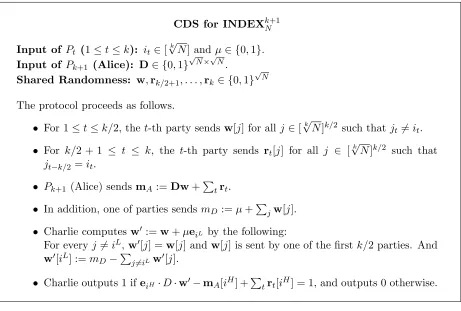
• For 1≤t≤k/2, the t-th party sendsw[j] for allj ∈[√kN]k/2 such thatjt6=it.
• For k/2 + 1 ≤ t ≤ k, the t-th party sends rt[j] for all j ∈ [k √
N]k/2 such that
jt−k/2=it.
• Pk+1 (Alice) sends mA:=Dw+Ptrt.
• In addition, one of parties sends mD :=µ+Pjw[j].
• Charlie computesw0 :=w+µeiL by the following:
For everyj 6=iL,w0[j] =w[j] and w[j] is sent by one of the first k/2 parties. And
w0[iL] :=mD−P
j6=iLw0[j].
• Charlie outputs 1 ifeiH·D·w0−mA[iH] +Ptrt[iH] = 1, and outputs 0 otherwise.
Figure 2: (k+ 1)-party linear CDS for INDEXkN+1, when k is even.
Theorem 7.2. There is a linear non-monotone secret-sharing for the family of all access functions
F :{0,1}n→ {0,1} with share size O(2n/2) bits for each party.
Proof. (Sketch) Use Lemma 6.3 to construct non-monotone secret sharing from multi-party CDS
forALL, with the observation that the transformation in Lemma6.3preserves linearity.
Acknowledgments. We thank Yuval Ishai for telling us about Conjecture 1. We thank the anonymous EUROCRYPT 2018 reviewers for their insightful comments.
References
[BBR94] David A. Mix Barrington, Richard Beigel, and Steven Rudich. Representing boolean functions as polynomials modulo composite numbers. Computational Complexity, 4:367–382, 1994.
[Bei11] Amos Beimel. Secret-Sharing Schemes: A Survey, pages 11–46. Springer Berlin Hei-delberg, Berlin, HeiHei-delberg, 2011.
[BF98] Laszlo Babai and Peter Frankl. Linear algebra methods in combinatorics, 1998.
[BGP95] Amos Beimel, Anna G´al, and Mike Paterson. Lower bounds for monotone span pro-grams. InFOCS, pages 674–681, 1995.
[BGW99] L´aszl´o Babai, Anna G´al, and Avi Wigderson. Superpolynomial lower bounds for mono-tone span programs. Combinatorica, 19(3):301–319, 1999.
[BI01] Amos Beimel and Yuval Ishai. On the power of nonlinear secret-sharing. InProceedings of the 16th Annual IEEE Conference on Computational Complexity, Chicago, Illinois,
USA, June 18-21, 2001, pages 188–202. IEEE Computer Society, 2001.
[BIKK14] Amos Beimel, Yuval Ishai, Ranjit Kumaresan, and Eyal Kushilevitz. On the crypto-graphic complexity of the worst functions. InTCC, pages 317–342, 2014.
[BL88] Josh Cohen Benaloh and Jerry Leichter. Generalized secret sharing and monotone func-tions. InAdvances in Cryptology - CRYPTO ’88, 8th Annual International Cryptology
Conference, Santa Barbara, California, USA, August 21-25, 1988, Proceedings, pages
27–35, 1988.
[Bla79] George Robert Blakley. Safeguarding cryptographic keys. InProc. AFIPS 1979 National
Computer Conference, pages 313–317, 1979.
[CFIK03] Ronald Cramer, Serge Fehr, Yuval Ishai, and Eyal Kushilevitz. Efficient multi-party computation over rings. InEUROCRYPT, pages 596–613, 2003.
[CKGS98] Benny Chor, Eyal Kushilevitz, Oded Goldreich, and Madhu Sudan. Private information retrieval. J. ACM, 45(6):965–981, 1998.
[Csi97] L´aszl´o Csirmaz. The size of a share must be large. J. Cryptology, 10(4):223–231, 1997. [DG15] Zeev Dvir and Sivakanth Gopi. 2-server PIR with sub-polynomial communication. In
STOC, pages 577–584, 2015.
[DGY11] Zeev Dvir, Parikshit Gopalan, and Sergey Yekhanin. Matching vector codes. SIAM J.
Comput., 40(4):1154–1178, 2011.
[Efr12] Klim Efremenko. 3-query locally decodable codes of subexponential length. volume 41, pages 1694–1703, 2012.
[FKN94] Uriel Feige, Joe Kilian, and Moni Naor. A minimal model for secure computation (extended abstract). In Frank Thomson Leighton and Michael T. Goodrich, editors,
Proceedings of the Twenty-Sixth Annual ACM Symposium on Theory of Computing,
23-25 May 1994, Montr´eal, Qu´ebec, Canada, pages 554–563. ACM, 1994.
[GKW15] Romain Gay, Iordanis Kerenidis, and Hoeteck Wee. Communication complexity of conditional disclosure of secrets and attribute-based encryption. In CRYPTO (II), pages 485–502, 2015.
[GPSW06] Vipul Goyal, Omkant Pandey, Amit Sahai, and Brent Waters. Attribute-based encryp-tion for fine-grained access control of encrypted data. InACM Conference on Computer
and Communications Security, pages 89–98, 2006.
[Gro00] Vince Grolmusz. Superpolynomial size set-systems with restricted intersections mod 6 and explicit ramsey graphs. Combinatorica, 20(1):71–86, 2000.
[IK97] Yuval Ishai and Eyal Kushilevitz. Private simultaneous messages protocols with appli-cations. InISTCS, pages 174–184, 1997.
[IK00] Yuval Ishai and Eyal Kushilevitz. Randomizing polynomials: A new representation with applications to round-efficient secure computation. In41st Annual Symposium on Foundations of Computer Science, FOCS 2000, 12-14 November 2000, Redondo Beach,
California, USA, pages 294–304. IEEE Computer Society, 2000.
[IK02] Yuval Ishai and Eyal Kushilevitz. Perfect constant-round secure computation via perfect randomizing polynomials. InICALP, pages 244–256, 2002.
[ISN89] Mitsuru Ito, Akira Saito, and Takao Nishizeki. Secret sharing scheme realizing general access structure. Electronics and Communications in Japan (Part III: Fundamental
Electronic Science), 72(9):56–64, 1989.
[IW14] Yuval Ishai and Hoeteck Wee. Partial garbling schemes and their applications. In Javier Esparza, Pierre Fraigniaud, Thore Husfeldt, and Elias Koutsoupias, editors,
Automata, Languages, and Programming - 41st International Colloquium, ICALP 2014,
Copenhagen, Denmark, July 8-11, 2014, Proceedings, Part I, volume 8572 of Lecture
Notes in Computer Science, pages 650–662. Springer, 2014.
[KW93] Mauricio Karchmer and Avi Wigderson. On span programs. InStructure in Complexity
Theory Conference, pages 102–111. IEEE Computer Society, 1993.
[LVW17] Tianren Liu, Vinod Vaikuntanathan, and Hoeteck Wee. Conditional disclosure of secrets via non-linear reconstruction. InCRYPTO Part I, pages 758–790, 2017.
[OSW07] Rafail Ostrovsky, Amit Sahai, and Brent Waters. Attribute-based encryption with non-monotonic access structures. InACM Conference on Computer and Communications
Security, pages 195–203, 2007.
[PR17] Toniann Pitassi and Robert Robere. Lifting nullstellensatz to monotone span programs over any field. Electronic Colloquium on Computational Complexity (ECCC), 24:165, 2017.
[RPRC16] Robert Robere, Toniann Pitassi, Benjamin Rossman, and Stephen A. Cook. Exponen-tial lower bounds for monotone span programs. InFOCS, pages 406–415, 2016.
[VV15] Vinod Vaikuntanathan and Prashant Nalini Vasudevan. Secret sharing and statistical zero knowledge. InASIACRYPT (I), pages 656–680, 2015.
[WY05] David P. Woodruff and Sergey Yekhanin. A geometric approach to information-theoretic private information retrieval. InCCC, pages 275–284, 2005.
[Yek08] Sergey Yekhanin. Towards 3-query locally decodable codes of subexponential length.
J. ACM, 55(1):1:1–1:16, 2008.
A
Private Simultaneous Message for Branching Program over
Com-mutative Rings
We sketch the PSM schemes from [IK02,CFIK03] for branching programs over commutative rings.
PSM for AFFINEkm
t-th Party’s Input: xt∈ Rn.
Shared Input: Affine function f :Rnk → Rsuch that
fy1,...,yk,c(z1, . . . ,zk) :=hz1,y1i+. . .+hzk,yki+c
Shared Randomness: r1, . . . , rk−1 ∈ R.
• The t-th party (for 1≤t < k) sendsmt:=hxt,yti+rt
• The k-th party sends mk:=hxk,yki+c−Pkt=1−1rt,
• Charlie outputsPk t=1mt.
Figure 3: The log|R|-bit PSM protocol for AFFINEk.
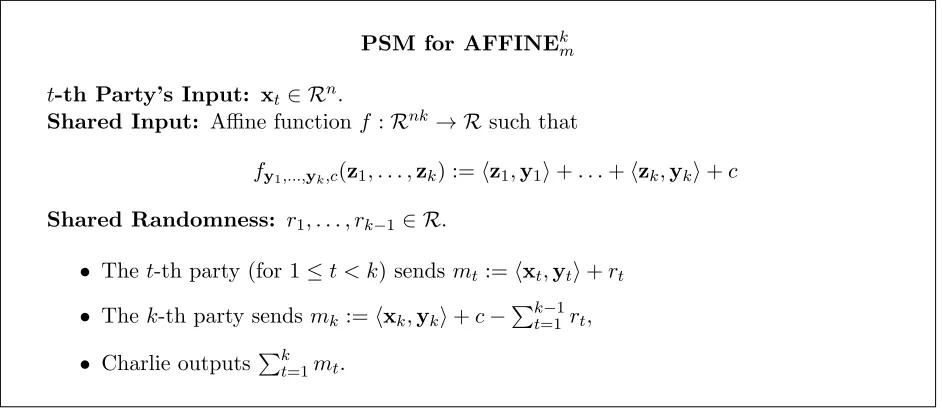
Theorem A.1 (folklore). There is a PSM scheme (Figure 3) for AFFINEk over commutative
ring Rsuch that every party sends one ring element.
Proof. The correctness is straight-forward,
k X
t=1
mt=
k−1
X
t=1
(hxt,yti+rt) +hxk,yki+c− k−1
X
t=1
rt=
k X
t=1
hxt,yti+c=f(x1, . . . ,xk).
Privacy follows from the following observations:
• the joint distribution ofm1, . . . , mk−1 is uniformly random, since we are using (r1, . . . , rk−1)
is one-time pads;
• mk is determined by m1, . . . , mk−1 andf(x1, . . . ,xk) as mk=f(x1, . . . ,xk)− Pk−1
PSM for BPk
t-th Party’s Input: xt∈ Rn.
Shared Input: Affine functions Fi,j :Rnk → Rfor 1≤i≤j≤m.
Shared Randomness: {L1,j}mj=2∈ Rm−1,{Ri,j}1≤i<j≤m ∈ Rm(m−1)/2
and randomness for 12m(m+ 1) nested PSM runs forAFFINEk
• Define matrix L, Rsuch that
Li,j =
1, ifi=j L1,j, if 1 =i < j
0, otherwise
Ri,j =
1, ifi=j Ri,j, ifi < j
0, ifi > j
(10)
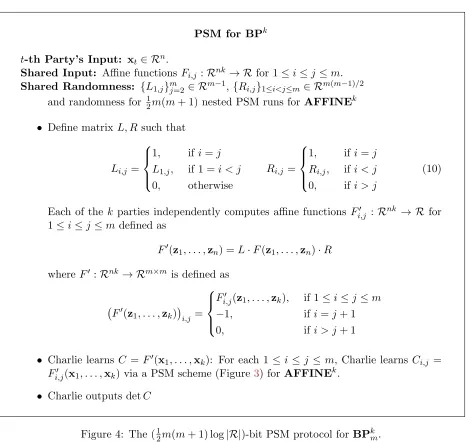
Each of the k parties independently computes affine functions Fi,j0 :Rnk → R for
1≤i≤j ≤m defined as
F0(z1, . . . ,zn) =L·F(z1, . . . ,zn)·R
whereF0 :Rnk → Rm×m is defined as
F0(z1, . . . ,zk) i,j =
Fi,j0 (z1, . . . ,zk), if 1≤i≤j ≤m
−1, ifi=j+ 1
0, ifi > j+ 1
• Charlie learns C =F0(x1, . . . ,xk): For each 1≤i≤j ≤m, Charlie learns Ci,j = Fi,j0 (x1, . . . ,xk) via a PSM scheme (Figure3) for AFFINEk.
• Charlie outputs detC
Figure 4: The (12m(m+ 1) log|R|)-bit PSM protocol for BPkm.
Putting the two together, we can simulate Charlie’s view given just f(x1, . . . ,xk).
Lemma A.2 ([IK02]). For any matrixM ∈ Rm×m such thatM
i,j =−1for i=j+ 1andMi,j = 0
for i > j+ 1, there exist matrix L, R∈ Rm×m satisfying (10) such that
M =
1 L1,2 · · · L1,m
1 . .. 1
| {z }
L · detM −1 . .. −1 ·
1 R1,2 · · · R1,m
1 . .. ... . .. Rm−1,m
1
| {z }