Rings on The Rangel
HUGH. E. COSBYRange Conservationist, Soil Conservation Service, U. S. Department of Agriculture, Minot, North Dakota
Circular patterns in native vegetation excite the imagina- tion of most observers. Such rings are not uncommon on North Dakota prairie, where ex- planations for their causes are many and often legendary.
This paper deals separately with each of four entirely dif- ferent kinds of rings and their causes. The purpose is to con- solidate information on the vari- ous types observed, to record some quantitative data from this area concerning such rings, and to report additional literature on each type.
Fungus Fairy Ring Rings of much local interest are circular bands of fleshy fungi. The fruiting bodies of the fungi, in this climate are irregu- larly produced, ephermal, and easily missed by the casual ob- server.
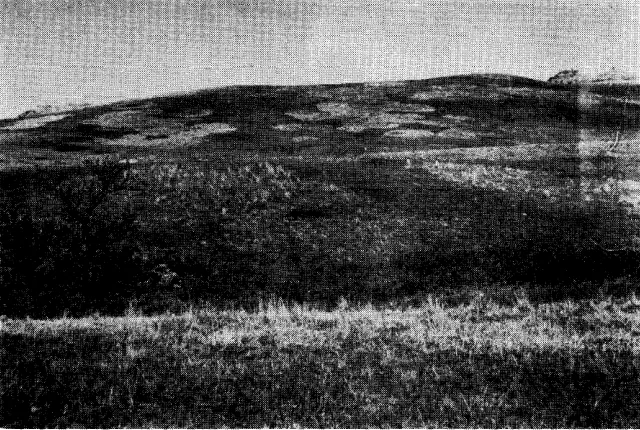
Such rings have a different ap- pearance at different seasons, ac- cording to the amount of pre- cipitation and the amount of grazing they have received. When sufficient moisture is available the circle is often de- tected by more luxuriant growth and by a darker green color. Shantz and Piemeisel (1917) ex- plained this deeper color as greater chlorophyll content of the plant. They sometimes ap- pear as a circle of grass seed heads when few seed heads occur on unaffected areas. When ungrazed, the circles may show as lighter colored bands of
1 Credit is given Mr. Robert L. Howey, Soil Scientist, Soil Conser- vation Service, Minot, North Da- kota, for help with description of soils; and Dr. E. J. Dyksterhuis, Range Conservationist, Soil Conser- vation Service, Lincoln, Nebraska, for many help jul suggestions.
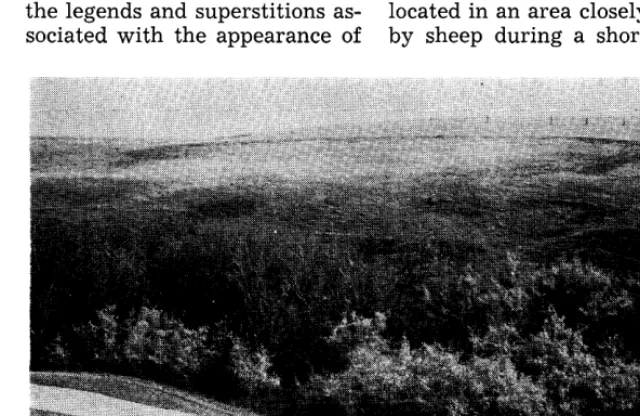
foliage in the fall. When grazed by livestock they are often marked by dark closely grazed bands (Figure 1).
Fungus fairy rings are most evident in the western part of the state. On the highlands along the Yellowstone River several fungus fairy rings can frequent- ly be seen in one pasture. Two local explanations are frequent- ly given for their origin. In some instances they have been re- ported as places where Indian war parties danced. Others have considered them caused by buffalo (bison) cows circling their calves to ward off attack by wolves.
Shantz and Piemeisel (1917) wrote, “The term ‘fairy ring’, generally used to describe the arrangement of plants in an ap- proximately circular form, origi- nated in the belief that these circular growths marked the paths of dancing fairies.” They also described, in great detail, the legends and superstitions as- sociated with the appearance of
Germany.
Effects on vegetation differ with different species of fungi. There are two major groups; those which kill the vegetation and those which stimulate the vegetation (Shantz and Piemei- sel, 1917). The species treated in this article is of the second group.
Study Area
This study was made in Sec- tions 27 and 28; T. 26, R. 59, on the John Cayko ranch in Rich- land County, Montana. This location was chosen because of the different grazing practices associated with each of three different fungus fairy rings.
One ring was in unfenced, natural grassland, long protected from domestic livestock. Occasional droppings indicated that cows sometimes got into the area but grazing by such strays was slight. Range condition was classed as “Excellent” (Dykster- huis, 1949). A visit there on December 18, 1959 showed some removal of forage by rabbits from the stimulated band but foraging outside of the band was not evident. A second ring was located in an area closely grazed by sheep during a short period
FIGURE 1. mer long.
Fungus fairy ring caused by Marasmius oreades on sheep range grazed sum-
each year. The third was in an area regularly grazed season- long. In this area rings common- ly lie on moderate slopes with runoff water consequently drain- ing from the higher ground across the lower edge of the circle. Circle boundaries are gen- erally less distinct on the low side.
Average annual precipitation in the area approximates 13.5 inches, with about 10.5 inches occurring in the period April through September.
Methods
Relative coverage by species of seed plants was determined by a mechanical arrangement of points designed to sample the area inside of the stimulated band and the area around the outside of the entire fungus fairy ring. At each point the
plant hit was identified and tal- lied. Weight of foliage was de- termined by clipping circular 9.6 square foot plots. These were located inside the circle, in the stimulated band, and outside of the area affected by the fungus. Procedure in clipping, segregat- ing, and naming materials fol- lowed that described by Dyk- sterhuis and Schmutz (1947). The fungi were identified by Dr. K. W. Kreitlow, Agricultural Research Service, USDA.
Resulfs
The fungus, identified as Ma- rasmius oreades, was described by Shantz and Piemeisel (1917) as a type causing fairy rings marked by stimulated vegeta- tion.
On ungrazed range the ring was prominently marked by
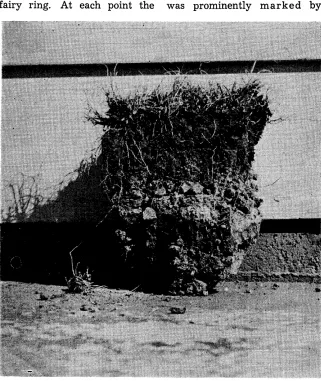
FIGURE 2. Soil sample from a fungus of the fungus Marasmius oreades.
fairy ring. The gray layer is caused by mycelium
seed heads on western wheat- grass (Agropyron smithii) in OC- tober of 1958 and 1959. Seed heads were not in evidence out- side of the stimulated band. Fungi fruiting bodies, when present, were in the outer zone of the stimulated band. The dried fruiting bodies were nu- merous in the ungrazed ring in October 1959. The average width of the fruiting zone was about 4 feet.
The ungrazed ring occurred on Williams loam, thin solum phase. The soil had a 3-inch very dark brown A1 horizon. The B2 horizon averaged about 4 inches in thickness. The pores of the B2 horizon were filled and the natural ped surfaces covered with white mycelium. The C horizon was highly calcareous loam glacial till. The soil is con- sidered typical of the “silty range site” being mapped by several agencies in range classi- fication.
Within the study area the non- calcareous part of the solum varied from 7 to 16 inches in thickness but the distinguishable hyphae were consistently in the upper B2 horizon, from 3 to 5 inches below the surface (Figure 2). They apparently had clogged all large pores and even capil- laries of this horizon so that al- most no moisture penetrated to the subsoil. A drop of water placed on the face of a broken ped took more than five minutes to penetrate while a similar non- infested ped absorbed the water instantly. No effect on soil structure or on normal soil pro- file development was observed. The soil outside of the area affected by fungus was wet to a depth of 18 inches on October 29, 1959. In the band occupied by the fungus mycelium the soil was moist above the mycelium but not below.
area, and 188 feet on the contin- uously grazed area. The width of the stimulated band was 12 feet. Shantz and Piemeisel, 1917, state that “Bayliss (1911) found the maximum increase of a ring of Marasmius oreades to be 13% inches per year, and the mini- mum increase 3 inches.” From this, one would expect the age of these rings to exceed 100 years.
Fungus fairy rings caused by Marsmius oreades are numerous in native grass on a farmyard in Divide County. The land owner first noticed the effects on the grass after horses win- tered in the shelter of the build- ings during the winter of 1946- 47. When the present renter moved to the farm in 1955 the rings were about the size of car tires. In late 1959 the diameter of one of these circles was 6 feet 7 inches and two others measured 8 feet 10 inches. These rings are apparently very young compared to those previously
mentioned. According to the growth rate found by Bayliss, it seems likely that the owner may have observed the beginning of these rings.
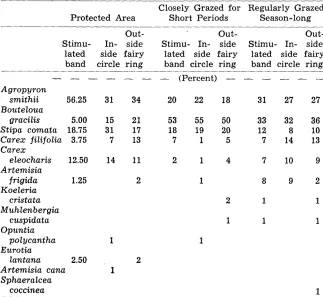
Relative vegetative cover by species in each of three fungus fairy rings and inside and out- side of each ring is shown in Table 1. The vegetative compo- sition in the ungrazed area, un- affected by fungus, compares rather closely with climax com- position on similar sites as re- ported by Larson and Whitman (1942) and Quinnild and Cosby (1958). Under the conditions of a climax type of cover and no grazing w es t e r n wheatgrass showed a significant increase in the stimulated band with a cor- responding decrease in blue grama (Bouteloua gracilis). Rog- ler and Lorenz (1957)) working near Bismarck, N. Dak., in a similar p 1 ant community, re- ported a similar increase in western wheatgrass from the ad- dition of commercial nitrogen.
Closely Grazed for Regularly Grazed Protected Area Short Periods Season-long
Out- out- Out-
Stimu- In- side Stimu- In- side Stimu- In- side lated side fairy lated side fairy lated side fairy band circle ring band circle ring band circle ring
---__ (Percent) - - - -
Agropyron
smithii 56.25 Bouteloua
gracilis 5.00 Stipa comata 18.75
Carex filifolia 3.75
Carex
eleocharis 12.50
Artemisia
frigida 1.25
Koeleria
cristata Muhlenbergia
cuspidata Opuntia
polycantha Eurotia
lantana 2.50 Artemisia cana Sphaeralcea
coccinea
31 34
15 21 31 17 7 13
14 11
2
20 22 18 31 27 27
53 55 50 33 32 36 18 19 20 12 8 10
7 1 5 7 14 13
2 1 4 7 10 9
1 8 9 2
2 1 1
1 1 1
1
2 1
1 Table 1. Relative coverage by species of seed planAs in and adjacent fo
three fungus fairy rings caused by Marasmius oreades.
The plant composition within the circle was not significantly different from that of the check area. This indicates that once the fungus has passed through the area the vegetation returns to normal.
In both grazed areas there was significantly more blue grama and less western wheatgrass, both within and outside the fun- gus affected areas. In the un- grazed area, winterfat (Eurotia Zanata) was a very conspicuous part of the entire landscape. On each of the other two areas win- terfat was not found. Green needlegrass (Stipu viridula) was not encountered in a relative cover determination but large, scattered bunches were noted on the ungrazed site. Clones of prairie sandreed (Calamovilfa Zongifoliu) were conspicuous but were not important in the total vegetation.
Table 2. Pounds per acre, air-dry herbage, fresh mulch, and humic mulch associated with different positions in relation to fungus fairy ring on nafive range, October 1958 and 1959. ,
- _____ ~___ _ _~________________
1958 1959
Herb. F.M. H.M. Herb. F.M. H.M. Control: near ring 1200 1800 4300 900 1400 3900 Inside: encircled 1500 1600 2900 1100 1100 3900 On stimulated band 1900 1600 ____-- 2900 1100 1400 2700
It may be noted (Table 2) that less herbage was produced out- side the influence of the fungus ring than within its influence. This was the case both years. However, it is noteworthy that the dried remains of growth of previous years, segregated as fresh mulch and humic mulch, was greater outside the influ- ence of the fungus ring. There- fore, the fungus was associated with greater current growth but less old growth. This might be explained by the more rapid de- composition of dead plant mate- rials in the area influenced by the fungus. The lack of well- defined zones of influence makes herbage yield determinations difficult. More clippings over a longer period of time would in- crease the accuracy of the data on herbage yield and mulch accumulation.
Rings Originating From Firebreaks
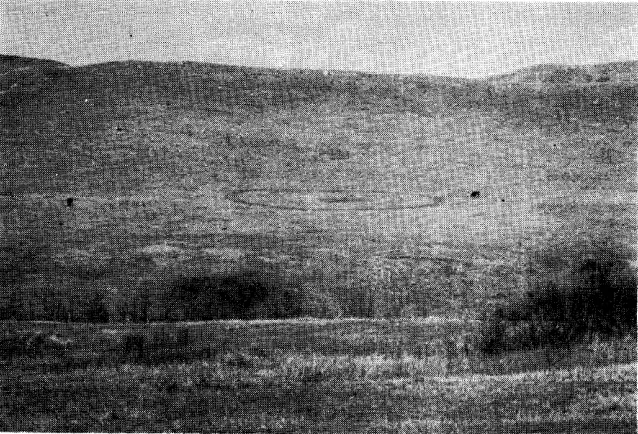
Some circles on prairie land that at first seems inexplicable could later be accounted for by the plowing of firebreaks around haystacks. These may persist for decades and in areas where hay has not been cut within the memory of current land owners. In time the plow marks all but disappear, leaving a circle that is visible only because of the dif- ference in vegetation. One such circle is on the Wayne Evans ranch along the Little Knife River in Mountrail County. It was first noticed in 1937. Hay has never been cut in the area to the owner’s knowledge but the square inside the circle scarcely leaves room for any other explanation. The circle ap- peared the same to Mr. Evans in 1937 as when the picture was taken in May 1958, some 20 years later (Figure 3).
FIGURE 3. Circle in native range apparently caused by plowing a firebreak around a hay stack. The circle appeared the same to the land owner when he moved there in 1937. No history of haying could be established for this site.
The circle is vivid in the spring but becomes less apparent each month until it is difficult to see, even under close inspec- tion. Relative cover age data were obtained by the same method used for relative cover- age on fungus fairy rings to de- termine the vegetative charac- teristics which caused the change in appearance by sea- sons. Table 3 describes the veg- etation in the circle and outside of the mechanically disturbed area on May 14, 1959.
Needleleaf sedge was 48 per- cent by count of the vegetation in the disturbed band, while blue grama made up only 7 percent. In the undisturbed area blue grama made up 52 percent of the plant cover while 16 percent was needleleaf.
Western wheatgrass and thick- s p i k e wheatgrass (Agropyron.
dasystachyum) are shown to- gether on the table because of the difficulty of identification when not in head and because of their similar growth habits. It was thought that thickspike wheatgrass comprised about 2 percent of the total cover.
Firebreak rings provide evi- dence that blue grama has been extremely slow in returning to bared areas even though these are but a few feet across. On abandoned fields in western North Dakota, Whitman, Hanson and Larson (1943) found that fields abandoned 25 to 35 years _ had only about one-sixth as much blue grama as native sod. They also remarked that needle- leaf sedge became established somewhat faster than blue grama.
Clones
FIGURE 4. Clones of Calamovilfa longifolia makin g circular patches indicating spread by rhizomes rather than by seed.
radiate out from a surviving plant or one newly established. The rate of spread is often equal in all directions providing sym- metry to the clone. The advanc- ing edges of such clones are marked by more vigorous growth and more seed heads than the older central part. Cen- tral portions of old clones may die, leaving rings. Quinnild and Cosby (1958) reported this type of vigor along the edge of an advancing western wheatgrass community.
The clones of western snow- berry (Symphoricarpos occi- dentalis) also often form almost perfect circles in this area. The colonies formed by the spread- ing rhizomes of this plant range from a meter to over 200 meters in diameter as described by Pel- ton (1955).
Creeping juniper (Juniperus horizontalis) has stems which creep over the ground and radi- ate in all directions from the central stem. Circles of this type usually result from one plant. When more than one plant or origin from both seeds and vege- tative offshoots is involved, the circular pattern of advance is soon lost.
Other grasses, forbs and woody
plants which reproduce by strong rhizomes may on occa- sion produce clones of nearly perfect circles. The more showy of these plants may add to the pattern of circles on the prairie.
Tepee Rings
Circles of surface stones, at- tributed to activities of Indians, are common on the undisturbed prairie throughout northwestern North Dakota (Figure 5). These man-made tepee rings sometimes show effects on the vegetation. There seems little doubt that tepee rings are man-made, but much speculation about the rea- son for the stones being placed in this manner is still heard. The name is derived from the Indian word tipi and is frequently re-
ferred to by this spelling. The name implies that the stones were placed around the base of the tepee for anchorage.
This belief is held by many. Others believe the stone circles have ceremonial significance and still others think they were con- structed merely as recreation or diversion from tedium. Robert Cory related much of the legend associated with the tepee rings in “The Minot Daily News” of March 3 and April 18, 1959.
According to information in the Museum Review (1946) some rings of small boulders found on the prairie may have been used to hold down tepee walls but the following opposing reasons were also given. In size the rings range from 5 feet, too small for a tepee, to 90 feet, much larger than any known tepee, and av- erage 15 to 20 feet in diameter. The rings are precisely circular, yet, when the tepees were re- moved the stones would have been moved and would have re- quired replacing to maintain the carefully laid circles. In many cases the rings are on high ridges, fully exposed to wind, and are long distances from wood or water. The following statement appears in The Mu- seum Review (1946): “The exact significance of the rings which were not used as tipi rings is problematical but due to their location it seems quite probable that they may have had a re- ligious or ceremonial signif i- cance.”
Table 3. Relative coverage by species of seed plants on circular firebreak. plowed once to profecf haystack decades ago, and on surrounding range.
Species Firebreak Control
Bouteloua gracilis Carex eleocharis
Agropyron smithii and A. dasytachyum Stipa viridula
Stipa comata
Calamagrostis montanensis Artemisia jrigida
Sphaeralcea coccinea Unidentified forb Poa pratensis
(Percent)
7 52
48 16
25 20
6 6
5 1
4
3 3
1
1 1
LITERATURE CITED DYKSTERHUIS, E. J. AND E. M.
SCHMUTZ. 1947. Natural mulches or “litter” of grasslands: with kinds and amounts on a southern prairie. Ecology 28: 1’73-179. DYKSTERHUIS, E. J. 1949. Condition
and management of range land based on quantitative ecology. Jour. Range Mangt. 2: 104-115. GDULD, C. J., H. M. AUSTENSON, AND
V. L. MILLER. 1958. Fairy Ring disease of lawns. Washington Agri. Expt. Sta. Cir. 330.
HERBEL, CARLTON H., AND KLING L. ANDERSON. 1959. Response of true prairie vegetation on major Flint Hills range sites to grazing treat- ment. Ecol. Mon., 29: 171-186. LARSON, F. .AND W. WHITMAN. 1942.
A comparison of used and unused grassland mesas in the Badlands of South Dakota. Ecology 23:438- 445.
PELTON, J. 1953. Studies on the life history of Symphoricarpos occi- dentalis. Ecol. Mono., 23: 17-39.
QUINNILD, C. L. AND H. E. COSBY. 1958. Relics of climax vegetation on two mesas in western North Dakota. Ecology 39: 29-32. ROGLER, GEORGE A. AND RUSSEL J.
LORENZ. 1957. Nitrogen fertiliza- tion of northern great plains rangelands. Jour. Range Mangt. 10: 156-160.
FIGURE 5. Tepee rings. Such rings are commonly 15 to 20 feet across but may be much larger or smaller. There are commonly many within the same area. Such rings are widespread in undisturbed North Dakota prairie.
Washburn (1956), in a compre- hensive a r t i c 1 e on patterned ground, has described the stone circles, nets, and polygons of cold climates. He also reviewed hypotheses of their origin such as ejection of stones from fines by multigelation. The circles of stones encountered by the author on North Dakota Prairie do not seem to conform with any of the types of frost-produced circles described by Washburn. Also unobserved were circles re- sulting from damage by white grubs as reported by Schu- macher (1959).
Summary and Conclusions Circular patterns in the vege- tation are common on the range lands of North Dakota and Mon- tana. The circles are of different types and have different origins. Data were obtained on two types in 1958 and 1959 and observa- tions were made of these and
other types over several years. Of the four types discussed the fungus fairy ring is probably the least widely distributed and is associated with the most mys- tery and legend.
Circles caused by plowing fire- breaks around haystacks often persist long after marking by the plow is obliterated. Single plants which propagate vege- tatively, commonly called clones, often form nearly perfect circles on the prairie. These form dur- ing periods of secondary succes- sion following great loss of cover, and also during range de- generation when grazable spe- cies are kept low in vigor while very short or woody plants ad- vance vegetatively.
Tepee rings are circles of sur- f ace stones. Their significance is unknown though it is generally agreed that they were placed by people at a time prior to the ad- vent of white men.
SCHUMACHER, C. M. 1959. White grubs in bluestem pastures. The Kansas Stockman 44: 12-13, Ills. SHANTZ, H. L. AND R. L. PIEMEISEL.
1917. Fungus fairy rings in East- ern Colorado and their effect on vegetation. Jour. Agri. Res. 11: 191-426.
THE MUSEUM REVIEW, 1946. Vol. 1; No. 9.
WASHBURN, A. L. 1956. Classifica- tion of patterned ground and re- - view of suggested origins. Bul. Geol. Sot. Amer. 67: 823-866. WEAVER, J. E. AND F. W. ALBERTSON.
1956. Grasslands of the great plains. Johnson Pub. Co., Lincoln, Nebr., 395 pp.
WHITMAN, W. C., H. THEO. HANSON AND G. LODER. 1943. Natural Re- vegetation of abandoned fields in western North Dakota. N. D. Agri. Expt. Sta. Bul. 320.
INDEXES FOR SALE
Ten Year Index for Vols. 1 through 10 is available at the office of the Executive Secretary for