A New Partial Key Exposure Attack on
Multi-power RSA
?Muhammed F. Esgin1,2, Mehmet S. Kiraz1, and Osmanbey Uzunkol1
1
T ¨UB˙ITAK B˙ILGEM UEKAE, Turkey
{muhammed.esgin, mehmet.kiraz, osmanbey.uzunkol}@tubitak.gov.tr
2
Graduate School of Natural and Applied Sciences, ˙Istanbul S¸ehir University, Turkey
Abstract. An important attack on multi-power RSA (N = prq) was introduced by Sarkar in 2014, by extending the small private exponent attack of Boneh and Durfee on classical RSA. In particular, he showed thatN can be factored efficiently forr= 2 with private exponentd sat-isfyingd < N0.395. In this paper, we generalize this work by introducing a new partial key exposure attack for finding small roots of polynomi-als using Coppersmith’s algorithm and Gr¨obner basis computation. Our attack works for all multi-power RSA exponents e (resp. d) when the exponentd (resp. e) has full size bit length. The attack requires prior knowledge of least significant bits (LSBs), and has the property that the required known part of LSB becomes smaller in the size ofe. For prac-tical validation of our attack, we demonstrate several computer algebra experiments.
Keywords: Multi-power RSA, Integer factorization, Partial key exposure, Cop-persmith’s method, Small roots of polynomials.
1
Introduction
A natural way of speeding up the decryption/signing procedure of RSA based cryptographic schemes is to use a small private exponent d. However, Wiener [22] showed that classical RSA construction becomes insecure whend < 13N14.
Later, this bound was further improved by Boneh and Durfee [2] to N0.292 by using results of Coppersmith [6].
Kocher [15] initiated a new type of attack that obtains information about the bits ofdusing side-channel techniques in 1996. The idea is to exploit certain weaknesses of the actual implementation (e.g., execution time, power consump-tion, noise), which in turn reveals some bits ofd. In general, the attacker gains information about either consecutive least significant bits (LSBs) or most signif-icant bits (MSBs). Therefore, partial key exposure attacks mostly focus on these two rather specific cases.
?
Boneh, Durfee and Frankel [3] introduced the first algebraic partial key ex-posure attack using partial information of d. The attack finds the whole secret exponent d when sufficient partial knowledge ofdis known. Coppersmith’s al-gorithm for finding small roots of polynomials is used in such algebraic attacks [6,5,4]. This algorithm uses lattice reduction techniques to obtain efficient small roots of certain polynomials (in particular, the LLL algorithm [16]). Later, new partial key exposure attacks on classical RSA were described by Bl¨omer and May in [1]. We refer to [9,14] for further partial key exposure attacks on standard RSA.
Notation: Let log denote the logarithm base 2 unless the base is given con-cretely. We use the following notation throughout this manuscript.
N Multi-power RSA modulus
n bitsize ofN p,q prime factors ofN
r integer satisfying the relationN =prq e RSA public exponent
d RSA private exponent
d0 known part ofd
α logNe(i.e.,e≈Nα)
β logNd(i.e.,d≈N β
)
δ logNd0 (i.e.,d0≈Nδ)
In this work, we focus on multi-power RSA (also referred as Takagi’s RSA or prime power RSA) introduced by Takagi in [21]. One of the motivation of this variant is to speed up the RSA decryption/signing process. More concretely, N =prq is chosen for two (distinct) primes of same bit length such thatr ≥ 2. Then, there are two different ways of generating public/private exponents. The first one imposes the conditioned ≡1 mod (p−1)(q−1) while the other ed≡1 modφ(N), whereφ(N) =pr−1(p−1)(q−1). Decryption of a ciphertext c is computed more efficiently using simply a combination of Hensel lifting and Chinese Remainder Theorem moduloprand q(see [21] for details).
For the multi-power RSA variant when exponents are generated modulo φ(N), Takagi proved in [21] that ifd≤N2r1+2, thenN can be factored. This was
later improved by May in [18] to d <max{N(r+1)2r , N (r−1)2
(r+1)2}. Recently, Sarkar
[20] improved this bound even further forr≤5 and showed in particular that if d < N0.395 andr = 2, thenN can be factored efficiently. Thereafter, Lu et al. [17] improved Sarkar’s result for r≥4. Their attack works when the unknown part ˜dofd(it may be all ofdor an MSB/LSB part of it) satisfies ˜d < N
r(r−1) (r+1)2.
In [13], a small private exponent attack is shown for the case when exponents are generated modulo (p−1)(q−1). This attack shows thatN can be factored if d < N2−
√
2
r+1 . Later, the idea of this work is used in [12] for partial key exposure
in any of the following conditions:
γ≤ 7 12−
1 4
q 16+24β
3 −
39
9 if MSBs or middle bits are known, or γ≤5
9− 2 3
q 2+3β
3 − 5
9 if LSBs are known,
whered≈Nβ and the unknown part ofdis approximatelyNγ. Note that their attacks do not work when dis of full size modulo (p−1)(q−1) (i.e.,d≈N23).
Our Contribution. In this paper, we provide a new partial key exposure attack on multi-power RSA when the exponents are generated moduloφ(N). The attack basically uses partial knowledge of LSBs and works for alle(resp.d) when the exponent d (resp. e) has full size bit length.3 More concretely, we prove the following theorem which generalizes Sarkar’s result [20].
Theorem 1. Let r ≥ 2 be an integer and N = prq be a multi-power RSA
modulus, where p and q are distinct primes with the same bit size (i.e., p, q ≈ Nr+11 ). Suppose that ed ≡ 1 modφ(N) with e ≈ Nα and d ≈ Nβ. Suppose further that an attacker obtains an LSB part d0 of d, where d0≥Nδ for some δ ∈R≥0. Then under Assumption 1, there exists an algorithm which finds the
prime factors ofN in polynomial time inlogN provided that
ρ(r, β, α, δ)<0,
whereρis a function of r,β,αandδ.
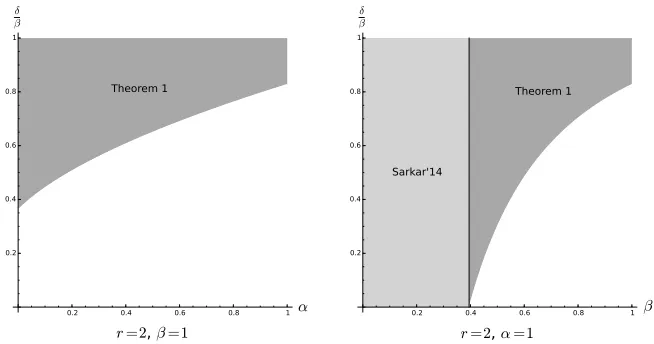
We show the improvement of our attack over Sarkar’s result in Figure 1 for the caser= 2. Light grey area (indicated by “Sarkar’14”) shows the attack region by [20] and darker grey areas are the applicable regions of our attack.
Organization of the paper. In Section 2, we give preliminaries about lattices. In Section 3, we prove our main result, Theorem 1, extending the result of [20]. Section 4 demonstrates several experiments justifying our claims for the multi-power RSA moduli of length 1024 or 2048 bits. We conclude the paper in Section 5 and argue the improbability of using our attack for known MSBs by addressing an issue in [12].
2
Preliminaries
In this section, we give basic definitions and theorems about lattices. Let v = (a0,· · · , as) be a vector inRs+1for somes≥0. We use the Euclidean norm||v|| ofv
||v||:= v u u t
s X
i=0 (ai)2.
3
0.2 0.4 0.6 0.8 1 0.2
0.4 0.6 0.8 1
α
δ β
Theorem 1
r =2
,
β =10.2 0.4 0.6 0.8 1 0.2
0.4 0.6 0.8 1
β
δ β
Sarkar'14
Theorem 1
r =2
,
α =1Fig. 1.The relation between the sizes ofe (resp.d) and the fraction of the part ofd
required to be known.
For a multivariate polynomialf, the norm ||f|| of f is the Euclidean norm of its coefficient vector. Letv1,· · ·, vw∈Rmbe a set of R-linearly independent vectors with w, m ∈ N>0 and w ≤m. Then, the lattice L generated by these vectors is
L:={b1v1+· · ·+bwvw : bi ∈Zfor 1≤i≤w}.
We always work on lattice havingfull rank, i.e.w=m. We denotedim(L) :=w for the dimension ofL. Each latticeLcan be represented by the following matrix M ∈GL(w,R):
M=
v1 . . . vw
.
We denotedet(L) for the determinant of L. We havedet(L) =det(M) for a full rank latticeL.
Theorem 2. Let Lbe a lattice with dim(L) =w as above. The LLL algorithm produces a set of reduced basis vectors {R1,· · ·, Rw} such that
||Ri|| ≤2
w(w−1)
4(w+1−i)det(L)w+11−i.
The computational complexity of the LLL algorithm is polynomial in dim(L) and in the maximal bitsize of an entry [19].
Coppersmith described methods for finding small roots of univariate and bivariate polynomials [4,5,6]. The methods can be extended to the polynomials having more variables, but the results become heuristic. Howgrave-Graham [11] reformulated these results and proved the following theorem:
Theorem 3 (Howgrave-Graham’s Theorem, [11]).
Let f(x1,· · ·, xs) ∈ Z[x1,· · ·, xs] be a polynomial for s ≥ 1. Assume that the
number of monomials is less than or equal to w. If the following two conditions hold:
1. M ∈Z+ andf(x10,· · ·, x0s)≡0 mod M for some|x01|< X1,· · ·,|x0s|< Xs,
2. ||f(x1X1,· · ·, xsXs)||<√Mw,
then(x0
1,· · ·, x0s) is a root off overZ.
After finding multivariate polynomials carrying a common root over integers, we need to extract this root using Gr¨obner basis computation.4Our main result Theorem 1 is valid under the following assumption:
Assumption 1 Letf1,· · · , fkbe the polynomials having the desired root overZ
fork≥3 computed using LLL reduction. Furthermore, letI be the ideal gener-ated by these polynomials. Then, the algebraic variety of I is zero-dimensional. In particular, the common root can be extracted by computing a Gr¨obner basis on I.
Since our result in Theorem 1 relies on this assumption, it is heuristic. However, our experiments show that this assumption holds in general (see Section 4). The computational complexity of a Gr¨obner basis computation can be bounded by a polynomial in logN assuming the number of variables and the maximal degree of input polynomials is fixed [10].
3
An Attack with Known LSBs
In this section, we prove our main Theorem 1.
Proof (Theorem 1). Multi-power RSA parameters satisfy the congruenceed≡ 1 modφ(N) with φ(N) = (pr−pr−1)(q−1). This implies the equation that ed−1 =k(pr−pr−1)(q−1) for some k∈
Z. Since we know an LSB part of d,
4
we can write this aseMd˜+ed0−1 =k(pr−pr−1)(q−1) where d= ˜dM+d0 andM is a power of 2. Hence, we have the following polynomial
feM(x, y, z) =ed0−1−xN−xyr−1+xyr−1z+xyr
carrying the root (x0, y0, z0) = (k, p, q) moduloeM. It is easy to see that|x0|< X := Nα+β−1, |y0| < Y := Nr+11 and |z0| < Z := Nr+11 neglecting small
constants.
Letm, t1, t2≥0 and define the following shift polynomials:
gi,j,k(x, y, z) =xjykzj+t1feMi (x, y, z),
wherei= 0,· · · , m,j = 1,· · ·, m−iandk=j,· · · , j+ 2r−2, gi,0,k(x, y, z) =ykzt1feMi (x, y, z),
wherei= 0,· · · , mandk= 0,· · ·, t2.
Recall thatyr
0z0=N. Hence, we replace every occurrence ofyrz with N in the shift polynomials. Denote new polynomials by g0i,j,k(x, y, z). Observe that choosingxyr as the leading monomial off
eM, the leading monomials ingi,j,k0 ’s are of the formxi+jyk+ri−rlzj+t1−l, wherel= minbk+ri
r c, j+t1 .
Algorithm 1Generating the LatticeL
Input:r≥2;m, t1, t2≥0 andfeM(x, y, z)
G, H, Ord← ∅
fori∈ {0,1,· · ·, m}do
forj∈ {1,2,· · ·, m−i}do
fork∈ {j, j+ 1,· · ·, j+ 2r−2}do
Append (xjykzj+t1fi
eM, i) toG
l←minnbk+ri r c, j+t1
o
Appendxi+jyk+ri−rlzj+t1−ltoOrd
end for end for end for
fori∈ {0,1,· · ·, m}do
fork∈ {0,1,· · ·, t2}do
Append (ykzj+t1fi
eM, i) toG
l←minnbk+ri r c, j+t1
o
Appendxi+jyk+ri−rlzj+t1−ltoOrd
end for end for
foreach element (g, i) inGdo
Replace each occurrence ofyrzwithN ing
a0`←a−`1modeM, wherea`is the leading coefficient ofg
Append (a0
`·g·(eM)m−i) toH
end for
i←1
foreach polynomialh(x, y, z) inHdo
Seti-th row ofLto the coefficient vector ofh(xX, yY, zZ) ordered w.r.t.Ord Incrementi
Let a` denote the leading coefficient. Assuming gcd(a`, eM) = 1, we can multiplygi,j,k0 ’s with the inversea0` of their corresponding leading coefficient in Z/(eM)mZ. Finally, the shift polynomials become
hi,j,k(x, y, z) =a0`·gi,j,k0 (x, y, z)·(eM) m−i
which carry the root (x0, y0, z0) modulo (eM)m.
We let the coefficient vectors ofhi,j,k(xX, yY, zZ) represent the basis vectors of a latticeL. Generation ofLis summarized in Algorithm 1.
Note that each polynomial inH generated by Algorithm 1 introduces exactly one new monomial, which is appended toOrdthat defines the monomial order-ing. Hence, the matrix representing the lattice is lower triangular when each row is ordered with respect toOrd. As a result, the determinant ofLis the product of the diagonal entries of the representation matrix.
det(L) = m Y i=0 m−i
Y
j=1 j+2r−2
Y
k=j
Xi+jYk+ri−rl1Zj+t1−l1(eM)m−i
× m Y i=0 t2 Y k=0
XiYk+ri−rl2Zt1−l2(eM)m−i
!
,
wherel1= min
bk+ri
r c, j+a andl2= min
bk+ri
r c, a . Letting sx,sy,sz and seM be the powers ofX,Y,ZandeM indet(L), respectively, and denoting the dimension of the lattice byw, we obtain
w= m X
i=0 m−i X
j=1 j+2r−2
X k=j 1 + m X i=0 t2 X k=0
1 = 2r−1
2 m
2+t
2m+o(m2)
sx= m X
i=0 m−i X
j=1
(2r−1)(i+j) + m X i=0 t2 X k=0
i= 2r−1
3 m
3+ t 2m
2+o(m3)
seM = m X
i=0 m−i
X
j=1
(2r−1)(m−i) + m X i=0 t2 X k=0
(m−i) = 2r−1
3 m
3+ t 2m
2+o(m3)
Assuming t2
r ≤t1≤m, we get as an asymptotic result
sy= m X
i=0 m−i X
j=1 j+2r−2
X
k=j
(k+ri−rl1) + m X i=0 t2 X k=0
(k+ri−rl2)
≈ 1 2
r2m3 3 −r
2m2t
1+r2mt21− r2t3
1 3 +rm
2t 2
−2rmt1t2+rt21t2+mt22−t1t22+ t32 3r
sz= m X
i=0 m−i X
j=1 j+2r−2
X
k=j
(j+t1−l1) + m X
i=0 t2
X
k=0
(t1−l2)
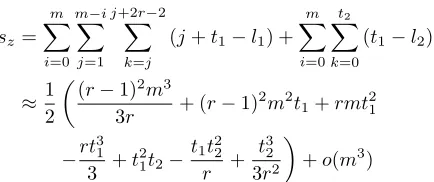
≈ 1 2
(r−1)2m3
3r + (r−1) 2m2t
1+rmt21
−rt 3 1 3 +t
2 1t2−
t1t22 r +
t3 2 3r2
+o(m3)
which are approximated as in [20].
Neglecting the low order terms as similarly done in related works, the conditions in Theorem 2 and Theorem 3 can be simplified to det(L) < (eM)wm. In our case, we need
sx(α+β−1) + (sy+sz)
1
r+ 1
+ (seM −wm)(α+δ)<0.
to be satisfied. Plugging in the values forsx,sy,szandseM, we obtain a polyno-mialρ0(r, α, β, δ) with parameterst1,t2andm. Lett1=τ1mandt2=τ2m, and terms ofo(m3) contribute to an error term. Next, we take the partial derivative ofρ0with respect toτ1andτ2, and find the values making the derivatives zero to obtain the maximum value ofρ0. Finally, forγ:=β−δ, whenτ1=
1−rγ+r2(1−γ)
2r and
τ2=
1 +r3(1−γ)−r2(1 + 2γ) +r(1−γ) + 2rp
r2(1−γ) +r(1−2γ) + 1−γ 2r+ 2
both derivatives become zero. Plugging in these values in ρ0, we get a func-tion ρ(r, α, β, δ). When the tuple (r, α, β, δ) satisfyρ(r, α, β, δ)<0, Howgrave-Graham’s theorem is satisfied. We can extract the root (k, p, q) under Assump-tion 1, and thus factorN in time polynomial in logN. ut
Remark 1. We note that our definition of shift polynomials is similar to the one in [20]. The difference is that we work moduloeM instead of moduloe. Hence, the constant coefficient offeM changes. EquatingM = 1 (i.e.,δ= 0), we obtain the result of Sarkar [20] as a corollary of Theorem 1.
Unfortunately, the exact expression of ρ is too complicated to be stated here. Thus, in Table 1, we provide some numerical values for δ which yields ρ < 0 whenβ is fixed to 1. We remind that for r= 2 new attack regions are given in Table 1 when eitherdoreis full-sized.
4
Experimental Results
r smallestδvalue satisfying ρ(r)<0 forα= 1
smallestδvalue satisfying
ρ(r)<0 forα= 0
2 0.828 0.362
3 0.798 0.344
4 0.750 0.314
5 0.703 0.285
6 0.662 0.259
7 0.625 0.237
Table 1.Numerical values satisfyingρ <0 for differentr andαvalues whereβ= 1.
of 216+ 1 moduloφ(N)). The experiments are performed on Sage 6.5 running on Ubuntu 14.04 LTS with Intel Core i7-3770 CPU at 3.40GHz and 16GB RAM.
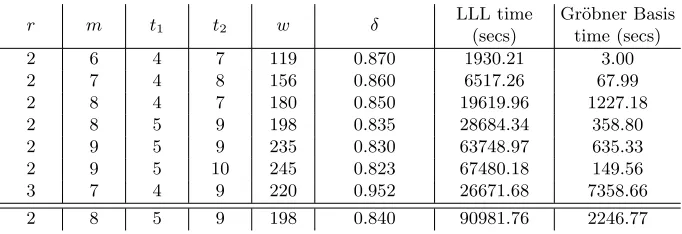
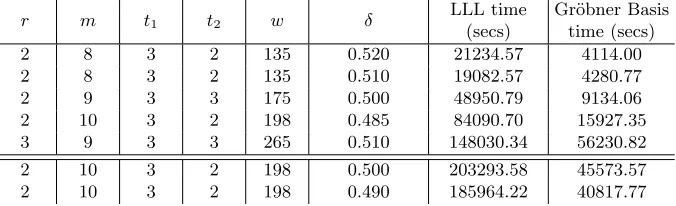
Our results are given in Tables 2 and 3. In all of our experiments, Gr¨obner basis computation yields to a polynomial of the formy−pgiving the factorization of N. For the case whenα=β = 1 (which is illustrated in Table 2), we would like to highlight that our result in a case is better than the theoretical bound δ≥0.828. However, wheneis chosen small (e.g.,e= 216+ 1), the moduluseM becomes very small when compared to the case α=β = 1. Therefore, the low order terms ignored to simplify the condition to det(L)<(eM)wm have much higher effect in this case. Thus, the results are a little bit worse than the best possible bound of Theorem 1.
r m t1 t2 w δ
LLL time (secs)
Gr¨obner Basis time (secs)
2 6 4 7 119 0.870 1930.21 3.00
2 7 4 8 156 0.860 6517.26 67.99
2 8 4 7 180 0.850 19619.96 1227.18
2 8 5 9 198 0.835 28684.34 358.80
2 9 5 9 235 0.830 63748.97 635.33
2 9 5 10 245 0.823 67480.18 149.56
3 7 4 9 220 0.952 26671.68 7358.66
2 8 5 9 198 0.840 90981.76 2246.77
Table 2. Experimental results for α = β = 1. n = 2048 bits for the last row and
n= 1024 bits for the rest.
5
Conclusion and Discussion
r m t1 t2 w δ
LLL time (secs)
Gr¨obner Basis time (secs)
2 8 3 2 135 0.520 21234.57 4114.00
2 8 3 2 135 0.510 19082.57 4280.77
2 9 3 3 175 0.500 48950.79 9134.06
2 10 3 2 198 0.485 84090.70 15927.35
3 9 3 3 265 0.510 148030.34 56230.82
2 10 3 2 198 0.500 203293.58 45573.57
2 10 3 2 198 0.490 185964.22 40817.77
Table 3.Experimental results for e= 216+ 1,β= 1.n= 2048 bits for the last two rows andn= 1024 bits for the rest.
results justifying our claims. Our attack even works in the case whene, d≈N. In fact, our experimental result is better than the theoretical bound for this case. This paves the way for a further study: investigating sublattices of the original lattice to improve the theoretical bound. However, this is a hard task because in this case the lattice will not be of full rank and calculating the determinant gets complicated.
One may wonder why our attack is not directly applicable to known MSBs case. Suppose that we know an MSB partd0ofd. Then, we obtain the equation
ed0+ed˜−1 =k(pr−pr−1)(q−1),
where ˜drepresents the unknown part of d. Considering this equation as a poly-nomial, we get
F(w, x, y, z) = 1−ed0−ew+x(N−yr−yr−1z+yr−1).
Now e, N or ed0 are possible choices of moduli. The case e is studied in [20] where one cannot benefit from partial knowledge of d as it vanishes. If N is chosen as the modulus, then the trick of replacing each term yrz with N and finding its inverse cannot be applied. That leaves us with the option to choose ed0 as the modulus. This case actually corresponds to finding a small root of
integer equations [4], not modular equations [5].
Observe that reducing F modulo ed0 does not eliminate any variable. In particular,Fed0 andF have the same monomials. Hence, the polynomials derived
from LLL may just be those of the formF ·gi for nonzero polynomialsgi not carrying the desired root. More concretely, the attacker does not obtain any additional information at all although LLL-reduced polynomials carry the root since they have the factorF.
For a recent work, one may see Coron’s works [7,8] about methods to ensure independence between the initial polynomialFand the polynomials derived after LLL reduction5. Unfortunately, the tricks used in this work cannot be directly applied with Coron’s method. This issue raises questions about the validity of
5
known MSBs attack shown in [12]. The authors do not specify any methodology guaranteeing the independence aforementioned. Their experiments for this case are very far away from the new attack region described by Theorem 1 in their paper. Moreover, the authors also state that in some experiments, they just veri-fied that the LLL-reduced polynomials contain the root. As we explained earlier, this does not have any implication for an attacker to be able to find the root.
Acknowledgments:Uzunkol’s research is supported by the project (114C027) funded by EU FP7-The Marie Curie Action and T ¨UB˙ITAK (2236-CO-FUNDED Brain Circulation Scheme). His work is also partly supported by a joint research project funded by Bundesministerium f¨ur Bildung und Forschung (BMBF), Ger-many (01DL12038) and T ¨UB˙ITAK, Turkey (TBAG-112T011).
References
1. Johannes Bl¨omer and Alexander May. New partial key exposure attacks on RSA. In Dan Boneh, editor, Advances in Cryptology - CRYPTO 2003, volume 2729 of
Lecture Notes in Computer Science, pages 27–43. Springer Berlin Heidelberg, 2003. 2. D. Boneh and G. Durfee. Cryptanalysis of RSA with private keydless thanN0.292.
Information Theory, IEEE Transactions on, 46(4):1339–1349, Jul 2000.
3. Dan Boneh, Glenn Durfee, and Yair Frankel. An attack on RSA given a small fraction of the private key bits. In Kazuo Ohta and Dingyi Pei, editors,Advances in Cryptology - ASIACRYPT ’98, volume 1514 ofLecture Notes in Computer Science, pages 25–34. Springer Berlin Heidelberg, 1998.
4. Don Coppersmith. Finding a small root of a bivariate integer equation; factoring with high bits known. In Ueli Maurer, editor, Advances in Cryptology - EURO-CRYPT ’96, volume 1070 ofLecture Notes in Computer Science, pages 178–189. Springer Berlin Heidelberg, 1996.
5. Don Coppersmith. Finding a small root of a univariate modular equation. In Ueli Maurer, editor,Advances in Cryptology - EUROCRYPT ’96, volume 1070 of
Lecture Notes in Computer Science, pages 155–165. Springer Berlin Heidelberg, 1996.
6. Don Coppersmith. Small solutions to polynomial equations, and low exponent RSA vulnerabilities. Journal of Cryptology, 10(4):233–260, 1997.
7. Jean-S´ebastien Coron. Finding small roots of bivariate integer polynomial equa-tions revisited. In Christian Cachin and Jan L. Camenisch, editors, Advances in Cryptology - EUROCRYPT 2004, volume 3027 ofLecture Notes in Computer Sci-ence, pages 492–505. Springer Berlin Heidelberg, 2004.
8. Jean-S´ebastien Coron. Finding small roots of bivariate integer polynomial equa-tions: A direct approach. In Alfred Menezes, editor, Advances in Cryptology -CRYPTO 2007, volume 4622 of Lecture Notes in Computer Science, pages 379– 394. Springer Berlin Heidelberg, 2007.
9. Matthias Ernst, Ellen Jochemsz, Alexander May, and Benne de Weger. Partial key exposure attacks on RSA up to full size exponents. In Ronald Cramer, editor,
Advances in Cryptology - EUROCRYPT 2005, volume 3494 ofLecture Notes in Computer Science, pages 371–386. Springer Berlin Heidelberg, 2005.
11. Nicholas Howgrave-Graham. Finding small roots of univariate modular equations revisited. In Michael Darnell, editor, Crytography and Coding, volume 1355 of
Lecture Notes in Computer Science, pages 131–142. Springer Berlin Heidelberg, 1997.
12. Zhangjie Huang, Lei Hu, Jun Xu, Liqiang Peng, and Yonghong Xie. Partial key ex-posure attacks on Takagi’s variant of RSA. In Ioana Boureanu, Philippe Owesarski, and Serge Vaudenay, editors,Applied Cryptography and Network Security, volume 8479 ofLecture Notes in Computer Science, pages 134–150. Springer International Publishing, 2014.
13. Kouichi Itoh, Noboru Kunihiro, and Kaoru Kurosawa. Small secret key attack on a variant of RSA (due to Takagi). In Tal Malkin, editor, Topics in Cryptology -CT-RSA 2008, volume 4964 ofLecture Notes in Computer Science, pages 387–406. Springer Berlin Heidelberg, 2008.
14. Marc Joye and Tancr`ede Lepoint. Partial key exposure on RSA with private exponents larger thanN. In Mark D. Ryan, Ben Smyth, and Guilin Wang, editors,
Information Security Practice and Experience, volume 7232 of Lecture Notes in Computer Science, pages 369–380. Springer Berlin Heidelberg, 2012.
15. Paul C. Kocher. Timing attacks on implementations of Diffie-Hellman, RSA, DSS, and other systems. In Neal Koblitz, editor, Advances in Cryptology - CRYPTO ’96, volume 1109 ofLecture Notes in Computer Science, pages 104–113. Springer Berlin Heidelberg, 1996.
16. A.K. Lenstra, Jr. Lenstra, H.W., and L. Lov´asz. Factoring polynomials with ra-tional coefficients. Mathematische Annalen, 261(4):515–534, 1982.
17. Yao Lu, Rui Zhang, and Dongdai Lin. New results on solving linear equations modulo unknown divisors and its applications. Cryptology ePrint Archive, Report 2014/343, 2014. http://eprint.iacr.org/.
18. Alexander May. Secret exponent attacks on RSA-type schemes with moduli
N = prq. In Feng Bao, Robert Deng, and Jianying Zhou, editors,Public Key
Cryptography - PKC 2004, volume 2947 of Lecture Notes in Computer Science, pages 218–230. Springer Berlin Heidelberg, 2004.
19. Phong Q. Nguyen and Damien Stehl´e. Floating-Point LLL revisited. In Ronald Cramer, editor, Advances in Cryptology - EUROCRYPT 2005, volume 3494 of
Lecture Notes in Computer Science, pages 215–233. Springer Berlin Heidelberg, 2005.
20. Santanu Sarkar. Small secret exponent attack on RSA variant with modulusN=
prq. Designs, Codes and Cryptography, 73(2):383–392, 2014.
21. Tsuyoshi Takagi. Fast RSA-type cryptosystem modulopkq. In Hugo Krawczyk, editor, Advances in Cryptology - CRYPTO ’98, volume 1462 ofLecture Notes in Computer Science, pages 318–326. Springer Berlin Heidelberg, 1998.