The Effectiveness of Mollusk Sand Filtration and Absorption of
Active Carbon to Decrease Pb, Turbidity and pH in Rain Water
and Its Correlation to Public Health in Pontianak
Khayan1*, Husodo2, Astuti2, Sudarmadji2, dan Sugandawaty2 1Health Polytechnic of Health Ministry, Pontianak-Indonesia. 2Medicine Faculty of Gadjah Mada University, Yogyakarta-Indonesia.
*E-mail: [email protected] ABSTRACT
Pb found in rain water is not only caused by tin roof on houses but also caused by the pollution of industrial activities, vehicles and land clearing activity by fire. Pb pollutant dissolves and enters into rain water storages and it’s consumed as drinking. Pb can cause bad impact to human, for example disruption of enzyme, anemia and low intelligence. The purposes of this research are (1) to evaluate Pb, pH and turbidity level in rain water, (2) to analyze the effectiveness of mollusk sand filtration and the absorption of activity carbon to decrease Pb, turbidity and pH, and (3) to analyze the correlation of Pb, length of stay and smoking habit on public health. This research is an experimental by using pre and post test designs with control and observational by using cross sectional design. The research was conducted in urban and rural areas of Pontianak and Kubu Raya regency. The sampling was done in determining the number of samples of Pb, pH and turbidity in rain water. The analyzing the data by using computer program. The results show that: (1) the average of Pb, pH and turbidity level before treatment is considered high at 131.7 µg/L on Pb, turbidity at 20 NTU and low pH at 5.2. After the treatment was the Pb has decreased to 0.71 µg/L and turbidity has to 5.66 NTU, pH to 6.9 and (2) Rain water treatment is very effective to decrease Pb for 99.4% and turbidity for 72%, and (3) there is a correlation among Pb found in rain water, length of stay and smoking activity to public health. Recommends that: the residents of Pontianak and Kubu Raya to process rain water before consuming. The rain water treatment can be done by applying mollusk sand filtration and absorption of active carbon.
Keywords: Pb, Turbidity, pH, Rain Water, Filtration, Absorbtion and Public Health.
1. INTRODUCTION
People in West Borneo who have access to improved drinking water source mostly get their water from the rain water reservoirs for 45.3% and this portion is bigger compared to the national portion for 2.9 and other regions, for instance Papua Province for 20%, Riau 19.3% and the West Papua for 15.7% (1). The using of rain water is due to the nature condition of the West Borneo which has tropical climate, high humidity and rainfall. It can be seen from the observation which is conducted in all regencies and cities in The West Borneo Province, the average of rainy days and rainfall each month is quite high, that is 29 days/month in Pontianak, with average rainfall 3830,4 mm/month. (2) It’s as same as with Malaysia, the rainfall averaging around 2400 mm for Peninsular Malaysia, 2360 mm for Sabah and 3830 mm for Sarawak. (3)
Before being collected into water tanks, the rain water will fall on tin roof. In the process of making tin roof, every piece of the roof is added or coated with Pb. Pb functions to strengthen
the bond of tin layer with iron layer, lead-based paint and solder in water supply system (4, 5, 6). Lead also to prevent corrosion on the tin roof. Realizing that rain water is corrosive because it contains aggressive CO2 and low pH in Pontianak city was 4.78–5.85. (7) So that it’s
causing the tin roof easily rusted and possibility Pb coated to the roof dissolves and increases Pb in rain water. The low pH can affect the poisonous metal solubility found in rainwater containers(8).
Pb in rain water can be sourced not only on the tin roof but also caused by Pb exposure from the environment, for instance; industrial activities, vehicle emission, land clearing of farm land by fire and charcoal burning. Next, the pollutant of Pb particles turns into crystals and is dissolved by rain water(5, 7), then it gets into rainwater harvesting system which is consumed as drinking water. In addition to Pb exposure, rain water has low pH and high turbidity level especially after few days without rain and it is stored directly.
Pb in rain water gives negative impact to human health. Moveover, Pb contamination can cause disruption of enzyme, anemia, mental disruption, lowering intelligence (IQ) and hyperactivity on children, insufficient weight and premature condition on new born baby and also increasing high blood pressure on adults.(4, 5) In our body, Pb accumulates in bones in a long term, around 20-30 years and causes chronic (5).
2. MATERIALS AND METHODS
This research will be conducted by using experimental research method to evaluate the effectiveness of rain water filtering by using sand and the absorption of active carbon in filtered tubes to decrease Pb level of rain water in the water container stored. The research designs used are pre and post design with control and cross sectional design. The research was conducted in Pontianak with two target areas; they are urban area and rural area. The chosen urban area was the North Pontianak district in two different locations; they are Subdistrict of Siantan Hulu and Siantan Tengah; meanwhile for the rural area, located in Sungai Raya district in two different locations; Desa Sungai Durian and Limbung.
The target population for this research was the people and their drinking water sources which are from rain water. The measurements taken to rain water are Pb, pH and turbidity. The research targets were those who consume rain water in rural and urban areas. The collected data would be analyzed descriptively by using Ministry of Health of Indonesia and WHO drinking water quality standard and by using analysis of statistics analytic by computer program.
3. RESULTS
3.1 Pb level in Rain Water
Table 1. The Average of Pb Concentration in Rain Water Before and After Treatment
Source: Primary Data 3.2 Rain Water Turbidity
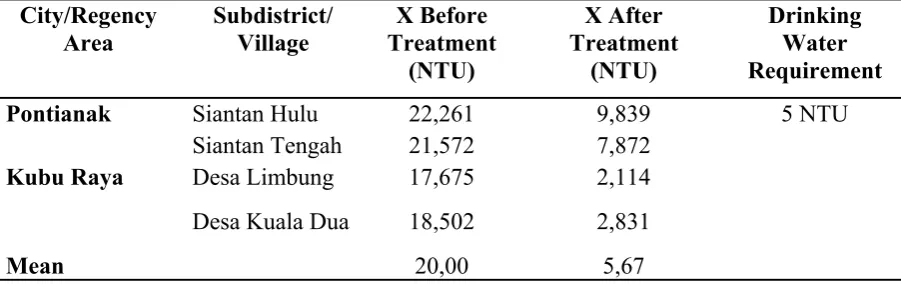
In table 2. shows that the average turbidity of the rain water which had contact with tin roof before the treatment has the highest level which found in subdistrict of Siantan Hulu of Pontianak for 22.26 NTU and after the treatment had been lowered to 9.84 NTU. Meanwhile the average turbidity of rain water which had contact with tin roof found in 40 houses is 20.0 NTU and after treatment the level had been lowered to 5.67 NTU. The turbidity level after treatment of rain water by using filtered tube has met the requirement for drinking water for 5 NTU. The effectiveness level of turbidity reduction after treatment is 72%.
Table 2. The Average of Turbidity Level in Rain Water Before and After Treatment
Source: Primary Data 3.3 pH in Rain Water
It is known from the examination result on table 3 that the lowest rain water pH which had contact tin roof before treatment found in Siantan Hulu of Pontianak had pH average of 4.62 and after the treatment had the highest escalation to 7.01, meanwhile the average pH level for rain water which had contact with tin roof before the treatment found in 40 houses was 5.16 and after treatment it had increased to 6.95.
Table 3. Rain Water pH Before and After Treatment City/Regency
Area Subdistrict/Village Treatment Before (µg/l)
After Treatment
(µg/l)
Drinking Water Requirement
Pontianak Siantan Hulu 201,3 0,75 0,01 mg/l
(10 µg/l) Siantan Tengah 222,0 0,77
Kubu Raya Desa Limbung 44,6 0,75
Desa Kuala Dua 58,9 0,47
Mean 131,7 0,69
City/Regency Area
Subdistrict/ Village
X Before Treatment
(NTU)
X After Treatment
(NTU)
Drinking Water Requirement
Pontianak Siantan Hulu 22,261 9,839 5 NTU
Siantan Tengah 21,572 7,872
Kubu Raya Desa Limbung 17,675 2,114
Desa Kuala Dua 18,502 2,831
City/ Regency
Area
Subdistrict/ Village
pH Before Treatment
Ph
pH After Treatment
pH
Drinking Water Requirement
Pontianak Siantan Hulu 4,626 7,001 6,5– 8,5
Siantan Tengah 4,937 6,981
Kubu Raya Desa Limbung 5,357 6,791
Desa Kuala Dua 5,721 7,014
Mean 5,16 6,95
Source: Primary Data
3.4 Pb level in Rain Water Before and After Treatment.
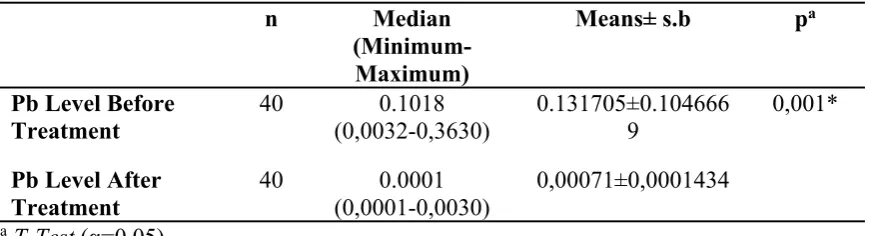
The table 4 above shows that Pb level of the rain water which had contact with tin roof before treatment has average of 131.7 µg/l and after treatment has average of 0.69 µg/l . The statistic test has shown that there is a significant difference on Pb level of the rain water before and after treatment (p= 0.000).
Tabel 4. Pb Level Differnces in Rain Water Before and After Treatment
n Median
(Minimum-Maximum)
Means± s.b pa
Pb Level Before Treatment
40 0.1018
(0,0032-0,3630)
0.131705±0.104666 9
0,001*
Pb Level After
Treatment 40 (0,0001-0,0030) 0.0001 0,00071±0,0001434
a T-Test (α=0,05)
*Significant (p<0,05) Source: Primary Data
3.5 Rain Water Turbidity Before and Afterv Treatment
The table above shows that the turbidity of rain water which had contact with tin roof before treatment has the average for 20 NTU, after the treatment average level of 5.67 NTU. The statistic test shown that there is a significant difference on turbidity level of the rain water before and after filtration of mollusk sand filtration and absorption of active carbon (p= 0.000).
n Median
(Minimum-Maximum)
Mean± s.b pa
Turbidity Before
Tratment
40 18,95(15,06-26,81) 20,0025±3,33 0,000*
Turbidity After
Treatment
40 2,92(0,14-14,96) 5,67±5,15
a T-Test (α=0,05) *Significant (p<0,05) Source: Primary Data
3.6 Pb in Rain Water and Public Health
There is a tendency between the levels of exposure of Pb in rainwater with Pb level in urine for those who consume rain water as their drinking water. Statistic analytic has shown that there is correlation between exposures of Pb in rain water with public health disorder. The higher the level of exposure of Pb in rain water the bigger chances for public to suffer health disorder from consuming rain water (r=0.3). A side from consuming rain water as drinking water, there are other risk factors related to the increase of Pb exposure to public health, for instance; the length of stay, occupation types, and smoking habit.
3.7 Occupation, Pb exposure and Health
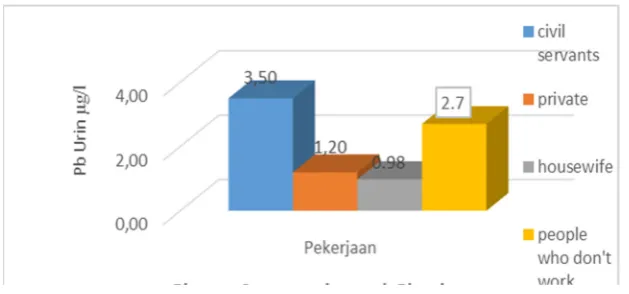
In accordance to the figure 1, it is known that there is a tendency of occupation and Pb in his blood. Occupation factor, as civil servants has higher risk to the exposure of Pb compared to those who are not working, private sectors, housewives for 3.5µg/l, 2.7µg/l, 1.2 µg/l and 0.98 µg/l. Statistic analytic has shown that those who consume rain water as their drinking water and work as Civil Servants are exposed with Pb have no significant difference compared to those who are not working, private sectors, and housewives (p=0.067).
Figure 1. Occupation and Pb Urine
On figure 2 shown that there is a tendency for public who consume rain water as their drinking water, and the length of stay ≥ 10 years to increase the risk of Pb exposure bigger than those who stay < 10 years that is 1.89 µg/l and 0.46 µg/l. Statistic analytic has shown that those who consume rain water as their drinking water and has stayed ≥ 10 years are exposed to Pb higher than those who has stayed < 10 years (p=0.000).
Figure 2. Lenght stay and Pb urine 3.9 Smoking habit, Pb exposure and Health
On figure 3 shown that there is a tendency for public who consume rain water as their drinking water, and have smoking habit to increase the risk of Pb exposure more than 1.84 µg/l compared to those who are not smoking for 0.98 µg/l. Statistic analytic has shown that those who consume rain water as their drinking water and have smoking habit having higher risk of Pb exposure than those who are not smoking (p=0.00).
Figure 3. Smoking habit and Pb urine
4.1 Pb in Rain Water
Pb level contains in rain water which had contact with tin roof in Pontianak and Kubu Raya Regency before treatment has shown that the average level is 131.7 µg/l. This numbers show that the quality of rain water stored directly from tin roof doesn’t meet the requirement for drinking water quality. Research conducted by Gakungu in Embakasi, Nairobi Africa on rain water which had contact with tin roof, clay roof and concrete roof didn’t find or detect any Pb concentration in the rain water (11). The neither research conducted in Africa country, like the one conducted by Mayouf on Pb concentration in rain water which flowed on the roof and stored in tanks or water containers in the City of Misurata Libya, which was below detection limit (12). The research conducted by Untari and Kusnadi in Malang of The East Java on rain water which was taken or stored directly from few places in Malang didn’t show any detected Pb in the rain water. (13)
Pb found in rain water confirms that generally rain water has relatively good (clean) quality for drinking water, but has tendency to get polluted when it is in the atmosphere and when it drops on the ground. The contamination which happens in the atmosphere can be caused by dust particles, microorganisms, and gasses such as NOx, COx and SOx. These pollutants are sourced from the emission of vehicles and industries and also can be sourced from the roof materials as the collector and container for rain water (4, 5, 7). The result of the analysis from some countries such as Palestine and Australia known that there dust particles especially in urban areas, hevy methal, bird waste, microorganisms, and physically has color and taste. (14, 15, 16)
Pontianak is higher than in Kubu Raya regency in countryside and rural areas, they are 211.6 µg/l Pb found in rain water and 51.75 µg/l. So, the findings cleared that the air pollution of the area is the main cause of rainwater pollution. Industries of the premises are the root cause of all type of air pollutants in atmosphere as well as in rainwater. Some parameters of air pollution of physical, chemical, and biological are quite high, for instance dust particles, CO and heavy metal such Pb. This particles of the emission produced by vehicles and industries especially for those located in urban areas. (15, 16, 17)
There are some sources of lead (Pb) in rain water which stored from roof. Pb found in rain water came from dust particles in the air which contains lead and stick on the roof in urban areas, and also can be sourced from combustion process of fuel on vehicles and industries. (6) Lead also can be sourced from dust particles contamination as the result of land clearing by fire for farming and planting purpose, and lead also can be sourced from the materials used as roof to collect and store rain water. (17, 18)
Land clearing activity by fire on rice fields and plantations in Pontianak and Kubu Raya regency also contributes dust particles in which contain Pb, It happens because most of the soil in these areas is peat moss. Therefore, Pb found in rain water which collected and stored from the rooftop is high. It’s known that Pb level found in rain water which collected directly has value of 109.7 µg/l and Pb concentration found in rain water which had contact with tin roof has value of 131.7 µg/l. Pb concentration found in rain water which had contact with tin roof is higher than the one without contact. This Pb hasn’t met drinking water quality requirement set by WHO on Guidelines for Drinking Water Quality. (9, 10)
to rural areas, which are 21.92 NTU and 18.08 NTU. Whereas pH value found in rain water collected in urban areas is lower, pH 4.78, compared to rural areas for pH 5.54.
The reason why Pb concentration found in rain water is high is not only influenced by dust particles produced by land clearing activities or fuel combustion but also influenced by the material used for collecting and storing the rain water. (17, 18) This can be found in examination result of Pb concentration in rain water both which were directly stored and stored after had contact with tin roof. Pb found in rain water which had contact with tin roof is higher than Pb found in rain water which was directly stored, they are 131.7 µg/l and 109.7 µg/l. Pb contained in rain water which had contact with tin roof is caused by the nature of acid in rain water and the humidity of air around it, therefore it increases the chances for corrosion on tin roof material which causes Pb as the bonding agent for iron plate and tin dissolves in rain water. The high of Pb dissolved in rain water is also caused by nature condition in Pontianak and Kubu Raya which are located in tropical areas and positioned exactly on equator line, therefore the sun always passes them the whole year. Because of this condition, Pontianak and Kubu Raya always get full sunlight the whole year and also the rain the whole day, especially in October and March. (3, 7) Therefore, air pollutants produced from land clearing activity and fuel combustion generate air pollutant emission such as Tetra Ethyl lead (TEL) and Tetra Methyl Lead. (15)The particles of Tetra Ethyl Lead and Tetra Methyl Lead will break apart in the air by the help of sunlight into Monoethyl-Pb, diethyl-Pb, and triethyl-Pb. These three organic Pb are easy to dissolve in water. The solubility of Pb in rain water, not only related to some factors but such as sunlight, air humidity, type of Pb produced from the breaking process but also affected by acid-base of rain water. Generally, rain water has the nature of soft water with quite high acidic level, pH <5. Soft water and pH <5 will cause Pb to have high solubility and increase its concentration, therefore when rain falls Pb will easily dissolve in rain water and enter to rain water storage and can’t be accepted or improper to consume. (8)
The research result shows that the acidic level of rain water in Pontianak is pH 4.78 and Kubu Raya is pH 5.54. These values are quite high. The average result of examination on rain water pH in Pontianak and Kubu Raya of the West Borneo is pH 5.16. This value is higher than the research of rain water conducted in Malang with pH 7.4 Untari and Kusnadi, and in Misurata, Libya with the pH 7.87-8.54. pH with high level of acidity will increase the solubility and poison contained in heavy metal such as Pb. (8) Because of its nature the acidity level will affect the health of those who consume the rain water. The examination result of Pb exposure on public health, with average Pb level in urine is 26.27 µg/l, even though this value is considered low. (15, 16)
Not only Pb and acid-base in rain water is high but also the level of turbidity of rain water in Pontianak and Kubu Raya is high. The research result shows that average level of rain water turbidity in Pontianak is 21.92 NTU and in Kubu Raya is 17.84 NTU. This value has met the requirement for drinking water quality for 5 NTU. (9,10) This value is higher than that in other locations, for instance rain water turbidity level in Embakasi Nairobi for 2.9 NTU and in Malang of The East Java for 1.05. (10, 15)
They can be seen that the concentration of Pb and acid-base in rain water and the level of turbidity of rain water are high, we can also see that the average pH level is considered low, 5.02. The pH of the rain water in Pontianak is 4.78 lower than pH of the rain water in country side and rural areas of Kubu Raya, 5.26. Those values are still below the standard of drinking water requirement as pH of 6.5-8.5. Drinking water sources included rain water proper to consume as drinking water if the pH ranges 6.5-8.5. Low pH level will affect the water processing, corrosive and can disturb disinfection process. (19) In soft water such as rain water with pH less than 5 will cause the level of metal solubility high, especially lead (Pb). Pb solubility comes from piping system and other other metal substances, as used for roof to collect and store rain water will be corrosive and dissolve in rain water. Therefore, the low pH of rain water (pH<5) will affect the poisonous metal solubility such Pb, makes the rain water improper to consume. (8) Based on the high level of Pb and turbidity found in rain water and low pH in rain water, which is above allowable value by WHO standard, so that we need appropriate technology for treatment.
4.2 Rain Water Treatment
To decrease the Pb in water, especially in rain water we can use several methods, the timer setting for collecting and treatment by using filtration method and absorption of active carbon method. Filtration and absorption method usually are used to process the ground water and underground water which have high level of metal such as Fe, Hg and Pb. For that reason treatment is needed to reduce the concentration of Pb in rain water. The method used to decrease pollutant level in rain water is Filtered Tube combined with gravel, mollusk sand and active carbon.
4.2.1 Filtered Tube for Rain Water Treatment
The result of the research shows that the use of filter, mollusk sand and absorption of active carbon of coconut shells is very effective to decrease Pb, turbidity level and increase pH level of rain water. The effectiveness of mollusk sand filter and absorption of active carbon of coconut shells in filtered tube has decreased Pb concentration for 99.47%, turbidity level for 72% and increase pH level for 35%. Statistics analysis shows significant value in decreasing Pb (p=0.001), turbidity level (p=0.000) and increasing pH level (p=0.000).
The result of the research shows that Pb treatment in rain water by applying mollusk sand and absorption of active carbon filtration method shows high effectiveness for 99.47%. It can be seen that average Pb concentration before treatment for 0.1317 mg/l (131.7 µg/l) and after treatment for 0.00069 mg/l (0.69 µg/l). Statistics analysis shows that Pb concentration found in rain water which was processed by applying mollusk sand and absorption of active carbon filtration is less than before treatment significantly (p=0.001) and also decreased turbidity level significantly (p=0.00). The result also shows the treatment of rain water by applying mollusk sand and absorption of active carbon filtration has increased pH level (0.00).
4.2.2 Mollusk sand Filter medium
The decreasing of Pb concentration, turbidity level and the increasing of pH happened after the substances or materials contained in rain water passed through filtered tube which consist of active carbon coconut shell granules, mollusk sand, and gravel. The tube length is 120 cm, 10 cm thick gravel, 20 cm thick mollusk sand and 10 cm thick active carbon granules. The function of sand medium generally and specifically 20 cm thick sand mollusk filter is able to filter and decrease turbidity level. The high level of turbidity is caused found in rain water is caused by dust particles included Pb particle, bird waste and microorganism or usually depends on the characteristic of pollutant in an area or a city. The mollusk san medium filter in the tube will form film layer that functions effectively in filtering the pollutant particles like dust, either metal such as Pb or non-metal such as bacteria, viruses and the color of rain water.
The effectiveness degree of mollusk shell sand filter is higher in decreasing Pb concentration and turbidity and also in increasing pH of rain water compared to ordinary sand and the active carbon used for filtration, for instance rain water treatment by using quartz sand as filter medium in treatment water from river has increased pH for 4.7% and for rain water for 2.9%, while mollusk san could increase pH of rain water for 26%. The ability of mollusk shell sand shows better function in increasing rain water pH, this happened due to Calcium Oxide (CaO) for 94.1%, Na2O 1% and SiO 1% contained in mollusk sand. Mollusk sand also has the ability to absorb heavy metal found in the water and hold suspended materials, so that mollusk sand is very useful to be used as filtration medium in water treatment. (19, 20)
Shell is one of the mineral sources which come from sea creatures which had been ground and have high carbon. Mineral contained in shell is varied and high, for example calcium contained in shell is 66.7%, magnesium 22.28% and SiO2 for 7.88%. That’s why mineral found in shells which naturally had attrition or decomposition can increase rain water pH and its carbonate can oxidize Pb in rain water. (21, 22)
4.2.3 Active Carbon Absorption Medium.
Rain water is not always a good clean water source that is ready to drink, physically it doesn’t have color, taste and clear. The rain water is affected by the area where the rain falls. In rural areas rain water could be polluted by waste produced by land clearing activity, pesticide, and animal waste, while in urban areas rain water could be polluted by chemical substances dissolved in water which is tasteless, no color, and unseen. Chemical substance such as Pb could come from the material used as roof, paint, tin, tar, dust and asbestos. Pb could also be produced from volcanic eruption, gas emission from fuel combustion of vehicles and industries. Not only caused by chemical substances, rain water contamination also can be sourced from micro organic matters such as bacteria, virus, and parasite. (15,16)
Rain water treatment by using absorption process is aimed to continue decreasing suspended organic and inorganic substances which were able to escape from filtration process, therefore this process functions to decrease metal substances found in rain water such as lead (Pb). Pb concentration in rain water doesn’t meet the requirement for drinking water has changed and is able to meet the requirement to be able to consume. The result of this research shows that Pb concentration in rain water doesn’t meet the requirement for drinking water, with the average Pb concentration found in rain water before treatment was 131.7µg/l and after treatment has decreased to 0.69µg/l with the effectiveness of 99.7%.
The ability of active carbon to absorb Pb substance in rain water is because active carbon has relatively big micropore and mesopore volume, therefore it is very possible to absorb pollutant substances (including Pb) in adequate amount. Active carbon is one of the absorbents which its carbon atom structure is amorphous carbon atom structure, mainly consists of free carbon and also has deep surface therefore it has a good absorption ability. ( 23, 24, 25) Therefore, to decrease Pb concentration level, turbidity, and to increase the pH of rain water is best to apply filtration process by applying mollusk sand and absorption of active carbon in filtered tube. The result shows that the level of decreasing effectiveness for Pb is 99.47%, 72% turbidity and the increasing of pH , with average 5.16 before treatment and 6.95 after treatment and the effectiveness of pH increasing to 26%. After the treatment Pb concentration level went down to 0.69µg/l, turbidity level to 5.6 NTU and pH went up to 6.95. This result has met the requirement for drinking water quality of Pb concentration level at 10 µg/l, turbidity at 5 NTU and pH level at 6.5-8.5. (9, 10)
4.3 Rain Water Pb, Length of Stay, Occupations, Smoking and Public Health.
There is a tendency between the high level of Pb exposure in rain water with the high level of Pb in urine (health disorder) in public who consume rain water as their drinking water. There is also a meaningful correlation, with the moderate correlation strength between the high level of Pb in rain water to the amount of Pb concentration found in urine in public health. Lead (pb) is toxic to human body, which caused by habit and consuming activity on food/drinks. Not only Pb is known to be toxic, but also can accumulate in human body.Based research in Abuja, Nigeria that the results show that occupational exposure increases the blood level of lead, which consequently increases the health risk of the exposed individuals. (26) The exposure source and the high level of Pb concentration are caused by toxication or health disorder in public. Research conducted by Al-Othman in Riyadh city shows that the concentration of Pb in domestic drinking water is higher than bottled drinking water, and also the concentration level of Pb in the blood of those who consumed domestic water is higher than those who consumed bottled drinking water. (27)
Based on research in Yogyakarta to 121 people, consist of pedestrians and vehicle users shows that 55,9% of them are exposed with Pb (Pb in blood 0.70 mg/l). 10.7% from those who exposed with Pb has subjective complaint such as headache, stiffness, feeling weak, nausea and vomiting. Another research conducted by Sutomo et al. (2000) to 95 toddlers in Yogyakarta shows that physical symptoms (subjective complaint) was identified related to Pb exposure, which are 12% has problem with their arms and legs movement, 51.5% has problem with their digestion system and 27.8% has problem with their IQ development that is below the average age of their mental. (28)
4.3.1 Length of stay, Exposur Pb and Health Disorder
a significant difference between length of stay and health disorder in public who consume rain water as their drinking water in Pontianak and in Kubu Raya. Pb exposure in human body can be accumulative and can be detected in three main tissues. First, in blood, Pb is bound in red blood cell (erythrocyte) and has half-life around 25-35 days. Second, in soft tissue (heart and kidney), it has half-life around 40 days to several months. From these tissues Pb is distributed and deposited into a compartment for 5% and excreted in urine and feces for 95%. Third, it is estimated that 5% of Pb concentration which is deposited in the tissues for 90-95% is accumulated in hard tissues (classification), they are teeth, bones, cartilages and others. The half-life of Pb in classification tissues is around 20-30 years. (5, 28) Therefore the longer someone stays in a location contaminated with pollutant such Pb especially by consuming rain water the bigger the Pb exposure. There is a significant correlation between working periods (the length of exposure) of Pb exposure in work place and which consequently increases the health risk of the exposed individuals. (26, 29, 30)
4.3.2 Smoking, Exposure Pb and Health Disorder
Another risk factor which can increase Pb exposure in rain water to public health who consume rain water as their drinking water is the factor of smoking habit. The research shows that those who smoke have higher risk of being exposed by Pb for 1.84 µg/l which is higher than those who don’t smoke for 0.98 µg/l. The statistics analysis shows significantly that those who consume rain water as their drinking water and smoke have bigger risk of being exposed by Pb than those who don’t smoke.
Research conducted, that the concentrations of Cd and Pb in cigarettes were significantly different between cigarette brands tested. (31, 32) Residents who live in countryside and do not smoke have different level of Pb concentration in their blood than those who live in countryside and smoke. Similarly, the research found evidence that suggests tobacco smoking has negative effects on the health outcomes of the musculoskeletal system. (31) The research also explains that the workers who are exposed to Pb in their work place and smoke have higher risk of health disorder (high blood pressure) higher than those who do not smoke. The impact on health for those who consume rain water as their drinking water has also increased related to their occupations. They whose works related to source of pollutant and have unhealthy life style will have higher risk of health disorder.
4.3.3 Occupations, Pb Pollution and Health Disorder
There is a tendency that the habit of consuming rain water as drinking water and occupation in increasing the risk of Pb exposure for Civil Servants to be higher than those who are not working, working in private sector, housewives, which are 3.5 µg/l, 2.70 µg/l, 1.20 µg/l and 0.98 µg/l. Palar explained the research conducted in Cincinnati shows that locations or work places as the same source with various or different occupation types describe different Pb exposure level (health disorder) for mechanics 38 µg/100 ml higher than parking attendant for 34 µg/100 ml and police officers for 30 µg/ 100 ml blood. Statistics analysis shows that they who consume rain water as their drinking water with different occupational risk such as Civil Servants to suffer health disorder insignificantly have higher risk than those who don’t work, work in private sectors and are housewives.
than concentration level and source of pollutant are length of exposure and unhealthy behavior, abiotic factors such as temperature, light and pH of the rain water also have big part in increasing the health disorder risk. Beside that exposure of Pb in rain water and to be unhealthy, it,s from the Industrial location contributed more to Pb in the collected rainwater. The relative general increase in Industrial location and activities in the area that usually facilitates transportation of particulate matter containing Pb. Pollution of lead (Pb) in rain water (drinking water) and in the workplace (accupational) exposed to organic lead and gasoline could been to public health disorder . (33)
5. CONCLUSION
According discussion above can be concluded that: (1) Pb found in rain water and turbidity level before rain water was processed by applying filtration method using mollusk sand and absorption of active carbon showed high level Pb at 131.7 µg/l and turbidity level at 20 NTU. After treatment method applied, Pb had decreased into 0.71 µg/l and turbidity level at 5.66 NTU, this means the rain water has met the drinking water requirement set by Regulation of Health Minister and WHO, (2) Rain water treatment with applying mollusk sand filtration and absorption of active carbon are very effective and significance for decreasing Pb and the turbidity of rain water of coconut shells in filtered tube, and (3) there is correlation between the high level of Pb in rain water, length of stay and smoking habit to public health disorder in Pontianak and Kubu Raya.
6. ACKNOWLEDGEMENT
Thank you for Faculty of Medicine, Gadjah Mada University for science and Polytechnic of Health (POLTEKKES), Indonesia. Pontianak who always support and have a complete laboratory for research.
7. REFERENCES
[1] Republic of Indonesia, Health Ministry, Basic Health Research, Central of Information and Data, Health Ministry, Jakarta; 2014.
[2] Indonesian Agency for Meteorology, Climatology and Geophysics, Observation of Rainfall, Supadio, Kubu Raya, West Borneo, 2014.
[3] Payus, C. and Meng, Kui Ju, Consumption of Rainwater Harvesting In Terms Of Water Quality International. Journal of GEOMATE, Dec., 2015, Vol. 9, No. 2 (Sl. No. 18), pp. 1515-1522 Geotech., Const. Mat. and Env., ISSN:2186-2982(P), 2186-2990(O), Japan
[4] Lisa H.Mason, Jordan P. Harp and Dong Y. Han, Pb Neurotoxity: Neuropsychological Effects of Lead Toxicity-NCBI-NIH, BioMed Research International, volume 2014 Jan 2, doi: 10.1155/2014/840547.
[5] Gagan F Lova, Deepesh and Gupta, Toxicity of Lead: A Review with Recent Updates, Interdiscilinary Toxicology, 2012 Jun; 5(2): 47-58doi: 10.2478/v10102-012-0009-2.
[6] B. Fonseca, H. Maio, C. Quintelas, A. Teixeira, and T. Tavares, Retention of Cr and Pb on a Loamy Sand Soil Kinetics, Equilibria and Breakthrough, Chemical Engineering Journal 152 (2009) 212-219.
[7] Tuti Budiwati, Wiwiek Setyawati and Dyah Aries Tanti, Chemical Characteristics of Rainwater in Sumatera, Indonesia, during 2001–2010, International Journal of Atmospheric Sciences,Volume 2016, Article ID 1876046, 11 page, http://dx.doi.org/10.1155/2016/1876046 [8] Andrew RW, JM J. Environmental Science, the Nature Environment and Human Impact. Singapore:
[9] Republic of Indonesia, Minister of Health, Regulation Number. 492/2010, for concerning the requirement of drinking water quality.
[10] WHO. Guidelines for Drinking Water Quality. Switzerland, 2011. Available from: http://www. Who.int.
[11] Gakungu JN. Qualitative Assessment of Rain Water Harvested from Roof Top Catchments: Case Study of Embakasi. International Journal of Soft Computing and Engineering (IJSCE) 2013;3(4). [12] Mayouf JA. Determination of Iron, Copper, Lead and Cadmium Concen-tration in Rain Water
Tanks in Misurata. International Journal of Physical Sciences. 2007;2 (5):112-8.
[13] Untari, T. and Kusnadi, J.. Utilization Rainwater As A Viable Water Consumption In The Malang City With A Simple Filtration Modification Method , September 2015. FTP. . Jurnal Pangan dan Agroindustri. 2015,;3.
(14) Daoud, A.K, Swaileh, K.M, Hussein and Matani, M., Quality assessment of roof-harvested rainwater in the West Bank, Palestinian Authority, JOURNAL OF Water and Health, IWA Publishing 2011
[15] Bharti1, 4*, Vijender Singh2 and Pawan Kumar Tyagi, Assessment of rainwater quality in industrial area of rural Panipat (Haryana), India Pawan Kumar, Archives of Agriculture and Environmental Science 2(3): 219-223 (2017), eISSN: 2456-6632
[16] Mielke, H.W., Dynamic Geochemistry of Tetraethyl Lead Dust during the 20th Century: Getting the Lead In, Out, and Translational Beyond, International Journal of Environmental Research and Public Health, 2018, 15, 860; doi:10.3390/ijerph15050860 www.mdpi.com/journal/ijerph
[17) Tiwari. S, I.P. Tripathi and H.L.Tiwari, Effects of Lead on Environment, International Journal of Emerging Research in Management &Technology , Jun 2013, ISSN: 2278-9359 (Vol.-2, Issue-6)
[18] Rui Zhang , Vincent L. Wilson , Aixin Hou and Ge Meng, Source of lead pollution, its influence on public health and the countermeasures, International Journal of Health, Animal science and Food safety, Vol. 2 No. 1 (2015) page 18 - 31.
[19] Sillanpää M1, Ncibi MC2, Matilainen A3, Vepsäläinen M, Removal of natural organic matter in
drinking water treatment by coagulation: A comprehensive review. Chemosphere. 2018 Jan;190:54-71. doi: 10.1016/j.chemosphere.2017.09.113. Epub 2017 Sep
[20] Mallongi, A,, Daud, A., Ishak, H., Ruslan La Ane, Agus Bintara Birawida, Erniwati
Ibrahim, Makmur Selomo and Stang Abdul Rahman, Clean Water Treatment Technology
with an Up-flow Slow Sand Filtration System from a Well Water Source in the Tallo District of Makassar
[21] SITI NAZAHIYAH, BTE RAHMAT, ZARINA MD ALI, SABARIAH MUSA, TREATMENT OF RAINWATER QUALITY USING SAND FILTER. International Conference on Environment 2008 (ICENV 2008).
[22] Sangeetha SP, Sruthi K Nair2 and Vemuri Lakshminarayana , An Experimental Analysis on Grey
Water Treatment Using Drawer Sand Filter, published inJournal of Industrial Pollution Control.
ISSN (0970-2083), 2015.
[23] Ginting, M.H.S., Lubis, M., Suwito, F., and Tanujaya, Effect of Calm shell Powder (Anadora Granosa) Composition on Physical Mechanical Properties of Polyester Resin Particle Board Product, Asian Journal of Chemistry, Vol. 29. No. I (2017) 81-85.
[24] Samuel, P. and Abraham C. Mathew, Techno-Economic Evaluation of a Multi-Media Vertical Flow Filter for Roof water Harvesting Manoj, International Journal of Current Research in Biosciences and Plant Biology ISSN: 2349-8080 Volume 2 Number 7 (July-2015) pp. 10-19 [25] Adedayo I, Anthony I, Henry B. Comparison of the Adsorptive Capacity of Raw Materials in
[26] Lukman Adewale Alli , Blood level of cadmium and lead in occupationally exposed persons in Gwagwalada, Abuja, Nigeria, Journal of Interdisciplinary Toxicology. 8(3); 2015 Sep, PMC4961911.
[27] Al-Othman A, Al-Othman ZA, El-Desoky GE, Aboul-Soud MA, Habila M.A., Giesy JP. Lead in Drinking Water and Human Blood in Riyadh City Saudi Arabia, Arabian Journal of Geosciences. 2012;e6.
[28] Sutomo, A.H., Sarwono, R.D., Rubiyo, Triyono, H., Herawati, E., Kasjono, H.S., Waluyo, H., Bambang, W.I., Priyanto, B., Sumaryoto, M.., dan Fadhila, A., 2000, Effect of Pollution of Lead (Pb) with child Growth at Yogyakarta City, Report of research of Environmental Health Impact Assessment, Yogyakarta, 2000.
[29] Parissa Karrari,1,2 Omid Mehrpour,1,2 and Mohammad Abdollahi 3, systematic review on status of
lead pollution and toxicity in Iran; Guidance for preventive measures, DARU Journal of Pharmaceutical Sciences ISSN: 2008-2231 (Online)
[30] Smith D, Mauricio HA, Martha MTR, Adriana M, Howard H. The Relationship Between Lead in, Plasma and Whole Blood in Women, Journal Environmental Health Perpctive. 2013:263-68.
[31] Muhammad Waqar Ashraf, CONCENTRATIONS OF CADMIUM AND LEAD IN DIFFERENT CIGARETTE BRANDS AND HUMAN EXPOSURE TO THESE METALS VIA SMOKING, Journal of Arts, Science & Commerce ■ E-ISSN 2229-4686 ■ ISSN 2231-4172 International Refereed Research Journal ■ www.researchersworld.com ■ Vol.– II, Issue –2,April 2011 140.
[32] AL-Bashaireh, A.M., Haddad, L.G., Michael Weaver,Debra Lynch Kelly, Xing Chengguo, and Saunjoo Yoon, The Effect of Tobacco Smoking on Musculoskeletal Health: A Systematic Review Journal of Environmental and Public Health, Volume 2018, Article ID 4184190, 106 pages
https://doi.org/10.1155/2018/41841
[33] Kalahasthi, R., and Tapu Barman, Assessment of Lead Exposure and Urinary-δ-aminolevulinic Acid Levels in Male Lead Acid Battery Workers in Tamil Nadu, India, Journal of Health and Pollution, Volume 8, March 2018.