ISSN (Print) : 2320 – 3765 ISSN (Online): 2278 – 8875
I
nternational
J
ournal of
A
dvanced
R
esearch in
E
lectrical,
E
lectronics and
I
nstrumentation
E
ngineering
(An ISO 3297: 2007 Certified Organization)
Vol. 4, Issue 1, January 2015
A Comprehensive Study on the Principles of
Integrity and Reliability towards Data base
Security
Surya Teja. N
1,
Sudheer Kumar Shriramoju
2Software Engineer, Holdify.com, India1
Project Manager, Wipro InfoTech, Hyderabad, India2
ABSTRACT: Protecting data is at the heart of many secure systems, and many users rely on a database management
system to manage the protection. Databases are essential to many business and government organizations, holding data that reengineered to make them more effective and more tune with new and revised goals.Database security is a difficult operation that any organization should enhance in order to run its activities smoothly. The various threats pose a challenge to the organization in terms of integrity of the data and access.
KEYWORDS:database, database security, integrity
I.AXIOMATICS OF NoSQL
A. ACIDfree
ACID stands for Atomicity, Consistency, Isolation and Durability. ACID concept basically comes from the SQL environment. But in NoSQL we will not use the ACID concept because of Consistency feature of SQL. As in the distributed environment, data is spread to different machines, each machine stores its data and maintenance of consistency is needed. For example, if there is change in one tupple of the table then changes are needed in each and every machine on which that particular data resides. If information regarding an updation spreads immediately, then consistency is given; if not, then inconsistency is carried out.
B. BASE
BASE stands for Basically, Available, Soft state, and Eventual consistency. BASE is reverse of ACID [1]. NoSQL databases are divided in between the road from ACID to BASE. After a transaction consistency the state that we will get is soft state not a solid state. The main focus leading behind the BASE is the permanent availability.
For example, thinking about the databases in banks, if two persons are accessing the same account in different cities then data updations is needed not just in time but needs some real time databases as well. Those updations need to be done frequently on all machines. Some more examples are online railway reservation, online book trade, etc.
C. CAP
CAP stands for Consistency, Availability and Partition tolerance. CAP is basically a theorem that follows three principles [1][2]:
The data available on all machines should be same in all respects and updations to be made on all machines frequently i.e. consistentdata.
ISSN (Print) : 2320 – 3765 ISSN (Online): 2278 – 8875
I
nternational
J
ournal of
A
dvanced
R
esearch in
E
lectrical,
E
lectronics and
I
nstrumentation
E
ngineering
(An ISO 3297: 2007 Certified Organization)
Vol. 4, Issue 1, January 2015
(2) During machine failure or any faults in the machines database going to work fine without stopping their work i.e. partition tolerance.
II.ROLE OF DATA ARCHITECTURE INNOSQL
Components: There are four elements in its foundation:
1.Designing Language: It illustrates the establishment of the database and likewise determines the schema on which it is located. Records are saved in the form of rows and columns, making use of XML layouts. And also, each information (market value) corresponding to it is assigned a key that is special in the attribute. For faster access to records, the version is integrated into a suitable setting.
2.Database Framework: Every database, while developing, utilizes its personal records constructs and stores documents using irreversible storage.
3.Database Concern foreign language: All the functions are done on the database that is development, updation, go through and delete (CURD).
4.Transactions: In the course of any transaction in the information, there might be any faults or even a failing; after that, the machine will certainly not quit working.
NoSQL data storetypes
Based on CAP theory, NoSQL data sources are divided into the number of databases. There are four brand new various forms of data outlets in NoSQL.
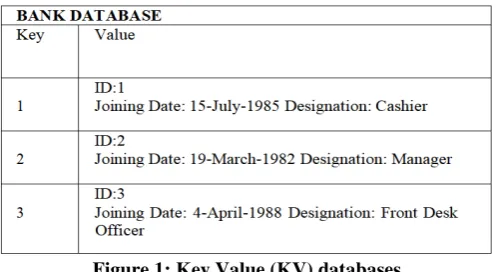
Key value databases: 1. The vital market value data sources label on its own explains that it is a combo of 2 traits that is crucial and also market value. It is one of the low key (standard) database systems. Principal Market Value (VK) databases are the mommy of all the data banks of NoSQL.The secret is a unique identifier to a particular record entry. Essential needs to not be repeated if one made use of that it is not reproduced in nature. Value is a kind of information that is aimed at a secret.
Secret market value data sources seem to be as hash dining tables or even seek out meals. Within this sort of database, there are a single means to inquire that is actually with help from trick (one-of-a-kind), and all the keys might name in any records items and are organized in an indexed order [3] For more excellent supply of information shops data things are imitated.
ISSN (Print) : 2320 – 3765 ISSN (Online): 2278 – 8875
I
nternational
J
ournal of
A
dvanced
R
esearch in
E
lectrical,
E
lectronics and
I
nstrumentation
E
ngineering
(An ISO 3297: 2007 Certified Organization)
Vol. 4, Issue 1, January 2015
In the given figure, there are a pair of columns representing crucial and a value. Listed here essential is unique as well as embodying their worths or characteristics describing it and records is worked with such as ring and the dividing of data is carried out based on their alphabets (in arranged order) and files are additionally replicated such as a ring.
III.DATABASE SECURITYREQUIREMENTS
The primary surveillance needs of database systems are like those of other computing systems. The primary troubles get access to management, the omission of spurious data, authentication of individuals, and integrity.
a)Database integrity: The data of a database are immune to physical concerns, like energy breakdowns, and a person may rebuild the database if it is damaged through a catastrophe.The construct of the database is protected. Along with the logical integrity of a database, an alteration to the market value of one area does not affect various other fields.
b)Review potential: It is achievable to track that or what has accessed the elements in the database.
c)Access control: A consumer is permitted to get access to licensed records, as well as various consumers can be restricted to multiple settings of gain access to.
d)Consumer authorization: Every consumer is favorably identified, each for the audit trail, as well as for permission to access specific records.
e)Schedule: Individuals can easily access the database generally and all the information for which they are licensed.
IV.DATABASE SECURITYGUIDELINES
If a database is to work as a core repository of information, users should have the capacity to count on the reliability of the data worths. This state implies that the database supervisor has to be guaranteed that updates are done simply by authorized individuals. The DBMS can quickly require strenuous individual authorization. For example, a DBMS may urge that a user elapsed both secure passwords and also time-of-day examinations. This verification supplements the authentication done by the system software.
Databases are usually separated realistically by individuals to get access to opportunities. For instance, all consumers can be provided access to necessary records. However, only the personnel department can obtain wage data, and merely the advertising division can easily acquire purchase information. Databases are incredibly beneficial since they systematize the storage and upkeep of information. Database stability problem that the database all at once is protected versus damages, as coming from the failure of a hard disk or even the shadiness of the professional database index. These concerns are dealt with through working system honesty managements and also recuperation operations [2]. If sensitive data are secured, a consumer who by mistake gets all of them can easily not decipher the information. Therefore, each amount of raw data may be stored in a desk encrypted under an essential unique to the degree of level of sensitivity.
V.PRINCIPLES OF INTEGRITY AND RELIABILITY IN DATABASESECURITY
Data sources amalgamate data from a lot of sources, and consumers expect a DBMS to supply access to the data in a reliable technique. When software application designers state that software application has integrity, they suggest that the software application runs for long periods without failing. Individuals undoubtedly expect a DBMS to be reputable because the records often are crucial to business or even company needs. Furthermore, consumers delegate their information to a DBMS and rightly expect it to secure the data from reduction or damages.
ISSN (Print) : 2320 – 3765 ISSN (Online): 2278 – 8875
I
nternational
J
ournal of
A
dvanced
R
esearch in
E
lectrical,
E
lectronics and
I
nstrumentation
E
ngineering
(An ISO 3297: 2007 Certified Organization)
Vol. 4, Issue 1, January 2015
VI.CHARACTERISTICS OF NoSQL
NoSQL does certainly not make use of the relational information design. Therefore, it performs not utilize SQL language.
NoSQL retail stores sizable quantity of records.
In a distributed setting (spread information to different devices), our team makes use of NoSQL without any disparity.
If any weakness or breakdowns exist in any device, at that point in this particular, there are going to be no ending of any work.
NoSQL levels source database, i.e., its resource code, is offered to everyone and is cost-free to make use of it without any overheads.
NoSQL makes it possible for records to keep in any document. That is, it is certainly not possessing any predetermined schema.
NoSQL does undoubtedly not utilize the principle of ACID features. NoSQL is flat scalable, triggering jazzed-up in a straight method. It has a much more flexible design.
Automatic System & Storage Optimization
Marketing of the database at the system degree is entirely under the command of Oracle Autonomous Database and is done without needing input from consumers of the database. System-level optimization consists of the following: System Worldwide Area (SGA) Moment
Process Global Area (PGA) Moment
Database Data Placement on Hard Drive and Flash Storage Space Tuning of on the internet redo logs as well as archival of renovating logs Tuning of database backups
Automatic Schema Level Optimization
Electronic marketing of the Autonomous Database at the application schema amount is becoming considerably more sophisticated. This ability currently resolves an amount of the most popular SQL marketing problems as follows: Automatic Optimizer Studies
Indexing for Data Integrity Restraints Automatic Storage Space Indexes Automatic Secondary Indexing
Automatic Optimizer Statistics
The database makes use of a cost-based optimizer, which counts on statistics to identify the optimal SQL execution strategy. Outdated (or even "stagnant") optimizer data is a significant resource of SQL efficiency concerns. Oracle Autonomous Database eliminates the requirement to personally collect optimizer data through immediately compile statistics in a lot of methods. When data is bulk filled into an Autonomous Database, data are automatically gathered as a component of the load function. Throughout DML functions (insert, update or remove claims), essential stats are automatically maintained. Autonomous Data banks might likewise utilize high-frequency studies acquiring projects to readjust any stale optimizer studies.
VII.INDEXING FOR DATA INTEGRITY CONSTRAINTS
ISSN (Print) : 2320 – 3765 ISSN (Online): 2278 – 8875
I
nternational
J
ournal of
A
dvanced
R
esearch in
E
lectrical,
E
lectronics and
I
nstrumentation
E
ngineering
(An ISO 3297: 2007 Certified Organization)
Vol. 4, Issue 1, January 2015
disabled as needed to promote information packing or various other activities that temporarily breach constraint checks as required by request. While index production for stability constraints is certainly not unique to Autonomous Database, this is a significant element of the overall database marketing. Data accessibility commonly make use of these constraints and related indexes for SQL optimization.
VIII.CONCLUSION
Security is an essential concern in database management since relevant information stored in a database is extremely important and also any time, susceptible product. So the records in a database management system need to be secured coming from abuse as well as must be shielded from unapproved get access to as well as updates. Database Security paper has sought to discover the problem of hazards that might be positioned to a database system. These include loss of privacy plus loss of integrity.
REFERENCES
1. Khan, K. R. Santiago-Chaparro, M. Chiturri, as well as D. A. Noyce, "Advancement of records selection as well as assimilation frame- help road inventory data," Diary of the Transport Analysis Board, no. 2160, pp. 29-- 39, 2010.
2. Federal Road Management and also UNITED STATE Department of Transport, Data Combination Guide, Federal Road Management, UNITED STATE Department of Transport, 2001.
3. K. Dueker and J. A. Head Servant, "GIS-T company records model along with advised implementation choices," Diary of the Urban as well as Regional Relevant Information Systems Organization, vol. 10, no. 1, pp. 12-- 36, 1998.
4. Pushpa Mannava, "An Overview of Cloud Computing and Deployment of Big Data Analytics in the Cloud", International Journal of Scientific Research in Science, Engineering and Technology (IJSRSET), Online ISSN : 2394-4099, Print ISSN : 2395-1990, Volume 1 Issue 1, pp. 209-215, 2014. Available at doi : https://doi.org/10.32628/IJSRSET207278
5. Kiran Kumar S V N Madupu, "Challenges and CloudComputing Environments Towards Big Data", International Journal of Scientific Research Science, Engineering and Technology (IJSRSET), Online ISSN : 2394-4099, Print ISSN : 2395-1990, Volume 1 Issue 1, pp. 203-208, 2014. at doi : https://doi.org/10.32628/IJSRSET207277
6. Pushpa Mannava, “A Study on the Challenges and Types of Big Data”, “International Journal of Innovative Research in Science, Engineering and Technology”, ISSN(Online) : 2319-8753, Vol. 2, Issue 8, August 2013
7. Kiran Kumar S V N Madupu, “Data Mining Model for Visualization as a Process of Knowledge Discovery”, International Journal of Advanced Research in Electrical, Electronics and Instrumentation Engineering, ISSN: 2278 – 8875, Vol. 1, Issue 4, October 2012.
8. Kiran Kumar S V N Madupu, “Advanced Database Systems and Technology Progress of Data Mining”, International Journal of Innovative Research in Science, Engineering and Technology, ISSN: 2319 – 8753, Vol. 2, Issue 3, March 2013
9. Pushpa Mannava, “A Big Data Processing Framework for Complex and Evolving Relationships”, International Journal of Advanced Research in Electrical, Electronics and Instrumentation Engineering, ISSN: 2278 – 8875, Vol. 1, Issue 3, September 2012
10. Mounika Reddy, Avula Deepak, Ekkati Kalyani Dharavath, Kranthi Gande, Shoban Sriramoju, “Risk-Aware Response Answer for Mitigating Painter Routing Attacks” in “International Journal of Information Technology and Management”, Volume VI, Issue I, Feb 2014 [ ISSN : 2249-4510 ] 11. Mounica Doosetty, Keerthi Kodakandla, Ashok R, Shoban Babu Sriramoju, “Extensive Secure Cloud Storage System Supporting Privacy-Preserving Public Auditing” in “International Journal of Information Technology and Management”, Volume VI, Issue I, Feb 2012 [ ISSN : 2249-4510 ]