
CONCEPTS, TOOLS AND TECHNIQUES
OF PROBLEM SOLVING THROUGH TRIZ:
A REVIEW
Prabhdeep Singh Bajwa
1, Dalgobind Mahto
2M.Tech. Student, Department of Mechanical Engineering,Green Hills Engineering College, Solan (H.P.), India1
Professor, Department of Mechanical Engineering,Green Hills Engineering College, Solan (H.P.), India2
Abstract:With the latest advances in technology along with the human advancements, a tough competition exists between various organizations and the top management. At this stage, the Research and Development (R & D) and Marketing of products are more important. As a result, the multinational enterprises should rely on both the innovations and marketing strategies of products for higher competency. TRIZ is a premier disruptive technology for innovation that can be used throughout many industries and sciences. Elements of TRIZ can be effectively used by a wide range of people -- from children to adults. The genesis of TRIZ is derived from empirical data, patents. This paper introduces the concept of ideality and an overview over the literature of TRIZ aiming to benefit the production industries in India. Keywords:TRIZ, Productivity, Innovation, inventive
I. INTRODUCTION
TRIZ is a foremost disruptive technology for innovation that can be used all the way through many industries and disciplines. Features of TRIZ can be efficiently used by a wide range of people -- from children to adults. The genesis of TRIZ is derived from empirical data, patents. The citations of how innovative individuals cracked inventive glitches. As can be well-read from his profile, Genrick Altshuller examined thousands of international patents from the prominent engineering grounds. He then studied solutions that were, in his conclusion, best operative. This effort delivered the major understanding of the tendencies, or configurations, of progression for methodological systems. This one too placed the basis for the growth of a logical approach to resolving inventive complications, later becoming the groundwork for
TRIZ, his philosophy of formulating problem solving, with its axiom: ―The evolution of all technical systems is governed
by objective laws[1].‖ Fast-tracked product development has become more and more significant. One mustadvance
effectivelyfor innovative generation of products while curbing development cycles and reducing job expenditure. Employing the TRIZ practice since the commencement of your project can save you plentiful time and sweat in your hunt for the idyllic way outs. In problem-solving, TRIZ scientifically examines the problem as an inventive state and relates a chain of strategies to create solution substitutes.Inconsistencies, or conflicts, characterize the most challenging type of problem during product development. In many cases a desired improvement can cause deterioration in another area. For example, very often an attempt to increase productivity causes deterioration in quality. As a result, a trade-off
situation is created [2].Many psychosomatic practices have been recommended and practiced to overcome the
psychological inertia, devising, lateral thinking etc. Yet, TRIZ is actually the only technology based systematic
methodology that overpowers the "psychological inertia" and produces a large range of solution concepts [3]. Along with
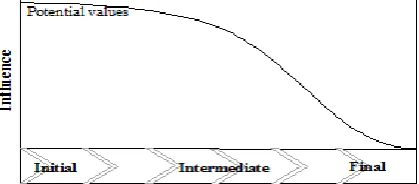
the society development, the construction works and processes have become more and more intricate, which puts pressure upon leaders of construction organizations from shake out. Therefore, resources and efforts on innovation scholars should be presented to face this challenge. In addition, extra headwork managers/engineers expended on innovation researches at the beginning of the construction projects will lead to greater possible performance (Fig. 1).
A. Tools of TRIZ
i. Contradiction Matrix
Matrix of 39-improving parameters and 39-worsening parameters (39 X 39 matrix) with each cell entry giving the most
often used (up to 4) inventive principles. This matrix isknown as the "Contradiction Matrix" and remains to be the
simplest and the most straightforward of TRIZ tools.
39 features: 1) Weight of moving object 2) Weight of stationary object 3) Lengthof moving object 4) Length of stationary object 5) Area of moving object 6) Area of stationary object 7) Volume of moving object 8) Volume of stationary objects 9) Speed 10) Force 11) Stress or pressure 12) Shape 13) Stability of the object's composition 14) Strength 15) Duration of action by a moving object 16) Duration of action by a stationary object 17) Temperature 18) Illumination intensity 19) Use of energy by moving object 20) Use of energy by stationary object 21) Power 22) Loss of Energy 23) Loss of substance 24) Loss of Information 25) Loss of Time 26) Quantity of substance/the matter 27) Reliability 28) Measurement accuracy 29) Manufacturing precision 30) External harm affects the object 31) Object-generated harmful factors 32) Ease of manufacture 33) Ease of operation 34) Ease of repair 35) Adaptability or versatility 36) Device complexity 37) Difficulty of detecting and measuring 38) Extent of automation 39) Productivity.
40 Principles:1) Segmentation 2) Taking out 3) Local quality 4) Asymmetry 5) Merging 6) Universality 7) "Nested doll" 8) Anti-weight 9) Preliminary anti-action 10) Preliminary action 11) Beforehand cushioning 12) Equipotentiality 13) The other way round 14) Spheroidality–Curvature 15) Dynamics 16) Partial or excessive actions 17) Another dimension 18) Mechanical vibration 19) Periodic action 20) Continuity of useful action 21) Skipping 22) "Blessing in disguise" or "Turn Lemons into Lemonade" 23) Feedback 24) 'Intermediary' 25) Self-service 26) Copying 27) Cheap short living objects 28) Mechanics substitution 29) Pneumatics and hydraulics 30) Flexible shells and thin films 31) Porous materials 32) Color changes 33) Homogeneity 34) Discarding and recovering 35) Parameter changes 36) Phase transitions 37) Thermal expansion 38) Strong oxidants 39) Inert atmosphere 40) Composite materials.
ii. Technical Systems
Anything that executes a task is a technical system. Illustrations of technical systems comprise cars, pens, and books and knifes. Any technical system can consist of one or more subsystems. A car is self-possessed of the subsystems engine, steering mechanism, brakes and so on. Each of these is also a technical system unto itself (with its own series of subsystems) — and each performs its own function. The grading of technical systems spans from the least intricate,
with only two elements, to the most intricate with many interrelating elements [4].
iii. Levels of Innovation
Exploration of a large number of patents discloses that not every invention is equivalent in its inventive assessment. Altshuller projected five levels of innovation:
Level #1is simple enhancement of a technical system. They entail knowledge obtainable inside an industry pertinent to that system.
Level #2inventions consist of the tenacity of a technical inconsistency. They need knowledge from diverse zones within an industry applicable to the system.
Level #3is an invention covering a purpose of a physical flaw. It necessitates knowledge from additional industries.
Levels #2 & #3 resolve paradoxes, and consequently are pioneering by definition.
Level #4is development of a new technology. It is industrialized by consuming breakthrough solutions that involves knowledge from altered turfs of science. This fourth level also rallies upon a technical system, but deprived of solving a prevailing technical problem. As an alternative, it mends the function by swapping the original technology with a new technology. For instance a mechanical system is swapped with a chemical system to accomplish the task.
Level #5 involves the unearthing of new phenomena. The new marvel is exposed that permits pushing the standing technology to an advanced level.
iv. Ideality
The objective of any technical system is to deliver some function. Orthodox engineering thought states: ―It is required
to deliver such and such a function. Therefore, we must build a mechanism or device to deliver this function.‖ TRIZ
philosophy: ―It is required to deliver such and such a function without introducing a new mechanism or device into the
system.‖ The Law of Idealitystates that any technical system, throughout its lifetime, tends to become more
reliable,simple, effective — more ideal. Every time we improve a technical system, we nudge that system closer to
Ideality. It costs less, requires less space, wastes less energy, etc. Ideality always reflects the maximum utilization of existing resources, both internal and external to the system.
v. Problem Solving Method
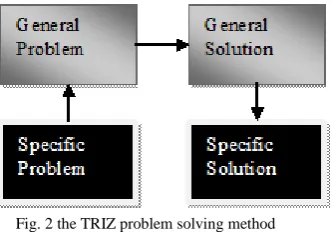
Fig. 2 the TRIZ problem solving method
The "General TRIZ Solutions" have been established over the progression of the 60 years of TRIZ study, and have been systematized in numerous different conducts. Some of these are logical methods such as:
The Ideal Final Result and Ideality,
Functional Modeling, Analysis and Trimming and
Locating the Zones of Conflict. (This is more familiar to Six Sigma problem solvers as "Root Cause Analysis.")
Some are more prescriptive such as:
The 40 Inventive Principles of Problem Solving,
The Separation Principles,
Laws of Technical Evolution and Technology Forecasting and
76 Standard Solutions.
vi. Contradictions
An important notion of TRIZ is that inconsistencies should be removed. TRIZ distinguishes two groups of inconsistencies:
Technical inconsistencies are the classical engineering "trade-offs." The anticipated state can't be reached because
something else in the system averts it. In other words, when something gets improved, something else gets inferior. Classicalexamples include:
The product gets stronger (good), but the weight increases (bad).
The bandwidth for a communication system increases(good), but requires more power (bad).
Facility is personalized to each customer (good), but the facility provision system gets thorny (bad).
Working out is widespread (good), but keeps employees missing from their projects (bad).
Physical flaws, also called "inherent" contradictions, are situations in which one object or system has
contradictory, conflicting chucks. Everyday examples abound:
Surveillance aircraft should fly fast (to get to the destination), but should fly slowly to collect data directly
over the target for long time periods.
Software should be complex (to have many features), but should be simple (to be easy to learn).
Coffee should be hot for enjoyable drinking, but cold to prevent burning the customer
Training should take a long time (to be thorough), but not take any time.
vii.Standards
Standards are structured rules for the synthesis and reconstruction of technical systems. Once understood and with some experience in their implementation, Standards can help combat many complex problems that regularly occur throughout industry with some common constraints.
Standards provide two functions:
1. Standards help to improve an existing system or synthesize a new one.
2. Standards are the most effective method for providing a graphical model of a problem. This is called
Substance-Field (or Su-Substance-Field) modeling. The actual contradiction — occurs. In this area, two substances (elements) and a field (energy) must be present. Analysis of the Su-Field model helps determine changes necessary within the technical system in order to improve it.
II. AIMS AND OBJECTIVES
The aims and objectives of this study are listed as follows:
To introduce present TRIZ
III.SCOPE
Indian industries have been primarily borrowing technologies from West and Japan. However, there are three main difficulties, TRIZ can help, in all the three cases, with quick results using fewer resources, to maintain a competitive edge and hold the market share.
1. Next generation product and/or New customer requirements
TRIZ tool - Trends of Technical Evolution
2. Some products need to be modified to suit
a. availability of new raw materials
TRIZ tool - Ideal Final Result and Resources
b. new processing equipment
TRIZ tool - Functional Analysis / Trimming
Chronic engineering problems need to be solved (Chronic implies that all known methods have been tried)
TRIZ tool - Technical or Physical Contradictions elimination
TRIZ tool - Substance-Field Analysis and system transformations.The algorithm automatically generates mask
image without user interaction that contains only text regions to be in painted.
IV.LITERATURE REVIEW
A. Production patents in India
According to the database of Intellectual Property Office of India, the patents are classified into categories of goods and
services as per the Fourth schedule to Trade marks rules, 2002. [4]
Class 1: Chemical used in industry, science, photography, agriculture, horticulture and forestry; unprocessed artificial resins, unprocessed plastics; manures; fire extinguishing compositions; tempering and soldering preparations; chemical substances for preserving foodstuffs; tanning substances; adhesive used in industry
Class 2: Paints, varnishes, lacquers; preservatives against rust and against deterioration of wood; colorants; mordents; raw natural resins; metals in foil and powder form for painters; decorators; printers and artists
Class 3: Bleaching preparations and other substances for laundry use; cleaning; polishing; scouring and abrasive preparations; soaps; perfumery, essential oils, cosmetics, hair lotions, dentifrices.
Class 4: Industrial oils and greases; lubricants; dust absorbing, wetting and binding compositions; fuels (including motor spirit) and illuminants; candles, wicks
Class 5: Pharmaceutical, veterinary and sanitary preparations; dietetic substances adapted for medical use, food for babies; plasters, materials for dressings; materials for stopping teeth, dental wax; disinfectants; preparation for destroying vermin; fungicides, herbicides
Class 6:Common metals and their alloys; metal building materials; transportable buildings of metal; materials of metal for railway tracks; non-electric cables and wires of common metal; ironmongery, small items of metal hardware; pipes and tubes of metal; safes; goods of common metal not included in other classes; ores
Class 7: Machines and machine tools; motors and engines (except for land vehicles); machine coupling and transmission components (except for land vehicles); agricultural implements other than hand-operated; incubators for eggs
Class 8: Hand tools and implements (hand-operated); cutlery; side arms; razors
Class 9:Scientific, nautical, surveying, electric, photographic, cinematographic, optical, weighing, measuring, signaling, checking (supervision), lifesaving and teaching apparatus and instruments; apparatus for recording, transmission or reproduction of sound or images; magnetic data carriers, recording discs; automatic vending machines and mechanisms for coin-operated apparatus; cash registers, calculating machines, data processing equipment and computers; fire extinguishing apparatus
Class 10: Surgical, medical, dental and veterinary apparatus and instruments, artificial limbs, eyes and teeth; orthopedic articles; suture materials
Class 11: Apparatus for lighting, heating, steam generating, cooking, refrigerating, drying ventilating, water supply and sanitary purposes
Class 12: Vehicles; apparatus for locomotion by land, air or water
Class 13: Firearms; ammunition and projectiles; explosives; fire works
Class 14: Precious metals and their alloys and goods in precious metals or coated therewith, not included in other classes; jewelry, precious stones; hierological and other chronometric instruments
Class 15: Musical instruments
brushes; typewriters and office requisites (except furniture); instructional and teaching material (except apparatus); plastic materials for packaging (not included in other classes); playing cards; printers' type; printing blocks
Class 17: Rubber, gutta-percha, gum, asbestos, mica and goods made from these materials and not included in other classes; plastics in extruded form for use in manufacture; packing, stopping and insulating materials; flexible pipes, not of metal
Class 18: Leather and imitations of leather, and goods made of these materials and not included in other classes; animal skins, hides, trunks and travelling bags; umbrellas, parasols and walking sticks; whips, harness and saddler
Class 19: Building materials, (metallic), metallic rigid pipes for building; asphalt, pitch and bitumen; non-metallic transportable buildings; monuments, not of metal.
Class 20: Furniture, mirrors, picture frames; goods (not included in other classes) of wood, cork, reed, cane, wicker, horn, bone, ivory, whalebone, shell, amber, mother- of-pearl, meerschaum and substitutes for all these materials, or of plastics
Class 21: Household or kitchen utensils and containers(not of precious metal or coated therewith); combs and sponges; brushes(except paints brushes); brush making materials; articles for cleaning purposes; steel wool; unworked or semi-worked glass (except glass used in building); glassware, porcelain and earthenware not included in other classes
Class 22: Ropes, string, nets, tents, awnings, tarpaulins, sails, sacks and bags (not included in other classes) padding and stuffing materials (except of rubber or plastics); raw fibrous textile materials
Class 23: Yarns and threads, for textile use
Class 24: Textiles and textile goods, not included in other classes; bed and table covers.
Class 25: Clothing, footwear, headgear
Class 26: Lace and embroidery, ribbons and braid; buttons, hooks and eyes, pins and needles; artificial flowers
Class 27: Carpets, rugs, mats and matting, linoleum and other materials for covering existing floors; wall hangings (non-textile)
Class 28: Games and playthings, gymnastic and sporting articles not included in other classes; decorations for Christmas trees
Class 29: Meat, fish, poultry and game; meat extracts; preserved, dried and cooked fruits and vegetables; jellies, jams, fruit sauces; eggs, milk and milk products; edible oils and fats
Class 30: Coffee, tea, cocoa, sugar, rice, tapioca, sago, artificial coffee; flour and preparations made from cereals, bread, pastry and confectionery, ices; honey, treacle; yeast, baking powder; salt, mustard; vinegar, sauces, (condiments); spices; ice
Class 31: Agricultural, horticultural and forestry products and grains not included in other classes; live animals; fresh fruits and vegetables; seeds, natural plants and flowers; foodstuffs for animals, malt
Class 32: Beers, mineral and aerated waters, and other non-alcoholic drinks; fruit drinks and fruit juices; syrups and other preparations for making beverages
Class 33: Alcoholic beverages (except beers)
Class 34: Tobacco, smokers' articles, matches
Services
Class 35: Advertising, business management, business administration, office functions.
Class 36: Insurance, financial affairs; monetary affairs; real estate affairs.
Class 37: Building construction, repair, installation services.
Class 38: Telecommunications.
Class 39: Transport; packaging and storage of goods; travel arrangement.
Class 40: Treatment of materials.
Class 41: Education; providing of training; entertainment; sporting and cultural activities.
Class 42: Scientific and technological services and research and design relating thereto; industrial analysis and research services; design and development of computer hardware and software.
Class 43: Services for providing food and drink; temporary accommodation.
Class 44: Medical services, veterinary services, hygienic and beauty care for human beings or animals; agriculture, horticulture and forestry services.
Class 45: Legal services; security services for the protection of property and individuals; personal and social services rendered by others to meet the needs of individuals
As for the production industry, most creative designs are usually taken as alternatives to cut off unnecessary costs or to increase customer‘s satisfaction, which is the purpose of ―Value Engineering (VE).‖ However some of these innovative ideas are discovered by means of ―Brain-storming‖ or unpredictable inspirations, while the others are developed via extended academic analysis. In order to systematize this innovation process and to enhance its effectiveness and efficiency, TRIZ, known as a systematic innovation tool, will be applied in this study
B. History of TRIZ
more than 200000 worldwide patents, he formed the theoretical basis of TRIZ in 1946 and laid the groundwork for the
problem-solving tools that would later be developed [4, 6, 7]. According to some references, the history of TRIZ can be
deduced in figure 3 [5, 7, 8].
Fig. 3 The history of TRIZ
C. The Theory of TRIZ
Almost all the traditional process of inventions depended upon professional and senior managers/engineers of specific knowledge area to seek specific solution by means of ―Brainstorming.‖ Alike, the famous inventor, Thomas Alva Edison, takes the same manner and also with his abundant inspiration to invent. This procedure has been criticized not only for its limited reasoning, lack of systematic thinking, but also for its effectiveness and efficiency. Due to untraceable spontaneous inspiration, managers/engineers usually delay the best time to solve problems and to fulfill the requirements.
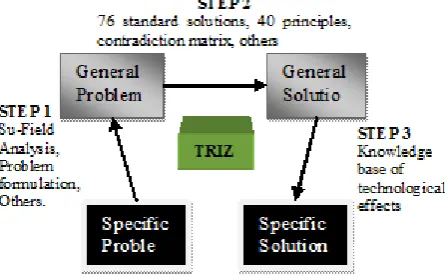
In comparison with traditional process of solving problems, this theory ―TRIZ‖ transforms specific problems into generic ones (general type of TRIZ), seeks for generic solutions (by ways of TRIZ), and finally infers the specific
solution from generic suggestions. The following is the structure diagram of TRIZ, illustrated afterwards. [9, 10, 11, 12, 13, 14,
15]
Fig. 4 The structure of TRIZ 1980-1986
G. S. Altshuller developed TRIZ
Fundamental discoveries, Basic ideas, Classical tools were made
First TRIZ specialist conference in Russia, 1980
1980-1986
• TRIZ receives publicity in the former USSR; the first TRIZ professionals and semi professions appear
• Due to large number of seminars conducted, TRIZ schools established, and other followers, TRIZ was developed
much efficiently
• TRIZ materials accumulate rapidly but vary widely in quality (from useless to real breakthroughs
1986-1991
• Russian perestroika allowed TRIZ to be applied commercially.
• A technical school, which specialized in teaching the TRIZ and providing analytical services for companies, was
founded
• the accomplishments of the school included:
over 4000 technical problems solved or facilitated
development of a methodology for solving scientific problems
Development of a methodology for identifying possible causes of failures.
Nine books of TRIZ published
Magazines and newspapers launched
1991 and beyond
• Zlotin, Zusman, and American professionals formed a company incorporated in 1992 and accomplished:
Acquired the Kishinev school and most of their scientists
Translated and repackaged an extensive amount of information
Adapted TRIZ to the American engineering process
Delivered goods and products to many industrial companies
Trained hundreds professionals in the methodology
Developed a family of software tools
Step 1: Specific problem → generic problem
Analysing and defining problems are the first step of the innovation process. There will be nothing more helpful for the following steps than understanding requirements of problems and transforming specific problems into generic ones. Tools such as ―Substance-Field Analysis‖ (Su-field Analysis) and ―Problem Formulation‖ are often used in the transformation and could let managers/engineers analyse specific problems clearly and systematically in order to clear up inter-relationship of specific problems.
Substance-Field Analysis (Su-field Analysis) is an analytical tool for modelling problems related to existing technological systems. Each purpose of the system is to perform some functions; likewise, the desired function is the output from an object or substance (S1) caused by another object (S2) with the help of some means (types of energy, F), which can be expressed as triangular diagrams. Substances are objects that can be single items or complex systems of any level of complexity, such as materials, tools components, human beings, systems environments, etc. And the means of accomplishing action is called a field that can be mechanical, thermal, chemical, electrical, magnetic, gravitational, etc. [6, 12, 16, 17]
The method ―Problem Formulation‖ gives an in-depth definition to problems through ―Useful Functions (UFs)‖ and ―Harmful Functions (HFs).‖ There are three kinds of inter-relations between UFs and HFs illustrated in Table 1.
Table 1 Relationship between UF and HF. [11, 18, 19]
Relationship Figure
UFx causes HFx UFxHFx
UFx can be changed to
reduce HFx
UFx═══►HFx
UFx is needed to UFx+1 UFxUFx+1
As for problem formulating, managers/engineers firstly define Primary Useful Functions (PUFs) that are the primary reasons for the system and Primary Harmful Functions (PHFs) to be improved. Secondly, the inter-relations between
PUF and PHF (from PUF to PHF and vice versa) are to be linked by a set of logical questions. [11, 18, 19]
For instance, each teacher may have a bad experience of carrying a baton or stick for pointing that is the PUF, as shown in Fig. 4. The convenience of pointing out what to teach and preventing himself/herself from blocking the students as
well is the UF1 that needs PUF. However, due to over rely on the PUF, the UF1 would increase the weight and length of
the baton or stick and make it too heavy or long to carry, which thus compose HF1. The formulation diagram of this
example is shown in Fig. 5. As long as the diagram is shown, managers/engineers are able to improve the
inter-relationship by means of reducing HF1, replacing UF1 by UFx to prevent HF1, etc.
Fig. 4 Traditional inconvenient pointers (example)
Fig. 5 The example of problem formulation
Step 2: Generic problem → generic solution
After converting specific problems into generic ones, managers/engineers could attain corresponding generic solutions by ―76 Standard Solutions,‖ ―Contradiction Matrix,‖ or other tools. Typically the ―76 Standard Solutions‖ are used as the Su-field model that has been developed and any constraints on the solution have been identified.
The Su-field model is the integration of the ―Su-field Analysis‖ and the ―76 Standard Solutions‖ which was also able to resolve the complex systems along with inventive problems. The ―76 Standard Solutions‖ were compiled by G.
Altshuller and his associates between 1975 and 1985 and were grouped into the following five categories: [16, 17]
Improving the system with no or little change [13 solutions]
Improving the system by changing the system [23 solutions]
System transitions [6 solutions]
Detection and measurement [17 solutions]
Fig. 6 The flowchart of Su-field model [16, 17]
The Su-field model could be made by a few steps illustrated with the above process flowchart[16, 17]. In comparison with
the method mentioned above, ―Contradiction Matrix‖ is much more famous. There are often contradictions and conflicts in our daily life, which drive us devastated and confused. Nevertheless, in G. Altshuller‘s opinion,
contradictions and conflicts are the sources of innovation and invention. Besides, he inferred the ―39Engineering
Features/Parameters‖ and ―40 Inventive Principles‖ from thousands of patents. Through the ―Improving Parameters‖
versus ―Worsening Parameters,‖ managers/engineers could easily and quickly attain the corresponding inventive principles for resolving problems effectively and efficiently. For the same simple example of pointers, generic solution
such as ―Substitution of Mechanism‖ (Principle 28)may be one of ―40 Inventive Principles‖ or ―76 Standard Solutions.
―The contradiction matrix will be delineated and applied afterwards. Step 2: Generic problem → specific solution
Once a generic solution is raised from 40 inventive principles, 76standard solutions, or other methods, what
managers/engineers are going to do next is transforming the solution into specific solutions by analogy, evaluation, or referring to the ―Knowledge Base of Technical Effects.‖ This knowledge base is composed of experience, specialists ‗judgment, expertise, and practical cases within specific knowledge area. For the same example stated above, if the generic correspondent solution for the baton or stick is to substitute its mechanics for optical means, laser beams shown
in Figure 2-6 may be the best choice after analogical thinking. [5, 13]
In addition, ―Knowledge Base of Technical Effects‖ could be developed as a specific ―Decision Support System‖ or ―Expert System ―by means of combining with computer programs or software‘s.
40 Inventive Principles:
40 Inventive Principles were deduced by G. Altshuller from lots of worldwide patents. These principles that are generic suggestions, included in ―Contradiction Matrix,‖ can be taken to solve most technical problems efficiently and
effectively. Processor Yuan-Nan Chu of National Taiwan University composed six categories of the 40 principles
afterward. [20, 21, 22, 23]
Transition related to space: principle no. 1, 3, 4, 7, 14 and 17
Transition related to time: principle no. 9- 11, 15, 19, 20, and 21
Transition related to subject: principle no. 2, 5, 6, 13, 22- 28, and 34
Transition related to Acting Force: principle no. 8, 12, 16, 18, and 29
Transition related to Material, Phase, or Shape: principle no. 30- 33, 35, 36, 37, and 40
Transition related to Environment: principle no. 38 and 39
Contradiction Matrix:
In accordance with the online website of Oxford Advanced Learner‘s Dictionary, the word ―contradict‖ means ―a lack
of agreement between facts, opinions, actions, etc.‖[24] By analyzing thousands of worldwide patents, G.Altshuller
found that most difficult problems in engineering involved physical or technical contradictions, which were solved by making trade-offs traditionally.
―Technical contradictions‖ result from trying to improve one parameter of technical system and leading to another one to deteriorate, such as power versus energy. However, ―Physical Contradictions‖ appear when two opposite
properties/attributes are required from the same element of a technical system or from the technical system itself.[4, 22, 25,
26]
After transforming specific problems into generic ones, managers/engineers should distinguish these two contradictions as illustrated in Figure 8.
Fig. 8 Two levels of contradictions. [25]
Separation principles, such as (i) separation of opposite requirements in space; (ii) separation of opposite requirements
in time; (iii) separation within a whole and its parts, and (iv) separation upon condition, will be good ways for physical
contradictions. As for technical contradictions, G. Altshuller pointed out the famous ―Contradiction Matrix‖ of size
39×39, including 39 features/parameters and 40 inventive principles. The columns of the matrix indicateimprovingfeatures/parameters, whiletherowsindicateworseningfeatures/parameters as trying to solve a problem.
There are 1263 cells of thematrix that contain a set of possible solutions. These solutions are collected andselected from
total 40 invention principles. Managers/engineers could solveproblems by translating system characteristics into these
39 parameters andgetting relative principles suggested.[4, 6, 21, 22, 25, 27, 28] The example of classical ―Contradiction Matrix‖
is illustrated in Table 2.
mechanics of a baton or stick is substitutedfor optical instrument. This inventive suggestion makes the pointer
moreconvenient and much easier to carry as well. [6]
Table 2. The example of contradiction matrix.[28]
Contradiction Matrix Worsening Parameters 3 : L en g th o f m o v in g o b ject 4 : L en g th o f statio n ar y o b ject 5 : A rea o f m o v in g o b ject 6 : A rea o f statio n ar y o b ject 7 : V o lu m e o f m o v in g o b ject Im p ro v in g Par am ete rs 10. Force 1719
936 2810
1910 15 118 3637 159 1237
11. Stress or Pressure 3510 36 351 1416 1015 3628 1015 3637 635 10 12. Shape 2934 34 1314 107 5344
10 -
144 1522 13. Stability of the object‘s composition 1315
128 37
211
13 39
2810 1939 14. Strength 115 835 1514 2826 334 4029 940 28 1015 147
It is worth noticing that there is one blank/empty cell of Table 2, the samewith others of ―Contradiction Matrix‖. Obviously, these blank/empty cells indicatethat managers/engineers would have no idea to deal with the correspondingengineering features/parameters. As a result, they will have to add some steps forgeneric solutions introduced at next section and applied in next chapter.
V. DISCUSSIONS
Apparently, TRIZ can help managers/engineers to resolve the design problemby providing them with an explicit direction to get improvement, such as reducingthe time for searching, avoiding wasting resource and enhancing the quality,effectiveness, efficiency, etc. Nevertheless, the powerful and potent theory―TRIZ‖ is, without exception, similar to any other method that has its owndeficiencies as well. These contentious subjects, discussed at posterior sections,are:
Attaining the right corresponding parameters, including improving andworsening features/parameters, and
Blank/empty cells of the ―contradiction matrix.‖[6, 25, 29, 30]
A. Attaining the right corresponding features/parameters
Firstly, the requirements confirmation and transformation of the specificproblem are the most important action in the first stage of applying TRIZ.Although TRIZ, the extended methodologies, and the various software productscould also be used as problem definition tools, their greatest strengths areresolving contradictions and solving problems defined
by other techniques. [26, 30, 31] Secondly, when using the definition tool such as ―Problem Formulation‖ or―Su-field
Analysis‖ drawn above, the execution process is usually full ofsubjective factors and personal judgments. What the correct generic solutions needindeed are objectively defining problems and transferring requirements intoengineering features/parameters, which is one of the weaknesses of TRIZ.
Regarding this point, the methodology ―Quality Function Deployment(QFD)‖ may be the better answer to link the gap between requirements andmanagers/engineers. The classical TRIZ doesn‘t offer an effective and efficientway to clear the key-point in the whole problem. Importing the QFD can improvethis disadvantage of TRIZ by gathering all relevant information about thecustomers‘ wishes through surveys, interviews, tests, benchmarks, etc. Moreover,the scores of the engineering features/parameters created from the ―House ofQuality‖ of QFD can express the importance of each
parameter of the problem. [26, 30, 31]
In other words, the primary function of QFD is to identify the most importantissues and parameters of the products and to link priorities and target values backto the customer. In Figure 2-8, a sample of QFD and the sequence of
constructingthe ―House of Quality (HOQ)‖ of QFD are shown. [26, 30, 31, 32, 33]
features/parameters, it seems straightforward that these identifiedcontradictory parameters are used to differentiate improving parameters fromworsening ones. The connection between HOQ and the ―Contradiction Matrix‖ is expressed
in Figure 10. [30, 34]
Fig. 9a sample of HOQ. [26, 30, 31, 32, 33]
Fig. 10 Connection between HOQ and ―Contradiction Matrix‖
B. The blank/empty cells of the ―Contradiction Matrix‖
As mentioned earlier, in the ―Contradiction Matrix‖ exist afew blank/empty cells that stand for no corresponding principles. In the past,managers/engineers would put these cells into a tight corner when encounteringsuch hardship. Thereupon, extended researches on the matrix were made, shownin Figure 11 and stated afterwards.
C. ARIZ (The Algorithm for Inventive Problem Solving)
ARIZ is composed of a set of systematic steps and various tools forinnovative problems of more complexity. Through its standard process andtools like ―Su-field Model,‖ ―Ideal Final Result,‖ etc., difficulty of theblank/empty cells could
be solved step-by-step. [6, 35, 36]
D. Interchanging the improving and worsening features/parameters
Instead of ARIZ, the corresponding principles obtained frominterchanging the improving and worsening
features/parameters could beworth of consideration. [6, 37, 38]
E. Single feature/parameter inventive principles table
―Single Feature/Parameter Inventive Principles Table‖ is deduced by statistical methods. According to the G.
Altshuller‘s ―Contradiction Matrix‖ of size 39 × 39, the appearance frequency of each principles are statistically
counted and assorted as several levels. For example, the appearances of Principle No. 35 are twelve times corresponding to the first ―Improving‖ features/parameters (Weight of Moving Object), while nine times are corresponding to the first ―Worsening‖ features/parameters. Therefore, the total appearances of Principle No. 35 corresponding to the first engineering features/parameters are nineteen times, which is assorted as Level A. As a result,
managers/engineers could choose suitable inventive principles based on this table.[6, 37, 38]
F. Updated contradiction matrix
In view of the fact that G. Altshuller‘s classical Contradiction Matrix isevolved during the 50s, 60s, and early 70s, a significant manifestation of theshifts that have taken place in the world of science and technology is that thenumber of things that managers/engineers and scientists have to take intoconsideration when they are designing a solution has increased. As a result,the axes of the matrix are expanded from 39 to 48; also, the puzzle ofblank/empty cells is
reinforced and filled. The additional engineeringparameters comprise:[39]
Amount of information
Function Efficiency
Noise
Harmful emissions
Compatibility/Connect ability
Security
Safety/Vulnerability
Aesthetics
Control complexity
On the other hand, these new parameters are re-sequenced and classified into six main categories as follows: [39]
- Physical related parameters - Performance related parameters - Efficiency related parameters
- Illity related parameters (reliability, maintainability, etc.) - Manufacture/Cost reduction related parameters
- Measurement
VI.CONCLUSION
From the above discussion, it is no doubt that TRIZ is not only aninfluential but also flexible to all classes of engineering complications of a system. However, it is vital that this theory should be sustained and systematized by other methodologies. Therefore, a systematic innovation model must be developed,in which, more objective tools shall be functional to refine this theory. In correspondence to the purposes of this study, such a systematic innovation model could be useful in the conceptual, design, and construction phases of the construction life for better design or more fiscalsubstitutes. Furthermore, it could be applied to ―Value Engineering (VE)‖ as well.
REFERENCES
[1] G. Altshuller (H. Altov), English translation by Lev Shulyak, "And Suddenly the Inventor Appeared: TRIZ, the Theory of Inventive Problem, Technical Innovation Center, Inc., USA (1994)
[2] Genrich Altshuller, English translation by Anthony Williams "Creativity as an Exact Science", American Supplier Institute, 1988. [3] The TRIZ Journalhttp://www.triz-journal.com/
[4] Controller General of Patents http://ipindia.nic.in/tmr_new/default.htm
[5] Tz-Chin Wei, ―Introduction to the Theory of Inventive Problem Solving(TRIZ),‖ [email protected], 2001.
[7] Frequently Asked Questions at the website of Ideation International Inc.,http://www.ideationtriz.com/faq.asp/. [8] History of TRIZ & I-TRIZ at the website of Ideation International Inc.,http://www.ideationtriz.com/history.asp/.
[9] Chii-Horng Lu, ―The Multi-Function Coin Mechanism Design with TRIZ‖, Department of Mechanical and Electro-Mechanical Engineering, NationalSun Yat-Sen University, 2000.
[10] Hsiang-Tang Chang, ―The Study of Eco-Innovative Design Integrating TRIZwith Extension Method,‖ Department of Mechanical Engineering, NationalCheng Kung University, Taiwan, 2004.
[11] A Yen-Chang Chu, ―A Study on Integrating TRIZ Method with FunctionalAnalysis‖, Department of Mechanical Engineering, National Cheng KungUniversity, Taiwan, 2003.
[12] Mei-Hsiu Lin, ―Application of TRIZ Principle in Case Study of a PatentDevelopment‖, Department of Mechanical Engineering, Chung YuanUniversity, 2004.
[13] Yung-Jin Shiau, ―Brief Introduction to the Inventing Theory - TRIZ‖, http://www.flotrend.com.tw, 2002. [14] ―Systematic Innovation Using TRIZ‖, http://www.innovationtools.com/.
[15] R. Stratton and D. Mann, ―Systematic Innovation & the UnderlyingPrinciples behind TRIZ & TOC‖, Journal of Materials Processing Technology,2003.
[16] John Terninko,「Su-Field Analysis」, Responsible Management Inc., 2000.
[17] John Terninko, Ellen Domb, and Joe Miller, ―The Seventy-six StandardSolutions, with Examples - Select One‖, http://www.triz-journal.com/, 2000.
[18] Larry Zeidner and Ralph Wood, ―The Collaborative Innovation Process‖, http://www.triz-journal.com/, 2000.
[19] John Terninko, Alla Zusman,and Boris Zlotin, ―Systematic Innovation – AnIntroduction to TRIZ‖, CRC Press LLC, 1998. [20] http://www.triz40.com
[21] GenrichSaulovichAltshuller, Lev Shulyak and Steven Rodman (translators),―40 Principles: TRIZ Keys to Technical Innovation,‖ Center, Inc., 1997.
[22] Yuan-Nan Chu, lectures of ―Inventive Design,‖ Bio-Industrial Mechatronics Engineering, National Taiwan University. [23] Darrell Mann and Ellen Domb, ―40 Inventive (Business) Principles withExamples,‖ http://www.triz-journal.com/, 1999. [24] The website of Oxford Advanced Learner‘s Dictionary,http://www.oup.com/elt/oald/.
[25] R. Stratton and D. Mann, ―Systematic Innovation and the UnderlyingPrinciples Behind TRIZ and TOC,‖ Journal of Materials ProcessingTechnology, 139, 120–126, 2003.
[26] Yao-Jen Fan, ―The Integrated TRIZ Method and the Applications,‖Department of Mechanical Engineering, National Cheng Kung University,Taiwan, 2001.
[27] Yen-Chieh Mao, ―Research on the Hydraulic Disc Brake System forBicycles,‖ Department of Mechanical Engineering, National Chiao TungUniversity, 2003.
[28] Ellen Domb, Joe Miller, Ellen MacGran, and Michael Slocum, ―The 39Features of Altshuller‘s Contradiction Matrix,‖ http://www.triz.org/, 1998.
[29] Jack Hipple, ―The Integration of TRIZ Problem Solving Techniques with OtherProblem Solving and Assessment Tools,‖ http://www.triz-journal.com/, 2003.
[30] Noel León-Rovira and Ing. HumbertoAguayo, ―A New Model of theConceptual Design Process Using QFD/FA/TRIZ,‖http://www.triz-journal.com/, 1998.
[31] Eve M. Burke, ―Quality Function Deployment from an Operations ResearchPerspective,‖ the Graduate School of Engineering of the Air Force Institute ofTechnology, 1999.
[32] Neil Eldin and VerdaHikle, ―Pilot Study of Quality Function Deployment inConstruction Projects,‖ Journal of Construction Engineering andManagement, 2003.
[33] J. M. Kamara and C. J. Anumba, ―Client Requirements Processing inConstruction: A New Approach Using QFD,‖ Journal of ArchitecturalEngineering, 1999.
[34] Min-Chieh Chang, ―The Improvement of TRIZ Method and the Application,‖Department of Industrial Engineering and Management, Huafan University,2004.
[35] Janice Marconi, ―ARIZ: The Algorithm for Inventive Problem Solving – AnAmericanized Learning Framework,‖ http://www.triz-journal.com/, 1998.
[36] Boris Zlotin and AllaZusman, ―ARIZ on the Move,‖http://www.triz-journal.com/, 1999.
[37] Chih-Chen Liu, ―A Study of TRIZ Method Improvements andEco-Innovative Design Methods,‖ Department of Mechanical Engineering,National Cheng Kung University, Taiwan, 2003.
[38] Jahau Lewis Chen and Chih-Chen Liu, ―A TRIZ Inventive Design Methodwithout Contradiction Information,‖ http://www.triz-journal.com/, 2001.
![Fig. 6 The flowchart of Su-field model [16, 17]](https://thumb-us.123doks.com/thumbv2/123dok_us/1706041.1216628/8.595.198.398.680.772/fig-the-flowchart-of-su-field-model.webp)
![Fig. 8 Two levels of contradictions. [25]](https://thumb-us.123doks.com/thumbv2/123dok_us/1706041.1216628/9.595.176.422.388.576/fig-levels-contradictions.webp)
![Table 2. The example of contradiction matrix.[28] Worsening Parameters](https://thumb-us.123doks.com/thumbv2/123dok_us/1706041.1216628/10.595.165.432.128.382/table-example-contradiction-matrix-worsening-parameters.webp)
![Fig. 9a sample of HOQ. [26, 30, 31, 32, 33]](https://thumb-us.123doks.com/thumbv2/123dok_us/1706041.1216628/11.595.176.422.132.503/fig-a-sample-hoq.webp)