Translation Errors and Incomprehensibility:
A Case Study using Machine-Translated Second Language Proficiency Tests
Takuya Matsuzaki
†‡, Akira Fujita
‡, Naoya Todo
‡, Noriko H. Arai
‡ †Nagoya University, Furo-cho, Chikusa-ku, Nagoya, 464-8603, JAPAN‡National Institute of Informatics, 2-1-2 Hitotsubashi, Chiyoda-ku, Tokyo, 101-8634, JAPAN [email protected],{a-fujita, ntodo, arai}@nii.ac.jp
Abstract
This paper reports on an experiment where 795 human participants answered to the questions taken from second language proficiency tests that were translated to their native language. The output of three machine translation systems and two different human translations were used as the test material. We classified the translation errors in the questions according to an error taxonomy and analyzed the participants’ response on the basis of the type and frequency of the translation errors. Through the analysis, we identified several types of errors that deteriorated most the accuracy of the participants’ answers, their confidence on the answers, and their overall evaluation of the translation quality.
Keywords: Machine Translation, Evaluation, Error Analysis
1.
Introduction
What level of “quality” is required for machine translation (MT) systems should change depending on who uses them in what situation. If it is used as a web page translator, even fragmentary information will be helpful. However, if it is used as an automatic interpreter on smartphones, it is a totally different type of matter. It is expected to con-vey correct information between two people who do not understand each other’s language, sometimes in critical sit-uations. In other words the measurement of the quality of MT systems should include not only the intrinsic metrics such as accuracy and fluency but also how often a user can complete his/her purpose in using it.
In our previous paper, we proposed a light weight, human-in-the-loop extrinsic evaluation scheme (Matsuzaki et al., 2015), where MT systems are evaluated by human subjects’ scores on the second language ability tests translated to the subjects’ native language by MT. Specifically, we used dialogue completion questions (Figure 1) as the test ma-terial. Dialogues often involve linguistic phenomena that are not frequent in written text, such as interrogatory sen-tences, imperative sensen-tences, and ellipsis. It turned out that our evaluation captured a different dimension of translation quality than that captured by manual and automatic intrin-sic evaluation.
In this paper, we report on another experiment involving 795 human participants, and scrutinize what kinds of errors hinder the users’ comprehension of the dialogues more of-ten than others. Although MT-mediated conversation is al-ready in the scope of development, automatic metrics such as BLEU (Papineni et al., 2002) and NIST (Doddington, 2002) do not tell us which errors are more harmful than oth-ers. The translation errors in the test materials were man-ually classified according to an error taxonomy. Then, the subjects’ responses on the translated questions were ana-lyzed on the basis of the type and frequency of the trans-lation errors. Through the analysis, we identified several types of errors that deteriorated most the subjects’ perfor-mance, their confidence on the answers, and the overall evaluation of the translation quality.
INSTRUCTION
Choose the most suitable utterance for the blank in the follow-ing dialogue from choices 1, 2, 3, and 4.
DIALOGUE
A: Jack, I just finished washing your school uniform, and
found your cellphone in the washing machine. It’s broken!
B: Oh, no. I have to call Bob now.
A: That’s not the point! I just bought it for you last week! B: Oh, yeah. I’m so sorry. But Mom, how am I going to call
him?
A: [BLANK] We’ll talk about your carelessness later.
OPTIONS 1. Buy him a new phone.
2. I’ll call you soon. 3. Just use my phone. 4. Tell him to wait for me.
Figure 1: Multiple-choice dialogue completion question
2.
Experimental Material and Procedure
2.1.
Material
All the test material used in this study were dialogue com-pletion questions taken from the English tests in National Center Test for University Admission (NCTUA)1. A ques-tion in this format consists of a short conversaques-tion be-tween two people, where one of the utterances is hidden ([BLANK] in the figure). One has to choose an appropriate utterance which fills the blank out of four choices.
We collected 200 past NCTUA dialogue completion ques-tions and translated them to Japanese using three MT sys-tems: Google translation2, Yahoo! translate3, and a system developed by National Institute of Information and Com-munications Technology (NICT) in Japan45. The translated questions were firstly classified into three groups:
1
NCTUA is a national standardized test in Japan.
2https://translate.google.co.jp/?hl=ja 3
http://honyaku.yahoo.co.jp
4
https://mt-auto-minhon-mlt.ucri.jgn-x.jp
5
• questions including serious translation errors • questions including minor translation errors • questions translated mostly correctly
The questions are then sorted in the descending order of the number of the systems that made serious translation errors on the questions. Ties were broken by the number of sys-tems that made minor errors. We then chose 50 questions ranked highest in the list as the test material while skip-ping such questions that involve linguistic issues in English but not in Japanese (e.g., subject-verb agreement). They included 463 sentences and 2,557 words in total.
The test material is thus not a representative or balanced example of English conversation (if such a thing exists) but designed to investigate how different types of translation errors affect the human subjects’ task performance. Please refer to our previous work for the system performance com-parison based on randomly chosen question set (Matsuzaki et al., 2015).
In addition to the three MT results, we prepared two kinds of human translations. One was produced by translating all the sentences in the test material in a randomized or-der (hereafter Human-Shuffle). The other was produced by translating the entire dialogue at once (Human-Original). The Human-Shuffle translation was used to investigate the effect of translation errors purely caused by the ignorance of the context (as is done in most current MT systems).
2.2.
Procedure
795 high school students participated in the experiment as the subjects. We prepared 25 different combinations of translated questions, each of which includes ten questions. The question sets were designed so that
• a student answers ten different questions,
• a question set includes no two translations of the same question and includes the same number (two) of trans-lations produced by each of the five systems, and • approximately the same number of answers are
ob-tained for each translated question.
On average, 31.8 answers were collected for each pair of question and translation system.
The subjects answered to each question in one minute. They were also asked to indicate their confidence on their answer on each question in three levels:
A: I am fully confident about my choice. B: I am not fully confident about my choice. C: I do not have any confidence at all.
After answering each question, the subjects were asked to evaluate the MT system that produced the translation:
A: This MT system will be useful.
B: This MT system may be useful in some situation. C: This MT system would not be useful in most situation.
We converted A, B, and C to 3, 2, and 1 respectively for the purpose of quantitative analysis described in§4.
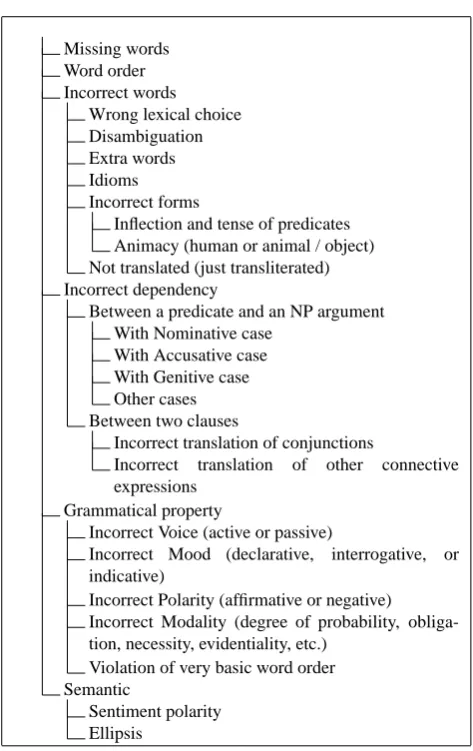
Missing words Word order Incorrect words
Wrong lexical choice Disambiguation Extra words Idioms Incorrect forms
Inflection and tense of predicates Animacy (human or animal / object) Not translated (just transliterated) Incorrect dependency
Between a predicate and an NP argument With Nominative case
With Accusative case With Genitive case Other cases Between two clauses
Incorrect translation of conjunctions
Incorrect translation of other connective expressions
Grammatical property
Incorrect Voice (active or passive)
Incorrect Mood (declarative, interrogative, or indicative)
Incorrect Polarity (affirmative or negative) Incorrect Modality (degree of probability, obliga-tion, necessity, evidentiality, etc.)
Violation of very basic word order Semantic
Sentiment polarity Ellipsis
Figure 2: Error classification taxonomy
3.
Translation Error Classification
3.1.
Error Taxonomy
in-terjections such as “oh!” can express both positive and neg-ative sentiment. When they are translated to Japanese ex-pressions with the opposite polarity, the dialogue becomes very unnatural and may cause misunderstanding.
An “Ellipsis” error is caused by a wrong supplementation for an omitted phrase. For instance, VP-ellipsis in an an-swer to a Yes-No question is often supplemented wrongly with a random phrase, as in the following example (Ques-tion ID 184, transla(Ques-tion by NICT):
EN: “You didn’t tell her?” – “No, I didn’t.” JP: Kanojo-ni iwa-naka-tta-nda? – Tabe-masen.
she-DAT say-NEG-PAST-Q eat-NEG
(“You didn’t tell her, did you?” – “No, I don’t eat it”)
3.2.
Error Classification Process
Two annotators parallelly classified the errors in all the translated questions. The annotators were provided with the translated questions in which the blanks in the dialogue were filled with the translations of the correct choices. This is because putting the wrong choices in the blank makes the whole dialogue incomprehensible or unnatural, and thus makes the error classification more difficult.
We asked the annotators to firstly translate the original En-glish questions so that the translation is as close to the sys-tems’ output as possible. The annotators then compared their translations and the systems’ output and classified the differences according to the taxonomy. This two-step pro-cess was to make the classification less subjective. An error could be classified to more than one leaf categories (but not into the same top/mid-level categories).
The classification was based only on the translated ques-tions; The annotators carried out the process without know-ing which MT system produced the translation or how many subjects answered the question correctly. The anno-tators’ translations were also used as the reference transla-tions for the calculation of the automatic metrics (§4.3).
4.
Experimental Results
4.1.
Error Profile
Table 1 shows the profile of the errors in the test material. The numbers are the percentages of the sentences that in-clude at least one error that was categorized to each of the error types (averaged over the results by the two annota-tors). Although the test materials are not random samples, the error profiles still seem to reflect the basic architecture of the three MT systems. Comparing to the two statistical systems (i.e., Google and NICT), the rule-based one (i.e., Yahoo!) makes far less errors categorized in “Predicate-argument deps.” and “Grammatical property,” which are mainly related to grammar and syntax. Meanwhile, the fre-quencies of the errors related to semantics and discourse are comparable across the three MT systems (“Incorrect words - Disambiguation” and “Semantic”).
4.2.
Effect of the Errors on Extrinsic Metrics
We conducted regression analyses to examine the effect of different error types on the subjects’ responses. The de-pendent variable yRCA stands for the rate of correct
an-swers in our linear regression model. We conducted two
Google NICT Yahoo! Shuf fle
Missing words 1.9 15.2 1.0 3.5
Word order 5.0 1.4 1.7 0.2
Incorrect words 56.9 35.6 36.9 4.3 Wrong lexical choice 0.7 2.2 0.2 0.0 Disambiguation 30.1 16.1 22.3 2.8
Extra words 8.0 6.2 2.8 0.0
Idioms 19.0 8.5 9.9 0.7
Inflection and tense 10.9 9.9 7.3 0.9
Animacy 2.2 2.1 1.9 0.0
Transliterated 5.5 1.6 1.9 0.0 Predicate-argument deps. 15.6 19.0 4.0 1.4 Nominative case 3.8 10.9 0.9 0.5 Accusative case 6.7 5.4 0.9 0.5
Genitive case 1.2 1.0 0.0 0.0
Other cases 5.4 3.6 2.2 0.3
Deps. between clauses 10.2 6.4 4.0 0.5
Conjunctions 4.0 3.1 3.5 0.5
Other connectives 6.4 3.3 0.5 0.0 Grammatical property 13.5 14.2 4.3 1.2
Voice 1.4 0.5 0.3 0.0
Mood 6.6 3.1 1.0 0.5
Polarity 1.2 1.2 0.3 0.2
Modality 3.8 3.8 2.6 0.3
Basic word order 1.4 6.2 0.0 0.2
Semantic 5.9 6.4 5.9 3.1
Sentiment polarity 2.9 3.1 3.3 1.7
Ellipsis 3.3 3.3 2.6 1.4
Table 1: Profile of the translation errors in the test material (percentages of the sentences that include at least one error classified to the error categories)
Independent variables Coefficients yRCA yconf yeval
(Intercept) -0.10∗∗∗ -0.16∗∗∗ -0.27∗∗∗
bGoogle 0.03 -0.13 -0.31∗∗∗
bNICT -0.01 -0.21∗∗ -0.35∗∗∗
bYahoo! 0.01 -0.16∗∗ -0.29∗∗∗
Missing Words -2.07∗∗ -1.87∗ -0.68 Word Order -0.60 -2.53 -1.03 Incorrect words -2.16∗∗∗ -2.99∗∗∗ -2.23∗∗∗ Pred-arg deps. 0.33 -1.29 -1.10 Deps. btwn clauses -1.55 -3.81∗∗ -1.58 Grammatical property -1.52∗ -2.95∗∗ -2.59∗∗∗ Semantic -2.74∗∗ -3.12∗∗ -3.18∗∗∗ AdjustedR2 0.366 0.554 0.613
(Legend:∗p <0.05,∗∗p <0.01,∗∗∗p <0.001)
Table 2: Estimated coefficients of the regression models with the number of errors classified to the top categories as the independent variables
more regression analyses where we set the subjects’ con-fidence on their answers (yconf) and their evaluation of the
MT systems (yeval) for the dependent variables. The
param-eters were estimated using the fifty questions translated by Google, NICT, Yahoo!, and Human-Shuffle all at once, i.e., the number of samples was 200.
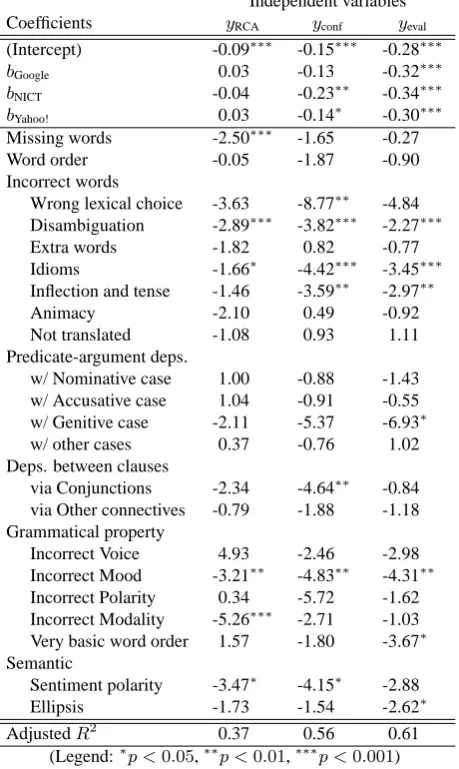
Independent variables Coefficients yRCA yconf yeval
(Intercept) -0.09∗∗∗ -0.15∗∗∗ -0.28∗∗∗
bGoogle 0.03 -0.13 -0.32∗∗∗
bNICT -0.04 -0.23∗∗ -0.34∗∗∗
bYahoo! 0.03 -0.14∗ -0.30∗∗∗
Missing words -2.50∗∗∗ -1.65 -0.27 Word order -0.05 -1.87 -0.90 Incorrect words
Wrong lexical choice -3.63 -8.77∗∗ -4.84 Disambiguation -2.89∗∗∗ -3.82∗∗∗ -2.27∗∗∗ Extra words -1.82 0.82 -0.77 Idioms -1.66∗ -4.42∗∗∗ -3.45∗∗∗ Inflection and tense -1.46 -3.59∗∗ -2.97∗∗
Animacy -2.10 0.49 -0.92
Not translated -1.08 0.93 1.11 Predicate-argument deps.
w/ Nominative case 1.00 -0.88 -1.43 w/ Accusative case 1.04 -0.91 -0.55 w/ Genitive case -2.11 -5.37 -6.93∗ w/ other cases 0.37 -0.76 1.02 Deps. between clauses
via Conjunctions -2.34 -4.64∗∗ -0.84 via Other connectives -0.79 -1.88 -1.18 Grammatical property
Incorrect Voice 4.93 -2.46 -2.98 Incorrect Mood -3.21∗∗ -4.83∗∗ -4.31∗∗ Incorrect Polarity 0.34 -5.72 -1.62 Incorrect Modality -5.26∗∗∗ -2.71 -1.03 Very basic word order 1.57 -1.80 -3.67∗ Semantic
Sentiment polarity -3.47∗ -4.15∗ -2.88 Ellipsis -1.73 -1.54 -2.62∗
AdjustedR2 0.37 0.56 0.61
(Legend:∗p <0.05,∗∗p <0.01,∗∗∗p <0.001)
Table 3: Estimated coefficients of the regression models with the number of errors in the leaf categories as the inde-pendent variables
values on the human translation (Human-Original) to re-duce the effect of the inherent difficulty of the questions. For instance,yRCAfor questionqtranslated by Google was
set to:
yRCA=RCA(Google, q)−RCA(Human-Original, q)
where RCA(s,q) stands for the rate of correct answers on questionqtranslated by systems.
The independent variables are the numbers of translation errors categorized according to the taxonomy. We normal-ized them by the total number of words in a question to reduce the effect of the length of the questions. In addi-tion, we used three binary (i.e., 1 or 0) dependent variables bGoogle,bNICT, andbYahoo!, that signify the MT systems that
produced the translation. The coefficients of the binary variables represent different intercepts (i.e., the predicted dependent value on a question including no error) for the three MT systems, while the constant term of the model represents the intercept for Human-Shuffle.
Table 2 lists the estimated coefficients of the models where independent variables are the numbers of the errors aggre-gated at top-most error categories. The adjustedR2values
System vs RCA vs CONF vs EVAL
Google 0.30 0.33 0.36
NICT 0.37 0.66 0.56
Yahoo! 0.54 0.59 0.64
Human-Shuffle 0.44 0.53 0.50
All 0.54 0.70 0.71
Table 4: Correlation coefficients between BLEU and sub-jects’ responses
show that the models for the confidence on the answers and the system evaluation fit the data modestly, while the rate of correct answers cannot be fully explained by the current regression model. Nonetheless, we can see some types of errors do have more effect on the rate of correct answers: the coefficients foryRCAsuggest that missing word errors,
incorrect word errors, and semantic errors are more harm-ful than other types. Coefficients foryconfandyevalsuggest
that they are affected by a wider variety of error types, es-pecially by errors related to grammar and syntax.
We also conducted the regression analysis where we set the number of errors in the leaf-level categories for the inde-pendent variables. Table 3 shows the estimated coefficients. The results foryRCAreveals that incorrect mood, incorrect
modality, and sentiment polarity errors have high negative impact on the subjects’ test performance though they are rare in our sample set. The error profile in Table 1 also suggests, overall, word disambiguation errors and literal translations of idioms damaged the subjects’ performance more often and severely. The coefficients foryconfandyeval
show they are affected by slightly different types of errors thanyRCA, such as the large negative effect of wrong lexical
choice onyconf.
4.3.
Automatic Intrinsic Evaluation and
Extrinsic Metrics
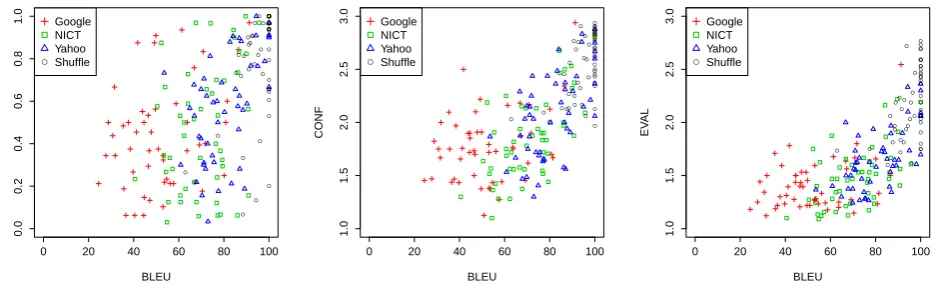
How well does an automatic intrinsic evaluation metrics such as BLEU (Papineni et al., 2002) predict the subjects’ responses? Figure 3 presents the scatterplots of BLEU score of translated questions and the rate of correct answers (RCA), the average of the subjects’ confidence (CONF), and system evaluation (EVAL). As the figures and the cor-relation coefficients (r) show, the BLEU score correlates well with the subjects’ confidence and the system evalua-tions, but only modestly with RCA.
Table 4 summarizes the correlation coefficients calculated only on the questions translated by a single system (i.e., #samples = 50) and on all of them (i.e., #samples = 200). The table reveals that the BLEU score does not correlate well with all of RCA, CONF, and EVAL when calculated only on the translations by Google. It also shows the BLEU score correlates modestly with RCA only on the transla-tions by Yahoo! and Human-Shuffle.
4.4.
Qualitative Analysis
●
Figure 3: Scatterplot of BLEU score and evaluation metrics. Left: BLEU vs. RCA (r= 0.54); Middle: BLEU vs. CONF (r= 0.70); Right: BLEU vs. EVAL (r= 0.71).
answers:
1. Incorrect translation of imperative sentences
2. Incorrect translation of modality
3. Wrongly supplied Japanese phrases for omitted phrases in the English sentences
4. Literal translations of the sentences including omitted phrases with no supplementation
5. Wrong disambiguation of a word in the utterance in the correct choice
This section provides examples for item 1, 2 and 3. Figure 4 shows the MT results of an imperative sentence in the test material. The whole dialogue was shown in Fig-ure 1. NICT and Google failed to produce an imperative sentence: NICT’s output is ungrammatical because dake “only” is postposition that requires an NP that precedes it. Even when dake is ignored, the remaining part is a declara-tive sentence with a null subject6. Google produced a
gram-matical sentence but it’s also a declarative sentence with a null subject. Yahoo! failed to translate the nuance of “just” but correctly produced an imperative sentence. The failures of the two SMT systems suggest that imperative sentences are relatively infrequent in their training corpus.
Figure 5 shows a question, in which the correct choice (shown in the square brackets [...]) includes the modal verb ‘should’ that has both deontic (“need to”) and epistemic (“certainly”) readings. NICT correctly chose the epistemic reading expressed by Japanese word darou (“probably”) but Google and Yahoo! wrongly chose the deontic read-ing and translated it to hitsuyou-ga-ari-masu (“need to”) and inakerebaike-masen (“ought to”). As shown in this ex-ample, different kinds of modalities ‘overloaded’ by a sin-gle English modal verb are usually expressed by different Japanese phrases. The low RCAs on Google and Yahoo!’s outputs revealed the wrong choice of the modality types may severly damage the readers’ comprehension.
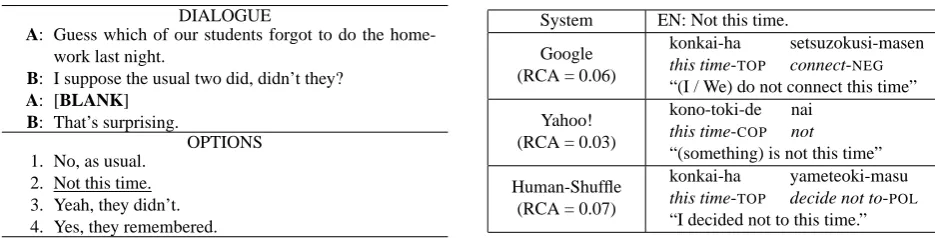
Table 6 shows a question, in which the correct choice (un-derlined) includes ellipsis, and the translations of that sen-tence by Google, Yahoo!, and Human-Shuffle. Google
6
Japanese is a pro-drop language.
EN: Just use my phone.
Translation by NICT (RCA = 0.06) dake denwa-o riyoshi-masu
only phone-ACCuse-POL
“only, (someone) uses phone” (ungrammatical) Translation by Google (RCA = 0.39)
chodo watashi-no keitaidenwa-o shiyoshi-tei-masu
just now I-GEN cell phone-ACCuse-PROG-POL
“ (someone) is using my cell phone just now” Translation by Yahoo! (RCA = 0.90)
chotto watashi-no denwa-o tsukatte kudasai
a little I-GEN phone-ACCuse please
“Use my phone a little, please”
Figure 4: MT results of an imperative sentence in the test material (Question ID: 206)
wrongly supplied “(do not) connect” as the omitted main clause, which does not make sense in the dialogue7.
Ya-hoo!’s output includes no such ‘supplementation,’ but is in-correct and fairly unnatural. The low RCA implies most of the subjects could not infer the original meaning from it.
Translation of the sentences including ellipsis is difficult even for human when the context is not provided. In pro-ducing Human-Shuffle translations for such sentences, the translator was instructed to find a correct translation that makes sense in most situation without any supplementation. If it’s impossible, the translator supplied a clause assuming a typical situation in which such an utterance is made. We believe this is the best strategy both for human and ma-chine translators that work on individual sentences without considering the context. The Human-Shuffle translation in Table 6 however reveals that the translator could not find a context-independent translation and the assumed context did not match the actual dialogue.
7
On its user interface, Google MT shows which part of an input sentence corresponds to a part of the output. It suggests the phrase “Not this time” is associated to the output konkai-ha
setsuzokushi-masen (“(We/I) don’t connect this time”) as a whole
DIALOGUE
A: We’ve been driving in circles for an
hour. Where are we?
B: I don’t know. Let’s stop at the next gas
station.
A: Yeah. [At least they should have a map.] B: Why didn’t you get one before we left?
System EN: At least they should have a map.
Google (RCA = 0.06)
Sukunakutomo karera-ha chizu-wo motteiru hitsuyou-ga-ari-masu
at least they-TOP map-ACC have need to-POL
“At least they need to have a map”
Yahoo! (RCA = 0.34)
Sukunakutomo karera-ha chizu-wo motte-inakerebaike-masen
at least they-TOP map-ACC have-ought to-POL
“At least they ought to have a map”
NICT (RCA = 0.70)
Sukunakutomo chizu-grai-ha aru-darou
at least map-at least-TOP exist-probably
“At least there will be a map”
Figure 5: Question involving deontic/epsitemic modality ambiguity and its translations (Question ID: 58)
DIALOGUE
A: Guess which of our students forgot to do the
home-work last night.
B: I suppose the usual two did, didn’t they? A: [BLANK]
B: That’s surprising.
OPTIONS 1. No, as usual.
2. Not this time. 3. Yeah, they didn’t. 4. Yes, they remembered.
System EN: Not this time.
Google (RCA = 0.06)
konkai-ha setsuzokusi-masen
this time-TOP connect-NEG
“(I / We) do not connect this time”
Yahoo! (RCA = 0.03)
kono-toki-de nai
this time-COP not
“(something) is not this time”
Human-Shuffle (RCA = 0.07)
konkai-ha yameteoki-masu
this time-TOP decide not to-POL
“I decided not to this time.”
Figure 6: Question involving a sentence including ellipsis and its translations (Question ID: 86)
5.
Conclusion
We have conducted a task-based MT evaluation involving 795 human participants where dialogue completion ques-tions translated by MT systems were used as the task. Quantitative analysis of the subjects’ responses indicated that the following types of frequent translation errors dete-riorated the subjects’ task performance significantly:
1. Missing words
2. Wrong disambiguations in the lexical choice
3. Literal translations of idioms
Meanwhile, quantitative and qualitative analysis revealed that the following less frequent errors also deteriorated the subjects’ performance severely:
1. Incorrect choice of grammatical mood
2. Incorrect choice of the kind of modality
3. Wrong supplementation to omitted phrase
4. Inversion of the sentiment polarity expressed in the source and the translated sentences
Acknowledgments
The authors are grateful to all the participants in the exper-iments for their time and patience. This study is conducted as a part of the Todai Robot Project (http://21robot. org/?lang=english).
6.
Bibliographical References
Doddington, G. (2002). Automatic evaluation of machine translation quality using n-gram co-occurrence statistics. In Proceedings of the Second International Conference
on Human Language Technology Research, pages 138–
145. Morgan Kaufmann Publishers Inc.
Matsuzaki, T., Fujita, A., Todo, N., and H. Arai, N. (2015). Evaluating machine translation systems with second lan-guage proficiency tests. In Proceedings of the 53rd
An-nual Meeting of the Association for Computational Lin-guistics and the 7th International Joint Conference on Natural Language Processing (Volume 2: Short Papers),
pages 145–149. Association for Computational Linguis-tics.
Papineni, K., Roukos, S., Ward, T., and Zhu, W.-J. (2002). Bleu: A method for automatic evaluation of machine translation. In Proceedings of the 40th Annual Meeting
of the Association for Computational Linguistics, pages
311–318. Association for Computational Linguistics. Vilar, D., Xu, J., D’Haro, L. F., and Ney, H. (2006).
Er-ror analysis of statistical machine translation output. In