Algorithms for Blind Components Separation
and Extraction from the Time-Frequency
Distribution of Their Mixture
B. Barkat
School of Electrical and Electronic Engineering, Nanyang Technological University, Nanyang Avenue, 639798 Singapore Email:[email protected]
K. Abed-Meraim
Signal and Image Processing Department, ´Ecole National Sup´erieure des T´el´ecommunications, Telecom Paris, 75013 Paris, France Email:[email protected]
Received 20 February 2003; Revised 29 November 2003; Recommended for Publication by Petar Djuri´c
We propose novel algorithms to select and extract separately all the components, using the time-frequency distribution (TFD), of a given multicomponent frequency-modulated (FM) signal. These algorithms do not use any a priori information about the various components. However, their performances highly depend on the cross-terms suppression ability and high time-frequency resolution of the considered TFD. To illustrate the usefulness of the proposed algorithms, we applied them for the estimation of the instantaneous frequency coefficients of a multicomponent signal and the results are compared with those of the higher-order am-biguity function (HAF) algorithm. Monte Carlo simulation results show the superiority of the proposed algorithms over the HAF.
Keywords and phrases:time-frequency signal analysis, components separation, polynomial phase signals, instantaneous fre-quency estimation.
1. INTRODUCTION
The joint time-frequency analysis has proved to be a power-ful tool in the analysis of nonstationary signals, that is, sig-nals whose spectral contents vary with time [1]. Such sig-nals may be found in many engineering applications such as radar, sonar, telecommunications, and biomedical engineer-ing. These signals can be classified in two groups: monocom-ponent and multicommonocom-ponent.
In this paper, we focus our analysis on multicomponent signals. By a multicomponent signal, we mean a signal whose time-frequency representation presents multiple ridges in the time-frequency plane. Analytically, it may be defined as
s(t)=
M
i=1
si(t), (1)
where each componentsi(t), of the form
si(t)=ai(t)ejφi(t), (2)
is assumed to have only one ridge, or one continuous curve, in the time-frequency plane. An example of a multicompo-nent signal, consisting of three compomulticompo-nents, is displayed in
Figure 1.
Recovery of a particular component from a given multi-component signal has always been a challenge for the time-frequency community. The objective of this paper is to ad-dress this particular problem. Specifically, we present two dif-ferent algorithms in order to retrieve and extract separately the components from the time-frequency distribution (TFD) of their mixture signal. The motivation behind this can be found in situations where the user may be interested in the instantaneous frequency (IF) law of one of the components only. For instance, in telecommunications the received signal may be a mixture of several source signals (multiple access in-terference) but the user may wish to recover only one source signal (blind source separation) [2,3]. In this context, by ap-plying either of the proposed algorithms to the TFD of the received signal, we may be able to separate and recover the desired source signal.
0.45
Figure1: A time-frequency distribution of a multicomponent sig-nal.Fs=1 Hz,N=512, Time resolution=1.
resolution, should be cross-terms free or at least be able to suppress them as much as possible.
Once the various components have been extracted, we can use available estimation techniques to obtain their de-sired characteristics [4]. In the literature, we can find other techniques for the estimation of multicomponent signals in noise [5, 6,7]. Among these we can cite the higher-order ambiguity function (HAF) algorithm [7]. Explicitly, the al-gorithm in [7] was designed to estimate the phase parame-ters as well as the constant, or slowly varying, amplitudes of each component of a multicomponent signal. Each of these components is assumed to have a polynomial phase law. As an illustration, we present here a brief statistical performance comparison between one of the proposed algorithms and the HAF in the estimation of a multicomponent signal consist-ing of two quadratic polynomial phase signals embedded in noise. We note that our proposed algorithms can also be used in the estimation of other nonlinear, not necessarily polyno-mial, phase signals. Examples, using real-life as well as syn-thetic data, are presented in order to show the high accuracy of the proposed algorithms.
The paper is organized as follows. InSection 2, we dis-cuss the choice of the appropriate TFD to be used in both algorithms. In Section 3, we present the first algorithm as well as the statistical comparison with the HAF algorithm. In
Section 4, we present the second algorithm.Section 5
con-cludes the paper.
2. TIME-FREQUENCY DISTRIBUTION CHOICE
There exist many TFDs. The choice of a TFD depends on the specific application at hand and the representation properties that are desirable for this application. One of the well-known TFDs is the Wigner-Ville distribution (WVD) defined as [1]
W(t,f)=
wherez(t) is the analytic version of the signal under consid-eration.
Figure2: The WVD of the same multicomponent signal displayed inFigure 1.Fs=1 Hz,N=512, Time resolution=1.
The WVD is known to have high resolution in both time and frequency; however, it suffers from the presence of cross-terms for a multicomponent signal. These cross-cross-terms result from the interaction of different components of the signal. As an illustration, we consider the WVD of the multicomponent signal displayed inFigure 1. The WVD of such a signal is dis-played inFigure 2. It is clear from this figure that the features of the signal are hidden making the WVD inappropriate for the analysis in this case.
In order to apply the proposed algorithms we need to have a “clean” TFD. That is, we need a distribution that can reveal the features of the signal as clearly as possible without any “ghost” component. For that, we need to apply a TFD that can get rid of the cross-terms while preserving a high time-frequency resolution. Thanks to the recent results in the design of TFDs, nowadays the user has a myriad of TFDs to choose from [8,9,10,11]. As an example, in the sequel, we will use a newly developed high-resolution quadratic TFD. This distribution, called the B-distribution, is defined as [12]
S(t,f)= distribution, or its modified version [13], stems from the fact that it presents a good performance in terms of resolution and cross-terms suppression. Detailed performance evalua-tion, design criteria, and implementation can be found in [12,13]. InFigure 1, it was this particular distribution that was used to display the time-frequency representation of the signal.
Masking Masking Masking
. . . . . .
Cd(t,f)
Ci(t,f)
C1(t,f)
C1
Ci
Cd
Components separation (Algorithm 2)
d Tth(t,f) Input 1D
signal
s(t) Signal TFD (B-distribution)
T(t,f) Noise thresholding
Estimation of the number of components
Figure3: Flowchart of the proposed first algorithm.
3. PROPOSED FIRST ALGORITHM
The first proposed components-separation algorithm is il-lustrated inFigure 3, and Algorithms1and2.Figure 3 pro-vides the algorithm flowchart,Algorithm 1summarizes the estimation technique of the number of components, and
Algorithm 2 summarizes the components-separation
tech-nique.
The first step of the algorithm consists in noise thresh-olding to remove the undesired “low” energy peaks in the time-frequency domain1. This operation can be written as
Tth(t,f)= T
(t,f) ifT(t,f)>,
0 otherwise, (5) where is a properly chosen threshold (in our simulations we used=0.01 max(t,f)T(t,f)).
The second step consists in estimating the number of components as shown next.
3.1. Estimation of the number of components
First, we assume that all components exist simultaneously at almost all time instants in the time-frequency plane. Second, we observe that, in general, for a noiseless and cross-terms free TFD, the number of components at a given time instant
t0can be estimated as the number of peaks of the TFD slice T(t0,f). By searching and counting the peaks of each TFD
slice, we end up with a set of numbers. The number corre-sponding to the maximum of the histogram of these num-bers yields an estimate of the number of components in the signal. This simple procedure is detailed inAlgorithm 1.
Note that the thresholding operation performed in the first step has an effect on the second step. Indeed, the TFD should present high peaks for the auto-terms compared to cross-terms and noise. In this situation, the threshold can easily remove all peaks that do not belong to auto-terms.
1This noise thresholding is justified by the fact that the noise energy is spread over all time-frequency domain while the components energies are well localized around their respective IFs leading to high energy peaks for the latter (assuming no cross-terms).
(1) For each time instantt, wheret=1,. . .,tmax, take a slice of the TFDT(t,f).
(2) Search and count the number of peaks in each slice. (3) Evaluate the histogram of the obtained set of peaks
numbers.
(4) Estimate the total number of the signal components as the argument of the maximum of the above histogram.
Algorithm1: Estimation of the number of components.
(1) Assign an index to each of thedcomponents in an orderly manner.
(2) For each time instantt(starting fromt=1) find the components frequencies as the peaks positions of the TFD sliceT(t,f).
(3) Assign a peak to a particular component based on the smallest distance to the peaks of the previous slice
T(t−1,f) (IFs continuous functions of time). For the special case of a crossing point (see step (4) how to detect it and its corresponding components), we assign the peak to both crossing components.
(4) If at a time instantta crossing point exists (i.e., number of peaks smaller than the number of components), iden-tify the crossing components using the smallest distance criterion by comparing the distances of the actual peaks to those of the previous slice.
(5) Permute the indices of the corresponding crossing components.
Algorithm2: Components-separation procedure for the proposed first algorithm.
However, in large noise situations the choice of the threshold value becomes more difficult and this may generate errors in the number of components.
3.2. Components-separation procedure
The proposed algorithm assumes that (i) all components ex-ist at all time instants in the time-frequency plane and (ii) any components intersection is a crossing point. Under these two assumptions, we note that if, at a time instantt0, two
compo-nents are crossing, then the number of peaks (at this partic-ular sliceT(t0,f)) is smaller than the total number of
com-ponentsd. For practical implementation reasons, we decide that a crossing occurs when the number of peaks is smaller thandover a fixed number of consecutive slices. In this case, we implement the following procedure:
(1) choose a particular maximum point location in the slice where the crossing occurs;
(2) measure all distances from this point to the peaks lo-cations of the previous slice (with no crossing); (3) select the 2 smallest distances and add them;
0.4
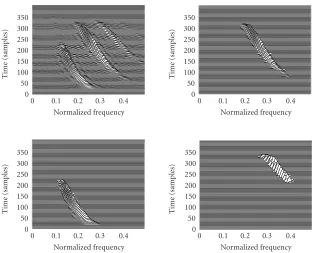
Figure4: The B-distribution of the original signal (top left) as well as the extracted components using the proposed first algorithm.
(5) from the set of the smallest sums found above, the pro-gram selects the smallest value and the points associ-ated to them. This will yield the location where the crossing occurred and the 2 components involved in the crossing.
Then, we use a simple numerical permutation opera-tion of the 2 components involved in the crossing. The de-tails of the proposed separation technique is outlined in
Algorithm 2.
To validate the proposed algorithm, we reconsider the same multicomponent signal analysed earlier. This signal consists of a mixture of a unit modulus (with increasing fre-quency) quadratic frequency-modulated (FM) component, a unit modulus (with decreasing frequency) quadratic FM component, and a unit modulus (with increasing frequency) linear FM component. The mixture signal is added to a zero-mean white Gaussian noise with power equal to 0 dB. This means that the individual signal-to-noise ratio (SNR) de-fined as SNRi=ith component power/noise power is equal
to 0 dB.
The B-distribution of the noisy signal as well as the com-ponents resulting from the separation algorithm are dis-played inFigure 4.
A different signal consisting of 5 components was also analysed using the proposed algorithm. In particular, this sig-nal is a mixture of two linear FM sigsig-nals, a quadratic FM signal, a cubic FM signal, and a pure sinusoid. The mixture signal was embedded in 0 dB Gaussian noise. Similarly to the previous case, the individual SNR is also equal to 0 dB. Again, the algorithm was able to separate and extract each of these components. The results are displayed inFigure 5.
Note that a similar algorithm to the one above could be designed if the signal exists over all frequencies but not nec-essarily over all times. In this case, the slices are taken at par-ticular frequencies and not time instants as we did here.
3.3. Performance evaluation and comparison
In this subsection, we evaluate the statistical performance of the proposed first algorithm and compare it to the perfor-mance of the HAF method [7]. For that, consider a discrete-time multicomponent signal consisting of two linear FM components embedded in additive white complex Gaussian noisew(n):
y(n)=z1+z2+w(n), n=0, 1,. . .,N−1, (6)
wherez1=exp{j(a1n+a2n2)}andz2=exp{j(b1n+b2n2)}.
The noisew(n) is assumed to be an independent and identi-cally distributed (i.i.d.) sequence with zero mean and vari-ance equal to σ2. The signals’ IF coefficients are given by a1=0.4π,a2=0.5π10−3,b1 =0.9π, andb2= −1.5π10−3.
The signal length is chosen equal to N = 256 with a sam-pling period equal to unity. We define the SNR as the total noiseless signal power over the noise power, namely,
SNR (dB)=10log10 z1
0.4
Figure5: The B-distribution of a different multicomponent signal (top left) as well as the extracted components using the proposed first
algorithm.
these linear FM components [4]. By recalling that the IF of
z1(n) (estimated from the peak of the extracted component)
is given by [4]:
tracted component) is given by
fz2(n)=
For comparison purposes, the same noisy signal y(n) is also put through the HAF algorithm [7]. From this algo-rithm, we directly obtain the IF coefficients estimates [7]. These estimates are then used to evaluate the corresponding IFs estimates of the two linear FM components (using the above expressions). We note here that, in the comparison, we choose the coefficients to be half of those of [7] to contain the frequency in the range 0–0.5 Hz instead of the 0–1 Hz. More-over, in the simulation, we used a second estimation stage as suggested in [7] to refine the phase parameter estimates.
In Figure 6, we display the estimated IFs of the two
components. The dotted lines correspond to the HAF algo-rithm and the dashed lines correspond to the proposed first algorithm. The true IFs are represented by the continuous
300
IFs estimated (new algorithm) IFs estimated (HAF)
Figure6: Estimated IFs of the two linear FM components. The dot-ted lines correspond to the HAF algorithm and the dashed-dotdot-ted lines correspond to the proposed first algorithm.
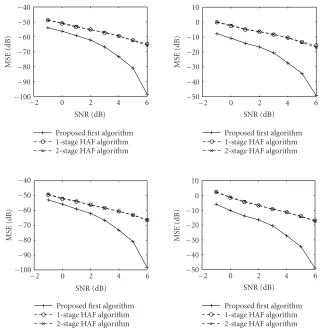
6 4 2 0 −2
SNR (dB) −100
−90 −80 −70 −60 −50 −40
MSE
(dB)
2-stage HAF algorithm 1-stage HAF algorithm Proposed first algorithm
6 4 2 0 −2
SNR (dB) −50
−40 −30 −20 −10 0 10
MSE
(dB)
2-stage HAF algorithm 1-stage HAF algorithm Proposed first algorithm
6 4 2 0 −2
SNR (dB) −100
−90 −80 −70 −60 −50 −40
MSE
(dB)
2-stage HAF algorithm 1-stage HAF algorithm Proposed first algorithm
6 4 2 0 −2
SNR (dB) −50
−40 −30 −20 −10 0 10
MSE
(dB)
2-stage HAF algorithm 1-stage HAF algorithm Proposed first algorithm
Figure7: Mean squared error of the various phase parameters.
We re-ran the above experiment for various values of the SNR. For each SNR value, we ran 6000 realizations. The results of the Monte Carlo simulations, namely, the mean squared error of the phase parameters are displayed in
Figure 7. The “◦” curves (resp., the “×” curves) correspond
to the 1-stage (resp., 2-stage2) HAF algorithm; while, the “+”
curves correspond to the proposed algorithm. These results confirm the superiority of the proposed first algorithm over the HAF.
4. PROPOSED SECOND ALGORITHM
In this second algorithm, the various components are ex-tracted sequentially. That is, the algorithm extracts the first component (or part of it), then the next one, and so on until the last one. Normally, the overall energy in the TFD becomes smaller and smaller after each extraction and after the last component has been retrieved the energy should be a frac-tion of the original one. It is the energy criterion that stops the extraction algorithm. Then, a classification procedure is applied, as explained later.
2As can be observed, for low and moderate SNRs, the performance gain due to the second stage of the HAF algorithm is not significant.
The proposed second algorithm is illustrated inFigure 8. As can be seen, the second algorithm consists of three major phases. The first phase is to analyze the mixture, or multi-component, signal using an appropriate TFD. By appropri-ate, we mean a cross-terms reduced TFD. In the sequel, we will consider the B-distribution but any other clean TFD can also be a candidate.
The second phase is the separation procedure. In this phase, the various components are extracted based on their peaks in the time-frequency plane. That is, the frequency and time occurrence of the highest peak are obtained first. Then, we look for the next highest peak in thenearest neighborhood
of the previous found one (making sure to reset to zero, and some frequency range around it, the previous peak in or-der to avoid it again). We continue this until we reach the extreme end of the TFD or when the new obtained peak is smaller than a prefixed threshold (chosen to be equal to a fraction of thefirst maximum). The consecutive found peaks would constitute the first component. We repeat the proce-dure again to obtain a new component and so on until the remaining energy in the TFD matrix is smaller than a frac-tion of the initial TFD energy.
Separated components Components classification Algorithm 4 No Remaining energy> ε
Yes Components
extraction Algorithm 3 Time-frequency
distribution (e.g., B-distr.)
Multicomponents or mixture signal
Figure8: The flowchart of the proposed second algorithm.
maximum location to one end. This will constitute only one part of the component. The other part of the component will be taken in a different step of the iterative algorithm. For this reason, at the end of the second phase, we end up with a number of components which is higher than the actual num-ber of components in the signal. Therefore, a classification procedure is necessary in order to group the halves (or parts) of the actual components together. This is performed in the third and last phase of the algorithm.Algorithm 3gives the details of the second phase.
The classification technique (detailed in Algorithm 4) consists of grouping the components obtained from the sec-ond phase based on an appropriate measurement criterion. This criterion is chosen to be the minimum distance be-tween two components. Indeed, if two components belong to the same actual component, their distance in the time-frequency plane should be smaller compared to any other ob-tained component. By applying the classification procedure once, we can group a certain number of the components and the resulting new number of components will be smaller than the one obtained from the second phase. We continue apply-ing this classification until there isno changein the number of components. This last number corresponds to the actual number of components in the original mixture signal.
As an illustration, we consider the analysis of a real-life data sound emitted by a bat. The B-distribution of this mul-ticomponent signal, which consists of three components, is displayed inFigure 9(top left plot). Note that although there
(1) Initialization. Create an empty matrix called compo-nentto hold the results (its first row will hold the time and its second row will hold the corresponding fre-quency of the extracted component).
(2) Find the maximum energy point,t0f0, of the time-frequency distribution.
(3) Augment the matrixcomponentby adding the point
t0 f0
as its first column.
(4) Set the TFD matrixT(t0,f) to zero, at timet0, around the found maximum point, that is,T(t0,f)=0 for
f∈[f0−∆f,f0+∆f].
(5) Find the next maximum energy point,t0 f0
, of the TFD in the vicinity of the previous maximum. That is,
t0
f0
=max(t,f)T(t,f) wheret∈t0−1,t0+ 1
andf ∈f0−F,f0+F
,
whereFis a chosen frequency window parameter. (6) Augment the matrixcomponentby adding the point
t
0 f0
as its next column.
(7) Again, set the TFD to zero at timet0, around the found maximum, that is,T(t0,f)=0 forf ∈[f0−∆f,
f0+∆f].
(8) As long as the time and frequency indices have not reached the boundaries of the TFD matrix and the TFD in the neighborhood oft0
f0
, defined in step (5), is not equal to zero, then, go back to step (5).
(9) Otherwise, go back to step (1) to extract a new compo-nent.
(10) Stop the algorithm when the remaining TFD energy is smaller than a threshold.
Algorithm 3: Components-separation procedure for the second algorithm.
(1) Initialization. Set the number of components equal to that found in the extraction procedure ofAlgorithm 3. (2) Do the following:
(2.1) For all pairs of components (Ci,Cj), compute the distancedi jbetween the two components; (2.2) If the distance between any pair of components
verifiesdi j<d, then, merge the two components (Ci,Cj), decrease by one the number of compo nents, and go back to step (2.1);
(2.3) If all distancesdi jare larger thand, then, stop the algorithm.
0.4
Figure9: The B-distribution of a bat signal (top left) as well as the extracted components using the proposed second algorithm.
is an overlap of the various components either in time or in frequency, they are well separated in the time-frequency do-main. Applying the proposed second algorithm, we are able to extract each of these components separately, as shown in
Figure 9.
5. CONCLUSION
In this paper, we presented two novel blind (i.e., without a priori information) algorithms to extract separately all the components, using a “cross-terms free” TFD, of a given mix-ture signal. The first algorithm assumes that the components exist at almost all time instants; while, the second one as-sumes that the components are well separated in the time-frequency plane. Such components extraction can be used, for example, as a preprocessing step to estimate the poly-nomial phase parameters of a multicomponent FM signal. Examples, using real-life as well as synthetic data, were pre-sented in order to validate the new algorithms. In addition, the first algorithm was compared with the HAF algorithm for the estimation of the IF coefficients of a multicompo-nent signal consisting of two linear FM compomulticompo-nents. Monte Carlo simulations showed the superiority of the proposed al-gorithm over the HAF.
REFERENCES
[1] L. Cohen, Time-Frequency Analysis, Prentice-Hall, Engle-wood Cliffs, NJ, USA, 1995.
[2] M. G. Amin, W. Mu, and Y. Zhang, “Spatial and time-frequency signature estimation of nonstationary sources,” in Proc. IEEE 11th Workshop on Statistical Signal Processing, pp. 313–316, Singapore, August 2001.
[3] L.-T. Nguyen, A. Belouchrani, K. Abed-Meraim, and B. Boashash, “Separating more sources than sensors using time-frequency distributions,” inProc. IEEE 6th International Symposium on Signal Processing and Its Applications, vol. 2, pp. 583–586, Kuala Lumpur, Malaysia, August 2001.
[4] B. Barkat and B. Boashash, “Instantaneous frequency estima-tion of polynomial FM signals using the peak of the PWVD: statistical performance in the presence of additive Gaussian noise,”IEEE Trans. Signal Processing, vol. 47, no. 9, pp. 2480– 2490, 1999.
[5] S. Barbarossa and V. Petrone, “Analysis of polynomial-phase signals by the integrated generalized ambiguity function,” IEEE Trans. Signal Processing, vol. 45, no. 2, pp. 316–327, 1997. [6] A. Francos and M. Porat, “Analysis and synthesis of mul-ticomponent signals using positive time-frequency distribu-tions,” IEEE Trans. Signal Processing, vol. 47, no. 2, pp. 493– 504, 1999.
[7] S. Peleg and B. Friedlander, “Multicomponent signal analy-sis using the polynomial-phase transform,” IEEE Trans. on Aerospace and Electronics Systems, vol. 32, no. 1, pp. 378–387, 1996.
[8] M. G. Amin and W. J. Williams, “High spectral resolution time-frequency distribution kernels,” IEEE Trans. Signal Pro-cessing, vol. 46, no. 10, pp. 2796–2804, 1998.
[9] H.-I. Choi and W. J. Williams, “Improved time-frequency representation of multicomponent signals using exponential kernels,” IEEE Trans. Acoustics, Speech, and Signal Processing, vol. 37, no. 6, pp. 862–871, 1989.
[10] L. Stankovi´c, “S-class of time-frequency distributions,” IEE Proceedings Vision, Image and Signal Processing, vol. 144, no. 2, pp. 57–64, 1997.
[11] L. Stankovi´c, “On the realization of the polynomial Wigner-Ville distribution for multicomponent signals,” IEEE Signal Processing Letters, vol. 5, no. 7, pp. 157–159, 1998.
IEEE Trans. Signal Processing, vol. 49, no. 10, pp. 2232–2239, 2001.
[13] B. Boashash and V. Sucic, “Resolution measure criteria for the objective assessment of the performance of quadratic time-frequency distributions,” IEEE Trans. Signal Processing, vol. 51, no. 5, pp. 1253–1263, 2003.
[14] B. Barkat and K. Abed-Meraim, “Blind source separation using the time-frequency distribution of the mixture signal,” inProc. IEEE 2nd International Symposium on Signal Process-ing and Information Technology, pp. 663–666, Marrakesh, Mo-rocco, December 2002.
B. Barkatreceived the degree of Ingenieur d’ ´Etat in electronics from the ´Ecole Na-tionale Polytechnique d’Alger (ENPA) in 1985 and the M.S. degree in control systems from the University of Colorado, Boulder, USA, in 1988. From 1989 to 1995, he held a Lecturer position in digital and advanced control systems at the University of Blida, Algeria. In 1999, he obtained the Ph.D. degree in signal processing from
Queens-land University of Technology (QUT), Brisbane, Australia. From September 1999 to November 2000 he was a Postdoctoral Research Fellow, first at QUT and then at Curtin University, Western Aus-tralia. Since November 2000, Barkat has been an Assistant Profes-sor in the School of Electrical and Electronic Engineering at the Nanyang Technological University, Singapore. His research inter-ests include time-frequency analysis, estimation and detection, sta-tistical array processing, and signal processing for communications.
K. Abed-Meraim was born in 1967. He received the State Engineering degree from Ecole Polytechnique, Paris, France, in 1990, the State Engineering degree from ´Ecole Na-tionale Sup´erieure des T´el´ecommunications (ENST), Paris, France, in 1992, the M.S. degree from Paris XI University, Orsay, France, in 1992, and the Ph.D. degree from the ´Ecole Nationale Sup´erieure des T´el´ecommunications (ENST), Paris,