Split SR-RLS for the Joint Initialization of the Per-Tone
Equalizers and Per-Tone Echo Cancelers
in DMT-Based Receivers
Geert Ysebaert
ESAT-SCD, Katholieke Universiteit Leuven, Kasteelpark Arenberg 10, 3001 Leuven-Heverlee, Belgium Email:[email protected]
Koen Vanbleu
ESAT-SCD, Katholieke Universiteit Leuven, Kasteelpark Arenberg 10, 3001 Leuven-Heverlee, Belgium Email:[email protected]
Gert Cuypers
ESAT-SCD, Katholieke Universiteit Leuven, Kasteelpark Arenberg 10, 3001 Leuven-Heverlee, Belgium Email:[email protected]
Marc Moonen
ESAT-SCD, Katholieke Universiteit Leuven, Kasteelpark Arenberg 10, 3001 Leuven-Heverlee, Belgium Email:[email protected]
Received 6 March 2003; Revised 25 August 2003
In asymmetric digital subscriber lines (ADSL), the available bandwidth is divided in subcarriers or tones which are assigned to the upstream and/or downstream transmission direction. To allow efficient bidirectional communication over one twisted pair, echo cancellation is required to separate upstream and downstream channels. In addition, intersymbol interference and intercarrier interference have to be reduced by means of equalization. In this paper, a computationally efficient algorithm for adaptively initializing the per-tone equalizers (PTEQ) and per-tone echo cancelers (PTEC) is presented. For a given number of equalizer and echo canceler taps per-tone, it was shown that the joint PTEQ/PTEC receiver structure is able to maximize the signal-to-noise ratio (SNR) on each subcarrier and hence also the achievable bit rate. The proposed initialization scheme is based on a modification of the square root recursive least squares (SR-RLS) algorithm to reduce computational complexity and memory requirement compared to full SR-RLS, while keeping the convergence rate acceptably fast. Our performance analysis will show that the proposed method converges in the mean and an upper bound for the step size is given. Moreover, we will indicate how the presented initialization method can be reused in several other ADSL applications.
Keywords and phrases:adaptive signal processing, split SR-RLS, DMT, DSL, per-tone equalization, per-tone echo cancellation.
1. INTRODUCTION
ADSL stands for asymmetric digital subscriber lines and is able to provide broadband data transmission over the ex-isting telephone network. To increase the spectral efficiency of the available bandwidth, ADSL employs a transmission technique based on multicarrier modulation, namely, dis-crete multitone (DMT) [1, 2]. DMT divides the available bandwidth into N parallel subchannels or tones, by means of anN-point inverse fast Fourier transform (IFFT). At the transmitter, each tone is modulated by quadrature ampli-tude modulation (QAM) and IFFT transformed to obtain
a time domain signal. At the receiver, an N-point FFT can be used for demodulation. Prepending each data block after IFFT modulation with a cyclic prefix ensures that the sub-channels remain independent after transmission over a chan-nel. If the order of the channel (modeled as an FIR filter) is smaller than the cyclic prefix length,ν, the transmitted sig-nal can easily be recovered by a bank of complex scalars, the so-called frequency domain equalizers (FEQs).
a channel-shortening time domain equalizer (TEQ) is re-quired [3,4,5,6,7]. An alternative equalization structure is based on “per-tone” equalization (PTEQ), which accom-plishes the joint task of TEQ/FEQ independently for each tone [8,9].
Besides equalization, echo cancellation is required to sep-arate upstream and downstream signals and to enable effi -cient bidirectional communication over the same telephone wire. Echo occurs due to signal leakage from the transmit side to the receive side in the modem since both sides are im-perfectly coupled to the telephone line. If properly designed, echo cancellation can improve the reach and/or noise margin of an ADSL system by allowing both upstream and down-stream signals to share the low frequency portion of the avail-able frequency band.
Several echo cancellation structures for DMT transceiv-ers have been studied in literature [6,8,10,11,12,13]. All the proposed structures exploit a common principle, namely, the echo channel is estimated through an adaptive updating pro-cess and an emulated version of the echo is subtracted from the received signal. Unfortunately, the echo cancelers, studied in [10,11,12], are designed independently from the equal-izer. Van Acker et al. presented ajoint per-tone echo cancella-tion (PTEC) and PTEQ, where an echo canceler and equalizer have to be designed for each tone separately [13]. For a given number of equalizer and echo canceler taps per subcarrier, this approach is able to optimize the signal-to-noise ratio (SNR) on each subcarrier and hence maximizes the achiev-able bit rate [13].
In this paper, we will focus on adaptively initializing the PTEQ/PTEC receiver structure. The problem consists of solving several parallel minimum mean square error (MMSE) problems (one MMSE problem for each tone) in an adaptive way. We are especially interested in developing an adaptive algorithm which exhibits fast convergence, low memory requirement, and low computational complexity.
In the literature, several adaptive algorithms exist to solve an MMSE problem of the form
min w E
d(k)−wTu(k)2
, (1)
where E{·} represents the expectation operator, {·}T de-notes the transpose, d(k) is some desired signal at time k,
ware the unknown coefficients andu(k)is the input vector.
The most well-known and extensively studied adaptive algo-rithm is certainly the least mean square (LMS) algoalgo-rithm by Widrow and Hoff[14,15]. Although the algorithm is sim-ple, the bad conditioning of the input autocorrelation matri-ces (one for each tone) for the PTEQ/PTEC receiver, leads to slow convergence.
Since the seventies, a lot of effort has been spent to find alternatives for LMS with faster convergence, which has lead to a variety of algorithms.
(i) LMS derivatives: these algorithms are derived from the original LMS scheme and include algorithms as nor-malized LMS (NLMS) [14] and looping LMS (LLMS) [16]. In NLMS, the step size is normalized with the
in-put signal power to avoid gradient noise amplification [14], which leads to slightly improved convergence. LLMS repeatedly applies LMS to a block of data, but still requires too many iterations and computations in case of the PTEQ/PTEC receiver.
(ii) Transform domain LMS: this type of adaptive filters refers to LMS filters where blocks of input data are pre-processed with a (unitary) data-independent transfor-mation [17,18]. The main purpose of this preprocess-ing step is to improve the eigenvalue distribution of the input autocorrelation matrix and hence to accelerate convergence. The choice of this transformation largely depends on the underlying problem. Time series fil-tering applications, whereu(k)is drawn from a tapped
delay line, typically use the discrete Fourier transform (DFT), to obtain the so-called frequency domain LMS algorithm. However, the PTEQ/PTEC receiver is in fact a “linear combiner” problem, where no shift structure inu(k)is available. Hence, an optimal transformation
is not straightforward to obtain.
(iii) Square root recursive least squares (SR-RLS): in general, the SR-RLS algorithm does not impose any restrictions on the input data structureu(k). SR-RLS exhibits fast
convergence, be it that SR-RLS adds computational complexity, compared to the LMS derivatives. Since the order of complexity increases with the square of the number of parameters inw, complexity reductions are desired. To mitigate the high computational burden of RLS, the family of fast RLS algorithms such as fast transversal filters (FTF) [19] and QR-decomposition based lattice filters (QRD-LSL) have been proposed. Unfortunately, the complexity reductions attained in these algorithms rely again on the signal shift nature of the filtering problem. Hence, these fast schemes are not suitable for our problem in particular.
(iv) Split RLS: this algorithm approximates the RLS algo-rithm with several lower-dimensional RLS problems and is able to obtain a complexity which is linear in the number of parameters [20]. Although this method does not require any specific data structure, only the estimation error is computed without finding w di-rectly. Moreover, the authors of [20] do not prove the convergence of the obtained algorithm and indicate that a high level of misadjustment is possible for highly correlated input signals.
The contributions of this paper can be summarized as fol-lows. First, we will derive a general method for adaptively computing w of (1) without relying on any specific data structure in u(k). Whereas the split RLS algorithm of [20]
only computes the estimation error, d(k)−wTu(k), the
pro-posed method “merges” the SR-RLS1and the split RLS
algo-rithms to find the tap weight vectorwexplicitly. The result-ing structure will be referred to assplit SR-RLS. As opposed
to [20], we will provide a general proof of convergence. The proof will indicate that the step size of the proposed adapta-tion process can always be chosen in such a way that conver-gence in the mean is achieved. In addition, an upper bound for the step size will be derived.
The second contribution of this paper is the application of the proposed split SR-RLS method to the PTEQ/PTEC initialization problem. Due to the specific nature of the PTEQ/PTEC input elements, we will illustrate how a lower complexity and lower memory requirement can be achieved compared to full SR-RLS. Although the rate of convergence will be slower than full SR-RLS, the presented algorithm will converge much faster than NLMS. We will also indicate briefly the applicability of the proposed split SR-RLS method to other ADSL initialization problems.
The paper is organized as follows. InSection 2, the data model and the notation for standard adaptive algorithms are introduced.Section 3describes the split SR-RLS algorithm, which is applied to initialize the PTEQ/PTEC inSection 4. Finally, simulation results are presented in Section 5, fol-lowed by the conclusions inSection 6.
2. DATA MODEL AND STANDARD
ADAPTIVE ALGORITHMS
Notation
Throughout this paper the following notation will be used:
(i) time domain vectors and matrices are indicated by bold face lower case and upper case letters, respec-tively;
(ii) {·}T,{·}H,{·}∗denote transpose, complex conjugate
transpose and complex conjugate, respectively; (iii) w is the unknown, complex-valued tap weight
vec-tor withT parameters, whileu(k) is used to indicate
a complex-valued input signal vector at timek; (iv) Xuu andXku denote autocorrelation and
crosscorre-lation matrices, respectively, (defined in (5) and (13)).
Problem formulation
Given the input data vectorsu(k)at time instantk,
u(k)=
u(0k) · · · u(Tk−)1
T
, (2)
the goal is to find theTunknown weight coefficients
w=w0 · · · wT−1
T
, (3)
such that the filter output, wTu(k), is as close as possible
to some desired signald(k) in mean square sense, compare
(1). Here, every variable can be complex-valued and no spe-cific structure on the input data is assumed. In general, w just forms a linear combination of the input elements and is henceforth referred to as alinear combiner. In the following subsections, we will discuss NLMS and SR-RLS to find the optimal MMSE solution of (1) in an adaptive way.
2.1. Least mean square
The (normalized) LMS algorithm was designed as a stochas-tic gradient descent method to solve (1) [14]. It approximates the MMSE solution by continuously updating the weight vectorwas new data vectors are received, according to
w(k+1)←−w(k)+ µ
α2+u(k+1)Hu(k+1)u (k+1)∗
e(k), (4)
wheree(k) =d(k+1)−w(k)T
u(k+1),µrepresents the step size
to govern the convergence rate andαprevents overflow for signals with low energy. This algorithm is computationally simple, but a large eigenvalue spread of the input correlation matrix,
Xuu=E
u(k)∗u(k)T
, (5)
often leads to a convergence rate which is unacceptably slow.
2.2. Square root recursive least square
To overcome the slow convergence of LMS, (1) can be ap-proximated by a least squares (LS) problem
min w(k)
d(k)−U(k)w(k) 2
2, (6)
whered(k)is a vector ofk+ 1 training or desired symbols
d(k)=d(0) · · · d(k)T, (7)
andU(k)contains a set ofk+ 1 input signal vectors
U(k)=
u(0)0 · · · u(0)T−1
..
. ...
u(0k) · · · u(Tk−)1
. (8)
GivenU(k)H
U(k)is full rank2, the LS solution of (6) is given
by
w(k)=U(k)HU(k)−1U(k)Hd(k). (9) With Q(k)R(k) the QR-decomposition of U(k) [21], we can
rewrite (9) as
w(k)=R(k)−1z(k), (10) wherez(k)=Q(k)H
d(k). The SR-RLS algorithm is based on
it-eratively updating the lower triangular matrixS(k) =R(k)−T by means of unitary Givens or Jacobi rotations [14]. The ma-trixR(k)is the (upper triangular) Cholesky factor of the
sam-ple covariance matrixU(k)H
U(k)=k j=0u(j)
∗
u(j)T
. Often, an exponential weighting factor 0 < λ < 1 is included to en-sure that data in the distant past is forgotten in order to track
Initialize filter coefficientsw(0)andS(0).
Fork=0,. . .,∞,
(1) form the matrix-vector product:
a= −S(k)u(k+1);
Apply exponential weighting withλ:
Algorithm1: The SR-RLS algorithm [22].
statistical variations of the input data in a nonstationary en-vironment. Correspondingly, we can write
U(k)H
The last equality only holds for largekandλclose to unity. As mentioned before, LMS convergence is dictated by the eigenvalue spread of the input correlation matrix Xuu. SR-RLS is able to “get rid” of the eigenvalue spread by using an iterative update based on a transformed update direction
k(k)=S(k)T
S(k)∗u(k)∗, (12)
which is called the Kalman gain vector. An efficient realiza-tion of updating S(k) andw(k) is described in Algorithm 1
[22].
Similar to LMS (cf. (5)), the convergence of SR-RLS is determined by the crosscorrelation matrix ofk(k)andu(k):
Xku=E
k(k)u(k)T. (13)
Based on (11), (12), and (13), we observe that all eigenval-ues of Xku are (approximately) equal. Hence, the Kalman gain update direction removes the eigenvalue spreadand by this improves the convergence speed. This improvement in performance, however, is achieved at the expense of a large increase in computational complexity and memory require-ment. Whereas the complexity of NLMS is on the order of O(T), the complexity and memory requirement of SR-RLS isO(T2).
3. SPLIT SR-RLS WITH REDUCED COMPLEXITY
To alleviate the computational burden of a full-blown SR-RLS, the input elements of the “linear combiner” application under consideration could be divided into smaller groups, compare the split RLS algorithm in [20]. Unlike [20], our goal is to computew(k)instead ofe(k)only. As we will
mo-tivate in the next section, we are mainly interested for the PTEQ/PTEC receiver in dividing the input vector into two (unequal) parts. The ultimate goal is to design a modified SR-RLS scheme maintaining a fast convergence rate but with lower computational complexity and lower memory require-ment.
To achieve this goal, we will merge the split RLS and SR-RLS algorithm into asplit SR-RLSalgorithm. Assume we split the input vectoru(k)into two parts of lengthT
1andT2,
re-spectively, such thatT1+T2=T(a reordering of the inputs
might be possible), that is,
u(k)=u(1k)T u(k)
Now, we design a separate SR-RLS problem for each set of inputs. This requires two lower triangular matricesS(1k)and
S(2k)(of sizeT1×T1andT2×T2, respectively) to be updated,
seeAlgorithm 2. The update direction is now determined by l(k+1), which consists of a concatenation of two Kalman gain
vectors, one for each input set. Similar to (12), we can write
l(k)=
Notice that a step sizeµhas been added to ensure conver-gence. InAppendix A, we show that the convergence of the proposed scheme is determined by the maximum eigenvalue of the crosscorrelation matrix betweenl(k)andu(k):
Xlu=E
l(k)u(k)T. (17)
Additionally, inAppendix Bit is shown thatXlu has eigen-values 1−λ2 with multiplicityT
1 −T2 and 2T2
eigenval-ues equal to (1−λ2)(1±di), with thedi’s equal to the
Initialize filter coefficientsw(0)andS(0) 1 ,S(0)2 .
Fork=0,. . .,∞,
(1) form the matrix-vector products:
a1= −S(k)
T−1. Apply exponential weighting withλ:
Algorithm2: The split SR-RLS algorithm.
U(1k) andU(2k) are matrices containing the first T1 and the
last T2 columns ofU(k), respectively. Apparently, the
mod-ified update direction is able to remove partially the eigen-value spread and by this will lead to a convergence speed in between SR-RLS and NLMS. InAppendix B, it is also shown that convergence in the mean is achieved whenµsatisfies
0< µ < 1
1−λ2. (19)
Since the convergence rate depends on the eigenvalue spread ofXlu, convergence will be faster when all eigenvalues tend to be equal, that is, when the cosines of the principal angles between S1 andS2go to zero. Hence, the convergence rate
will be faster wheneverS1andS2are more orthogonal.
The proposed algorithm is straightforwardly obtained but can attain substantial complexity improvements and memory reductions, as illustrated in the following section. Similar to [20], the algorithm could be extended to more than two distinct parts, leading to higher misadjustment and slower convergence. In this case, an upper bound for the step size can not easily be derived. In the limit, we obtain an LMS like update, where each input element is weighted with the averaged energy of that element.
4. SPLIT SR-RLS INITIALIZATION OF
THE PTEQ/PTEC RECEIVER
In this section, we will apply the split SR-RLS algorithm for the initialization of the PTEQ/PTEC receiver structure. The PTEQ-only receiver [9] will be briefly reviewed in the first subsection and will be extended with PTEC in the second subsection [13].
4.1. Per-tone equalization
As mentioned in the introduction, the channel impulse re-sponse in the ADSL context typically exceeds the cyclic pre-fix length, thereby destroying subchannel orthogonality. The resulting ISI and ICI can be mitigated by means of a channel-shortening TEQ combined with a bank of one-tap FEQs [3,4,5,6,7]. An alternative equalization structure is based on PTEQ, which accomplishes the joint task of TEQ/FEQ in-dependently for each subcarrier [8,9] and which is able to optimize the overall bit rate. In the following, the ADSL data model is mainly based on [9] and only the main results will be repeated here.
Mathematically, the received signal vectory(k)is obtained
from the transmitted data through the following operations:
where h is a row vector representing the overall chan-nel (transmit and receive filters plus telephone wire), n(k)
is additive channel noise, s = N + ν, and TEQ is the
number of PTEQ taps per-tone. The vector X(k) contains
the data symbol of interest, X1:kN, as well as the preced-ing and succeedpreced-ing symbol. The data vector is first IDFT modulated (by means of the IDFT-matrix IN) and after-wards a cyclic prefix is inserted, represented by P. The matrices 0(1,2) are zero matrices of appropriate dimension
[9] and 1 is the synchronization delay, which is a design
parameter.
After DFT demodulation (implemented by the DFT-matrix FN), PTEQ of tonei is accomplished by forming a linear combinationof theith DFT output,Yi(k), withTEQ−1
per-tone equalizer for toneican be obtained as
where Xi(k) is the QAM symbol of interest, transmitted on tonei. Note that ¯viis a linear combiner and has to be initial-ized for each tone. The inputsu(ik)can be separated into two parts:
(i) the elements of ∆y(k) are real-valued since they are
formed out of a pre-FFT signal and henceforth are commonfor all subcarriers,
(ii) Yi(k)is complex-valued and tone dependent.
The distinct nature of the inputs will be exploited when ap-plying the split SR-RLS to the overall PTEQ/PTEC structure.
4.2. Joint per-tone echo cancellation and per-tone equalization
In ADSL, the available subchannels are assigned to either the upstream or downstream transmission direction, or to both. As transmission in both directions takes place over a single twisted pair, the transmitter and receiver at one end are cou-pled to the line by ahybrid. A perfectly balanced hybrid pre-vents leakage of transmitted signals into the receiver. How-ever, due to large variations in the subscriber loops, a fixed hybrid is not able to exactly balance all possible loops and hence leakage orechooccurs. To allow efficient bidirectional communication over one twisted pair,echo cancellationis re-quired to separate upstream and downstream channels. Due to the asymmetric character of ADSL transmission, a smaller bandwidth (25–138 kHz) is foreseen for the upstream direc-tion compared to the downstream direcdirec-tion (25–1104 kHz) and echo cancellation enables to share the low frequency por-tion of the available frequency band.
In this subsection, we will focus on the per-tone echo cancelers where the bank of per-tone equalizers is extended with a bank of per-tone echo cancelers [13]. The resulting echo cancellation is then completely done for each tone sep-arately. For a given number of equalizer and echo canceler taps per-tone, this approach is able to maximize the achiev-able bit rate [13].
An initialization formula has been derived in [13], based on an exact channel model and exact knowledge of the sig-nal and noise statistics. This direct initialization results in a high computational cost. Hence, we will focus in this paper onadaptivelyinitializing the joint PTEQ/PTEC structure.
When echo is present, the overall received signal vector r(k)is obtained as
r(k)=y(k)+y(k)
E , (23)
wherey(Ek)is the received echo component modeled as
Here, the row vectorhE represents the overall echo channel andU(k)are the transmitted echo symbols. Again, the
ma-trices0(3,4)are zero matrices of appropriate dimension [13].
Now, define the echo reference signal asuk, which contains a block ofTECcyclically prefixed, transmitted time domain
echo samples. The exact position of this data block within the transmitted echo stream depends on the alignment between echo symbols with respect to far end symbols, see [8,13] for more details. The output of the joint PTEQ/PTEC for tonei can mathematically be written as
Zi(k)=v¯Ti
received signal, theTEC−1 difference terms of the echo
ref-erence signal and the corresponding DFT outputs for tonei, respectively. The MMSE solution for ¯viand ¯vE,ican be ob-tained as the solution of
ized for each tonei. The input vector has similar properties as the PTEQ-only problem:
(i) ∆r(k)and∆u(k)are (T
EQ−1) + (TEC−1)real-valued
difference terms which are common for all frequency bins,
(ii) R(ik) and ˜U
(k)
By reordering the inputs, we are able to separate the common part and the per-tone part, that is,
Zi(k)=
The straightforward application of SR-RLS, according to Algorithm 1, to initialize the PTEQ/PTEC coefficients, will lead to a matrix S(k) = S(k)
i that is different for each tone. However, due to the reordering of the inputs, the TEQ+TEC−2 real difference terms,∆r(k) and∆u(k), give
rise to a (TEQ+TEC−2)×(TEQ+TEC−2) real
triangu-lar part in S(ik) which is common for all the tones, simi-lar to [23]. The FFT outputs are taken as the last inputs to the SR-RLS-structure and make only the two last (bot-tom) rows of S(ik) tone dependent. Hence, full SR-RLS for PTEQ/PTEC initialization requires the update and the stor-age of acommonlower triangular matrix of size (TEQ+TEC−
2)×(TEQ+TEC−2) and 2tone dependent rows of length
(TEQ+TEC).
To avoid all the complexity and memory requirement of a full SR-RLS, the split SR-RLS (cf.Algorithm 2) can be applied with T1 = TEQ−1 +TEC−1 and T2 = 2. The
matrix S(1k) will again be constructed based on ∆r(k) and
∆u(k) only and hence will be real-valued andcommon for
all the carriers. The second matrix S(2,ki) is lower triangular of dimension 2 ×2, complex-valued, and tone dependent since it receives R(ik) and ˜U
(k)
i as inputs. The resulting ini-tialization algorithm is given inAlgorithm 3and depicted in Figure 1.
Figure 1represents a signal flow graph (SFG) for the ini-tialization of the PTEQ/PTEC receiver. The functionality of the building blocks is also explained and is based on [23]. The hexagons represent the computational complexity to up-dateS(1k)andS
(k)
2,i by means of Givens rotations. Observe that S(1k)is common for all the tones andS(2,ki)has to be computed for each tone separately. Note that when considering only the firstTEQ−1 difference terms andR(ik)as inputs inFigure 1, we obtain a SFG for PTEQ initialization. A similar approach for PTEQ-only initialization was followed in [24,25], where a mixture of SR-RLS and LMS was applied instead of a split SR-RLS algorithm.
To see the benefits of the split SR-RLS scheme, we should compare the proposed scheme with the original SR-RLS ini-tialization. When SR-RLS is applied for the PTEQ/PTEC initialization, the real-valued common matrix S(1k) in Algorithm 3 is equal to the common part of the full SR-RLS scheme. On the contrary, S(2,ki) is reduced to a 2 ×2 complex-valued lower triangular matrix per-tone instead of a complex-valued 2×(TEQ+TEC) matrix per-tone with full
SR-RLS.
Initialize filter coefficientsw(0)i andS(0)1 ,S(0)2,i.
Fork=0,. . .,∞,
(i) common part based on difference terms: (1) form the matrix-vector product:
a1= −S(k)
rotations [14]Qm(represented by hexagons in Figure 1), whereQmzeroes out the elements ofa1:
modified Kalman gain vector, and apply exponential weighting:
(ii) tone-dependent part based on DFT outputs: fori∈S, (1) form the matrix-vector product,
a2,i= −S(2,ki)
modified Kalman gain vector, and apply exponential weighting:
Algorithm3: Split SR-RLS for PTEQ/PTEC initialization.
Due to the asymmetric character of ADSL data transmis-sion, the upstream signal (from customer to central office) will typically be generated and demodulated by an (I)DFT size which isκtimes smaller than the corresponding (I)DFT size for the downstream signal (from central office to cus-tomer). This has some implications on the complexity.
From transmit IFFT Add cyclic prefix
∆ε ∆
N+v
· · ·
To transmitter
∆ ∆
N+v N-point
FFT ˜
Ui(k)
· · · · · · ∆u(k)
+ −
∆r(k) +
− TEQ∆−1
N+v N+v
TEC−1 ∆
N+v N+v
0 1
0 0
0
0 0
0
0 0
0 0
0
S(1k)
S(2k,i)
R(ik)
δ1 −k(1k)δ1
1 0
0 0
0 0 0
δ2,i −k(2k,i)δ2,i
0
N/2 ∆
∆ ÷
∆ ∆
∆ ∆
vi,(k(TEQ) +TEC−2)
. . . . . .
v(i,k(TEQ) +TEC−1)
v(i,k()TEQ+TEC−3)
v(i,k()TEQ−1)
vi,(k()TEQ−2)
vi,(k0)
÷ ×
µ E(ik)
Zi(k) +
Xi(k) N-point
FFT
N+v
From receiver
N ... ∆
∆
∆
N+v
Delay element
a(l)
∆ a(l−1) Delay with weighting
∆ ×
=
1/λ
Multiply-add cell
b a
b c c a−bc
Multiply-add cell
a b b c
a+bc
Rotation cell
φ,Ψ φ,Ψ
a acosφ
+bejΨsinφ
b −ae−jΨsinφ
+bcosφ
Figure1: Signal flow graph of the split SR-RLS algorithm to initialize the joint PTEQ/PTEC problem.
size. Van Acker et al. showed that due to this asym-metry, the number of PTEC taps can be reduced by a factorκ[8,13]. As a result, the split SR-RLS scheme is able to save 2·(2·(TEQ+TEC/κ−2))·Nu
mem-ory places, whereNuis the number of used tones and the additional factor 2 is due to the complex-valued elements. Also the corresponding computational com-plexity to updateS(2,ki)is reduced with a similar factor. Typical values for downstream ADSL areTEQ = 16,
TEC=200,κ=8, andNu=223.
(ii) In the upstream case (modem at the central office), where the echo transmit IDFT isκ timeslarger than the receive DFT size, κ DFT’s are required for the PTEC [13]. By this,S(2,ki)is of size (κ+ 1)×(κ+ 1) or (κ+ 1)×(TEQ+TEC) for the split SR-RLS or the
orig-inal SR-RLS, respectively. Now, we gain approximately 2·((κ+ 1)·(TEQ+TEC−κ−1))·Numemory places.
Typical values for upstream ADSL areTEQ=40,TEC=
200,κ=8, andNu=25.
4.3. Similar applications
Finally, we want to mention briefly some other ADSL ini-tialization problems where a similar split SR-RLS approach could be followed.
(i) In [26], a joint PTEQ and windowing receiver struc-ture is described, which require the initialization of T coefficients for each tone. Here, narrow band ra-dio frequency interference (RFI) is mitigated by adding a fixed window in front of the demodulating DFT. When, for example, a trapezoidal window is used, the split SR-RLS algorithm could be applied (similar to Section 4.2) with T1 = 2(T−2) (tone independent)
andT2 = 2 (tone dependent) [26]. For a raised
co-sine window the following values are required:T1 =
2(T−2), andT2=3 [27].
250 200
150 100
50 0
Tones −180
−160 −140 −120 −100 −80 −60 −40
PSD
(dB)
Far-end before DFT Echo before DFT Noise before DFT
Far-end after DFT Echo after DFT Noise after DFT
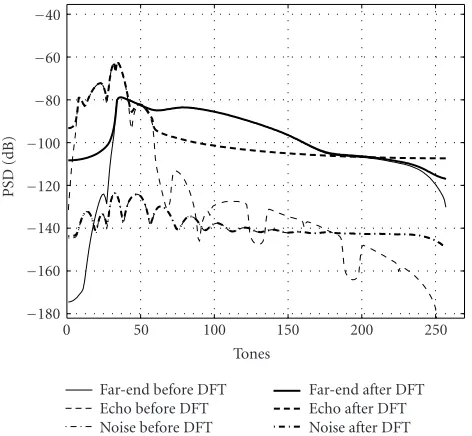
Figure2: Power spectral densities of received far-end signal, echo, and external noise before and after DFT demodulation for the CSA-1 standard loop.
T1 =2(T−2) (tone independent) andT2 =2 (tone
dependent).
For further details on these applications, we refer to the cor-responding papers.
5. SIMULATION RESULTS
The split SR-RLS scheme will be demonstrated by ADSL sim-ulations for the PTEQ/PTEC receiver structure. As a perfor-mance measure for the simulations, we will use the SNRifor toneiand the overall bit rate, according to the following for-mulas:
bit rate=
i=used tone
bi · Fs
N+ν,
bi=+log21 + 10((SNRi−Γ−γm+γc)/10) ,
,
(28)
wherebiis the number of bits assigned to tonei,Γis the SNR gap,γm the noise margin, andγc the coding gain. The SNR was calculated based on [9]. In our simulations the following values were used:N =512,ν=32,Γ=9.8 dB,γm =6 dB, γc=3 dB, andFs=2.208 MHz.
Simulations were performed on CSA standard loops (see e.g. [4]) with additive white Gaussian noise of−140 dBm/Hz and 24 DSL near-end crosstalk (NEXT) disturbers. For downstream transmission, the used tones range from 33 to 255, while upstream was simulated with tones 7 to 31.
Figure 2shows typical power spectral densities of the re-ceived far-end, echo, and channel noise signals before and af-ter DFT demodulation for the CSA-1 loop. The tone spacing is 4.3125 kHz. In this scenario, the upstream signal is
modu-250 200
150 100
50
Tones −30
−20 −10 0 10 20 30 40 50 60
SNR
(dB)
k=4000
k=1800
k=1200
k=600
k=200
k=9000 MMSE
Figure3: Evolution of the downstream SNR (CSA 1) during con-vergence for the split SR-RLS scheme withTEQ=16,TEC/κ=25,
λ = 0.997, andµ = 1. The upper curve indicates the maximal
achievable SNR obtained by the MMSE solution forwi.
lated by a 64-point IDFT which causes echo due to aliasing and DFT leakage at the downstream receiver (with a 512-point DFT, κ = 8). The PSD on the transmitted upstream and downstream tones are−38 dBm/Hz and−40 dBm/Hz, respectively. The echo and far-end channels include the transmission loop together with all the transmit and receive front end filters. Although the tones are “separated” in fre-quency, one can clearly see that all the tones at the receiver are affected by echo. Hence, echo canceling on all subcarriers is required.
Figure 3depicts the SNR evolution during convergence of the PTEQ/PTEC coefficients for the split SR-RLS scheme withTEQ = 16 andTEC/κ =25. The simulation was again
performed for a downstream CSA-1 loop. The training and echo sequence were constructed using 4-QAM modulation on all the tones. Notice that especially low and high tones have a relatively slow convergence due to the high ISI and ICI present in this region.
To illustrate the convergence rate of the split SR-RLS ver-sus the original SR-RLS, simulations were performed on sev-eral CSA loops for PTEQ/PTEC initialization. Downstream and upstream bit rates as a function of the number of train-ing symbols are depicted in Figures4and5, respectively. In the simulations, a 64-point DFT and IDFT and a 512-point DFT and IDFT were used for upstream and downstream transmission, respectively. During the firstTEQ+TEC
500 450 400 350 300 250 200 150 100 50 0
Iteration/20(symbols) 0
1 2 3 4 5 6 7 8 9×10
6
Bi
t
ra
te
(b
p
s)
SR-RLS
Modified SR-RLS CSA 7 CSA 3 CSA 1 CSA 5
Figure 4: Learning curves for the joint PTEQ and PTEC initial-ization using the original SR-RLS and split SR-RLS scheme. The
curves are simulated for downstreamCSA loops withTEQ = 16,
TEC/κ=25,λ=0.997, andµ=1.
6. CONCLUSIONS
In this paper, we have presented an efficient way to initial-ize the bank of per-tone equalinitial-izers and per-tone echo cancel-ers in a joint fashion. The proposed initialization algorithm is based on a modification of the full SR-RLS algorithm to obtain a convergence rate and complexity in between NLMS and full SR-RLS. We have shown that the method is con-vergent in the mean and provided an upper bound for the step size to be used. Finally, we briefly indicated how the pre-sented algorithm could be applied to other DSL applications as well.
APPENDICES
A. PROOF CONVERGENCE IN THE MEAN
OF THE SPLIT SR-RLS
We start by proving that the convergence of the split SR-RLS algorithm is determined by the cross correlation matrix be-tween the update directionl(k)and the input vectoru(k), that
is,Xlu=E{l(k)u(k)T}. Let
d(k)=u(k)Tw0+n(0k), (A.1)
wheren(0k)is the estimation error when applying the optimal
Wiener solutionw0. Now, define the weight error, using (18),
as
(k)=w(k)−w 0,
=w(k−1)+µl(k)d(k)−u(k)Tw(k−1)−w0
=IT−µl(k)u(k) T
(k−1)+
µl(k)·d(k)−u(k)Tw0
, (A.2)
500 450 400 350 300 250 200 150 100 50 0
Iteration/20(symbols) 0
1 2 3 4 5 6 7 8 9 10 11×10
5
Bi
t
ra
te
(b
p
s) SR-RLS Modified SR-RLS
CSA 5 CSA 3 CSA 1 CSA 7
Figure5: Learning curves for the joint PTEQ and PTEC initializa-tion using the original SR-RLS and split SR-RLS scheme. The curves are simulated forupstreamCSA loops withTEQ=40,TEC =200,
λ=0.999, andµ=1.
whereIT denotes the identity matrix of sizeT. With (A.1), this leads to
(k)=I
T−µl(k)u(k) T
(k−1)+µl(k)n(k)
0 . (A.3)
With the explicit definition ofl(k)=T(k)u(k)∗
, we have
(k)=I
T−µl(k)u(k) T
(k−1)+µT(k)u(k)∗
n(0k). (A.4)
Taking the statistical expectation of (A.4) yields
E-(k).=EI
T−µl(k)u(k) T
(k−1)
+µT(k)Eu(k)∗n(k) 0
,
(A.5)
where we assumed thatT(k)becomes independent of the time
index (which holds for stationary inputs andλ <1). This re-lation will hold approximately for a slowly time varyingT(k)
due to nonstationary inputs. Due to the orthogonality prin-ciple [14], the input vectoru(k)will be orthogonal to the
es-timation error when approaching the Wiener solution and hence zeroes the second term in (A.5). According to the tra-ditional “independence assumption” [14]—standardly ap-plied in LMS analyses—the input vectoru(k)is independent
of(k−1). Hence, we may write
E-(k).=I
T−µE
l(k)u(k)TE-(k−1).
=IT−µXlu
E-(k−1).. (A.6)
The unknowns w(k) converge to the optimal Wiener
solu-tion w0 whenE{(k)} = 0 orE{w(k)} = w0. This occurs
all eigenvalueszj,j=1,. . .,TofXlusatisfy
−1<1−µzj<1, (A.7)
convergence is assured. This relation is true when
0< µ < 2 zmax
, (A.8)
and allzj’s are positive. In the following section, we will de-rive an upper bound forµ.
B. UPPER BOUND FOR THE STEP SIZEµ
In the following, we will derive more specific upper and lower bounds for the step sizeµ. Withkapproaching infinity, one can state approximately
where the factor 1/(1−λ2) represents the effective window
length. The matrixXlucan now be written as
Xlu=E
where the following correlation matrix definitions were ap-plied:
Using the following relationship between determinants of block matrices,
the eigenvalues ofXluof (B.2) can easily be obtained as the Troots of the characteristic polynomial
Xlu−zIT= tiplicity T1−T2, where the remaining eigenvalues are
ob-tained as (1−λ2)(1±di) withdiequal to the eigenvalues of
the matrixX−1
22X21X−111X12. Due to the specific structure of
X−1
22X21X−111X12, one can prove that thedi’s represent in fact
the cosines squared of the principal angles [21] between the subspaces spanned by the columns of U(1k) andU
(k) 2 . Here,
U(1k) andU (k)
2 are matrices containing the first T1 and the
lastT2columns ofU(k)(see (8)), respectively. Hence, all the
di’s are always positive and less than or equal to one. As a consequence, the maximum eigenvaluezmaxofXluis upper bounded by 2(1−λ2).
Since convergence is assured when (A.8) is satisfied, we obtain the following restriction on the value for the step size,
0< µ < 1−1 λ2 ≤
2 zmax.
(B.6)
This equation indicates that in order for (18) to converge, the step size must be smaller than the effective number of samples in thememoryof the system,W=1/(1−λ2), where
λis the forgetting factor.
ACKNOWLEDGMENTS
This research work was carried out at the ESAT laboratory of the Katholieke Universiteit Leuven, in the frame of the Bel-gian State, Prime Minister’s Office, Federal Office for Scien-tific, Technical and Cultural Affairs, Interuniversity Poles of Attraction Programme (2002–2007), IUAP P5/22 and P5/11, the Concerted Research Action GOA-MEFISTO-666 of the Flemish Government, Research Project FWO nr. G.0295.97, and Research Project FWO nr.G.0196.02. The scientific re-sponsibility is assumed by its authors.
REFERENCES
[1] J. A. C. Bingham, “Multicarrier modulation for data
transmis-sion: an idea whose time has come,” IEEE Communications
Magazine, vol. 28, no. 5, pp. 5–14, 1990.
[2] S. B. Weinstein and P. M. Ebert, “Data transmission by
frequency-division multiplexing using the discrete Fourier transform,”IEEE Transactions on Communication Technology, vol. 19, no. 5, pp. 628–634, 1971.
[4] N. Al-Dhahir and J. M. Cioffi, “Optimum finite-length equal-ization for multicarrier transceivers,” IEEE Trans. Communi-cations, vol. 44, no. 1, pp. 56–64, 1996.
[5] P. J. W. Melsa, R. C. Younce, and C. E. Rohrs, “Impulse re-sponse shortening for discrete multitone transceivers,” IEEE Trans. Communications, vol. 44, no. 12, pp. 1662–1672, 1996. [6] T. Starr, J. M. Cioffi, and P. J. Silverman,Understanding Digital Subscriber Line Technology, Prentice-Hall, Upper Saddle River, NJ, USA, 1999.
[7] K. Vanbleu, G. Ysebaert, G. Cuypers, M. Moonen, and K. Van Acker, “Bitrate maximizing time-domain equalizer de-sign for DMT-based systems,” IEEE Trans. Communications, vol. 52, no. 6, pp. 781–786, 2004.
[8] K. Van Acker, Equalization and echo cancellation for DMT-based DSL modems, Ph.D. thesis, Katholieke Universiteit Leu-ven, LeuLeu-ven, Belgium, January 2001.
[9] K. Van Acker, G. Leus, M. Moonen, O. van de Wiel, and T. Pol-let, “Per tone equalization for DMT-based systems,” IEEE Trans. Communications, vol. 49, no. 1, pp. 109–119, 2001. [10] J. M. Cioffiand J. A. C. Bingham, “A data-driven multitone
echo canceller,”IEEE Trans. Communications, vol. 42, no. 10, pp. 2853–2869, 1994.
[11] M. Ho, J. M. Cioffi, and J. A. C. Bingham, “Discrete multitone echo cancellation,” IEEE Trans. Communications, vol. 44, no. 7, pp. 817–825, 1996.
[12] D. C. Jones, “Frequency domain echo cancellation for discrete multitone asymmetric digital subscriber line transceivers,”
IEEE Trans. Communications, vol. 43, no. 2/3/4, pp. 1663– 1672, 1995.
[13] K. Van Acker, M. Moonen, and T. Pollet, “Per tone
echo cancellation for DMT-based systems,” in Proc. IEEE
Int. Conf. Acoustics, Speech, Signal Processing, vol. 4, pp. 2365– 2368, Salt Lake City, Utah, USA, May 2001.
[14] S. Haykin,Adaptive Filter Theory, Prentice Hall, Upper Saddle River, NJ, USA, 3rd edition, 1996.
[15] B. Widrow and M. E. Hoff, “Adaptive switching circuits,” inInstitute of Radio Engineers Convention Record at the West-ern Electric Show and Convention, pp. 96–104, New York, NY, USA, August 1960.
[16] M.-L. Alberi, R. A. Casas, I. Fijalkow, and C. R. Johnson Jr., “Looping LMS versus fast least squares algorithms: who gets there first?,” inProc. 2nd IEEE Workshop on Signal Processing Advances in Wireless Communications, pp. 296–299, Annapo-lis, Md, USA, May 1999.
[17] S. S. Narayan, A. M. Peterson, and M. J. Narasimha, “Trans-form domain LMS algorithm,” IEEE Trans. Acoustics, Speech, and Signal Processing, vol. 31, no. 3, pp. 609–615, 1983. [18] J. J. Shynk, “Frequency-domain and multirate adaptive
filter-ing,”IEEE Signal Processing Magazine, vol. 9, no. 1, pp. 14–37, 1992.
[19] J. M. Cioffi and T. Kailath, “Fast, recursive-least-squares transversal filters for adaptive filtering,” IEEE Trans. Acous-tics, Speech, and Signal Processing, vol. 32, no. 2, pp. 304–337, 1984.
[20] A.-Y. Wu and K. J. R. Liu, “Split recursive least-squares: algo-rithms, architectures, and applications,” IEEE Trans. on Cir-cuits and Systems II: Analog and Digital Signal Processing, vol. 43, no. 9, pp. 645–658, 1996.
[21] G. H. Golub and C. F. Van Loan, Matrix Computations, The Johns Hopkins University Press, Baltimore, Md, USA, 3rd edi-tion, 1996.
[22] C. T. Pan and R. J. Plemmons, “Least squares modifications with inverse factorizations: Parallel implications,” J. Comput. Appl. Math., vol. 27, no. 1-2, pp. 109–127, 1989.
[23] K. Van Acker, G. Leus, M. Moonen, and T. Pollet, “RLS-based initialization for per tone equalizers in DMT-receivers,” inProc. European Signal Processing Conference, Tampere, Fin-land, September 2000.
[24] G. Ysebaert, M. Moonen, and T. Pollet, “Combined RLS-LMS initialization for per tone equalizers in DMT-receivers,” in
Proc. IEEE Int. Conf. Acoustics, Speech, Signal Processing, vol. 3, pp. 2537–2540, Orlando, Fla, USA, May 2002.
[25] G. Ysebaert, K. Vanbleu, G. Cuypers, M. Moonen, and T. Pol-let, “Combined RLS-LMS initialization for per tone equalizers in DMT-receivers,” IEEE Trans. Signal Processing, vol. 51, no. 7, pp. 1916–1927, 2003.
[26] G. Cuypers, G. Ysebaert, M. Moonen, and P. Vandaele, “Com-bining per tone equalization and windowing in DMT re-ceivers,” inProc. IEEE Int. Conf. Acoustics, Speech, Signal Pro-cessing, vol. 3, pp. 2341–2344, Orlando, Fla, USA, May 2002. [27] G. Cuypers, K. Vanbleu, G. Ysebaert, M. Moonen, and P.
Van-daele, “Combining raised cosine windowing and per tone equalization for RFI mitigation in DMT receivers,” inProc. IEEE International Conference on Communications, vol. 4, pp. 2852–2856, Anchorage, Alaska, USA, May 2003.
[28] K. Vanbleu, G. Ysebaert, M. Moonen, and P. Vandaele, “Com-bined equalization and alien crosstalk cancellation in ADSL receivers,” in Proc. European Signal Processing Conference, Toulouse, France, September 2002.
Geert Ysebaertwas born in Leuven, Bel-gium, in 1976. He received the Master’s and the Ph.D. degrees in electrical engineer-ing from the Katholieke Universiteit Leuven (KULeuven), Leuven, Belgium, in 1999 and 2004, respectively. From 1999 till 2003, he was supported by the Flemish Institute for Scientific and Technological Research in In-dustry (IWT). His research interests are in the area of digital signal processing for DSL communications.
Koen Vanbleuwas born in Bonheiden, Bel-gium, in 1976. In 1999, he received the Mas-ter’s degree in electrical engineering from the Katholieke Universiteit Leuven (KULeu-ven), Leuven, Belgium. Currently, he is pur-suing the Ph.D. degree as a research assis-tent at the SCD laboratory of the Depart-ment of Electrical Engineering (ESAT), Leu-ven, Belgium. From 1999 till 2003, he was supported by the Fonds voor
Wetenschap-pelijk Onderzoek (FWO) Vlaanderen. He is working in the field of digital signal processing for telecommunication applications under the supervision of Marc Moonen.
Gert Cuypers was born in Leuven, Bel-gium, in 1975. In 1998, he received the Mas-ter’s degree in electrical engineering from the Katholieke Universiteit Leuven (KULeu-ven), Leuven, Belgium. He is currently pur-suing the Ph.D. degree at the Department of Electrical Engineering (ESAT), Leuven, Bel-gium, under the supervision of Marc Moo-nen. From 1999 till 2003, he was supported by the Flemish Institute for Scientific and
Marc Moonenreceived the Electrical Engi-neering degree and the Ph.D. degree in ap-plied sciences from the Katholieke Univer-siteit Leuven, Leuven, Belgium, in 1986 and 1990, respectively. Since 2004, he is a Full Professor at the Electrical Engineering De-partment of Katholieke Universiteit Leuven, where he is currently heading a research team of 16 Ph.D. candidates and postdocs, working in the area of signal processing for