Coding Across Multicodes and Time in CDMA Systems
Employing MMSE Multiuser Detector
Jeongsoon Park
School of Electrical and Computer Engineering, Purdue University, West Lafayette, IN 47907, USA Email:[email protected]
Jong-Han Lim
Samsung Electronics, 416 Maetan 3-dong, Paldal-gu, Suwon-si, South Korea 442-742 Email:[email protected]
Saul B. Gelfand
School of Electrical and Computer Engineering, Purdue University, West Lafayette, IN 47907, USA Email:[email protected]
Received 1 November 2003; Revised 23 March 2004
When combining a multicode CDMA system with convolutional coding, two methods have been considered in the literature. In one method, coding is across time in each multicode channel while in the other the coding is across both multicodes and time. In this paper, a performance/complexity analysis of decoding metrics and trellis structures for the two schemes is carried out. It is shown that the latter scheme can exploit the multicode diversity inherent in convolutionally coded direct sequence code division multiple access (DS-CDMA) systems which employ minimum mean squared error (MMSE) multiuser detectors. In particular, when the MMSE detector provides sufficiently different signal-to-interference ratios (SIRs) for the multicode channels, coding across multicodes and time can obtain significant performance gain over coding across time, with nearly the same decoding complexity.
Keywords and phrases:multicode CDMA, MMSE detector, multicode diversity.
1. INTRODUCTION
In third generation code division multiple access (CDMA) systems, multimedia data transmission needs to support variable data rates. Multicode CDMA is one method to do this, the basic idea of which is to allocate more spreading codes to users with higher data rates [1].
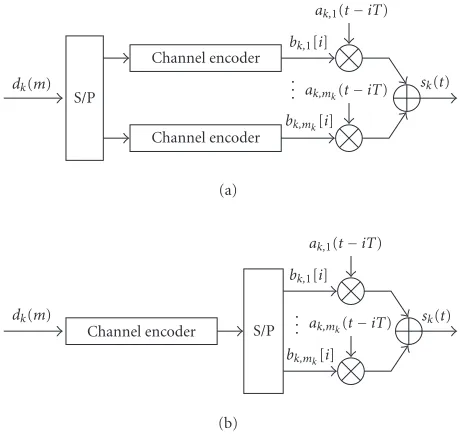
There are two methods which have been suggested to combine a multicode CDMA system with convolutional cod-ing. In one approach, a serial-to-parallel (S/P) conversion precedes the convolutional coding [2], while in the other ap-proach the S/P conversion follows the convolutional coding [3]. When S/P conversion precedes convolutional coding, the coding is only across time in each multicode channel, while when the order is reversed, the coding is across both multi-codes and time.The latter approach has also been applied to multicarrier CDMA systems [4] and multiantenna CDMA systems [5]. These systems assume that the temporal diver-sity associated with convolutional coding is fully exploited by interleaving. The case where the fading is slow and the
de-lay constraints do not allow the adoption of an interleaver is considered in [5], where instead spatial diversity for the coded symbols is provided by the transmit antenna. None of these methods employ multiuser detection, which may be additionally required to get the desired performance.
over all multicodes is dominated by the worst multicode SIR. However, when coding across multicodes and time (CMT) is used, each convolutionally coded symbol is transmitted over several multicodes with different SIRs, and it is shown that the average coded performance over all the multicodes is re-lated to the average multicode SIR. Thus, the diversity inher-ent in multicodes at the MMSE multiuser detector output can be exploited with CMT.
We develop and analyze maximum-likelihood (ML) de-coding for both CMT and CT in multicode CDMA systems. For CMT, the optimal decoding metric is rather complex. To reduce the complexity, three suboptimal decoding metrics are also considered, including one which has the same com-plexity as CT (we call this latter metric the “conventional” one in that it ignores the correlation due to multicoding and decodes the convolutional coding in a conventional way). In CMT, for metrics other than the conventional one, there ex-ist both time-invariant and time-varying trellis representa-tions. The time-invariant trellis is useful for analysis, while the time-varying trellises can significantly reduce the decod-ing complexity dependdecod-ing upon the number of multicodes and the code rate.
To find a true upper bound on the user bit error rate (BER) for the ML and suboptimal decoding, the Laplace transform method can be combined with the transfer func-tion method [8]. But using the residue method for the evalu-ation of the Laplace integral results in computevalu-ationally com-plex symbolic operation to evaluate the transfer function. However, if the Gauss-Chebyshev quadrature rule is used for numerical integration, each pairwise error probability (PEP) can be expressed in a product form and the transfer function method can be applied. This is the approach taken in this pa-per.
The paper is organized as follows. InSection 2, the sys-tem model is presented. InSection 3, decoding metrics and trellises for CMT are proposed, and inSection 4a theoretical upper bound on BER for each metric is derived. Simulation results are provided inSection 5and some conclusions and future work are discussed inSection 6.
2. SYSTEM MODELS
The transmitter block diagram of a multicode CDMA system with CT and CMT for desired user kis shown inFigure 1, and the corresponding receiver block diagrams are shown in Figure 2. The mth information bit for userk is dk[m]. Let 1/Tkdenote the information bit rate,mkthe number of mul-ticodes, andRk the code rate, for userk. Theith coded bit of multicode j for user k is ck,j[i] ∈ {0, 1}, and the cor-responding binary code symbol isbk,j[i] = 2ck,j[i]−1 ∈
{+1,−1}.
The code symbol rate for each multicode channel of user
kis 1/mkTkRk. For the purpose of designing and implement-ing the MMSE multiuser detector, it is simplest to require that these code symbol rates are the same for all users, that is, 1/mkTkRk = 1/T for someT. A special case of this oc-curs when the user information bit rates are all integral mul-tiples of the lowest bit rate 1/Tb=1/maxkTk, and the
multi-dk(m)
S/P
Channel encoder bk,1 [i]
ak,1(t−iT)
sk(t)
Channel encoder bk,mk [i]
ak,mk(t−iT) .
. .
(a)
dk(m)
S/P
bk,1[i]
ak,1(t−iT)
sk(t)
Channel encoder
bk,mk[i]
ak,mk(t−iT) .
. .
(b)
Figure1: Transmitter of desired userk. (a) Coding across time, (b) coding across multicodes and time.
codes are assigned such thatmk =Tb/Tk and all users em-ploy the same rate 1/n convolutional code (CC). For ease of presentation we will assume this case in the sequel. (A more general but similarly treated situation is the case when
mk = Tb/Tk for some users k ∈ A and all other users are assignedmj = Tb/Tj multicodes for j /∈ A. Each user
j /∈ A employs the same rate 1/n CC. The code rate Rk,
k ∈ A, becomesTb/Tkmkn and the integermk ≥ 1 must satisfy mk > Tb/Tkn to make Tb/Tkmkn a realizable CC rate which should be less than 1.) Note that the process-ing gains of CT and CMT are equal when the chip rates of the spreading waveforms of the two systems are equal. How-ever, the encoder and decoder of CMT requires mk times faster processing speed at both the encoder and decoder than CT.
In CDMA systems, the transmitted signal for userkis
sk(t)= mk
j=1 i=∞
i=−∞
Ak,jbk,j[i]ak,j(t−iT), (1)
whereAk,j is the received signal amplitude of thejth multi-code of thekth user, andak,j(t) is the normalized spreading waveform of the jth multicode of thekth user with support in [0,T]. The spreading waveformak,j(t) is
ak,j(t)= N−1
m=0
pk,j[m]ψ
t−mTc
, (2)
where pk,j[m] ∈ {+1/
√
a1,1(−(t−iT)) (i+ 1)T
rk,1[i]
Channel decoder
r(t) MMSE
detector P/S
ak,mk(−(t−iT)) (i+ 1)T
rk,mk[i]
Channel decoder
dk(m)
. . .
. . .
(a)
a1,1(−(t−iT)) (i+ 1)T
rk,1[i]
r(t) MMSE
detector P/S Channel decoder
ak,mk(−(t−iT)) (i+ 1)T
rk,mk[i]
dk(m)
. . .
. . .
(b)
Figure2: Receiver of desired userk. (a) Coding across time, (b) coding across multicodes and time.
the normalized rectangular chip waveform with support in [0,Tc],
Tc
0 ψ2(t)dt=1.
The received signal in a downlink CDMA additive white Gaussian noise (AWGN) channel is
r(t)=
K
k=1
sk(t) +n(t), (3)
wheren(t) is (real) white Gaussian noise with power spectral densityσ2, andKis the number of active users. The matched
filter output of multicode jof userkin theith code symbol interval is
yk,j[i]= (i+1)T
iT ak,j(t−iT)r(t)dt. (4)
The vectoryi=[y1,1[i],. . .,y1,m1[i],y2,1[i],. . .,yK,mK[i]]T is
given by [6]
yi=RAbi+ni, (5)
whereRis the crosscorrelation matrix
(R)k−1
p=1mp+j,
l−1
p=1mp+m=
T
0 ak,j(t)al,m(t)dt, (6)
A =diag{A1,1,. . .,A1,m1,A2,1,. . .,AK,mK}, andbi =[b1,1[i], . . .,b1,m1[i],b2,1[i],. . .,bK,mK[i]]T. The covariance matrix
of the Gaussian noise vector ni = [n1,1[i],. . .,n1,m1[i], n2,1[i],. . .,nK,mK[i]]Tisσ2Rand{ni}is i.i.d.
Since we do not employ an interleaver in our system,{bi} is a correlated sequence due to the convolutional coding. Fur-thermore, for CMT (but not CT) the components ofbi asso-ciated with the same user but different multicodes are corre-lated for the same reason. However, the correlation between code symbols becomes smaller as the constraint length gets larger. We will assume thatbk,j[i] andbk,j[i] are indepen-dent for i = ior j = j. Our simulations show this to be a good approximation with rate 1/2 or 1/3 codes and con-straint length greater than or equal to 5. This approximation is employed in the design of the MMSE detector below, and to design and analyze the decoding metrics in Sections3and 4.
The MMSE detector output for multicode j of desired userkin theith symbol interval isrk,j[i]=ωTk,jyi, where [6]
ωk,j=
R+σ2A−2−1e
k,j, (7)
andek,jis the vector whose elements are all zeros except for the (k−p=11mp+j)th element which is 1. Thus the MMSE de-tector for allKp=1mpmulticodes can be expressed as
M=ω1,1,. . .,ωk,mk,. . .,ωK,mK =
R+σ2A−2−1. (8)
3. DECODING METRICS AND TRELLISES
For both CT and CMT, the decoder input of desired user
k is given by {(rki)T}∞
i=−∞, where rki = [rk,1[i],rk,2[i], . . .,rk,mk[i]]T. However, for CT mk decoders are required and the input of each decoder with index j = 1,. . .,mk is
rk,2[i],. . .,rk,mk[i],rk,1[i+ 1],. . .}.rki can be expressed as
Ikismk×mkidentity matrix andrepresents elementwise product of two matrices. The covariance matrix of ˆnki isσ2R˜k where ( ˜Rk)
j,l=ωTk,jRωk,l,j=1,. . .,mk,l=1,. . .,mk. In CT, thekth user employsmk encoders and the trellis stage indextjforjth encoder is related to the input bit index
mbytj(m)= (m−1)/m
k + 1 andm(tj)=(tj−1)mk+j,
j =1,. . .,mk. Assumingiki and ¯iki are well approximated as Gaussian [6], the branch metric corresponding to the tjth transition reduces to
In CMT,mkcode symbols are aligned at the same symbol interval and their MMSE detector outputs are correlated with each other. The covariance matrix ¯Φkof ¯ik
i is given by ¯Φk = ¯ˆ
RkA¯k( ¯Ak)T( ¯ˆRk)Tand that of ˆnk
i isσ2R˜k. Assuming ¯iki is well-approximated as Gaussian, the branch metric corresponding to thetth transition is given by
µkt,1=
whereitand ¯itdepend on the choice of decoding trellis dis-cussed in the sequel.
To reduce the complexity, suboptimal metrics are con-sidered. If the Viterbi decoder does not consideriki, the cor-responding suboptimal metric is given by
µkt,2= sponding suboptimal metric is given by
µkt,3=
Finally, the suboptimal metric
µkt,4=
corresponds to both of the above simplifications and is just the conventional decoding metric for vector observations in additive white Gaussian multiple access interference and (in-dependent) AWGN.
We first consider the time-invariant trellis for CMT. In the time-invariant trellis, one transition corresponds to ˜m=
LCM(n,mk)/ntransitions in the code trellis and any combi-nation of mk andncan be treated. For the time-invariant trellis we have it = i˜(t−1) + 1 and ¯it = it˜, where ˜i = LCM(n,mk)/mkin the branch metrics above. The case where
nis divisible bymkcorresponds to a special case of this time-invariant trellis with ˜m=1, ˜i=n/mk. Here a transition oc-curs at each information bit input and the state transitions are equivalent to those of the CC. In this case we say thatmk
andnare matched. If we define the decoding complexity as the number of visited branches per decoded bit, the decod-ing complexity of the CC is 2ν+1, whereνis the memory of
the CC. The decoding complexity of the time-invariant trel-lis is that of the CC multiplied by 2m−˜ 1/m˜, when we employ
metrics other than that in (15) (if the conventional metric (15) is used, the decoding complexity is equal to that of the CC regardless of ˜m).
Mismatched cases ofmkandncan be dealt with using the time-invariant-trellis approach. But with a time-invariant trellis we have to search over 2m˜ branches at each state for
each transition, and for somemkandnthis complexity can be prohibitive. However, if we design the trellis so that a tran-sition occurs for information input bits corresponding to an appropriate number of observation vectors of the decoder depending onmkandn, it turns out that the decoding com-plexity can be significantly reduced. But because of the mis-match ofmkandn, the trellis becomes time varying.
interference with each other at each CC state transition. When mk and n are matched, ¯m = 1 which reduces to the case of CC. When mk < n and n is not divisible by
mk, ¯m = 2 because multicode interference can affect code symbols corresponding to two transitions in the code trel-lis. When mk > n and (mk −nmk/n ) = GCD(n,mk),
¯
m = mk/n +1{(mk−nmk/n )≥1}. Whenmk > n and (mk−
nmk/n )=GCD(n,mk), ¯m= mk/n +1{(mk−nmk/n )≥1}+ 1{(mk−nmk/n )≥2}. In the following time-varying trellis discus-sion, we are interested in mismatch ofmkandn, that is, when
¯
m ≥ 2, and we consider both fixed and variable state aug-mentation approaches corresponding to whether the CMT trellis obtained by augmenting the input bits and/or state in the CC trellis varies from one transition to another (in ad-dition to the number and/or structure of the CMT branch metrics).
We first consider fixed state augmentation time-varying trellises.
(i) Whenmk < n andnis not divisible bymk, the CC state is augmented by 1 bit, but the number of infor-mation input bits per transition is kept equal to one. For this fixed state augmentation time-varying trellis, ¯
it = maxi(imk ≤ tn) andit = ¯i(t−1) + 1 in the branch metrics in (12), (13), (14), and (15). The com-putational complexity of the fixed state augmentation time-varying trellis decoding is that of the CC multi-plied by 21. Ifnis divisible bym
kthen the CMT trellis is just the CC trellis.
(ii) Whenmk> n, for some transitions more than one in-put bit is required and there is no simple fixed state augmentation time-varying trellis. It is possible to modify the variable state augmentation time-varying trellis, below to enforce a fixed state augmentation, but such an approach has no advantage either intuitively or computationally so we do not elaborate on it here.
Next we consider variable state augmentation time-varying trellises:
(i) When mk < n and n is not divisible bymk, at the
tth transition, if (t−1)nis not divisible by mk, the CC state is augmented by 1 bit and otherwise it is not augmented. The number of information input bits at thetth transition is one if (t−1)nis not divisible by
mk and is two otherwise. For this variable state aug-mentation time-varying trellis, ¯it = (xt + 1)n/mk and it = (xt −1)n/mk + 1 when (t −1) is divis-ible by ( ˜m−1) and otherwise ¯it = ytn/mk and
it= (yt−1)n/mk +1, wherext=(t−1)/( ˜m−1)·m˜+1 andyt=t+(t−1)/( ˜m−1) + 1 in the branch met-rics in (12), (13), (14), and (15). The computational complexity of the variable state augmentation time-varying trellis decoding is that of the CC multiplied by 2·( ˜m−1)/m˜, which is always less than the factor of 2 for the fixed state augmentation time-varying trel-lis decoding. When ˜m=2, the variable state augmen-tation time-varying trellis reduces to a time-invariant trellis with the same decoding complexity as CC. Ifn
TI Fixed TV Variable TV 100
101 102
R
elati
ve
co
mple
xit
y
2 4
6 8
10
n
2 4 6 8 10
mk
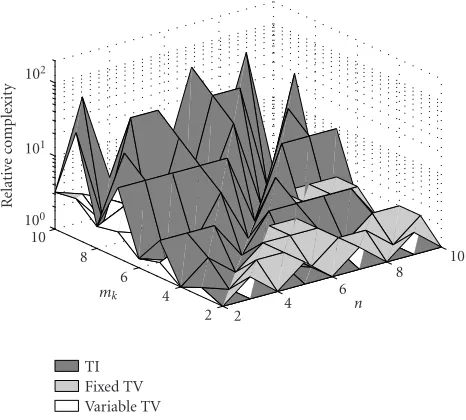
Figure 3: Complexity comparisons of invariant and time-varying trellises.
is divisible bymk, then the CMT trellis is just the CC trellis.
(ii) When mk > n and mk is not divisible by n, at the
tth transition, if (t−1)mk is not divisible by n, the CC state is augmented by 1 bit and otherwise it is not augmented. The number of information input bits at thetth transition is given bytmk/n − (t−1)mk/n. For this variable state augmentation time-varying trel-lis, ¯it = it = tin the branch metrics in (12), (13), (14), and (15). The computational complexity of the variable state augmentation time varying trellis decod-ing is upper bounded by that of the CC multiplied by 2m−¯ 1/m˜ ·i˜. Ifm
kis divisible bynthen the CMT trellis is justmk/ntransitions in the CC trellis.
Time varying trellises were considered above based on the feedforward convolutional encoder. However, we can also develop time varying trellises with a recursive systematic convolutional code (RSCC). With RSCC, the information bit vector input can be dealt with because we know the primi-tive state transition in the code trellis. We can also treat the augmented state in RSCC.
The complexity relative to the CC complexity of time-invariant and two time-varying trellises are shown in Figure 3for eachnandmk. “TI” denotes time-invariant trel-lis, “TV, fixed” time-varying trellis with fixed state augmen-tation and “TV, variable” time varying trellis with variable state augmentation.
4. PERFORMANCE ANALYSIS
4.1. Numerical approach
quadrature rule is employed. We will focus on the analysis of CMT in this section, since the analysis of CT is simpler and conventional.
The optimal metric in (12) considers interference among multicode symbols iki, and correlation of ¯iki andnki for the same multicode symbols. If ik
i and/or the correlation of ¯iki andnk
i are disregarded in the Viterbi decoder, it corresponds to employing one of the suboptimal metrics in (13), (14), and (15). The Viterbi decoder using the metric in (13) isiki -mismatched, and that using the metric in (14) is (¯iki +nki )-mismatched. The metric in (15) is bothiki- and (¯iki +nki )-mismatched.
The evaluation of the PEP for a mismatched Viterbi de-coder was analyzed in [9] but a true upper bound for BER using the transfer function method was not treated there. This problem was considered recently in [10] and the follow-ing derivation is based on the results in [10]. For the anal-ysis, we employ the time-invariant trellis. We evaluate the PEP,P(bk,c → bk,i) of choosing the incorrect code symbol sequence bk,i whenbk,c was transmitted. LetM denote the length of the error event.
For the analysis of the Viterbi decoder employing the metrics in (12) and (13),
Uk
and for the metrics in (14) and (15), let
Uk
where for the iki-matched Viterbi decoder employing met-rics in (12) and (14), dkt,,jc = RˆkAkbk(t−,c1)˜i+j and d
and for the metrics in (14) and (15) is
ΦUk(λ)=E
for positive real constant c. By using the Gauss-Chebyshev rule, it can be obtained as [11]
Pbk,c−→bk,i product form and can find the union bound on BER by applying the transfer function method. Since uniformity does not hold for CMT, the transfer function bound is computed based on matrix branch labels instead of scalar branch labels. Let Nsbe the number of states of the time-invariant trellis, which is 2ν, equal to that of CC. Let e
be the error code vector ck,c(i,j) ⊕ ck,i(i,j), where ck,c and ck,i are correct and incorrect output code bits corre-sponding to the transition from state j to state i, respec-tively. Letck,l,c(i,j)=[(ck,c(i,j))
(l−1)mk+1,. . ., (ck,c(i,j))lmk]T,
ck,l,i(i,j)=[(ck,i(i,j))
let theNs×NsmatrixGλ(e) be defined by
Gλ(e)
i+1,j+1
=0, if no transition is possible,
= 1
nisn×1 vector whose elements are all ones. Similarly, for metrics (14) and (15), let Gλ(e) be
Gλ(e)
i+1,j+1
=0, if no transition is possible,
= 1 to the transition from error state j to error statei. The first error event probability (FEEP) is bounded by
FEEP≤ 1 ated by calculating residues of Tλ/λ. This requires the in-verse of the symbolic matrix in (24) and as the state num-ber of the trellis grows, it is infeasible to compute due to numerical problems. The Gauss-Chebyshev quadrature rule allows us to avoid numerical problems associated with the symbolic operation. When evaluating BER, the number of bits for each transition should be considered in the transfer function. In this case, we employ the first-order difference method in [12], avoiding the symbolic operation.
4.2. SIR-based approach
InSection 4.1, we presented a method to compute a tight up-per bound for both CT and CMT numerically and the re-sults are in good agreement with the simulation rere-sults (see Section 4). However, it does not explain qualitatively under what conditions CMT performs better than CT. Here, we present another method which can give some insight.
According to [6], the residual interference at the MMSE detector output is well approximated as Gaussian distributed and the probability of error of multicode jof userkat the MMSE detector output is given byPek,j=Q(
We use the decoding metrics in (11) for CT. In CMT, we assume thatE[(nki + ¯iki +iki)(nki + ¯iki +iki)T]≈(σ2R˜k+ ¯Φk+
Φk)I
Φk=Rˆk−RˆkI other. Hence for CMT, we use the decoding metric
µkt,5=
and we see that decoding can be done in the code trellis with this metric.
We assume that a uniform interleaver with interleaver sizeNi[13] is employed at the encoder output. The effect of the uniform interleaver is to make the SIR difference on each multicode channel disappear and hence uniformity holds for CMT. Thus, we can evaluate the union bound on BER by considering only the all-zero path as a reference path.
Consider an error event of lengthMand Hamming dis-tancedfrom the all-zero path in the time-invariant trellis. If
Ni=Mmn˜ , the uniform interleaver maps a given codeword with d“1” bits into Niddistinct permutations with equal probability 1/Nid. For each permutation index p, the set of indices of “1” bits in the trellis diagram isIp. Then the SIR resulting from the comparison of two paths of Hamming dis-tancedin CMT is given by where lis the coded bit index in the trellis, since Ni is an integer multiple ofmk. Hence the PEP of the path of distance
din CMT is obtained as
Pk
In CT, the PEP of the path of distancedis given by
P1,kp(d)=
when it is averaged over multicodes.
Proposition 1. Pk
2,p(d)≤Pk1,p(d)with equality if and only if
creasing function. Since Q(x) is also a convex function for
x > 0,Q(mkj=1(1/mk) by Jensen’s inequality. The proposition follows.
From the proposition, we can assert that CMT works bet-ter than CT. Furthermore, as SIRk,j, j =1,. . .,mk, become more different, the advantage of CMT over CT gets larger. The PEP of CMT in this section provides optimistic perfor-mance since it is assumed that the elements of random vec-tor (nki+ ¯iki+iki) are uncorrelated. However, the analysis gives some intuition where the multicode diversity comes from.
Next we comment on when the MMSE detector (8) ac-tually provides different SIRs in (29). Note thatRis a sym-metric matrix with all diagonal terms equal to 1. As an ex-treme case, if allAk,j are equal and all off-diagonal terms of R are equal, all off-diagonal terms ofMalso become equal and equality of all SIRk,j follows. Generally, the variation of crosscorrelations of two spreading codes increases when they are not synchronized. In ISI channels, when we consider the effective signature waveform of each user, the variation of crosscorrelations can be significant because the spreading codes are not synchronized in the effective signature wave-form’s crosscorrelation.
5. SIMULATION RESULTS
Computer simulations have been done for a BPSK system. Signature sequences with processing gainN=15 were gen-erated randomly and fixed.1 The code rates of CCs were
1/n = 1/2, 1/3, and 1/4, and the constraint length L is set to 5. The generator matrix is23 35 ,25 33 37 , and
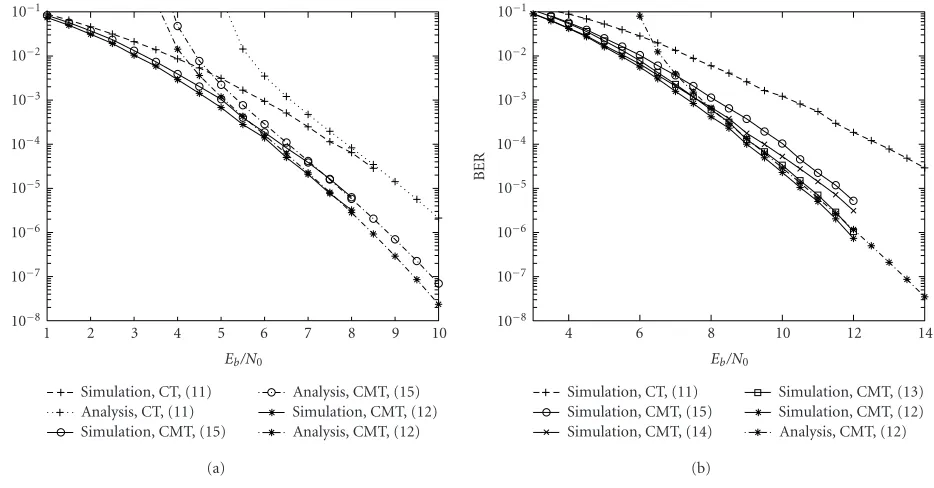
25 27 33 37 for rates 1/2, 1/3, and 1/4 codes, respec-tively, and the decoding delay is 6L. The cases where the de-sired userkhas two, three, or four times faster information bit rates than others and all other users have the same data rates are considered. Thus, mk = 2, 3, or 4, and mj = 1 the figures andTable 1, we see that when uncoded BERs of multicode channels at the MMSE detector output are simi-lar, the performance improvement of CMT compared with CT is negligible; however, when the performances of multi-code channels at MMSE detector output are very different, the performance gain of CMT over CT becomes significant. Also, the simulated BER of the MMSE detector is in good agreement with analytical BER. Simulation results of mis-matchedmk andnare shown in Figures6and7and have similar behavior.
Simulation, channel 3 Analysis, channel 3 Simulation, channel 4 Analysis, channel 4
Simulation, channel 5 Analysis, channel 5 Simulation, channel 6 Analysis, channel 6 100
10−1
10−2
10−3
10−4
BER
4 6 8 10 12 14
Eb/N0
Figure4: MMSE detector (uncoded) BER for CDMA channels 3, 4, 5, and 6,C=15,N=15.
Simulation, CT, (11) Simulation, CMT, (15) Simulation, CMT, (12) Analysis, CMT, (12) 10−1
10−2 10−3 10−4 10−5 10−6 10−7 10−8
BER
4 6 8 10 12 14
Eb/N0
(a)
Simulation, CT, (11) Analysis, CT, (11) Simulation, CMT, (15)
Analysis, CMT, (15) Simulation, CMT, (12) Analysis, CMT, (12) 10−1
10−2 10−3 10−4 10−5 10−6 10−7 10−8
BER
4 6 8 10 12
Eb/N0
(b)
Figure5: (a) Coded BER,K=14,mk=2,n=2,ck,1=3, andck,2=4. (b) Coded BER,K=14,mk=2, andn=2,ck,1=5, andck,2=6.
Table1: Comparison of CT and CMT whenn=2 andmk=2 (10 dB SNR).
ck,1=3 ck,2=4 ck,1=5 ck,2=6
Uncoded BER 0.0702 0.0459 0.0610 0.0126
SIR 2.1874 2.8390 2.3873 4.9950
CT (11) 3.38×10⁻⁴ 1.28×10⁻⁴
CMT (15) 1.67×10⁻⁴ 1.68×10⁻⁵
CMT (14) 1.29×10⁻⁴ 1.23×10⁻⁵
CMT (13) 1.40×10⁻⁴ 7.59×10⁻⁶
Simulation, CT, (11) Analysis, CT, (11) Simulation, CMT, (15)
Analysis, CMT, (15) Simulation, CMT, (12) Analysis, CMT, (12) 10−1
10−2 10−3 10−4 10−5 10−6 10−7 10−8
BER
1 2 3 4 5 6 7 8 9 10
Eb/N0
(a)
Simulation, CT, (11) Simulation, CMT, (15) Simulation, CMT, (14)
Simulation, CMT, (13) Simulation, CMT, (12) Analysis, CMT, (12) 10−1
10−2 10−3 10−4 10−5 10−6 10−7 10−8
BER
4 6 8 10 12 14
Eb/N0
(b)
Figure6: (a) Coded BER,K=14,mk=2,n=4,ck,1=5, andck,2=6. (b) Coded BER,K=13,mk=3,n=2,ck,1=5,ck,2=6,ck,3=7.
Simulation, CT, (11) Simulation, CMT, (15) Simulation, CMT, (14)
Simulation, CMT, (13) Simulation, CMT, (12) Analysis, CMT, (12) 10−1
10−2 10−3 10−4 10−5 10−6 10−7 10−8
BER
4 6 8 10 12 14
Eb/N0
(a)
Simulation, CT, (11) Analysis, CT, (11) Simulation, CMT, (15)
Analysis, CMT, (15) Simulation, CMT, (12) Analysis, CMT, (12) 10−2
10−4
10−6
10−8
BER
2 4 6 8 10
Eb/N0
(b)
Figure7: (a) Coded BER,K=12,mk=4,n=2,ck,1=5,ck,2=6,ck,3=7, andck,4=7. (b) Coded BER,K=14,mk=2,n=3,ck,1=5, ck,2=6, andck,3=7.
To examine the effect of crosscorrelation on the perfor-mance of CMT, the crosscorrelation
R=
1.0 0.2 0.3 0.2 1.0 ρ
0.3 ρ 1.0
(33)
CT CMT 100
10−1
10−2
10−3
10−4
BER
0 0.2 0.4 0.6 0.8
ρ
Figure8: Coded BER for 0≤ρ≤0.95,K =2,m1 =2,m2 =1, C=3,c1,1=1,c1,2=2 (3 dB SNR).
6. CONCLUSION
In this paper, we investigated two coding schemes combined with MMSE multiuser detection in multicode CDMA sys-tems. Four metrics for CMT were considered along with different decoding trellises. Time invariant-trellises are em-ployed for the analysis, and to reduce decoding complexity, time-varying trellises are used.
CMT generally provides better performance than CT with all four metrics. As the variation of SIRs among the multicodes increases at the MMSE detector output, the gain of CMT over CT becomes more significant. The Gauss-Chebyshev quadrature rule yielded a tight upper bound on BER using transfer function method. An SIR-based method provides insight into where the multicode diversity comes from.
ACKNOWLEDGMENT
This work is supported in part by NSF Grant CCR-1109580.
REFERENCES
[1] M. Zeng, A. Annamalai, and V. K. Bhargava, “Recent advances in cellular wireless communications,” IEEE Communications Magazine, vol. 37, no. 9, pp. 128–138, 1999.
[2] C.-L. I, C. A. Webb III, H. C. Huang, S. T. Brink, S. Nanda, and R. D. Gitlin, “Is-95 enhancements for multimedia services,”
Bell Labs Technical Journal, vol. 1, no. 2, pp. 60–87, 1996. [3] F. Adachi, M. Sawahashi, and H. Suda, “Wideband DS-CDMA
for next generation mobile communication systems,” IEEE Communications Magazine, vol. 36, no. 9, pp. 56–69, 1998. [4] D. N. Rowitch and L. B. Milstein, “Convolutionally coded
multicarrier DS-CDMA systems in a multipath fading
chan-nel. I. Performance analysis,” IEEE Trans. Communications, vol. 47, no. 10, pp. 1570–1582, 1999.
[5] K. Ban, M. Katayama, W. E. Stark, T. Yamazato, and A. Ogawa, “Convolutionally coded DS/CDMA system using multi-antenna transmission,” inProc. IEEE Global Telecom-munications Conference, vol. 1, pp. 92–96, Phoenix, Ariz, USA, November 1997.
[6] H. V. Poor and S. Verdu, “Probability of error in MMSE mul-tiuser detection,” IEEE Transactions on Information Theory, vol. 43, no. 3, pp. 858–871, 1997.
[7] J. R. Foerster and L. B. Milstein, “Coding for a coherent DS-CDMA system employing an MMSE receiver in a Rayleigh fading channel,” IEEE Trans. Communications, vol. 48, no. 6, pp. 1012–1021, 2000.
[8] J. K. Cavers, J.-H. Kim, and P. Ho, “Exact calculation of the union bound on performance of trellis-coded modulation in fading channels,”IEEE Trans. Communications, vol. 46, no. 5, pp. 576–579, 1998.
[9] O. E. Agazzi and N. Seshadri, “On the use of tentative de-cisions to cancel intersymbol interference and nonlinear dis-tortion (with application to magnetic recording channels),”
IEEE Transactions on Information Theory, vol. 43, no. 2, pp. 394–408, 1997.
[10] J.-H. Lim, Combined predistortion and coded modulation in evolutionary digital satellite transmission systems, Ph.D. dis-sertation, Purdue University, West Lafayette, Ind, USA, 2001. [11] E. Biglieri, G. Caire, G. Taricco, and J. Ventura-Traveset,
“Sim-ple method for evaluating error probabilities,”Electronics Let-ters, vol. 32, no. 3, pp. 191–192, 1996.
[12] A. J. Viterbi and J. K. Omura, Principles of Digital Communi-cation and Coding, McGraw Hill, New York, NY, USA, 1979. [13] S. Benedetto and G. Montorsi, “Unveiling turbo codes: some
results on parallel concatenated coding schemes,”IEEE Trans-actions on Information Theory, vol. 42, no. 2, pp. 409–428, 1996.
[14] J. Park, J.-H. Lim, and S. B. Gelfand, “Coding across multi-codes and time in CDMA systems for dispersive channels,” in
Proc. IEEE Wireless Communications and Networking Confer-ence, vol. 1, pp. 300–305, New Orleans, La, USA, March 2003.
Jeongsoon Parkreceived his BSEE degree from Yonsei University, Korea in 1996 and his MSEE degree from Korea Advanced Institute of Science and Technology (KAIST), Korea in 1998, respectively. He is currently pursuing his Ph.D. degree in electrical engineering with Purdue University, Ind, where he is working on equalization and channel coding techniques for HDTV receivers and CDMA systems. His interests include equalization, channel coding, and it-erative decoding.
Jong-Han Limwas born in Daegu, Korea, in 1967. He received the B.S. and M.S. degrees from Seoul National University in electrical engineering in 1990 and 1992, respectively. He received the Ph.D. degree from Purdue University, School of Electrical and Com-puter Engineering in 2001. From 1992 to 1994, he worked with Korea Telecom, Seoul, Korea, as a member of technical staff, where he participated in optical communication