R E S E A R C H
Open Access
Unstructured mesh generation based on
Parallel Virtual Machine in cyber-physical
system
Hao Dong
1, Haiqing Si
2*, Huiying Zong
3and Xiaozhu Liu
4Abstract
A parallel unstructured mesh generation technique is proposed based on the built-in cyber-physical system (CPS) of Parallel Virtual Machine context. A static load-balancing strategy for computational domain decomposition is firstly presented in the paper. After dividing the whole computational domain into several sub-domains, unstructured grids are separately generated in each sub-domain using the advancing-front grid generation technique. Besides, for a dynamic load-balancing strategy, Lohner’s advancing front domain-splitting algorithm is improved to make the sub-grids and their boundaries more favorable for the grid generation. Moreover, a new optimization strategy of sub-domain’s boundary is simultaneously presented to smooth the boundaries and improve the quality of grids. Finally, conditions of receiving new points and elements are also developed during the grid generation in the sub-domain. Meanwhile, a new strategy of receiving new elements and refusing new points during the interface grid generation is proposed, which can save computational cost. A new parallel Laplacian smoother technique is implemented to generate high-quality mesh. Meshes for NACA0012 airfoil, cylinder, and multi-element airfoil are generated by the improved parallel algorithm using the static and dynamic load-balancing strategies. Some comparisons of parallel calculations are also made using the different number of processors in the tables.
Keywords:Cyber-physical system, Advancing-front method, Unstructured grid, Parallel algorithm, Domain-splitting, Parallel Virtual Machine
1 Introduction
The development of computer and network technology
has brought great convenience to human life [1, 2].
However, with the advances of the hardware product per-formance and the rapid development of network commu-nication technology, computer system and intelligence information for all kinds of engineering systems are highly expected to improve the data processing ability. Comput-ing devices have not only confined to the system function expansion but also focused on the reasonable and effective
system resources allocation efficiency and system
performance optimization and personalized service and customer satisfaction. Under the guidance of these de-mands, a cyber-physical system (CPS) emerges as a new intelligent system and has attracted great attention from
governments, academic researches, and business applica-tions [3,4]. Cyber-physical system (CPS) is an integration of computation, networking, and physical processes. Em-bedded computers and networks control and monitor the physical processes, with feedback loops where physical processes affect computations and vice versa. The eco-nomic and societal potential of such systems is vastly greater than what has been realized, and major invest-ments are being made worldwide to develop the technol-ogy. The technology builds on the older (but still very young) discipline of embedded systems, computers, and software embedded in devices whose principal mission is not computation, such as cars, toys, medical devices, and scientific instruments. CPS integrates the dynamics of the physical processes with those of the software and network-ing, providing abstractions and modelnetwork-ing, design, and ana-lysis techniques for the integrated whole.
Since CPS was first proposed by the US National Sci-ence Foundation in 2006, it has been viewed as the next
© The Author(s). 2019Open AccessThis article is distributed under the terms of the Creative Commons Attribution 4.0 International License (http://creativecommons.org/licenses/by/4.0/), which permits unrestricted use, distribution, and reproduction in any medium, provided you give appropriate credit to the original author(s) and the source, provide a link to the Creative Commons license, and indicate if changes were made.
* Correspondence:[email protected]
2College of Civil Aviation and Flight, Nanjing University of Aeronautics and
Astronautics, Nanjing, China
generation intelligent system with the advantage of flexi-bility, high efficiency, and intelligence [5,6]. Thus, it has the potential to serve as the interconnection and collab-oration of virtual world and physical world. Besides, CPS can be described as a thematic subject rather than a dis-ciplinary topic. Multidisdis-ciplinary areas such as mecha-tronics, robotics, and CPS often begin with themes and eventually evolve into subject areas. CPS has become an important direction for academic research and industrial application, such as in computer science, communica-tion, control, and transportation [7, 8]. Therefore, the development of CPS has been supported by many gov-ernments. Specifically, applications of CPS include auto-motive systems, manufacturing, medical equipment, military systems, assisted living, traffic control and safety, process control, power generation and distribu-tion, energy conservadistribu-tion, HVAC (heating, ventiladistribu-tion, and air conditioning), aircraft, instrumentation, water management systems, train, physical security (access control and monitoring), asset management, and distrib-uted robotics (remote presentation, telemedicine) [9,10]. Furthermore, CPS can be developed in the aspect of managing data and leveraging the interconnectivity of machines to achieve the goal of intelligent, resilient, and self-adaptable machines [11].
As for computational fluid dynamics (CFD), the calcula-tion of flow fields is commonly divided into many correla-tive mesh parts. Usually, we handle both parts themselves and their connections independently to acquire the whole flow filed data, which is quite time-consuming. In this work, we introduce the idea of CPS into the mesh gener-ation and parallelly process the different mesh parts to en-hance the computing efficiency [12,13].
Great progress in CFD using unstructured mesh method has been achieved over the recent years. How-ever, conventional unstructured grid generation is quite time-consuming; for example, the generation of grids
with more than 107 elements probably needs several
hours. Therefore, a study on improving the efficiency for unstructured grids generation is of great significance for flow field calculations [14].
Despite that there are a large variety of grid generation schemes, the technique of parallel mesh generation is still not well addressed. Important attempts on parallel mesh
generation have been made by Lohner [15] and Okusanya
[16]. Lohner provided wave-front domain-splitting algo-rithm so that grids in the sub-domain and their boundar-ies are more favorable for grid generation. However, there exist several aspects to be improved in Lohner’s methods, such as optimization of sub-domain boundary and grid smoothness; at the same time, there are too many com-munication overheads [17–19] in the method of Okusa-nya’s Delaunay triangulation. Hence, it is necessary to further improve the parallel grid generation technique
[20–22] to solve flow problem with complex geometries [23–25]. It is well known that CFD is becoming increas-ingly sophisticated: grids define highly complex geom-etries and flows are simulated involving very different
length and time scales [26, 27]. The number of grid
points, and thereby the number of degrees of free-dom, is increasing as the memory of supercomputers is growing. CPS integrates computing, communica-tion, and storage capabilities and can reliably, safely,
stably, and efficiently run in real time [28]. Due to
the demand for the mutual communication during the parallel grid generation, CPS can provide a good bridge for parallel calculations and can improve the performance of parallel mesh generation [29, 30].
This paper focuses on the efficient parallel mesh gen-eration in CPS. Load balancing is a technique in which the workload is evenly assigned to every slaver processor as much as possible, which includes static and dynamic load balancing. To save computational cost, a static and dynamic load-balancing strategy for the domain decom-position technology is developed in the paper. For some applications, the workload on per processor can be esti-mated or even analytically determined in a preprocessing step before the simulation is started, so a static load-balancing method can be adopted. If the workload does not change during the course of the computation, static load balancing is sufficient. However, the majority of applications in computational science and engineering show a more complex runtime behavior, necessitating some kind of dynamic load balancing to provide the same workload on each processor at all times. The goal of a dynamic load balancing can be stated as follows: given a collection of tasks performing a computation and a set of processors on which these tasks are to be executed, find the mapping of tasks to processors that minimizes the run time.
After the whole computational domain is divided into sub-domains, advancing-front grid generation technique is used to generate unstructured grids in each sub-do-main separately. Laplacian smoother is implemented on a parallel machine. Based on the 2D parallel algorithm presented by Lohner, a new simple algorithm which can decrease communication overheads is provided and im-plemented on the Parallel Virtual Machine (PVM) con-text. PVM is a software system that enables a collection of heterogeneous computers to be used as a coherent and flexible concurrent computational resource. The in-dividual computers may be shared- or local-memory
multiprocessors, vector supercomputers, specialized
The remainder of this paper is organized as follows:
Section 2 presents the proposed mesh generation
scheme, Section 3 shows the numerical results and,
fi-nally, Section4concludes this paper.
2 The proposed parallel algorithm of mesh generation
In this section, an efficient mesh generation algorithm is proposed, which is easy to be coded, and it can decrease communication overheads and also enhance parallel effi-ciency. It mainly includes the following steps:
1. Inner and outer boundary points of the whole flow field domain should be defined firstly.
2. Background mesh is then generated by triangulating boundary points using Delaunay algorithm, and scales at boundary points are also calculated. 3. Computational domain of flow field is decomposed
using the static or dynamic load balance strategy based on the number of boundary points.
4. Virtual boundary is determined by connecting the common boundary points from both neighboring sub-domains and then virtual points are inserted into the virtual boundary by background meshes. 5. Data of common boundary from sub-domains are
sent to slaver processor by master processor, then mesh generation in the sub-domain is implemented using the wave-front domain-splitting algorithm on every slaver processor, separately.
6. Parallel Laplace smoother in the CPS. Mesh points inner the sub-domains are firstly smoothed except common virtual boundary points; secondly, virtual boundary points are smoothed independently due to the fact that the smoother for these points need mesh point information from neighboring sub-domains, where data information is mutually sent among slaver processors.
7. Information of the smoothed mesh points on every slaver processor is sent to master processor and stored in the CPS.
The present algorithm needs mutual communication only when mesh points are smoothed, which can de-crease communication overheads. Using the present al-gorithm, not only high quality meshes are generated, but also computational time decreases.
Load balancing is to assign every slaver processor even workload as much as possible, including static and dy-namic load balancing. For some applications, the work-load on per processor can be estimated or even analytically determined in a preprocessing step before the simulation is started, so a static load-balancing method can be chosen. However, if the majority of appli-cations in computational science and engineering show
a more complex runtime behavior, a kind of dynamic load balancing should be adopted to provide the same workload on each processor at all times. Next, a static and dynamic load balancing strategy is introduced in the paper, separately.
2.1 Domain-splitting technique with a static load-balancing strategy
As a result of the domain decomposition procedure on a
parallel platform ofNprocessors, havingNsub-domains
means that there is one task only to carry out per worker; it is denoted as a static load balancing. Some-times, there is no communication necessary between the workers, i.e., each sub-domain is generated
independ-ently, sub-dividing the domain into M sub-domains
where M>N makes it possible to carry out more than
one task per processor (dynamic load balancing). The standard of splitting flow field domain is to minimize communication overheads among slaver pro-cessors during the parallel calculations. A static load bal-ancing technique is firstly adopted in the paper. Flow field domain is divided into several sub-domains accord-ing to the number of boundary points and processors in order that the number of boundary points assigned to every slaver processor is almost the same. Parallel mesh generation is implemented for the flow field domain of NACA0012 airfoil in order to validate the efficiency of the present static load balancing.
Common boundary points among neighboring
sub-domains should be firstly determined, and these
points are connected, then their scales δ can be
calcu-lated by the interpolation of background mesh. The
point with the distance δ far away from the outer
boundary point is denoted as the first virtual point. Scale δ1 of the first one is interpolated by background mesh,
then the second virtual point can be determined by the similar method where the distance between the first and second virtual point is δ1. The search is stopped until
the scale of the virtual point is larger than one of the inner boundary point. In order to better understand the insertion of the virtual point, the simple case of two
points is shown next. Suppose thatAandBare common
boundary points from neighboring sub-domains, where
A is outer boundary point and B is inner boundary
point. The detailed steps are as following:
Step 1: Scales ofAandBare calculated using background mesh, and they are denoted as SIZE(A) and SIZE(B), separately
Step 3: The search is not stopped until SIZE(C) is larger than SIZE(B); otherwise, Step 2 is executed again.
Statistics of mesh elements of four sub-domains can be found in Table 1, and it is clearly seen that elements
in every sub-domain are almost the same. Figure 1
shows the background mesh of airfoil using Delaunay
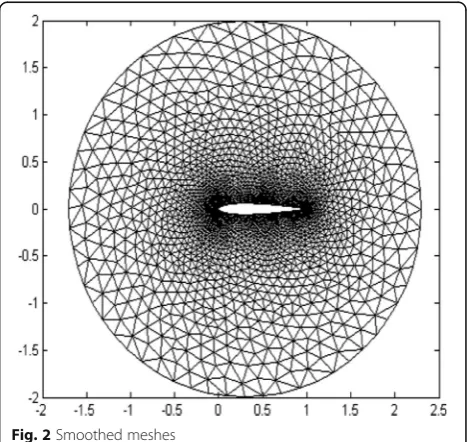
al-gorithm. Figure 2 reveals the smoothed meshes using a
wave-front domain-splitting algorithm in the serial context.
2.2 Wave-front domain-splitting algorithm with a dynamic load-balancing strategy
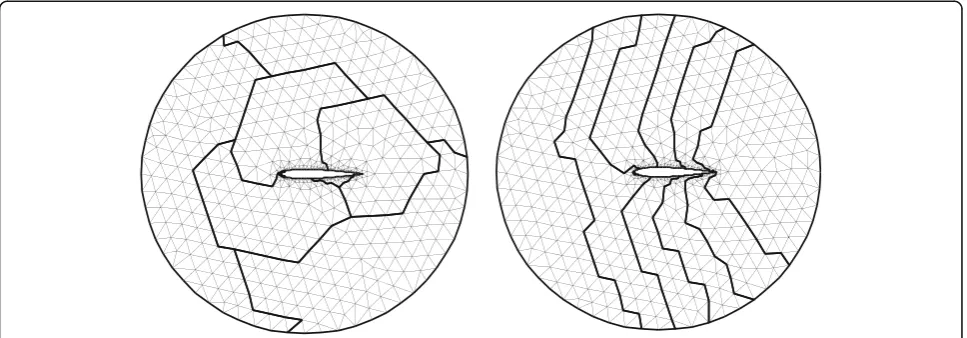
Wave-front domain-splitting algorithm was presented by Lohner, which is fit for the parallel unstructured mesh generation as shown in Fig.2. However, there exist some flaws in the algorithm. Its disadvantages are as follows: (1) neighboring domains are too many; (2) common boundaries among neighbors are also many; and (3) add-itionally, it is very difficult to search for the common boundaries. They make it inconvenient for generating sub-grids and coding programs in the parallel context. The amount of interfaces should be consistent with that of neighboring sub-domains. According to their existing weakness, the algorithm should be improved in order to save computational cost using a dynamic load balancing technique.
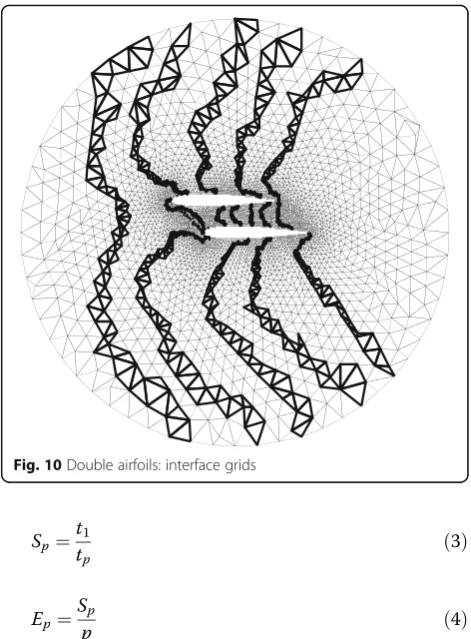
Given the background grid of the field domain, the glo-bal domain can be divided into sub-domains with smooth boundaries using the improved algorithm. Grid up each sub-domain separately by the advancing front technique, then slots that are interfaces between neighbors are made, and finally, we grid up the inter-sub-domain regions by mutual communication of processors. However, the ad-vancing front technique in the parallel context differs from that in the serial context.
In contrast to Lohner’s methods, advantages of the
parallel generation method in the paper are as follows:
(1) we improve the conditions of receiving new points and elements in generating sub-grids; (2) concepts of the transient inactive face and the perpetual inactive face are presented in the paper, which helps to understand the grid generation algorithm; and (3) steps of the grid gen-eration in the inter-subdomain regions are included here. A new strategy of just receiving new element and refusing new point is presented in generating the inter-face grids, which can spare much central processing unit (CPU) time.
Given the sub-domains, there are two possible par-allel grid generation strategies: (1) in-out and (2)
Table 1Elements and nodes for four sub-domains
Sub-domain Number of elements Number of nodes
1st one 2213 1169
2nd one 2212 1167
3rd one 2210 1164
4th one 2215 1171 Fig. 2Smoothed meshes
out-in. The first approach is implemented in the paper due to its convenience. According to the im-proved algorithm, there are at most two neighbors for every sub-domain, which can avoid the generation of corners; therefore, the third step in the strategy of in-out can be omitted.
2.2.1 Generation of sub-domain grids
In each sub-domain, the advancing front technique is used to generate an unstructured grid. Compared to the steps, the required modification is the fourth step. In order to understand the generation algorithm better, the classification of edges and the concept of transient and perpetual inactive faces are defined below.
Active faces on the front can be used to form faces of elements. The transient inactive face is not the active face in generating sub-domain grids, but the active one during the course of generating interface grids. The per-petual inactive face is not the active face in generating sub-domain grids or interface grids. In a word, faces in-clude active and inactive ones, while inactive faces con-stitute transient and perpetual ones.
The step F.4 in reference [15] is on how to determine new points and elements. The modified steps in the paper are as follows:
Step 1: The line segment joining the new point with the midpoint of the selected front edge cannot intersect any other fronts.
Step 2: New point and sub-domain boundary point cannot coincide.
Step 3: New element cannot include any boundary point of the front.
Step 4: New element cannot intersect boundaries of the sub-domain.
Step 5: New element cannot cross any transient inactive faces (including coincidence).
Step 6: New element cannot incorporate points of the transient inactive faces.
New point or element can be received if all the above six items must be satisfied; otherwise, the selected front face is denoted as a transient inactive face.
2.2.2 Generation of the interface grids
In generating the interface grids, a new strategy of only re-ceiving new element and rejecting new point is presented here, according to the geometry features of the slots be-tween sub-domains. The following steps should be added in the generation of interface grids.
1. Receive the information of the transient inactive faces from the neighbors in the present
processor.
2. Find the coincident points of the transient inactive faces from the receiving processor and the present processor, then start with the coincident points and merge all the transient inactive faces upon each other into the closed sequential fronts.
3. Call the advancing front technique program (serial program) and generate meshes.
4. Assemble the results and store them.
Fig. 3Meshes using wave-front domain-splitting algorithm
Table 2Comparison between wave-front algorithm and its improvement
Grids of NACA0012 Wave-front algorithm The improved algorithm
NCB 950 924
ANND 4.1 1.75
Advantages of the algorithm improved are as follows: (1) the number of neighboring domains decreases very much, which is generally at most 2; (2) the amount of common boundaries also declines accordingly; (3) this cuts down the complexity of compiling parallel codes; (4) furthermore, it is very easy to search for common boundaries; (5) complex interfaces are avoided after each sub-domain is gridded up separately; 6) the third step can be omitted, which attempts to grid up the corners in parallel grid generation strategies.
2.3 Parallel smoother of mesh
In order to enhance the quality of the whole mesh, grid needs to be smoothed, and simple Laplace iteration is adopted in the proposed scheme:
xnþ1
i ¼xni þmω
Xm
k¼1
xn k−xni
ð1Þ
ynþ1
i ¼yni þmω
Xm
k¼1
yn k−yni
ð2Þ
where m is denoted as the number of points which
share the common edge with the point i, n is defined as iteration time and it is chosen to be the range from 50 to 100, and ω is the relaxation factor and it is 0.2 normally.
Due to the fact that virtual boundary points still be-long to inner ones in the whole flow field domain, they should be smoothed independently; otherwise, it will affect the quality of whole grids. Therefore, mu-tual communication from neighboring sub-domains is needed when virtual boundary points are smoothed. The detailed steps are as following:
1. Mesh is firstly smoothed independently in the sub-domain excluding virtual boundary points. 2. Triangle elements to which virtual point belongs
are gathered by slaver processors.
3. Send the information of triangle elements to neighboring slaver processors.
4. Virtual points are then smoothed when information is received in the slaver processor.
5. Send the update coordinates of mesh to master processor.
Fig. 4Inserted virtual points and parallel meshes in sub-domains
What outlined above is successfully implemented on a workstation with many processors. Parallel unstructured grid generator is ported to a multiple instruction
mul-tiple data (MIMD) PVM context [18] in the CPS. PVM
is a software system that enables a collection of hetero-geneous computers to be used as a coherent and flexible concurrent computational resource. The individual com-puters may be shared- or local-memory multiprocessors, vector supercomputers, specialized graphics engines, or scalar workstations, which may be interconnected by a variety of networks in the CPS. PVM software executes on each machine in a user-configurable pool and pre-sents a unified, general, and powerful computational en-vironment of concurrent applications. User programs written in C or Fortran are provided access to PVM through the use of calls to PVM library routines for
functions such as process initiation, message transmis-sion and reception, and synchronization via barriers or rendezvous. Users may optionally control the execution location of specific application components. The PVM system transparently handles message routing, data con-version for incompatible architectures, and other tasks that are necessary for operation in a heterogeneous, net-work environment in the CPS.
Table 2 lists the statistics of the number of common
boundaries (NCB), the average number of neighboring domains (ANND), and the maximum amount of neigh-bor domains (MAND) in order to compare wave-front algorithm with the improved one. They show that the value of three parameters decrease after the algorithm is done in the paper, especially for the third one, which
contributes to the grid generation. Figure 3 shows the
meshes using the wave-front algorithm and the im-proved one, respectively.
3 Experimental results and parallel efficiency 3.1 Numerical validation for a static load-balancing strategy
The NACA airfoils are airfoil shapes for aircraft wings developed by the National Advisory Committee for Aeronautics (NACA). In order to validate the effective-ness of the proposed parallel algorithm, meshes for
Fig. 7Mesh using four sub-domains for cylinder
Table 3Computational time, speedup, and parallel efficiency for airfoil meshes
1 CPU 2 CPUs 4 CPUs
Computational time(s) 168.3 89.67 48.0
Speedup 1.0 1.82 3.4
Parallel efficiency 100% 91% 85%
Fig. 6Smoothed grids for airfoil
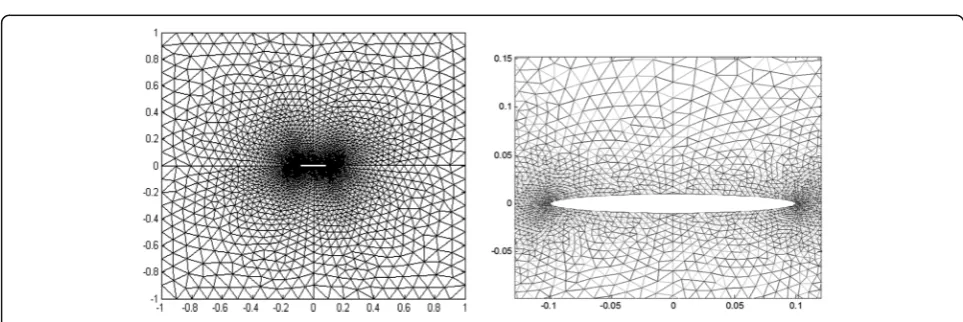
NACA0012 airfoil and five cylinders are generated in the paper, where NACA 0012 airfoil is symmetrical, the 00 indicating that it has no camber, and the 12 indicates that the airfoil has a 12% thickness to chord length ratio: it is 12% as thick as its length. Figures4,5, and6 reveal meshes of NACA0012 airfoil.
Figure 4 shows that the NACA0012 airfoil flow field
domain is decomposed into two sub-domains, where 88 virtual boundary points are inserted into the present
computational domain. As depicted in Fig. 5,
computa-tional domain is split into four sub-domains, where 166 virtual boundary points are inserted in the common boundary of sub-domains. The high resolution of the local grid around the NACA0012 airfoil has to be also displayed clearly in Fig.5. Figure 6shows the smoothed meshes of the airfoil, and it is clearly seen that mesh quality is better than the initial meshes. Mesh for five cylinders can be found in Figs.7 and 8, where the com-putation domain is divided into four sub-domains and 132 virtual points are inserted into the common bound-ary of sub-domains.
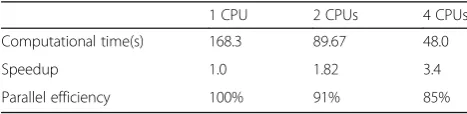
The quality of a parallel implementation is often mea-sured by the speed up or parallel efficiency.
Sp¼tt1
p ð3Þ
Ep ¼Spp ð4Þ
where Sp and Ep denote speedup and parallel efficiency separately;t1andtpdenote the execution time of the
al-gorithm on one and P processors, respectively. Tables3
and 4 show the speedup ratio and parallel efficiency of mesh generation for airfoil and cylinder.
Table 4Computational time, speedup, and parallel efficiency for airfoil meshes
1 CPU 2 CPUs 4 CPUs
Computational time(s) 49.128 26.41 13.8
Speedup 1.0 1.86 3.56
Parallel efficiency 100% 93% 89%
Fig. 9Double airfoils: gridded subdomains
Fig. 10Double airfoils: interface grids
From the tables, it clearly reveals the comparisons of computational time, speedup, and parallel efficiency using the different number of slaver processors. The
fol-lowing conclusions can be drawn from Tables3and4:
1. Computing time decreases very much, and the aim of quickly generating unstructured grids is attained. 2. Parallel efficiency of two processors is much
higher than that of four processors. The reason why parallel efficiency is on the decline is that mutual communication overheads between
neighbor processors accordingly increase with the number of sub-domains during the course of parallel smoothing.
3.2 Numerical validations for a dynamic load-balancing strategy
If the majority of applications in computational science and engineering show a more complex runtime behavior, a kind of dynamic load balancing to provide the same workload on each processor at all times should be adopted. Next, a dynamic load balancing is validated in the paper.
What outlined above is successfully implemented on a workstation with many processors. Parallel unstructured grid generator is ported to a MIMD PVM context. Nu-merical examples show the success of the improved
Fig. 12Multi-element airfoil: gridded subdomains
Fig. 13Multi-element airfoil: interface grid
Fig. 14Multi-element airfoil: smoothed grids
parallel unstructured grid generation algorithm. Fig-ures 9, 10, and11 depict sub-grids, interface grids, and smoothed whole grids for double airfoils, separately.
Figures 12, 13, and14 show sub-grids, interface grids, and smoothed grids for complex multi-element airfoil, separately. They demonstrate that the quality of parallel grids is satisfactory for flow field calculation and the improved parallel grid generation technique is feasible.
Figure 15 reveals the local grid around multi-element
airfoil.
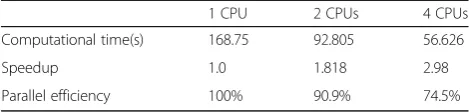
Table 5 displayed the comparison of time, speed up,
and parallel efficiency using the different number of
pro-cessors. As stated from the above Tables 3 and 4, the
similar conclusions can be also drawn from Table5. Due to the limited computer resources, four PCs are optimal and used in the course of the calculations. Speedup and parallel efficiency demonstrate that the effectiveness of a dynamic load balancing developed by us is enough for fast calculation of flow field, especially for the complex bodies.
4 Conclusions
Based on Lohner’s algorithm, a parallel unstructured
grid generation technique is studied and developed in CPS to improve the performance. For some applications, the workload per processor can be estimated or even analytically determined in a preprocessing step before the simulation is started, so a static load-balancing method can be recommended. However, if the majority of applications in computational science and engineering show a more complex runtime behavior, a kind of dy-namic load balancing to provide the same workload on each processor at all times should be adopted. A static and dynamic load-balancing strategy for the domain de-composition has been proposed, where communication overhead can decrease greatly. A new parallel smoother technique is also provided in order to enhance mesh quality in CPS. Based on the PVM context, mesh for the NACA0012 airfoil and cylinder is generated on PC clus-ters. By comparison, parallel efficiency can be enhanced as the number of processors used in the calculations.
Abbreviations
ANND:Average number of neighboring domains; CFD: Computational fluid dynamics; CPS: Cyber-physical system; CPU: Central processing unit; HVAC: Heating, ventilation and air conditioning; MAND: Maximum amount of
neighbor domains; MIMD: Multiple instruction multiple data; NCB: Number of common boundaries; PVM: Parallel Virtual Machine
Funding
This work was supported by Special Foundation of China Postdoctoral Science (Grant No. 201104565) and National Natural Science Foundation of China (Grant No. 11272151, Grant No. 61103019).
Availability of data and materials
The data will be shared if request received.
Authors’contributions
HD and HS contributed to the conception and algorithm design of the study. HZ contributed to the acquisition of simulation. XL and HD contributed to the analysis of simulation data and approved the final manuscript. All authors read and approved the final manuscript.
Authors’information
Hao Dong received the B. S. in Aircraft Design from Northwestern Polytechnical University in 2005, and his Ph. D. degree in Fluid Mechanics from Nanjing University of Aeronautics and Astronautics in 2010. Dr. Dong is an associate professor at college of Aerospace Engineering, Nanjing University of Aeronautics and Astronautics, and is the deputy director of the department of aerodynamics. He has published more than 20 journal articles in the areas of computational fluid dynamics, and mesh generation in CPS.
Haiqing Si received the B.S., M.S. and Ph.D. degrees in College of Aerospace Engineering from Nanjing University of Aeronautics and Astronautics, China, in 1999, 2004 and 2007, respectively. His research interests include parallel computing, numerical method in computational fluid dynamics. He has published over 40 papers in international journals and conferences in the areas of parallel computing, parallel generation technology of calculation meshes.
Huiying Zong is pursuing her M.S. degree in the science college from Nanjing University of Aeronautics and Astronautics, China. Her research interests include CPS, parallel computation in numerical simulation. Xiaozhu Liu is an associate professor in the school of automation, Wuhan University of Technology, China. She received the Ph. D. in Computer Software and Theory, Wuhan University, in 2011. Her research interests include CPS, mobile computing, and numerical simulation.
Competing interests
The authors declare that they have no competing interests.
Publisher’s Note
Springer Nature remains neutral with regard to jurisdictional claims in published maps and institutional affiliations.
Author details
1College of Aerospace Engineering, Nanjing University of Aeronautics and
Astronautics, Nanjing 210016, China.2College of Civil Aviation and Flight, Nanjing University of Aeronautics and Astronautics, Nanjing, China.3College of Science, Nanjing University of Aeronautics and Astronautics, Nanjing, China.4School of Automation, Wuhan University of Technology, Wuhan, China.
Received: 2 November 2018 Accepted: 28 February 2019
References
1. R. Rajkumar, I. Lee, L. Sha, J. Stankovic,Cyber-physical systems: The next computing revolution. 47th ACM/IEEE Design Automation Conference (DAC) (2010), pp. 731–736.
2. X. Liu, R. Zhu, B. Jalaian, Y. Sun, Dynamic spectrum access algorithm based on game theory in cognitive radio networks. Mob. Netw. Appl.20(6), 817– 827 (2015).
3. R. Zhu, X. Zhang, X. Liu, W. Shu, T. Mao, B. Jalaeian, ERDT: Energy-efficient reliable decision transmission for cooperative spectrum sensing in industrial IoT. IEEE Access3, 2366–2378 (2015).
4. B. Jalaeian, R. Zhu, H. Samani, M. Motani, An optimal cross-layer framework for cognitive radio network under interference temperature model. IEEE Syst. J.10(1), 293–301 (2016).
Table 5Computational time, speedup, and parallel efficiency for airfoil meshes
1 CPU 2 CPUs 4 CPUs
Computational time(s) 168.75 92.805 56.626
Speedup 1.0 1.818 2.98
5. E.A. Lee,Cyber physical systems: Design challenges, 11th IEEE Symposium on Object Oriented Real-Time Distributed Computing (ISORC) (2008), pp. 363–369. 6. J. Du, X. Liu, L. Rao, Proactive Doppler shift compensation in vehicular
cyber-physical systems. IEEE/ACM Trans. Networking26(2), 807–818 (April 2018). 7. K. Gai, M. Qiu, H. Zhao, X. Sun, Resource management in sustainable
cyber-physical systems using heterogeneous cloud computing. IEEE Trans. Sustain. Comp.3(2), 60–72 (April-June 2018).
8. S. Cai, V.K.N. Lau, Zero MAC latency sensor networking for cyber-physical systems. IEEE Trans. Signal Process.66(14), 3814–3823 (July 15 2018). 9. X. Lu, B. Chen, C. Chen, J. Wang, Coupled cyber and physical systems:
Embracing smart cities with multistream data flow. IEEE Electrification Mag. 6(2), 73–83 (June 2018).
10. C. Lu, IoT-enabled adaptive context-aware and playful cyber-physical system for everyday energy savings. IEEE Trans. Hum. Mach. Syst.48(4), 380–391 (August 2018).
11. B.H. Krogh,Cyber physical systems: the need for new models and design paradigms(Carnegie Mellon University), pp. 1–31.
12. H.Q. Si, T.G. Wang, J. Cheng, Domain decompositions and parallel algorithms to solve Euler equations on the unstructured grid. Acta Aerodynamica Sinica24(1), 102–108 (2006).
13. Y.P. Chien, F. Carpenter, A. Ecer, H.U. Akay, Load-balancing for parallel computation of fluid dynamics problems. Comput. Methods Appl. Mech. Eng.120, 119–130 (1995).
14. P.A. Cavallo, N. Sinha, G.M. Feldman,Parallel unstructured mesh adaptation for transient moving body and aero-propulsive applications, AIAA 2004-1057(2004). 15. R. Lohner, Parallel unstructured grid generation. Comput. Methods Appl.
Mech. Eng.95, 343–357 (1992).
16. T. Okusanya, J. Peraire,Parallel unstructured mesh generation, 5th
International Conference on Numerical Grid Generation in Computational Fluid Dynamics and Related Fields(1996), pp. 719–729.
17. Y.P. Chien, A. Ecer, H.U. Akay, S. Secer, R. Blech, Communication cost estimation for parallel CFD using variable time-stepping algorithms. Comput. Methods Appl. Mech. Eng.190, 1379–1389 (2000). 18. R.U. Payli, E. Yilmaz, A. Ecer, H.U. Akay, S. Chien,DLB-A dynamic load
balancing tool for grid computing, Parallel CFD conference, May 24-27(2004). 19. H.Q. Si, T.G. Wang, Load balancing strategy for parallel calculation and time cost
estimation. Acta Aeronautica et Astronautica Sinica28(Sup), S57–S61 (2007). 20. R. Löhner, Recent advances in parallel advancing front grid generation.
Arch. Comput. Meth. Eng.21(2), 127–140 (2014).
21. A. Lintermann, S. Schlimpert, J.H. Grimmen, et al., Massively parallel grid generation on HPC systems. Comput. Meth. Appl. Mech. Eng.277(2), 131–153 (2014). 22. A. Bihlo, R.D. Haynes, Parallel stochastic methods for PDE based grid
generation. Comput. Math. Appl.68(8), 804–820 (2014).
23. R. Haynes, F. Kwok, Discrete analysis of domain decomposition approaches for mesh generation via the equidistribution principle. Math. Comput.86, 303, pp. 233–273 (2017).
24. G.J. Page, Rapid, parallel CFD grid generation using octrees. Aeronaut. J. 117(1188), 133–146 (2013).
25. E.A. Hereth, K. Sreenivas, L.K. Taylor, D.S. Nichols. An automatic parallel octree grid generation software with an extensible solver framework and a focus on urban simulation, 55th AIAA Aerospace Sciences Meeting, AIAA SciTech Forum, (2017).
26. O. Meister, K. Rahnema, M. Bader, Parallel memory-efficient adaptive mesh refinement on structured triangular meshes with billions of grid cells. ACM Trans. Math. Softw.43(3), 19 (2016).
27. O. Meister, M. Bader, 2D adaptivity for 3D problems: Parallel SPE10 reservoir simulation on dynamically adaptive prism grids. J. Comput. Sci.9, 101–106 (2015). 28. C.F. JanãŸEn, N. Koliha, T. Rung, A fast and rigorously parallel surface
voxelization technique for GPU-accelerated CFD simulations. Commun. Comput. Phys.17(5), 1246–1270 (2015).
29. M. O’Connell, S.L. Karman, Advances in parallelization for large scale Oct-tree 681 mesh generation. AIAA Science and Technology forum and exposition, (2015). 30. I. Fejtek, T. Barfoot, G. Lo, Turboprop nacelle optimization using automated