An FPGA Implementation of
(3
,
6)
-Regular Low-Density
Parity-Check Code Decoder
Tong Zhang
Department of Electrical, Computer, and Systems Engineering, Rensselaer Polytechnic Institute, Troy, NY 12180, USA Email:[email protected]
Keshab K. Parhi
Department of Electrical and Computer Engineering, University of Minnesota, Minneapolis, MN 55455, USA Email:[email protected]
Received 28 February 2002 and in revised form 6 December 2002
Because of their excellent error-correcting performance, low-density parity-check (LDPC) codes have recently attracted a lot of attention. In this paper, we are interested in the practical LDPC code decoder hardware implementations. The direct fully parallel decoder implementation usually incurs too high hardware complexity for many real applications, thus partly parallel decoder design approaches that can achieve appropriate trade-offs between hardware complexity and decoding throughput are highly desirable. Applying a joint code and decoder design methodology, we develop a high-speed (3, k)-regular LDPC code partly parallel decoder architecture based on which we implement a 9216-bit, rate-1/2 (3,6)-regular LDPC code decoder on Xilinx FPGA device. This partly parallel decoder supports a maximum symbol throughput of 54 Mbps and achieves BER 10−6at 2 dB over AWGN
channel while performing maximum 18 decoding iterations.
Keywords and phrases:low-density parity-check codes, error-correcting coding, decoder, FPGA.
1. INTRODUCTION
In the past few years, the recently rediscovered low-density parity-check (LDPC) codes [1,2,3] have received a lot of at-tention and have been widely considered as next-generation error-correcting codes for telecommunication and magnetic storage. Defined as the null space of a very sparseM ×N parity-check matrixH, an LDPC code is typically represented by a bipartite graph, usually called Tanner graph, in which one set ofN variablenodes corresponds to the set of code-word, another set ofM checknodes corresponds to the set of parity-check constraints and each edge corresponds to a nonzero entry in the parity-check matrixH. (A bipartite graph is one in which the nodes can be partitioned into two sets, X andY, so that the only edges of the graph are be-tween the nodes inXand the nodes inY.) An LDPC code is known as (j, k)-regular LDPC code if each variable node has the degree of j and each check node has the degree of k, or in its parity-check matrix each column and each row have jandknonzero entries, respectively. The code rate of a (j, k)-regular LDPC code is 1−j/kprovided that the parity-check matrix has full rank. The construction of LDPC codes is typically random. LDPC codes can be effectively decoded by the iterative belief-propagation (BP) algorithm [3] that, as illustrated inFigure 1, directly matches the Tanner graph:
decoding messages are iteratively computed on each variable node and check node and exchanged through the edges be-tween the neighboring nodes.
Recently, tremendous efforts have been devoted to ana-lyze and improve the LDPC codes error-correcting capabil-ity, see [4,5,6,7,8,9,10,11] and so forth. Besides their powerful error-correcting capability, another important rea-son why LDPC codes attract so many attention is that the iterative BP decoding algorithm is inherently fully parallel, thus a great potential decoding speed can be expected.
Check nodes
Variable nodes
Check-to-variable message
Variable-to-check message
Figure1: Tanner graph representation of an LDPC code and the decoding messages flow.
fully parallel design is that with the increase of code length, typically the LDPC code length is very large (at least several thousands), the incurred hardware complexity will become more and more prohibitive for many practical purposes, for example, for 1-K code length, the ASIC decoder imple-mentation [12] consumes 1.7M gates. Moreover, as pointed out in [12], the routing overhead for implementing the en-tire interconnection network will become quite formidable due to the large code length and randomness of the Tan-ner graph. Thus high-speed partly parallel decoder de-sign approaches that achieve appropriate trade-offs between hardware complexity and decoding throughput are highly desirable.
For any given LDPC code, due to the randomness of its Tanner graph, it is nearly impossible to directly develop a high-speed partly parallel decoder architecture. To circum-vent this difficulty, Boutillon et al. [13] proposed a decoder-first code design methodology: instead of trying to conceive the high-speed partly parallel decoder for any given ran-dom LDPC code, use an available high-speed partly par-allel decoder to define a constrained random LDPC code. We may consider it as an application of the well-known “Think in the reverse direction” methodology. Inspired by the decoder-first code design methodology, we proposed a joint code and decoder design methodology in [14] for (3, k)-regular LDPC code partly parallel decoder design. By jointly conceiving the code construction and partly paral-lel decoder architecture design, we presented a (3, k)-regular LDPC code partly parallel decoder structure in [14], which not only defines very good (3, k)-regular LDPC codes but also could potentially achieve high-speed partly parallel decoding.
In this paper, applying the joint code and decoder design methodology, we develop an elaborate (3, k)-regular LDPC code high-speed partly parallel decoder architecture based on which we implement a 9216-bit, rate-1/2 (3,6)-regular LDPC code decoder using Xilinx Virtex FPGA (Field Pro-grammable Gate Array) device. In this work, we significantly modify the original decoder structure [14] to improve the de-coding throughput and simplify the control logic design. To achieve good error-correcting capability, the LDPC code de-coder architecture has to possess randomness to some extent, which makes the FPGA implementations more challenging since FPGA has fixed and regular hardware resources. We propose a novel scheme to realize the random connectivity by concatenating two routing networks, where all the ran-dom hardwire routings are localized and the overall routing
complexity is significantly reduced. Exploiting the good min-imum distance property of LDPC codes, this decoder em-ploys parity check as the earlier decoding stopping criterion to achieve adaptive decoding for energy reduction. With the maximum 18 decoding iterations, this FPGA partly parallel decoder supports a maximum of 54 Mbps symbol through-put and achieves BER (bit error rate) 10−6 at 2 dB over
AWGN channel.
This paper begins with a brief description of the LDPC code decoding algorithm inSection 2. InSection 3, we briefly describe the joint code and decoder design methodology for (3, k)-regular LDPC code partly parallel decoder design. In
Section 4, we present the detailed high-speed partly parallel decoder architecture design. Finally, an FPGA implementa-tion of a (3,6)-regular LDPC code partly parallel decoder is discussed inSection 5.
2. DECODING ALGORITHM
Since the direct implementation of BP algorithm will incur too high hardware complexity due to the large number of multiplications, we introduce some logarithmic quantities to convert these complicated multiplications into additions, which lead to the Log-BP algorithm [2,15].
Before the description of Log-BP decoding algorithm, we introduce some definitions as follows. LetHdenote the M ×N sparse parity-check matrix of the LDPC code and Hi, j denote the entry of H at the position (i, j). We
de-fine the set of bits n that participate in parity-checkm as ᏺ(m)= {n :Hm,n =1}, and the set of parity-checksmin
which bitnparticipates asᏹ(n)= {m:Hm,n =1}. We
de-note the setᏺ(m) with bitnexcluded byᏺ(m)\n, and the setᏹ(n) with parity-checkmexcluded byᏹ(n)\m.
Algorithm 1 (Iterative Log-BP Decoding Algorithm).
Input
The prior probabilitiesp0
n=P(xn=0)andp1n=P(xn=1)=
1−p0
n,n=1, . . . , N; Output
Hard decisionx= {x1, . . . ,xN}; Procedure
High-speed partly
Figure2: Joint design flow diagram.
{(i, j)|Hi, j=1}, compute
(i) Horizontal (or check node computation) step: for each(m, n)∈ {(i, j)|Hi, j=1}, compute
(ii) Vertical (or variable node computation) step: for each(m, n)∈ {(i, j)|Hi, j=1}, compute
n, update the pseudoposterior log-likelihood ratio (LLR)λnas to horizontal step until the preset maximum number of iterations have occurred.
We call αm,n andβm,n in the above algorithm extrinsic
messages, whereαm,nis delivered from variable node to check
node andβm,nis delivered from check node to variable node.
Each decoding iteration can be performed in fully paral-lel fashion by physically mapping each check node to one in-dividualcheck node processing unit(CNU) and each variable node to one individualvariable node processing unit(VNU).
Moreover, by delivering the hard decisionxifrom each VNU
to its neighboring CNUs, the parity-checkH·xcan be eas-ily performed by all the CNUs. Thanks to the good min-imum distance property of LDPC code, such adaptive de-coding scheme can effectively reduce the average energy con-sumption of the decoder without performance degradation.
In the partly parallel decoding, the operations of a cer-tain number of check nodes or variable nodes are time-multiplexed, or folded [16], to a single CNU or VNU. For an LDPC code withMcheck nodes andNvariable nodes, if its partly parallel decoder containsMpCNUs andNpVNUs,
we denote M/Mp as CNU folding factor andN/Npas VNU
folding factor.
3. JOINT CODE AND DECODER DESIGN
In this section, we briefly describe the joint (3, k)-regular LDPC code and decoder design methodology [14]. It is well known that the BP (or Log-BP) decoding algorithm works well if the underlying Tanner graph is 4-cycle free and does not contain too many short cycles. Thus the motivation of this joint design approach is to construct an LDPC code that not only fits to a high-speed partly parallel decoder but also has the average cycle length as large as possible in its 4-cycle-free Tanner graph. This joint design process is outlined as fol-lows and the corresponding schematic flow diagram is shown inFigure 2.
(1) Explicitly construct two matricesH1andH2in such a
way thatH =[HT1,HT2]Tdefines a (2, k)-regular LDPC
codeC2whose Tanner graph has the girth1of 12.
(2) Develop a partly parallel decoder that is configured by a set of constrained random parameters and defines a (3, k)-regular LDPC code ensemble, in which each code is a subcode ofC2and has the parity-check matrix
H=[HT,HT 3]T.
(3) Select a good (3, k)-regular LDPC code from the code ensemble based on the criteria of large Tanner graph average cycle length and computer simulations. Typi-cally the parity-check matrix of the selected code has only few redundant checks, so we may assume that the code rate is always 1−3/k.
trix. LetTdenote the right cyclic shift operator whereTu(Q)
represents right cyclic shifting matrixQbyucolumns, then Px,y =Tu(I) whereu=((x−1)·y) modLandIrepresents
and each column contains a single 1. Thus, the matrixH = [HT1,HT2]T defines a (2, k)-regular LDPC codeC2 withL·
k2variable nodes and 2L·kcheck nodes. LetGdenote the
Tanner graph ofC2, we have the following theorem regarding
to the girth ofG.
Theorem 1. IfLcannot be factored asL=a·b, wherea, b∈ {0, . . . , k−1}, then the girth ofGis12and there is at least one
12-cycle passing each check node.
Partly parallel decoder
Based on the specific structure ofH, a principal (3 , k)-regular LDPC code partly parallel decoder structure was presented in [14]. This decoder is configured by a set of constrained ran-dom parameters and defines a (3, k)-regular LDPC code en-semble. Each code in this ensemble is essentially constructed by inserting extraL·kcheck nodes to the high-girth (2, k )-regular LDPC codeC2under the constraint specified by the
decoder. Therefore, it is reasonable to expect that the codes in this ensemble more likely do not contain too many short cycles and we may easily select a good code from it. For real applications, we can select a good code from this code ensem-ble as follows: first in the code ensemensem-ble, find several codes
with relatively high-average cycle lengths, then select the one leading to the best result in the computer simulations.
The principal partly parallel decoder structure presented in [14] has the following properties.
(i) It containsk2memory banks, each one consists of
sev-eral RAMs to store all the decoding messages associ-ated withLvariable nodes.
(ii) Each memory bank associates with one address gener-ator that is configured by one element in a constrained random integer set.
(iii) It contains a configurable random-like one-dimen-sional shuffle networkwith the routing complexity scaled byk2.
(iv) It containsk2VNUs andkCNUs so that the VNU and
CNU folding factors areL·k2/k2=Land 3L·k/k=3L,
respectively.
(v) Each iteration completes in 3Lclock cycles in which only CNUs work in the first 2Lclock cycles and both CNUs and VNUs work in the lastLclock cycles.
Over all the possibleand, this decoder defines a (3, k )-regular LDPC code ensemble in which each code has the parity-check matrix H = [HT,HT
3]T, where the submatrix
H3is jointly specified byandS.
4. PARTLY PARALLEL DECODER ARCHITECTURE
In this paper, applying the joint code and decoder design methodology, we develop a high-speed (3, k)-regular LDPC code partly parallel decoder architecture based on which a 9216-bit, rate-1/2 (3,6)-regular LDPC code partly parallel decoder has been implemented using Xilinx Virtex FPGA device. Compared with the structure presented in [14], this partly parallel decoder architecture has the following distinct characteristics.
(i) It employs a novel concatenated configurable ran-dom two-dimensional shuffle network implementa-tion scheme to realize the random-like connectivity with low routing overhead, which is especially desir-able for FPGA implementations.
(ii) To improve the decoding throughput, both the VNU folding factor and CNU folding factor areLinstead of Land 3Lin the structure presented in [14].
(iii) To simplify the control logic design and reduce the memory bandwidth requirement, this decoder com-pletes each decoding iteration in 2L clock cycles in which CNUs and VNUs work in the 1st and 2nd L clock cycles, alternatively.
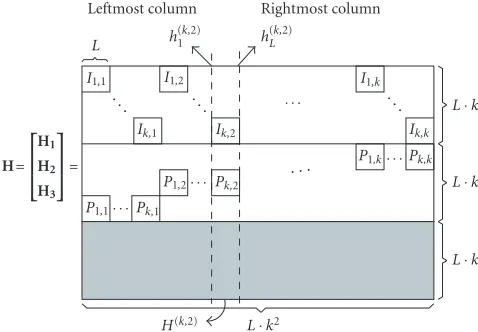
Following the joint design methodology, we have that this decoder should define a (3, k)-regular LDPC code ensemble in which each code hasL·k2variable nodes and 3L·kcheck
nodes and, as illustrated in Figure 4, the parity-check ma-trix of each code has the formH=[HT1,H2T,HT3]TwhereH1
andH2have the explicit structures as shown inFigure 3and
the random-likeH3is specified by certain configuration
H=
Figure4: The parity-check matrix.
decoder architecture, we introduce some definitions as fol-lows: we denote the submatrix consisting of theLconsecutive columns inHthat go through the block matrixIx,yasH(x,y)
in which, from left to right, each column is labeled ash(ix,y)
withiincreasing from 1 toL, as shown inFigure 4. We label the variable node corresponding to columnh(ix,y)asv
(x,y)
i and
theLvariable nodesv(ix,y)fori=1, . . . , Lconstitute a variable
node group VGx,y. Finally, we arrange theL·kcheck nodes
corresponding to all theL·krows of submatrixHiinto check node group CGi.
Figure 5shows the principal structure of this partly par-allel decoder. It mainly containsk2PE blocks PE
x,y, for 1≤x
and y ≤k, three bidirectional shuffle networksπ1,π2, and
π3, and 3·kCNUs. Each PEx,ycontains one memory bank
RAMsx,ythat stores all the decoding messages, including the
intrinsic and extrinsic messages and hard decisions, associ-ated with all theLvariable nodes in the variable node group VGx,y, and contains one VNU to perform the variable node
computations for theseLvariable nodes. Each bidirectional shuffle networkπirealizes the extrinsic message exchange
be-tween all theL·k2variable nodes and theL·kcheck nodes in
CGi. ThekCNUi, j, for j=1, . . . , k, perform the check node
computations for all theL·kcheck nodes in CGi.
This decoder completes each decoding iteration in 2L clock cycles, and during the first and secondLclock cycles, it works in check node processing mode and variable node processing mode, respectively. In the check node processing mode, the decoder not only performs the computations of all the check nodes but also completes the extrinsic message exchange between neighboring nodes. In variable node pro-cessing mode, the decoder only performs the computations of all the variable nodes.
The intrinsic and extrinsic messages are all quantized to five bits and the iterative decoding datapaths of this partly parallel decoder are illustrated inFigure 6, in which the dat-apaths in check node processing and variable node process-ing are represented by solid lines and dash dot lines, respec-tively. As shown in Figure 6, each PE block PEx,y contains
five RAM blocks: EXT RAM ifori=1,2,3, INT RAM, and DEC RAM. Each EXT RAMihasLmemory locations and the location with the address d−1 (1 ≤ d ≤ L) contains the extrinsic messages exchanged between the variable node vd(x,y)in VGx,y and its neighboring check node in CGi. The
INT RAM and DEC RAM store the intrinsic message and hard decision associated with nodev(dx,y)at the memory
lo-cation with the addressd−1 (1 ≤ d ≤ L). As we will see later, such decoding messages storage strategy could greatly simplify the control logic for generating the memory access address.
For the purpose of simplicity, inFigure 6we do not show the datapath from INT RAM to EXT RAM i’s for extrinsic message initialization, which can be easily realized inLclock cycles before the decoder enters the iterative decoding pro-cess.
4.1. Check node processing
During the check node processing, the decoder performs the computations of all the check nodes and realizes the extrinsic message exchange between all the neighboring nodes. At the beginning of check node processing, in each PEx,ythe
mem-ory location with addressd−1 in EXT RAMicontains 6-bithybriddata that consists of 1-bit hard decision and 5-bit variable-to-check extrinsic message associated with the vari-able node vd(x,y) in VGx,y. In each clock cycle, this decoder
performs theread-shuffle-modify-unshuffle-writeoperations to convert one variable-to-check extrinsic message in each EXT RAM i to its check-to-variable counterpart. As illus-trated inFigure 6, we may outline the datapath loop in check node processing as follows:
(1) read: one 6-bit hybrid data h(x,yi) is read from each
EXT RAM iin each PEx,y;
(2) shuffle: each hybrid datah(x,yi) goes through the shuffle
networkπiand arrives at CNUi, j;
(3) modify: each CNUi, jperforms the parity check on the 6
input hard decision bits and generates the 6 output 5-bit check-to-variable extrinsic messagesβx,y(i) based on
the 6 input 5-bit variable-to-check extrinsic messages; (4) unshuffle: send each check-to-variable extrinsic mes-sageβx,y(i) back to the PE block via the same path as its
variable-to-check counterpart;
(5) write: write eachβ(x,yi) to the same memory location in
EXT RAM ias its variable-to-check counterpart.
All the CNUs deliver the parity-check results to a central control block that will, at the end of check node processing, determine whether all the parity-check equations specified by the parity-check matrix have been satisfied, if yes, the de-coding for current code frame will terminate.
Active during variable node processing
PE1,1
VNU
RAMs1,1
PE2,1
VNU
RAMs2,1 · · ·
PEk,k VNU
RAMsk,k
· · ·
π1(regular & fixed)
· · ·
π2(regular & fixed)
· · ·
π3 (random-like &configurable)
CNU1,1
· · ·
CNU1,k CNU2,1
· · ·
CNU2,k CNU3,1
· · ·
CNU3,k
Active during check node processing
Figure5: The principal (3, k)-regular LDPC code partly parallel decoder structure.
· · ·
CNU1, j
6 bits 5 bits
π1(regular & fixed) h(1)
x,y
· · ·
CNU2, j
6 bits 5 bits
π2(regular & fixed)
h(2)x,y
· · ·
CNU3, j
6 bits 5 bits
π3 (random-like &
configurable)
h(3)x,y
PEx,y
{h(x,yi)} 18 bits
{β(x,yi)}
15 bits
EXT RAM 1 EXT RAM 2 EXT RAM 3
18 bits {h(x,yi)}
{β(x,yi)}
15 bits
INT RAM
5 bits VNU
1 bit DEC RAM
Figure6: Iterative decoding datapaths.
CNU Read
6 bits
Shuffle
6 bits CNU (1st half)
CNU (2nd half)
5 bits
Unshuffle 5 bits
Write
Figure7: Five-stage pipelining of the check node processing datapath.
shuffle networks by two distinct sets of wires with opposite directions, which means that the hybrid data from PE blocks to CNUs and the check-to-variable extrinsic messages from CNUs to PE blocks are carried on distinct sets of wires. Com-pared with sharing one set of wires in time-multiplexed fash-ion, this approach has higher wire routing overhead but ob-viates the logic gate overhead due to the realization of time-multiplex and, more importantly, make it feasible to directly pipeline the datapath loop for higher decoding throughput.
In this decoder, one address generator AG(x,yi) associates with one EXT RAM iin each PEx,y. In the check node
pro-cessing, AG(x,yi) generates the address for reading hybrid data and, due to the five-stage pipelining of datapath loop, the ad-dress for writing back the check-to-variable message is
ob-tained via delaying the read address by five clock cycles. It is clear that the connectivity among all the variable nodes and check nodes, or the entire parity-check matrix, realized by this decoder is jointly specified by all the address genera-tors and the three shuffle networks. Moreover, fori=1,2,3, the connectivity among all the variable nodes and the check nodes in CGiis completely determined by AG(x,yi) andπi.
Fol-lowing the joint design methodology, we implement all the address generators and the three shuffle networks as follows.
4.1.1 Implementations ofAG(1)x,yandπ1
The bidirectional shuffle networkπ1 and AG(1)x,y realize the
π3
Stage I: intrarow shuffle
r=0· · ·L−1
Stage II: intracolumn shuffle Figure8: Forward path ofπ3.
that nodev(dx,y)corresponds to the columnh (x,y)
i as illustrated
inFigure 4and the extrinsic messages associated with node vd(x,y)are always stored at addressd−1. Exploiting the
ex-plicit structure ofH1, we easily obtain the implementation
schemes for AG(1)x,yandπ1as follows:
(i) each AG(1)x,yis realized as alog2L-bit binary counter that is cleared to zero at the beginning of check node processing;
(ii) the bidirectional shuffle network π1 connects the k
PEx,ywith the samex-index to the same CNU.
4.1.2 Implementations ofAG(2)x,yandπ2
The bidirectional shuffle networkπ2 and AG(2)x,y realize the
connectivity among all the variable nodes and all the check nodes in CG2as specified by the fixed matrixH2. Similarly,
exploiting the extrinsic messages storage strategy and the ex-plicit structure ofH2, we implement AG(2)x,yandπ2as follows:
(i) each AG(2)x,yis realized as alog2L-bit binary counter that only counts up to the valueL−1 and is loaded with the value of ((x−1)·y) modLat the beginning of check node processing;
(ii) the bidirectional shuffle network π2 connects the k
PEx,ywith the samey-index to the same CNU.
Notice that the counter load value for each AG(2)x,ydirectly comes from the construction of each block matrixPx,yinH2
as described inSection 3.
4.1.3 Implementations ofAG(3)x,yandπ3
The bidirectional shuffle network π3 and AG(3)x,y jointly
de-fine the connectivity among all the variable nodes and all the check nodes in CG3, which is represented byH3as illustrated
inFigure 4. In the above, we show that by exploiting the spe-cific structures ofH1andH2and the extrinsic messages
stor-age strategy, we can directly obtain the implementations of each AG(x,yi) andπi, for i = 1,2. However, the
implementa-tions of AG(3)
x,y andπ3 are not easy because of the following
requirements onH3:
(1) the Tanner graph corresponding to the parity-check matrixH=[HT1,HT2,HT3]Tshould be 4-cycle free;
(2) to make H random to some extent, H3 should be
random-like.
As proposed in [14], to simplify the design process, we
separatelyconceive AG(3)x,yandπ3in such a way that the
im-plementations of AG(3)x,yandπ3accomplish the above first and
second requirements, respectively.
Implementations ofAG(3)x,y
We implement each AG(3)x,y as alog2L-bit binary counter that counts up to the value L−1 and is initialized with a constant value tx,y at the beginning of check node
process-ing. Eachtx,yis selected in random under the following two
constraints:
(1) givenx,tx,y1=tx,y2, for ally1, y2∈ {1, . . . , k};
(2) given y,tx1,y −tx2,y ≡ ((x1−x2)·y) modL, for all
x1, x2∈ {1, . . . , k}.
It can be proved that the above two constraints ontx,yare
sufficient to make the entire parity-check matrixH always correspond to a 4-cycle free Tanner graph no matter how we implementπ3.
Implementation ofπ3
Since each AG(3)x,yis realized as a counter, the pattern of shuf-fle networkπ3cannot befixed, otherwise the shuffle pattern
ofπ3will be regularly repeated in theH3, which means that
H3will always contain very regular connectivity patterns no
matter how random-like the pattern ofπ3itself is. Thus we
should makeπ3configurable to some extent. In this paper,
we propose the following concatenated configurable random shuffle network implementation scheme forπ3.
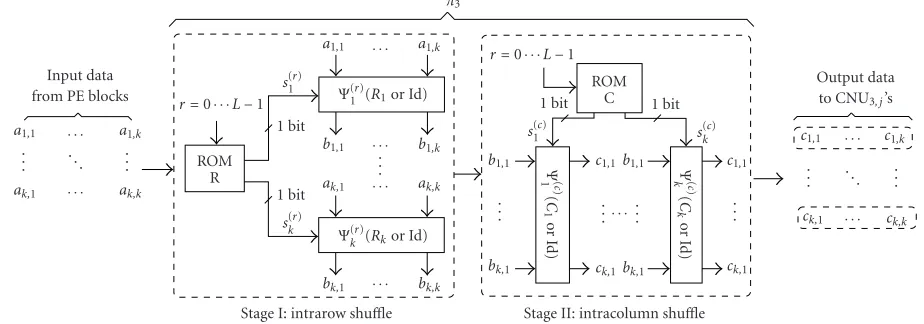
Figure 8shows the forward path (from PEx,yto CNU3, j)
realizes the data shuffle fromax,ytocx,yby two concatenated
stages: intrarowshuffle andintracolumnshuffle. Firstly, the ax,ydata block, where eachax,ycomes from PEx,y, passes an
intrarowshuffle network array in which each shuffle network Ψ(r)
x shuffles thekinput dataax,ytobx,yfor 1≤y≤k. Each Ψ(r)
x is configured by 1-bit control signals(xr)leading to the
fixed random permutationRx ifs(xr) = 1, or to the identity
permutation (Id) otherwise. The reason why we use the Id pattern instead of another random shuffle pattern is to min-imize the routing overhead, and our simulations suggest that there is no gain on the error-correcting performance by using another random shuffle pattern instead of Id pattern. Thek -bit configuration words(r)changes every clock cycle and all
theL k-bit control words are stored in ROM R. Next, thebx,y
data block goes through anintracolumnshuffle network ar-ray in which eachΨ(yc)shuffles thek bx,ytocx,yfor 1≤x≤k.
Similarly, eachΨ(yc)is configured by 1-bit control signals(yc)
leading to the fixed random permutationCyifs(yc)=1, or to
Id otherwise. Thek-bit configuration words(yc)changes
ev-ery clock cycle and all theL k-bit control words are stored in ROM C. As the output of forward path, thek cx,ywith the
samex-index are delivered to the same CNU3, j. To realize the
bidirectional shuffle, we only need to implement each config-urable shuffle networkΨ(xr)andΨ(yc)as bidirectional so that
π3canunshufflethek2data backward from CNU3, j to PEx,y
along the same route as the forward path on distinct sets of wires. Notice that, due to the pipelining on the datapath loop, the backward path control signals are obtained via delaying the forward path control signals by three clock cycles.
To make the connectivity realized byπ3random-like and
change each clock cycle, we only need to randomly generate the control words s(xr) ands(yc)for each clock cycle and the
fixed shuffle patterns of eachRxandCy. Since most modern
FPGA devices have multiple metal layers, the implementa-tions of the two shuffle arrays can be overlapped from the bird’s-eye view. Therefore, the above concatenated imple-mentation scheme will confine all the routing wires to small area (in one row or one column), which will significantly reduce the possibility of routing congestion and reduce the routing overhead.
4.2. Variable node processing
Compared with the above check node processing, the opera-tions performed in the variable node processing is quite sim-ple since the decoder only needs to carry out all the variable node computations. Notice that at the beginning of variable node processing, the three 5-bit check-to-variable extrinsic messages associated with each variable nodev(dx,y)are stored at the addressd−1 of the three EXT RAMiin PEx,y. The
5-bit intrinsic message associated with variable nodevd(x,y)is
also stored at the addressd−1 of INT RAM in PEx,y. In each
clock cycle, this decoder performs theread-modify-write op-erations toconvertthe three check-to-variable extrinsic mes-sages associated with the same variable node to three hybrid data consisting of variable-to-check extrinsic messages and
VNU Read
5 bits
VNU (1st half)
VNU (2nd half)
6 bits
1 bit Write
Figure 9: Three-stage pipelining of the variable node processing datapath.
hard decisions. As shown inFigure 6, we may outline the dat-apath loop in variable node processing as follows:
(1) read: in each PEx,y, three 5-bit check-to-variable
ex-trinsic messagesβx,y(i) and one 5-bit intrinsic messages
γx,y associated with the same variable node are read
from the three EXT RAM iand INT RAM at the same address;
(2) modify: based on the input check-to-variable extrinsic messages and intrinsic message, each VNU generates the 1-bit hard decisionxx,yand three 6-bit hybrid data
h(x,yi);
(3) write: eachh(x,yi) is written back to the same memory
location as its check-to-variable counterpart andxx,y
is written to DEC RAM.
The forward path from memory to VNU and backward path from VNU to memory are implemented by distinct sets of wires and the entire read-modify-write datapath loop is pipelined by three-stage pipelining as illustrated inFigure 9. Since all the extrinsic and intrinsic messages associated with the same variable node are stored at the same address in different RAM blocks, we can use only one binary counter to generate all the read address. Due to the pipelining of the datapath, the write address is obtained via delaying the read address by three clock cycles.
4.3. CNU and VNU architectures
Each CNU carries out the operations of one check node, including the parity check and computation of check-to-variable extrinsic messages.Figure 10shows the CNU archi-tecture for check node with the degree of 6. Each inputx(i)
is a 6-bit hybrid data consisting of 1-bit hard decision and 5-bit variable-to-check extrinsic message. The parity check is performed by XORing all the six 1-bit hard decisions. Each 5-bit variable-to-check extrinsic messages is represented by
sign-magnitudeformat with a sign bit and four magnitude bits. The architecture for computing the check-to-variable extrinsic messages is directly obtained from (3). The func-tion f(x)=log((1 +e−|x|)/(1−e−|x|)) is realized by the LUT (lookup table) that is implemented as a combinational logic block in FPGA. Each output 5-bit check-to-variable extrinsic messagey(i)is also represented by sign-magnitude format.
X(1)
6
5 1
X(2)
6
5 1
X(3)
6
5 1
X(4)
6
5 1
X(5)
6
5 1
X(6)
6
5 1
4 1 4 1 4 1 4 1 4 1 4 1
6 LUT
6 LUT
6 LUT
6 LUT
6 LUT
6 LUT
4 1
5
y(1)
4 1
5
y(2)
4 1
5
y(3)
4 1
5
y(4)
4 1
5
y(5)
4 1
5
y(6)
Pipeline
1
Parity-check result Figure10: Architecture for CNU withk=6.
Z 5
Pipeline
S-to-T: Sign magnitude to two’s complement
T-to-S: Two’s complement to sign-magnitude 1
Hard decision
y(1) 5 S-to-T
y(2) 5 S-to-T
y(3) 5
S-to-T
T-to-S 7 6 LUT 4 1
6
X(1)
T-to-S 7 6 LUT 4 1
6
X(2)
T-to-S 7 6 LUT 4 1
6
X(3)
Figure11: Architecture for VNU withj=3.
generates three 5-bit variable-to-check extrinsic messages and 1-bit hard decision according to (4) and (5), respectively. To enable each CNU to receive the hard decisions to per-form parity check as described above, the hard decision is combined with each 5-bit variable-to-check extrinsic mes-sage to form 6-bit hybrid data x(i) as shown inFigure 11.
Since each input check-to-variable extrinsic message y(i)is
represented by sign-magnitude format, we need to convert it to two’s complement format before performing the addi-tions. Before going through the LUT that realizes f(x) = log((1 +e−|x|)/(1−e−|x|)), each data is converted back to the sign-magnitude format.
4.4. Data Input/Output
This partly parallel decoder works simultaneously on three consecutive code frames in two-stage pipelining mode: while one frame is being iteratively decoded, the next frame is loaded into the decoder, and the hard decisions of the previous frame are read out from the decoder. Thus each INT RAM contains two RAM blocks to store the intrinsic messages of both current and next frames. Similarly, each DEC RAM contains two RAM blocks to store the hard de-cisions of both current and previous frames.
Intrinsic data
5 Load address log2L+log2k2
log2L log2k2
Binary decoder
k2
PE block select
log2L
Read address
PE1,1
1 PE1,2
2
PE2,1
1 PE2,2
2
. .
. ...
PEk,1
1 PEk,2
2 · · ·
· · ·
· · ·
· · ·
k−1 PE1,k
k
k−1 PE2,k
k
. . .
k−1 PEk,k
k
k2 Decoding
output
Figure12: Data input/output structure.
thek2PE blocks. To minimize the routing overhead, we
de-velop a square-shaped floor planning for PE blocks as illus-trated inFigure 12and the corresponding data input/output scheme is described in the following.
(1) Intrinsic data input. The intrinsic messages of next frame is loaded, 1 symbol per clock cycle. As shown inFigure 12, the memory location of each input in-trinsic data is determined by the input load ad-dress that has the width of (log2L+log2k2) bits
in which log2k2 bits specify which PE block (or
which INT RAM) is being accessed and the other log2Lbits locate the memory location in the selected INT RAM. As shown inFigure 12, the primary intrin-sic data and load address input directly connect to the kPE blocks PE1,yfor 1≤y≤k, and from each PEx,y
the intrinsic data and load address are delivered to the adjacent PE block PEx+1,yin pipelined fashion.
(2) Decoded data output. The decoded data (or hard deci-sions) of the previous frame is read out in pipelined fashion. As shown inFigure 12, the primarylog2L -bit read address input directly connects to the k PE blocks PEx,1for 1 ≤x ≤k, and from each PEx,y the
read address are delivered to the adjacent block PEx,y+1
in pipelined fashion. Based on its input read address, each PE block outputs 1-bit hard decision per clock cycle. Therefore, as illustrated inFigure 12, the width of pipelined decoded data bus increases by 1 after go-ing through one PE block, and at the rightmost side, we obtaink k-bit decoded output that are combined together as thek2-bit primary decoded data output.
5. FPGA IMPLEMENTATION
Applying the above decoder architecture, we implemented a (3,6)-regular LDPC code partly parallel decoder forL = 256 using Xilinx Virtex-E XCV2600E device with the pack-age FG1156. The corresponding LDPC code length is N = L·k2 = 256·62 = 9216 and code rate is 1/2. We obtain
the constrained random parameter set for implementingπ3
and each AG(3)x,y as follows: first generate a large number of parameter sets from which we find few sets leading to rela-tively high Tanner graph average cycle length, then we select one set leading to the best performance based on computer simulations.
The target XCV2600E FPGA device contains 184 large on-chip block RAMs, each one is a fully synchronous dual-port 4K-bit RAM. In this decoder implementation, we con-figure each dual-port 4K-bit RAM as two independent single-port 256×8-bit RAM blocks so that each EXT RAM i can be realized by one single-port 256×8-bit RAM block. Since each INT RAM contains two RAM blocks for storing the intrinsic messages of both current and next code frames, we use two single-port 256×8-bit RAM blocks to imple-ment one INT RAM. Due to the relatively small memory size requirement, the DEC RAM is realized by distributed RAM that provides shallow RAM structures implemented in CLBs. Since this decoder containsk2 =36 PE blocks, each one
Table1: FPGA resources utilization statistics.
Resource Number Utilization rate Resource Number Utilization rate
Slices 11,792 46% Slices Registers 10,105 19%
4 input LUTs 15,933 31% Bonded IOBs 68 8%
Block RAMs 90 48% DLLs 1 12%
PE1,1
PE2,1
PE3,1
PE4,1
PE5,1
PE6,1
PE1,2
PE2,2
PE3,2
PE4,2
PE5,2
PE6,2
PE1,3
PE2,3
PE3,3
PE4,3
PE5,3
PE6,3
PE1,4
PE2,4
PE3,4
PE4,4
PE5,4
PE6,4
PE1,5
PE2,5
PE3,5
PE4,5
PE5,5
PE6,5
PE1,6
PE2,6
PE3,6
PE4,6
PE5,6
PE6,6
Figure13: The placed and routed decoder implementation.
scheme exactly matches the structure of the configurable shuffle network π3 as described in Section 4.1.3, thus the
routing overhead for implementing theπ3is also minimized
in this FPGA implementation.
From the architecture description inSection 4, we know that, during each clock cycle in the iterative decoding, this decoder need to perform both read and write operations on each single-port RAM block EXT RAM i. Therefore, sup-pose the primary clock frequency is W, we must generate a 2×W clock signal as the RAM control signal to achieve read-and-write operation in one clock cycle. This 2×W clock signal is generated using the delay-locked loop (DLL) in XCV2600E.
To facilitate the entire implementation process, we exten-sively utilized the highly optimized Xilinx IP cores to instan-tiate many function blocks, that is, all the RAM blocks, all the counters for generating addresses, and the ROMs used to store the control signals for shuffle networkπ3. Moreover, all
the adders in CNUs and VNUs are implemented by ripple-carry adder that is exactly suitable for Xilinx FPGA imple-mentations thanks to the on-chip dedicated fast arithmetic carry chain.
This decoder was described in the VHDL (hardware de-scription language) and SYNOPSYS FPGA Express was used to synthesize the VHDL implementation. We used the Xil-inx Development System tool suite to place and route the synthesized implementation for the target XCV2600E device with the speed option −7. Table 1shows the hardware re-source utilization statistics. Notice that 74% of the total uti-lized slices, or 8691 slices, were used for implementing all the CNUs and VNUs.Figure 13shows the placed and routed design in which the placement of all the PE blocks are con-strained based on the on-chip RAM block locations.
Based on the results reported by the Xilinx static timing
analysis tool, the maximum decoder clock frequency can be 56 MHz. If this decoder performssdecoding iterations for each code frame, the total clock cycle number for decoding one frame will be 2s·L+L, where the extraLclock cycles is due to the initialization process, and the maximum sym-bol decoding throughput will be 56·k2·L/(2s·L+L) =
56·36/(2s+1) Mbps. Here, we sets=18 and obtain the max-imum symbol decoding throughput as 54 Mbps. Figure 14
shows the corresponding performance over AWGN channel withs=18, including the BER, FER (frame error rate), and the average iteration numbers.
6. CONCLUSION
Due to the unique characteristics of LDPC codes, we be-lieve that jointly conceiving the code construction and partly parallel decoder design should be a key for practi-cal high-speed LDPC coding system implementations. In this paper, applying a joint design methodology, we devel-oped a (3, k)-regular LDPC code high-speed partly paral-lel decoder architecture design and implemented a 9216-bit, rate-1/2 (3,6)-regular LDPC code decoder on the Xil-inx XCV2600E FPGA device. The detailed decoder architec-ture and floor planning scheme have been presented and a concatenated configurable random shuffle network imple-mentation is proposed to minimize the routing overhead for the random-like shuffle network realization. With the maximum 18 decoding iterations, this decoder can achieve up to 54 Mbps symbol decoding throughput and the BER 10−6 at 2 dB over AWGN channel. Moreover, exploiting
100
10−1
10−2
10−3
10−4
10−5
10−6
BER/FER
1 1.5 2 2.5
Eb/N0(dB)
BER FER 18
16
14
12
10
8
6
4
Av
er
ag
e
n
u
m
b
er
o
f
it
er
at
io
n
s
1 1.5 2 2.5 3 3.5
Eb/N0(dB)
Figure14: Simulation results on BER, FER and the average itera-tion numbers.
REFERENCES
[1] R. G. Gallager, “Low-density parity-check codes,”IRE Trans-actions on Information Theory, vol. IT-8, no. 1, pp. 21–28, 1962.
[2] R. G. Gallager, Low-Density Parity-Check Codes, MIT Press, Cambridge, Mass, USA, 1963.
[3] D. J. C. MacKay, “Good error-correcting codes based on very
sparse matrices,” IEEE Transactions on Information Theory, vol. 45, no. 2, pp. 399–431, 1999.
[4] M. C. Davey and D. J. C. MacKay, “Low-density parity check codes over GF(q),” IEEE Communications Letters, vol. 2, no. 6, pp. 165–167, 1998.
[5] M. Luby, M. Mitzenmacher, M. Shokrollahi, and D. Spiel-man, “Improved low-density parity-check codes using irregu-lar graphs and belief propagation,” inProc. IEEE International Symposium on Information Theory, p. 117, Cambridge, Mass, USA, August 1998.
[6] T. Richardson and R. Urbanke, “The capacity of low-density parity-check codes under message-passing decoding,” IEEE Transactions on Information Theory, vol. 47, no. 2, pp. 599– 618, 2001.
[7] T. Richardson, M. Shokrollahi, and R. Urbanke, “Design
of capacity-approaching irregular low-density parity-check codes,” IEEE Transactions on Information Theory, vol. 47, no. 2, pp. 619–637, 2001.
[8] S.-Y. Chung, T. Richardson, and R. Urbanke, “Analysis of sum-product decoding of low-density parity-check codes us-ing a Gaussian approximation,” IEEE Transactions on Infor-mation Theory, vol. 47, no. 2, pp. 657–670, 2001.
[9] M. Luby, M. Mitzenmacher, M. Shokrollahi, and D. A. Spiel-man, “Improved low-density parity-check codes using irreg-ular graphs,” IEEE Transactions on Information Theory, vol. 47, no. 2, pp. 585–598, 2001.
[10] S.-Y. Chung, G. D. Forney, T. Richardson, and R. Urbanke, “On the design of low-density parity-check codes within 0.0045 dB of the Shannon limit,” IEEE Communications Let-ters, vol. 5, no. 2, pp. 58–60, 2001.
[11] G. Miller and D. Burshtein, “Bounds on the
maximum-likelihood decoding error probability of low-density parity-check codes,” IEEE Transactions on Information Theory, vol. 47, no. 7, pp. 2696–2710, 2001.
[12] A. J. Blanksby and C. J. Howland, “A 690-mW 1-Gb/s 1024-b, rate-1/2 low-density parity-check code decoder,”IEEE Journal of Solid-State Circuits, vol. 37, no. 3, pp. 404–412, 2002. [13] E. Boutillon, J. Castura, and F. R. Kschischang,
“Decoder-first code design,” inProc. 2nd International Symposium on Turbo Codes and Related Topics, pp. 459–462, Brest, France, September 2000.
[14] T. Zhang and K. K. Parhi, “VLSI implementation-oriented (3, k)-regular low-density parity-check codes,” inIEEE Work-shop on Signal Processing Systems (SiPS), pp. 25–36, Antwerp, Belgium, September 2001.
[15] M. Chiani, A. Conti, and A. Ventura, “Evaluation of low-density parity-check codes over block fading channels,” in Proc. IEEE International Conference on Communications, pp. 1183–1187, New Orleans, La, USA, June 2000.
[16] K. K. Parhi,VLSI Digital Signal Processing Systems: Design and Implementation, John Wiley & Sons, New York, USA, 1999.
Tong Zhang received his B.S. and M.S. degrees in electrical engineering from the Xian Jiaotong University, Xian, China, in 1995 and 1998, respectively. He received the Ph.D. degree in electrical engineering from the University of Minnesota in 2002. Cur-rently, he is an Assistant Professor in Elec-trical, Computer, and Systems Engineering Department at Rensselaer Polytechnic Insti-tute. His current research interests include
Keshab K. Parhiis a Distinguished McK-night University Professor in the Depart-ment of Electrical and Computer Engineer-ing at the University of Minnesota, Min-neapolis. He was a Visiting Professor at Delft University and Lund University, a Visiting Researcher at NEC Corporation, Japan, (as a National Science Foundation Japan Fellow), and a Technical Director DSP Systems at Broadcom Corp. Dr. Parhi’s