R E S E A R C H
Open Access
Research on routing optimization of WSNs
based on improved LEACH protocol
Haibo Liang
1*, Shuo Yang
1, Li Li
1and Jianchong Gao
2Abstract
LEACH routing protocol equalizes the energy consumption of the network by randomly selecting cluster head nodes in a loop, which will lead to the defect of unstable network operation. Therefore, in order to solve this problem, it is necessary to reduce the energy consumption of data transmission in the routing protocol and increase the network life cycle. However, there is also a problem that cluster heads count with a wide range and the cluster head forwarding data consumed greatly power in the LEACH, which remains to be solved. In this paper, we put forward an approach to optimize the routing protocol. Firstly, the optimal number of cluster head is calculated according to the overall energy consumption per round to reduce the probability of excessive cluster head distribution. Then, the cluster head is used as the core to construct the Voronoi Diagram. The nodes in the same Voronoi diagram become a cluster, that the energy consumption communication in intra-cluster would be less. Finally, in order to optimize the multi-hop routing protocol, an ant colony algorithm is added using a cluster head near the BS to receive and forward it from a remote cluster head. According to the MATLAB simulation data, the protocol can significantly prolong the lifetime of WSNs compared with the LEACH protocol and increase the energy efficiency per unit node in per round. Energy consumption of the proposed approach is only. The approach improved the First Node Death (FND) time by 127%, 22.2%, and 14.5% over LEACH, LEACH-C, and SEP, respectively.
Keywords:Ant colony algorithm, LEACH energy efficient, Routing protocol, WSNs
1 Introduction
With the advancement of technology, WSNs are widely applicate in society and playing a vital role
such as environment monitoring [1], weather
fore-casting [2], precision agriculture [3], petroleum
drilling [4], natural disaster prevention [5], urban
transportation [6], diagnose wall collapse [7], and
indoor positioning [8]. The outperformance of
WSNs has many practical applications because of its low cost, low power, high integration, and high
sen-sitivity [9]. However, sensor nodes still have
prob-lems such as too random layouts, large quantities required, and limited battery conditions in field ap-plications. Therefore, improving the efficiency of sensor nodes, reducing node energy consumption, and extending network time are still the hot issue of WSNs [10].
The energy consumption of the communication transmission protocol is basically proportional to the transmission distance in WSNs. Therefore, in order to reduce the extra loss of energy and more energy is used for data transmission, resulting in a
routing protocol [11]. There are two main types of
routing protocols: flat routing protocols and
hier-archical routing protocols [12–16]. The LEACH
protocol distributes all energy loads of the WSNs balancing into each node, and this can effectively reduce energy consumption compared to the flat routing protocol. The LEACH protocol adopts data
transmission local control technology and
low-energy MAC layer protocol, which better fulfill the needs of energy control and WSNs throughput of a large range of nodes [17].
The cluster head election is the core of LEACH protocol. Define a threshold (Tn) firstly and all nodes
are given different random values in per round. If the random value of the sensor node is no more than the
© The Author(s). 2019Open AccessThis article is distributed under the terms of the Creative Commons Attribution 4.0 International License (http://creativecommons.org/licenses/by/4.0/), which permits unrestricted use, distribution, and reproduction in any medium, provided you give appropriate credit to the original author(s) and the source, provide a link to the Creative Commons license, and indicate if changes were made.
* Correspondence:[email protected]
1School of mechatronic engineering, Southwest Petroleum University,
Chengdu 610500, China
Tn, the node acts as a CH in the current round. The
where pis the initial percentage of CHs, r represents
the round number, rmod(1/p)indicates the node count
that has been assigned as the CH in the period, and G
indicates the node set that has not been served as the CH in the front 1/p wheel. Therefore, it is essential to re-elect the CH, and the number of cluster heads is ut-most unstable. On the one hand, since the CH needs to perform data fusion on the received data and send it to the base station, excessive CHs will inevitably bring the additional load to the entire network. On the other hand, fewer cluster heads make that the coverage area of one cluster will be too wide to increase the energy con-sumption of data transmission. In this algorithm, all nodes use the single-hop transmission protocol. If the transmission distance is too far, the CH will consume the mass of power for data transmission, which may cause the CH to die prematurely due to energy exhaustion.
Cluster-head selection is a complex optimization prob-lem. Heuristic algorithm is an effective solution to complex optimization problems, such as ant colony optimization [18], particle swarm optimization [19], and
genetic algorithm [20]. Many optimization algorithms
are applied to overcome the above shortcomings. In
[21], a new variant of bat algorithm combined with
centroid strategy was proposed, which develops a two-stage cluster-head node selection strategy and can save more energy compared to the standard LEACH
proto-col. In [22], a new LEACH-based clustering algorithm
called enhanced multi-hop LEACH (EM-LEACH) was proposed, which improved the network efficiency, par-ticularly in terms of energy distribution. In [23], an en-hanced algorithm called ESO-LEACH was proposed. The enhanced proposed algorithm is successful in ex-tending network lifespan adequately, and it gives super-ior vitality proficiency and longer system lifespan than conventional LEACH. In order to ensure the stability of CH quantity and higher energy utilization of the whole network, an improved algorithm based on the LEACH protocol is proposed in this paper.
The structure of this paper is as follows: Section 2 concisely presents the related literature work in this field. Section 3 establishes a network model (LEACH-VA). In Section 4, presents the LEACH-VA network model simulation and data analysis. In Section 5, pre-sents the summary analysis and proposes the prospect of the new algorithm.
2 Related work
Clustering routing protocol based on LEACH protocol has been researched by many scholars. The research dir-ection is divided into three aspects: make the clustering more uniform, optimize the election of cluster head and control cluster head count.
In the hierarchical routing protocol, homogeneous clustering can balance the energy consumption better, which cause a cluster head to die prematurely due to excessive energy consumption impossible. Unequal Clustering Size (UCS) build clusters of non-uniform sizes according to the distance from the CH to the BS to balance the energy of the network [24]. Hybrid Energy-Efficient Distributed clustering (HEED) makes CHs dis-tribution more uniform in a full disdis-tribution manner, which works according to the residual power of the pri-mary parameter node and the communication cost
within the subordinate parameter cluster [25].
DK-LEACH dynamically adjusts the number of cluster heads according to the distribution density of nodes, making the energy distribution uniform [26]. Energy Efficient Clustering Scheme (EECS) selects CHs with more residual energy through local radio communication while achieving better cluster distribution [27]. Efficient Clustering LEACH (ECLEACH) is dedicated to improv-ing the CH intensive problem [28].
Nodes with less energy are selected as CH possible in LEACH protocol. If the node with more residual energy
as a reference factor, both LEACH-C [29] and Energy
Efficient LEACH (EE-LEACH) protocols [30] select a
CH if the node with more residual energy as a reference factor. LEACH Clustering Protocol Based on Three Layers (LEACH-T) divides WSNs into three layers and elects a cluster head in each layer [31]. Stable Election Protocol (SEP) determines whether a sensor node se-lected a CH according to the weighted probability [32]. CL-LEACH forward data according to more current en-ergy of the node to better balance network enen-ergy [33]. In LEACH, nodes with more residual energy are selected as CHs with higher success rates by deterministic cluster
head selection (LEACH-DCHS) [34].
The election of cluster heads by LEACH protocol has great randomness and cluster head count fluctuates greatly. Threshold Sensitive Energy Efficient Sensor Network Protocol (TEEN) controls the number of clus-ter heads betclus-ter by adjusting the threshold size [35]. The Cell-LEACH protocol is also like the LEACH
protocol [36]. Both V-LEACH and TL-LEACH balance
inter-cluster energy consumption by electing
sub-cluster heads [37, 38]. LEACH-MAC maintains cluster
The long-distance transmission from the cluster head to the base station consumes a lot of energy in practical applications. Al-Sodairi Sara Ouni Riha used energy-efficient multi-hop protocol to optimize
net-work energy consumption [41]. DL-LEACH utilizes
the double-hop tiering method to combine single-hop
short-distance transmission and multi-hop
long-distance transmission, effectively improving data
transmission efficiency [42]. N. G Palan proposed to
apply an energy model advantage point to apply it to all nodes in the network [43]. Arifin proposed the en-ergy analysis of WSNs based on LEACH protocol under black hole attack [44]. Nitin Mittal proposed to use energy-aware heuristics to balance the load
be-tween nodes to ensure a higher stability period [45].
Julie E G proposed a routing protocol based on the CCE Virtual Backbone cluster to calculate the message success rate and maximum connection parameters [46].
However, the authors did not propose to cut down the power consumption of negotiated communication within a cluster. In the paper, we are committed to stabilizing the number of CHs and reducing the extra load on the network caused by too more or too fewer CHs. We use the Voronoi diagram to reduce the data transmission consumption of negotiated communication with the cluster, and optimize the multi-hop transmission routing protocol by the ant colony algorithm to reduce the en-ergy consumption of long-distance data transmission.
The low-energy adaptive clustering hierarchy (LEACH) was developed and analyzed. It combined the ideas of energy-efficient cluster-based routing and media access together with application-specific data aggregation to achieve good performance in terms of system lifetime, la-tency, and application-perceived quality [47]. In [48], the article analyzed four different clustering protocols. The comparison was based on the number of control packets, number of rounds, live nodes, and data delivery to the base station and the residual energy in each round. A hier-archical routing improved algorithm based on the LEACH algorithm was proposed, which solves the disadvantage that cluster-head frequently built cluster and consumes lots of energy [49].
3 Network model (LEACH-VA)
Assume WSN area is in 100 × 100 m2and is randomly
distributed 100 sensor nodes in this area. The BS is lo-cated in the symmetric center of the WSNs. These 100 sensor nodes are used for data collection, fusion, and forward. The establishing processes of the network model are as follows.
3.1 Cluster modeling
In LEACH protocol, assuming each node has the same initial energy of the network, it appears different
generally. Every time slot has data communication. Usu-ally, the nodes have a higher probability to be selected as a CH which has more residual energy. In addition, it re-duces the possibility that the nodes will stop working due to energy depletion.
The energy of CHs is mainly consumed in three as-pects: data in receiving, merging, and sending to the BS from member nodes. Because most cluster heads are far from the BS, which mostly protocols use multiple paths attenuation channel model. The energy consumption of the CH function is given follow:
ECH¼lEr n
where n is the number of sensor nodes in WSNs; in
this article, n= 100. k denotes the scale of the cluster head; in this article,k= 0.05%.lrepresents the bit counts in one packet. d1indicates the distance from the cluster
head to the BS. Er represents the energy consumed to
receive information. EDA represents the energy
con-sumed to fuse data. εr represents the energy
consump-tion factor of multiple paths attenuaconsump-tion channel power amplifier.
The energy consumption of a member node expressed as:
ECN¼lErþlεrd2 ð3Þ
where d represents the distance from sensor nodes to the CH. εr represents the energy dissipation coefficient
of free space channel model power amplifier.
The area covered by each cluster is A2/k on average. The distribution density of nodes in WSNs isρ(x,y). The expected valued2is given as:
Eð Þ ¼d2 ∬ x2þy2
ρðx;yÞdxdy¼∬r2ρðr;θÞdrdθ ð4Þ If the distribution of clusters is treated as a circular area, the above formula can be reduced to:
Eð Þ ¼d2 ρ
Assume that the node density distribution within the cluster is uniform,ρ= 1/A2k, the above formula is given
ECN¼lErþlεf
1 2π
A2
k ð7Þ
The energy consumption of a cluster ETotal−c is
expressed as:
The total energy consumption of WSNsEWSNis given
as:
To minimize the total energy consumption EWSN of
WSNs, let EWSN derivate k and make it equal to zero.
The final valuekis given as:
k¼
The length of the cluster head to the BS is various and within a range of value. The range of values ofkis deter-mined by replacing the range of values of d1. We
simu-late different k values to get the optimal number of
cluster head count. Substituting other simulation param-eters into the above equation, it can be concluded that the cluster head count ranges from 3 to 10.
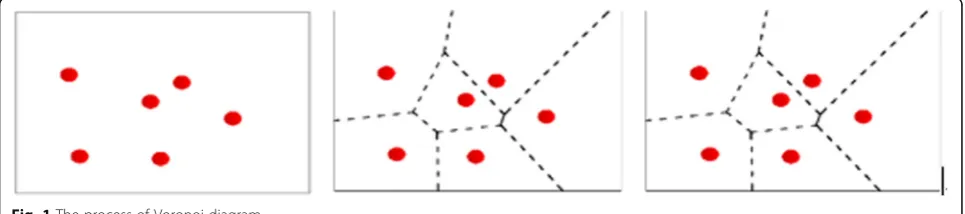
All cluster heads used as a regional point of the Voronoi Diagram. First, a cluster head is randomly used as the generator element, and then, two cluster heads are selected to generate their dual Delaunay tri-angulation that is extended clockwise. Next, find the circumcircle of each triangle. Finally, the Voronoi dia-gram is generated by connecting the circle and the outermost vertical line of the triangle. The specific schematic is shown in Fig. 1.
In order for more energy to be applied to the com-munication period, nodes in a Voronoi diagram auto-matically become a cluster. The specific intra-cluster negotiation principle is as followed: nodes are con-nected to an adjacent cluster head. If the connection
does not intersect with the Voronoi diagram, it be-comes a cluster. The connection has an intersection with the Voronoi diagram, and the next adjacent clus-ter head is selected for negotiation.
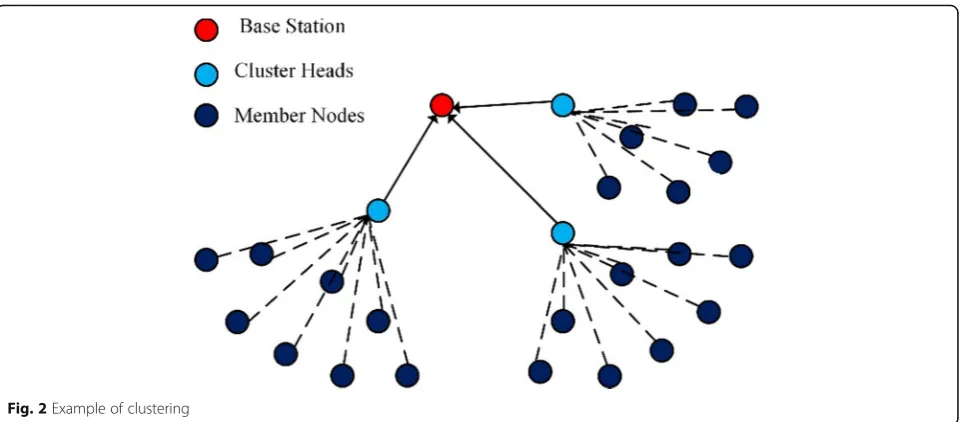
The clustering period is divided into electoral cluster heads and cluster negotiation. The member nodes com-municate directly with the cluster head. Cluster heads fuse received data and forward it to the BS. The example of clustering is shown in Fig.2.
3.2 Constructing a communication phase model
The establishment of cluster heads needs some time and energy per round. The stable communication period takes longer than the cluster head setup period to use energy as much as possible for data transmis-sion in an ideal state. In the communication phase, the time is too long, which is not conducive to other nodes communicating with the BS. Because the en-ergy consumed to CH increases, it consumes quickly. Therefore, the communication time per round needs to be calculated to obtain the optimal solution.
We ensure that the battery power of node can be served as cluster head once in its lifetime and be a member node to normal communication in other rounds. All nodes have a sufficient residual energy to
play as a CH and n/k−1 times the member node.
The initial energy of the sensor node is assumed as:
E0¼nf
wherenfis the average number of frames in each round,
which can be expressed as:
nf
head rotation time can be expressed as:
tTotal¼nf
Substitute simulation parameters into the above
for-mula. The wireless transmission rate of the data Rb is
1 Mb/s. The time of rotation of the cluster head is usu-ally 18 s in an ideal state.
3.3 Multi-hop transmission path based on ant colony algorithm optimization
Ant colony algorithm is the process of ants searching for food in nature [50].
Taking into consideration, the TSP problem of n is
cited as an example. The probability that a cluster se-lected next one in the path is given as:
Pkijð Þ ¼t
where τij represent pheromone concentration and
subscript indicates the corresponding path, ηij(t) is the inspiring factor for selecting the next cluster head (ηβijðtÞ ¼1=dij, dij=Eimit−Ecur), allowedk statistics k
past nodes, α is pheromone inspired factor, β is ex-pectation inspired factor, and α and β need to be de-termined by experiment.
In order to prevent the inspired factor from being overwhelmed by the residual information, pheromone
volatilization mechanism is introduced to update the pheromone on the path. The way to update the phero-mone after the path is given as:
τijðtþnÞ ¼ð1−ρÞτijð Þ þt Δτijðt;tþsÞ ð15Þ The probability function ofkselecting the next hop is determined by the pheromone. However, since the pheromone concentration and the node energy are not quite different at the initial stage of establishing a path, the effect on establishing the optimal path is weak. The distance inspired probability transfer function is intro-duced as follows: λ= 2, and allowed(t) representing a collection that khas not accessed, dmaxis the maximum of alldj, goal, and dj, goal denotes the length of the node j to the destination node.
In the non-initial state, selecting the next-hop node needs to filter the nodes that have been accessed through the taboo table. For the purpose to balance the network energy load, the state transition formula is given as:
Pk
where Ej−current represents the current energy of the CH. j and Ep−current denote the average current energy of the sensor nodes, and allowedk= {0, 1, 2,…,n−1}
in-dicates a set of nodes that can be selected. In order to achieve better convergence, the inspired function is im-proved accordingly as:
ηijð Þ ¼t
1
dijþdj−goal ð
20Þ
The above formula increased the proportion of a sin-gle neighbor in all nodes. When selecting the next node, neighbor nodes with low energy consumption are more likely to be selected. Reduce the probability of energy ex-haustion of individual nodes quickly and speed up the search for the optimal next node rate to prolong net-work lifetime.
Pheromone update determines the speed of conver-gence. In order to make the algorithm of the paper get better results, we combine global update and partial up-date. The algorithm is given as:
τijðtþnÞ ¼ð1−ρÞτijþρΔτgbij ;ð Þi;j ∈Tgb ð21Þ Δτij¼ Q
Lgb ð
22Þ
whereρ(0 <ρ< 1) indicates the pheromone volatility co-efficients,Tgb indicates the best path,Lgb represents the optimal path length, and Q represents a constant and appropriately selected according to the actual experi-ment and updated local information dynamically.kstarts from the boundary, the closer to the central the less pheromone is released. When k is reaching the other boundary, the pheromone reduced to the minimum. The pheromone update model is given as:
τijðtþ1Þ ¼ð1−ρÞτijþρΔτij ð23Þ
wherewdenotes the number of nodeskhave visited, dks
denotes the length of k walks, and Ltot represents the sum of length thatkhas passed.
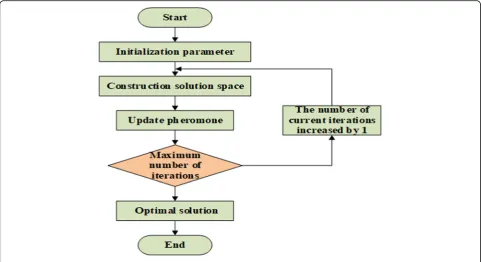
The flow chart of ant colony algorithm is shown in Fig.3.
4 Simulation results and analysis
4.1 Experimental platform construction and simulation
The simulation area set 100 m × 100 m distributed with 100 sensor nodes randomly. These nodes simulate to collect environment parameters such as temperature and humidity. The base station set in the center of the area at the position (50, 50) where the BS station and the sensor nodes represented as a red triangle and a solid dot, respectively. Figure 4a shows 100 nodes
ran-domly distributed in the region. Figure 4b shows the
elected cluster heads. Figure 4c shows the clustering.
Figure4d shows the optimal path.
The simulation parameters are divided into two parts mostly, one part in the LEACH and the other part con-centrated in the ant colony algorithm. Most of the pa-rameters refer other related papers to set. The specific parameters are shown in Table1.
4.2 Results and analysis
4.2.1 the stability of cluster head number
Cluster head counts impact the energy efficiency of protocol greatly. If the number of cluster heads is less, the data transmission length of sensor nodes to CH will be too long which leads to extra energy consumption, and the excessive data received and forwarded by the cluster head makes it consume excessive energy. If the number of cluster heads is large, the total load of the network is obviously increased, the total energy con-sumption of each round of networks is increased, the network data fusion efficiency is reduced, and the life-time of the network is not prolonged.
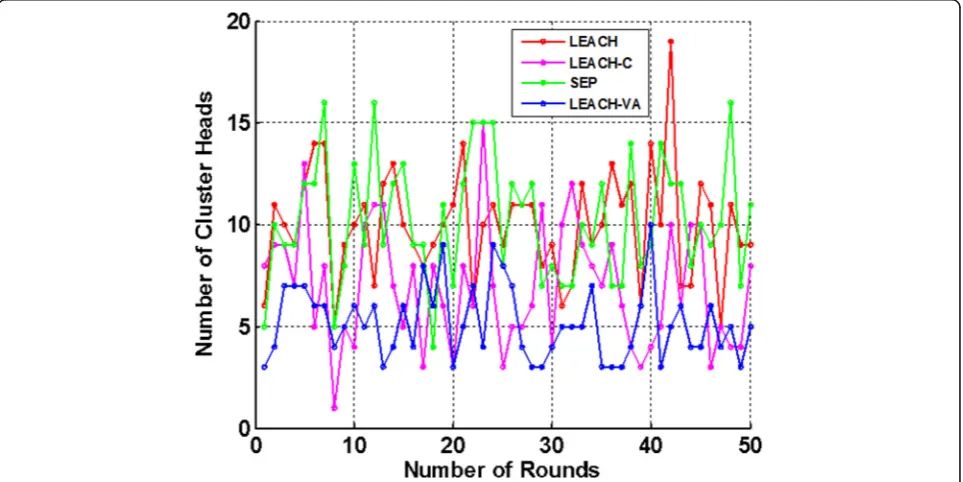
Figure 5 shows the cluster head count per round for
LEACH protocol, LEACH-C protocol, SEP protocol, and LEACH-VA protocol. As can be seen from the figure, the cluster head fluctuations in the proposed LEACH-VA protocol gives better results and outperformance as compared to LEACH, LEACH-C, and SEP protocols. In LEACH protocol cluster head election mode, cluster head selection and cluster head count are randomly gen-erated based on the threshold function model, which has great randomness. From the figure that cluster head
count fluctuates in the range of 5≤k≤18 in LEACH
protocol and 3≤k≤10 in LEACH-VA protocol.
Fig. 3The flow chart of ant colony algorithm
network, the total capacity of the cluster will be reduced accordingly.
4.2.2 Network lifetime
With this parameter measurement, we can monitor the life cycle of the WSN area. It is composed of two parts, the stable period and the unstable period. The time be-tween the FND and the Last Node Death (LND) denotes the unstable period. In the paper, it is mainly used in the field of environmental monitoring, and it requires a large area to place sensor nodes. Due to the wide distribution area, if large-area nodes die, some collected data cannot
accurately evaluate the environmental parameters.
Therefore, this paper evaluates network lifetime accord-ing to FND to evaluate whether LEACH-VA has clear advantages compared with the above three protocols.
Figure6indicates the distribution of dead node count in LEACH, LEACH-C, SEP, and LEACH-VA protocols
over rounds. From the figure, it is shown that the FND rounds of four protocols are 991, 1847, 1970, and 2257. Compared with LEACH, LEACH-VA increased FND by 127%, increased by 22.2% over LEACH-C, and increased by 14.5% over SEP. Therefore, the method proposed in the paper has significantly improved performance during the stabilization phase.
This performance improvement is due to the stable number of cluster heads. LEACH, LEACH-C, and SEP observed cluster head fluctuates obviously, especially when the FND appears. LEACH-VA protocol reduces these fluctuations by as follows. Firstly, it is valid to steady cluster head count, effectively reduces the prob-ability of CHs to be intensive, and decreased the energy loss of CHs. Then, clustering protocol uses Voronoi diagram geometry principle to validly decrease the en-ergy consumption of negotiated communication with intra-cluster. LEACH-VA effectively prolongs the sur-vival time of WSNs and optimizes energy utilization of unit nodes.
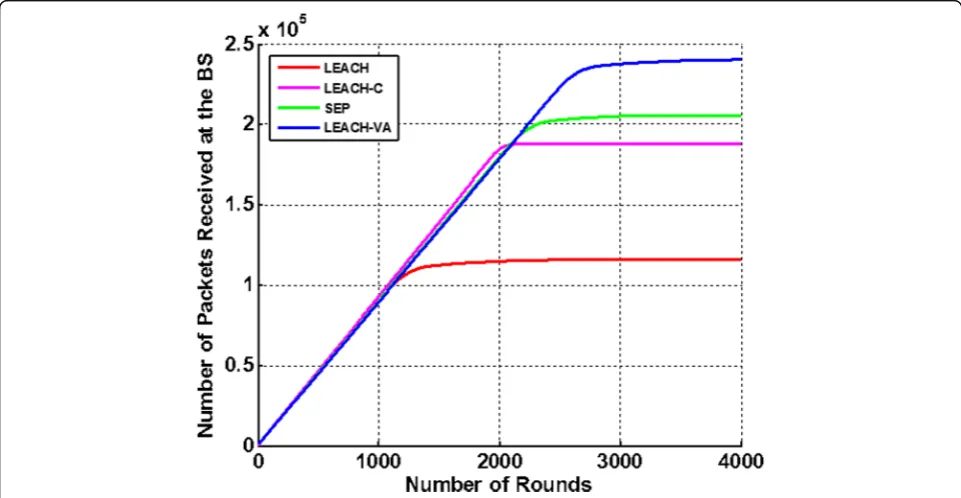
4.2.3 Number of packets received at the BS
The number of data packets received by the base station is also a parameter for evaluating the high energy utilization rate. The more balanced the energy distribu-tion in the network, the more packets the base stadistribu-tion
receives. Figure 7 observes that the number of packets
received at the BS for LEACH, LEACH-C, SEP, and LEACH-VA protocols, where the length of one packet is 4000/bit. As can be seen from this picture, LEACH-VA increases packet counts received at the BS by 71.4% as
Table 1Simulation parameters
Notation Value Notation Value
E0/J 0.5 n 100
p 0.05 d0/m 87
α 0.5 EDA/(nJ/bit) 5
β 1 Er/(nJ/bit) 50
ρ 0.5 l/bit 4000
τ0 100 εr/((pJ/bit)/m4) 0.0013
τmax 5000 εf/((pJ/bit)/m2) 10
τmin 5 ETx/(nJ/bit) 50
compared to LEACH, 33.3% over LEACH-C, and 14.3% against SEP.
The significant increase in packet counts received by the base station is due to reduce the probability of clus-ter head clusclus-ters and effective reduction of energy con-sumption of negotiated communication within the cluster. Based on the stable number of cluster heads and the geometric principle of the Voronoi diagram, the
clusters are more uniform, the energy consumption be-tween the clusters is better, and the energy utilization of the unit nodes is also improved. Moreover, in the paper, multi-hop transmission routing protocol according to ant colony optimization algorithm used to forward the data packets of long-distance cluster head by neighbor-ing cluster head of the BS to reduce the energy con-sumption of direct communication.
Fig. 6Number of rounds versus the numbers of node death
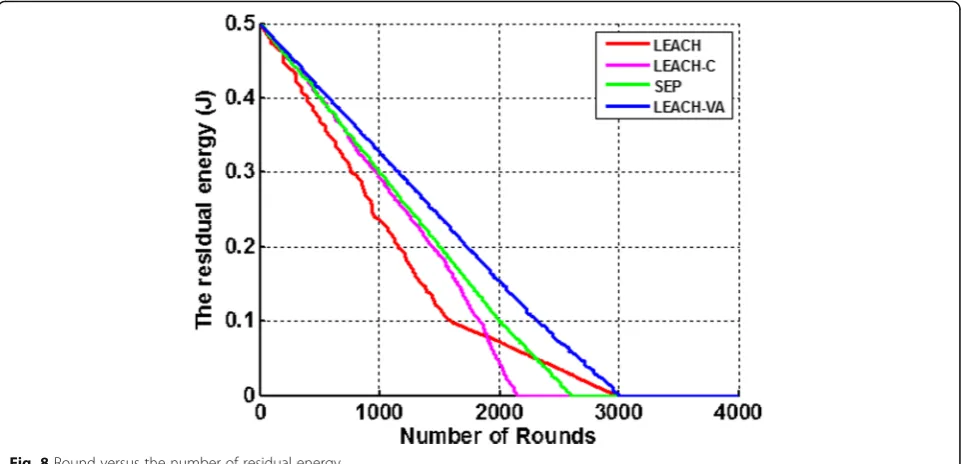
4.2.4 Residual energy
Node energy consumption is divided into mainly four parts: data transmission, data reception, data fusion, and negotiation communication within the cluster. The more uniform energy consumption the longer lifetime nodes alive.
The conclusion is drawn that the energy consump-tion of the LEACH-VA protocol is more uniform than
the LEACH, LEACH-C, and SEP protocols (Fig. 8).
The change of threshold function value will cause the change of the cluster head count. A large number of cluster heads produced during the leaching process are the main reason that causes leaching energy consumption. LEACH-C and SEP protocols do not consider the energy consumption of negotiation com-munication within the cluster. More energy is used in LEACH-VA protocol for data transmission to increase energy utilization.
The method proposed in the paper reduces energy consumption between clusters and reduces the energy consumption of negotiated communication within the cluster. It also optimizes the data transmission of multi-hop paths. The residual energy has improved both in the establishment phase and stabilization
phase (Fig. 8), which makes energy saved and the
net-work lifetime is increased.
5 Conclusion
Wireless sensor networks are widely used in different fields. LEACH protocol has always been the focus of re-search on wireless sensor networks. Aiming at the prob-lem of traditional LEACH protocol, the paper proposes a method that uses improved LEACH protocol and the
Voronoi diagram principle to cluster. Firstly, the optimal number of cluster head is calculated to the overall en-ergy consumption per round. Secondly, Voronoi diagram is established. Finally, the ant colony algorithm is added to the protocol to optimize the multi-hop routing proto-col. The experimental shows that the proposed approach can control cluster headcount to fluctuate within3≤k≤10 this range. Compared with classic LEACH, LEACH-VA protocol effectively increases the FND by 1300 rounds, the network lifetime is increased by 127%, and the data packets received of BS are increased by 71.4%. Because node energy consumption is more balanced, there is a large area of node death, which will not affect its energy consumption, and energy consumption per unit node is only 2.0084 × 10⁻⁴J. Because the total number of clusters does not exceed 10, the ant colony algorithm is used to optimize the path will bring some delay for the WSNs. Therefore, the model proposed in the paper appears to be more accurate and fast. In the future, it is worth studying to optimize multiple paths.
The purpose of this study is to increase the life cycle of WSNs and reduce the energy consumption of data transmission. Therefore, in future studies, LEACH protocol should be optimized in combination with intel-ligent algorithms, compared with different methods, and applied in practice.
Acknowledgements
The authors gratefully acknowledge the helpful comments and suggestions of the reviewers, which have improved the presentation.
Authors’contributions
All authors take part in the discussion of the work described in this paper. All authors read and approved the final manuscript.
Funding
This work was supported by the Applied Basic Research Program of Sichuan Province (CN. No. 2016JY0049).
Availability of data and materials
Please contact the authors for data requests.
Competing interests
The authors declare that they have competing interests.
Author details
1School of mechatronic engineering, Southwest Petroleum University,
Chengdu 610500, China.2China National Offshore Oil Corporation, Tianjin,
China.
Received: 6 May 2019 Accepted: 3 July 2019
References
1. T. Alhmiedat, Low-power environmental monitoring system for ZigBee wireless sensor network. KSII Transaction on Internet and Information Systems11(10), 4781–4803 (2017)
2. S.A. Malek, S.D. Glaser, R.C. Bales, Wireless sensor networks for improved snow water equivalent and runoff estimates. IEEE Access7, 18420–18436 3. O. Kaiwartya, A.H. Abdullah, Y. Cao, et al., T-MQM: testbed-based multi
-metric quality measurement of sensor deployment for precision agriculture-a case study. IEEE Sensors Journal16(23), 8649–8664 (2016) 4. H. Liang, J. Zou, Z. Li, M. Junaid, Y. Lu, Dynamic evaluation of drilling
leakage risk based on fuzzy theory and PSO-SVR algorithm. Futur Gener Comput Syst95, 454–466 (2019)
5. D. Chen, Z. Liu, et al., Natural disaster monitoring with wireless sensor networks: a case study of data-intensive applications upon low-cost scalable systems. Mobile Networks & Applications18(5), 651–663 (2013)
6. M.A. Kafi, Y. Challal, D. Djenouri, et al., A study of wireless sensor networks for urban traffic monitoring: applications and architectures. Procedia Computer Science19, 617–626 (2013)
7. H. Liang, An sand plug of fracturing intelligent early warning model embedded in remote monitoring system. IEEE Access7, 47944–47954 (2019) 8. S. Han, Z. Gong, W. Meng, et al., Automatic precision control positioning for
wireless sensor network. IEEE Sensors Journal16(7), 2140–2150 (2016) 9. M.S. Elgamel, A. Dandoush, A modified Manhattan distance with application for
localization algorithms in ad-hoc WSNs. AD HOC Networks33, 168–189 (2015) 10. M. Erazo-Rodas, M. Sandoval-Moreno, et al., Multiparametric monitoring in
equatorial tomato greenhouses (III): environmental measurement dynamics. Sensors18(8) (2018)
11. S. Singh, P. Kumar, J. Singh, A survey on successors of LEACH protocol. IEEE Access5, 4298–4328 (2017)
12. A. Pau, C. Juan, et al., Performance evaluation of video streaming over ad hoc networks using flat and hierarchical routing protocols. Mobile Networks and Applications13(3-4), 324–336 (2008)
13. S. Peng, Energy neutral directed diffusion for energy harvesting wireless sensor networks. Computer Communication.63, 40–52 (2015) 14. J. Kulik, W. Heinzelman, H. Balakrishnan, Negotiation-based protocols for
disseminating information in wireless sensor networks. Wireless Networks8, 169–185 (2002)
15. X. Fu, G. Fortino, P. Pace, G. Aloi, W. Li, Environment-fusion multipath routing protocol for wireless sensor networks. Information Fusion (2019). https://doi.org/10.1016/j.inffus.2019.06.001
16. S. Soro, W.B. Heinzelman, Prolonging the lifetime of wireless sensor networks via unequal clustering. IEEE International Parallel & Distributed Processing Symposium365(2005)
17. F. Bagci, Energy-efficient communication protocol for wireless sensor networks. Ad Hoc & Sensor Wireless Networks30(3-4), 301–322 (2016) 18. Y. Zhai, L. Xu, Ant colony algorithm research based on pheromone
update strategy, 2015 7th Int. Conf. Intell. Human-Machine Syst. Cybern.
1(2), 38–41 (2015)
19. W. Ding, W. Fang, Target tracking by sequential random draft particle swarm optimization algorithm. IEEE Int Smart Cities Conf.2018, 1–7 (2018) 20. N. Thi, H. Thi, T. Binh, N. Xuan, An efficient genetic algorithm for maximizing
area coverage in wireless sensor networks. Inf. Sci. (Ny).488, 58–75 (2019)
21. J.P.D. Comput, Z. Cui, Y. Cao, X. Cai, J. Cai, J. Chen, Optimal LEACH protocol with modified bat algorithm for big data sensing systems in Internet of Things. J. Parallel Distrib. Comput. (2018)https://doi.org/10.1016/j.jpdc.2017.12.014 22. S. Al-sodairi, R. Ouni, Sustainable computing: informatics and systems
reliable and energy-efficient multi-hop LEACH-based clustering protocol for wireless sensor networks. Sustain. Comput. Informatics Syst.20, 1–13 (2018) 23. G.K. Nigam, C. Dabas, ESO-LEACH: PSO based energy efficient clustering in
LEACH. J. King Saud Univ. - Comput. Inf. Sci.1, 4–11 (2018)
24. N. Mazumder, H. Om, Distribute fuzzy approach to unequal clustering and routing algorithm for wireless sensor networks. International Journal of Communication Systems31(12) (2018)
25. O. Younis, S. Fahmy, Heed: a hybrid energy-efficient distributed clustering approach for ad-hoc sensor networks. IEEE Trans On Mobile Computing
3(4), 660–669 (2004)
26. X.X. Ding, M. Ling, Z.J. Wang, et al., DK-LEACH: an optimized cluster structure routing method based on LEACH in wireless sensor networks. Wireless Personal Communications96(4), 6369–6379 (2017)
27. M. Ye, C. Li, G. Chen, et al., EECS: an energy efficient clustering scheme in wireless sensor networks. Journal of Frontiers of Computer Science & Technology3(2-3), 99–119 (2007)
28. M. Bsoul, Al-Khasawneh, et al., An energy-efficient threshold-based clustering protocol for wireless sensor networks. Wireless Personal Communications70(1), 99–112 (2013)
29. W. Heinzlman, A. Chandrakasan, H. Balakrlshnan, An application-specific protocol architecture for wireless microsensor networks. IEEE Transactions on Wireless Communication1(4) (2012)
30. G.S. Arumugam, T. Ponnuchamy, EE-LEACH: development of energy-efficient LEACH protocol for data gathering in WSN. Eurasip Journal on Wireless Communications & Networking, vol., 76 (2015)
31. M.A. Al Sibahee, S.F. Lu, et al., LEACH-T: LEACH clustering protocol based on three layers. International Conference on Network & Information Systems for Computers.59, 36–40 (2017)
32. S. Kumar, S.K. Verma, A. Kumar, Enhanced threshold sensitive stable election protocol for heterogeneous wireless sensor network. wireless personal communications85(4), 2643–2656 (2015)
33. P. Marappan, P. Rodrigues, An energy efficient routing protocol for correlated data using CL-LEACH in WSN. Wireless Networks22(4) (2015) 34. Y. Liu, J. Gao, Y. Jia, et al., A cluster maintenance algorithm based on
LEACH-DCHS protocol. Computer Engineering & Applications45(30, Palladam, INDIA), 165–166 (2009)
35. T. Samant, P. Mukherjee, et al., TEEN-V: a solution for intra-cluster cooperative communication in wireless sensor networks. International Conference on I-SMAC2017, 209–213 (2017)
36. A. Yektaparast, F.H. Nabavi, A. Sarmast,An improvement on LEACH protocol (Cell-LEACH), Advanced Communication Technology (ICACT) 2012 14th International Conference on(2012), pp. 992–996
37. A. Singh, S. Rathkanthiwar, S. Kakde, in2016 International Conference on Communication and Signal Processing (ICCSP). Energy efficient routing of WSN using particle swarm optimization and V-leach protocol, vol 1 (Adhiparasakthi Engn Coll, Dept Elect & Common Engn, Melmaruvathur, INDIA, 2016), pp. 2078–2082
38. V. Loscri, G. Morabito, S. Marano, A two-levels hierarchy for low-energy adaptive clustering hierarchy (TL-LEACH). Proc. IEEE 62nd Veh. Technol. Conf., 1809–1813 (2005)
39. B. PK, K. Kant, LEACH-MAC: a new cluster head selection algorithm for Wireless Sensor Networks. Wireless Networks22(1), 49–60 (2016) 40. S. Pourbahrami,Optimization of LEACH method using distribute nodes and
cell clustering, vol 2017 (IEEE 4th International Conference on Knowledge -Based Engineering and Innovation (KBEI), Iran Univ Sci & Technol, Tehran, IRAN, 2017), pp. 83–87
41. S. AS, O. Ridha, Reliable and energy-efficient multi-hop LEACH-based clustering protocol for wireless sensor networks. Sustainable Computing -Informatics and Systems20, 1–13 (2018)
42. L. JY, J. KD, M. SJ, et al., Improvement on LEACH protocol of a wide-area wireless sensor network. Multimedia Tools and Applications76(19), 19843–19860 (2016) 43. N.G. Palan, B.V. Barbadekar, S. Patil, Low energy adaptive clustering hierarchy
(LEACH) protocol: a retrospective analysis. International Conference on Inventive Systems and Control (ICISC), 363–374 (2017, 2017)
45. N. Mittal, U. Singh, B.S. Sohi, A stable energy efficient clustering protocol for wireless sensor networks. Wireless Networks23(6), 1809–1821 (2016) 46. E.G. Julie, S. Tamilselvi, Y.H. Robinson, Performance analysis of energy
efficient virtual back bone path-based cluster routing protocol for WSN. Wireless Personal Communications91(3), 1171–1189 (2016)
47. W.B. Heinzelman, A.P. Chandrakasan, S. Member, H. Balakrishnan, An application-specific protocol architecture for wireless microsensor networks. IEEE Trans. Wirel. Commun.1(4), 660–670 (2002)
48. M. Omari, W. H. Fateh, M. Omari, S. Laroui, and A. Leach, Simulation, comparison and analysis of wireless sensor networks protocols: LEACH, LEACH -C, LEACH-1R, and HEED, 2015 4th Int. Conf. Electr. Eng, pp. 1–5, 2015. 49. Y.-Z. Li, A.-L. Zhang, Y.-Z. Liang,Improvement of LEACH protocol for wireless
sensor networks, Third International Conference on Instrumentation Measurement Computer Communication and Control(2013), pp. 322–326 50. Y. Jian, Y. Li, ScienceDirect Research on intelligent cognitive function
enhancement of intelligent robot based on ant colony algorithm. Cogn Syst Res56, 203–212 (2019)
Publisher’s Note